Burnout & Pivots in Career - Explained by Dr. Grace Yum on The Dr. Joy Kong Podcast
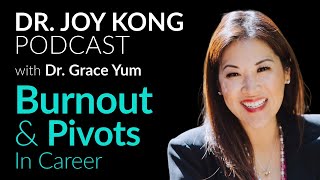
Dr. Grace Yum, a pediatric dentist, built two practices before pivoting to Mommy Dentists in Business, an online community she started in 2017. She discusses burnout drivers like high patient volume and insurance hassles, early warning signs like losing your temper, and why joining supportive communities and considering a career shift can help.
Questions this video answers
2017
24 seasons
Over 250,000 downloads
Over 10,000 members
First practice circa 2007–2008; second practice circa 2013–2014
Chapters
As doctors, definitely there's a high burnout rate, especially if you, I think if you practice a form of traditional western medicine, just the current medical model of high patient volume, insurance driven, and the compensation is getting lower and lower. I don't think it's very effective, you know, looking at short term solutions and not taking care of people for the long term.
You are, as a doctor easily prone to burnout when you feel not appreciated. Right. Your patients don't listen to you. When you know you're not collecting the money that's due to you. You did all these services and nobody's paying. If you are in a place where you're feeling like you can't take this anymore, take the next step and explore what makes you happy.
Hello everybody. Welcome back. This is Dr. Joy Kong. Welcome to the Doct Joy Con podcast where I bring to you some of the leading thought leaders in health, wellness, just how to fully enjoy and embrace life. So today I'm super excited because I have a wonderful doctor, Dr. Grace Yum, who's coming to speak with us. I've known Dr. Yum at a female entrepreneurship group and she strikes me as a very dynamic and very giving and generous spirit. Also quite an entrepreneur. Sure. So I really, I'm really excited to have her here today. Hi, Dr. Yeon, welcome.
Hi Dr. Kong. Thank you so much for having me. I am excited to be here with your listeners.
Yeah. So let me give the listeners understanding a little bit about Dr. Yam. So Dr. Grace Yam actually grew up in Illinois but now lives in sunny California. She's a mother and a certified pediatric dentist. So this particular certification is only achieved by 5% of all dentists in the U.S. she's also the former founder and practice owner of Yummy Dental and Orthodontist for Kids and she's the founder and CEO of Mommy Dentists in Business. So this particular organization has over 10,000 mommy dentists dedicated, sharing best practices in dentistry while balancing life and work. So Dr. Yam, in addition to managing this community, she hosts her own podcast called Mummy Dentist in business podcast. With 24 seasons, her podcast has been in the iTunes top 100 and was ranked number three out of 15 of the top dental podcasts. The podcast has been downloaded over 250,000 times and she has become nationally recognized in her field, has appeared and featured on today's show on NBC nationally, NBC Chicago and as a repeat guest in Parents magazine, Parenting magazine, Chicago Parent magazine. She's also appeared in over 50 podcasts with topics covering dental industry, work, life Balance and business tips for the working mom. So there's a lot of good things we can cover here. So. Yes. So, Grace, maybe tell us a little bit about how you, what inspired you to go from a dentist and a mom to an entrepreneur? Maybe share with us a little bit.
Absolutely. I grew up with parents who are entrepreneurs and have grown up in a setting where my parents owned small businesses, multiple small businesses. And I watched them do that and worked in many of the small businesses myself with, alongside my sister. And we learned many of the small business ownership challenges. And we learned that it is hard to employ people, people who rely on you for their paychecks. Right. And the responsibilities that come along with it. We learned along the way that if you're a business owner, it's hard to go on vacation, it's hard to close up shop, it's hard to trust other people to manage your money. It's. You know, I watched my parents get swindled and embezzled. I've watched my parents lose employees, hire employees, and having that experience really put in my brain as a young child and into adulthood what it's like to be an entrepreneur, what it's like to be a business owner. And when you're in that setting and you grow up in that, for you, you just think, that's what I'm going to do, right. Like as a dentist. So when I went to dental school and became a dentist, I knew right away that ultimately I would own my own business, that would, I would own my own practice. The goal was to own three practices and have, you know, a brand and have clout in my industry. Right. And I wanted to be the go to pediatric orthodontic practice in Chicagoland and built my own name up in my own brand. And doing so, I had to work for other dentists to learn the ropes. I had to learn all about dentistry, front desk scheduling, doing all those things as my parents are not in healthcare. And it's a different way, it's a different system. Right. So learning all the systems. And I knew from a very young age that's what I wanted to do. And being an entrepreneur is about risk, and a lot of healthcare professionals are not about risk. And when you marry the two together, a lot of things can happen. Right. And as a risk taker myself, you have to assess your risk assessment. What can you really take on and, and what can you really do? Because when it comes down to it, it's all about the money, right? There's a huge financial risk when you're an Entrepreneur. And then the other kind of objective is how do you build a business that runs without you? How do you run a business and be an entrepreneur without you yourself being the technician or you yourself having to be in there doing and working the business? So those are the kinds of things that I had to learn along the way that I built for myself and, and, and really captured those objectives while running my businesses.
You run into some of the same difficulties that your parents ran into, I assume.
Absolutely. And in on all levels, no matter if you're a pizza shop owner or you're a shoe store owner or you're, you know, whatever store, small business, brick and mortar you have, you rely on people to help you with your business. And I definitely ran into a lot of the same issues that my parents did and I learned how to handle them. But again, you know, as time evolves, you have different ways to run business, right? So as you're evolving like 10, 15, 20 years ago, 20 years ago, there was no such thing as a Google search, right? So when I was working, there was no such thing as a website. There was no such. We had paper charts, not digital. Right. So even business has to evolve and you have to evolve with that. You cannot be stuck in one way. The times and technology forces you to evolve. And with that evolution comes the evolution of you being an entrepreneur. Like, you have to be up with the times, right. In order to serve the population that you're serving. And yes, so definitely had a lot of the similar challenges, but also different challenges along the way. And I wouldn't have it on the any other way. Like I tell my friends, having your own business is blood, sweat, tears. It's not easy. And you are so invested in it, right. It's hard not to take things personally. And when you put in your heart and soul into your business and it is yours, you want to be successful, you're driven and, and all that hard work eventually pays off. And along with that though comes times when you doubt yourself, like, why am I doing this? Or what I sign up for, right? There are times when you're like, did I get in over my head? That self doubt does come. And then there are times when you're like, I'm burnt out, like I don't want to do this anymore, I'm not passionate about it, like I don't want to do this. So there are many different cycles of ownership and business ownership and entrepreneurship that people have to go through. And that's what I'm here to talk about today.
Yeah. So you Said your goal was to build three practices and you built two. Right. And so what happened at two?
Right. So in 2017, so 2007, eight was when I birthed the first one. And then 2013, 14 is when I birthed the second one. And then 2017 I was on my way to doing the third. And then I started this online community and, and it's on Facebook. And I started it for fun. Had no intentions of it being a business because who, who's heard of a business on Facebook? Right? And so in 2017, I started an online forum, online community. And I called it Mommy Dentist in Business because those are all the hats that I wear. So I'm a mom, I'm a dentist, I'm a business owner. And I wanted to collect all the women that were like me. I said, I want to get to know all the women that are like me, that understand me and what I have to do. Because it wasn't enough. If you didn't have a practice, right. If you're working at a hospital or you're working for somebody else, but you are not providing a paycheck for somebody else, then you cannot experience what I'm experiencing. Right. If you are a woman and you're not taking care of three children or two children or one child, you still don't know what my life is like every day. And that is why I created that forum. And then it just blew up, that community just blew up.
Why do you think that is?
I think I hit a nerve. I think there were a lot of women that were, that was seeking support and a lot of women that was seeking like minded women to talk to because we're all spread out in the US And I think that online is easy, right? You don't have to physically be somewhere so it's convenient. We're all walking through the same thing. And then I slowly began to open it up to non business owners because many of them would sell their practice and go through a phase where they were not a business owner for like a year and then buy another one or, and then, you know, and it was on, off, on, off. Or there were a lot of people who were business owners with their families, like their spouse or their parents or their sister or their uncle. And so they owned it in partnership. They weren't 100%, but they still were responsible. So that definition started to change and the community just grew and grew. And of course, because it's on Facebook, not everybody's on Facebook. Right. So the demographic, the majority of the demographic that I Serve that population is on Facebook, but then there's another group demographic on Instagram. And so we have these two platforms that we use for support and giving resources. So it's not just clinical information and it's not just about practice ownership, but it's also about motherhood and all the feels that we have and the guilty feelings that we have when we're at work and we're not with our six month old baby or we're at home with a child or two and we're guilty of feeling, oh my God, I should be at work and I need to see this emergency patient. So there's a lot of emotions that go back and forth and there are very few people that know how to compartmentalize the emotional aspect of it. It's very hard to separate it all out. And so we have these discussions online on how to best deal with that or solutions, how to best schedule your day so you could have the best of both worlds. So isn't that why we became a dentist, to have flexibility? Isn't that why we became a practice owner, to have the decision and power making to say, I'm going to take this week off. And that is, that is what we try to do, is have those discussions, try to help each other, create balance in our, in our lives and try to create a forum where people are feeling supported. Questions come up all the time, like, hey, this employee was doing xyz, how do you handle it? Or hey, this patient put up a negative review of me online. How do I handle it? So all of these topics come up and it's a form of healthy discussion and no one is there to judge, no one is there to be negative or toxic. It's all about support. And that was my third baby. So instead of doing the third practice, this kind of took over. And when this became a business, it evolved into podcast webinars, live events, online events. I had to get accredited to provide continuing education, you know, in CMEs or CE CLA people call it, all these different things. And so I am now an education provider.
Wow, that's fantastic. So how did this online forum evolve into a business business? How did this process?
The community was asking me for education, asking for podcasts, asking me for webinar. I didn't even know what a podcast was. In 2017, I was not listening to podcasts. And my babysitter, who's, you know, in her 20s, right, and I was like, hey, do you listen to podcasts? And she said, Dr. Yum, I know how to make them. Oh, And I said, what? She said, yeah, my family are musicians, we make podcasts all the time. And I'm like, okay. And I'm like, can you make a podcast, Rachel?
Yeah.
She's like, I've got all the equipment, every, everything. And that's how I started. And I learned how to do that. And, and then the community, I was telling my community, hey, you, you guys want all of these things? Because they said, hey, I want to meet everybody. We're socializing online, let's have a big meeting. So, okay, I'll organize it. But then it started to get expensive. You know, I needed to pay my staff, I needed to hire people, and then developed this subscription model. So I said, if you want to do all of these things and you want all of these things, you have to start to help pay for all of it. Because it's not fair that I'm paying for all of it. And for what? Like, you know, this isn't for free. And so we have a annual subscription and they can become an official member and they pay an annual fee. And that helps me. Now I have, you know, four or five employees. I have a physical space in Chicago, an office space in Chicago. We call it the Learning Center. We throw events and we do all these things. I just got back from our annual event. There's 300 people, 270 people, plus speakers and sponsors. And it was in Boston Tuesday to Sunday. And it was amazing and we had an amazing time and people were just so excited to be there. And in 48 hours, we just sold another 250 tickets for next year's meeting. And the formula is working and it's really a space where the dentists come and feel emotionally full. And as doctors, we get so much CE everywhere else, through our local dental society, through the, you know, conferences. So it's not really about the CE when you come to the, the live events. It's really about gathering and sharing information and feeling like you belong somewhere. Right? It's a community where you feel like you belong. You understand me? I understand you. And we had to leave our families to be here and sacrifice. But we're here having a great time together and that's what it's about. And I find that people just crave that. And once they experience it, because we, we make it an experience. Once they experience it, they keep coming back and they realize, they realize I'm missing something that I didn't even know it was missing. And it's, it's missing that friendship of like minded women because you're every day you're in the trenches, rolling up your sleeves, seeing patients, coming home, taking care of kids, working out, taking care of yourself, taking care of your dog, taking care of your, your spouse. There's not a lot of downtime. And of course, we all plan our vacations, right? But then to plan an event and have people come so that they can fill their cup is equally important. And it's part. I, I call it part of self care. And if you don't emotionally take care of yourself too, and you, you start to feel burnt out and then you start feeling bitter and jaded and tired. So you need to find things that are going to release that right to, to emotionally be happy in your career. And then you don't feel alone that these women understand how you feel. I think even, even challenging things like, oh, you know what? I did get into a lawsuit. They're too embarrassed to talk about it. They're too, they don't want anybody to know, right? But they come and say, you know what? I'm going to share my failure with you so you don't make that mistake. I did a root canal. The root canal went wrong. I got, the patient was upset, called the board. I was audited and examined. I had my license suspended. I mean, those are things that, oh, my God. That's like, as a doctor, you're like, that is like the death of your career. How do you bounce back from that? You know, some of our speakers, one was a malpractice attorney. She, her parents are doctors. She's coming and teaching about how to cover yourself. What are the most common mistakes that doctors make that they get sued? One of our other lawyers was a labor and employment attorney. How do you know the difference between an associate independent contractor versus an employee? Talking about the differences, right? And talking about employee laws and what you need to do, know as a business owner, then we have other specialists coming, talking about tax savings is, is a high earner as a medical care provider, as a, as a doctor, your earning income is up here. How do you shelter yourself from taxes? How do you do things that will benefit you rather than just what your CPA is talking about? So those are all kinds of topics that we talk about. And we can all say, oh, I do this or I do that, and we share the best practices. And truly the phrase it's iron sharpens iron. That is what it's for. Like, if you want to come and learn to be the best and the best, how do you do that? You learn from the best. So that's what we provide. That's what we're, the, the, that's what we're there for as doctors.
Definitely there's a high burnout rate, especially if you, I think if you practice a form of traditional western medicine, just the current medical model of a high patient volume, insurance driven and the compensation is getting lower and lower I think. And also just, I don't think it's very effective. You know, looking at short term solutions and not taking care of people for the long term, wellness and prevention. I think eventually you're just not going to be as effective and people are not going to be as happy. So just general sense of not being as effective, you know. Right. We're, we're healers and we're here to fix things and to be effective. And if you are not feeling as effective, I think definitely there's going to be more emotional, you know, discord and, and burnout. And I've heard about dentists having high suicide rate. So yeah, what are, you know, did you get to the point of burnout?
I felt like I was getting there. Right. I was starting to go in that direction where I was being short, like short fused at the office. Right. Like if my employees would say something and I, I wouldn't, I didn't want to deal with it or patience and I would start to get impatient with my patients. Right. But just feeling like the day to day, every day doing the same thing over and over and over. And even if I went to learn new things and I consider my an early adapter of most new things in technology, like I'm the kind of doctor that my staff is like Dr. Yum. Another thing, another thing we have to learn like what another toy this is, you know, what else are you bringing? But even with that, I felt like I was getting tired and I wasn't, I started to feel like unhappy. Right. I mean I love my patients, I love them and that's not it. But it was starting to feel like a chore. Now my, my practice model was fee for service. So I wasn't in network and I never was, I never had to be. So I don't identify with my colleagues that have to deal with insurance because I never had to. But you know, I think that for every doctor you have a patient relationship that is meant to be your patient and for all the doctors listening, not everybody has to be your patient. You don't have to win everybody over.
Right.
And you, as time goes on, you learn like the young new dentist or the young new doctor wants to Win everybody over. Right. But as time goes on, you'll see that not every patient is meant for you, and that's okay. And you'll see how to pick and choose your patient. And that's where I want to challenge our listeners, is to get to a point where. Where you're not bitter, but you know how to selectively choose your cases so that you feel fulfilled and the patient is fulfilled. And when you're mutually fulfilled, there's less risk of emotional burnout. You are, as a doctor, easily prone to burnout when you feel not appreciated. Right. When your patients don't listen to you, when you know you're not collecting the money that's due to you, you did all these services and nobody's paying. And insurance reimbursement. I don't know about medical, but in dental, a lot of them haven't increased their fees in 10 years. In fact, I'm. The dentist is paying the patient to be in the chair. I mean, how am I supposed to pay a hygienist $60 an hour if the insurance is only paying $30 for the cleaning? That makes zero sense. And so I think with all of those stressors, dentists feel upset, disgruntled, suicide. During the pandemic, there were a couple that we lost in our group. It was very upsetting. And people suffer in silence because they're too scared to talk about it or they're too embarrassed or ashamed to talk about it. You know, So I think that it's really important to offer, hey, a space to say you can talk about it. It doesn't mean you're a failure. Everybody makes mistakes, and what can you do? And if you're no longer passionate about what you're doing, how do you pivot? You're not locked in for life. You don't have to be a doctor for life. You don't have to be a dentist for life. You don't have to do it. There are other things out there that you can do even with dental background or without a dental background. But it's a better alternative than to being upset all the time, right?
How did you deal with your early stage burnout?
Well, I think, you know, for me, the Facebook community really saved me, and I looked forward to that. And when I realized that I could make this an organization and make this a business, I decided to put all my eggs in this basket. So then I said to myself, I'm going to sell my practices, or maybe just one, Maybe sell one and keep one and focus on growing this organization. Because it really makes me feel good that I'm helping other people. And it felt really good to be helping my colleagues and my peers. And so I said, I'm going to pivot into this. And joy, what's really kind of funny, and maybe the listeners might think I'm crazy. I had no idea. I had no idea what it was going to become. I had no financial plan. I had nothing. Selling the practice was my financial backup plan. And selling the real. I owned the real estate, too. So selling that was kind of my. My little safety. Right. And then I said, I'm going to try this. But that saying, that quote that says, you know, try something that scares you or do something that scares you every day, I think that it. It's true that it rings true that when you push yourself and you challenge yourself, you realize how strong you are and you realize what you're made of. And I think that if you have the courage to do that, you will figure it out. Like, you'll figure it out whatever it takes. And my challenge to the listeners are, if you are in a place where you're feeling like you can't take this anymore, take the next step and explore what makes you happy, because you are only responsible for your happiness. Nobody can make you happy. Not your husband, not your. Your friends, not your children. You are responsible for your own happiness.
So find something that brings you joy.
Ultimately, yes, you have to. And go for it. And don't be stuck in fear.
Yeah, Fear is what keeps a lot of us back, keeps us stuck.
It does paralysis by analysis. You can analyze the situation all day, every day, and you'll never get anywhere. Right. Kind of like having kids. Now's not a good time. Now's not a good time. There's never a good time.
So in a sense, you just followed your bliss. You followed what make you feel good. Yeah, you just let it unfold.
You let it unfold. And you just have to trust the process and. And go for it. You can always go back. I mean, you have a license, you have the skill set. Just because I'm taking a clinical break doesn't mean I can't go back.
And of course, same goes. Rings true for people in other professions. There are plenty of burnouts. But, yeah, look for something that actually, you know, makes you, you know, I call it listen to your own energy. So what. What is your energy level when you're doing something? Because that. That's actually how I landed in medicine and then initially how I landed in psychiatry and then later on in stem cells. I think each time I listen to how I'm feeling. I thought I wanted to do neuroscience because I loved the brain and understanding, you know, why we, you know, think the way we, we do and why we do things the way we do. So but, you know, the research is one thing, you know, it was interesting, but it's not until I went to shadow a doctor, a ob GYN doctor in New York. And just that one morning, just being in the clinic and feeling what it's like to interact with patients and utilizing technology and with the science, you know, in my pocket and, you know, being able to help patients and that just, you know, the, the sense of energy, the exhilaration. I felt the same thing with psychiatry, you know, which was so exciting. It's so interesting trying to delve into why all these pathologies occur, you know, how a human mind could play tricks like that on you, what is going on in the mind and, and how we can even break that cycle, you know, with medications or with, you know, other methods. So that was very exciting. And then, and then, you know, after a while, it wasn't bringing me joy anymore. It was the same thing over and over, you know, was not coming at the root cause of a lot of what's happening in mental illnesses. And then when I found out something about anti aging medicine and stem cell therapy, then we're looking at a whole other mechanism of how to look at the human, the human body and how we, you know, our brain works. So that's a whole other, you know, and then it was. Was so exciting. You know, it was, it was so fun. It's, you know, it's something that makes me want to do. Right. I can spend hours reading articles and having fun. So that's, I think that's the energy that people can listen to. What makes you feel this, this exhi. That. That you're willing to put in the time without compensation?
Absolutely. And I think that that's. You just nailed it. Is listening to your intuition of what brings you joy and moving in that direction. And it takes time. It takes a certain amount of bravery, and it takes just being able to listen and channel that desire and hone that in. I mean, you really have to know yourself to be able to do that.
Yeah, yeah. So what are some of the, you know, the people in your group, you know, the, the challenges they were able to overcome and how they dealt with their burnout that you think would be really good tips for people, like how, you know, what are the wisdoms that people have collectively shared?
Yeah. It's a beautiful thing. And there's a whole gradient list, but it really depends on where you are in that stage of burnout. It's, it's a spectrum, right, of feeling that way. And I think if you're at this really overwhelming sense where, hey, you need medical help with prescriptions and that's okay, right? And that, that can go into anxiety and that can go into other areas. But I think in, in the beginning, when you're just starting out, you not even know that you're feeling burnt out, right? You may not even know that you're burnt out and then you hit this wall. And a lot of the women in the group, initially, they'll say, hey, you know what? Especially with dentistry, learn a new skill. Like learn something new. Maybe you need to learn Invisalign, maybe laser dentistry, maybe learn something that's going to bring you excitement and passion. Because if you're just doing fillings all day, you might be bored. You might need a new skill subset. So step number one, step number two, if you still feel that way, is finding personal hobbies, right? We also have to get out of this zone. You are not always doctor. There's a whole nother part of you. There's a whole nother you, right? You're a doctor at work, but out, when you go outside, you are not just the doctor, you are, yes, doctor at work. And yes, that's who you are. But sometimes we put too much emphasis and we put too much of our identity into our work. And it's like, do you enjoy running? Do you enjoy baking? Do you enjoy singing? Do you enjoy podcasting? Find other passions outside of your work that bring you joy. Like, I met this woman who's a periodontist. So what that means is a specialist as a dentist who specializes in gums and implants. She has a whole business on making lip balm, so. And all like natural beauty products. And she sources them from women owned farmers. And she works three days in her practice and she does three days of this and that. She says, without that, I would be bored as a dentist. She's like, I like to have both. Because then when I go into my dentistry, I'm focused there for those three days and then when I leave, okay, I'm gonna focus on this other business. So having something else is okay. And I think that there's a misunderstanding or a fear of judgment. Oh, well, if you make lipstick or lip balm, you must not be successful dentist. You, you know, if you have to supplement your income with something else, you must not be successful. Dr. But that is not true. That could be further from the truth. And I think that people have to stop thinking about what other people are going to think about them.
Right? New skills or new hobbies. And, and as females, I guess there's, you know, more challenges. Do you think the, the main challenges come from just having children, you know, as females?
I don't think it's just one. I think it's just a component. I mean, the balancing is very difficult. And for me, I owned my practice six years before I had a child. And once I had a child, it threw my world upside down. And I honestly, on Sunday night, I was looking forward to Monday because the whole weekend of being a mom, it's exhausting. And with kids, you have no control. I have more control at work and peace and quiet than I do at home. And so a lot of times it's a challenge of. The children are uncontrollable. Like, you can't control if they're going to get sick. You can't control if they're going to get hurt. A lot of times when they were younger, I'm sitting in my operatory doing whatever work I'm doing. Knock, knock, knock. And my assistant from the front is like, the school called and your kid has a 103 fever. Somebody needs to pick her up. My husband's traveling for work. Who's gonna go pick her up? I'm sitting here doing, you know, fillings and who's good. So my office manager has to go and pick her up, bring her to the office because she can't stay at school, and she's stuck at the office for the next five hours until we go home, you know, and so there's a lot of different nuances. Yes. That women faced once they have a child and have to face that if you were not working or maybe if you had a different job, maybe if you work from home, it's easier, but it throws in a different element of balance, balancing act. It just throws you a curveball that, that can make it more challenging.
What kind of advice do you have for female entrepreneurs? Is there a lot of people or people who are, you know, wanting to go into business but haven't yet, you know, kind of pulled the trigger?
I think that people think they have to go to business school to be a business person. And I want to put out there, you do not need to go to business school to have a business. And so I think that that right there, if you think like that, it's not true. Or you might think, well, I don't know anything about owning a business. There's plenty of information online and my, my best advice for anyone who wants to be an entrepreneur is do the research, find a mentor, Find someone that you think is amazing at business or you want to model yourself after. You have to shadow. It's like being an apprentice. Right. Like in a lot of different countries, especially outside the US Which I love about their education system. Like starting high school, they throw them into apprenticeship. Like if you want to be a jeweler, a blacksmith, you want to learn about technician, being a vet tech or a nurse tech, X ray tech, farm tech. Starting from an early age, they throw them into being an apprentice because you have to learn a lot on the job. So if you want to be a business owner or you want to be. Own a business in a certain area, you need to go shadow. You have to be an apprentice and you have to learn before you actually just open up your own shop.
Right. Right. Yeah. Or I guess you can kind of learn on the spot, which is what I did.
Yeah.
Then you find people who are really good at it and you, you ask for their advice. I guess that's. Yeah. Dip your foot into it. Yeah. It's interesting, this point about burnout. You know, I, I think I probably had the, you know, burnout as a psychiatrist without even knowing it. I really resonate with, with what you said about being short, being short with patients and short with staff. And because you're, you're, you're very tense, I think there's a lot of cortisol floating around in your body. The. Yeah. The ability to handle stress has, has decreased. So every little thing can just set you off.
Yes.
That's a, that's a sign. It's time to, you know, really step back and think about what's important in life. And, you know, like you said, first step, you know, possibly looking at new skills and then new hobbies and find something that resonate with you, that makes you, you know, make you feel good. Now that's really the bottom line, you know, not keep pounding on things. That. That's not making you feel very good. No.
And life is short, you know, And I would like to add there. Don't be isolated. I think isolation and being alone makes it even worse. If you can find a group of people that understand you, I mean, you know, Dr. Joy and I belong to a group of entrepreneurs. It's nice to be around other women. And it doesn't have to just be women. It could be, you know, A group, just a community. Like, plug in somewhere where you can find resources and support, ask questions and feel not alone. I think that's very important to have that and really specific. You know, I mean, it's great if you belong to, you know, a church or religious organization, but I think if you want to be an entrepreneur, it's nice to have a group of entrepreneurs to discuss and share thoughts and learn from, even if it's not in the same lane as you.
Yeah. Okay, so. So where can people find your podcast? Is it focused on dentistry or is it. What. What kind of subjects do you cover?
It's a mix. It's a total mix. We have lifestyle, we have dental. You know, there's a lot of different things. I would have to say that, like, one of my number one downloaded podcasts is with the acupuncturist and also the gynecologist about women's health. And I think that those are really interesting topics. Of course, there are some episodes with dental specific education, but you can find all kinds of things from therapists, have a sex therapist, we even have, you know, so there's a lot of really great pieces of content on there. Apple, their podcast section hosts us, but we are also on every platform. Spotify, I Heart Radio, Google Stitcher. Like, if you look everywhere, it's under Mommy, Dentist, and business. And I really have enjoyed so much of recording podcasts for the past, you know, five years. And I have to say, like, I was pleasantly surprised. You know, when I first started, I was like, who's gonna listen to my podcast? You know, I was like, no one's gonna listen, you know, and. And sure enough, we have a community that listens to our podcast. I'm not on YouTube. Well, we have a Mommy Dennis YouTube station, but. But our followers really are not on YouTube. So it's been. It's been great to see that and it's been a. It's been a huge pleasure to meet you, Joy, and talk about you. You were a guest on my podcast as well. And honestly, it's wonderful to get to know people and share experiences with.
It's true. It's. It's almost like a meditative experience, you know, really, really listening and be. Be present with somebody else and, and gaining their life' wisdom and, and sharing with the world. And it's, you know, it's just a. A matter of. I think it just is fascinating. It can be helpful. And, and the response that I get, it's actually surprising, you know, like, when I go to an event, I'VE got all these people coming up to me saying that they're a fan of my podcast. I was like, wow, really? That's, that's amazing that the people are listening.
It's so great. It's so wonderful. I love it. Yeah.
Thank you so much, much for sharing your wisdom and, and, and giving tips to the audience. So I hope it's going to help a lot of people really take a good look at their life and, and how they can enhance it and maybe do something that's more inspiring for themselves.
Absolutely. My pleasure. Well, thank you for having me. And if anybody wants to get in touch, you can always reach out on our website, mommydibs.com and you can find me at, on Facebook, Instagram, and everywhere else on social media. The only thing I don't do is TikTok.
I don't either. Not yet. Okay. So is Mommy D I B right.
M O M y dash dash I dash B s dot com or on social media, Mommy Dentist in business.
Wonderful. Thank you so much, Dr. Grace. It's been such a pleasure.
Thanks, Dr. Kong. Have a good one.
Thank you. It.










