Double Lifespan with ESS60? | Chris Burres on THE DR. JOY. KONG PODCAST
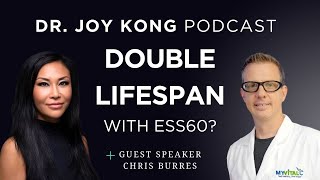
YouTube interview (Dr. Joy Kong with Chris Burres, Feb 9, 2024) about a carbon molecule marketed as ESS60 (a C60 “buckyball”) and its purported longevity and wellness effects. Burres recounts the molecule’s discovery (1985) and Nobel recognition (1996), describes its structure (spherical, 60 carbon atoms, sixfold symmetry), industrial uses (inks, batteries, tires, photocells) and a notable rat toxicity study in which rats given ESS60 in olive oil lived ~90% longer (reported lifespan increase from ~32 to ~62 months). Proposed mechanisms discussed: strong antioxidant capacity (reported >> vitamin C), mitochondrial localization/function support (described as buffering oxidative stress), and anti-inflammatory effects consistent with Mediterranean/Blue Zone diets. Burres describes human and pet anecdotal reports (improved daytime focus/energy, better sleep at night, reduced joint/hip issues, improved pet mobility and coat), low reported adverse effects (intestinal looseness for some after added oil; 2–3% report sleep disruption if taken later in day), product formulation (dissolved in organic extra virgin olive oil; typical serving 5 ml / 1 teaspoon), and manufacturing (graphite-rod vaporization in inert atmosphere). He notes limited human clinical trials to date and ongoing plans for regulatory-style studies and biological-age testing (glycan/DNAm tests) and emphasizes that the FDA has not evaluated the product (labeling: not intended to diagnose/treat disease).
Questions this video answers
1985
1996
60 carbon atoms
~90% (reported increase from ~32 months to ~62 months in the study described)
5 ml (1 teaspoon) per serving
Chapters
Tell us about this molecule, which sounds fascinating.
Scientists discovered it in 1985 and then won the Nobel Prize for that discovery in 1996. So this is a Nobel prize winning molecule, is amazing for industrial applications. It makes better inks, better batteries, better tires, better photocells. This is where people start getting nervous because we're talking about a supplement and the most abundant of the third whole kind of collection of carbon molecules and is the one I'm holding up now. So if you're three scientists here in Houston, that's where I'm based. They were at Rice University, discovered the third form of carbon and so the molecule is great for industrial applications. It's an amazing molecule. It actually has six fold symmetry.
Hello everybody. Welcome Back to the Dr. Joy Kong podcast where I bring to you some amazing scientists, doctors and thought leaders in the field of health, longevity and wellness. So today I have the pleasure of having Chris Burris join us and he's going to tell you something that's quite interesting and mindboggling. So Chris, thank you so much for being here.
Dr. Hong, thank you so much for having me. I'm excited to share the research that I get to talk about all the time with you and your audience.
Yeah. So let me introduce you a little bit. So Chris is a published author, he's the host of Uncovering the Secrets to Longevity Health Summit and he's also a patent holder. With a surprising twist, he's not just a visionary scientist, but also a master of comedy improv. Chris is the founder of and chief scientist at My Vital C where he manufactures a Nobel Prize winning molecule which is responsible for the single longest longevity experiment results and in history, achieving a full 90% extension of life. And this is the longest number I've ever heard. He is the intersection where science meets laughter. And his life's mission is to help people live longer, healthier, happier and painfree one dose at a time. So thank you for making this so interesting and welcome on the show and tell us about this molecule, which sounds fascinating.
It's, it's, it's, it's, it's actually mind boggling. So back in 1985, three scientists here in Houston, that's where I'm based, they were at Rice University, discovered the third form of carbon. And the most abundant of the third whole kind of collection of carbon molecules is the one I'm holding up now. So if you're listening, don't worry, just imagine a soccer ball where the lines on the soccer ball represent the bonds between the carbon atoms. So we Have a spherical molecule of 60 carbon atoms. That molecule is amazing for industrial applications. It makes better inks, better batteries, better tires, better photocells. This is where people start getting nervous because we're talking about a supplement. And usually you don't think about better inks, batteries, tires and photocells when you're thinking about a supplement. By the way, I didn't mention those scientists discovered it in 1985. That and then won the Nobel prize for that discovery in 1996. So this is a Nobel prize winning. I mean technically the molecule can't win a Nobel prize, but like the, the sentiment is still the same. So the molecule's great for industrial applications. It's an amazing molecule. It actually has six fold symmetry, so there's six planes through the soccer ball shape where it's symmetrical. What that means is it's incredibly resilient. Where you can fire most molecules at about 15,000 miles an hour. At steel, they'll just shred apart. This one, by the way, this is how I picture it, just kind of compresses and bounces right back. That's how resilient it is. And they actually thought you'll recognize this shape. This shape on the exterior of the cage. One of the facets of that soccer ball looks like benzene. Now benzene is ubiquitous for our society. We don't have modern society without benzene. In fact, if you just glance around and think, well that's plastic. It doesn't exist without benzene. Like that's how important benzene is also in detergents and fuels, all sorts of things. But benzene is a known toxic material and known to be carcinogenic. So for that reason they assumed this soccer ball caged molecule would be toxic. So they put it in a toxicity study. And in that study they gave test subjects, in this case it was Wistar rats, water as the control group, olive oil as another kind of pseudo control group, and then olive oil with this molecule, and we call it ESS 60 if you're going to consume it. So with ESS 60 in it. And again, this was a toxicity study. Instead of being toxic, the test subjects that they gave the olive oil with ESS 60 really the My Vital C formula lived 90% longer than the control group. So this, you're right, the single longest longevity experimental result in history. The the reason it's a surprisingly large number for you, the next best research way to live longer is calorie restriction. Right? That's the. If you reduce your calorie consumption by 30%, you can extend your life by 30%. I call that the starve yourself one third to death diet. And nobody signs up for that like you, you petition, and nobody. Maybe they need a marketing twist. But, but think about the contrast. You're talking about reducing your calorie consumption by 30%, right? Starving versus adding this to your current kind of nutrition protocol. And yes, it's in rats. And so we've got more research to do, but the testimonials and the kind of logical science behind it kind of make it make sense that this has this positive impact.
Hmm. Okay, so do we know why? What's so special about this molecule?
So other than we're talking about, it's really amazing because you can fire it at a plate of steel and then it just, it won't shatter. That's special, but not the reason that it's useful in a supplement. Right? From the early days back in 19, 1991, really, we knew that this molecule could hold up to six negatively charged particles. In fact, someday there'll probably be a battery. This molecule is kind of colloquially known as a buckyball. And it'll be very cool to have bucky batteries, just because that sounds really cool. And it's a molecule I've been working with for 32 years. But we know it can hold six negatively charged particles, right? So you're in the industry, you're like, oh, that sounds like a reactive oxygen species sponge. Right? So we know that it can hold that. And in fact, when I share the story about these test subjects living longer and people ask, okay, what is the mechanism? Well, the medical community kind of thinks of aging in two regards, right? One of them is an oxidative process and one of them is an inflammation process. In fact, inflammation is so key, it's called inflamma. Aging now, right? Like that's how important it is. So we tick off both of those boxes and I have to be careful with one. But knowing that this can hold six negatively charged particles, we know that it's going to be a good antioxidant. And in fact, there's peer reviewed published research that, that shows it to be 125 times more powerful than vitamin C. There's an ad hoc study on the web that shows it to be 172 times more powerful than vitamin C. So, so we check that antioxidant box. The next one is anti inflammatory. And you have to be extremely careful. The FDA has really decided that when you're speaking about inflammation, you're speaking about disease, right? They're equate, you can't say, oh, I address inflammation because that means you're addressing Alzheimer's and cardiovascular disease. Can't like all of these diseases of inflammation. What we're allowed to say, what the FDA allows us to say is that we address inflammation at least as it relates to exercise induced inflammation. Right. So where, where does the medical community sit between like exercise induced inflammation and actually acute or chronic inflammation? We, we can talk about that a little, but we can't, like the FDA doesn't allow us to say that it addresses this chronic inflammation. I can kind of wrap this up to say that the product fits perfectly in the Mediterranean diet, this anti inflammatory diet known with the blue zone people. Right, Associated with the blue zone people who tend to have, tend to live longer, tend to have less incidences of strokes, less incidences of cardiovascular disease. And so we do fit in that diet. So, so those are the two keys. Now I'm going to, I'm to going, going to blow your mind away here because we're going to go back to the antioxidant because this, this is a theory and there's, and I'll tell you the supporting research that, that's the research that supports it. So we call it, boss, the buffering oxidative stress system. Right. Already sounds like it's amazing. We know from peer reviewed published research that this molecule gets into the mitochondria, right? So we know it's one of those few antioxidants that can get into the mitochondria. Typically you've got glutathione and melatonin. What we think this does is act like a paddy wagon, right? So I use the example. Imagine you're on Bourbon street, it's the end of Mardi Gras and you've got the drunken reactive oxygen species messing up the cars and tearing down the light poles and all this stuff. And you have the police, the glutathione and the melatonin coming to those reactive oxygen species, handcuffing them and getting them off the street, right? That's their job. But if they get overwhelmed and you, you run out of glutathione and melatonin, what do you do? That's when those reactive oxygen species continue to do oxidative damage, oxidative stress in the system. That's where this molecule comes in and acts like a paddy wagon. Now you can visualize that they go inside, but they don't, they just get attached to the exterior. And so this can hold on to those reactive oxygen Species preventing them from doing any damage while, while that mitochondria replenishes the glutathione and melatonin so that they can then handcuff themselves from that paddy wagon, from that ESS 60 molecule, and then get them out of your system or manage them safely. So those are the mechanisms that we're thinking address. Now I'm going to, I want to add one, one last thing before we kind of put these pieces together. Our most consistent testimonial is that people take it in the morning, they report mental focus and energy during the day, and then better sleep that night. Now we know that sleep is positive for your mental, physical and emotional well being. And if all we did was help people sleep better, then we would actually be helping, you know, just their mental, physical and emotional well being. That's it. Just those things. And so that was really kind of the initial thought. And you think about it being a great mitochondrial support system that works in a way that we really don't have anything else that does and that starts to piece all of these, these pieces together.
Wow. Yeah. So this is fascinating. So some people may have objections because a lot of people don't like synthetic molecules. They, they like what's produced by nature. And. Well, what, what, what do you say to that?
Well, first. Yeah, yeah, first, this is a naturally occurring molecule, right? So if you take a candle flame and you collect the soot from a candle flame, and the way you usually do that is you take a cold steel plate, you know, have it over the candle flame, and you collect that black soot on that plate of steel. That black soot has parts per million or parts per billion of the ESS 60 molecule, right? So it is a naturally occurring molecule. Then we get into the debate of like, is it a synthetic hormone versus a real hormone? Like, that's where people go automatically. But this molecule is so simple that there, there is no other iteration, right? The, the, the challenge in, in biology and organic chemistry specifically is to have a right handed or a left handed molecule, right? It can be the same exact chemical equation, but if it's right handed or left handed, it actually interacts differently with the chemicals around it, with your body. This doesn't have that. This is literally 60 carbon atoms in the shape of a soccer ball. And so a natural, you could, you could literally put a pile of natural molecules and a pile of synthetic molecules next to each other and you cannot tell the difference because there is no difference. And so it's a naturally occurring molecule. And we of course we put it in oils and we put it in, you know, organic. Our preferred, the recommended one is organic extra virgin olive oil. And so that's what we dissolve it in.
Okay. So on rats, it has shown almost doubling the. The lifespan, which is, you know, astounding. But what have you. Have we seen in people?
Yeah, so let me start on, on the first one, because I think, you know, our most consistent testimonial. Again, people take it in the morning, mental focus and energy during the day, and then better sleep that night. I'm not aware. And maybe you are. And if you are, please share because I'm trying to kind of accumulate this data of things that you can do in the morning. I'm aware of a couple things you can do in the morning to positively impact sleep. I'm not aware of things that you can take in the morning to positively impact that sleep that night. So if you exercise in the morning, you will sleep better that night. That's understood. If you wake up and get exposure to the sun, you'll get your circadian rhythm in line with the rising and falling of the sun. Provided you go to sleep at a reasonable time, it'll help you sleep that night. But to take something in the morning and positively impact your sleep is pretty amazing. Think of it this way. There's a book by Dr. Matthew Walker called why We Sleep. Amazing book. I don't know if you've read it. If you haven't, you might not want to. I call it the Credit the Freddy Krueger of sleep books. Right? Freddy Krueger from the Nightmare on Elm Street. Except Freddy Krueger woke you up, right? Because he terrified you in your dreams and then he followed you. I guess that's a spoiler alert in this case. This book will scare you to sleep because he outlines 25 years of research of the detrimental things that happen to us when you don't get enough sleep or when your sleep is just skewed, right? If you're getting to sleep later or you're getting interrupted in the middle of the evening or you wake up earlier, it actually has different impacts on the, the type of sleep that you're getting. And he talks about the $2 billion sleep aid industry, right? These are these prescription drugs that you take to go to sleep. And the way he describes it is these are depressants, right? What they do, there's a. There's a thing called a chemical called adenosine. And as it builds up in our bodies throughout the day, it's actually related to ATP. Interesting as it builds up in our body throughout the day, it causes us to desire sleep. And these prescription sleep aids relax the chemical pressure of adenosine. So you wake up without the desire for sleep. And I can imagine, like, that would be an amazingly refreshing experience. If you woke up 10 days in a row and all you wanted to do was sleep more. And then you take this pill and you wake up and you don't want to sleep. You think you got a good night's sleep. The problem is, and this is Dr. Matthew Walker, it's a depressant. It negatively impacts the REM and in REM sleep that you get. So you're not getting the healing and restorative sleep that you actually need. And I tell that story because it's in direct contrast to our product, which you. So you don't take it at night. Is. Which is when you take the prescription medications, you take it in the morning, and then it positively impacts your sleep that night. So. So that's one of the ones. And I'll. I'll share a. This is a kind of fun, embarrassing testimonial. I used to take two naps before noon on Saturdays and Sundays. Of course, if my family was doing anything, then we would go do that and I wouldn't take a nap. But it worked out this way. I've. I have twins. When they were much younger, because they're 13 now. When they were much younger, I would wake up in the morning, they would sit literally on top of me, and we would watch cartoons. Well, they would watch cartoons. I would take my first nap, then we would have breakfast, go downstairs, have breakfast, come back, resume the position, and I would take nap number two. And this was every Saturday and Sunday, unless we were out doing something. When I started taking our formula on a regular basis, we got in that position. They're 13 now, so that doesn't happen anymore. But we got in that position and I just wouldn't sleep. And so I got up and did stuff. Right. So that's a positive impact on energy, focus and energy. And then it's also because I was sleeping well.
So you're supposed to take in the morning, you don't take it at night.
Yeah, yeah. And. And here's a. There's a caveat to that. A small percentage of our customers say if they take it later in the day, it'll keep them up. That focus and energy will keep them up. I think what's going on is they have the mental. Their minds. I won't say racing, because that has a negative Their mind's working at full speed, right? If they put their head on the pillow, they'd actually go out. But their mindset is, my mind's racing, I shouldn't go to go to sleep, right? So I think that's what's going on. We even have a small number of people. If they take a full. A typical serving is 5 mils or 1 teaspoon. We have a small number of people who say if they take it in the morning, a full 5 mils or 1 teaspoon, that it will interrupt their sleep that night. So it doesn't apply to me. And I think it's, like I said, 2 to 3% of our customers, so we just tend to recommend it in the morning. I can also say it has a positive impact on how alcohol negatively impacts your sleep, right? So you have a couple of drinks and your sleep profile. If you've got an OURA ring, I don't have mine on, but if you've got an OURA ring or a whoop, like it's demonstrable. What, what, what alcohol does, how it negatively impacts your sleep. If you've had a couple of drinks to take it at night, I find that it counterbalances. So one, I haven't had a hangover in a long time. I. I'm not out trying every night. That's. That's not my style. But certainly. Excuse me. I've been at a conference in Vegas and, and was very glad not to have a hangover the following day because of, because of the product. So if you're, if you're having alcohol as a depressant, then I, I take extra and it mitigates whatever impact that has.
Okay, so some people can get overly activated. Are there any other potential side effects?
We are not aware of any. So the way the supplement market. I've gone through this very bizarre and interesting journey, right? So my business partner and I are carbon nanomaterial scientists. I call us Happy Go Lucky carbon nanomaterial scientists, right? And we didn't want to get into the supplement market. In fact, kind of the way our journey went was this study, right, where the rats live 90% longer than the control group came out in mid-2012. By mid-2013, we started getting phone calls from people, crazy biohackers like me now going, hey, how much of this stuff should I be taking? And you have to think in terms of like a conservative. We have our conservative carbon nanomaterial hats on. And we're like, wait a minute. What you're asking me is how much of this stuff that I sell to research institutions around the world to put into ink, batteries, tires, and photocells? How much should you be consuming? And. And our answer was an unequivocal zero. We actually put not for human consumption on our labeling, not because we thought it was dangerous, because the literature was already very clear. That's why biohackers were interested in taking it. They don't. I mean, biohackers are crazy. Like, you and I both know that. But they're not dumb, right? They're not like, Look, I have two studies. One says I live 90% longer, and the other one says I die instantly. Let me try that, right? Like, that's not, that's not the strategy. But the data was really clear that it was safe. We're just conservative scientists. So that was mid-2013. We're getting phone calls two to three times a week, hey, my knee pain is gone. And we're going, hey, hey. You mean the knee pain of your rat? Because it literally says not for human consumption on the labeling. And they're like, yeah, yeah, yeah. If I weigh 250, should I take more? And we're like, I don't know why your rat, that's a big rat, right? So we know in the biohacker community that this is going on. And think about that. You know, one of the main concerns when you think about a supplement that's on the market is the placebo effect, right? In this case, we got the anti placebo effect. Literally, it says, don't take this. It's, it's, it's potentially dangerous, right? Not for human consumption, consuming it anyway. And then it had no marketing material. It didn't tell you that your knee pain went away. Or, you know, testimonials like better sleep, or people talk about hair growth. Like, it didn't have any of these on any of the labeling. So when they're giving these testimonials, they're like, this is just what. And, and biohackers tend to, you know, know, collect data and think in terms of, you know, data positive, data negative. So that's mid-2013, we're saying, not for human consumption. And my business partner and I are getting together like every quarter, like, what should we do with this? Like, like the, the, the supplement market is very different than the carbon nanomaterial, you know, selling to research institution market. I'm not sure we want to get in there. And that changed in 2017. But about the middle of that, so maybe 2015, I found a peer reviewed published paper that said 50. They tested supplements on the market, and they said 50% of the supplements that they tested didn't have in them what they said they had in them. Right. And that was a paper that really convinced me I didn't want to be in this industry. So fast forward 2017, a guy with a big YouTube following starts sharing all the benefits he's getting, taking it on a daily basis. And, and, and our phone went from two to three calls a week to ten calls a day. So really, our customers drove us in this direction. My business partner and I like, okay, so this is obviously an entrepreneurial opportunity outside of just being carbon nanomaterial scientists. And we asked ourselves two questions. And the first one is, is a moral question, right? Are we comfortable selling this? Are I take it, My wife takes it. Everybody on our team takes it. By the way, it's not a requirement. You don't have to take it to work here, but everybody on our team does take it. So, yes, I'm comfortable selling it. And then the next was the FDA and the ftc and you just got to dot the eyes and cross the T's. Now, that was a really long story to get back to the fda. As I'm trying to figure this world out, this world of supplements, you know, what do our labels need to look like? Because the guidelines for that I found on the FDA website, a piece of text that I took a screenshot. It's like, this is a mistake and they're going to take it down. And what it said was, you do not have to prove that a supplement is safe before you put it on the market. I think if you were to share that with anybody, they'd be like, that sounds dangerous and you shouldn't do that. And I'm going to turn that around and say, let's say, Dr. Kong, you decide to make a supplement, and it's 10% vitamin C and 90% vitamin D. Right. They don't go together well, but anyway. And I do the opposite, right? So 10% D&90, that's a new supplement, Right? So there's, there's an infinite number of potential supplements out there. There's no way the FDA is going to give approval before those things go on the market. What is required is that if there are any serious adverse side effects, you have to report them to the fda. Now, this sounds like, really scary. Hey, I've got a serious side effect. I'm going to tell the FDA and they're going to shut me down. That's not how it Works you actually, because they're, they're, they're smart enough to know, like, every person is different. You probably will have some serious side effects with some very small number of people. We just need you to make sure we have the data so we can assess this. Right. And if you start getting more and more and more, then obviously they're going to come and investigate. To date, we have not had to report anything to the fda. There have been no serious side effects. The things that we do get on the negative side are, and you may fall into this category, uh, it's olive oil. It has a very distinctive flavor. Some people don't like olive oil. In fact, a high quality olive oil will leave a peppery flavor at the back of your throat. And we get calls like, is it rancid? It's peppery at the back of my throat. Actually. No, that's the sign of the highest quality olive oil you can find. I don't know if you've been to a, an Italian restaurant where they'll crack pepper into the olive oil. They're doing that so it tastes like an expensive olive oil. Right. Because cheap olive oil doesn't leave that peppery flavor at the back of your throat. So, so that's the complaint. And the other one we get from time to time is if you start adding a teaspoon of oil to your diet, your, your stool can get loose for a couple of days. That's it. Right, that's. Those are the negative side effects that we've, that, that people have reported to it. And the sleep. Right. So a small amount of people say that it can negatively impact their sleep. But, but, but that's it. And there is no literature, like people are doing research on this. There's no literature of adverse interactions, adverse side effects. It's, it's to this point kind of miraculous that it's all extremely positive.
Okay. So increase energy, better sleep. And then, you know, people.
Do you want to hear the, the worst testimonial about a supplement in history?
Okay.
So we have a big distributor in Houston. Her name is Gwen, and she, we did a video together. And she shared on that video that she originally ordered the product for her dog with no interest in taking it for herself. But she noticed such a profound difference in her dog, right, who had been lethargic and was getting up in years, started like running around like a puppy and all this amazing stuff that she was like, okay, I need to take that. Right? And one of the pieces that I like about that is there's no Placebo effect with dogs, right? The dog doesn't like, oh, I took the little dropper today, so I feel like I'm going to have more energy. No. Either dog feels energy or the dog doesn't feel energy, and that's it. And then Gwen in that video, she said, listen, I got to be honest. Three months in, if you had asked me if I had noticed any difference, my initial response would have been to say, no, I haven't noticed anything. Except then I started taking stock of my life, and I'm like, well, I'm working later than I did in the past. I wake up earlier. I was never a morning person. And here's the worst testimonial about a supplement ever. I cleaned my garage. Now, it's like, it's very esoteric. Esoteric. But there's usually something holding you back from doing that task, right? Whether it's emotional, and we have interesting emotional kind of testimonials, and I can share one with you, or it's just energy, right? Like me sleeping on the couch for two naps before noon. Like, if I stop doing that, my garage gets clean. Right? So it's that piece of energy, or it's kind of overcome, you know, the baggage of clearing. Clearing out whatever the emotional stuff that might be in the garage or whatever it is. And so I actually, I like that testimonial because it is about that energy, and then ultimately, you know, which could be driven simply out of better sleep.
Hmm. Okay, so is this a patented molecule or can anyone make it? Make this?
Anyone can make it. And I'll share you how. Because this is a lot of fun if you take two graphite rods, right, and you vaporize them. By the way, in order to vaporize graphite, you have to use local temperatures of the sun, right? It's the hardest, one of the hardest materials to vaporize. Now, you have to do that in a chamber that has no oxygen. So it has to be a vacuum chamber where you evacuated the oxygen, backfilled it with nitrogen or helium or something like that, argon, and then it has to be at a reduced atmosphere, right? So it's not normal pressure. It's a. It's a slight vacuum. So this is an incredibly complex piece of equipment to make. And in fact, why I originally got involved in the project, because I helped my business partner, Robert, build that piece of equipment to manufacture this molecule. And so, yes, anyone can do that. There's no patents protecting that. There's no patents putting it in oil, which is probably one of the reasons that big pharma will never touch it and will never promote it and doesn't even care about us.
Okay, so what other things that people notice? So a lot of energy, better sleep, people where animals are living longer. And.
I'll share other reports. Yeah. So. And. And we have to be careful. So I'll be careful as I. I tell this. So in the early days, there was a. I was a hero at the office on a Saturday. And this guy knocks on the door, and. And I was like, okay, that's weird. And I was by myself, but I. I answered the door, and it felt very clandestine. He's like, have any ESS 60? And I was like, yes, we do have ESS 60 come in, because we don't have a, you know, we don't have a retail. Like, we're. We're kind of office warehouse space. And so he comes in, and I, like, I had to figure out how to sell the product to him, right? Because I was like, give me your credit card and I'll go to the website and type in your information. Because we. We don't. We're not a retail location. So he goes off and. I don't know, it was a number of months later. I was walking by and I recognized him, right? Because the. A customer who visited and the lady who works up front, Cassandra, tells me, hey, this is his third order. So not just the first order that I took, but this is his third order. And we were, at the time, we were running a special on three bottles, and he was ordering three bottles, right? So immediately I'm like, this guy's gonna have an amazing testimonial, right? Like, this is a guy. Let me ask him, hey, so. So what's been going on? And it's kind of funny because he was like, know. He felt bad because he was like, well, I. I haven't. I haven't really noticed anything. I'm like, well, that's interesting. Maybe you just want to keep taking it because these rats live longer, right? Like, that's a legitimate reason to keep taking it. And then he goes, well, does it. Does it help with. With arthritis, right? I can't say that our product helps with arthritis, but I told him. I mean, we've had people tell us that. I. I don't. I don't know, right? We. We can't make that claim.
And he.
He goes, well, that. That's up. Also, there was. I had this click, click, click in my knee, and that's gone. And I was like, okay, yeah, that's. That's great. And he goes, I haven't been jogging for. I don't remember the specific, like, some number of years. And later today, I'm going for, like, my third jog, like, back to back, right. So he picked up jogging again. It's kind of reminiscent of cleaning the garage, right? Like, had the energy to do these things. And in my head I'm going, well, I'm sorry, you haven't noticed anything. And then he says, and I have to share this at my work, I feel less stress. And let me be very clear, it's the same job, it's the same people, it's the same stress. I just feel less stress. And I'm like, that's amazing. And again, maybe it's just the better sleep. If you've got better sleep, you're going to jog more, you're going to feel less stress. You're able to handle your emotions significantly better when you get a proper night's sleep. Um, or maybe it's the positive impact that it's having on the mitochondria, which is driving the sleep and, and not the other way around.
Hmm. How does it affect the mitochondria?
So I think the value is when the mitochondria is pushed and, and there are so many things that cause stress in our life right now, Right. Like whether it's just UV radiation, whether it's, you know, I'm sitting with some lights and a bunch of monitors and with computers running and a cell phone next to me. Whether it's that stress or whether it. The emotional stress, the stress of our job, we're constantly under stress. And that puts the mitochondria to function more. And the more stress we put on, the more reactive oxygen species that it's created. I mean, think about the mitochondria as, as you might think of any energy source, and this is not really source, but a car going down the road, it's got exhaust coming out of it, a. A power plant with a smokestack, it's got smoke coming out of it. And the mitochondria creating that energy has these reactive oxygen species. And so this going in and acting as that boss, that buffering oxidative stress system, that's the thing that we believe supports, is how it supports ESS 60 supports the mitochondria.
Has there been any research showing its effect on mitochondria?
So, not yet. And those are. Actually, I've been, you know, you, you participated with the Longevity Summit. We'll probably mention that at some point. And I've been so busy with that coming out of that it was like, hey, there's probably some mitochondrial studies that I could do that are pretty inexpensive. I mean at this point we're a small operation, you know, a full scale human trials. Just, it's not in the budget, right. We'll, we'll try and get there. Our next step, and this is how the scientific process is supposed to work is somebody has a theory. In this case ironically, it was that the molecule was toxic. Somebody does a study and then publishes the results and, and then some other organization does that same study, right. To prove those results. We're 10 years later, that hasn't happened yet. And so that's our first goal is like let's do this kind of same. Turned out to be a five year study on, on with our rats. We'll make a couple changes to the study because we think we can make improvements on even the 90%. And that's really the next step. And in order to do that we're doing. There's four studies that are really kind of regulatory agencies. And even if we want the product inside of Whole Foods or some large organization like that, there's particular studies that they want to have done. We've already got three of those done and now we need to finish, finish the fourth one. And then once that's done, we'll be looking at that study. But so, so no, we haven't looked at it. I will be looking at our. There are probably some inexpensive things that we can play around with. Oh, I can share. So I did some biological age testing, right. So I did glycan age and I did my DN age, right. I don't know if you've messed around with those. These are kind of really fascinating. Right. And I'll tell, I'll, I'll tell, I'll tell the story this way. So the first my DNA age study I did was three years ago and it said that I was five years older than I am, right? So my biological age was five years. I didn't like that test very much as you can imagine. So then I did a glycan age test. I actually gave my blood, paid for it and gave my blood at the biohacking conference at Dave's biohacking conference in Orlando. And that came back and I was 33 years younger than my bio, than my chronological age, right. So a different test that's really looking at inflammation. So my, my so called, so, so called chronic inflammation levels are extremely low. Like a 21 year old. I think I Probably had more inflammation as a 21 year old than I do now. But that's a, that's a, that's a different story. Right. And then I, coming off of this longevity summit, I took another DNA. My, my DNA test. Now I'm still unhappy with the result, but the result was. So when I took the first study, I was 51 and it showed me to be 59. I'm now 54, three years later, but it showed me to be 58. So in three years I've regressed one year. Right. And I don't like that the numbers are higher than my biological, than my chronological age, but I like the direction that they're going.
Right.
And so we're looking to do more of those. We actually had a, a small study going with a doctor out of California. He called, he was excited, he was doing different protocols on really people around his office. And I'm like, yeah, sure, we'll pay for the test, we'll. And what, what we realized is, and this was a, my DNA test, I believe that's ex. That test is extremely susceptible to like disease. Like Covid specifically. Right. So you get Covid and your biological age shoots up 10 years, right? Now that's kind of, I look at that kind of two, a couple of different ways. One, it's a little depressing because you would like the test to be less susceptible to like a cold or a flu on, on a given day. But at the same point you think about who, who was actually, who was dying when they were getting Covid and it was actually the people who were elderly and if you accelerated their age by 10 years, that would have been pushed, that would push them over the typical, you know, human lifespan. So it actually also makes sense. But, but yeah, so those are, those are some of the tests that, that, that we've done. And yeah, we're looking to do those kinds of studies. If you have any contacts or, or ideas about a, an priced mitochondrial study, then yeah, we'd love to do that.
Okay, so you developed a product that's in the highest grade olive oil, Right. For people to consume hopefully in the morning. But sounds like only a small percentage of people actually get their sleep adversely affected, so.
Correct. Yeah, 2 to 3%.
Yeah. It's very small. Yeah. Okay.
So you can take it, I mean just like anything, right. Like you might take a magnesium which can help you with sleep. Right. But if you take it too early day, I don't think magnesium will make you drowsy. I haven't played around with Magnesium. But you got to play around with it, like, what is your physiology? Because your physiology is going to be different.
Right. And then you guys developed products for cats and dogs, correct?
Yes. Yeah.
So that's going to make a lot of people very happy.
Yes. I do have to share. So we've got one for cats, and it's, it's got a salmon flavor, and then we've got one for dogs, and it's got a bacon flavor. And it's kind of cool to see the dogs and cats. And I love pet testimonials. Again, I'm the geeky science guy. Like, yes, I like pets make me feel good. Right. I'm like everyone else. But I like the fact that pet testimonials don't have the placebo effect. That really excites me as the scientist who's responsible for this. But, yeah, pretty quickly, people wanted to have some for their pet. I do like to point out. Right. I think this is interesting. We sell a lot more of our dog product than we do our cat product. So if you're a cat lover, you, your, your, your, your peer group is not representing you. Well, you guys don't seem to want your cats to live longer.
That's very strange. Yeah. So what do they notice? Oh, some arthritis decreased and then energy level got better.
So, so if you look at some testimonials are related to hips. Like, so a number of species of dogs get. Have hip problems and so improvements there. A testimonial of my dog used to, I used to have to carry my dog downstairs, like to go to the bathroom outside, and now he bounds up the stairs again. I mean, they're just phenomenal. And often with cats, it's a lot about their coat. Right. And then I actually just had an interview last week where the lady said her cat had a scab that hadn't gone away for a couple of months. And like two, I think it was two days into taking the product, her sister, who's a vet, came over and was petting the cat and was like, hey, where'd the scab go? And, like, it's gone. Like, it's gone. So there seemed to be. And I'm going to interject a disclaimer here in a second. There seem to be a lot of kind of speeding up the. Again, if you're improving the mitochondria, like, these things are going to get better. And so let me just say, because I think it's the right thing to say, is that not just legally, but the right thing to Say that the FDA hasn't evaluated our product. It is not intended to treat, diagnose, cure or prevent any disease. And that's, that's the right thing to say because we have, we have more research to do and we're, we're going to do our best to do as much as that research as, as quickly as we can. But, you know, that's just where we are right now.
Hmm. So did this molecule propel you into this kind of exploration of longevity?
Absolutely right. So here you get this result. And I was, you know, I'm a happy, go lucky carbon nanomaterial scientist, right. I'm not looking. I'm probably barely eating well and barely exercising intelligently and like, you know, not aware that there's a terminal velocity of aging, right? Like all of these things that have come out and, and you get this result, a 90% extension of life. And you're like, ah, that sounds like a lot. I wonder, I wonder where that sits in the space, right? Let me dig in and understand where it sits in the space. And you're like, wow, the next best way to live longer is the starve yourself one third to death diet. So I like ours better, right? And then let's, well, let's dig in and like, well, what are other ways like that you can, what are other steps you can take to, to actually live longer or live healthier? And what is the terminal velocity of aging? Let me read Dr. Matthew Walker's book why We Sleep and Dr. David Sinclair's book why We Age and why we don't have to, which is an amazing book and kind of catapulted me, like, I need to spend a lot more time understanding where our product sits and understanding. And then now that I'm doing it, how do I share it with people? Which is why I ended up doing that Longevity Summit, right? So the summit's called Uncovering the Secrets of Longevity. Live beyond the Norms and you participate. It was, it was a phenomenal interview. I don't know if I shared this with you when I started that the goal. So I'm working with a company called Health Means, and they're like, hey, you're going to need to, you need to do 35 interviews. And in my head I'm like, I'll be able to do 25. Like, it won't be easy, but I'll be able to get 25 done. And then we'll see what happens. I think they would have been very disappointed I ended up interviewing 55 people, right? Like 55 experts. In longevity. And some of them are fringe. Like I had to twist it a little bit so that they're, they're, what they're doing is relevant and certainly relevant to our health span, stretching it to lifespan. Right. But we want like one of the override I can share. There's a couple kind of cool things and, and, and one's related to stem cells. When you think about what are the real limiting factors to us living longer and, and you kind of have a solution to this, it's when you start realizing that your red marrow, which has your stem cells, right, the, if not all of them, most of them, that it shrinks with age. And so eventually at one point, you don't have this reserve of stem cells. And for me, as I'm looking at and having all these conversations, I'm like, that's the one thing that we've got to solve, right? Like if, if we can just figure out how our hearts don't fail, how our blood vessels don't get clogged, how we, we don't get cancer, how, like if we can figure all of these things out, great. But if we run out of stem cells, that's, that's not good, right? Like, that's a, that's a big problem. Or we've got to figure out some sort of. In my mind, I think of like a dialysis process, right? A stem cell dialysis so that you're able to continue to get stem cells into your system because you're going to need them. Like they're the repair mechanism of, of anything. Whether it's simply you're working out and you've torn your muscle. That's what working out does. And you need to repair it or you're repairing whatever and managing, you know, other, other systems in your body. So I don't know if you've thought about that ever and, and what your thoughts are on it.
Well, definitely that's what we're doing. I mean, we're replenishing. I mean, there are different ways of doing it. Science is evolving. But as far as we know, yes, we're basically, basically have a fraction of stem cells compared to when we were born. Actually when we reach our teenage years is only 10% of what we had. So it drastically declines. As far as, you know, your body's ability to regenerate. So to replenish. Is there a way to replenish within yourself? And that's a, that's a question. So there's some research, I think, some, you know, methods possibly looking at getting More stem cells inside your body. But as far as you know, the majority of the evidence now is that, you know, we have to put it into the body from somewhere else, but things could change. But right now you know, which was why I was so impressed by the 90%, because research of regular IV stem cell infusions for animals, rats and mice, it showed extension of lifespan for about 30%. So. So this molecule that you were talking about, USS 60 extending about 90% is astounding.
Yeah, it's really a. There are a couple kind of key pieces in, in the story and I haven't even mentioned, by the way, I, I've got this book Live longer and Better and, and I've put this entire story in, in the book right from the beginning, from being in college, meeting my business partner, why I wanted to be an entrepreneur in the. In the first place. You know, the discovery and what that meant, how revolutionary that discovery was. And there are a couple key pieces in it. So one of them is at one point, a professor that my business partner Robert Wong was working with came in and said, hey, this molecule, right, is selling for $6,000 a gram, which is amazing, right? That's back $91. And you guys are young guys, you could start the business. So that was really where he started. And then we were good friends and I got involved. So that number is crazy, right? And then a 90% extension of life is just a crazy number. It's a bizarrely crazy number. And I do think that we'll be able to improve it in a study with some tweaks to the study because that's, I mean we could talk an hour just on the study, but in fact, let's talk about it real quick. So there's three key pieces. One, the rats live 90% longer to the. A typical Westar rat lives about 32 months and has a known amount of tumor mass in its body. Right? So the longer they live, the more tumor mass they get in their body. Even though the, the my vital C rats lived out to 62 months, full 90% longer, none of them had any tumors. Right? So you know, and a lot of people, they hear that and like ah, cure for cancer. No, no, no, no. There's a big difference between being a cancer preventative, which is this kind of implies that, and being a cure for cancer, right? So once a cancer is metastasized, that's a different animal altogether. And we know things as simple as a good diet, exercise, good sleep can be cancer preventatives. It, it throws it into that category with the caveat of what need a lot more research. And the other thing that they did in that they actually created oxidative stress in the rats by injecting carbon tetrachloride. That's a standard methodology for creating oxidative stress. And it was only. So remember, there are three groups of rats. Water, olive oil, and then olive oil with ESS 60. It was only the ones with olive oil with ESS 60 that were able to recover from that oxidative stress. And that's in the liver. So when you hear things like, well, it's good for hangovers, liver. Right. Like, there are things that tend to go together and really, again, make it. Make it a phenomenal result. Hmm.
So how long do you think humans can live?
I. So, so I had, I asked 55 experts, and actually we're going to come out with a document that shares the tips. Right, So I got your tips. All 55 experts. What are their tips that's going to be available for free when, when somebody registers for the free summit. Actually, the summit's coming out in February, and I know you'll have a link in your description. And so I asked everyone, how long do they. How long do they want to live and how long do they think they can live? Just an interesting data point. Only two people gave the same number. Right. Which is just kind of interesting in terms of mindset. Right. I believe humans can live X, but that's not where my number is. Right. That's just very interesting. I personally believe with our technology today, we're probably at 120 in that range. And that was a number that was given by a lot, a lot of the experts. But I believe that we're going to be making quantum shifts in how long we can live really quickly. And they say now back in 1950, medical knowledge doubled every five years. Currently, they say medical knowledge is doubling every 73 days. Right. Doubling of medical knowledge. And just think about how many more people there are on the planet and how many more people are in labs. And I always love the example. You know, in the old days, if somebody in, in whatever, in a remote land, part of Kazakhstan, knew how to do a little bit of biology and was excited about something. They were just in a vacuum, right? There was nothing. There's no collaboration or anything. But now you can have that person in Kazakhstan and some kid in Ecuador, and now they can connect on the Internet and they can be excited together and they can motivate each other. Like these are. These are orders of magnitudes increases in creative people pushing each other creatively in different endeavors. And I think we've already experienced some of that. I mean look how shocked shocking AI is right? ChatGPT comes out and I have a conversation. Actually my co author, pretty excited. The co author of my book is a two time New York number one bestseller. He's 77 years old. And I was like hey, could you help us with this content here? Not the book, but this content here. And, and I'm going to suggest this. And he was like nah, yeah, like in his head it can't be that good. And I said Jerome, let me show you. And so I showed him and you can do things like you know what is give me the pros and cons of electric vehicles from five, four perspectives. We'll just do like Republican Democrat scientists and, and environmentalists and it'll bust out like answers like two to three paragraph, intelligent paragraphs of those. Like we didn't think that was possible last year, right? Like if somebody told you I in fact I remember probably five years ago, maybe, maybe more like eight, I was at a seminar and somebody was like yeah, all the content is going to be written by computer soon. And in my head I was like not only is it not going to be written in written by computer soon, I just don't see that ever happening. And then here we are like the content. Google actually recently changed their guidelines and says good content used to be content written by people for people and now it's just content written for people. They actually took the BI people out so they accept AI content in their algorithm. So I think that's why I think that we're going to see quantum shifts and I ultimately think that David Sinclair is right that if I can take a cell from your finger and I can create a baby Dr. Joy which we can do, right? There's probably somebody who's doing it somewhere but you know, we shouldn't be yet. I don't know what other the restrictions are but we can certainly do this with animal models. But then that means that every cell in your body has the information to be a young Dr. Joy. Right? Like that's, that information is there. His concept is we just got to figure out how to like what are the levers to pull and how do we pull them and, and, and potentially revert you to the age you want to be. Like maybe it's 25. And I actually had an interesting conversation in the summit. We're like yeah, I was probably too irresponsible. And then you're like well, you're right, your hormones are different at younger ages that maybe you don't want to go back to. Maybe you want the youth, you know, the youth of 30, but not the, the hormones of 22. Right. Like that's a, you know, it's my, my mind goes to younger, but maybe there's reasons not to be young.
Well, if you can address all the epigenetic factors and you know, and guide yourself on a different path, maybe you will be a lot better. 25 year old and, you know, also.
Right. Where do we go? Yeah, well, and, and then add the maturity. Right. So the, you know, you've got, you've got the brain cells that you didn't have then. Right. Like that's, that's the reality. Not brain cell, but, you know, brain processes and.
Right.
Stuff like that.
Memories and, and wisdom. All the wire. Yeah. So that's gonna be, if that day happens. It would be a very interesting adventure for the human race.
And I had one of the talks, so again, a reason to tune in to the Longevity Summit. So my co author is, has a storied career across like three different industries. He was like a, an advisor on terrorism at one point, heavy in financial. He's written, I don't even remember the number 30 books on all sorts of politics and economics. And so I brought him in to have some philosophical conversations, right. Because if we're thinking about living significantly longer, we should be thinking about, okay, one, equities, right. Does everybody have access to this technology? And as with most new technology, the answer on day one is no, it's too expensive. But where are we going to be on whatever day 50 and then day 100, if that's the span, in order to make sure that everybody has access to it. So those are interesting conversations. What do we do? Because people automatically think in terms of a population crisis, right? But Elon Musk and a number of people are sounding the alarm that we're running out of people. Like we're not creating enough new people. And this is problematic. And you look at, you know, how many times I think we were supposed to run out of fuel, gas and food in the 70s, but that didn't happen. Well, why didn't it happen? Because people, smart people, maybe one in Kazakhstan, one in Ecuador now, like got together and solved the problem that we're thinking we can't solve. Like the, like it's people is the resource, like the brains of people is the real resource. And so I think people will probably have less kids, right, because there's not that, that much drive anymore. And, and then if you like, if you put everybody back to age 25, then everybody can mingle with everybody. But you're like, I don't want to, I don't want to have kids. Like that's already, I've already done that or I'm not interested or whatever. Right. There's there, there a lot of that we kind of discuss in, in that kind of philosophical conversation with, with Dr. Jerome Corsi.
Yeah, that'd be quite a discussion. So unfortunately, we have to wrap up. So, Chris, people can get your book, I assume on Amazon.
Yes, they can find it on Amazon. They can find it on, on my website. And we've got a link specifically for your audience. That's myvitalc.com forward/doctor joy. So that's Dr. J O Y. And so that, that page has kind of some limited products. We like to keep it not overwhelming, but they can click and get to the book and, and so. So that's good. You can, or I can. You can order it signed. It's $10 extra for me to sign it. But. But that $10 goes directly to Operation Underground Railroad. There was a movie recently called Sound of Science. I think it's Sound of Freedom, the Sound of Freedom, which is about like child sex trafficking. And I actually saw the guy who started that organization and is represented in that movie speak. And so all of the signature dollars goes directly to that charity. When they land on that page, they can find different products. We sell products on subscription. There's a 25% discount on subscription. Take advantage of the subscription. We want you to. Even if you're just going to try one, you can cancel that at any time. Our customer service department has like 800 five star reviews. They're not trained to talk you out of canceling your subscription. So go ahead and take care of that advantage. And then we have a Coupon code also, Dr. Joy D RJoy that gives them 15% off of their initial order if they're interested in trying it. Like, and if you want more research, call us. Our staff is extremely well trained. They're all taking it. They'll all show you their experiences. And if you're like desperate to talk to me, then they can often make that happen.
Wonderful. Thank you so much, Chris. This has been a really fascinating discussion and lots of new information for people to digest. And I really appreciate you being such a fun and dynamic guest. And I look forward to chatting you at some point in the future and your health summit.
Thank you. That'll be awesome. Maybe we'll connect at one of the conferences or something. Like, we can actually meet face to face. That would be very cool.
That would be fantastic. Okay, Chris and everybody, thank you for listening. If you like this episode, please like and subscribe to the channel. And thanks again.










