Dr. Joy Kong Stem Cell Therapy Testimonials - Courtney Gillenwater, MD
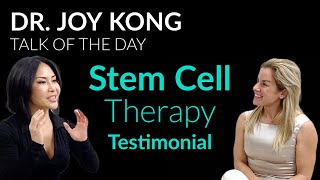
Physician Courtney Gillenwater describes rapid healing after stem cell and exosome treatments: she returned to the gym five days after complex palate surgery, versus the expected five to six weeks. She cites a knee study where stem cell injections prevented most replacement surgeries, with only one revision needed in the treated group versus six in the surgery group over a decade.
Questions this video answers
June 24 (surgery on June 21; IV treatment on June 24).
About 90% blocked.
Planned: ~45 minutes; Actual: ~6 hours.
Expected downtime: about 5–6 weeks; Actual: back to gym and functioning within five days.
About seven years.
Chapters
They ended up reconstructing my palate, the back of my throat, took out my uvula. Big procedure. I ended up in the hospital and the morning after I had the IV therapy, the nurse went to take off my face bandages and she literally jumped back. It was incredible and almost superhuman the amount of healing that occurred after the stem cells.
I just think one day this is going to be commonplace, that people are not even going to think twice. You're going to do surgery. You have to do surgery. Okay, let's get you some stem cells. So heal twice or three times as fast. So, Dr. Courtney Gillingwater. So you've had some interesting experiences with stem cells, so I wanted to see if you can share.
Yeah, thank you so much. So the stem cells that I received literally changed my life. I spent years not being able to breathe at night and I put off getting, I had a deviated septum blocking 90% of my nose. So I was snoring like a 75 year old man, basically not getting any oxygen at night. And I had a sleep study confirming this. But for years I kept putting off the surgery because of the downtime. And I think this is something that everybody can relate to because sometimes we need surgery or we need some sort of treatment, but there's that, you know, awareness that you're going to have to have downtime afterwards for healing. And I finally got to a point in my life where I had a little bit of time and I was able to schedule a surgery, thankfully with the West Los Angeles VA Hospital and Dr. Eric park was the surgeon. And I went in and it was going to be a 45 minute surgery just for, you know, a septoplasty to fix the nose. But what they ended up doing when they went in there ended up being six hours and they ended up reconstructing my palate, the back of my throat, and took out my uvula. Big procedure. I ended up in the hospital and I, with the complications that happened, I should have probably for at least five or six weeks not been able to swallow or you know, eat really food or, or speak or do any of these things, you know, normal day to day things, activities of daily living. But I was lucky enough and very, very fortunate to get the stem cells and exosomes right after my surgery. Post op day. The third day afterwards, my surgery was on the 21st and then of June and then on the 24th of June, I was able to get the stem cells and exosomes via iv. And when I say it was incredible and almost superhuman, the amount of Healing that occurred after the stem cells. I went from being swollen in the face, unrecognizable iPhone. Face recognition was not working for a valid, for something objective. And we were doing post operative pictures of my face from all the angles every day and within. I got the treatment via iv and the morning after I had the IV therapy, the nurse went to take off my face bandages and she literally jumped back and she was like, oh, my gosh. And I was laying there going, oh, no. Like, what could possibly happen? And then she held a mirror up to my face and I started crying because I could actually see my face, my iPhone could recognize my face, and I looked like myself and I was still a little bit swollen and a little bit black and blue. But it was incredible the amount of healing that occurred. And from a scientific reasoning and a medical background, it was incredible, incredible healing that occurred as a result of your stem cells. So I'm very grateful, very fast.
Yeah, I have somewhat similar story. When I broke my calcaneus and yeah, I was doing everything there was. I injected some cells, but what I found to be the most powerful was actually the IV infusion. So. And I was doing hyperbaric oxygen, light therapy, different herbs, and you know, every autumn sound. Yeah, I have so many tools and I, I was able to regain a little bit every day of the, of the, you know, flexion of my foot. But after the, the IV infusion, that's when it just, you know, sped it up probably at least twice or three times as fast.
So it was incredible the amount of healing that occurred. So just to give you context, I spent over 10 years working with reconstructive facial plastics with Operation Smile. They do cleft lip and palate repair. So very specifically, I'm very familiar with how much downtime is associated with complex, you know, pharynx surgery, neck surgery, palate surgery, all of that. And it should have been five or six weeks and. And I had allotted for a couple of weeks to be down. I missed a family vacation, literally. But I needed the surgery debris. And so it was important. And within five days, I was back at the gym working out. And I wasn't, you know, running a marathon, but I was able to function. And what that can mean for anyone is you could go back to work, you could go back to whatever you're doing, your family, your loved ones, your. Your passion project or whatever it is, or travel, whatever you have, it took away the downtime and not be trapped.
At home, but have some kind of.
Sort of a life, right? You know, be Productive.
Continue with your life. Yeah. That's what I've seen with people who are doing either elective surgeries, sometimes plastic surgeries, or things they have to do like gum surgeries or other type of operations. Then they do a stem cell treatment right before or right after it. The amount of healing it propels them into is pretty, pretty incredible. So I just think one day this is going to be commonplace, that people are not even going to think twice. You're going to do surgery. You have to do surgery. Okay, let's get you some stem cells. Are you going to heal twice or three times as fast? It just. There's not going to be, you know, anything that's drastic. It just is part of medicine.
It shouldn't be part of medicine. And it should be just like antibiotics. It should be something that everyone can have access to and something that everyone can have made available after surgery or after procedures. And the amount of healing potential that this has to help other people is something that should be shared. Not all stem cells are created equal. So as compared to other kinds, like, you have to look at the science and you have to look at the research and you have to look at the actual components that are actually in what is being given. Because there's different sources for stem cells, There are different kinds of stem cells, and then there's also that. And she'll go into this more, I'm sure. So just to keep it simple. But the mesenchymal stem cell component, that percentage is able to make a drastic difference when given in the appropriate amounts to patients. And when you give these IV infusions and when you couple it with exosomes as well to, you know, increase the uptake in the system, there are all of these different modalities of medicine, and regenerative medicine has all these things, you know, new treatment modalities and technologies coming out with, you know, you could do the hyperbaric oxygen or if you had a sinus surgery, you can do ozone post operative as well, all of these things. And then, you know, couple it with infrared LED light therapy so that you're even increasing the, you know, further potentiating the oxygen uptake in the bloodstream. There's all of these things, but it's base of it all. If you have the stem cells potential capacity to heal and that is given to the body and it's coming from the right source so that the potential healing that can occur is highest possible, that is available, it is drastically different results with drastically improved outcomes when you have the right stem cells.
Yeah. Yeah, I always think of it as a very revolutionary way of helping the body to heal. Because all of a sudden we're using intelligence that's very broad spectrum, right. That's the intelligence that created life in the first place. So utilizing that to get your body to get to a, you know, better place, right. What can make life, can make you thrive in life.
Right. And it's also going to just be an opportunity for what she has discovered and what she is trying to share is something that can help everyone. When you have a procedure that you have to get done or if you have an injury, there are people that have injuries. For example, if you have a knee injury or an ankle injury or fractures, you know, let's say you're someone who happens to have fractured, you know, your heels and you haven't been able to walk for nine months and you've been in boots. There is the medical healing potential to receive treatment via IV infusion and local injection. And what that can do. There are other patients, very specifically, that I have watched go from not being able to walk for nine months to receiving the IV infusion and receiving the local injection of these stem cells coupled with the exosomes. And very specifically, within a matter of a few weeks, these people are up and walking around again. They're able to go about your day to day life, go about working. And the guy actually ran a 5K. So these are results that are outstanding and very, very unique and very, very special. And again, it has to do with the science, the medical quality of the stem cells. There is the ability to heal exponentially faster than anything else. And it is something that should be available to everyone. And it's separate from autologous stem cells, these specific ones that are sourced from the placental and the umbilical cord sources. It's a different kind of healing potential because there is a different percentage of these mesenchymal stem cells component which, you know, can increase the healing. And it's just a different variation of treatment therapy. And it has so much healing power and it's so much faster, I think.
Yeah. So the way I designed the product is that I'm seeing healing potentials from different compartments of the birth tissue. So that includes the umbilical cord blood, umbilical cord tissue and amniotic membrane. And you've got different companies that produces products from these particular compartments. So when I come in, when I reviewed all these scientific studies, looking at different compartment, you know, cells from these different compartments and getting good results, but probably suited for a particular purpose. You know, more, maybe a little better for certain conditions, for particular cells from particular compartments. So what I did was that I came in, I wanted to kind of harness the best of all these compartments. So why not put cells from all these compartments from the same donor into one product and giving people a full spectrum of different types of cells instead of just, you know, hammering on one type. So, so that's my philosophy. It's always been holistic. If I can bring in different aspects of healing and have them work together, then you're amplifying the results.
And where did you, when you first started doing this, how long have you been doing this?
It's about seven years now.
Oh, wow. Okay.
That's amazing. Started by using umbilical cord blood cells. And that's what got me really intrigued. And then I started to look at autologous sources. That's from bone marrow or fat mostly. And I just started reading and reading and to make sure that I'm actually giving people the best source. So I was comparing cells from the birth tissue with cells from the bone marrow or fat. So I have a lecture actually on YouTube called Rob created Equal where actually go into very, you know, detailed scientific studies comparing those sources. So really when you go through these studies with me, you'll realize that the birth tissue source is the superior source. Not only that they're more potent and more effective, so they have more power in them, but they're also safer. So they're kind of the best of both worlds. So. But that within birth tissue there's still different compartments and everyone's just utilizing one. So why not put them all together? So I think that probably is my reason, you know, these products have worked so well is because we got a very comprehensive profile that can amplify results. As a clinician, so as a doctor utilizing these, these, these products, I have seen people with all kinds of chronic conditions getting incredible benefits. So partially is from all the properties of these cells that they're so anti inflammatory. They can modulate the immune system, they can help break down scar tissue, they can help you grow more vasculature, you know, more blood supply. They can have direct antimicrobial properties. They can also rescue cells that don't have to die, that somehow, you know, damage, damage. And they can also fight cancer cells or senescent cells and make then die. So there, there are all these benefits, right? So whatever condition there is, if the mechanism action can fit into how the condition came about, then you have a potential match that the cells can potentially help the person and it's the same for aging process. If somebody's aging, you're accumulating inflammation, you are just, you know, getting more senescent cells and your immune system is more inflammatory. Right. It's, it's, it's not as, as balanced. So that's where these cells can come in, helping you to kind of reorient and maybe even, you know, bring back some of the aging process, you know, reverse some of the inflammation and stopping the process or even reverse it.
Okay, so it's more than just people who have surgeries that you can help. It's people who have chronic conditions and injuries, maybe if they have like an old ACL injury in their knee or a shoulder injury or something like that. But in addition to that, what's great is the anti aging properties is also what you're saying is what I'm hearing, right?
Yeah.
Give me a little bit more information.
You know, you can see from your own face right after age 35, you know, you start to see the decline, you know, the, you know, the facial, the more laxity, the of course, the wrinkles and you know, things just start to change, you know, hair. And there's no denying that there's a gradual decline. So what can you do about that decline? Can you reverse some of the aging process? And that's what I've seen in the clinic with a lot of people coming in, able to, you know, to help preserve the vitality, so basically stop the aging process. So, so that, you know, of course can be seen by, you know, we can do lab tests to look at inflammation markers, but a lot of it's from their functioning, right. How they feel, how they look and just the overall vitality. Of course, research have shown, you know, not in humans yet because it takes so long to look at longevity, but in animals extending lifespan by about 30%. Oh, at the same time of making the animals live 30% longer, they're also majority of that extended lifespan. They're really healthy and look great. So they're not really quite aging. And yes, eventually there's a decline, but majority of the time they're living, they are looking and moving and feeling their cognition. Everything is going great.
And so that's actually a really big expanding, just that whole kind of world of expanding, not just living longer by a timeline, but also being able to live longer. So you're enhancing your brain's ability to function. So the cognition is getting to a point where you can maintain that higher level of functioning, that higher level of thinking and your higher level of Activity and energy level. And as an example, I mean, do you have some people that are, that you can think of any stories that you'd like to share from, you know, just other testimonials, other patients who you've been able to help that, you know, what have they described feeling after they've received some therapies from these longevity, you know, enhancing treatments that you've been able to give.
You're talking about particularly for longevity or for just anything.
So they're overall, because what you're talking about, what I'm hearing, and correct me if I'm wrong, I could be mishearing also, but it sounds like it's not just living longer, but it's also the energy level that has improved and then the cognitive function that is improved. Because with aging, you know, it's one thing for the aesthetics to, you know, alter in a way that is less than, you know, what we would like it to be sometimes. But the cognition, the ability to maintain your ability to think, the ability to maintain your ability to interact with other people and with the world, to engage with, you know, traveling and work and projects and pastimes just, just to touch on that, how it's impacting not just living longer, but the quality of life? I guess maybe, definitely.
You know, people saying that they, you know, in their 70s, 60s, 70s, all of a sudden, you know, feeling like they were 35 again. So they, they're getting, oh, wow, okay, got, you know, kind of the juice flowing, right? And okay, that, that may have been kind of gradually waning, but now they're getting back some of that mentality. But you know, that, that's, that's more subjective. You know, their sleep, their energy, their sex drive. But when people are, you know, sicker, you see things a lot more, you know, clearly, right? Somebody had a problem and then no more problem, right. So it could be somebody with severe heart issues and getting repair and getting better ejection fraction and getting, you know, being able to do a lot of activities. They, they were absolutely not able to do, you know, feeling like being run.
Over by a truck, generally bad feeling.
Actually, you know, going out in the world and do a lot of, you know, pretty strenuous things and enjoying life and, and you know, I had a patient, you know, had a few COPD patients and wow, those are great. You know, the anti fibrotic property, breaking down scar tissue. All of a sudden they're able to get off most of the medications and off oxygen tank and you know, living life, you know, wow. You know, going Back to living, living life. There's somebody with testicular swelling and pain. Already lost the testicle because of the, of the repeated swelling inflammation. So that testicle was removed. So now is the second one that's having the same problem. So what I did was that I gave an IV infusion. Not sure if this is going to help since there's nothing in the literature that says yes or not. You know, we don't, we don't know if this is going to help. And then it turns out all the nodules, the marble sized nodules, there were three of them, they all disappeared and the swelling went away. So I saved his testicle. I mean, these are the things that, you know, I would have not, you know, I would have never been able to say whether or not I can help. But it's amazing.
These are tangible differences.
No question. That's what the cells did. Yeah.
Okay. And then that's really great for the copd, for the patients with that, you know, the breathing issues like that to come off of oxygen tank requirements.
Yes.
I have family members. My grandmother Mimi, she, bless her heart, from Texas, she needed, she, she smoked from, you know, from a young age and unfortunately she developed lung cancer and she had emphysema and COPD and she was on oxygen. And she said that was one of the hardest things was the oxygen requirement because she had to carry this thing around. I don't know if any of you have ever had a family member or a loved one that needs this, but they're fairly heavy, so they're not lightweight. They come with wheels because they're so heavy. And if you have to have that to sleep at night and just to go around, you know, two family members, weddings or, you know, birthday parties, things like that, or the street dance, you know, in our small town in Texas, just for her to go to these day to day things, she had to bring the oxygen with her. And it's, you know, that time has passed since she's been with us. And I, you know, I treasure the memories of her. But if there is a way to help people who have oxygen requirements for various reasons, and that can be anyone from people with a history of smoking to people who have fibrotic, you know, issues with their lungs or, you know, veterans. I'm a military veteran myself. There are veterans who've been exposed to things, you know, in their, you know, service overseas to protect this country. And some of them have these lung issues. And if there's a way to help these people just, you know, breathe better, I think that has a huge potential for healing and just to help people actually not just live longer, but to actually be enjoying life while they're here for the time they have on this planet.
Yeah. So there are many, many uses and it never stops to, you know, surprise me of how powerful these cells are. I'm just, you know, I feel like I'm just a, you know, I'm an agent for the cells that I'm, I just need to put the cells in the body and the cells will start fighting their way, finding where they're needed and they would start to work. And sometimes, you know, I didn't even know, I didn't know certain places needs healing.
Right.
The patient may not tell me, but then because the cells were able to find their way there, certain problems are fixed. So it's really, it's really very fun to do because of the difference that we can make in people's lives and with such an elegant and simple treatment.
No, it's incredible what you're doing. Thank you so much, really, just, I am honored to be able to help, just share the message and the information because the capacity of these cells to heal is something that people should be aware of. And it's not something to be scared of. It's something that can be looked at as an opportunity for people to have access to healing in a way that is advancing modern medicine, I think. And I need to learn more about it, obviously, because I need to learn I. Underneath the wings of this incredible physician here who's been doing this seven years of work in this field. And it's just an opportunity for other physicians as well. Keep your mind open to the potential healing that these cells can do for your patients. So just for you and your family at home, but also for your patients because this is something. Think of the people who you are trying to help on a day to day basis in your clinic. These are opportunities where, what if you could get that person to heal faster? What if you could get that person to be healing better? Getting, you know, for the orthopedic surgeons out there, what if you could get the range of motion back? What if you could avoid having to replace an entire joint and instead of having a big massive surgery replacing, you know, a hip or a knee or a shoulder, what if you could minimize the amount of surgery needed by infusing some of these cells beforehand? That there's, there's still research and scientific, you know, studies that need to be done. But opening the mind to the potential for this, I think because there were some studies That I was learning that you had touched on that. As far as for orthopedic potential benefits of the stem cells, could you just touch on a little bit maybe just as far as for, you know, preventing the need for a total hip replacement surgery or things like that that you've mentioned before?
Yeah, there's one study that was very illustrative when people had bilateral knee damage, really necrosis from overuse of steroids, and, and they actually decided to do an experiment on these people. Since both of the knees are in need of replacement. What they did was that they replaced one knee for each person or 30 people. They replaced one knee and then the other knee they gave stem cell injections. So, so there are 30 knees that got replaced and 30 knees got stem cell injections. So they followed them I think for 10 or 12 years. So the, out of the 30 knees that got replaced, six of them needed revision surgery. So that means things didn't go right and they had to go back and fix it. But out of the 30 knees that got stem cell injections, only one actually needed surgery at all. So the other ones, they were doing great, they were doing fine. So they never needed surgery. So that's a powerful study just to show you what your body is capable of with the right tools. So instead of being cut up and go, go through that, you know, think about what you can do to let the body heal itself.
I think that was one of the most impressive studies that I learned about through your course. Dr. Connie has a course that she offers where she actually can help other physicians and other providers and anyone interested in learning, really, if you want to learn about what the potential abilities of these stem cells have for healing. That was where I personally came across the study when she was explaining it. And it was just eye opening for me because I had my personal experience. But then on top of that, to learn that there are these studies where people are receiving this opportunity to not have to have. It's the potential to not have to have surgery. And again, you're always, you know, one out of the 30 patients ended up needing surgery, but 29 out of the 30 did not need surgery. And that piece of information, there is just one, you know, part of the story, one opportunity for potential healing. Think of the amount of people who you can help. The people who are sitting at home right now who, if they have a knee injury or hip injury or shoulder and their day to day activities are limited by this, you know, condition and if they have access to the tools provided, you know, by Dr. Kong and the potential healing abilities of these stem cells via the IV infusion that's going to change lives. And it's doing something more than just an infusion. You're actually helping that person get back to living. And I just, I commend you for, for being a part of this. I, I, I really can't say enough about this. I can't wait to learn more, so.
Okay, well, thank you for your enthusiasm and for sharing your experience. I think that will help a lot of people. And, yeah, thank you for a great conversation.
Yeah, thank you for having me. And thank you guys for having a good day with us.










