Elevate Your Brain Performance, One Pill at a Time | Mark Effinger
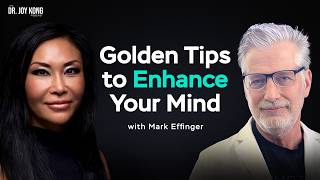
This is a podcast interview (Dr. Joy Kong) with Mark Effinger, CPO of Nootopia, about brain health and nootropic formulations. Effinger recounts his personal recovery from hypothyroidism that led him into nutrition and nootropics, describes physiological levers (hormones, neurotransmitters, BDNF, mitochondria, sleep, microbiome), and outlines multiple proprietary stacks and delivery formats (e.g., Nectar X drink mix, Ultimate Focus, Dopa/Dopa Drops, Upbeat, Brain Flow, Zamner/Xamner spray, Gobalicious, Sleep Breakthrough/Dream Optimizer, Collagenius/Mushroom Breakthrough). He frames nootropics as tools to optimize day-to-day cognitive performance, support recovery (including addiction contexts), and build lasting neural pathways when combined with sleep, exercise, and behavioral practices (breathing, power naps).
Chapters
We all suffer from the big monster called aging health decline that can come with aging. Our life mission is to make biological optimization available to everyone because we know that if you start before you get to the critical part where you're hospitalized, to get to a state of performance, you need to start listening to your body, and you need to start operating from a point of clarity, of understanding that if you don't, your life is going to be wrapped around just trying to exist.
Hello. Welcome Back to the Dr. Joy Kong podcast. Today our focus is on the brain health, and I have a superb expert with us, Mark Effinger. I said your name right, correct.
Effinger. But that's good. If we were in Germany, you would totally have rocked it.
Thank you, Mark. Okay, you were nicknamed Mr. Newts, so you can tell us a little bit later about how that came about. So Mark was a, I guess a prodigy. You built your radio at age 5, and then later on you built a helium neon laser from scratch when you turned 10. So you've loved science, chemistry, and physics. You're passionate about brain health and delve deep into brain enhancing supplements and created the most effective brain and mood enhancing formulas. And now you're the chief product officer for Nootopia and devoted to optimizing brains and minds around the world. So maybe tell us what got you passionate about the brain.
I got really sick in the early 90s with a thyroid condition, hypothyroidism. I did not know what it was. And I went from being formerly from being a pretty dedicated athlete to. To just being beat down and very depressed and super low energy. And then an ndmd, a naturopathic doctor and medical doctor at a bed and breakfast resurrected me. Did put me on EWAT exercise with oxygen therapy, kind of like a hyperbaric chamber, but you're working out at the same time. It did a first level detox of a drug I was on in the 80s called Accutane, which is a really powerful acne drug that has a lot of really powerful side effects. And. Yeah, and that was kind of the turning point. And then I realized after. And so I got on thyroid, like armor desiccated thyroid at the time. Six months later, I felt like a freaking rock star. I negotiated a VC deal that kind of made me feel like I was back. I was back. I was back. I was no longer a victim to my, you know, my weaknesses. And that was a turning point. And so I. I just started deeply looking into nutrition. And then a guy on a radio show I called into a radio show while I was dropping somebody off at an airport and he owned a little tiny vitamin company doing the first nootropic I had ever heard of, which was Huperzine. A Huperzine serrata is the plant and it's a, it's an acetylcholinesterase inhibitor. So the main neurochemical for thinking is called acetylcholine. Comes from choline. Choline acetylates into acetylcholine. This herb keeps acetylcholine flowing in your brain so it doesn't break down acetylcholinesterase enzymes that break down acetylcholine so that you don't have too much of it. It's a good thing you don't want a lot of it, but it also can break it down so fast if you don't have enough of a supply, then you suddenly go into brain farts and you can't think clearly. Or if you have an over load of choline, you'll be foggy headed and a little bit depressed, a little bit cold. So having a balance is really important. And this herb helps to achieve that balance and also to recirculate choline in the synapse. And so you get improved memory, you get longer term memory. You don't go through as many cycles since the brain is sucking up glucose or ketones, depending on how you're fueling your body at about 20% of your total caloric burn is in the brain. And so you're burning a lot of it. And so it's important to be able to understand how to modulate that burn, how to improve it and then how to preload the neurotransmitter precursors and the amino acids and the glucose sources or the ketone sources so that your brain can operate at full efficiency and do its work.
Yeah. So you took this herb and then what happened?
I actually, yeah, I drove the half hour to his little tiny shop. I took the herb. I was super impressed that anybody knew that there was this thing out there. I was in my late 20s and that there was this stuff out there. It was early 30s. There were these herbs out there that would make a fundamental difference or a profound improvement in your. Whether it's your cognitive performance or your health or your mood. And yet they were safe. They didn't cause what's called downregulation, they didn't get trapped in a synapse or they didn't build up an excess so that your body says, ah, I've got enough of that, I'm going To quit making it. A big problem for a lot of meds are that specific fact because to patent a med you've got to be very specific in what the patent outlines. You have to make the drug very specific to what it does outside of off label applications. And because of that and to be able to uphold its patent, it has to do something pretty measurably. Well, somewhat reasonably well. It doesn't have to be actually that great. And if you do that, the problem can be, especially if you're doing it, you know, with a foreign exogenous chemical is it can cause the body to reduce the output of very critical elements to your body and cause, and that's called downregulation when it quits producing those because it senses that you already have enough of it. This is something that happens when men start TRT testosterone replacement therapy. Same thing that happens with women is when you start unless you balance out the hormone levels well and you know what you're doing and you do blood measurements and saliva measurements on the regular, you what can happen. And by the way, I'm not opposed to either of those therapies. I think they can be incredibly helpful for both overall health, wellness, vitality, life extension. It's super critical. You have this. There are a number of ways to accomplish those things. Some ways are more problematic than others. Joe Rogan, who's a huge, you know, he's a huge fan of trt, can't get off TRT like he's now locked in, right? Unless he does some, unless there's a radical new therapy that he can take. There's a couple that are radical, but they don't, they, they aren't reliably effective. He's going to be stuck on TRT the rest of his life. Now that's not necessarily bad. He's got a few hundred million sitting around. So I don't think he's going to run out of resources to be able to get his trt. But there are. If you're not at that point or if you're early in that point or even if you've had a couple years on in TRT or on any kind of hormone replacement, there are ways to actually you can titrate down off of them and get the right precursors to testosterone and start boosting things up. And you can often find a place, a really good place that actually accomplishes both goals. Effective testosterone levels and less exogenous, more endogenous testosterone.
So you think this is related to the brain health.
If your hormone levels aren't running well, here's a fun test, here's a fun test to do. Go grab. There's a brand, we make a product called DHCA and dhea and these are hormone precursors that follow what's called the cholesterol hormone chain. Do you know that cholesterol hormone cascade right where you start with cholesterol, it becomes a form of pregnenolone and then it comes another form of pregnenolone and then it branches off into the male hormones and the female hormones, androgens and estrogen. And if you take a little bit of. So the, so the two key ones there to play with that are easy to access, that are legal and that are, that are, you can meter them really well are pregnenolone and dhea. So you feel, in foggy, you're feeling unmotivated, you're feeling maybe a little bit weak, maybe you're starting to fall off your performance curve at, you know, two or three o' clock in the afternoon, or you get that, that you know, post lunch, you know, lag, which has, is completely different than this. But if you're a male, you know, 150 to 200 pounds, try taking 25 milligrams of DHEA and try doing an equivalent amount of pregnenolone. Guarantee you will pop out of that low spot quickly and effectively. And for the next four to five hours you'll probably run at a. If you, especially if you're, if your hormones are low. I'm 62, so my hormones should be crashed. And yet they're at the same level as a 27 year old because I know what to take and when to take it and how to take it. So, and that makes a huge critical, it makes a major implication on cognitive horsepower.
So the DHEA and the DHEA and the DHEA are two different formulations?
Yeah, one, one we built for women, it has a, it has a higher pregnenolone level and a much, much smaller. It's almost a micro dose of dhea. And then it has a number of other, we've got like tricetyluridine and uridine monophosphate and a couple of other elements that basically help the cognitive part of the formula. And it's what we call a stack. Right. So anytime you take multiple elements that reinforce each other or potentiate each other, that's called a stack. And this stack we made specifically to help restore hormone levels to be able to give people a higher baseline, a higher operating baseline, so that instead of going from weak to normal you go from weak to post normal, like above normal, or to. There's a graph that we've created. Matt Gallant, who. I know you know, I think you've had him on the podcast recently, and. And I think. Do you know Wade yet?
Yes. Yeah, I was. He was on my podcast, and I was on his as well.
Yeah. So this is. It's really important to balance these pieces of the formula to be able to go from sick to superhuman is what we call it.
Are you saying if you take the DHEA or DHEA and chie, you probably have to do trt?
No, but. But they're really key. They're. They're key to a couple. A couple of things. And they're just a. They're. They're a sliver of what a protocol will be for replacing testosterone or estrogen or progesterone. So the way to do that, obviously, like, for progesterone. Right. Wild yam. We know that the extract's wild yam, very effective for that. And there's a number of different components of that that can help to buttress those and make that a more effective product for women. For men, same thing is there are. Matt and I have uncovered probably 150 different extracts or compounds that can improve testosterone levels.
Wow.
We've whittled that down to about a dozen that are effective. And out of that dozen, we found four to five that are absolutely critical to the development of testosterone in the male body, especially after the age of, say, 35 or 40. So Matt's 46 now. Maybe. I think he's 46, maybe 47. And Wade just turned 50. I think he's 51, going on 51 this year. And so those are ages where typically people are starting to look in their rearview mirror at their performance, going, yeah, I was really good back there. But with the right combinations of these elements taken at the right times and obviously augmented with things like weight training. I've got a whole gym here in my office because it's an important thing, you know, whether it's weight training or strength training or aerobic training, yoga, meditation, sleep, all of those are. Are the building blocks to building a better you and to helping you go from sick to superhuman. And you can't just isolate one of them and say, well, that's the one. That's everything. Everything is in testosterone. Everything is in progesterone. No, it's not. It's a really important.
Testosterone and estrogen both are crucial for our cognitive function.
Absolutely. You can't. Here's an insight People that are fighting or think that they're fighting high cholesterol, the brain is fricking cholesterol. Glial cells are cholesterol, you need cholesterol, and you don't create hormones without cholesterol. And this is not a preachy anti statin type of thing. But the moment you start statins are the moment that you're going to start witnessing cognitive decline. Statins can be very valuable in the right cases in a. A fragment of society that actually needs that to survive. But if you've gotten that, that's far past the kind of slightly unhealthy and need to look at the numbers and start to manage those. It's critical that you don't mess with the body's own endogenous or internal systems of production. And instead of fighting these things that might be ghosts, they're not real problems. They're just problems that we've created in order to medicate. Start looking at how do you improve the body's own ability to produce the right levels of the key neurotransmitters, the key hormones. Right. The key components that. The key digestive components. Really, really critical to allow us to get to what we consider the superhuman state, which is not just a hypey thing. When we say superhuman, what we mean is that there's usually a. We all suffer from the big monster called aging. And, you know, health decline that can come with aging. And so we can be, we're subjected. I shouldn't say we suffer. We can be subject to that. Our mission, our life mission is to make biological optimization available to everyone. Because we know that if you start before you get to the critical part where you're hospitalized, if you start working on, on these factors, on your hormone levels, like skin, a huge part, right. We have this organ, this massive organ in our body that we kind of treat as nayside. And we, you know, we use toxic chemicals on it on a regular basis, often not even thinking that the soap that we're using in the shower might not be the best. You know, we do sunscreens that are toxic. There's a bunch of these elements, and yet we're just absorbing those into our bloodstream and causing all kinds of problems. To get to a state of performance. You need to start listening to your body and you need to start operating from a point of clarity, of understanding that if you don't, your life is going to be wrapped around just trying to live, just trying to exist.
Yeah. So I'm super curious about all these incredible formulations that you've brought to the world. I mean out of all these different supplements and molecules, like, what have impressed you the most? What do you think give people the biggest bang for their buck as far as enhancing cognition and mental performance? Like, what has impressed you the most?
Not to be too self serving, you know, I've, I've spent it's gone on 15 years now developing nootropic stacks, which are, nootropic stacks are basically brain enhancing formulas and a stack being multiple compounds that interact with each other in a positive way. So kind of the first and foremost thing, the thing that, that really is fun and effective to work with, to start is called Nectar X. We call it Nectar Axe, probably rename that in the future but, but it's been a really effective. It's a powdered drink mix. Here's some right here.
Okay. Nectar X.
The Nectar X. And Nectar X is really powerful in the fact that it allows you. One is. So you, you come to our website and we don't just ship you a product. What we do is we get a little idea of what you're made of, your brain chemistry. We do a neurochemical analysis. You just click a button, it's free and it. But we ask you some questions that help to give us a better idea of your neurochemical makeup and your goals. And then we want to find out a few more things like maybe your eating habits and your workout habits and your drinking habits and you know, what your caffeine intake is and what you're sensitive to and what meds you're on and what vitamins you're already taking. And then from there we can go, ah, great, these are your goals. Here's where you're at right now. We think this would be the most appropriate for you to take in order to get kind of dip your toe in the water of cognitive enhancement. So what I like about Nectar X, it was by the way, the first product, the first nootropic product I developed was this. So this took. There were 3,000 prototypes made before this first product came out. Wow. So, and 1100 people in my beta test. But the cool part is that you can you mix it with, you know, 750 milliliters to a liter of water, 20 ounces on the low end, 16 ounces on the way low end. And you can just sip it and you can feel the cognitive lift and then you can regulate, self regulate. Instead of sipping every 15 minutes, you know, an ounce or whatever, Maybe you do 4 ounces as an attack dose where you Take a big dose to start and then you follow with a secondary sips and you can bring yourself up to a cognitive level and you can maintain that level all the way through the day.
So what's in it that's doing this?
Oh, I love it, I love it. So this one starts with we, we have a couple of kind of trademark compounds based on Celastrus paniculatus, which is a. Celastrus is. It's a really cool viney seed that is super valuable for getting oxygen into the bloodstream and for promoting a thing called neurogenesis. Neurogenesis is the creation of new brain cells. The brain, the stimulation of new brain cells. Thing called bdnf. Brain derived neutrophic factor is what that does. So this is a really powerful way to do that. You've got that, you've got, oh, we've got a bunch of stuff. Citrulline, malate, uridine monophosphate again, again a form of choline. It basically creates choline through a slow stream conversion event in the body. And that allows you to kind of your body to self regulate the amount of choline going into your system. So it's very smart way to do that. Phenylalanine, arginine, akg, D, ribose, rhodiola, acetyl L, tyrosine, acetylcarnitine. Really, really important for mitochondrial health is acetyl L carnitine helps to improve the, the basically the, the throughput of your mitochondria. So getting the, the precursors into the mitochondria, turning them into carbon dioxide, getting them out of the mitochondria so that you're get basically bringing your energy level up, but you're bringing it up from a mitochondrial level, from an ATP mitochondrial level, not from adenosine abatement via caffeine that you're gonna suffer from later. It's gonna, you know, jack your heart rate up, it's gonna give you some vasoconstriction. So yeah, and there's, there's just a ton, there's I think 27 different ingredients in this pretty important formula. The ratios were super critical as we were putting it together again. That's why 3,000 prototypes it was getting it to the point where it would be cognibly powerful, do no harm and have a residual effect where over time you're increasing your cognitive resolution so that tomorrow your baseline is higher already the moment you wake up so that if you do it again you get a higher baseline, you can keep doing that.
So you just get smarter and smarter.
So there's an illusion that, I mean, all the, you know, the great. Like whether it's the movie Limitless or Lucy or any of these great movies about cognitive performance is, you know, they say, well, we only use 10% of your brain. It's not true. True. You were used 100% of your brain. You just use different parts at different times for different things. And there's a thing that you do on a hard drive where your hard drive, you start scattering data around your hard drive as you use it, because it pulls memory into RAM and then sends it back out to your hard drive on a computer over time, that hard drive has bits and pieces of the same program all over the hard drive. And to pick it up, the hard drive head has to go look for it. And it's got to go find it and assemble it and then put it back into ram. There's a thing called garbage collection also in that, that we can talk about someday. But over time, the same thing happens in the brain. You got bits and pieces of memories located in different places that were. Happen to be active during those events. And there, there are clusters of areas where certain kind of memory and activity happen. What happens over time is the connections between those components of memory grow weaker unless you reinforce them. You recall the memory or you have an event similar, and it suddenly strikes a little bit of adrenaline and norepinephrine that excit, excitatory effect creates a glutamate release. Glutamate is one of the more powerful neurochemicals in the brain, and it instantaneously reinforces all those networks again and activates them so that you can do the recall. You know, that's why under pressure, certain people fail and certain people just completely activate. And in fact, if you go to a 911, a 911 center or similar, you'll often find that the people that are the best responders to that are adhd. Because once under pressure, that ADHD mind suddenly goes, I know how to focus. It's the 11th hour. I know how to make this happen.
Oh my God. Now I understand why I'm such a crammer, why I always outperform myself. Every time I take an exam, I was like, I don't think I knew that much. But on the exam I seem to know more.
Exactly. I was, yeah, a complete failure up until test, test time. Thank God. Yeah, it was my, my saving grace.
That's really interesting about the adhd. So the ADHD brain does it Tend to be more scattered.
Yeah, well, what it is is it's more. The, the glutamate activity and some of the other co factors are creating more of a lateral thinking alignment. So one is it's easy to be distracted. I'm the poster child for adhd. I can talk to this at length. The other is that it's always looking for a creative thing. It's always looking for the edges of an object. It's when it's. I was listening to a podcast the other day, Smartless Podcast, with Jason Bateman and his buddies. One of the guys in the podcast constantly asks the most obscure questions that are coming out of nowhere, like, what kind of toast do you really like? Or, you know, you change the diaper on your baby from front to back or back to front, which you know, and it's just this obscure and it's classic ADHD behavior, which, you know, that I can laugh at and love. I can, you know, I can embrace it because, you know, I've been subject to some pretty brutal punishment as a result of it. But a couple things. One is, oh, go back to the brain is we all have the capacity for tremendous cognitive outcomes. Like we have the capacity for that. But it does take. The first thing you have to do is really, really embrace curiosity and what I call give a shittiness. Like you have to care about something in order to be able to embrace it. And then the other is the question asking thing is your brain doesn't embed memories until you ask the question. It can be as simple as, I wonder how that happened to. All right, it's a past event. I wonder how that happened. Think through the event. Or it can be the I'm asking a question class and I, you know, when you ask the question, the way the synapses open up, they're looking for the answer. They're hungry for the answer. So that's a great way to kind of like utilize more brain is ask more questions. I used to work with a founder of Century 21. I've got a software up here somewhere. We created a software called Idea Fisher. And what the software did was it asked you a series of questions in a four level hierarchy, like a four level outline. 16,000 different questions, but it only asks you bits, tens to maybe 100 in any specific category. And then it did this lateral thinking stuff that helped you to think outside on the edges of things. Like, you would be trying to write something interesting about aging and it would say, there was a movie called Mr. Nobody with this actor who Said this thing at this time, and he was 120 years old. And so he would help you to find these relevant pieces of history, to help you compile thoughts. So we couldn't get there without finding. We met with a half dozen really, really super bright neuroscientists and said, how does the brain think, recall? How does it store memory? How does it come up with a fresher idea? And we found that it was asking questions, asking a series of questions that drill down into the problem or the opportunity or the interesting thing. By doing that, our brain starts to open up. But now that we've opened our brain up, how do we augment that to make it powerfully embed those memories or to take those memories or take those ideas and kind of disassemble them into the thought particles that make them up so you can continue to expand those networks like a brain map, a mind map. If you've ever seen a mind map, like a mind map that just keeps going, a fractal that keeps going. And the way to do that is to be able to give your brain the correct neurochemical precursors that will then convert to the neurochemicals at the right rate for your brain to be able to optimally intake and augment those thought processes. So we talked about, about this, about Nectar X, which is a great way. It's a drinkable, it's easy to take, tastes delicious, and it's a fun way to kind of dip your toe into the cognitive horsepower landscape. But then we get into what about specific things. Let's say you already kind of know you've got a problem. Let's say that ADHD is an issue and you're going into a situation where you need what we call deep work. You need to be able to focus for four to six or eight hours. And you need to be like on an Adderall drive without the Adderall side effects. And so we built a solution for that. It's a stack. It's called seeing it. Ultimate Focus.
Ultimate focus. Okay.
And what Ultimate Focus does is first it has a very powerful bunch of, again, neurochemical precursors with a big focus on dopamine, acetylcholine, and this norepinephrine or this kind of adrenaline type of thing. But it does it in such a smooth way that, that it doesn't cause adrenal fatigue or adrenal burnout or adrenal. It doesn't jack your adrenals, which can happen if you over caffeinate or if you do something like methylphenidate, which is Adderall. Doing too much of that. I was listening to John Mulaney the other day, the comedian John Mulaney talk about how much methylphenidate or Adderall he would take just to make it through a day at. When he was on snl, Saturday Night Live, writing for Saturday Night Live, he'd be doing like a dozen a day.
Oh, my goodness.
Until finally somebody pulled them aside, the family pulled him aside and did an intervention. So that's a really great one for Focus.
Are there a lot of ADHD kits taking this?
One of the things is one, it's non invasive, so it's not going to. It's not going to create a situation that is going to become addictive. You can take it or not take it. If you take it two or three days a week, because they have a very long tail of effect, you can get the results for seven days, right? So you don't have to take it every day. One of the things, when I tried Adderall, for me, it was very effective for short term. But my employees said they would come into my office, I would bark at them and they would say, excuse my language, but they'd say, you're on that asshole drug again, aren't you? And it was true. And it's the way it made me feel. And then I met enough people that wanted to get off of it because they felt so disempowered when they weren't on it. When they woke up in the morning, they just felt like nothing until they took their Adderall. And again, I'm not harping on the medical industry. I'm just saying that there are alternatives that can reinforce the brain and help the brain become better and better at what you need.
Well, how does it compare?
It's non or very low stim. So it doesn't cause that, that kind of Adderall thing. But what it does do is the way that it articulates the, the neurochemicals is it does create that dopaminergic focus. Here's the difference. This is great. So Adderall creates a dopamine flow, right? This dopamine flow through this meth type of high. So you're getting this meth type of high. It's forcing this, this dopaminergic activity and acetylcholine through the synapse and then it's trapping it on the other side and recirculating it. So you're basically recirculating in that, in that synapse does that through a thing called a calcium ion cloud, which is a part of the whole process. And then after the 8 or 10 or 12 hours, however long it lasts for you, depending on your own biochemistry or neurochemistry, then it fades. And what happens is you get a bit of a calcification of the neuron pumps. They're not pumping as efficiently, so you might need a little bit more tomorrow to make it to have the same effect. The other is it really hammers your adrenals, um, because it's, you know, it's doing this. It's this upper. It's a very. It's the equivalent of taking, like, cups and cups of caffeine. And so it's causing this, you know, this release of adrenaline that is also hyping you up and making you a little bit can be scary, depending on how much you're. How sensitive you are to that, and it causes this dependency. Whenever you're recirculating like that, think of it as SSRIs in. If you're taking an SSRI for depression, you're. You're recirculating selective serotonin reuptake inhibitor. So it inhibits the reuptake of serotonin, so it just recirculates it. So then when it finally fades, you get this last kind of flow of serotonin, and it's over. But what it's done is it's signaled to your body to quit your brain, to quit making serotonin. About 90%, 95% of serotonin is made in the gut. Then you get the vagal nerve connection, and you have a serotonin made in the brain, 5% or 7%. And it kind of bypasses that and says, no, while we're on this drug, we've got enough serotonin, so we don't need to make as much. Hence the reason that when you're not on it, you might go through a depression path. You know, you might have a path to a light depression. So you take some more and you recover that and can be very valuable for people that have really, really unique neurology. But some of the other ways that you can augment that or you can do it outside of it is to take a component. Like we have one called upbeat that I really like.
Oh, I like that one.
Yeah. And upbeat is great in that it's dopa drops. Yeah. So upbeat. So is that right there, upbeat. And it's great. And it's really good for, like, podcasts because your verbal fluency is Improved. And you're, you know, you're excited to see the host, the guest and, and have the conversation going and those things. It's great. And it's really a super effective way for people to kind of, you know, I'm, I can't say that it is a antidepressant. I can say that it does help shift your state, your operating state towards the more positive or the more optimistic. And that's really what we're doing with these nootropics is we're optimizing your mental state to do the things that you want to do, when you want to do them, for as long as you need to do them, and then in that process creating better and stronger neural pathways to be able to achieve that state easier with less input, which is remarkable.
Just for, just to be able to do that, to make a statement saying that we can help shift your mental state to be more positive, increase your verbal fluency. I mean, you know, to do, to be less pessimistic. Just to be able to do something like that by putting something in your body, I mean, that's remarkable.
Everybody has their own unique neurochemical makeup. No two are alike. And so even as they've done, you know, twin studies and they're the most similar and yet they are still dramatically different. You can have a twin who is deeply depressed and one who's super optimistic.
Identical twins.
Identical twins, yeah. There are event based neurological dysfunction or issues and those can be a contributing factor. Trauma, those kinds of things.
Right. But also microbiome, right?
Microbiome's huge, Huge on this. Yeah, it's, it's the baby. There's also things like, like this product called Dopa Drops. I don't know if you've had a chance to try it yet.
I did, yeah.
I developed this initially to reduce the refractory period in men during orgasm. That's what it was originally developed for. To be able to essentially perform longer, better, have a, have a stronger orgasm and then to recover from the orgasm faster because an orgasm has such a release of dopamine. And then you're suddenly, you're falling off your performance curve. So this was made to handle that. But what happened was as we started giving this out to our prototype clients, they started loving it because they could basically, instead of having something like Adderall that's forcing this dopaminergic activity through this adrenergic system, right. You know, the adrenal adrenaline and this flow from this, you know, methylphenidate. What this did was it Said, hey, we've got all the precursors to dopamine, we've got a 22% L dopa, we've got a 98% L dopa, we've Got acetyltyrosine, we've got. And we've got these stacked with the right kinds of B vitamins at the right levels, phenylalanine. And every one of those has a pathway to the dopamine in the brain, but they do it at different levels at different times. So what it created was a multi stage dopamine release mechanism using precursors, which is the right way to do it so that your body didn't say, oh, I'm fine, I got enough dopamine. You know, when you take it, it doesn't say, oh, I've got enough dopamine, I'm not gonna create any. It says, hey, I've got all the raw product to create dopamine now. I can create as much as I need without running out. And so you can go do high dopaminergic activities, whether that's base jumping or bass playing in front of a, you know, in with Pearl Jam over a weekend. Whatever your dope manergic hit is, it could be, you know, on your phone, right, getting likes on Facebook or on Instagram or TikTok. Whatever your dopaminergic high is, you now have a surplus of it available to you that your body can use so you don't deplete dopamine and become depressed or some other factor. Some of our first customers for this were using it after raves. They would go to rave events, they would, they would do all, all kinds of crazy stuff like Molly or, you know, ecstasy or those. And then they would take this as a way to quickly recover so that they, yeah, they wouldn't run out.
So they take it the same night and they go to sleep and is that how you. They do it or they take it next morning?
These are people that are taking, they're starting to party at, at 9 in the evening or 10 in the evening and at 6am or 8am they're finally quit dancing. And, and they would take it then or they would take it halfway or some would take it before as a way to increase their dopamine availability during those. So yeah, really, really great.
So sounds like the dopa drop is great for ADHD as well.
Yes, yes. It's also kind of a, it has an inbuilt mechanism for optimism towards optimism. So it does help you focus a bit. Not as much as, as Our ultimate focus, but kind of a byproduct of the, of the dopamine availability.
I see.
It helps you feel better about what's going on in your life. So it kind of has this, I'm not, I can't say antidepressant thing, but it has kind of a. It has a feel good vibe to it. It also helps you to memorize, to have good memories to memorize things. Because dopamine is one of the key neurotransmitters towards memorization or memory. Right. Acetylcholine and dopamine are paired up in that and they work really well. And then of course, if you can augment it with either one of two things, a micro nap, rest, close your eyes, think about what you just studied. Right. That's a huge recall mechanism that works really great. You can do it for 5 seconds, 10 seconds, 15 seconds. Works great. Or shock yourself or alert yourself. Like kind of the teacher doing the, you know, the professor stomping the foot and saying, this is a test question. Right. That's a fairly typical. Back in the 70s and 80s, that was a technique, you know, stomp, stomp. Oh, okay. That's a test question. Pay attention. There's people who put a rubber band on their wrist and they'll snap the rubber band. There's a device that I'm trying to remember who uses it, but there's a device that gives you a micro shock when you do something. Neil Brennan, the comedian Neil Brennan, used it as a way to quit frowning on stage. It would remind him to smile more and it would just give him a tiny, tiny electric shock. It's actually a device, it's a medical device.
Wow.
So those are some of the stuff. But ultimately what you want to do is you want to say, here's my schedule for the day, here's what I've got to do. Here are the activities. I've got to meet with my team at 8am for 45 minutes. Right. Get everybody on the same page. We have the same page meeting. Then you might have a 10:30 meeting with a critical client to try to figure out what you're doing or a project you're working on. Then you're going to have lunch, might be a lunch meeting, post lunch. You might have a. You're going to do some deep work for three hours, four hours, try to get some stuff done. And then the next couple of hours, as you kind of wind down towards evening, you might have a creative part of your business that you totally dig, that you really want to Engage in. And you want to have the natural energy, the ATP derived energy in your system to be able to execute on that. And you also want to have the engagement qualities. You want to be happy or optimistic or enthusiastic or driven or passionate. And you want to be able to have that sustainable long enough that you can kind of execute on that piece of the deal. A lot of people that are kind of creating their ultimate dream deal by compressing their day and making it super effective at work so they can get off and do their avocation that they want to become their vocation, whether it's people that want to podcast or they get some creative pursuit or they got a side gig going on, um, they want to get out of the nine to five or whatever. Being able to have your, being able to optimize your neurochemistry so that you can perform just as well at 6, 7, 8, 9 o' clock at night as you did at 8am that's key. And doing it so that it doesn't disrupt your sleep. I mean we do, we're pretty good at, we make a couple of sleep formulas, Sleep Breakthrough and Dream Optimizer. And we now have a capsule coming out of Sleep Breakthrough that's phenomenal. You want to be able to nourish your brain, get BDNF going and also get a lot of the CO factors that come from mushrooms, which is what this is. So Collagenius is a really deep mushroom formula that we all know. We have another version of it now through bioptimizers called Mushroom Breakthrough. And every dose of this, 18 grams of this is 1.2 pounds of mushrooms.
Wow.
So yeah, medicinal mushrooms are, it's fantastic. So it's being able to know what your brain needs at what time you need it to do the thing that you need to do. That's the ultimate when you can manage your day and augment your neurology and performance by just optimizing these events.
So give us an example of that person you just talked about the whole day needing to perform. What would you recommend the regimen? Like what does the person start?
Well, it depends on who they are. Like, you know, there's, there's some people that are fast starters, some people don't sleep. They, their sleep sucks. They don't get to bed until 1, 2 in the morning. When I was doing a lot of software development and web web development, I was up till 2, 3 o' clock in the morning. And so then your, your day is kind of wrecked because what happens at night, this is very important by the way what happens at night is your brain does a lot of housekeeping where memory storage is kind of relegated. That's where REM sleep comes in. And then deep sleep. You get physical recovery if you don't get good sleep. Well, my shorthand for this is sleep is the world's most powerful stimulant. If you get good sleep, you can be a rock star. The next day your mood will be lifted because your hormones are at much higher levels than if you don't sleep. Your neurochemicals, your balance in neurochemicals is going to be much higher as well. Your ability to take on a lot more tasks, your perseverance through things is much higher. You know, I've got a Fitbit and I've got an Oura ring to be able to measure some of my stuff. I'm looking at some other devices as well. And then I use this thing called the Mendy is this is. I use this a couple times a day. Just turn it on, put on the app five minutes. And it helps to articulate the prefrontal cortex blood flow and take the nootropics that I'm taking and put them to work. So it's, it's a great tool to do that. So that's kind of the gist of, of what we do.
Let's say somebody slept pretty well and then has a, you know, full day ahead of them. All these meetings needing to, you know, maybe do a presentation. What would you recommend that they go with the ultimate focus? Should they do upbeat? Like what was.
If you're going to be social, I would recommend like an upbeat and a brain flow. That's my pairing that I like to use before conversational tasks. Yes.
Together. Okay.
Yeah, yeah, they're great. They're great. Here's brain flow. It's a unique design. It's a capsule within a capsule.
Oh.
So it's an oil, we call an oil suspension cap.
Very cool.
And the oils are incredibly effective. That's one of the salacious paniculatus and some ginger oil and some pepper oil. And it basically dissolves in your stomach, it gets into your bloodstream and then the inner capsule dissolves past the duodenum into your upper intestine and then it starts to meet up with that oil. It bonds to the oil, goes through the blood brain barrier, goes into the brain, separates into the key neurochemicals that it wants to help as well as increasing the blood oxygen. And you get this wonderful long term effect. Very subtle but very effective. And so you take that which is gonna give you a good long term supply of acetylcholine and a little bit of gaba, some other CO factors and some B vitamins and things. You combine that with something like whether it's a nectar X like I'm taking here, or if you need to chill a little bit, if you're too on your game, you're too hyped up, maybe a gobalicious would be the way to go. You might take this. So if you're too excited or too excitatory or too nervous, you might do that.
That's the chemist in his lab.
Yeah, exactly.
And I love how you're drinking out of a flask. I love that. It looks so cool. Purple drink. In the flask we have a thing.
Called Zamner juice and it's a, it's really cool. It's a sublingual spray that increases GABA levels in your system almost instantaneously, usually within about three minutes. And GABA is the neurotransmitter of calm and really good healthy decision making. When your GABA levels are right or good, you don't feel tired. You just feel like you can take on a lot because you're chill, you're not as stressed. Your cortisol isn't like trying to drag you down or you know, make you feel like you're right on the edge. So you take something like, you know, you. Depending on what your mood is that morning, you might take a gobalicious. You might take, you might take a couple hits of Xamner to get started because it'll raise your, it'll raise your cognitive clarity without causing any kind of an energy burst. I made it. For people that are stuck on the 405. If you don't get, if you can't get in the diamond lane and you're stuck at 3:30 on the 405. Few shots of Xander and it'll chill you out and you can just groove. But then you want to take the things necessary. You want to like you have something really highly cognitive you need to deal with and you have to deal with people. You're going to take an upbeat and you're going to sip on nectar Axe because those are gonna give you this really nice combination of serotonin. So you're gonna be friendly and kind and nice to people and your verbal fluency is gonna be high and you're gonna take the nectar X which is gonna increase further increase your inherent energy, your ability to focus without being a jerk and your ability to kind of follow through and see the second, third and fourth order consequences of your ideas as you're brainstorming with that individual, as you're coming up with solutions, you can kind of see these future permutations of those decisions clearly and easily. You don't have to struggle with it.
So why do you have Gabalicious and Zamner spray? I mean, I know one is something you can sip, the other one is a spray. Do they achieve very similar things?
They do. Gobalicious feels more like having a sip of a martini or a whiskey, but without the alcohol. So you get that kind of lightly euphoric but not like out of control at all. Not highly functional, but it just relaxes you from a. It does a state change of relaxing you and putting you into a nice.
How long does that last?
As long as you're drinking it and about another two to three hours. So yeah, and it's again, you can, you can pour it in anywhere from 16 ounces to a liter of water, depending on how much dilution you want.
For like an alcoholic drink, kind of.
Yeah, yeah, that was. And it was developed for that. It was developed for. As an alternative to alcohol and for people that needed to hydrate while also having really good cognitive performance without having stress and anxiety. So this was developed literally or the Zamner juice was developed specifically for a woman who owned a bunch of medical clinics in the Pacific Northwest who was stuck in traffic one day she called me in a panic and said, I'm about to rip a trucker out of his cab, get in this 18 wheeler and mow over all the cars in front of me. She goes, so help me, help me. Yeah, great lady. And yep. And she called and so we made it for. And it worked great.
All the truckers.
Yeah, the mother truckers. The mother truckers. So the, the ultimate scenario for people is to be able to kind of sample these pieces. When you come through our site, we're going to take a neurochemical test. We're going to recommend certain things based on your neurochemical profile and what you're aiming for and then try those and eventually you can utilize them to manage every part of your day. But here's the really important thing, Joy. I'm anti dependency. I got into this because my former wife committed suicide on oxycontin and I got three kids and it just broke my heart and it shattered a lot of dreams that we had had as family. So it was very hard on the kids. Caused a lot of trauma as well in their lives. And I couldn't figure out why addicts were addicts. And so the first thing was, how do I help people who are in addiction to be able to get out of it in a effective way? I went to a rehab clinic in Astoria, Oregon, and spent some time with the staff there and found out that after interviewing a bunch of people coming in on Friday nights, just completely based it out of their minds and asking them questions, and then looking at the protocol that the facility was going to give them, they were going to take 22, 23, 24, 25 different meds over a period of 6 to 12 weeks to be able to go through a full detox campaign based on what they were on. And it may be much less than that, it may be more than that, it may last a lot longer. They may have to be in there for six months, a year. And it just didn't make sense. So I started working with them. And my whole thing was the reason, you know, after asking thousands of questions of these people was why are you in here? Well, addiction, right? Okay, so the reason you're in here is poor decision making. Like, you made a decision, that decision led to a poor outcome. You didn't think the decision all the way through to the end. You didn't look at this, you know, the second, third and fourth, you know, repercussions. And so that was part one. So if I could give something to people that would, one, help their brain kind of get out of the fog that they're in, that's caused by the drugs that would be pretty powerful. That'd be a great first step, get them out of the fog. The second was if I could get them clarity, then they could start making good decisions. So clear up the fog, give some clarity, they can start making good decisions. And then the third thing I found was that many of them, depending on what drug they were on, the drug of choice felt like a couch potato. Either from the meds that they were on, like they would take these meds to get them off the drug. Some of them are just a stand in. Like methadone is a stand in for, you know, it's a replacement for heroin. And some of them made them feel just crappy and they just would be. They didn't have any drive or desire left in them. So the other one was, how do you create intrinsic energy in the individual and motivation so they can execute on the better decision making? Being able to make a great decision and not being able to execute on it is awful. It's better than just Making crappy decisions and being addicted all the time and coming in on a paddy wagon on Friday night. But if you can't execute on those, it kind of is, is a very frustrating thing. So the second part of that was how can I create really effective mitochondrial output so that people can execute on these decisions? And what happens is really, really profound thing is you start making good decisions, you execute on those decisions, you get a positive result, a success in some way, measurable way of success that feeds into the making better decisions. Because now the better decision give you a much better outcome than the poor decision. So you want to stay, whether it's sober or you want to just augment your system to be on the right stuff that's going to give you the right outcomes. And that success leads to the kind of, this upward spiral. And that was the most powerful thing I witnessed in working with these people, was those positive outcomes that suddenly got them into a whole new level of performance. And suddenly they're getting their jobs back, they're getting their lives back, they're, they're starting to become, you know, really, really productive members of society. Some of them go on to become very successful people. Some of my first customers were hyper successful people, well known in industry, well known in Silicon Valley, who were taking our stuff because they knew they were that close from not being at the top of their game. And they could not afford to be off, they couldn't afford to skip a beat because they're running potentially multi billion dollar companies. And if they didn't have that edge, they felt that it would be one, it would be a really negative for their company overall. But it reflected on them and they had to be on it 24, 7. But a cocaine high from the 70s wasn't going to do it and their 6 cup of Starbucks wasn't going to do it. So somewhere in between had to be a natural solution that was gonna be really healthy, that was gonna optimize her brain health and maybe have a secondary or tertiary positive outcome that was being able to change her physiology and neurology to call it up on demand. So one of the cool things that can happen over time using nootropics is you can just go into that state of mind, so you can just think that state of mind and you're there because your neural pathways have been so grooved in to be able to go there because you've been doing this bdnf, you know, brain derived neutrophic factor as a byproduct of either collagenius or our Nootropics. So now you've built these new neural pathways, and you've reinforced those neural pathways by the activity that those solutions support. Now you can go there on demand. Flip the switch. I'm focused. Flip the switch. I'm creative.
So you're saying you don't have to necessarily do it forever. You can do it for some time and build up your neural network and enhance your connections, and then you're at a whole different state.
Yes. And it's exactly what you want, right? You want. You know, there's a lot of. I think we all know who Brian Johnson is. I think he's. He's, you know, Venice beach, not far. And he's the $2 million, you know, biohacker man that's trying to extend his life, you know, forever. And he's a freak of nature. I mean, he's an incredible person. I have a huge admiration for him. But he's doing something that is at the very, very top. I mean, 0.001% of humans can even be disciplined enough to follow his protocol and have the resources to, like, if you had to work and do his protocol, I don't know how that works out. How do you live that life? And I'm sure that he's figured ways to do it, but it's pretty strict for you and I. We're working pretty extensive days and weekends. It doesn't stop for us because one, we love what we do, and the other is, you know, we see the change we're making and that. That impact, and it's kind of hard not to fall in love with that. We need to be able to create an environment where we can reach the optimum state, that superhuman state on demand, as needed, without having to induce, having any exogenous input. And it takes time to build those pathways. It takes time to get into that state. Takes time to realize how to do it. Like, to get into, like to close my eyes. There's a thing I can do. I used to play competitive junior tennis. The minute my hand wraps around a tennis racket, my body, my physiology, my balance and everything goes into this operating state of competitive tennis player. I know exactly how to hit the ball. I know it's. And it's this. This interesting thing. When I get in a room with people and there's a whiteboard, my body and mind instinctively know how to illustrate the problems that we're having and how to turn them into a solution and how to use that as a tool to brainstorm. When I sit down with an Instrument. I kind of instinctively know this is kind of where I want to go with it today. And then kind of I just pull, you know, explore the notes coming out of the guitar or the bass or drums or whatever. And so everybody wants to get into that state. They just don't know what tools to use. We've created a whole suite of tools that articulate very different parts of your neurology, but individually and combined can help you create the optimum outcome and go from, we call it sick to superhuman. But somewhere in that spectrum of being not at my optimum, to being optimum, to being super optimal to being superhuman and being able to dial that up and down as needed and wanted, and then to be able to dial it up and down in the different areas, like dial it up and down in focus, dial it up and down in cognitive performance and lateral thinking and creativity, right in expression and love, all of these things. You should be able to kind of dial up and down on demand. I don't mean robotically. I mean being able to go there, to be able to fulfill the mission of being a human being at a very human level. And a lot of us from. From life experiences, we talk about trauma, from our cognitive decline, from aging or other aspects, from toxicity, from our water and our food and other things, from just poor habits, from trying to, you know, trying to decompress with, you know, a couple martinis. You know, those add up over time, and suddenly we're. We're fighting cognitive decline. All of those are factors that we have a goal of overcoming and helping people not just get back to normal, but get to the next level. And that takes exploration, it takes practice, it takes commitment to your own physiology, neurology, and health. But if you've ever dealt with somebody that is not mentally healthy or not on their cognitive game, it's very apparent that it's important for us to take care of that. My mother died a couple years ago from. She had dementia, Alzheimer's, dementia, and to the point where it didn't recognize you walk into a room, she didn't recognize you. You had to spend a lot of time with her. And then eventually her recall would get to the point of, oh, that's right, you're my son. And it's just the most harrowing thing to see somebody you love so much not be able to kind of have that expression. Once you've had that experience, you really, really will take pains to make sure that you don't go there. And that's what we try to do. We try to Give people the tools that help them to not have to go there.
So if people have gone to a state that they got a diagnosis of dementia or Parkinson's, things like that, I know you can't make any claims, but has anybody used your product after they got diagnosed and noticed anything, or is that too late?
It's pretty late, but we've had a lot of really wonderful feedback from clients who have shared the difference that we've made in their loved ones. One of our first customers, one of these very well known executives in Silicon Valley, he used our product originally, what is now Nectar Axe, to help his brother get off meth. And so that was like an addiction problem. We had a guy who had lupus living in Florida. And again, this is not a testimony of us, you know, acting like a drug. But. But he. He called one Friday night. I was just about to quit doing the business. I was. I was about to quit. It was so hard, so difficult to make, you know, personalized nootropics for people. And he called. I. I hit the space bar on my. On my computer. I had Google voice on. And he was crying. And I thought, oh, crap, I hurt somebody. You know, like this last thing you want, right? And I said, are you okay? And he goes, mark. He goes, I'm more than okay. He goes, I've been bedbound for three years. I've been on your stuff for six weeks, and I'm no longer bedbound. They gave me my license back, my driver's license back. He goes, I'm kind of a country song played backwards, you know, I didn't. Instead, I got the girl back, I got my dog back, I got my job back. And he goes, like, I have to give you and your team a lot of credit for what you've done for me. And that was a point where my daughter and I. My daughter Livy was my only employee at the time, and where we looked at each other and said, I think we got to do this. We got to keep doing this. So we've had a number of those, quite a large number of people who have been going down the cognitive decline road and have seen a marked change in their performance. When you're at that point, there's, you know, one of the most critical things you can do is start getting really, really healthy sleep. I mean, the reason that we created Sleep Breakthrough and Dream Optimizer to the other side of it were solutions to help increase REM and NREM sleep so that you could get that hour and a half to two hours of really Quality sleep recovery so that your brain would detox itself at night. When you go to sleep, your brain shrinks. It opens up pathways around your capillaries for cerebral spinal fluid to come in and clean out all the toxicity that comes as a result of just natural processes that happen in the brain. And it cleans out the detritus, it puts it through the blood brain barrier, through the brain stem, out the body. And now you've basically done a detoxification cycle in the brain. Well, as sleep, as we as poor sleep starts to build up, those toxins start to build up. And if you don't have a solution to detox, that becomes problematic over time. That's when the, you know, tau proteins and beta amyloids start building up and you can start having some really negative effects. Our products don't, you know, we can't claim to remove tau and beta amyloid protein. We can say is that we can help improve. Especially for people that have a cognitive glitch or are starting to see reduced cognitive performance or memory or whether it's long term or short term. The components in our products are researched and have shown to help. If you go to NCBI or PubMed and take a look at the docs on those, they've been critical in helping to reverse the effects of cognitive decline and those things. So I can't say that our products do that, but it just so happens that the components that make up our products absolutely have some backing on that.
Yeah. Have you guys worked with rehab centers, you know, drug and alcohol rehab centers?
Not since I. So my company was acquired by Bioptimizers a few years ago and we formed a new company called Neutopia. Prior to that, I'd done work with one detox center and rehab center and, and that was, you know, again, profoundly powerful for me. I also had, there's a close family member of mine who was a heroin addict for decades. And so seeing her, you know, that life and then, and then seeing having this experience was really, really eye opening. What we do know is that there's a number of people that use our products religiously and critically. And again, a lot of high performers, like we see super performers going. These are people that say whatever it takes to keep me on this level where I can hyper perform, I'll do it. So we find a lot of those and then we find a lot of people who have noticed that they're not at their optimum and they want to be cognitively. And so they're the other side of the coin of our process. Occasionally we get people that are very far down that this kind of like last ditch effort, I don't know how much you can do for that. I still think it's worthwhile. I think that, I mean, just like, you know, Rhonda Patrick the other day was saying, hey, guess What? You do 10 air squats every hour and it's the equivalent of running, you know, doing a five mile run. In fact, it's, it's shown to be better cognitively for, than even a five mile run on the performance. So there are little hacks like that, little things you can do that are super important to, to cognitive performance. Exercise is absolutely at the top of the list. Especially, you know, some form of exercise that gets your heart beating hard and gets your breathing hard. I'm not necessarily saying aerobic exercise, although it is pretty critical. I do. We have a, we have. The curviest road in America is right up the street here, and I sprint that curvy road. So I'll do that. It's about 30, 30 seconds to the top of it and take a minute break and then do it again. But it's those kinds of events that make a profound difference on your cognitive performance. If you combine that kind of movement, that kind of exercise with cognitive enhancement solutions, it amplifies that effect. And that's where you really start to get the leverage. Like don't make the meds or the, or the supplements. Do the heavy lifting. Do the heavy lifting and use those to radically amplify the heavy lifting. So go do the thing that, you know, is you should be doing like, get off the couch, go do some exercise. It can be short bouts. It can, you know, like Ronnie Packer saying, you know, do 10, you know, air squats every hour. Ben Greenfield every time. Ben. Ben drinks a lot of fluids a day, right. A lot of electrolytes. So he does 40 air squats every time he goes to the bathroom.
Wow.
Right? So, and if you've ever done air squats as a way to kind of like find your, your optimum volume and you hit, you hit somewhere between 30 and 40, you start feeling it. There's a burn coming on, you know, because oxygen displacement and some of the other, you know, activities going on in the, in the muscle lactate buildup, the rest, and so those kind of activities. But, but it does make a profound difference on your outcome. Combine that, combine those activities with nootropics and you dramatically amplify the results of the nootropics and you gain benefit on the athletic side. As well, we have, in Venice Beach, Santa Monica, we have a world renowned triathlete, Justin Peters. He's fantastic. And he uses our stuff throughout his races as a way to keep himself cognitively on because he knows the game is mental at that level of performance. At world class level of performance, the game is mental, right? It's, you know, yeah, there's some physical things. You gotta be in shape, but you're fighting, when you hit the wall on a marathon, you're fighting a mental issue. Your body is physically telling you, come on man, you can't go any further. You don't need to go any further. This is stupid.
Wow. Oh, such amazing tools to bring to the world, I'm sure. I mean, so many people are struggling with just, you know, their brain cannot keep up with what they need in life. Either is just creative or cognitive performance or just feeling good enough to take on life. So having these available to be able to enhance and boost your existence, I mean, that is such a gift. So thank you, Mark. Thank you for your passion and for your creativity. It's just fantastic. It's so fun to talk to you. So if just one last thing, if you have one suggestion to make to give to people so they can enhance their brain health, what is one thing that you would, you would tell them to do?
So I'm going to do two things. One is learn how to learn how to breathe. So do learn how to do deep breaths and breathing exercises. I'm not saying go Wim Hof on this, but I am saying, but I am saying learn how to breathe deep. And there's a, there's a breathing technique I learned. When I was eight years old, I met a Zen master who taught me how to do tm. And one of the things he taught me was really, really valuable, which was take a deep breath in, all the way to the top and count your heartbeats in your head. And then hold that until you feel a little bit of the kind of pressure to release it, which is basically carbon dioxide interaction. And then release it and count your heartbeats on the way, all the way down to when you have emptied your lungs. Hold it, count the heartbeats at the bottom. And then as soon as you feel like inhaling, start from zero and count the heartbeats all the way up and breathe in. Control that breathing. It'll make a profound difference on your able, your ability to get into a state of really, really focused relaxation. So if you're, if you need to get into state, I use that technique to fall asleep at night. Really effective. The other is I am a huge proponent, depending on how well I slept the night before, I'm a huge proponent of power nap in the afternoon for between 16 and 22 minutes. I use a free app called Pizziz P Zizz dot com. It was developed by special forces, former special forces dude who knew that they couldn't sleep any kind of guaranteed hours when they were in the field. So he had to develop a technique to be able to sleep well. It's a binaural audio system that basically helps to get you into state very quickly. It doesn't help you sleep, it's not its purpose. It does have a sleep module, but its purpose is to really get you into an optimum brain state of theta so that. And then pull you out of theta and into full wakefulness and you can, in that 16 to 22 minutes, you can get the equivalent of a 90 minute reboot on your day. So basically you can recover 90 minutes of fatigue by just doing this little 20 minute reboot. And it's kind of, it's so profound that there's a guy named Tony Schwartz who did a thing called the Energy Project where he talked about finding your cycles, your 45 to 90 minute cycles. And when you're in a down cycle, take a break for 10 minutes, take a micro nap or go walk around the block or whatever. And that will pull you back into managing your energy. Like don't manage time, manage energy because that's more important. Right? Because your output is a byproduct of your energy output. So that's the other thing is binaural audio power naps and I. Isn't that funny that so of the most stimulating things you can do, I'm suggesting learn how to breathe well to get into relaxation and learn how to do a power nap because.
That'S the foundation. Yeah, amazing. Thank you, Mark. I really appreciate your time and you're sharing your knowledge knowledge and developing these amazing products. And after you talked about a few of them, definitely there are a few more I want to try. It sounds amazing. So thank you so much for enhancing everybody's life.
You're very welcome, Joy. And thank you. Appreciate you.
I look forward to chatting with you sometime later. Okay, you take care now. Thank you everybody for watching. Oh, I just want to mention. So everybody, if you want to go on Bio Optimizer and purchase these amazing products, you can always use Dr. Joy coupon code to get 10% off. So yeah, go check them out. I think you will find your life will become more enjoyable, and you probably will feel better at work and make more money. So thank you again and bye now.










