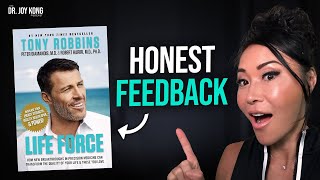
Dr. Joy Kong, MD, provides commentary on Tony Robbins' book Life Force, agreeing with its enthusiasm for stem cells but correcting inaccuracies about US legality and common practices. She explains that umbilical cord–sourced mesenchymal stem cells were being used in the US (as non-expanded, native cells) as early as 2016, contrasts these with expanded/altered cells commonly used in overseas clinics, and outlines regulatory constraints—expanded allogeneic cells in the US require clinical trials and are not FDA-approved outside hematopoietic uses.
Chapters
Hi, this is Dr. Joy Kong. And as you know, I love stem cells and I was really happy to see Tony Robbins book Life Force and I read through it, love the book, great contribution to the whole new field of medicine, especially regenerative medicine, since he's such a big fan. And there's a lot of information that I think are very helpful. But you know, some of them I want to address because there may be parts that are not entirely accurate. So thing I want to talk about is that it's great that, you know, Tony went overseas to get his stem cell treatment. That's because he thought that stem cell therapy was not legal in the United States, especially the type that he was trying to get, which was umbilical cord sourced stem cells. He thought he had to go overseas that in the US you have to use your own stem cells so your body's own stem cells from fat or bone marrow. But that's not really true because in 2016 I was performing stem cell therapy and a doctors were starting to do stem cell therapy and what we used were umbilical cord sourced stem cells. But the difference between what we're doing and what overseas clinics were doing is that we were using native stem cells, cells that have not been grown to huge numbers and have not been altered in any way. But overseas, because the regulations are more lax and you don't have to do clinical studies in order to use expanded cells source, which means that you are growing the cells to huge numbers or you can even add enzymes and chemicals to alter the cells. So in the US if you want to do that, you have to participate in a clinical study and it's very costly, very time consuming. So all these companies do not want to do that. So they go overseas and they set up their, you know, business and start treating patients using these expanded cell source. And that is true. It's not legal in the US unless you are going through a clinical study. But if you are using expanded cells, it sounds great that you're getting a huge number of cells. It doesn't mean that quality is preserved because oftentimes when you expand the cells to multiple generations, the cells actually start to age and, and degrade and lose some of the potentials and also express surface markers that's consistent with the donor's surface marker, which means, you know, some HLA markers and certain cell surface receptors that your own body, the recipient's body can recognize and start rejecting. But if you're giving them very young cells that have not started to express these surface markers, then there's no such potential as rejection. So in overseas clinics, when you're getting the expanded cells, you tend to have more rejection type of reaction. Frankly, in my clinic, I've not seen that happen. Because we're not altering the cells before transplantation and because they're so young, even though they're not matched, there's no immune interaction. Especially we're talking about mesenchymal stem cells. These are what's considered immune evasive. So not only they're evading the immune attack, but also they're calming the immune system. That's why mesenchymal stem cells, MSCs have been used in organ transplantation cases to reduce organ rejection. So there's a huge difference between this different type of cells and what would you do with the cells? If you start to multiply the cells, then you can change the cells and the cells can cause problems. So these are just some of the things that that's not talked about in the book. But I think it's important for people to understand because the number of stem cell clinics have multiplied actually in the US Even though the, you know, the official language does not support it because it's not FDA approved. So the only FDA approved the therapy is hemoreconstitution. In those cases, you can give stem cells because either a person has blood cancer or they have autoimmune diseases and their own blood system is wiped out. So you can give either bone marrow transplantation or cord blood transplantation. Everything else is not FDA approved, even though there are a lot of evidence from all around the world of research showing benefits in different conditions. But there's no formal FDA approval. So despite some resistance from the traditional medical route, like a lot of my colleagues, doctors who have been educated traditionally who were taught very little about stem cell treatments, so they may not know much about it, or even the mainstream outlets, like social media outlets, sometimes there's censorship even about stem cell therapy. But despite that, the number of stem cell clinics have multiplied in the U.S. i think, because there's a real need. So. But if you see anybody that's using expanded stem cells and they're giving it to you in the United States, that is not legal unless they have a clinical study that's going on. So. So that's my feedback on that portion of the book. So I'm going to talk more about various aspects of what the book mentions so I can give people a kind of a fuller picture of the field of stem cell therapy. And thank you for your attention and good luck to your health.