How Is BrainTap 🧠 Different From Other Devices? 🤔 Dr. Joy Kong & Patrick Porter
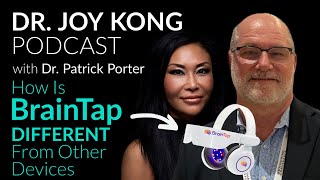
Dr. Patrick Porter explains how BrainTap differs from apps like Headspace and Muse by combining light flashing, sound frequencies, and music to actively change brain structure rather than just relax. A pilot program showed dementia reversal, and studies measured 49% neuroplasticity improvement after typical 13-week courses.
Questions this video answers
5%
30,000
49% neuroplasticity
Six weeks
11 university studies total; 7 ongoing in the last two years
Chapters
The problem is only 5% of the people that started meditation practice continue it because it's boring. The brain isn't engaged. We're not a binaural beat company. We're not an isochronic tone company. We're not even a guided imagery company. We're all of those things. And when you mix those together, you create neuroplasticity. Now, the end result was everyone in the pilot study was off dementia in six weeks, diagnosed by their doctor. Cambridge science tested and neurologically we had 49% neuroplasticity.
Okay, so, Dr. Patrick, I want to ask you this question because I've been asked before. People say, okay, so Brain Tab sounds great, but what's the difference between Brain Tab and New Calm or Headspace? Because now there are multiple technologies available. So how would you describe the differences between the Brain Tap technology and the other ones?
The biggest difference is that we have more technology in it. So I'll explain. They're both good. I mean, if you, if it helps you to relax and down regulates your stress, headspace is great. And if you like to do that kind of meditation, it's great. But the problem is that there's no real neuroplasticity when you're just doing voice and you have music. We've done studies that show, hey, when you're listening to that, you get a change while you're listening. But your brain literally goes right back to its other stated, there's no real brain fitness that's happening. What I mean by that is we took a piece of music just to give an example. A lot of people will just do binaural beats just alone. If you don't have perfect hearing, binaural beats aren't going to work. So that's why people get online and go, I tried binaural beats, they don't work. That's all Newcom has. And then they have you use Gabacrene. Well, it's almost impossible. I mean, we've scanned 30,000 brains, so I haven't seen it. Somebody going to Theta. Without the use of light technology, what we find is if you don't include light technology, what I mean by that is retinal flashing. There's 300 times more mitochondria in the eyes than there are in the brain. And the eyes are attached to the brain, but the eyes are meant to absorb light energy. So our brain is always looking for ways to conserve energy. So when you close your eyes, your brain is literally going to shut down a third of your brain's activity. We know this because of a group called nora, the Neuro Ophthalmology Research Association. We work tightly with them. And so we know that when you're using retinal flashing and specific frequencies of flashing, which means that we're using earth frequencies. So the same things people do with the light, with the ears, with binaurals, which for those that don't know what binaurals are, if I wanted to get 10 cycles, which is alpha, I would put 300 Hz frequency in one ear, 310 in the other. The brain doesn't hear either of those. It hears a phantom sound of 10 hertz. So that 10 hertz frequency is there. Now, if you have perfect hearing, that works. But almost everybody doesn't have perfect match hearing. Like for instance, myself. And I learned this because what happened to me, I was on an airplane and I blew up my eardrum and Now I have 20% less hearing in one ear. So when I'm tracking my brain activity, I have a lag. It doesn't work the same way because by the nervous system in my ear, the nerve endings have been damaged because of blowing out the eardrum. And I had surgery. Scarring is not really good for connectivity, right? So what we found out was, why don't we mirror that with something called isochronic tones? And then we said, what if we mirror that with solfeggio frequencies? What if we mirror that with noget frequencies? What if we put the music in and we tune that music? So think of it like this. I've been to a lot of restaurants that serve Italian food and they have the same kitchen, but I've had fettuccine alfredo. Some of them, some are good, some are bad. It's only three ingredients. It's how you mix them. So what we know none of those others have done the studies we've done with our technology. They're using other people's technology to improve their technology. We're talking about. We have 11 university studies that just in the last two years, we have seven going on right now. So we're looking at, is it just music? Is it the music doing? Because people will say, why don't you just listen to music? So the study we just finished in Brazil, 200 people in the study, we had their brain, we had them on qeg, which is multi channel, which measures the brain. If you're measuring the brain, we have to put it on the brain. Because the electrical activity is so low when you're listening to music, they call it the mos art Effect, it makes you smarter. We know that. It's been scientifically proven. But once you turn the music off, the brain goes right back to its regulation that it was before the music started. So while you're in that environment, it works. But as soon as you turn it off, it has no brain fitness. It's like going to a movie. You had a great experience, but it wasn't life changing. When we took that same piece of music and I put my algorithm in the background, that music took 72 hours to regulate the brain back to their stressed out state that they had before. And most people don't realize it's not alpha, it's not theta, it's not delta, it's not gamma. All of those things don't even matter. It's a proprietary mix of all of those. Your brain is always operating at all those brain wave frequencies. If you're missing any of them, you're not going to have the same neural function, neurological function, because those brain waves kind of act like WI FI networks. So if you're doing, let's say, any. It doesn't have to be headspace. It could be any meditation app. The problem is only 5% of the people that start a meditation practice continue it because it's boring. The brain isn't engaged. If you go, I don't know too many people that listen to radio shows anymore. There's a few people like myself. I like audiobooks, but most people don't because they want to see. You know, they don't sell TVs that don't have pictures. So people want to know. They want their. They want to engage their sight, their sound, their experience. That's why IMAX theaters are charging so much money, because people want an experience. So we provide an experience and we provide the training. So it's like the difference between going to Planet Fitness and going to Gold's Gym or Equinox. You know, there are different levels of gymnasiums. We're beyond Equinox even because we're leading the charge. When somebody looks at all this technology, they can search the Internet, they're going to find out that I started this technology back in the 80s. So it's evolved. It's not the same. Most people are using the same technology that we proved out in 1980, 1986, it works, but not for everybody. So what we said is, okay, this works for 60% of the people. How can we get the other 40? We're just still not at 100%. So we're still going to keep changing. We're still going to research, we're going to figure out what needs to happen. In fact, we enhance our experience by using even sound beds and using other biotech technology that's going to help you do it. Because there's not one thing that's better than anything else. But I mean, we're tested on seven continents right now. It's not just an American study. We're tested all over the world. And really you can always get cheaper, but you can't get better, you know, so what I tell people is if you want to drive a Cadillac, you got to buy the Cadillac. You can't buy a Yugo, think you're going to get a Cadillac, you know, or a lot of people think. We're not a binaural beat company. We're not an isochronic tone company, we're not even a guided imagery company. We're all of those things. And when you mix those together, you create neuroplasticity. The key is, are you going to get the result that you're promising to people when you look at the churn? Which means how many people are dropping off the app, how many people are using it? I can tell you right now, I've not met one person that's a clinic that didn't have those two products or more that didn't switch to Braintap as soon as we proved to them through our NeuroCheck technology that they were getting a result. Because we can literally show them with clinical data and evidence that we get results. And so when somebody says, why wouldn't you use that? You can use whatever you want, but you want to. If I'm going to go to Hawaii, I'm going to take a jet plane, I'm not going to take a sailboat, you know, so they're going to both get you to Hawaii, but one's going to take a lot longer. So that's the whole key here is. And there's really not, there's nothing wrong with what they do, but in the absence of Newcom, they're using all their research from an old technology they can't even use anymore because the government banned it. They used, it was called Electrostim technology. You actually put clips on your ears and they ran low level electricity across the brain. I'm not really big on destroying brain tissue, so I'm, I mean, for some people you need to use that. And it was designed, you can buy that for $100. That technology is available everywhere. But it's more for people that have ptsd. High anxiety. You know, they used to do lobotomies. That was high level current.
This is alpha stim.
Yes.
Okay.
I have an alpha stim. Because if somebody's got a lot of stress and anxiety, might have to do that, you know, and. But it's not. Everybody doesn't need that. Okay? And so that's the key. But they don't do that anymore because they can't sell it. You need a doctor's prescription now. So it's not even the same technology. Okay? So their, their research isn't about what they have now. What they have now is they have a mask and they have binaural beads and they have GABA cream. But guess what? The most powerful pharmacy on earth is not in the cream. It's in your brain. So if we can trigger theta, which I was talking about earlier, you can't trigger theta without light. I've never seen it happen. Even Muse, which is a very popular headband, we use it all the time. The Muse headband that measures brainwave activity. It's only 200. And when somebody asked me about neurofeedback and they're not a clinician, I say, go get the museum. But the problem is you got to get a third party app because Muse took Theta off the menu because nobody can get there. And so you're getting all these complaints. Why don't I get Theta? Because you can't with sound alone. Very few people can. It takes years of meditative practice. And so they just took it off the menu. If you go to. If you look at the Muse app, and I love Muse, we use it all the time. We have two of them in our clinic, but we use a third party app that registers called Playing in the Mind. And it actually will do QEG almost activity with a museum app, which is really good. But you're not going to get data by using Muse alone because it's just. It's just recording brainwave activity. So there's. There's a lot of things out there and people get confused because we're in the space of. We're not really in the space of meditation either. We use. We use technology during meditation because people can kind of contextualize it. But we're brain fitness. We're showing neuroplasticity. And very few people can claim that, but we can claim that because we have research that backs it up.
And headspace is pretty much just guided meditation, right?
Yes. I mean, they just. They're buying up a couple other companies now. Who knows what they're Going to be tomorrow. They got a lot of money. They just bought an app that I was reading about. So, you know, who knows what they'll do in the future? You know, it's a great app, but we have a lot of people that do both, you know, because they like what Headspace does for what they're doing, because it's a little guided journey, but it's so limited that if you play that. If you play that app more than three or four times in a row, it's like living next to a paper mill. We all know people that live or some place that really stinks because they're near an industrial something, and you go over there and you say, wow, how can you live here? It smells so bad. But once you live there, the nervous system says, or mold in your house even. What happens is your body says, well, it must not be dangerous. They keep walking in here. So the nervous system shuts off that. That field, and then your friends come over and go, how can you live here? It smells so bad. I don't smell it. Well, that's because your nervous system says, that's not a danger to me, even though it is a danger, because odor has mass. But they don't think about that.
Right. So habituation, you're just repeating the same pathway over and over. So is this why you develop so many different meditative pieces?
Yes. Like, for instance, when we did our dementia study with Dr. Kelly Miller with the book Saving youg Brain, they listened to something different every day during that training for six weeks because we wanted to create neuroplasticity. Now, the end result was everyone in the pilot study was off dementia in six weeks, diagnosed by their doctor. Cambridge Science tested and neurologically, we had 49% neuroplasticity, every person in the study. So it's not like one person missed out, because everybody's brain works the same. Unless they're. I would think there might be someone out there that has a organic problem or something that wouldn't work with. But these were people that. They were diagnosed by their doctor. They had dementia. They took the testing, they scored it as dementia. They had cognitive decline. They were between 55 and 65 years old. And we've actually shown even at over 100 years old, we've scanned people over 100 years old that got neuroplasticity.
Oh, wow.
I believe the brain can be changed at any age. You know, we have to get blood flow and circulation. Sound alone can't do that. Light can. Because we all doctors know about lasers now. It's just low level light. So we're talking about vasodilation, blood flow, circulation. We're going to bring oxygen to the system, to the place. But the biggest thing is blood flow. Anywhere there's a new blood flow. For those that aren't physicians out there, your body will create a lymphatic vessel because it has to follow the bloodstream. And everybody in physiology knows that. But they didn't even know the brain had a lymphatic system till 2016. And then poof, they found out because they started studying the brain during sleep and they said, what's this system doing, the glio lymphoma system? Now everybody knows about it, but if you went back to physiology books before 2016, you'd see it stops at the neck. Now that goes against all of the laws of nature, but because it's the blood brain barrier. So what happens is only when you reach level four sleep will that system light up and it basically drains out the toxins. But if you don't have the, I tell people, lymph system, think of it like the trash man of the system. If you don't, if you don't have a way to clear that out or if it's clogged, you know, like a traumatic brain injury would do because of a hematoma or something, then you've got to do something. Light is one of the best sources. That's why a lot of doctors, we use lasers, but we're not going to have somebody put a laser on their head and leave them unattended. So we're going to use low level light and the body will absorb it because the body absorbs light. We're all biophotic in nature. So like solar panels running around. And so that's why light is so important.
Yeah, yeah. And how many sessions do we have now?
We have 1,800 sessions. Wow. And so let's say for instance, you were coming in and you want to do stop an addiction, let's say, whether it be smoking, drinking, pornography, whatever it is, somebody comes in, I'm not going to have just one session for them because one session isn't going to do it. So most of our sessions are 13 week programs because during that 13 weeks they're going to learn, they're going to develop, they're going to get different skill sets. We're going to take them to different places in their brain and we're going to use some positive psychology because we need them to start thinking differently. Because thinking can actually affect 2,300 different gene expressions. So if you're going to change how they show up, most people don't realize that every minute of every day they're showing up as somebody different because our cells change at a rate of about, you know, they're dying at a rate of about 50 million cells per second. But the genetics of the cells that are alive are changing every 40 seconds based on your environment, based on. Based on the food you're consuming, the people you're hanging out with. All this epigenetic experience. Now, we can manipulate that or we can introduce like you do. If you're doing stem cells and things like that, you're introducing new biologics into the body. So the body's going to have to react to that, depending upon how the body reacts. That's why in medicine, they're practicing, because what they do is they present a drug or they present a solution. How does the body respond to that? Hopefully it's favorable. If it's not, they're going to say, okay, that didn't work. Let's try this. Just like everyone's doing here at the biohacking conference, Right. They're saying, hey, this worked for me. I've got my whoop. I've got my blood flow monitor, all these things. What did I just do? How do we measure it? That's what we do with our technology. You want to know, we're not just making claims. We have research. The whole thing is that. And I think that's what people are demanding now. It's not just, is it a cheaper price? Because there's a saying when you're actually doing software development, it says you can either have it fast or you can have it cheap. You can have both. So the same thing is true with most things. You can have it good or you can have it cheap. You know, so you usually can't have it both.
Yeah.
So it's not about price and all of that. It's one thing is that I think people deserve the best.
Yeah. And I think it's actually very affordable, you know, $650 for something that you can use for the rest of your life.
Yeah. And your whole family can use it.
Yeah.
It's not like it's locked into your DNA. It's not like getting stem cell treatment. Oh, let me give you 50 million of these stem cells. You know, once you inject them, they're yours. You know, this is something that you can use. And. And it's not aggressive, which means the worst thing that can happen is you fall asleep but the best thing is your life can change. So that's what we really want to focus on is what do you need to do to make life changing experiences. Yeah.
It's fantastic. Inspiring. Especially like what you thought said about your thoughts changing your body and you know, how every minute you have a chance to change your DNA and your physiology. Yeah. And with the help of the brain tab.
I love when the mystics would say our body is like a river. Most people think their body like a pond. It's always the same thing. It's not because if you step into a river today that looks the same tomorrow, but it's going to be different water because it's flowing downstream. Everything in your body is changing. So how are we addressing that change? How we, what are we eating? What are we thinking, what are we doing? So of course we're just dealing with how does our body respond to light, sound and vibration. So it's not just about one thing or another, it's the mixture. Like I said, it's like the Italian food, you know. The other thing is that people don't realize is our brain needs ATP, right. It needs that energy to work. So when you're doing just plain meditation, any meditation app, as long as you have energy, you can make changes to the brain. If you don't, it's like you have a Lamborghini in the garage and you want to take it for a ride, but there's no gas in the tank, so it doesn't matter. That's why people fall asleep when they meditate. And it's meditation isn't sleeping. Meditation is a lot of neurological activity, a lot of planning whether you're doing it for spiritual practice or whether you're doing it like hypnosis or something like that. You still have to do some work to picture, image, experience. All those things are important. So what we're going to do is we're going to deliver energy to the brain through the eyes and the ears. That energy is going to be taken in through the bloodstream, through the hemoglobin. It's going to go into the brain and then the brain. Because we know that light therapy does vasodilation, blood flow, circulation, nitric oxide release, and it's a low level dose, so it's not going to hurt anybody. Some people will feel a little warmth in their ears at first and that's because they have a blocked, their meridians are blocked. But once they do two or three sessions, they usually, it almost feels like a flushing effect because now the energy can flow through the body. And that's key is our body needs to be in a state of flow and it's less resistance, the better. That means stress. You know, if somebody has stress, they're going to have resistance in the body. Wow.
Amazing. Yeah, I love it. I feel more inspired now. I'm going to use it even more.










