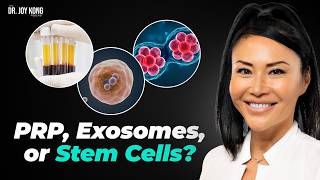
A brief patient-facing YouTube explainer by Joy Kong, MD clarifying that many marketed "stem cell" treatments (PRP, exosome products, amniotic fluid injections) do not actually contain viable stem cells. The speaker defines PRP (platelet-rich plasma) and its role in healing, explains exosomes as cell-secreted vesicles (useful but acellular), and contrasts amniotic fluid sources (early gestation vs. birth) and the variability/risks. The video urges patients to ask their doctors whether a product actually contains cells.
Chapters
You think you got stem cell treatments, but did you? A lot of people tell me, oh, yeah, I got stem cell treatment before, and either it worked or it didn't. So when I talk with them more, I find out they got either PRP treatment or exosome treatments or amniotic fluid injections. So what are these things? They're not stem cell treatments. So PRP stands for platelet rich plasma. So this is when a doctor draw your blood and thin it down. And the bottom is the red blood cells. On the top is the plasma. At the lower part of the plasma, where it's close to the blood cells, is the platelet rich portion. And why is platelet important? We all know when we get cut, platelets arrive on the scene first, right? They form the clot to prevent further bleeding, and then they release all these growth factors to help promote the healing of the tissue forming the lattices and so we can form the new tissue. They do have a really important role in repair and orthopedic surgery. You know, they use that a lot, orthopedic surgeons. It's now widely used for joint ejections, soft tissue repair, even facial and hair rejuvenation. So they are fantastic. But they're not stem cell therapy because there are almost no cells in it. One could argue there are some very small embryonic, like stem cells, B cells, however, they're not activated, so they're completely dormant. They're really not doing much. We're relying on the growth factors from these platelets. That's producing a benefit. So much so that it works quite well that a lot of insurance companies are covering it, but they're almost no cells. So if you think that that's stem cell therapy, you really, you really didn't experience the real stem cell therapy. So I've seen people who use PRP treatments and it didn't work. And then when they actually tried real stem cells, it actually worked. So that's one thing, right? So that's prp. The second one is exosome therapy. So a lot of people thought the exosomes are actually stem cells somehow. But exosomes are secretion products from stem cells. Stem cells are the mothers of exosomes. They are secreting these exosomes, which are really a lipid bilayer covered little vesicles that the cells pinch off to communicate with other cells. So these are little nanoparticles. They're, they're packages that's full of growth factors and so different proteins, lipids and pieces of DNA material, rna. So they can actually go to another cell and fuse with another cell and dump all, all this content into the other cell. And that can promote changes in this, this new cell, right, that you're trying to communicate with to the point where the microrna in this little packet can go across cell nucleus and actually help change the DNA of the recipient cells. So that's how versatile they can be. So they are important and I use that in our clinic all the time because they're very anti inflammatory, they can produce profound changes, but they are not cells. Because cells have the ability to make exosomes and make it according to your demand. Right, the demand of your tissue and of the situation. So the cells, because they have the DNA and have the intelligence, then they can make these exosomes. So when exosomes are produced in the lab, basically mass produced by growing these mesenchymal stem cells in the culture, and then you collect all these little vesicles they secrete and then you give it to patients. They can be very helpful, but they're not as targeted as what the cells can secrete in your body according to your need. So again, there are no cells in these products. And what about the amniotic fluid? So that's what's obtained either from amniocentesis, when they're testing to be done on the baby, that's early gestation, right. Or they're collected at birth or right around birth, you know, from the, you know, basically the water. Right? The water broke and so you collect amniotic fluid. So there's a great variation. What are you getting these amniotic fluid? Are you getting it from the time of amniocentesis? Are you collecting those? Or are you collecting it at the time of birth? At time of birth, the growth factor profile will not be as wide ranging and as potent as the earlier gestation stage. But why do people do amniocentesis? Because they want to get genetic tests. Right. No one is going to disturb the fetus by poking a needle into the amniotic sac to draw fluid out of it. Unless you're worried about certain things. You're testing usually for genetic abnormalities if the mother is older, usually over age 35, or if there's strong family history of genetic problems. So then if you're getting it from the early amniotic fluid, withdrawal from amniocentesis, then are you getting cells that have genetic defects? Possibly. So these are all questions. So the bottom line is a lot of people thought they were getting stem cell therapy and there were really no cells. So if the person got the therapy didn't think they worked very well. Please don't think that stem cell therapy don't work. Right. You haven't gotten the real thing, so make sure you ask your doctor. Are there cells in this? What. What is this? So hopefully your doctor knows and he's not gonna lead you astray. So I hope this episode is helpful, and I will chat with you next time.