Key Signs You're MISSING Essential Amino Acids | Dr. David Minkoff
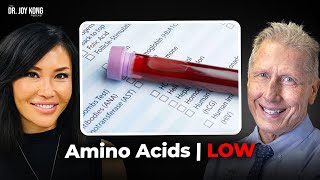
Podcast interview (Dr. Joy Kong with Dr. David Minkoff) discussing Dr. Minkoff’s clinical journey from pediatrics/emergency medicine to nutrition and performance medicine, his observations that many patients have essential amino acid deficiencies, and the development/use of a product ('Perfect Amino' / Body Health) to restore amino acid status and improve healing, performance, lean mass, and multiple clinical symptoms. The conversation covers causes of deficiency (gut dysbiosis, acid-blocker use, poor diets, plant-based diets), critiques of single-source proteins (BCAAs, whey, collagen), and practical dosing/usage examples.
Chapters
I injured my hamstring and I could not get it to heal. And every time I tried to run hard, I could feel it. And I knew that if I pushed it, I was going to tear it. I started consistently taking this. In about six weeks, my hamstring stopped hurting. I started measuring amino acids in everybody, and I found that almost everybody was deficient. People would come back and say, you know, my hair wasn't growing, and now my hair is growing and my energy's better and my chronic plantar fasciitis is better. I got 3,000 people wrote me, like, where do I get this stuff?
Oh, wow. Okay. Welcome to the Dr. Joy Kong podcast Today. I'm so excited to have an esteemed colleague, Dr. David Minkoff, as my guest. And I've heard Dr. Minkoff lecture at a 4am Years back and he does a lot of lectures and help a lot of doctors and he's doing some groundbreaking work and I really want to share his knowledge with you guys. So just brief introduction. Dr. Minkoff was board certified in pediatrics and did a fellowship in infectious diseases at UC San Diego where he became a faculty member and conducted research on infectious disease therapeutics. In the 90s, Dr. Minkoff became interested in nutrition and biochemistry and went on a search to find the best way to cure the ailing body and improve performance. He gained expertise in biological medicine, heavy metal detoxification, anti aging medicine, hormone replacement, energy medicine, prolotherapy, homeopathy, integrative oncology, acupuncture, and more. He established LifeWorks Wellness center in 1997 and it quickly became one of the largest complementary and alternative medicine clinics in the US as he saw the demand for the products and protocols he developed. He founded Body Health in 2000, is a nutritional company that now manufactures and distributes products with cutting edge solutions for many health problems. Dr. Minkoff is also an avid athlete. Very remarkable. Completed 43 full Ironman triathlons and has qualified to race an Ironman world championship eight times. He also devotes much of his time to writing and research and regularly sees patients from around the world. His Amazon best selling book, the Search for the Perfect Protein has been as a landmark work in protein nutrition. So I think protein is a very hot topic and I'm so excited to have you here. Dr. Minkoff, welcome.
Thank you. Dr. Joy.
Yeah, thank you for all the amazing work you've done and the relentless education that you're providing for everybody. So maybe share with us a little bit of just what happened. How did you get so interested in protein? And a little bit of your journey of health optimization.
I got interested in health optimization because my wife, my wife's a nurse. She got a degree in microbiology and she's a nurse. And she went to a Jeffrey Bland. I don't know if Jeffrey's still around, but Jeffrey Bland was, worked for Linus Pauling. He was a biochemist, PhD biochemist and he was at Stanford and he used to go around doing lectures on nutritional biochemistry and he worked for Med. At the time he worked with Metagenics. And he's like one of the smartest guys I ever met. You know, he could read. He could read medical journals at 1500 words per minute, had an eidetic memory, collected probably the largest medical library outside of an official library of his own. It was up in Seattle. And he could quote you page numbers and journal citations on about anything he said. So she started to go to these lectures and she got really excited by it. And one day she said to me, at the time I was doing emergency. I switched from pediatrics, infectious disease, hospital practice to emergency medicine. And she said, you got to go hear this guy because he's really smart and you'll like him. So I went to one of his lectures. He did a weekend seminar over in Orlando, not too far from here. And he was, he just amazed me and he got me completely interested in the subject. And so we. She had some health challenges which, which learning about this stuff helped her with. And we were playing around and we had friends who said, well, you're learning all this stuff, why don't you try it on us? And so I said, I'm not really sure I know what I'm doing, but emergency room shift work. So I had 12 hour shifts, either 7am to 7pm or 7pm to 7am and I was doing probably 14 shifts a month. And I had some days where I could play around. And she's a nurse, she has a home health nursing business and she had an extra room. And so I said, well, I'll meet you there at 2 o' clock on Wednesday afternoon. I'm off and we'll play around. I had gone to sort of the, the greats, you know, O'Miura, Klinghardt, you know, like I went everywhere, we went everywhere. Like, who knows something we're going there. And in the middle 90s there was really no organized courses, A4M, you know, like it was. Everything was sort of very primitive. And so you had to go to some guy's office and. Or if he was doing a weekend seminar you had to go to seminar and learn from him. So we went and we learned stuff. And so I had people coming in and was like, I've got rheumatoid arthritis and my doctor's not helping me and can you help me? And I would take them through my sort of program and it really worked. And the practice just like it just blossomed. And I was having way more fun doing that than emergency medicine because, you know, it's drunks and car accidents and, you know, old people who are on 12 or 14 drugs who are, and you know, they're, they're out of it and they got a bellyache. And it just was, I don't know, it got to be, you know, the big corporations came into ers and bought ers and then you were, you know, it just wasn't fun. So I started this practice and it really mushroomed and it sort of paralleled with, I like performance racing. So I'm a triathlete and I was always trying to, how can I get faster and how can I keep my health and how can I improve my physiology? And what I learned is that what's good for sick people is also good for, well, people. And I worked with some of the best athletes in the world and I would do my same workup on them as I would do on someone who had chronic fatigue or Lyme disease. And, you know, you don't find the degree of dysfunction in these guys, but for a Tour de France athlete, if he can get five more watts of power over six hour ride, he can win. You know, he can get up that mountain faster. Or a swimmer, you know, hundredth of a second is the difference between the champion and the second place. And so I would do the same workup and I would find things and we would put those things in, you know, cleaning up their gut and, you know, they had nutrient deficiencies and they had toxicities and they would get better and then they would send. I mean, I saw NASCAR drivers, I saw, you know, like all kinds of different people, all who had wanted performance. So I injured my hamstring and I could not get it to heal. And every time I tried to run hard, I could feel it. And I knew that if I pushed it, I was going to tear it. And I did everything that I could think of at the time. You know, I saw chiropractors and acupuncturists and massage therapists and I put cold on it and I put heat on it. And we didn't have peptides then, but I did, you Know, I did everything that I could do, and it just wouldn't heal. And then I started experimenting. I did a lab test which looked at. It was. It's. It. It's Genova now, but it was. The lab is called Metagenics, and they have this profile called an iron profile Ion individual optimized nutrition, and they had fasting levels of serum amino acids. And I did the serum amino acid test, and I had a lot of deficiencies in essential amino acids. Like, mine were low. And I really thought that I had optimized my nutrition energetically. I felt, well, I could race well, but I had this nagging leg that just wouldn't get better. So I started playing around with amino acids, essential amino acids. And I. I had a friend over in Europe who had some mixtures, and we horse. I just horsed around with it, and I found that I started consistently taking this in about six weeks. My hamstring stopped hurting, and I could go. I could push hard. And about six weeks after that, I went to. There's a. There's a famous iron man in British Columbia in Canada. And I had done the race probably 10 times. And I went there and I had my. The best time I'd ever had. And my leg was strong. And I thought, wow, this is a. This is. This stuff does something. And so I started to use it in the practice, and people would come back and say, you know, my hair wasn't growing, and now my hair's growing and my energy is better and my chronic plantar fasciitis is better. And I. So I started measuring amino acids in everybody. Like, my stat. Part of my standard workup is to get that panel. It's got vitamins, minerals, essential fats, and amino acids. And I found that almost everybody was deficient. And so we. And so I wrote an article for Triathlete Magazine. On what? On my experience. And this is before there was really Facebook and real Internet stuff. So it was an article, it was a published magazine. And I got 3,000 people wrote me, like, where do I get this stuff?
Oh, wow.
And so I already had this company that I'd started a few years before called Body Health, and we were selling mostly heavy metal detoxification products, multivitamins, heavy metal detoxification products. And I said, we might as well make this stuff. So we started making this stuff, and then we've got, you know, thousands of doctors buy the product, use it in their practice for their patients, and this stuff really works. And it works because it fills that niche, which today is, you know, I think 50 or 75 years ago, when food was actually food and you could get it and you could eat it, you know, like real food, not packaged food, you know, vegetables that had vitamins and minerals and meats that weren't contaminated and fish that weren't contaminated. And, you know, I mean, it's hard to find clean food and, and where people, 100% of people that I see now have gut dysbiosis. They have bad bugs in their gut, 100%. They Malabsorb, they don't digest. They've got overgrowth of fungi and bad bacteria. Many of them have parasites. And many, many people, like, if you, if you. I think the market for acid blockers, for prescription acid blockers is like 24 billion a year. It's a huge market that might be a little bit high, but it's big. It's really big. And then now, you know, Pepcid and Tagamin and all these drugs are available over the counter and anyone that's got probably really a food allergy or a stomach acid deficiency is taking these products because they don't know what's wrong with them. And if they take these products, then they, their stomachache goes away and they feel better. Really, what they don't know is silently, slowly killing them. You know, the stomach cancer incidence is way higher and the chances that they're going to get sibo and, you know, small intestinal bacterial overgrowth and, you know, bad stuff is 100 of them. And they, and when you don't have stomach acid, you can't digest proteins. The first step in protein digestion is pepsin. And pepsin, in order to become active, has to have an acid environment. And when you take these, these drugs which block acid, then your stomach ph is seven or thereby. It really needs to be one and a half or one. And when you take the drugs and so you don't digest proteins and you don't absorb minerals. So people get low in magnesium and calcium and iodine and other things that they need that they, that you really need stomach acid to absorb. And they don't know it and it's going to catch up with them later, but at the time they don't know. So we have this problem now of food that's a problem. And many people, it's virtually everybody, if we measure a stool test on them, which we do on every person, there's, there's, there's really problems there. They have lack of digestive enzymes and lack of hydrochloric acid and bad bacteria and Then the good bacteria and then yeast overgrowth or parasites. And so even if they are eating a good nutritious diet, the best that they can, the chances of them actually digesting it and then turning that protein into the amino acids which we measure in their blood, it's just not successful. So amino acids are the building blocks of all the body proteins in our bodies, basically made out of protein. So it's enzymes, it's immune. You know, all the immune mediators are proteins. It's bones, it's skeletal muscle. And you know, you go to a 4M muscle is, is, is longevity. You know, old people lose their muscle, then they die, they fall down, they break their, you know, going with the muscle is going with the bones and they, you know, you fall down and break your hip. The chances that you'll be dead in a year, a 60 year old or 65 year old or 70 year old, is 50% because the body structure is decomposed. So I found that not only did my performance increase and my leg got better, I gained nine pounds of lean body mass. When I started taking perfect amino.
Wow.
And I didn't measure any difference. Like I didn't look physically different. And I consulted with an amino acid chemist and he said, well, you probably were amino acid deficient eating what you were doing. You know, I'm on a triathlon diet. I'm on a high carb, you know, rice and beans and not enough protein. I mean, I thought I knew what I was doing, but, you know, I anyway. And he said, you're probably gaining bone strength. Like you're filling in your bones and you're filling in your organs.
Oh, wow.
And you were malnourished. Now there's an interesting story with this because there's a very infamous dentist in New York named William Donald Kelly. And I don't know if you ever heard of the Kelly protocol. Anyway, William Donald Kelly was a dentist in New York and he developed pancreatic cancer. He was very anti regular medicine. And the, the successes for pancreatic cancer with traditional medicine are lousy.
Yeah.
So he discovered some work done by a Scottish anatomist back in the like 1920s that said that pancreatic enzyme deficiency underlies cancer. And so he put together mixtures of pancreatic enzymes, which he took in very high doses and sauna and coffee enemas and cured his pancreatic cancer. Well, he then had 10,000 different people that he worked with remotely using this protocol where they got better too. That's very tough protocol. And before he died he trained a woman who happened to be a patient of mine and she's going through this training and she's learning this whole thing. And then one day she comes in for a visit and she says, you know, I've got access to these real high dose pancreatic enzymes. And what he says is that you could do a test run on yourself to see if you have brewing cancer because they will eradicate brewing cancer. And I said, I'm gay. So these things are very concentrated and you're supposed to take 12 these tablets before breakfast with breakfast, 12 before lunch, 12 with lunch, 12 before dinner, 12 dinner and then 12 more before you go to bed. So like 72 of these a day, okay? And these are super concentrated enzymes from pork pancreas. So I take the first 12 and within about an hour and a half, I think I burned a hole in my stomach. I'm vomiting bile, I've got a severe burning stomach. I was really scared and it took, you know, I was drinking bicarbonate soda and I was doing, you know, I was trying to like alkalinize my stomach. And then I saw her the next day and I said, I don't think I have cancer, but man, I couldn't take these things. And I didn't really know what was wrong, but I just knew that wasn't going to work for me now. So that was a couple years before. So I started taking the amino acids I heal. My performance is getting better, I'm doing really good. And I remembered that and I thought maybe the symptom of amino acid deficiency in me because we were giving these enzymes to people and they were doing fine with them, but I couldn't take them because I'm going to try these enzymes again. So I call her up and I said, send me another bottle of enzyme. And I did 72, three days in a row with nothing. So the downstream effects of, of amino acid deficiency really is what it is is very different in each person. We have had people who, you know, like if you look on body health website, you there's, you know, we have probably thousands of testimonials and these people have, they come in from all different angles of like, I started taking this and then this happened and I could never fix this and then this happened. So because the body is made out of protein and the building blocks for protein are amino acids that if you're not getting them or you're not digesting them, you know a person who has a bagel with some cream cheese and a cup of coffee for Breakfast and a salad with 4 ounces of chicken at lunch and maybe some roast beef at dinner with some green beans. They're going to be protein malnourished. They are. You measure their amino acids, they're going to be low, it isn't enough. And you have people doing intermittent fasting which can be fine, but now they're down to two meals a day.
Yes.
And they're not getting enough protein. And one of the beautiful things about, about and, and, or people who are pre diabetic or diabetic or they want to go on ketone, know the ketogenic diets because they're having trouble with blood sugar, they're having trouble neurological problems or we put our cancer patients on ketogenic diets because we want to restrict carbs in them. But then if you restrict carb, if you restrict carbs and you have, and the diets are high fat, they don't get enough protein either. And so they get protein malnourished. So one of the beauties of perfect amino is that it's got Basically zero calories. 10 tablets is only 4 calories. So you can use this to supplement. So you, you asked me earlier but you know, I'm trying to get people to eat a gram per, per pound of protein per day. Okay. So if you weigh 130 pounds and you want a gram per pound, that's 130 grams protein. Now in two meals, it's impossible. You won't eat 75 grams of protein in a meal. You know, like a, like a, a, a, an egg is like 6 or 7 grams of protein. I don't know how many eggs you can eat in one serving, but my limit's four. That's only 28 grams of protein. You know, I've seen some of these guys, they eat 12 eggs. I don't know how they do it. I mean I can't do it anyway. It's not enough. So even if you have good protein meals, it's hard to get to that point. And if you, So a scoop, two scoops of perfect amino is the equivalent of 30 grams of steak of the protein and steak. So you could have two protein meals, you know, meat, fish or eggs for lunch and dinner. If you're trying to do an intermittent fast or if you're even if even divided three meals that would be, you know, for your 130 pound woman, it's 45 grams of protein per meal. That's a full amount of protein. That's, that's probably seven, six, seven ounces of Steak or fish, you know, or, you know, eight eggs. That's a lot of protein. And the, there's calories with that too. So if you're trying not to become a blimp, perfect amino has no calories, so you can use it. So when I get up in the morning, I take two scoops of perfect amino. That gives me 30 calories to like jump start my whole day. And then if I'm training a lot, I'll eat three protein meals and then I'll have extra, you know, an extra couple scoops of perfect amino and I could get my. I need 160 grams of protein a day. And I find that that works for me. Like, I like, but I, I couldn't do it with food. It was just too much.
I think there's a bit of controversy. There are some doctors who really don't think we need that much protein. Like Dr. Zach Bush, he doesn't think that we need that much protein. Like, how do you decipher all this?
So there is an individual biochemistry aspect, but I'd like to see his serum amino acids. Okay. And I'd like to do a DEXA scan on him and see how much lean body mass does he have, huh? Because those are the truth. Those are sort of the truth tellers because in a shirt on TV or on a pot. And I love Zach Bush and I'm, he's my friend, okay? Oh, okay. So I'm, I'm, I know how he feels. And people who really consider the planet, all the crops that are getting that are killing all the land are wrecking more animals than the cows and the chickens and the thing, like, if you're really an environmentalist, you can recycle animal stuff. So I don't agree on that part of it. But there's individual biochemistry. Some people have a gut bacteria profile where they can make essential amino acids like cows do. And so you'll see some guys who are their natural bodybuilders and assuming they're telling the truth, that they're not, you know, they're not, they're not eating roast beef on the side, but assuming that they aren't, who have, you know, big muscles and it works for them. And so 90 plus percent of the time what I see is that you can optimize by doing perfect, by adding perfect amino. And if you're a vegetarian or a vegan, you need a lot of it because the plant proteins are inadequate. And most people who go plant protein within a couple years get some benefits, like good fiber benefits, good Minerals, okay? But they don't have amino acids and they get deficient. They don't have B12 unless they're substituting that. And many of them aren't getting omega 3 fats in a form that, you know, EPA, DHA, where they really need it. So I'm doing this on all these patients. I got thousands, probably tens of thousands of patients who are done these profiles on it. And I can look at the amino acid profile and say, you're a vegan, aren't you? Or you're a vegetarian. I am.
Okay.
And here's the ribbon on my collar. I say, well, you could do that, but there's a few things that you're missing. And it might be why you're tired all the time, or why your testosterone level's so low, or why you're losing lean body mass, or why you have osteoporosis, or why your thyroid hormone is low, or why you can't remember anything anymore, or why your sleep is bad or why you're depressed. Because the amino acid pathways feed into all these things. And in an individual, this might be one of the keys to improving their health. And then they add this in, and in three to six months, you see, like, wow, like, this is really better. And their symptoms go away. And they really. They had malnourishment. One of the most dramatic ones was a guy who ran a nursing home in Hawaii. And most of these patients had memory problems, but they also had sort of performance of daily living challenges. Like they couldn't safely get out of their bed and walk to the bathroom. They were too frail. And he started giving them 10 tablets of perfect amino twice a day. And he said 30% of the people within three months were sort of back. They got their strength back. Their memories came back. You know, they could actually. They didn't have to stay there because their bodies, it was. It was a. You know, it was malnutrition that was the biggest problem for them. And then when you fix that, and I think that's true now for many people, even many children.
Yeah. I would want to ask you about the popularity of branch chain amino acids. Why is it so popular? Everybody seemed to know about them, and I know they're not as well absorbed. But what is the story? Why is it so popular?
So it actually isn't absorption, because they're absorbed. Well, absorption means it went from your mouth into your small intestine and it got into your bloodstream. So branched chains absorb well in order to make protein in the body. There's Eight amino acids called essential amino acids that are needed for virtually every protein in the body. And if you don't have even one of them, or if you're lacking one of them, you can't make the protein. It's sort of like we're going to make a car. And our basic minimum of a car is we have to have a frame and four wheels and a motor and a steering wheel. Now, I send you, and you have a factory, but you have no space to store any extra things. So in our bodies, there's no storage pool for protein. Like, it either gets made into your body part, your muscle and your organs and your bones, or it's converted into something which you use for fuel. So when the, when the proteins come in, either they become structure or the body uses them for fuel or they get stored as fat. Those are the two choices. Now, if I sent you 100 wheels and 25 steering wheels and 25 motors and 10 frames, you could only make 10 cars, right? And you'd have a lot of wheels left over that you couldn't use. And so you'd have to get rid of them from your, your factory lot because you have no way to store them. And so plant proteins have. So in order to make proteins, you need a certain balance of the eight amino acids. And if you're, you're eating foods which have say very low levels of lysine or methionine, these are very low in vegetable protein and leucine too, that, that you, you don't have enough of those because those are in every protein. So if you did a big workout that day and now your body wants to rebuild those muscle fibers and you have a big plant based shake and it's deficient in leucine and methionine and another amino acid, essential amino acid. When that cell is saying, I need these things to make this muscle and you're not giving me enough of them. You gave me a lot of wheels and a lot of steering wheels and a lot of motors, but I don't have enough frames. And so it can't make the muscle. And what happened with me is I had a backlog, a year's backlog, because I decided to become a vegetarian. And I had a backlog. I wasn't getting enough proteins. And so when I then started taking perfect amino, my body was like, oh, yeah, the liver is supposed to be this big, but it's only this big. Okay, let's build it up to the right size.
Okay, so you're saying the branch chain amino Acids has too many excesses.
No, it's only three. It's only three out of eight.
Right.
Leucine, isoleucine, valine, these are essential amino acids. There's only three. So you put that in and you can do them. This is measurable. So the difference between an amino acid or protein and the other two macronutrients, fats and carbohydrates is that amino acids or proteins have nitrogen and fats and pro and fats and carbohydrates don't have nitrogen. So you can do a balance study on something. You can say, okay, I'm going to give you 100 grams of branched chain amino acids and 100 grams of branch chain amino acids equals out to about 16 grams of nitrogen. Now, if that nitrogen becomes flesh or immune cells or enzymes, your body keeps the nitrogen. If your body can't use the nitrogen because it doesn't have the other stuff it needs to make it into structure, then it's going to get peed out. Mostly urine is getting rid of or one of the main aspects of urine is getting rid of nitrogen waste. Urea is nitrogen. A BUN is blood urea nitrogen. It's the nitrogen waste that's going to your kidney that you got to get rid of. So if you do a balanced study on. Okay. And you do it for a couple of weeks so that you get a good average. I take in 16 grams of nitrogen in the form of branched chain amino acids, and then I collect urine for 24 hours and measure how much nitrogen came out. Guess how much comes out. 16 grams. Yeah, it all comes out. If you're not eating anything else, it all comes out. It's not usable. Now people aren't just eating branched chain amino acids and they're eating other foods and probably it's not a zero. This formula is called net nitrogen utilization. Like how much nitrogen got utilized by your body to make something? So it's probably not zero, but it's really low.
Yeah.
So you might as well have a banana because most of what you're taking with branched amino acids is, gets turned into fuel, it gets turned into calories, and the body burns it. So if you read the literature carefully on branch chain amino acids, it's just, it's just like most of the nutritional science on mut. A lot of stuff is just all baloney, I guess. All baloney. I went to, I had a patient who, who had chronic fatigue. She's a doctor, and I treated her and she got better. And she said, geez, I'm so Excited by the stuff you're doing. And she happened to be the program chairman for the American College of Nutrition. She said, we have an annual meeting. I want you to be one of the keynote speakers. Okay. So I talked to some friends and they said I wouldn't go there because the source of the American College of Nutrition is the whey protein industry. And the whey protein industry needed scientific backup that whey protein was the best thing that there ever was. And so they financed it and the American College of Nutrition got this money and it's sort of a front group. This is what I was told. So he said, you probably shouldn't go there because they're not going to like what you're going to have to say. Because if you do the balanced study on whey protein, it's only 16% of the nitrogens retained. Whey is actually a lousy protein now. It doesn't hurt you. And if you tolerate dairy, it tastes good, but if you're trying to build lean body mass, it isn't very efficient. There's a big place down in Miami which is, you know, trains football players and strength training coach, and he's one of the best guys in the world. And he, you know, he was having his guys take 200 grams a day of whey protein. And the gastric upset that they had sort of chronically, you know, bloating and gas, and they just couldn't take all the dairy protein. And I said, just give them ten tablets of amino acids three times a day, a perfect amino, and their gastric stuff will all go away and you will see way better gains in your strength training. And he, he wrote me back and he said, holy smokes, this is like a miracle. Amazing because they. And all these guys are so happy with me now because I'm not forcing them to take all this whey protein.
Do you think the marine collagen, which is very popular, do you think that's in a similar case category as whey protein, is just very limited amount of amino acids?
Well, animal collagen, you know, like the collagen that's sold in stores is skin or feathers or bills or hoofs. That's where they get. The collagen does not have tryptophane. It's missing an essential amino acid.
Okay.
So probably you get some tryptophan. And I'm not saying that collagen doesn't do anything, but it's, you know, if you take perfect amino, you get all eight, and you'll get the maximum nitrogen retention and the nitrogen and the maximum effect of anything. And I'm not telling. People don't eat any foods because foods are fun. And taking amino acid tablets or powders is. Isn't that much fun. But we're, we're, you know, we're trying to sort of. We're trying to get to where people have adequate intake of amino acids so they can keep their bodies as genetically good as they, you know, as they're able.
Yeah.
And. And that, that's a, That's a challenge.
Yeah.
For most people. And most people don't even know. And most doctors have no idea. So I went to this American College of Nutrition. I do this lecture and there's like 300 people in this room and these guys are PhD dietitians and biochemists and MDs, and their jaws about dropped to the ground because they never heard any of this stuff. And I got. I was supposed to have 15 minutes for questions, and the questions went on for 45 minutes. The next speaker was delayed by a half an hour because the audience was so like, why didn't we ever learn this?
Yeah, yeah. That's how I listen to your lecture the first time. Yeah. This is amazing. This is going to be so helpful for so many people. So where can people get this amazing perfect amino.
So there's a lot of doctors who sell it, but we have. Our company website is body health.com b o d y h e l t h dot com. You can get it on Amazon from us. You can get it from Body Health directly. There's. So now originally it was tablets. Amino acids are very bitter. Like, like very few people would chew them up. And the product is a pure product. Like in an amino acid tablet. There is nothing else except amino acids that are. That are. Crush, sort of crushed together. So it's a tablet and there's a little coating to make it a little smoother. Used to be the tablets were just crushed powder and that was hard to swallow because they. They're sort of sticky. But now there's. Now they're smooth and they go down really easy. And then we make. Now we've got them as about six different flavors where you can do it as a drink. And there's mocha and lemon, lime and berry and. And they're not. They're. They're pretty good. We have a new chocolate coming, which is really good. And we've made it into a meal shake. So we add some MCT oil and vitamins and some other stuff and we make them in bars. So we have. If if you like protein nutrition bars. Have you tested ours?
Not yet.
They are. They are like. They're the best ones for sure. Oh, okay. When we go to a. When we go to, like, an expo and we chop up the bars and put them on the table, we can't keep them. You know, if you've had quest bars or you've had, you know, name a bar that you like. This bar tastes really good and it's.
Got good stuff in it that's fantastic. So many ways to supplement. Yeah. So is there a way people can keep following you? Is there. You have an Instagram?
Yeah. So I do a newsletter twice a month.
Okay.
If you go to bodyhealth.com, you can sign up. And then my practice is called lifeworks L I F E W R K S Wellness Center. We're in Clearwater, Florida, and I do a newsletter for that once a month. The newsletters are free. The websites have hundreds of videos, both of them on health, nutrition, all kinds of stuff. I just. On Saturday, we were filmed all day, So I did 27 new videos. Wow. So we're trying to just educate people, and then they know what to do and then they can stay healthy. And we do see new patients. We have a large clinic. We have 70 staff.
That's huge.
And it's. You know, most of the people that we see are people who either are looking for optimal performance or they're people who have, like, serious chronic illness that hasn't, you know, cancer, heart disease, Lyme, chronic fatigue, neurological disease, Parkinson's, Alzheimer's. And we do this on them and we get a lot of people better. So it's.
Yeah.
Very exciting work.
Okay. I hope lots of people, you know, get to get some help from your wonderful clinic because they've listened to this. So we're going to wrap up here, and I want to thank you again for being a very valued guest, and I hope people really enjoy this.
Thank you.
You're welcome.










