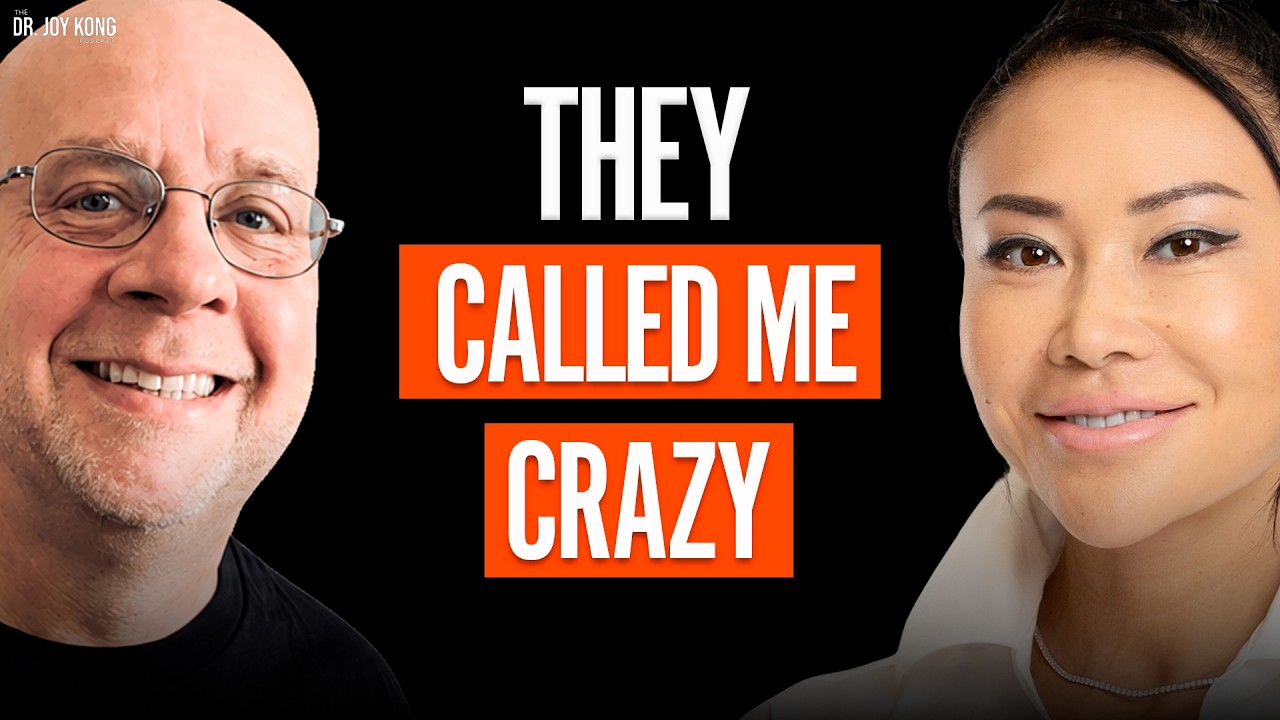
In this interview, Dr. Joy Kong reflects on the personal journey chronicled in her memoir Tiger of Beijing, detailing how she escaped a restrictive China, overcame a visa denial, and left a toxic relationship to build a new life in the United States. She describes the psychological shifts required for that transformation—letting go of ego, the savior complex, and blind trust—while cultivating discernment, purpose, and belief. Kong illustrates how mindset and purpose intersect with physical wellness, sharing her mother’s story of spontaneous remission from multiple myeloma as a testament to willpower and proactive health seeking. Throughout, she promotes her work in regenerative and anti‑aging medicine through Chara Health, describing various modalities (stem‑cell, peptide, plasmapheresis, ozone, laser). The conversation culminates in a philosophical call for humanity to heal by reconnecting with the heart—cultivating empathy and expanding consciousness as essential for collective survival. The tone is narrative, motivational, and occasionally promotional, with an overall sentiment of hopeful resilience.
Chapters
My mom told me that I would become nothing but social garbage. What I decided is that no, I'm going to college, I'm going to be somebody. Even though my visa was rejected, to other people it's really just time to give up. What did I do? I took a year off because I need to keep going, I need to give this my full effort. And then 8 months later, I was in San Francisco. So, so all these are evidence that I, I'm gonna be fine. And I'm actually not very attached to the outcome. I think there's part of me that's certain that it will happen, even if It doesn't. It's okay. It's a journey.
You wrote a memoir, Tiger of Beijing. It tells a story about courage and reinvention. What identity did you have to let die in your life in order to become the woman you are today?
One big death is ego. I think at one point, yeah, I think that was blasted away. When you— I mean, no one is completely free of ego and the influence of ego. You all, you know, you need the ego to survive, to to keep this entity going. But as far as thinking that I'm it, I'm so great, and this world revolves around me, I mean, all that's gone. So that focus, me, me, me, is the one that I had to let go. And there are other tough things, right? You let go of savior complex, possibly, you know, realizing that everyone is their own guardian. So if somebody even, even if they got into your world and that they are having their own problems, it is not my responsibility. I can try to help a little bit, but at some point when you keep trying and the result is that you are going to be dragged in and be the sacrifice for, you know, the possibility of them getting better, that's when you need to take a step back, is to let go of that notion that you are here. If just because you run into somebody needs help doesn't mean that you need to sacrifice your entire life to help, right? I'm still learning lessons, balancing kindness with discernment. So I've been burned, especially as an entrepreneur, you know, working with people, being kind to people. But now there's, you know, I've seen quite a few, just the things that shows the ugly side of humans. So let go of that, you know, without completely losing my innocence and my, you know, my heart, right? So how do you let go of that great acceptance to everybody and thinking that everybody has your best interest and everybody's gonna do their best. But no. So how do you gain that discernment? So lose the blind trust. Yeah. And that's a journey. I'm sure a lot of people have similar experiences.
How do you, how do you continue trusting your vision when you face skepticism or resistance?
Because I have had a record of success. So in the face of, uh, uh, of, uh, skepticism. So starting with, um, well, you know, starting with maybe when I was 13 and when, when I became a bad girl, you know, basically not opening up my textbook for 6 months and my grades plummeted and I was hanging out with all these bad kids and everyone was giving up on me, including my mom. My mom told me that I would become nothing but social garbage. What I decided is that no, you know, I am going to, I'm going to college, I'm going to be somebody. So then Once I put my mind to it, my grades jumped even though everybody said, "Oh yeah, when a girl falls behind at age 13, nobody has been able to catch up. You know, they're kind of like lost." And I thought, "No, no, not me." So, so that's what I did the first time that I just really proved my own capabilities. Later on when I was in college, first year in college, when the new policy toward college students came down, basically making it very, very difficult for any college students to leave China. And I decided that I was going to leave. And it's not just the Chinese side is making it difficult, the American side is making it very difficult because that's the place I wanted to go. You know, out of every place, America is the most welcoming to immigrants, to somebody from another land. And I love the American ideal of inclusiveness. So that's the place I wanted to be. But all my friends And they thought I was a little crazy because it's so difficult, is next to impossible. And that's why all my friends, none of them were trying. I'm the only one trying. And so they were trying to make it, um, you know, to make me stop trying because they thought that was impractical. But I told them, my, I will only find out if I try. So that was the second time, even though my visa was rejected and it seemed like it was impossible because my family's My family had no connections. We had no money. We're just, you know, working teachers, basically, my parents. It was, to other people, it's really just time to give up, time to come back to school. So I was in the university studying architecture. Just come back and, you know, get back to what you were doing. What did I do? I took a year off. I was like, I'm taking a year of leave of absence. Why? Because I need to keep going. I need to give this my full effort. I don't care if the embassy said no, I'm going to try. And then 8 months later, I was in San Francisco. So, so all these are, are evidence that I, I'm going to be fine. Hello, my loyal listeners. I want to interrupt this podcast for just a second because I want to let you know that if you're looking to help solve a major health issue, or you're looking for health optimization and just for longevity purposes, you can find us at Chara Health. We are considered the leader in the regenerative medicine and longevity space, and we utilize modalities like stem cell therapy, peptide therapy, plasmapheresis, ozone treatments, laser therapy, all to create a beautiful symphony to get you to where you want to be. You can find us at www.chara-health.com. That's C-H-A-R-A. And in my book, Tiger of Beijing, I talked about the second obstacle. The first one is getting out of China. The second one is getting out of a very toxic relationship. How do you free yourself? Yes, a lot of people would have given up. I'm— a lot of women, my parents were trying to tell me to give up to— but well, they were telling me that I had a good— that this is somebody that loved me and cared about me, has good financial resources, and I'm taken care of, everything is fine. Why would I want to leave? But I knew if I stayed, that will be the death of my soul. So do I want my soul to live on, or do I want to live and be a walking dead? So there's no— there's, there's, it's not a choice. It's not— I wasn't choosing. I knew exactly what I had to do. I am going to live. So I left and I survived and I got a scholarship and I became valedictorian of my school. So everything I've put my mind to, I was able to achieve. So now when people say, oh, you're doing stem cell therapy, it's, you know, it's not FDA approved, it's, you know, taking on risks, I, I, and, or, you know, business trying to set up, you know, incredible business scale it. And I, I said, I don't think actually any of that is as difficult as me trying to get out of China because that was literally, there's no way forward. I was completely stuck. So if I was able to somehow make things happen from believing in myself and from the universe willing to help me, then whatever I want to do now, will happen. And I'm actually not very attached to the outcome. I think there's part of me that's certain that it will happen, but part of me is like, even if it doesn't, it's okay. It's a journey. So I love that.
I have a saying, I call it marry yourself to the process and divorce yourself from the outcome. Because if you dive, throw yourself into the process, you're going to get the result eventually, but you can't be attached to that result. It'll come eventually. As long as you stay in the process. You talk about belief. Where do you think purpose, mindset, and belief intersect with physical wellness?
I think it means a lot. You know, even just interesting, from my mom, you know, that's interesting example. She was diagnosed with multiple myeloma when she was 43, and everybody thought she was gonna be dead within a few years. And she was pouring through these medical journals. She's not a doctor, she's a chemist, but she was pouring through these medical journals trying to figure out what she had and what's going on. What happened was that She did live. She lived for another 32 years and really amazing life. Very active, very full. At her funeral, I didn't even know, my dad said, she's an extraordinary woman because when she was pouring through those medical books, she told my dad, she said, there's 1 out of 10,000 people that have been reported to have spontaneous remission. She said, I am that 1 in 10,000. So the belief in the strength of the, you know, the will. I mean, but she didn't just sit on her butt and just waiting for that spontaneous remission. She went ahead and was seeking, seeking remedy. You know, she was in a hospital for 6 months and the chemotherapy was getting close to killing her. So she left and started using Chinese medicine and aerobics 1 hour a day. And within 6 months, everything went back to normal. You know, so you still have to search. Just like when I thought I'm gonna be in America after my visa was rejected. But if I'm just sitting at home thinking that I'm just gonna be in America, I'm never gonna get there. So what did I do? I picked up the phone book and started calling hotels, hotel rooms randomly, cuz I had to do something. I had to do something. If I don't stir the energy fabric to make things happen, then nothing's gonna happen. Then I'm just gonna sit there until I'm 95 years old. So yeah.
I love that. And then once again, nothing changes if nothing changes. So if you don't do anything, a lot of people hope and wish for their life to be different, but they don't do anything and their life stays the same for 30-something years. Negative. I can't accept that. And you don't, I don't think you've accepted that either for your life. So Dr. Joy, I really appreciate our time today. I got one more powerful closing question for you before we wrap up our time today. If healing is ultimately about becoming whole again, what do you believe humanity is most in need of? Healing from right now?
Their heart.
Mm-hmm.
Yeah. I don't know. So much of the suffering that we inflict on each other, on other creatures on Earth, is because we can't tap into our heart. We don't, we can't feel what another person or creature is feeling. If we can just feel, then we would not, you would really hesitate to do that to somebody else. And if we, all of us, just stop, stop hurting each other, can you imagine what a place this world will be? And that's the first step of humanity. You've got to learn to feel for somebody else, anything living. So I think that's step one, and that's the part of the rising of consciousness. So I do think that humanity, if we, if we want to survive, There's no guarantee that humanity is going to survive. You know, we might go extinct because of how violent and vicious we can be. But if we want to survive, we've got to expand our consciousness. You got to tap into the heart and, yeah, and then use that brain, the heart and brain coming together.
See, that's the longest 18 inches ever in life.
Thank you for watching and listening. If you enjoyed this kind of content, please subscribe. And turn on your notification bell so you don't miss any of my future content. And if you want to learn more about regenerative medicine or other modalities in anti-aging medicine, please go to my YouTube channel, Joy Kong, MD, and there are all kinds of videos to help you keep learning.