Plasma Exchange (Plasmapheresis) Explained With Dr. Dobri Kiprov
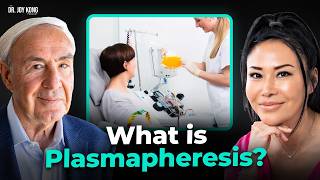
Dr. Dobri Kiprov explains plasma exchange, a treatment that removes and replaces blood plasma to treat over 80 autoimmune diseases. A recent human trial showed it reduced biological age by 7 to 9 years and improved hand strength and walking speed. About 65 percent of long COVID patients in his case series responded to treatment.
Questions this video answers
5% albumin (he stated this represents about 65% of human plasma).
Over 80 different diseases (majority autoimmune).
Reported in the 1950s in Sweden (for Waldenstrom's); wider clinical adoption noted in the late 1970s.},{
Peter Dow (identified by Dr. Kiprov as his teacher and a U.S. pioneer).
Six sessions (the clinical study arm used six treatments).
Chapters
We do know that systemic inflammation plays a major role in aging.
That's the word.
Inflammaging, inflammatory, therapeutic plasma exchange can remove these inflammatory factors very effectively. Attacks inflammation on many different levels.
So inflammation markers will keep rising even if the person looks perfectly healthy. But still they are in a state of decline. And that's one thing I think that's exciting about using plasmapheresis for longevity purposes is how to reverse that aging process and actually revert the body into a younger state. Dr. Kiproff, I am so excited to be interviewing you. You are a pioneer in the longevity field and you have been contributing to the world of health with, particularly when it comes to plasmapheresis, which has gaining popularity. People are just beginning to really understand what a powerful modality this is at rejuvenating their body, not to mention combating illnesses. So thank you so much for be speaking with me.
It's a pleasure and an honor to be with you.
Oh, thank you. So, of course, I had just gotten treatment from you. My badges of honor. Of course. The blood comes out one side and then comes back in the other side.
How do you feel?
I feel amazing. Yeah, it's fantastic. It was easy. You know, my veins usually are not cooperating, but, you know, today actually did quite well. I saw my full bag, so one and a half liters of my own plasma held in my hand. So that was amazing. So gone with old, and now we're replenishing with something that doesn't have harmful elements in it.
That's correct.
And then you can. Yeah. So, well, tell us a little bit about plasmapheresis and the history of it. Like what. What even got you interested in plasmapheresis and what is it?
First of all, as you described it, it's the removal of old plasma and replacing it in, in your case, with 5% albumin, which is about 65% of human plasma. So we clean up the old plasma, which accumulates a variety of substances that contribute to a variety of diseases and also raging. And by removing them and substituting with human plasma with human albumin, we accomplish a variety of different things, including fighting inflammation, which is very important, is basically the major contributor to aging and the major contributor to most age related diseases. So how do we do that? We do it with a machine which is capable of separating your whole blood into cells and plasma. We give you the cells back with the 5% albumin, and we throw your old plasma away. As simple as that.
Right. And somehow you mean what we have is not good. People are trying very hard to Protect what's inside the body. Right. They're always afraid to let go.
That's.
So what's going on in the blood that maybe we don't want?
Well, blood is obviously very important for life because it creates the environment, the milieu of every single cell in the body, from stem cells to your brain cells, heart and so forth. So it's critical. In addition to that, blood distributes all the food and hormones and everything that the body needs and the cells need. So it's a very important organ to have. The problem becomes later in life for most people and sometimes in younger people as well, and that is that there is some sort of imbalance that happens in the content of the plasma. So the plasma has hundreds and hundreds, probably thousands of different molecules, different proteins that circulate in the plasma. And in normal situation, called homeostasis, these are all imbalanced and function pretty well. In some diseases there is an imbalance of plasma components. Whether these are coagulation, clotting factors or some other proteins, they may cause diseases. And some of these diseases are really very, very rough to deal with. They are really deadly. So in these cases we do plasmaphoresis or plasma exchange to remove these substances that cause these horrible diseases.
And how long ago did this treatment even start? Plasmapheresis? When did we start to use them?
Probably the first plasma exchange treatment started in the 1950s of Sweden, I believe, for a disease called Waldenstrom's, where the blood gets thick from the accumulation of abnormal immunoglobulins. That's where it started in general, I think the late late 70s. It started to getting more and more popular with equipment becoming more available. Some of the early cases came from England and from the United States. Peter Dow, who was my teacher, is the pioneer of plasma exchange in the United States. So I would say late 70s.
And this is an FDA approved treatment, right, for a variety of diseases?
Well, actually no. The FDA approves the equipment we use. The machines that we use to separate blood are approved by the fda. There are number of machines approved in the United States, many more approved in other countries. We don't have all the equipment that's available in other countries. We have only limited number of FDA approved machines. But again, FDA approves the equipment, they don't approve the diseases.
Right, but does it approve the equipment for treating a certain condition?
Right. So if you're a physician, you have the ability off label to use FDA approved equipment. So how do we get to the diseases? We get to the diseases through medical associations. So American Society for Apheresis is a. A medical association that represents A4E6 in general, Plasma Exchange is part of that. This society called ASWA publishes every three years a special edition of the Journal of Clinical Apheresis where they publish recommendations. Recommendations, not approvals, just recommendations for the use of different apheresis procedures for different diseases. And they're categorized depending on scientifically published documentation that there is benefit of plasma exchange or other apheresis procedures in certain diseases.
It's interesting. Okay. It reminds me of a little bit of different therapies. Maybe even something like stem cell therapy. Maybe there's no FDA approval for certain conditions. A lot of devices, they do seek indications, but some may just be approved for, you know, for. For a certain function, I guess. And then it's up to the medical organizations to recommend whether or not it's. It's fits certain criteria, whether or not something has enough scientific evidence to be basically recommended. Yeah, so a lot of people may be confused with the different words. So plasmapheresis is the same as plasma exchange. Are they exactly the same thing?
Actually, they're not, but they're used interchangeably. Interchangeably in some way. Plasmapheresis is actually the act of the separation of whole blood into plasma and cells. That's what plasmaphoresis is.
Oh, I see.
Plasma exchange is the fact that we will perform plasmapheresis, but in addition to that, we're going to throw the old plasma away and embrace it, exchange it with a new fluid. In our situation, 5% albino.
I see. And then apheresis, because you have a company called Global Apheresis. What is apheresis?
Well, apheresis is a general term. It comes from the Greek and means to take away. However, we use it today in medicine to indicate a field of medicine which involves the separation of blood in its different components and the removal of each individual component separately, as you need it or your patients need it. And it could be done in blood banking. We collect red cells, platelets, plasma could be done in plasma centers where they collect plasma for variety of products. And it could be used to collect stem cells for transplantation, usually in oncology and hematologic diseases. And more recently, something that's very popular now and I think will become even more popular, is called CAR T therapy. These are specialized procedures to treat really bad cancers. And it also will become more and more popular, I believe, in genetic engineering. So, you know, in order to perform genetic engineering, you need cells, and these cells circulate in the blood. And we collect these cells and give them to labs where they're genetically manipulated and then brought back to the patient.
That's so interesting. Thank you for making that clear because I've been not, not sure in my head or how to connect the dots. So as far as plasma, you know, plasmapheresis, that's the, the separation of different components and, and I think it implies plasma exchange as well, right? Correct that as a procedure.
Yeah.
And what has, has it been recommended for? What type of conditions has it been helpful for?
Plasma exchange has been used in probably over 80 different diseases. The majority of these diseases are autoimmune diseases. How we call them autoimmune diseases. So basically it is something that your own immune system attacks itself and other organs. So the immune system is the protective army of the body. So it protects us from infections, it protects us from cancer and other outside invaders, if you will. So in the autoimmune conditions, the immune system fails to recognize and differentiate self from non self and it starts attacking self. And it may attack the kidneys, it may attack the brain, it may attack the heart and other tissues. And it does that by creating autoantibodies, which are proteins that attack self tissue. That's why they're auto antibodies. So these autoimmune diseases, there's a bunch of them in neurology, nephrology, in variety of different specialties. And by removing these autoantibodies from the blood, we help treat these diseases, usually in combination with other medications.
And how well does it work in your practice?
It depends. It depends on many things. It depends on the disease, it depends on the how advanced the disease is, how much damage has already been created in different organs. So the earlier you start in any treatment, in any disease, the better. What happens with plasma exchange, unfortunately, is that people don't know much about it. It's an obscure thing, although it's approved and it's being available. It's a procedure that even well educated physicians don't understand. So they ask for plasmaphoresis in difficult cases. Usually they're a last resort and by that time it is difficult to achieve great results. Nonetheless, we see some dramatic improvement in very difficult conditions where everything else has failed. So it's very rewarding. And that's why I'm here. Pretty practicing this for four years is because we have success, not in every single case, but in many cases. And many times this success is very dramatic. As I said, people have tried everything on earth. It didn't work. And they finally come to us and all of a sudden they open their eyes, they start talking Again, they start moving. That's very rewarding to see that.
And you were just showing me just a few things in your office related to patients you've treated. One of them was an athlete. Right. He was an eye condition that he couldn't see. And he was a dart player. Right. And then with how many sessions does it take for him to go into remission?
Well, he had a condition called myasthenia gravis, and I've been treating him for years. But lately, as the pictures that you showed, he's been coming periodically to get treatments. He's doing well.
Yeah. Another picture you showed me was lots of kids that were born because you helped a mother to improve their condition. So what were these mothers suffering from?
It's a difficult question, and I'm not sure I know the answer, but we have seen quite a few number of women who experience first trimester miscarriages. So first trimester miscarriages is characterized by somebody who has more than three. Three or more miscarriages in the first trimester. And the women that we see have three or more. Some have five, six, 11 miscarriages. So the majority of these ladies, we have identified autoantibodies. So they have an autoimmune condition, which is poorly defined, but they have a variety of antibodies circulating in their blood. And we believe that these antibodies contribute to the miscarriages. By removing them, either by plasmapheresis or by attacking them with medications such as intravenous immunoglobulin, we can solve the problem. And fortunately for all these women and us, we have been successful in the majority of these cases to. To help these women have children. And what you saw in the picture are the kids. I call them my kids. I guess they're not, but I feel proud that I contributed to their lives.
Yeah, that's amazing. So autoimmune condition is really the mainstay of what plasma exchange is kind of indicated for, right?
Correct. And. And inflammation.
And. And just general inflammation.
Correct.
Okay, so how do you decide that? Who comes to you for inflammation like.
Well, there are many tests today that indicate systemic inflammation. I'm not talking about inflammation where you cut yourself and you. You have swelling of the fingers and all that. But systemic inflammation leads to a variety of diseases, from type 2 diabetes to stroke to cardiovascular disease, cancer, and so forth. So systemic inflammation can be measured with a variety of laboratory tests, blood tests, usually biopsies if needed, and all that. So we do know that systemic inflammation plays a major role in aging.
Yeah, that's the word. Inflammaging inflammagic. They're hand in hand.
Exactly. Inflammation and aging. And I think that this is the so called longevity medicine attacks that inflammagic. So how do we attack inflammation? Usually a single drug doesn't do the job because it's a very complex physiologic process or pathophysiologic process. And we know that therapeutic plasma exchange can remove these inflammatory factors very effectively and attacks inflammation on many different levels.
Yeah, right. So inflammation is accumulating as we age, whether or not the person has any disease. So inflammation markers will keep rising even if the person looks perfectly healthy.
Correct.
But still they are in a state of decline. And that's one thing I think that's exciting about using plasmapheresis for longevity purposes is how to reverse that aging process and actually revert the body into a younger state.
Right, correct. That's the goal. And by doing so, we expand the health span of people. People in general are healthy over many years until certain age comes and then they start developing diseases. In the United States, this border of health and disease is around 65, 70 years old, maybe a little earlier. So at that point the health span is interrupted. People start getting diseases and fortunately or unfortunately, we keep them alive because medicine has made tremendous progress over the last 50, 70 years. So we know how to treat these diseases. We don't know how to cure them, but we know how to treat them. Unfortunately, we prolong the life of people with these diseases, but they're not healthy, they're non productive, they're not very happy, they are suffering and it takes an enormous amount of money to keep them alive. So it is a problem. So the goal of the so called longevity medicine, it's a word that I don't like at all, but the goal here is to extend the health span to have people develop these diseases, if at all, over long, you know, longer health span. So if we can prolong the health span of people with two, three or five years, it will add tremendously to their productivity in life, happiness and living a good life. Because people with injuries and these diseases that I mentioned, they don't live a good life. It's suffering with 72 pills every morning. So that's the goal.
Yeah, yeah. Fantastic. And that's, you know, most people I talk to, they say, I don't care how long I live, I just want to be healthy. So. So that's really the goal. That's what I was trying to achieve.
Yeah.
So I'm curious, you are a Harvard trained immunologist Right. And you are treating people with all kinds of severe illnesses. So what happened that all of a sudden you got into the longevity space? The words you don't like, but the, the, the promoting health rather than curing diseases. So what promoted that shift in.
And yeah, as I mentioned, I don't like this word. You know, the longevity word is. I know it's getting now popularity and I'm a beneficiary of the popularity, but the truth is that it is, it is health. Patty. I have been a proponent of healthy living and there are. Before plasma phoresis, there were two scientifically proven approaches to healthy living. One is the Mediterranean diet and the other one is exercise. These are all scientifically proven with clinical, controlled clinical trials. Now we can add plasma floresis to that because we just finished a controlled placebo controlled clinical trial in plasmapheresis. So we know that this contributes to extending lifespan.
What did the stats show?
Study showed variety of different things.
Is it an animal study or a human study? It's a human study. Okay.
It's the only human study in longevity I see that is clinically controlled.
Okay.
So I think that the most significant finding was that the biologic age of the patients who were treated as opposed to the non treated one, the placebo control, their biologic age was much younger than their chronologic age. And actually we have the ability to identify the biologic age of different organs. Not only the total body, but the different organs. Brain ages differently than the kidneys and the heart and so forth. So we can clarify every, every organ's biologic age. And we showed that the immune system rejuvenates. Rejuvenates seven to nine years better than, than the non treated group, you know, the placebo group, which did not get the treatment. So the results are very encouraging. We'll continue to do more research, but so far the results are encouraging. And overall now we have the Mediterranean diet, exercise and plasma phoresis that can really extend your lifespan. Not necessarily, but you certainly your health plan.
Yeah, I was actually. So I guess the nurse who was conducting the therapy for me, she actually went through the study herself.
She's the best nurse in the world.
She's amazing. Yeah. But she was telling me she had frozen shoulder, right. And that went away and she had thinning hair and she was really worried about that. And that started to get better and better.
Right. There are a variety of symptoms that come with aging, not necessarily a determined disease that are influent there due to inflammation for sure. And they respond right Away to the plasma exchange. You know, usually Rhea arthritis that she had. Other people have that we had patients with autoimmune alopecia, which is autoimmune conditions that leads to loss of hair. The effect is dramatic. They lose pieces of hair, and all of a sudden it grows back. It's amazing.
That's beautiful. And how many sessions would that usually take?
We are still working on that. I think that different diseases, different people require different number of sessions, Usually between three and six.
I see. What if someone just comes to you for rejuvenation? Just want to stay ahead of the game, you know, maybe get a little younger. So how. How many sessions would you recommend?
In the clinical study that I just described, we used six sessions. This was based on preliminary studies that we did with at the University of California in Berkeley that indicated that there is a cumulative effect of osborpheresis. The more treatments we did, the more changes we saw in the different. In the different parameters that we measured. So six treatments is what is generally recommended. I think that what we found in the current study is that the. The first two or three treatments are the most effective.
Okay, and these treatments are usually a month apart?
Yes, we had three different treatment groups. One was a month apart. The other groups were two treatments per month for three months.
Okay. Okay. So which one did better? The one that's farther apart or closer together?
Well, interestingly enough, it was not. They all improved. They all improved. But the group that received, in addition to the plasma exchange, intravenous immunoglobulin, which is part of the normal plasma. So we added a small amount of. It's called ivig, Intravenous immunoglobulin. We added a small amount after each procedure. Had this made a big difference?
Okay, can you explain the ivig? People talk about that a lot these days. What do you think made it so popular? And can you tell us a little bit about that and the difference between that and the plasma paresis, or are they often given together?
So intravenous immunoglobulin is made from plasma. Immunoglobulins are major component of human plasma, and they are very important for the immune system. That's why they're called immunoglobulins. There are four different kinds, and the one called IgG is the most prominent one. And I don't know if it's the most important, but certainly a lot of the autoimmune conditions are associated with autoantibodies of igg class. If we want to get deeper into this, there's IgG1, there's IgG2, there's Ig3.
So when people talk about IVIG therapy, which one are they using?
So the intravenous immunoglobulin is a preparation, pharmaceutical preparation, from plasma. It predominantly has IgG in it, but it has small amounts of IgA and IgM, right. The other immune. So initially I started using small amounts of IVIG as a replacement. So we remove plasma and we remove everything that's in it. We use as a replacement fluid 5% albumin, that's 65%. So we accomplish that. But the immunoglobulin is very, very important for your protection from infections and so forth. We are not replacing those. So I said, well, if we infuse a little bit of ivig, this gets closer to normal plasma. So that was the initial idea. I didn't know that it will have such a profound effect on DNA methylation. That's how these biologic age clocks work. But it did. And I. I don't have the exact explanation of how this works, but there is something, and we getting a little off label here, but there is a study that was published From Johns Hopkins Dr. Bob Montgomery, a famous nephrologist and renal transplant physicians. He used plasmapheresis followed by relatively small dose of IVIG to treat renal kidney rejection very successfully. So again, I don't think we know exactly the mechanism. The idea is to suppress the immune system. That's why people use a very high dose of ivig. So that's another different mechanism and it's very complicated. I'm not going to go into it, but there are different ways to use ivig. One is to use very high doses to attack autoimmunity. So it causes immunosuppression. I believe it's more immunomodulation rather than immunosuppression. But these are semantics. And the way we use it in combination with plasma exchange we use with much smaller doses, which is obviously much less expensive, works really very well both for renal transplantation rejection as well as in longevity. I wish I knew the exact mechanism of action. There is definitely influence on the different immunocompetent cells. There are cells in the body, in the blood, that have a lot to do with the immune system. So we know that we influence those in a positive way and there is a replacement of antibodies, but that's as much as I know at the moment.
Does it help with fighting acute infections?
Well, it theoretically does. I don't think it's being used universally to do that. It's being used in patients who are born immunodeficient, who are born with very low or absent icg.
Okay. And you've also used plasma exchange to help people that's recovering from long haul Covid. Right. So is that, is that something you want to talk about?
I'm blamed of being the first to use plasmaphoresis for long Covid and publish it. We've published that and we did extensive studies of why plasmaphoresis helps in this condition. Having said that, long Covid is a very complicated disease and I don't think we know much about it. And the reason for that is that long Covid is a political disease to a certain extent and there isn't much information about it because it's not being studied, because there is no, no financial support for the studies that are necessary. There are people who believe that long Covid is not a single disease, but several diseases. So it's a very complex matter. Unfortunately, there are around 30 million people that suffer from this disease around the world. There is no treatment for it. Therapeutic plasma exchange helps some of them. We have published our results in small group of patients, about 65% success rate, which is better than nothing. But still it's an issue. One of the problems that we see, especially today as opposed to three years ago, is that people got infected three years ago and had symptoms and come and show up three years after the disease started. So there is already so much damage the disease has caused that it's difficult to predict where they're going to respond at all. One thing we know is that it's certainly there is an autoimmunity in long Covid. One common symptoms is affecting peripheral nerves. It affects the brain as well, but peripheral nerves is common and we are fairly successful in treating that part of the problem.
Okay. Yeah. So I remember you said you had significant success for people who come to you for these long Covid symptoms.
The earlier the better, the better. When they come up three years after they started, their chances are markedly diminished.
I see. And usually, how many sessions does it usually take for people to start noticing a difference?
It varies. It varies. Some people will respond right away with maybe two, three treatments. Others will take six treatments. Some will respond and they will come back because the disease exacerbates again. It's definitely not a cure, it's a treatment. And until we know more, more about the disease, I don't think that we'll have a proper treatment.
And I want to come back to the subject of longevity. The Happy subject, keeping people healthy. So I know you worked with very well known researcher Dr. Irena Convoys, who was the one that was first designed the famous experiment of sewing two mice together, the young and old. The younger mice started to manifest symptoms of being old and the older mice start to seem younger. So that was a landmark study. And so you also, you know, a lot of people thought that it was because the younger mice has something in the blood that's magical, that's helping the older mice. But we're just discussing that, that's not the new perspective on the phenomenon. So can you talk a little bit about what you think happened when these two mice are sewn together?
Well, there are a lot of things that happen when, yes, I don't really.
Like, you know, yeah, I love animals and you know, mice, you know, still. But anyhow, so the experiment happened. The two animals had direct.
The first thing when I discussed this, the first thing that I mentioned when I discuss this is I remind people you're not a mouse. So everything that happens in experimental animals may teach us a lot of different basic science things, but they're not immediately applicable to humans. The human body is unmatched in its complexity. There's no mouse that can come close to what the human body is in the complexity. So a lot of things that happen in mice and can lead us to certain conclusions and to try to mimic that in humans, but it's not going to be the same and the same with the experiment you're referring to is called parabiosis. And parabiosis is obviously impossible in humans. You can't do that. But so several years after I work with the, with the convoys on the subject, I publish a hypothesis that plasma exchange can be as close as we can get to parabiosis issues. Again, to get back to your question of finding the silver bullet in yarn blood, I think I mentioned that to you earlier, there were millions of dollars spent and a lot of very capable and brilliant scientists have been looking to find this silver bullet. And now it's 20 years later and there is zero evidence that this exists. I'm not saying it doesn't exist, but what I'm saying that so far nobody has been able to identify them. What we have been able to identify are substances that contribute to aging and inflammation in older people and in our experiments with humans at a certain age. So we know now that if you compare the plasma components in people at age 20, 30, 40, 50 and 60, there is a difference. And by age 40, 45, the plasma components keep changing, there is more accumulation of certain factors. And we can identify plenty of them that contribute to a variety of diseases, primarily by inflammation and other accumulation of other factors that contribute most prominently to Alzheimer's disease. If you look at the plasma of patients with Alzheimer's disease, you will find all kinds of bad stuff. So removing this bad stuff with apheresis, which the word means to take away, is helpful. Is that the whole answer? No, it's not. But as Irina labeled, this process is dilution. So when you connect the two mice, their blood is diluted either way, Both for both mice. So this dilution diminishes the bad factors. And some people say, well, in the.
Older mice, it lose the bad factor.
Yes, but the idea is, can we add something to that process to rejuvenate? We haven't been able to identify that at this point. It's mythology. And what we do know, and people ignore the fact that the young mouse became older. Nobody talks about this because it's not a pleasant subject. Everybody goes, oh, the, the old mouse became younger. Well, how about the other way?
Yeah, yeah, right. So what is in the older mouse blood that's making life so much more unpleasant?
Well, and, and we do know we have been able to identify over the last 20 years a bunch of molecules that cause aging and cause inflammation.
So can you give an idea of approximately how many molecules that are pro aging and are dex metal?
Well, probably. Probably more than we know. I mean, we discover all kinds of molecules that cause aging all the time. The most Recent one is IL11. I'm not going to get into this, but now it's conversational subject, and people want to make a monoclonal antibody to kill Heil 11. How about the rest of them? Right, so it's complicated.
Right. It's like a whack a mole almost. Yeah. So Alina from generation lab actually gave a really nice analogy. She was like, she said, well, think about a truckload of tomatoes, and some are rotten and bad. So do you want to make the whole truckload better by throwing more fresh tomatoes in there, or do you want to remove the rotten ones so the. So the truckload can be better? Right, so that was a great analogy.
Good analogy. Yes.
Yeah. Yeah. So with the plasmapheresis process that, you know, what I saw was that my blood was going through the machine and the plasma was separated out, was taken away, and then you were giving me fresh albumin. And then that got, you know, basically connected or combined with my blood cells, and I gave them back to me. And so I got this whole bag of just my own. My own plasma. So just that simple act itself has profound rejuvenation effects. And. And the. The research, when it comes to longevity, what parameters did it show as far as people improving and benefiting?
So we mentioned the biologic age. So this was the main parameter that we found improving. In addition to that, we had clinical parameters that we followed, and one was strength, hand strength, the other one was speed of walking. And there are approved methodologies to do these things. Balance. We measured balance. Balance is extremely important for old age. There's a lot of debts and problems come from falls, injuries, and so forth. And we used a variety of questionnaires that are given to AI to examine. So we did a variety of clinical parameters, and we showed statistically significant difference in the treated versus the placebo patients.
Yeah. Wow. This is such an incredible discussion. So happy to learn from you. You're such a pioneer and have trained a lot of providers and done a lot of lectures internationally. So it's amazing to be sitting next to you and learn from any parting words of wisdom that you can share with people who have followed the conversation this far.
Stick to the Mediterranean diet and exercise every day. Doesn't matter what exercise. Not at all. Whatever you like. Like tennis, pickleball. We had a Chinese lady last week, and she's been coming here, and after each treatment, she asked me, can I go and play pickleball now? She's 83 years old. It looks, you know, a little fragile. She goes and plays every day. So if you like that, do it. If not, just walk.
Wonderful. Thank you, Dr. Kiprov.
You're very welcome.
Oh. So how do people find you? Because you're in the Bay Area, right? I guess. Is this in San Francisco? Are we in San Francisco?
No, we are in Milwaukee.
A gorgeous place. Yeah. Incredible view from your office. So. And what's the best place where people can find you?
Globalafreezes.com yes.
Wonderful. Thank you so much.
You're very welcome. Pleasure.










