The Power of Stem Cell Therapy | DR. JOY KONG, Stem Cell Expert
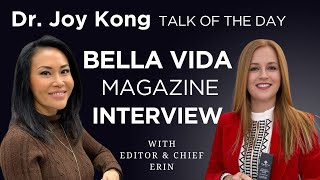
Dr. Joy Kong explains how mesenchymal stem cells work: not by becoming new tissue, but by reducing inflammation and modulating the immune system. She argues that younger stem cells from umbilical cord and placenta are more effective than cells taken from older patients, and describes applications ranging from autoimmune disease to organ damage.
Questions this video answers
Chatsworth, California.
March 13, 2024.
JoyKong MD.
joykongmd.com (also cited variants drjoykong.com / drjoycon.com in the transcript).
American Academy of Integrated Cell Therapy (AAIC).
Chapters
I am the editor in chief of Bella Vita magazine and I'm here today with Dr. Joy Kong. She has a lovely clinic up in Chatsworth, California and she's here to tell us more about stem cell treatments that they do. And it's very exciting. Thank you for joining me today.
Yeah, you're so welcome. Yeah. Thank you for coming in. Yes. As we were discussing, there's so many, so much about the science and how it can apply to individual cases because some people may have genetic changes and defects and some people may have toxicity and damages. So even with genetic issues, it's not so much that we can correct the genes, although some cells may stay in the body and may in a sense correct the gene pool a little bit. But it's such a tiny portion of how the cells work. The cells are very anti inflammatory. They actually shift your immune system and promote, trigger your local stem cells to start dividing and replenish the local tissue. That's how the regeneration repair happens. And numerous research has shown over and over again it's not because the cells are dividing and differentiating, forming new tissue. It's because the cells are telling everything around it and telling all the other cells. First of all, clean up the debris, get rid of the cells that doesn't work and then start repopulating, make more of your healthy self. And so that's how the regeneration is happening. So even with genetic problems, a lot of times people's problems happen as we move on in years. Right. It doesn't manifest right away, it's teenage years, they start to accumulate. So a lot of times, if you can trigger the cells to produce younger cells, it hasn't accumulated a lot of the genetic issues. And that's how people can do better. But also stem cells can address the downstream problems that's created by genetic diseases. Because genetic diseases itself, just because the genes are not correct doesn't mean the organs can't function properly. But it's because the genes, gradually all the different organs involved are damaged and that's why people are getting sick. So if you can use cells to actually fix the damage so you don't go correct the genes upstream, if you can just correct all the downstream damages, all of a sudden the person's doing better. Of course, at one point we're going to have gene editing and all that stuff, but we're not quite there yet. Right? Yeah.
And so tell us where the stem cells are coming from. I know there's this hot topic, right. And there's a lot of controversy. So where are you Sourcing those.
Yeah. So I've been a, you know, kind of educator in the field, trying to tell people, you know, really, if you're deciding what stem cells to give people, then you need to pick the one that works the best, that's the most effective and the safest. So you can either get cell from your own body or get cells from younger sores, like the umbilical cord. We don't deal with embryonic stem cells. Those are not even legal in the US and they're not the safest either because it can cause new tumors. And. But so we're facing whether or not using a person's own or using something like from the birth tissue, placenta and umbilical cord. So when I started in the career in this stem cell field eight years ago, I went to read all this literature looking at comparisons across the different tissue sources, what actually works better. So I have a YouTube video called Our OMSCs Created Equal. So I show people the evidence that in fact they are not equal. The birth tissue stem cells, the MSCs that we're talking about, mostly that's the most popular type of cells right now. Those cells, when you get from a person's own, not only they're less potent, they have accumulated more changes, they are older, they don't have as long of a telomere, they have more, just more toxicity built in, and they're not secreting as many growth factors and you know, they're just not. Not as potent. Not only that, they're also not as safe because they have lost some of the capabilities of recognizing cancer. So we all, you know, have cancer popping up here and there, right? That just, just the fact of the human body in existence, but our immune system, if it's strong, it can get rid of the cancer. The problem is that these older stem cells, and if they, one of their major properties to help with growth, they do secrete a lot of growth factors. But if they don't retain the intelligence to detect cancer, they're just telling everything to grow. So if somebody has existing cancer and you just put all these, your own older stem cells in your body, you could exacerbate existing cancer. But if you use younger sores, like the umbilical cord sores that I use in clinic, and not only is a lot more potent, it's just much younger, much more vibrant, it can differentiate in more directions, it can send more signals, and it also has the ability to recognize cancer. So in fact, it has been used as a cancer treatment. So it can, you know, I Think it's, you know, safeguard your body in a sense. So there's a big difference. So the. Once I decide what's the best source, right, the umbilical cord, the birth tissue is the best source, then the next step is how do we get it? What kind of production, what kind of product will be the best? Because there are companies who are producing different types of products from the birth tissue. But some people only use umbilical cord blood, which is very similar in composition to the bone marrow. And some people only use the cord tissue, but which is mostly called Wharton's jelly. It's a gelatinous material that's wrapping around the arteries and vein in the umbilical cord. It's full of mesenchymal stem cells. It's just packed full, you know, packed with mesenchymal stem cells. So some companies only use those. And then there's amniotic membrane that. The one that's wrapping around the cord, that's also full of mesenchymal stem cells. So what I did in, you know, that's kind of innovative in the field, it's that I'm getting cells from all three sources, because I've seen great clinical evidence of how studies are utilizing one of the three sources and getting really good results. But no one source of cells is good for everything. So what I decided is that God created everything for a reason. And whether or not you believe in God, you know, can call it the universe. They're there for a reason. So who am I to pick and choose? So I'm gonna give people everything. It's the same thing as giving people one chemical out of an herb or give you the whole herb, because there could be hundreds of molecules that all interact together and are synergistic. So that's what I'm looking for, and I'm trying to tap into the intelligence that are in these cells.
That's all so fascinating, and I know people would love to know. Sumer, what are some of the disorders that stem cell therapy could really potentially help with?
Yeah, so, first of all, there's only one condition that, say, stem cell therapy can treat, because that's the only one with FDA indication. And that's when people have blood cancer or some kind of blood disorder, they can wipe out their own immune system, basically with drugs and then transplant stem cells. So the bone marrow transplant, that's one example. But they can also transplant umbilical cord blood, which is very similar to the bone marrow, but actually, because since they're younger, you don't need you don't even need matching. You know, matching is a unmatched umbilical cord blood will have less side effect profile than a perfectly matched adult bone marrow. That's how different young cells are. So people don't realize when cells are younger, they're more able to adapt to the host body. So coming back to the question of what conditions, I actually have founded an academy, American Academy of Integrated Cell Therapy. A lot of the cases I posted there, so aaic, so the case studies, there's a whole range of cases. Most of them are my patients. So, you know, I've some of the cases, people will come to me with all kinds of strange conditions like testicular swelling and repeated infection or some, some, you know, plantar plate injuries and you know, some odd even mitochondria diseases. Things that there's not much information on, you know, in the literature. So, so those are things that I just have to experiment on and see how people do. And because I know how the cells work. The cells are anti inflammatory. They shift your immune system from a more inflammatory to anti inflammatory state, boost your immune function. The cells can also enhance your vascular formation, so provide more nutrients and oxygen to the tissue. And the cells can also break down scar tissue. So like people in the cases of COPD or liver cirrhosis or even thyroid nodules, I have seen people's condition getting much better and nodules going away or the testicular nodules. So the anti scar properties breaking down the fibrosis and then it has properties that can protect the cells from dying because in some injuries neighboring cells may end up dying. But these stem cells can rescue the cells that don't have to die just because they receive certain signals like in stroke or crash injury, chemical injury. So a lot of times cells don't have to die. So you can rescue cells. But there's also anti cancer property. So the cells have direct anti cancer capabilities of triggering programmed cell death to literally tell the cancer cells to die. And then they also have antimicrobial properties setting up antimicrobial peptides so to kill the microbes. And then it can also transfer mitochondria. So it has these fresh new mitochondria. Especially if you use cells from the birth tissue from the younger source, right? If you use it from your own, that's your own old tired mitochondria. But if you use younger cells, then they have young vibrant mitochondria. And those cells can also transfer those mitochondria and help elevate your own cellular energy. So because I know how they work. Then if a person comes to me with a condition that even if there's nothing in the literature that I can tell, well, this is how the cells may be able to help by knowing how the cells work. That's how we know what conditions that it may be helpful for. But as far as clinically, I have seen patients ranging from, you know, five year old autistic kids to someone in the 80s with dementia. So anywhere from autoimmune diseases. So all full range of autoimmune conditions. That's where the research is the most robust. And also any muscular skeletal problems, all internal organ issues, lung, liver, kidneys. We've seen benefits in all of those. We've even seen enhanced fertility for, for women. And of course, helping with the male wellness. We can inject stem cells directly into the sexual organ or even just through IV infusion. We've seen benefits in people. And of course neurodegenerative conditions, traumatic brain injury, heart disease, chemical sensitivity, Lyme disease, different infections. So very broad range of, of how the cells that we can see. The cells can help. It really is because the cells have its own intelligence that somehow we don't even know how it helped. We're still trying to understand. So the intelligence is so powerful that we can give it to you, but we don't know how it did it. That's how beautiful it is. That's why it's so exciting. It's inspiring to provide these treatments.
It's miraculous in some cases. I think that people are. What I saw was having a big turnaround, right?
Yeah.
So how can people learn more and how could they contact you to learn.
More about stem cell? I think one really good place to learn about stem cell treatment is actually on my YouTube channel because I do so much education. So it just stop. Joycong MD so that's my YouTube channel. Just.
And Kong Kong just in case.
Like King Kong. Yes. And. Or just look at my website, joykongmd.com it has everything that I'm doing, including the education I'm providing to a lot of doctors and the stem cell company I started, because I want to make sure that we're actually giving people something that has the broadest range of action. So the most comprehensive but also highest quality, the most potent so that I feel like have accomplished it. And also I produce a skin cream to that help with skin regeneration that has stem cells and peptides and you know, it's 100% natural. So all these different things I'm into, it's all on the website joycomd. And I also wrote a memoir called Tiger of Beijing, and the information on that is there, too. So I'm into a lot of things because, you know, life is full spectrum, right? And that's what I'm doing in the clinics to give people this full spectrum of treatment. I'm not just addressing one thing. I'm gonna give you everything that life encompasses so the cells can do that. But then also there are other aspects. Nutrition, detoxification, hormone issues. And there are a lot of things that we can wrap around a patient to make sure that stem cells are going to function in a maximum way, because we're not going to ignore all these other factors because we're a little universe. This body is miraculous. But there are so many factors that's coming in. I call it a world web of relationship. So in Western medicine, one problem is that they were addressing linear relationship. They were always looking at A to B. But what if we're dealing with a system that's a web? You've got everything affect each other. So you've got to use a system approach, and that's what stem cell therapy can do. That's wonderful.
Thank you so much for all of that. And to learn more, please go to.
Dr. Joykongmd.com either drjoycon.com or joyconmd.com Got it. Okay.
Thank you so much.
Thanks. Thank you for being here. Yeah. Thank you.










