Unlock Your Body’s Natural Healing Powers With Stem Cell Mobilization | Dr. Christian Drapeau
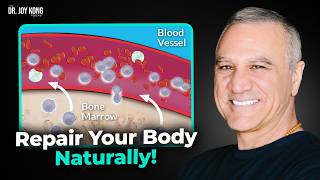
Dr. Christian Drapeau discusses stem cell mobilization, a technique using plants and algae to trigger the body's own stem cells into circulation. His product Stemregen Release reportedly increases circulating stem cells by 80% within three hours. Early data shows improvements in heart failure and Parkinson's patients, including a small group reaching normal heart function after six months.
Chapters
If you look at everything in stem cell research literature, it's very clear that there's a direct link between how many stem cells you have in your bloodstream and your body's ability to repair. Either if we're looking at how many stem cells naturally have in your blood, or increasing the number of stem cells, regardless of what you're doing, the output is going to be how many stem cells you have in your blood, and that will determine your ability to repair.
Hello. Welcome back, Everybody, to the Dr. Joy Kong podcast. I am here to serve you, to help your health to be the most vibrant possible by inviting great guests. And today I have the esteemed Dr. Christian Dropoux joining us. Dr. Drapeau has been a guest here before, and people absolutely loved the episode we had. And you have some new developments in the things that you're bringing to the world. So I'm really excited to bring you back so you can share more with the world.
Always a pleasure to be with you, Joy. Thank you.
Yes, you're a fantastic human being, period. So I'm excited to share to my audience what you have created. So first of all, I want to introduce everybody to you a little, a little bit so people understand where you came from. You're actually Canadian, right? You're French Canadian. You had a degree in neurophysiology, and then you authored various articles in the field of epileptogenesis, so the genesis of epilepsy and stem cell research. And you created new therapeutic approaches called endogenous stem cell mobilization. And you are the author of best selling book Cracking the Stem Cell Code, which I have read and is an excellent book. Let's just dig in first, about your interest in stem cells. How long ago was that that you got into stem cell research?
I got in stem cell research in 2001, and it was not an interest. I mean, I'm assuming I was going to say probably like you. No. Maybe it was a little bit different. I did not have an interest in stem cells in the sense that it was too early. Stem cells were just at the time known to be just precursors of blood cells. But in the very early days of stem cell research, I was trying to explain how this blue green algae that I was working with, I was trying to explain the mechanism of action behind the broad variety of benefits that we were seeing with this plant. And we just could not explain why some people had much better function of their heart, other people their lung, other people their liver, pancreas, their brain. We just had no explanation until the first discoveries on stem cells, meaning that your own stem cells can become cells of all these tissues. So in this attempt to understand what was the mechanism of action, we had this wild idea. What if stem cells were the repair system of the body? And what if this plant was stem cells? So we bought a flow cytometer to count stem cells, and making the story short, we discovered that that plant was releasing stem cells. So that's really my introduction to stem cell research and how I started. Hmm.
Okay, that's great. That's. That's a good, good, you know, interesting journey because it really started with trying to understand a particular plant that, you know, has been very beneficial for people's health. And it's cool because you were early in the journey and. And you're still trying to figure out, you know, connecting the dots. Yeah, that's really cool. And then how did you evolve that into a product that apparently has helped a lot of people?
Let's rewind. We're in 2001. I'm trying to understand how this plant, this blue green algae, is working. I'm witnessing a lot of benefits, but without a real understanding of how it works, it's hard to draw, you know, significant conclusions. And at the same time, you hear stories, but. But stories are not studies. So they're just cases. So it's very amorphous. Like, I know that there's something interesting there. I don't know the magnitude of it. And then we discover this plant is triggering the release of stem cells from the bone marrow. So we derive an extract from it that is working well, that is fairly potent. But at that time, it's really just an idea. I have a product that in the lab we can show put more stem cells in circulation. I think stem cells are the repair system of the body. I think, well, more stem cells in your bloodstream should be better for you, but these are all, like, hypotheses. So at some point, I shipped maybe, I don't know, 200 bottles to a friend of mine in France. And he was working as a sort of alternative. It was not a doctor himself, but working in some alternative medicine. And he had patients that were in terminal phase in all kinds of conditions. So I told him, well, share it with your people and tell me what you see. And the results that came out from that. It's not even a study. It's just like a preliminary investigation just to see what kind of stuff would come back. And we had, like, a woman on 18 hours a day on oxygen tank with severe, severe emphysema in 2, 3 months. She was essentially like a normal 70 year old. We had people with severe heart disease that basically resume a normal life. We had a young girl with spinal myopathy that had never walked, and suddenly she started to walk. So the stuff that we saw coming back was just like, I remember in that time thinking, my goodness, like, we can put an end to disease with this, you know, with stem cells. So it. It sucked me in. It completely sucked me in. And I dove into everything about stem cells. And so in 2005, we launched the first product, my first product on stem cells, which was essentially just this blue green algae extract. But my interest was we have evolved in symbiosis with the environment. It's not possible that there's only one plant having an effect on stem cells, just like many plants have an effect on the immune system. Well, there must be many plants having an effect on the repair system. So how do you find them? So I simply start to look at what else has been associated over centuries to a broad variety of health benefits. Immediately, you would think medicinal mushroom, goji berries, seaweed, ginseng, those kinds of things. So we tested just about everything. Almost all the plants that are understood as being good for many things, they all have some sort of an effect on stem cells. But the real discoveries is when I had a chance to go to Madagascar, Tibetan Plateau, some remote areas, where we really found plants that. That really had a big effect on stem cells. So then as the years moved on, I started to develop more and more of these blends. And I realized at some point that this concept of endogenous stem cell mobilization, releasing your own stem cells, will never become a thing on the marketplace, will never be accepted, unless or until it is utilized by the medical profession. So I then decided to sit down and, like, regardless of cost, to develop what would be the absolute most potent product that I could do for stem cell mobilization so that I can start to work with the medical community, people like you. And that's how stem regen release was developed. So the product that I'm working on right now was developed so that we can kind of really document that your own stem cells in your body are potent. They can be really effective if we can simply trigger their own release from the bone marrow. Mm.
And you've done some research on how these stem cells, these products work?
Yeah, I mean, every single ingredient, the product itself is a little bit complex. I'll get back to that in a second. So as we're studying all these, study them one by one.
I actually really like the backstory of how you discovered them. So you actually got to travel, right, which is fun, right? You went exotic places. What a good excuse. So you went to Madagascar, the Amazon rainforest. Right. And then, and then China. Where else did you go?
I mean to look for plants. Tasmania and I think right now, I mean I've been to many places in Southeast Asia, but I don't have today. I'm working on plants right now, but I don't have any of those plants in any of our products right now. Coming from Southeast Asia, Thailand, Malaysia, they have some beautiful plants that are virtually unknown that could really help various aspects of human health. So I'm working on that, but they're not in our products right now. So yeah, Tasmania, Tibetan Plateau, Madagascar, South America, these are the countries where we have found cool plants.
And how many plants did you end up putting in your formula of the first, the initial stem regen production?
So there are five plants that are aimed at triggering the release of stem cells from the bone marrow. So each one of them is studied separately using crossover placebo controlled double blind studies. So a patient comes in the morning, or a participant, I should say, rest for an hour, we take a blood sample, then we give them placebo or a product we want to test. And then an hour later, two, three hours later, we take another blood sample and then we count the number of stem cells in these blood samples to using flow cytometry. And the person comes a week later in the exact same time, day, same circumstances. And then we give them the plant or the placebo, whichever the person did not get the week before. And we do the exact exact same process and we use the placebo to establish the circadian cycle of that person with regard to their stem cells. And then we can see what's the difference that the plant is doing in terms of releasing stem cells. So that's how we determine the effect of each plant. And as we move forward, we discovered that some plants, like take, take medicinal mushroom for example. I was expecting medicinal mushroom to increase the number of stem cells and we thought we saw the reverse. They actually trigger a sudden drop in the number of stem cells in circulation. And as we continue to investigate all of this, what we discovered is that the polysaccharides in medicinal mushroom actually trigger a sudden increase on the receptor that stem cells have on their surface to listen to the signal from an injured tissue. So if the stem cell is more receptive, meaning they can leave the bloodstream more effectively to migrate where they need to go to repair. So as soon as we started to document those kinds of plants, it became obvious to me that even though in pure academic science right now research, migration of stem cells is not very well documented. It's not really a thing, but we saw it. So it's clear to me that if you want a stem cell, let's say to go and rep. Repair your liver, well, it needs to leave the blood and go into your liver. So migration is one crucial step. So the thought is let's release stem cells and then let's put these polysaccharides that will then push these stem cells to migrate into tissues. So the product now is a complex product that does will. That will do both release of stem cells and then migration into tissues. So the best way to test the effectiveness on the product is not to go into actual clinical conditions, which is what we have started. So we have an ongoing project right now, unstable chronic congestive heart failure. So we have people that are at least two years with an ejection fraction less than 45%. And then so far, this is preliminary data, but so far on 10 patients, 10 of them, like all of them, after six months have regained normal heart function. They have at least 50% ejection fraction.
This is by taking which product? Stem regen release one that increases, I think, the number of circulating stem cells by 80%. Right?
Correct. I mean, it's 80%. Just to. Just to put that in context, what that means, because when I started all of this, I tried to report the data as conservative as possible because the idea itself was already not accepted. I was so much resistance just for the concept that your own stem cells can work, that releasing your stem cells can really mean something. I mean, there was so much resistance that I didn't want. I thought I could not afford being challenged and being caught with data that would just sort of, yeah, be. Be just positive. So I went super, super conservative in the data. So when I say 80%, I mean after three hours, I can see that I have 80% more stem cells in the blood circulation. But these stem cells that are released, they migrate in tissues after they're released. All I'm doing, I'm taking a snapshot after three hours, I have no clue how many more have been released that may have disappeared from the blood to go and migrate into tissues. So an area under the curve would be a better quantification. So when you start to now quantify the area under the curve in terms of released, it could easily be 300% increase. So at some point down the road, we will do some of that work. But we still continue to say 80% is what we can show. Just because that's the data that we have quantified and that's the number that we have. But it's by far an underestimate.
That's great. And you said just with that one product, 10 out of 10 cardiac patients saw improvements.
Correct. And then we started another one on Parkinson. And so I need to analyze some of the data that we just got. Again, preliminary data, because the project is ongoing. But on the first set of like four patients, which is not a big number, but the data was very interesting. We had, after, I believe it was four months, we had 50% reduction in motor symptoms, 36% reduction in depression, using the Beck scale for measuring depression, and about 56% improvement in quality of life. So now we have way more patients in the study. I think we're close to 10 or 12. So. So I have more data here to dissect. Again, preliminary, but just as a follow up, we are preparing another one on copd, another one on liver failure.
So within six months, these people were noticing these degrees of improvement. And this is with only the stem, the stem regen release, Correct?
Correct. Correct. The Parkinson s, at the time of the data analysis that I just shared with you, that was after four months, three or four months. So, but, but, but the study is six months. We were just in the early days of this study. So we have new data near that now that I need to go back to. But, but just, just to say stem cells can go in the brain, can help support brain function as well. And we have no intention here of claiming or stating stem regen is good for heart disease. We will never do that. This is not the aim. The aim is to show releasing your own stem cells means boosting your ability to repair. Your ability to repair at 50 or 60 years old is not the one that you had at 20. The problem that you have today, you did not have them at 20. One of the main reason is that at 20 you had way more stem cells that were repairing and would not let the problem develop. So if we can put more stem cells in circulation, they will do the same thing that they did before. They will repair. Here's what it means for the heart, here's what it means for the brain. And then we'll do the same thing with the lung, with the liver. And at the end it's just to show, to demonstrate that indeed the stem cells that you release from your bone marrow can go and do repair in the body because at the end, I don't want this to be for heart disease or for, for emphysema, because then it becomes medical. And what I'm trying to do here in the whole world of longevity medicine, biohacking, health optimization, is to give an option to people who are healthy today to keep their health for decades to come, instead of saying, develop a problem and then we'll start to repair it. So I really try, I'm trying to guide all this message to be for health optimization and health maintenance.
Yeah. And then you said you did some other studies, including liver. You mentioned a few, I interrupted you.
We're preparing them. So we're now in the process of finalizing the protocols. So we developed a clinic with a good colleague of mine in Madrid and he's a cardiologist. So we started the heart study. So we then started the Parkinson's study with a colleague of his neurologist. So we're using the facility that we've developed to do this now to just branch and basically do the same thing for COPD emphysema. Do the same thing with a fibroscan and different tools. Probably a CAT scan for liver and then probably colitis as well. For now, that's probably what we'll be looking at.
Yeah. So we talked a little bit about the mechanism of what happened with these herbal extracts. How are they able to get more stem cells into the circulation?
There are different mechanisms of action to trigger the release of stem cells from the bone marrow. If I try to make this super simple, the stem cells are released by what is called a disruption of the CxCR4 SDF1 axis. That means is that at the surface of your stem cells there's a receptor called CXCR4. There is released by your bone marrow or by an injured tissue, a molecule called Sdf1. When Sdf1 connects with Cxcr4, it triggers the expression of adhesion molecule and the stem cells cling to the environment. Where it is in the bone marrow, it's in the bone marrow. If it is in an injured tissue, it will cling to the capillary in the process of migrating into that tissue. So in tissues, this SDF one is released only when there's an injury, but in your bone marrow is there all the time. So it's aimed at keeping stem cells in the bone marrow. If you disrupt this connection in one way or another, then stem cells will lose their ability to adhere to the bone marrow matrix and they will be released. Your natural response, our natural response, when there's an injury is that the injury will release gcsf, which is a compound that will go to the bone marrow and in the bone marrow will trigger the secretion of an enzyme that digest SDF1. So without SDF1, there's no connection. No connection, no adhesion molecule, massive release of stem cells. So if you look for example, at a heart attack, within a few, let's say 10, 12 hours of heart attack, we can pick up GCSF in the blood. And within three to five days, we can see about a tenfold increase in the number of stem cells in circulation. That's your normal response to an injury. Same thing with a broken bone, burn to the skin, something significant. So that's your repair system. So when you will use plants, what we have is that. Well, let's say there's a drug that was developed called AMD3100. It has another name now in the marketplace, but it's a blocker of sdf, so a blocker of the receptor. So if you block the receptor, so you prevent SDF1 from connecting with it, then that means you don't get the adhesion molecule, you trigger stem cell release. What we have in blue green algae is an L selectin blocker. L selectin is a molecule that when it is activated, it triggers the expression of the receptor. So if you block the expression of the receptor, that means you have SDF1, but you have no longer the receptor to connect to. So you trigger release of stem cells from the bone marrow. So one of the ingredients is working like this L selectin blocker. Other ingredients, like the Panax neurogensin. Panax neurogensin will make your body just like when you have fasting mimicking compounds. Well, some of these products would have what we would call injury mimicking compounds. Like they would make your body release stem cell factor that will then go to the bone marrow and trigger the release of stem cells from the bone marrow. Sea Buckthornberry we have some preliminary data showing that it does something similar. It increases GCSF in your bloodstream, so it makes your body act as if it had an injury. So these are like the main mechanisms of action that we have documented so far behind this effect. But all we measure is how many stem cells you have in your blood. So this is done in humans, human subjects, how many stem cells you have in your butt before and a few hours after taking these plants.
Isn't that strange? In our body are all the solutions already? But why isn't it doing it on its Own. Why aren't people having all these stem cells in the bone marrow and they're not just coming out to help fix the problem?
It's a question that I had in my mind for a long time and one day kind of dawned on me that we have lived for the past, I don't know, hundred thousand years with a life expectancy of about 30 years of age. Longevity has never been selected in our evolution. Longevity is something that just belongs to the last century. Over the past 150 years, we gained 50 years of life expectancy. So we don't have the biology up to our 30s. We are, I mean, we're strong in recovery and healing. None of the problem that are so called age related problems have showed up by 30s and until your 30s you still are releasing quite a bit of stem cells. So the decline of stem cells continues and then you just don't have enough stem cells. It's just our human biology. I think it's, it's just because longevity has never been selected.
Yeah. Did God not foresee?
Exactly. You know, our ancestors didn't think one day, gee, let's try to do something for this one. They will live longer. Yeah.
Okay, so now you're hacking into the system by, I mean this is definitely, you know, part of regenerative medicine. Right. You are tapping into the regenerative potentials and these plants by releasing the stem cells. So the more you have in circulation, and that's been shown to correlate with the level of repair that a person can undergo. Correct. The number circulating cells.
That is probably, if you look at everything in this, in the overall stem cell literature, stem cell research literature, the one thing that everything is not, it's not only pointing at like it's very clear is that there's a direct link between how many stem cells you have in your bloodstream and, and your body's ability to repair either if we're looking at how many stem cells naturally have in your blood, or increasing the number of stem cells through an injection or by triggering endogenous stem cell mobilization, meaning releasing your own. Regardless of what you're doing, the output is going to be how many stem cells you have in your blood. And that will determine your ability to repair. Not only your ability to repair, but your ability to stay healthy for decades to come. Your number of stem cells, we can dive into this if you want, but your number of stem cells in circulation is probably your best marker for longevity. This is the next book that I'm working on. It's probably your Best marker for longevity. But it's not available yet to quantify easily.
So of course, in my clinic, I inject very young, very potent stem cells directly into people's blood or tissue. And that of course, can guarantee an increase amount. And then when we trigger endogenous release from a person's own body. I know stem cells, once in circulation, there's a lifespan. They don't live forever, right? They, they do your battles that are activated, they come out of hibernation. So there's finite lifespan. It just is. This is just the law of life. So if they do do their work and then perish, then what happens to your own stem cell supply? Have we looked into that?
Okay, let me reposition this because it's true, and at the same time, it's not quite accurate. Your own stem cells, when you release them, they don't perish. They will circulate for up to about six hours. The data on this is not extensive. So we need to base that on data that has been done on mice and on dogs. But, but let's say up to six hours. And that residence time of your stem cells in your blood is really purely dependent on two things. How fast they will be called to migrate, either in a tissue for repair or in your bone marrow that constantly releases this SDF one. So the bone marrow is constantly going to capture, capture back the stem cells that are in your blood, and then they will be rereleased. So it's more of a cycle. So when we say they perish, they do disappear, but it's not because they perish, it's just because they're recaptured in the bone marrow. So they have a limited residence time in the bloodstream. As long as they are in the bone marrow, telomerase is maintained. So they are technically immortal. And that's why you can live. You know, you die at 120, you still have stem cells in your bone marrow. So that's because of telomerase.
Ever actually studied these centenarians and to see how much stem cells they still have in their body? So I mean, and eventually die, right? Do they die because they actually run out of stem cells?
I mean, I am pretty sure that at the end of the day, at the end of the day, the answer is yes, but not in the sense that it could be easily understood by that statement, like you run out of stem cells. It's just that as your number of stem cells decline, your ability to maintain your tissue is declining. So you will die because of some form of dysfunction in organ failure somewhere but you will still have stem cells. So you're not dying because you exhausted your stem cells, but you have exhausted your ability to repair to a point where there's a point where you get an organ failure and then you pass.
Just not enough anymore.
So maybe you just don't have enough anymore to keep going. Yeah, which is where stem cell injection can be interesting. But we're too early to be able to say anything definitive because can you recreate red marrow or is your new stem cells just going to go and find a niche of existing red marrow which is very small in a centenarian, and that those stem cells cannot really engraft in that bone marrow? I really don't know. It's an open question. But where the kind of work that you do is, I think very interesting, is that you inject your umbilical cord stem cells. They will go back to the bone marrow, no question. So many of them on that day may not go to the tissue. So the people who sometimes say, well, I didn't really see any benefit. What I think is that when you start to couple it now with stem regen release, where those stem cells that go back to the bone marrow, you kick them out actively you kick them out and you retrigger that cycle. So you increase and magnify the opportunity for these new stem cells to go back into your tissues, then you will both experience greater benefit, but you also stimulate this whole process of these new stem cells really repenetrating the niche of stem cells in your bone marrow. So you're likely. I'm not aware of the data. I'm suspecting here that the stem cells that you're injecting will go and will populate the bone marrow. And I'm basing this on the simple fact that if you get leukemia and you get chemotherapy, like they kill your bone marrow and then they give you a bone marrow transplant, they don't inject these in the bone marrow. They put them in your bloodstream and they go back in your bone marrow. The stem cells will repopulate and very quickly give it four to six weeks. You have completely repopulated your bone marrow. So any stem cells that you inject in the blood, there's a very, very high likelihood that they will create new colonies of stem cells in your bone marrow. I was going to say. So you're in your 60s, your 70s, and you can get a new colony of, let's say, one day old stem cells.
That's true. And they've seen that in studies, animal studies, where they actually analyze the bone marrow of animals, analyze their stem cell supply. And if the animal's older, so that means their own stem cell supply has dwindled, and they give them young stem cells. Like in this one study, 28% of them are chimeric, which means are from another organism. So 28% of their stem cell supply actually come from another, from the donor. So that's a good evidence. I'm curious about stem cells because people think of stem cells, people who are not familiar with the field, as if that there is one thing called stem cells. There's so many kinds of variations, right? There can be thousands. It's like thousand shades of gray. They all have the different surface markers and differentiation pathways. So when we talk about stem cells having a tendency to go back to the bone marrow, are we talking about all types of stem cells, including, let's say, hematopoietic progenitor cells, endothelial progenitor cells, and mesenchymal stem cells? Are we talking about all of them?
I think yes. I mean, I will not say all of them because I don't know if all of them, but those that you name, and the most common stem cells, yes, they will have. They will follow the SDF1 attraction. So any stem cell that has chemotactic ability to follow SDF1 will be recaptured in the bone marrow. And that is why when you take a sample of stem cells from the bone marrow, mostly, I would say adults, you will see a whole spectrum of stem cells, which led many scientists early on to just say, well, these stem cells are all produced in the bone marrow because you find them all in the bone marrow. But I think a more accurate representation is that they are released. They go in a tissue, they start to differentiate, they are re released from that tissue, they get back in the blood circulation, and they're at that point. Liver stem cells, muscle stem cells, endothelial progenitor cells, there are different types of stem cells and they're recaptured by the bone marrow. So over time, you build more diversity in your bone marrow by this process of recapturing these stem cells. And I also do believe, and what I'm telling you here is not these things. There's not enough research today to just tell you that's what it is. You look at all the data. And if I take all the data in my mind, what makes more sense is that we don't have all these different kinds of stem cells the way, you know, scientists like to put a label on something and then we start to interact with the Label and not with the animal itself. So I think stem cells are way more labile, way more flexible than we think. Like the moment you put a label on it, your label has fixed it in that way. But in nature, it could probably go from mesenchymal, which, like, for example, you put hematopoietic stem cells that are known to be blood precursors. Well, if you put them in the liver, they can become liver cells. And this has been documented more than 10 years ago. And that these are blood cells, technically they should not become liver cells. And when you look at the whole spectrum, I think that stem cells are way more flexible. We developed a classification that makes them look like, as if they're fixed. And there's so many different species of them. There are, but. But for a number of them, they may be just different stages in their, in their, in their life, in their. In where they are in your body with what is needed in your body.
Yeah. And since you've been studying stem cells for so long, besides plant extracts, have you found other things that release more stem cells into the bloodstream?
Hyperbaric chamber puts more stem cells in circulation through a different mechanism, but most likely by proliferation of stem cells in the bone marrow. So now with more stem cells, then their likelihood of being released is increased. So something that would then work super well with stem regen as a, as a, as a combination. So we're working with some groups where that's what they're doing. So, hyperbaric chamber. What else? Vibration. It has not been really.
What is it?
Vibration. Your vibration plates and anything that will produce like, percussions on your bones. I think there's some documentation to show an increase in stem cells and blood circulation. Fasting will put more stem cells in circulation. Fasting is interesting in the sense that the stem cells are in circulation, but they are more dormant. So if you extract them during a fast and you try to make them multiply, they are much more sluggish. So they're not as effective. But the moment that you resume feeding, those stem cells now have almost like rejuvenated. Now they will show an ability to multiply and migrate that you would see in much younger stem cells. So it's almost like you allow your bone marrow to rejuvenate through fasting. It's new data, but it's fascinating.
Yeah, that's. That means you've got to eat once in a while. Okay, that's good news. That's fascinating. What about cold plunge? Any data on that?
Not that I'm aware of.
Okay. And exercise.
What about exercise? Always good. I mean. Yeah, the question or the. Yeah, the question with exercise is that most likely the release of stem cells is because of micro lesions and micro injuries. Like you won't have stem cell release with a walk in the park. You will have stem cell release if you do something that is significant and it triggers tissue damage. I'm speaking super general here. It's not an injury, it's just microlesion. You know, the day after you get soreness, and the soreness is tissue damage, so it must repair. So stem cell release has been triggered to stimulate your natural repair system. So it puts more stem cells in circulation. But those stem cells are needed to repair tendon, muscles and ligaments. So you may not release enough to just say that I'm going to boost my overall ability to repair everywhere. And I think this is why you see athletes. And although they may be in better shape, they don't necessarily are protected against heart disease, copd, whatever other part of, you know, other parts of their body.
Or even just musculoskeletal injuries. Still, it's not, not enough exercise to repair it. Yeah, they have to go get some injections.
There you go. So it does trigger the repair of stem cells, the release of stem cells. But I'm not sure that it's like a great strategy for healing to just say, I'll go in and kill myself at the gym.
Yeah. So really interesting. You already got so much great results with the release formula. You just kick all these cells into the circulation. And why did you feel the need to develop two other products? One is called Mobilize, the other one is called signal. So can you explain that to us.
So very early on? So back in 2005, with the first product that we had. Before I go there, let me just put that in context when I give lectures. You may have seen that joy at some of the. Of the presentation I did where I showed a video of the heart that is digested. Have you seen that video? It's a study that. I'll send it to you. So it's a study where the group of Doris Taylor took the heart of a mouse and then they circulate enzymes, digestive enzymes, proteolytic enzymes on. On the cardiac muscle. So at the end, the muscle is completely gone. The only thing they're left with is the connective tissue of the heart. And on that connective tissue that still has the traces that this was a heart, they took the stem cells from the animal and they simply lay out the stem cells from the animal on that connective tissue. And about a week later you have a full beating heart in a test tube. Wow. Amazing.
Beautiful.
This is our stem cells and our bone marrow. And it follows the hard study that we have. We have a patient's published, we've published this a number of years ago. 13% ejection fraction. They basically send him home saying he will not come back. So we'll put him on a heart transplant list, but he's not going to survive until the time that we have a heart. So he started to take our product and he was basically, when they called him for a heart, he showed up at the hospital, he looked normal, he. They canceled the surgery, they did a bunch of tests on him and at the end he was just a normal 65 year old. So we have seen that kind of repair in the human body. But you don't see this with everybody. It's not always the same benefit. You've seen that in your clinic. Some people, you give them an injection and they don't really see the benefit that you would expect. So the question has always been with me, why is it that we don't see all the benefits that we would expect in everybody and definitely not all the time. That test tube experiment where you get the whole organ regeneration, why don't we see this? And based on some of the work that we did, this was in the early 2000 we had access to a number of patients with Alzheimer's, about 100 patients with Alzheimer's and the original theory which proved true later on, but it was our first opportunity to test the idea that in more advanced patient we would see fewer stem cells and that is why they have advanced more in Alzheimer's. And strangely enough, it's the only condition where that is not always true. Other people have published the same observation that we had. We never published it, but they have seen the same thing. So there are patients with very advanced Alzheimer's and they had a lot of stem cells in circulation. But when we looked at systemic inflammation, it was very, very high. And when we look at the density of the receptor at the surface of these stem cells, it was gone. Meaning the stem cells are there, but they cannot respond to the SOS from the tissue to go and repair. So they're there and they are ineffective.
The stem cells themselves are defective.
Correct, they're there. They can't migrate into the tissue, so they cannot do their job of repair. So it's from that study that all of these years I thought the day will come when I can really make a product that will help in that area, meaning reducing systemic inflammation. So that. Because what is happening is that you get systemic inflammation, inflammation should be a local signal to tell stem cells where to go. But if that signal is everywhere in the bloodstream, the stem cells basically uses its machinery, its machinery to migrate outside of the capillaries. So when it reaches the capillaries, it cannot migrate anymore. So we need to suppress systemic inflammation to make stem cells primed and ready to migrate when they reach the area where there is the injury. So that's what signal is for. Signal is a blend of plant extract that will block Cox 2.5lox, the secretion of all the main inflammatory cytokines, bromelain, to digest existing cytokines. So it's a whole broad formula to just suppress the secretion of all these inflammatory compounds in the bloodstream. So we call it noise. So it's basically, it's to reduce the noise in your bloodstream so stem cells can better see where they need to go. And the other product, and I had made one of these products before in one of my previous company, and we had seen the results. And it's the fact that a stem cell can be up to 20 microns. You see that a lot in stem cell injection because you put them in the vein. So the first place that they go is the lung, and they're too big for the lung, so they get captured. So a stem cell can be 20 micron, a capillary 12 micron. So you need to have a lot of things to line up for a stem cell of that size to effectively migrate into the fine capillaries. So mobilize is nattokinase to increase blood fluidity. Nitric oxide producers to dilate the capillaries, A bunch of bioflavonoids, plant extract, Gotu, kola, ginkgo bilopa, well documented. To help develop a flexible or healthy environment for the microvasculature so that they can extend healthily. And then the polysaccharides to rebuild the glycocalyx. That helps cells to really circulate easily in the fine capillaries. So by combining these four technologies together, we basically optimize capillary flow so that stem cells can reach everywhere they need to go in the capillaries. So even when you do an injection, for example, of umbilical cord stem cells, it would be good to start by suppressing the systemic inflammation, improving capillary flow, so that whenever you do that injection, for example, you increase the probability that these stem cells really Reach, you know, the areas where, where there's a need for repair. Because if you see someone with a chronic condition, why has this not repaired before? Why is it chronic? One of the reason is that the chronic condition has developed over time a poor microvasculature in that area. So there is systemic inflammation, there's poor microcirculation. So we, we lift that up so that stem cells can really do the best that they can what, what they need to do in the body. So that's why these two products.
Okay, so would you say for some people just the stem regen release works great, but for some others, you may end up having to add the other two?
I mean, all the data that we talked about before was just with stem regen release. So in the people that it works, you see with the data that we have and the case that we have published, I mean, sometimes the results are almost unbelievable. The question is, if you take now 100 person unselected for a study, we just take 100 people, they do not all see the same level of benefits. So it's for the people who would not see the main benefits. And you don't always know this before you start. And this being said, you can also say, well, if somebody got good results, what could have been the additional results if we were to suppress systemic inflammation and open the microvasculature? So right now, the concept, the way that I'm looking at it, is if you really want to give your body a chance to repair, either with release or an injection, well, give it a chance to repair. Do the maximum that you can to really see what your stem cells can do. So at the very least, start with the three products and after a while you can drop mobilize, you can drop signal. And if you see that you were feeling better and things were better with the other two, then you can just re add them. But at first the idea is like, well, give it the best.
Yeah, yeah, makes sense. So have you seen in your patients, you know, in real cases that the addition of the other two was making a significant difference?
Yes, to my surprise, I was expecting the signal, the one with systemic inflammation to make the biggest difference. And we have seen so far, I mean, we see a difference, but we see the biggest difference with mobilize. So we have had many people taking stem regen over the years, friends sometimes who told me, yeah, you know, I was taking it because I believe in it, because I believe in what you're doing, but I have not seen the benefits that they were. They have not seen what they were looking for and the moment that they added Mobilize, within a matter of days, they saw a huge improvement. We have heard a lot of those stories with Mobilize and we need to understand Mobilize. I have developed these products as companion to stem regen release. But let's put out stem cells aside for a moment. You take a blood sample and you look at your entire blood profile and everything that is in your blood, nutrients, hormones, white blood cells, red blood cells, everything that is in your blood only means something if that blood can reach your capillaries. Otherwise it's pointless. It's like your aqueduct system, like the water system in your city. It leaves the water treatment facility. It's good water, it gets into your neighborhood, it's good water, it gets into a smaller pipe on your street. It's great water. But if the pipe going to your house is blocked, who cares that you have great water in the city? You don't have water in your house. If a tissue does not have good capillary circulation, you can take whatever supplements you want, you can do whatever you want for your health. It's not helping that organ. So microcirculation to me is an area that has been, that has remained so poorly addressed in the overall medical language and medical practice, or health practice spoken. I'm talking here very broadly. So I remember from my class of cardiovascular physiology that I was amazed that we rarely talk about capillaries and everything is happening at the level of capillaries. So to me, mobilized is addressing this. You restore good capillary circulation. That means better nutrient delivery, mineral, vitamins, amino acids, better oxygen delivery, better cell delivery. And then because better cell delivery, then of course it will support any kind of stem cell treatment, stem regen release or stem cell injection. So these are standalone products.
Yeah. That's fantastic. I know that it's amazing what blood circulation can do. I think the first glimpse I had it was by burning PMF mat into my practice. Having people get on that because the main mechanism is enhancing circulation. Right. It makes the red blood cells more flexible, stop sticking together so they're flowing through easier. So it's better circulation is amazing what that does for, you know, chronic diabetic ulcers. The ulcer just started healing itself as, you know, the moment you start to bring blood supply. It's. Yeah, it's pretty amazing.
And stem cells as well. There's a lot of research to my surprise, because I asked somebody in the whole field of pulse electromagnetic frequencies maybe a year or two ago, and I Said, well, do you know of any effect on stem cells? And he was looking at me, says, of course. And I thought, you know, there would be like one or two papers. And I realized there's, there's a pretty vast literature documenting the effect of, of pulse electromagnetic frequencies on stem cells. And mostly people, it stimulates their migration into tissue and stimulates their, their differentiation into ligament, tendon, muscle and bones. So anything that has to do with, with joints, and that is, that has been one of the, of the very well documented application in sports medicine for PMF for joint. And one of the mechanism of action, if not the main one, is stem cell. You inject stem cells with PMF in a joint, you magnify your, your outcome, right?
Yeah. And then I want to add one thing because I, I realized that, you know, light is also very powerful, right? Photobiomodulation using different wavelengths. So a lot of people know about red light therapy, but in our clinic, we use laser light that has red and green and purple, those colors, but also they're shining at different frequencies. It's almost like, like there's an encyclopedia pd, there's language to different organs. So you can program the light by the frequencies that you want to give send out, so you can talk with different organs. So it's, it's pretty, pretty fascinating. But that's what they've shown, that they were shining light on TPA of this. I think they created some cardiac damage to these group of mice, and then they were shining light on the tibia. And then when they measured how many new stem cells are aggregating in the damaged heart, I think the number of aggregation was multiple times as much stem cells aggregating into the heart just from light shining on the leg of the animal. So that itself is fascinating.
What were the wavelengths?
Maybe 630 nanometers, I think. You know, don't pity me on that one. But that's my impression. Somewhere around there, I think it's the RET wavelength. So, yeah, if we can combine all this, it's going to be even more powerful. But I love, you know, having stem region at our clinic, and I take it every day. And that's another thing I want to ask you. Is there an issue with taking it chronically all the time? Like, should people take a break? Like what, what do you think? All these herbs, how should people approach this?
I mean, there are many ways of answering the question. Have we done a study where we have followed people taking it every day for 50 years? No, because it's not an easy thing to do. So in lieu of that let's look at everything that is available. And so here are different ways of looking at it. Athletes that, I mean professional athletes, people who really work out a lot, that means every day they release stem cells. By working out are they suffering any problems unrelated to the overusage if you want of their joints. But overall no. Athletes are generally speaking fairly healthy. So there's no negative effect of releasing a lot of stem cells. You take of all these plants that we have in stem regen release, they have like Seabockton berry. I mean this has been used for more than 2000 years in Tibetan medicine and Mongolian medicine, Chinese medicine. There has never been anything that that has emerged in the use of these, of this plant showing any kind of negative effect. And and Sea buckthornberry as always release stem cells. We just discover it today. But it. So that means these plants have been used for a long time. Same thing for the blue green algae, same thing for aloe, Aloe macroclada used for century in Madagascar. So there is no evidence whatsoever that the constant use of these plants over long periods of time have been linked to any kind of negative effect. And then we can go back onto the very product that I've developed. I mean my dad is a study n of 1 so it's not really meaningful. But it's interesting to see he's going to be 90 this year and he is the 13th of 13 children. And I have seen all my aunts and uncles, I would say spending the last five, 10 years of their lives with really not good health. Wheelchair, oxygen tank, heart disease, dementia and they all, they all add not a great lifestyle. In terms of diet it's really not very good. My dad retired 30 some years ago and decided that he was going to rest for the rest of his life and that's what he has done. He's sticking to that commitment. So he's resting and he loves cookies. So I mean honestly, terrible diet, terrible lifestyle. But he has been on all the products that I've developed since 1995. He's been taking them every day. He's 90 years old, he's still playing golf, he's still fine. He doesn't have anything major in terms of health condition. So he's very different from his siblings. And while he's definitely not the picture of health, what I'm thinking here is that if everything that we're talking about in terms of helping the body to repair by putting more stem cells in circulation, we take a man like him and what we should expect, well, when he should live longer and have probably is held for longer. And that's what we're seeing. He's different from his siblings and he has not developed any. Anything negative. Actually there's nobody that I know that have been taking any of these products for a long time, me included, where it has led to anything whatsoever. There's not a shred of evidence to show that there's anything negative with long term use. I'm using it every day now since, I mean we, we created the first product in 2001, but we discovered this product because we were using it before. We just did not know how it was, how it was working. So I've been using this since 1995.
So Dr. Christian, of course me and a lot of medical providers are doing stem cell injection themselves and a lot of us are utilizing the stem regen in conjunction. But the question is if you're using your own stem cells by kicking them out of the bone marrow through stem region and you are using, you know, the person of your own age. Right. So for me I'm giving a younger stem cell. So we know the younger stem cells tend to be more vibrant in from many parameters. So what are your thoughts on using stem cells on its own? You know, of course there are all kinds of different stem cells. One is using a person's own like from just fat derived stem cells which is the person's own age or using a very young source versus kicking the cells out of the bone marrow and then letting them do their work. And these cells are a person's own age. So how do you reconcile what to tell patients whether or not they should just try stem region or should they do stem cell therapy, should they use their own or should they use younger sores? So I, I know you've looked into this to some extent.
Yeah, I think what you're referring to here has been fairly well documented which is younger stem cel, older stem cells. And even this has led to a, I wouldn't say a belief, but something that is said a lot. I've seen it on tons of podcasts in and written in various articles that you know, after 40 years of age your stem cells are so old they're worthless. And, and look at the study that we have using stem regen, so triggering the release of your own stem cells on heart function with people with chronic stable congestive heart failure and after six months their heart function is as completely normalized. These are people, these patients are all like, I think it's like 65 to 72, 74 years of age. So they're all into the age range that we would say right now their stem cells are supposedly pathetic according to that view. And I think to reconcile all of that, to use the word that you use to reconcile that, I think the way to look at it is that in all these studies that compared the effectiveness of young stem cells versus older stem cells, it's to take an animal, let's say, let's say you take a mouse 10 months old, it's not super old, but it's a, it's an aging mouse and then you trigger an injury and you inject one week old mouse stem cells or 18 month old stem cells like super geriatric mouse, and then you will see that the younger stem cells are much more effective at repair. So there's a truth to say that younger stem cells are better. But I think that when we, when we compare this to endogenous stem cell mobilization, meaning releasing your own, you release older stem cells, but it's not a one time boost of stem cells. You do this every day for extended period of time, you do this for months, you can do this for years. So the cumulative effect of releasing your less effective stem cells, I think cumulatively over time ends up being the same, if not over time, even better. And that is why I think, and I think we mentioned that before, combining the both of these approach is probably the best way. So you, you, you inject younger stem cells, they repopulate the bone marrow and then you stimulate their release over a longer period of time. And now you give a, a greater opportunity for all these stem cells, younger stem cells to really go in the body and doing their job. So that's why oftentimes when people ask me what should I do, stem regen or stem cell injection? And I ask them, well, can you afford a stem cell injection? So if they can afford it, I say then do it. But you would be foolish if you can afford a stem cell injection to not do it with stem regen because it's clear that the benefits are better when you combine both. And if you can't afford it, then yes, stem regen over time will be, will be a very, very good option as well. So that's kind of how I reconcile the two together.
Yeah. And you actually did a study comparing using stem regen alone and versus stem cells and stem regen.
Correct. So this is a hard study. So I shared part of the data. But when we published a whole study, we actually have three groups, one group Stem regen, another group, adipose stem cell injection, one time injection. And the other group, one time injection of adipose stem cells followed by stem regen over six months. And so far what we have in terms of data is that the stem regen and injections are. The injection is a little bit better than stem regen, but I'm not sure that. I think that it's part of how the patients, the participants were distributed randomly. There was a greater potential for repair in the stem cell group, but let's say a little bit better with stem cell injection. But when we combined both, it's almost like twice the benefit. So that study is really supporting what we have seen so far and what we've been talking about, which is if you can avoid stem cell injection, do it. Couple it with stem regen. If you cannot afford it, over time, just releasing your own stem cells will bring significant benefits.
Wonderful. Now I feel so good about incorporating stem regen into our stem cell treatments. Thank you, Dr. Christian.
And see what you can do now that you include also the mobilize and signals, because you will see. I mean, I would be very curious to see what you see in your clinic. I am convinced, you tell you prove me to the contrary if it's not true. But I'm convinced that the moment that you start to include these two products with a stem cell injection, you're going to maximize the impact of that injection to the point of saying even someone that did not see good results before, maybe you try it again, but this time with the mobilize and signal and just see what's the difference in the outcome.
Oh, wow. Okay. Amazing. Yeah. So good. And oh, I'm also gonna. People probably really are very, very intrigued and maybe want to try them, you know, for, you know, enhancing their health or whatever issue that they may want to see improvements in. So I think it's definitely, you know, for people who don't have the resources to get stem cell treatment, I mean, this is giving them a lot of hope. Right. So I can actually mobilize my own stem cell resources and then at a fraction of the cost of a stem cell injection. So I think it, it's going to help so many more people. So your company did kindly give a discount code for, for my audience so people can just, I put a link on the show notes and then people can just use the Dr. Joy as a coupon code and get 15% off, which is great. And then I want to ask you, where can people find you to learn more from you besides buying your book, cracking the stem cell code on the.
Website, I think there's quite a bit of information, but other than this, I'm answering questions on as stem cell Christian on either Instagram, TikTok, as long as it's there. So I answer questions. So yeah, they can reach out to me there. There's a team here that will pick up the questions and we'll send them to me.
Yeah, fantastic. Again, like I said, your wealth of information and thank you for developing these products. It's going to help so many people. So again, I want to thank you and then I wish everybody great health.
Thank you so much. Joy.










