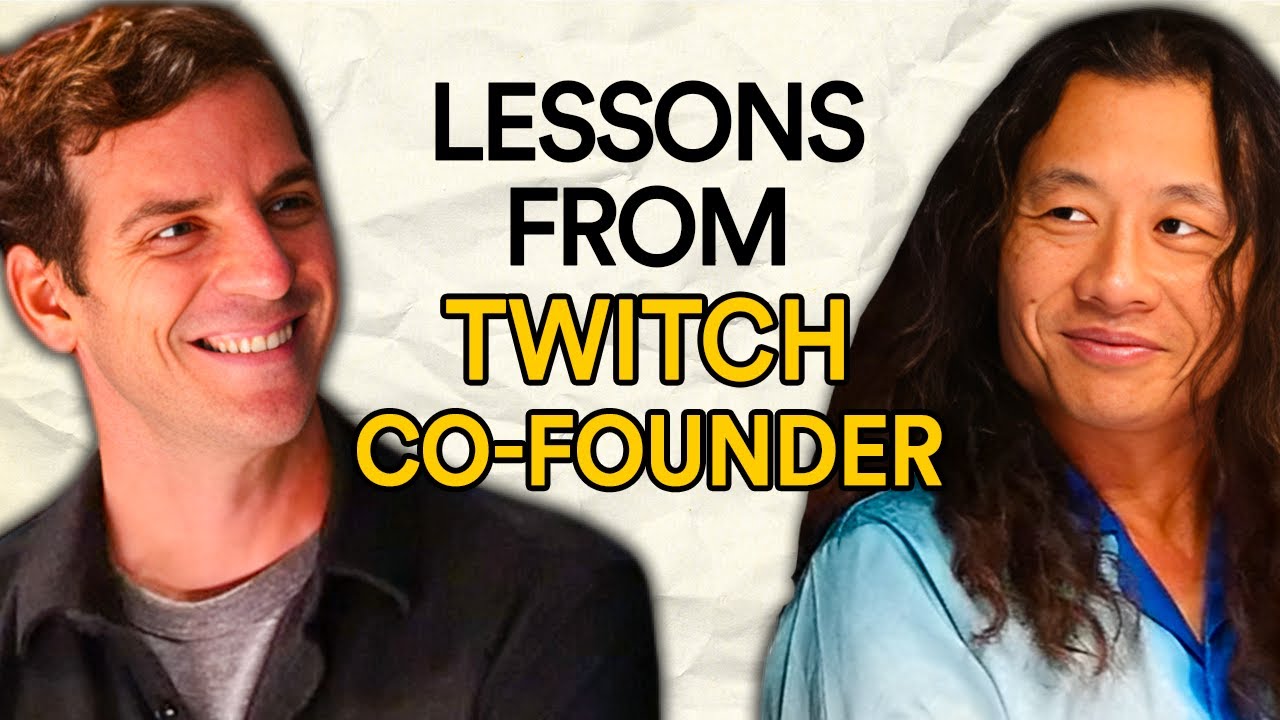
Justin Kan's Story | Twitch.TV Founder/Y Combinator Partner Justin Kan
In this interview, Justin Kan recounts his journey from a nerdy Seattle childhood—playing Magic, role‑playing games, and taking advanced math—to studying physics and philosophy at Yale, where he discovered the value of writing. While in college he and his dorm‑mate Emmett built Kiko, an early calendar web app that pre‑dated Google Calendar, learning to code by Googling tutorials and launching the product without any real user research or clear monetization strategy. The startup joined the first batch of Y Combinator, receiving $12,000 in funding, but after a year of low engagement they decided to sell the company on eBay, ultimately fetching about $258,000. Reflecting on the experience, Kan highlights key founder mistakes: not talking to customers, lacking product‑market fit, insufficient technical and recruiting skills, and the tendency to cling to an untested vision. He emphasizes that success requires systematic user feedback, strong communication, and the humility to iterate, noting that if he could go back he would have built something like Dropbox instead.
Chapters
I guess I really want to get started with pretty much where your origins are before—
My origins before I got my superpowers?
Before you got your superpowers, yeah.
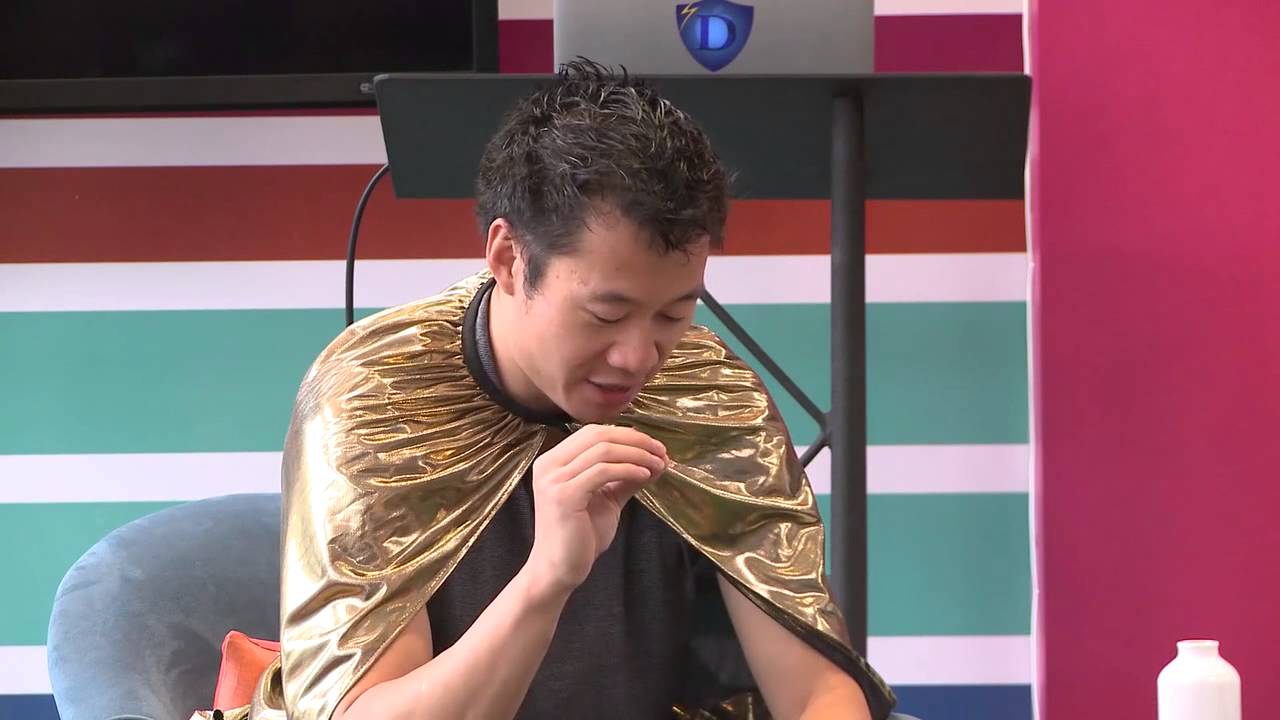
Before I got this cape.
Justin Kan, before Yale, before you went there.
Yeah.
Like, what were your aspirations?
What were my aspirations? So I'm from Seattle, and I grew up a couple blocks from one of my friends who would become my co-founder and is Twitch's CEO, CEO today. I liked all sorts of nerdy stuff when I was a kid. I liked Magic cards. I don't know if you— no one plays that anymore? A few people. A few people, OK. And I liked playing role-playing games and stuff. And I got into— I was in the advanced math class and all that great, really stuff that made me super popular when I was a kid. I guess the— I didn't really learn how to program, though, until I was— I kind of dabbled around in it, but I wasn't like a young programming genius or anything. I just, you know, pretty normal, nerdy suburban— well, actually, I lived in the city, but it was kind of like a— just, I don't know, played soccer badly.
Right.
So yeah, nothing special. There was nothing spectacular.
Right. But then you went to Yale for physics and philosophy. Where did you think that was gonna go?
Yeah, so I mean, I went, I got, luckily got into Yale. I was like in July, like way past, like off the waitlist. Someone actually had to get suspended so that I could take his place and get in. So I lucked out, I lucked out. I saw that guy years later, I was like, thank you, good job. But yeah, I got into Yale. I wanted to study physics because my parents kind of told me, hey, you should study something quantitative, like with, you know, where there's numbers. That'll be a good basis for whatever you want to do. And so I studied physics, but actually at Yale you can do a combined major, which means taking 2 different majors and doing half the classes in each. So after I took physics for a while, I was like, this is really hard. The advanced classes I was like not doing very well in. So I decided to change to a physics and philosophy major, which meant I could replace half the physics classes, like all the hard ones, with philosophy classes. And people now— well, I mean, it was great. I'm glad they offered that option.
Did you have a passion for philosophy?
Not really, no. Philosophy was pretty fun. I mean, I feel like I learned a lot. I got to write a lot, which is nice. I think writing is really important to develop just basic communication skills. That's kind of a fundamental thing that— it's probably the— people ask me, what did you learn before that helped you with business stuff? And that was the one thing that probably helped the most, being able to write well.
Right. So you're with your dormmate, and you guys come up with the idea for Kiko. Now, was that idea originally something for you to use where it was like, okay, I really need this piece of software in my life, so I'm going to develop this for myself? Or did you develop it right away as, this is something I think everyone could use and maybe I can monetize this in the end?
Yeah, so Kikyo was this calendar. It was kind of like Google Calendar except it came out about a month before before Google Calendar came out. And we had seen Gmail. We were college students. We'd seen Gmail come out, and we were like, this is really cool email. Someone should make a calendar that's kind of the accompaniment for this. Of course, many thousands of people, I think, thought the same thing at the time, including people who worked at Google. But we didn't really know what we were doing. We didn't know anything about startups or building— Product management. web apps or anything like that. So we just said, okay, let's just try it out. And we started working on it from our dorm room, me and my friend Emmett. And Emmett and I, we just like, we weren't good programmers. He like knew a little bit more than me. He was a CS major, but I didn't like know anything. And so I kind of just learned by Googling JavaScript tutorials and kind of piecing together various things. I was like, oh, I want to be able to drag and drop appointments around. Right. on my calendar. So I figured I would Google, like, how do you make something drag and drop on a page? And then we would just, you know, kind of build a prototype. And we didn't really have a plan. We didn't know how we would make money from it. We didn't, like, say, oh, this could be a big business one day. We just kind of said, hey, this seems like something that would be on the internet, so let's just try to, like, make it.
Right.
The bad thing was that we weren't really building it for ourselves because, you know, we were building a calendar. My senior year, I only had class like Monday and Wednesday. I remembered that, you know, there wasn't any—
right.
I didn't have appointments. I didn't have the busy schedule or anything. So we never really used it. And I think that was kind of the fundamental flaw was we were building something that, you know, we didn't know like what people wanted with the product. So we kind of were unable to make something that was super compelling.
Did you have a pretty significant user base?
No. We had an insignificant user base.
So there was no one to really bounce off of, like, how can we fix this, how can we improve it?
Well, that would have been a good idea, probably, to talk to our users and figure out how we could fix it or improve it, but we didn't do that. We just kind of guessed. We were, I think, wrong 100% of the time, actually. And at the end, we had maybe 25,000 people who had signed up for accounts, but it wasn't— most of them were not like active users.
So eventually it became something that you could sell, because obviously there's a story where you sold it on eBay and the CEO of 2 Cows picks it up. Maybe could you tell a little bit of that story just in case someone— Sure.
So, you know, a year in, we were— had gotten funding from this program called Y Combinator. It's the first time, you know, through the first batch of YC, so it was very unproven. It wasn't anything that people didn't know about it at the time. time. We were just like, we were amazed that anyone would give us any money for our company. And so we graduated, we decided, okay, we're gonna work on startups full-time. We don't know what that means. We didn't really have any role models or anything. So PG and Y Combinator gave us, you know, I think $12,000 to work on our idea. And we were like, okay, that seems amazing, like that someone would invest in our business at all.
Yeah.
So we worked on it for about a year, and unfortunately we were not able to produce anything that people were like using that much. And we were pretty discouraged. We were like, okay, let's sell the company and try to, you know, get back enough money that we can pay our investors back. We raised a little bit of money from PG's friends afterwards. Right. And we ended up— we couldn't— like, we had no idea how we would sell the company. And so I'd seen this other company sell themselves on eBay like the year before. I was like, okay, let's— that's a thing, that's an idea. Let's try that out. And so we ended up listing Kikko, like our website, on eBay. And I just remember the day of— someone's getting an important phone call. The day of the auction, it was like we'd listed it at like $50,000 and it went up. We got a bid at like $80,000 or $85,000. And I was like, that's awesome, we're gonna make some money. Finally, you know, right? We're paying ourselves very little. And then every time I'd refresh, I was sitting in my friend's apartment in New York. It was like super hot day. It's like in my underwear. He didn't have air conditioning. I'm like at his computer, just like clicking refresh on this thing. Really shitty apartment, right? And, uh, it just kept going up. Every time it would go up like $10,000. I'd be like $100,000 and then like $113,000 and then $150,000 and end up at like $258,000. And like we made, we actually made some money. It was like super exciting for me at the time. I was like, this is, you know, we invented a new business model. We'll just make a failing startup and then sell it on eBay. That was, you know, so that's how we got our start in entrepreneurship.
So if you could travel back in time, all right, and you go see your former self in your underwear, going to sell your company on eBay, Would you advise that person to take that path? Even though that is a pretty big step in building who you are today, would you have advised them to do it differently?
Yeah, I would have gone back in time and told me to make Dropbox.
Yeah,
but I think it was pretty good, right? Like, I don't think— one of the things I realize now, it's like, is that, you know, I wasn't in the position where I like knew how to be successful or knew how to do the things to like become successful when I was 22 years old. I didn't know like how to talk to customers and identify what they actually wanted out of our product. I didn't like have enough actual technical skills to build something that was actually very good. First product was pretty bad, actually. I didn't know how to like recruit people who were like really excellent and get them to work on my company. So like, there's all these things we learned, you know, in the last 10 years that enabled us to become much more successful. And I think that like just knowing, oh, you know, you should start this company or have like do this idea or it's all gonna work out in the end, right? That's not— that wasn't— that's not enough like information to, you know, actually make me successful, right? I feel like there were a lot of like things behind the scenes, like skills that, you know, you had to learn to like, you In order to figure out how to build a company that could be 20 or 50 or 100 people.
Right, right. So going back on what you just said about knowing how to talk to people to figure out what they want out of whatever you're putting together, was part of that just getting to the people or was it actually knowing how to process what they tell you?
Well, the first step was probably just talking to them. I didn't do that at all.
Right.
Like, we never went to our customers. I mean, I think there's a lot more people writing about it now and talking about it, but at the time there was no playbook for how you should do a startup. We didn't know, like, oh, we should identify some— I mean, I guess it sounds pretty obvious, but we were just out of college. We didn't even know how to have a job, let alone start a company that would employ other people. And so we were just— we didn't know, like, oh, we should go talk to our users and figure out how we can make what they're like their lives better or like what problem are we solving? Identify a specific problem that we're solving for them and then figure out how we can like solve it better.
Right.
So we weren't talking to anyone and then we weren't asking them any questions really. We were just kind of like imagining a product and then building it from our minds, you know?
Yeah. Were you kind of in that space? I know sometimes I get in that space as well where it's like I have this great idea and I don't want to hear how to change it because in my mind I'm like, this is perfect. Like, I don't need to hear anything, you know.
A lot of founders in the early days are like, you know, I have this great idea for a product. Like, if only everyone saw, like, the world how I see it, it could be, you know, everyone would be using this thing. And a lot of times, you know, people aren't going to give you that benefit of the doubt if you're not, like, immediately solving a problem that they have at that moment. They're not going to, like, invest the time to figure out how you're supposed to use the product. I think that's a very first-time founder problem.
There's also, I'm sure, a problem with sort of wearing your heart on your sleeve too, where it's like maybe you don't know how to take criticism as well, sort of like— again, going back to, we already mentioned the perfect— you think it's the perfect app, but you put so much of yourself into it too, you just don't want to hear that it's not perfect. Yeah,
yeah, I think that like in the early days when, you know, I'd design a product, I was like, this is like great and tons of people are gonna use it. And then people would say, oh, it's not, you know, it doesn't really work that well, or like, I don't know why I would ever use this. And then, you know, it's easy to be defensive.