Fix the Land, Fix the System: Why Permaculture Matters More Than Ever #permaculture #datacenter
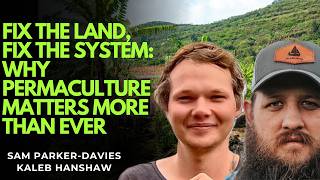
Permaculture designer Sam Parker Davies explains how regenerative design can replace destructive systems. He's worked on water capture in deserts across Somalia, Iraq, and Jordan, turning arid land into flowing rivers using leaky weirs and gabions. Centralized infrastructure like data centers creates fragility; decentralized, pattern-based thinking builds resilience.
Chapters
I bring that up because a lot of people think that, you know, it's all— it's a life of sacrifice. It's a life of sacrifice, and it's not a life of thriving. No, there's beauty. There is—
I think it's the other way around. I think it's the other way around. I think my quality of life, if I gave up the life that I'm living to go and work an office job in the city, that would be my version of a life of sacrifice. I would be sacrificing clean water. I'd be sacrificing clean food. I'd be sacrificing the community that I'm a part of. I'd be sacrificing the ability to walk from my teacher's house to my house and end up at my house with a basket full of fruit and food. I'd be sacrificing luxuries, life's luxuries. I'd be stuck in a little concrete box, getting in a little steel box, ferrying myself to another concrete box to sit on a screen all day to come back. I'm not into that. That doesn't sound fulfilling. That doesn't sound fun. That sounds like a sacrifice.
Hey everyone, Caleb Panchal with the Finding Home Podcast. I'm outside. At our farm in Mingo County, West Virginia. I'm so excited about this guest we're having today. I'm having my good friend Sam Parker Davies from Zaytuna Farm in Australia. Sam has taken permaculture way outside the backyard and has helped facilitate and design and help solve serious issues in many countries around the world. Sam is a permaculture designer He's an educator and he is a consultant who has worked in multiple continents helping regenerate land in small farms to refugee projects. I got to meet Sam as I furthered my permaculture education with Geoff Lawton at Zaytuna Farm, where Sam has his homestead. Also helps facilitate the permaculture design courses, even offering his own PDC online. On his website. So without further ado, let's jump into this conversation that I had with Sam. I know you'll enjoy.
So you just one-upped me on the background. This isn't fair.
I thought, you know, it's beautiful.
My goodness.
Wow.
Well, Sam, I, I appreciate you coming on. I, I value you more than you know. Just the, the chances we get to talk and connect. You've really helped me as a designer, as a permaculturalist, especially where I live. Not a lot of people know about permaculture or what it is. They connect it to, you know, gardening or something like that. It's a good first step just to get them thinking about, you know, systems thinking. But I'd like to start off this conversation with A boring way for me to ask you is, how do you define permaculture? And I don't want to— I don't want to give you the boring question. I would like for you to connect it to a story of, like, for me, when I discovered permaculture, it was a very foreign concept, but something about it drew me in to really develop kind of my own definition. I mean, you look at the definition on Wikipedia or in the def— in the dictionary, it's kind of boring. It's true what they say, but it doesn't connect us like philosophically or anything like that. So my first question to you is, you know, how did you discover permaculture and what does it mean? How can you define it attached to, you know, an actual experience?
So I'll start with the definition just because I think it carries weight. I mean, I think how we define something when it's as, I guess, broad and complicated as permaculture is really relevant to what what drives us at that time, why, why we're involved in it. And I think for me, the biggest thing about, about permaculture, the biggest thing that permaculture does is it's a shift from humanity destroying the Earth to humanity regenerating the Earth. It's the study of how do human beings become a beneficial element on planet Earth. It's the study of how do we become The most beneficial element to the world around us that we could be, that we possibly could be. That to me is, that's, it doesn't give the whole context of permaculture, doesn't explain it to someone who like, they're not going to go, oh, that means gardens. And, but I don't necessarily want someone to think that straight away because permaculture is for the civil engineer, is for the architect, it's for the massage therapist, it's for the, It's for any person that does anything for humanity, um, to find a practical means to engage with helping humanity and by extension the planet, by extension all the things that inhabit the planet. It is not, uh, um, it's not gardens. For how I found permaculture and what I understood permaculture to begin with was my grandmother did her permaculture design course in the '80s. And I was surrounded by this concept. It was a family word. It was a word that was used in the home. I knew permaculture from very young. But to me it meant gardening. It meant what my grandma did out in the garden. And I thought that was a bit lame. It was a bit boring. I thought I, I, I came into it wanting to see whole system change. I was not satisfied with the status quo. I was not satisfied with how people were living. I thought it was destructive. I was worried about the future. Um, I mean, I'd done my own research about how corrupt the, the businesses, um, that the largest businesses in the world were, the largest governments in the world were, how, um, scary and disturbing the general corruption of the planet was. And I wanted whole system change. I wanted something bigger than a garden. I wanted to see the world shift in its orientation and direction. And I was, I was worried about I was worried about the state of humanity. I was worried about the heart, the, the, the, um, the disturbance or the corruption of, of the purity of what humanity could be or what humanity really is. And to see, um, to see gardening, I mean, it didn't excite me. I wasn't excited by the concept of it. I'm like, there are some big things that need to happen. We need to see serious change. We don't need to grow tomatoes. That's, that's insane. And, and as, as it unfolded, so I, I naively, very enthusiastically jumped on, um, the advice of a mentor and, and I ran for council. I ran for my local government when I was 17 years old. Wow. So I put myself up as a candidate. I, I was working in a little cafe washing dishes, and every dollar I made while I was washing dishes I put towards my campaign. My campaign was just me walking around the street putting pamphlets in, talking to anyone that was going to talk to me. It was just me and a couple of other people making sure that everyone heard about it, putting posters up on the street, putting pamphlets in people's letterboxes, just going and going and going. And me just putting any bit of money that I could make out of my little job into it. And we campaigned on the concept of community meeting. So the thing I thought was one of the biggest problems with how the system was running was the lack of general engagement. I heard a lot of people complain about what the government was doing. I heard a lot of people complain about what local government was doing, what the councils were doing. And I thought, why don't— why doesn't anyone do anything? Why, why are we complaining about the only people who does do stuff? We've got such an issue with this park, how come we're nagging the only people that are doing anything about the park rather than creating a system or a situation where we can do something about the park, where we can engage? Why is the onus just on them? And second, secondarily, isn't— aren't they supposed to serve us? Aren't they public servants? Aren't they supposed to do what we want? Why are we complaining that they're doing what they want? We should hold them to account. So the concept was we do monthly meetings, monthly community consultations, or monthly, monthly community meetings where people come and they engage. So what we did was we had a big, big board. We rented out this big hall and people would come and we'd, we'd write up would just popcorn anyone, like anyone's got any issues, anything, anything people want to fix in the local community, just spit it out. And so someone would say, oh, this park, I'd like to see this park develop further. This person would go, oh, this road's not safe, there's no lights on it at night. Or this person will say, oh, these potholes have been there for 5 years and I want to see these potholes fixed. And you write them all up, you write up everything they say on the board. And then they have natural groups, so one would be roads One might be water. Maybe, maybe people are preparing for disaster. They're really horrified by the last fires that happened and they don't feel safe. And so you're like, disaster, water, roads, um, you just keep grouping them into these groups and you go, okay, cool, these are the groups that we've got. We've got 7 distinct groups. Um, everyone separate into the group that, that most interests you and discuss the main projects that you'd like to see completed within those groups. They discuss them, they come back and we go, okay, cool. We'll pick the top 3 in each 7, the most important, most relevant. We outline the top 3 and then it's like, okay, go back into the groups and we go, okay, top 1. And then, and this gives everyone an opportunity to shift into different groups and you will see people going, ah, that is so much more interesting to me right now. It's so much more relevant to what I was doing before. And you come out the other side with some obvious emphasis in what's happening. And so you can galvanize community action behind 1, 2, 3 key things that need to happen. And we address the other ones next meeting. But what's cool, so, so like at the end of these meetings, you discover what people do. So one person might be a landscaper with an excavator and some machines. He go, what? Why doesn't the council engage you in fixing this park? Why should we hire someone who lives, like a large company that lives hours away and export the local money? Why don't we cycle that money in the community and support you, a local business trying to do local work and lift you up? Why would we not do that? And then what the magic about this as well is the more, because people live there, they're willing to give extra. They're willing to engage in the area that they're in. They're at the community meeting in the first place because they care. And if they care and they have resources and they live locally, why should we not leverage what they have locally? Why should we export that? Right. And so that, that as a platform, as a model, that was really exciting. I really love doing that stuff. And I had a lady come to one of the meetings. Who, her name was Liz Bastian, and she worked with a lady called Ro Morrow. Ro Morrow is a big name in permaculture. She does a lot of permaculture aid work. She's getting on in years. I think she's in her late 80s now. I don't know how much longer she's going to be with us in the permaculture movement, but she's done so much. She's done huge heavy lifting. She's been a real pioneer. And I was given a free course with Ro Morrow and Liz Bastian because of what I was doing. They were impressed and said, hey, like, you should really listen to this permaculture concept. It's not just growing tomatoes. There's a little bit more to it. And so I went—
It's not just salsa. Come on.
And so I went to one of the courses and I was like, wow, this is incredible. And Ro Morrow was the same lady that taught my grandmother as well in the '80s. Wow. So there I was, like, 30 years on.
Incredible.
Yeah, doing a course with the same teacher that taught my grandma. Wow. And, um, yeah, so I did my permaculture course when I was 18, um, on the back of not, not getting in. We got 1/8 of the total vote, um, but it just was not enough for us to qualify. We didn't get in, and thank God. Imagine, imagine, I just, so hard to imagine the life I would have been living if I, if I had gotten in. Um, and so, and so I, not long after, like after I did the course, I was like, okay, well I need to, I need to just do this. And so I got a gardening job. I got an eco-building apprenticeship. And so I started building with mud brick and straw bale and those sorts of things. And then I, I started up my own homeschooling business. So I was teaching homeschool children permaculture. And then I ended up at Zaytuna Farm where I am now with Geoff Lawton, who, I mean, surprising to me because I, I, all this kind of faded into the background. My, my big thing about this shifting point was when I was 12 years old, we were doing this, this segment in geography where we were learning about environmental collapse. We're learning about the pollution in the ocean. We're learning about the depopulation of fish. We're learning about the the amounts of birds that used to fly overhead that weren't there anymore. And we're watching this film called Home, which is just like stunning, stunning, beautiful videography of the destruction of the planet. It's like, it's a really full-on thing to watch. And so, I'm 12 years old sitting through this in high school, just getting very suicidal, very sad. Yeah. Wow. Yeah. And then, and then what blew my mind about this, and this might— this must be such a common thing for young people that get, that get this information, is the next subject, like the next thing we focus on. We did that module, module's done, okay, ancient China, now we're going to study ancient China. It's like, are we not going to address that? Like, are we not gonna— are we not gonna study the solutions to that? We just accept, oh, my future's screwed, I don't know what's next, good luck guys, okay, ancient China. No, no, no.
Oh man.
So I went down a rabbit hole. I went down an internet rabbit hole and I researched all sorts of stuff. I got very sad, very depressed. And the same teacher who'd shown us all that was like, all right, look, like, Sam, you should watch this little video. And it was like 5-minute video about this madman in Jordan greening the desert. And it just made me realize that they're worth belichtens.
That video, it got me.
That video, that video, it's wild. Hey, do you know the story of that video?
No, I just know they heavily— because I'm sitting in West Virginia wondering why I live there and we have all these strip mines and I'm trying to figure out why am I here, like what. And then I see this video and it just, it hooks me, man, like And there's no coming back from it after, after you watch the video. I just— so funny that you brought this video up.
Well, so it's for so many people, it was the video. And for— if anyone hasn't seen it who's watching this, it's an old video with my teacher Jeff Lawton who, um, it's done by the Australian Broadcasting Company. I think it's— you just look up Greening the Desert. Yeah, Greening the Desert, Jeff Lawton.
Yeah. I'll put it in the show notes for sure. Yeah, yeah, I'll put a link in the show notes for people to, to watch it. So we're gonna get some converts already just by the link.
So I guess it's just mind-blowing that you can green a desert, you can make a desert green, you can make rivers flow through deserts. Like, all this stuff seems so out there until you study it, but really, I, I guarantee you Some of the driest deserts in the world, if we did the work, we can make rivers flow in them within 5 years easily. Why do we not do it? Like, we look at the water crisis in Saudi Arabia, look at the stuff that's happening in the Middle East, all these insecurity, because if they hit the, the desalination plants, the country's got no water. It's like, we can make rivers flow. Yeah, we can make rivers of fresh water flow through that land. Why do we need to be so worried about this, this insecure infrastructure when we could do that? That could be a done thing.
It was so interesting because I remember that was one of the, the, a pivoting moment for me personally because I, I, I came to Zaytuna, um, just to be a better designer with what I did in my job. And then there was a particular session that you were teaching and then you were talking about system changes and how there were so many injustices in terms of what's happening in the world that permaculture was much more than being a better designer, but we could actually help change the world. And I remember breaking down in that class, like crying, and I'm trying to hold it together. And that was the marking point where, okay, this is a lot. More than just trying to be good at a job. This is like permaculture can fix a lot of things. I go out to say almost everything, but I'll just— I'll be cautious and say a lot of things. And, and I'm just— I'm taken aback by you and your work because you've been to, you know, I would say almost 20 countries. At least 4 continents. I mean, you, you've been all over the world, so this was something more to you. Like, it wasn't just, um, a way to design that it hooked you. Like, this is what you've given your life to, is, is permaculture. So why do you think that is? I mean, is it, is it because you were exposed to the opportunity to change a little bit of the world at a time?
I think, I, I think from— because it happened to, to me young, the, the relationship with it. I didn't have ideals and then I got lost on a career path or something like that. I didn't have fantasies or, or these sorts of things. I fully got to live them. I, I didn't, I didn't have this concept that it wasn't possible, achievable, or attainable. It happened. It was something that was happening in front of me. And I think that's the, the will for us to live our highest ideals is something that should not be lost to us in humanity. We get sold this story that this is the way life is. We have to do drudgery. We have to live, live lives we don't like. We have to do jobs we don't want. And I decided very young, watching my dad do a job he didn't like, that I was never going to do that. It was just not something I was going to do. I was going to love my life. I was going to do a job I loved, and I was going to be present and available to the people around me because I loved what I did. I was not going to be someone who had my soul sucked through my mouth because I didn't love what I was doing. I was not engaged in what I was doing. I decided that young. I was like, I'm not ever, ever, ever, ever going to build my life around something I don't love. I'll do stuff I don't love for sure in the moment. There'll be stuff that'll be hard, there'll be things that I don't want to do forever, but I'm not going to center my life around them. I'm going to center my life around things that give me meaning, that make me happy. And for some people, that, that's their family, it's not their career. And that I'm finding that more and more with my family now, that I am centering my life more and more around my family. And that's a beautiful thing. I think that's for a lot of people who do have that engagement with life. I find that is a lot of, a lot of the time the thing. But it also, our livelihood needs to give us that energy too. We need to have livelihood that has an ethical impact that gives back. I think it's a mandatory thing for a happy human. If we have a livelihood that is not enriching us and enriching the people around us, if we instead see our livelihood is degrading our happiness, and the quality of life of other people, then how can we be happy? How can we— how could we be content with ourselves, with our role on planet Earth? How would that make us content? So I think for my realization around it, or my engagement around it, the ideal from being young of seeing how terrible the world was, the direction the world was going in, the stuff that's on the TV telling you how horrible things are, And then having this glimpse or this understanding that not just idealistically but very logically, very tangibly, we could create an incredible world. We could create the paradise that we imagine. We could create flowing waters of fresh— flowing rivers of fresh water in deserts. We could create forests of food, literal forests of food. We could create all sorts of things that would make our life more meaningful and make our life more diverse, make our memories more impactful, and give us the life we want to live. So I, I mean, for me, going from young forward, I would rather be homeless than not do this sort of stuff. I would rather be poor. For a lot of people, that, that the, the hamster wheel is motivated by this fear of falling off. If I don't keep in this rat race, if I don't keep pedaling this wheel, I'm gonna fall off, and what'll happen to me? And you have to ask, what will happen to you? Will it be worse than what you're already living? Like, what, what, where's your priority? Is your priority just in material security, or do you actually care about your fellow human beings? Do you actually care about the planet that you live on? Do you care? Do you give a shit? If you care, is your material security worth more to you than that? Is your material security worth more to you than the future of your children or the future generations of humanity? If it's worth more to you, then cool, you're probably, probably happy. You're probably living some sort of bliss. But I'm sure the majority of humans, if they really sat down and thought about it, they would go, wow, I've got my priorities all skewed up. Yeah, this is wrong.
And it's— I, I call it— it's the danger of convenience. When, when we pursue this life of convenience and comfort, that becomes very, very dangerous because then we start to compromise. We'll compromise here, we'll compromise there. And I, I know in a podcast I have this last question. I want to end the podcast with this one question, and I— you are trying to get me to ask it like immediately.
Let's just do it.
I'm gonna hint at it, just talking about the future of AI and data centers and all that, but we cannot go there right now. We cannot. But where we can go is there was something, and I had it in my journal, I had it with me, man. Oh, it's right here. This is the journal I had in Australia, and I wrote something down that you said in one of the classes. You said design can be the difference between surviving or suffering and thriving. That's what you said in the class. And that just really hit home because we live in a culture, you know, in the West. I'm sure that you've, you know, experienced this too in all the places that you've been. We live in this place where we're just trying to survive every element of life, like we're just trying to get through the day. We're trying to avoid pain. We're trying to avoid being broke. You know, we're trying to avoid sickness, and there's all these things that we have to say no to, to where— I mean, we even develop rehabilitation like this, just say no to this, just say no to that, where we forget as, as the human race how to say yes to something, how to really be intentional about living life. That I believe, and just seeing the desert have water in it and turn green speaks to this. Like, it is possible not to just survive but to thrive. So you say that you drop this bomb in the middle of class, and it's almost like you were 12 and you, you got shown the movie and you just moved on. And you said that, and I don't remember anything else you said the rest of the class. I'm just sitting there like, design is the difference between suffering and thriving. I want you to peel back the onions of that statement just because permaculture is a lot about design, about designing systems and thinking differently. I want to give you just some space to really go in depth because that's what I was wanting in the class and I'm going to get it now.
So I'll preface it with a story of where, where, where I went recently. So I, I've worked in some pretty difficult places. I've worked in Iraq, and I've worked in Jordan, I've worked in Palestine, um, and the situation is hard. But people are suffering in a way that I think maybe a lot of the people watching this podcast might not have seen before. And I went, I went to Somalia recently. Somalia is an amazing place. I really love Somalia. It's not as scary as people make it out to be. There's not nearly as much violence and those sorts of things. I think left to their own devices, the Somalis are doing very— going very peacefully. But they are sanctioned, and so their development's been really hard. And I look at the, the influences of what's going on in Somalia, and it's dumb what's, what's happening insofar as their development. You watch footage of Somalia in the '70s It was beautiful. There was heaps of resources in Somalia. People were, were doing really well. And sanctions happened, bombing happened, all sorts of turmoil, turmoil and nasty things happened. And out the other side, they're, they're in a worse place than they were in the '70s or before the '70s. They're a very primitive people still, a lot of places in Somalia. You go, there's people living in grass huts in the middle of the desert. And there's no water pipes, no electricity cables, people living without water and electricity in little grass huts, carrying water back to their place like kilometers, like what you, what you see in those videos and that sort of stuff we hear about in, um, in aid stuff. There's like lots of remote communities with, with not much. And I mean, some of them have designed their lives where they're very content with that, but some of the situations as, as different cycles of the year come as drier times come and there's less vegetation and there's less water, it's, it's suffering. It's hard for a lot of the communities out there, particularly as they modernize and become more and more reliant on modern agriculture. The poverty of the place becomes extreme. In the context where they have their own goats, they just need to move to find new greenery. You can, you can adapt, you can be adaptive. But I couldn't help but look at all this. I mean, we, we drove while I was in Somalia. We drove from the from the top of one of the largest catchments in all Somalia, um, all the way down to the mouth of, of what could be a river. And it was huge. It was 70,000 square kilometers of land. It was a massive area. And I couldn't help but see how easy it would be to make this place flow with fresh, clean water. And then you think the distribution. So at the moment They're pumping water out of the ground, they're cleaning it, they're putting it in trucks and they're sending these trucks to these remote communities. That's how the government's helping sort of support these distant areas. But you can imagine now with fuel prices going up, fuel shortages, these people who have become dependent on trucks delivering them water, I'm sure that's more and more difficult. I'm sure these people are suffering more than before. And that was the system that they designed. They designed a system that was reliant on fuel. They designed a system that was reliant on other people, on transport, which is unreliable. It's an unreliable thing to center your design around. And this huge catchment, I guarantee, I promise anyone watching this that you could turn this into a river easily within 5 years using the same amount of money that they've already invested in all this water infrastructure. So they've tried to build 3 dams, so big concrete dams, heaps of infrastructure in these dams. They fill up with silt and rocks. Because it's an eroding landscape. The landscape is eroding. There's no grass. There's no trees holding the landscape together. When it rains, water goes into the dam, yes, but so does silt, so do rocks, so do dead people, so do dead sheep. They all end up in this dam. Even if the water was there, it'd be highly contaminated and make people sick. And that's what happens in dry lands. That's what goes on. So, other option, is you build walls that leak. You build these leaky sort of rock walls and they leak, so they'll fill up with silt. But there's not this big dam wall, there's not this big dam holding back water, not allowing it through. So if these— if this wall leaked, if it was this, this wall just made out of loose rock or concrete with holes in it or whatever, you wouldn't have to line the whole thing. Then the water would push through this area and push out the other side and run. Because of the surface area of all the silt and rocks, it would go a lot slower. It wouldn't just pass through and be finished. The water would come in, would slow down, and for 2 months, this wall would be weeping water. If we did 12 of this, it would be weeping water for 2 years. If we did 36 of these, if we did 100 of these. You can imagine quite a healthy flowing river flowing all year round with no trucks, no pipes delivering that water all over that area of Somalia. That is the opportunity to thrive. That is an opportunity right there for people all through this desert, all these remote people, to thrive where they are, to have water delivered to their doorstep By gravity. We went and met with the Minister for Water for the, for the whole of Puntland, this area in Somalia that we're working. They were, they were the minister, the, the, the top boss. They have a ministry for water in Somalia. And their deal, their thing was they wanted to do a desalination plant. They had funding proposal for a desalination plant. And I said, that's dumb. That's really, really not a good idea. I mean, we can see now why in that context, I think the common person can see why the desalination plant's not a great idea because of threats to water infrastructure. If a desalination plant gets bombed, you're offline, you're gone. If China decides not to deliver the part for the desalination plant, you're gone. If you do not have your own oil, if you don't produce your own oil, and someone sanctions you, America sanctions you, or someone sanctions you to stop the water, the oil from coming in, what do you do? You die. You based all your infrastructure, all your water, your, your basic resource around this really insecure little thing, around this thing that could just disappear, and you've based all life in your country around that. How, how could that not be seen as a bad idea? We can design systems using natural law, using natural principles, that deliver water to your door for very cheap. You don't need pipes, you don't need petrol pumps, you don't need all this infrastructure that's very vulnerable and very expensive. You can maintain walls of rock, you can put a rock in a place, maintain walls of rock and silt and deliver water to your doorstep. It's very cheap to replace a rock. There are rocks everywhere in Somalia. It's a landscape of rock. It's not, it's not difficult. Replacing a whole desalination plant with all the, all the parts and components that it's made from is very hard. Even part of it, to replace part of it, is very difficult. Why would we base the most important things in our society around things that are so fragile and so fleeting? Around things that have a life. Steel corrodes, um, concrete collapses. Like, these, these are things that we have to keep supplying or keep importing. It's fine to use, it's great to use, it's awesome to use, but why would we base the most important things of our society around things that, that aren't going to last? It's not going to give us any permanence in, in our relationship to to the world around us. So we've looked at, we've looked at the suffering of bad design, and now the potential of having this flowing water, of having excess water in the desert. You can imagine what you could do with flowing water in, in such an environment. If, if there's flowing water all the time, it will flood. There will be more water. There'll be excess water. If I bring that water out throughout the landscape, if I dig trenches that go off of these these silt fields, these gabion silt fields, into the flatter areas of the, the land around us, then those, that, that excess water starts to support all sorts of things in drier places in the landscape. We can have forests supported. We can have herds of all sorts of different animals supported. We can have a richer and richer environment that makes life easier and easier to live in. We start to value these things when we understand how important these resources are. Living on this farm, living on a permaculture farm, there is— during COVID food shortages, lockdowns, all those sorts of things, life didn't change here. I ate the same food I ate before. The quality of the food didn't change. The quality of my life didn't change. I was happy relating to people, being with people in quite a beautiful setting and quite an amazing environment. People in the city were losing themselves. They were having a really difficult time of it. It was really hard. We're robust in the, in the face of disaster. We have a higher quality of life, higher quality of health, higher quality of food than most people. Um, and it's an open invitation to anyone, anyone who wants to do it, anyone who wants to start it. We design this, we do this. This is something we can give any person on planet Earth. We can put in these things. We have forests of food. We have self-sufficient gardens. We have so much more than that too. For our leisure, right now I'm building a sauna out of bamboo. I'm building a sauna out of bamboo and rocks. I'm putting in a little fireplace right over my natural swimming pool. So I've got this huge dam that I'm converting into a natural swimming pool. I've lined it with geotextile fabric. I'm putting rocks all the way through it. And I filter it with plants. I've got a waterfall coming down next to my sauna. And I can, I could put Barry inside my plant cleaning system, a little jacuzzi. But I'm just saying it can be a very luxurious, very beautiful life. It doesn't have to be this idea of I'm living in the mud, eating the carrots I grew, like those sorts of things. It can be very sophisticated, complex, beautiful life.
Hey guys, Caleb with the Wild Country. We have our first in-person permaculture design certification course. It's going to be hosted in Mingo County, West Virginia, on our permaculture farm. And here's the deal, since it is our first time, admission is 75% off. It'll never be this price moving forward. If you want to jump in at the ground ground level, be the first class graduating from the Wild Country Permaculture Institute. Click the link below, register, and we'll see you this summer.
When I talk to people about permaculture, they like, you talk about like the guys in the forest that are digging in the mud. I'm like, no, I'm not. It was interesting though, because what I noticed that was— and I tell, I told my wife the story, I tell everybody. but the story about, you know, Zaytuna is I had a realization after being there a week. I thought, I don't know where the trash can is. I have no idea. And it wasn't because I was like this bit, I'm being a hippie and all. Legitimately because of the activity that was on the farm, we were eating food straight from the farm. There was this community dependency upon, you know, washing our dishes and reusing things. And drinking some of the best water that I've ever had on tap. Your dad dishing out lattes like they were— oh my gosh, it was amazing. But, but this, this just speaks to that. Like, I, I didn't know where the trash can was, and I just felt such a joy to be a part of a system that was bringing this abundance. So I bring that up because a lot of people think that, you know, it's all— it's a life of sacrifice. You know, it goes back to the question I just asked. It's a life of sacrifice and it's not a life of, of thriving. And this is where I want to have these conversations. Like, no, there's, there's, there's beauty. There is—
I think it's the other way around. I think it's the other way around. I, I, I think My quality of life, if I gave up the life that I'm living to go and work an office job in the city, that would be, that would be my version of a life of sacrifice. I would be sacrificing clean water. I'd be sacrificing clean food. I'd be sacrificing the community that I'm a part of. I'd be sacrificing the ability to walk from my, from my teacher's house to my house and end up at my house with a basket full full of fruit and food. I'd be sacrificing luxuries, like life's luxuries. I'd, I'd be stuck in a little concrete box, getting in a little steel box, ferrying myself to another concrete box to sit on a screen all day to come back. I'm not, I'm not into that. That doesn't sound fulfilling. That doesn't sound fun. That sounds like a sacrifice. I mean, here we've got all the modern conveniences of life. We have washing machines and fridges. We have coffee machines. We have all those sorts of things that people, um, associate with luxury. We have big solar system. We have all the electricity we need. We have all the water we need. There's nothing about this that's really a sacrifice. The only, only thing is that we, we have an enriching impact. I am engaged with the outside world around me. I'm excited to be outside. What someone might associate as work, and particularly might associate as peasant's work, I take great joy in. I really enjoy it because it gives me meaning and because I love it. I think for a lot of people, that is really the disconnect. Is it a class thing? Is it, oh, that's what poor people do? Because I hate to break it to you, if you're not making millions, you're a poor person. And if you're, if you're in that situation where you value making other people millions more than your quality of life, you're going to stay pretty poor. That's so good.
That's so good. Um, just, just to kind of tag along, because I was listening to you talk about how other governments want to address issues. I see this pattern of designing centralization. Like, if we can, we can have everything centered. It's even the food systems, the grocery stores. There's this element of control in that. And how is— how important is it to design in terms of decentralizing a lot of these, a lot of these, uh, aspects.
So I, I'll give, um, I was gonna give another context. So that there's periods of history, and this is where permaculture comes from, like, these, these sorts of realizations and, and patterns. In permaculture, there's, there's patterns that underpin what we look at and what we think. If we can learn to think of things in a patterned way, we unlock the key to genius. So if we, if we can observe patterns around us, we can observe the patterns of, of how nature works, of how people work. It's the patterns that really matter. The details inform the patterns, but it's the patterns that we should be focused on. If we see— and I mean pattern, not patent, I mean patterns, patterns, the patterns around us.
Is that how we sound?
Yeah, pattern, it's a pattern. We don't say R's in the Australian accent, so forgive me if you're—
I'm with you, I'm tracking.
Um, but so the, the patterns around us inform how we should think and what we should do, not the details. So if we see a pattern, we see like, look, if I don't put all your eggs in one basket, if I start putting all my stuff in, in one spot, it gets too heavy, it breaks, it can't, can't be supported. I need to invest more and more, bigger and bigger thing for it, for it to work. Then it becomes more and more fragile, the more and more I heap in one spot. If we look at old empires. So the Roman Empire lasted for a long time because it had vassal states. It administered a place that ruled over itself, so it was centralizing itself in a way that aided some, some form of decentralization. Ultimately collapsed in some form because of centralization. But I would, I would suggest that the modern Roman Empire learned its lesson, and it has again lots of vassal states. This kind of semi-decentralization of power. And what we're going to see with the US, what we're going to see with any sort of big empire, is collapse. And the things that are going to be able to adapt to that collapse, that change quickly, are small things. The big things are going to come crashing down. It's very easy, the smaller you are, to adapt. It's like, just as an example, the leaves on the tree, they shake and they fall and they regenerate. They move quickly. Leaves go and come, they move, they fall. It happens quickly. The branches on the tree, or the twigs on the tree, they can do the same thing. They can fall, not as quick as— quickly as a leaf, not as much turnaround. But you can break some twigs, twigs can fall off, they regenerate, they move quickly in the wind. Again, not as quickly as leaves, but— and then you go into branches, small branches, similar, but again, we can see it slower. Big branches, forking branches, that's major. If a big branch or a forking branch fell off, that would change the whole life of the tree. The tree would not be so quick to change, to regenerate, to adapt to that. The trunk, the trunk fell over, the tree's dead, yeah? Tree's gone. So we have this same sort of pattern in our society where if we have everything resting on a trunk, and we do, and the trunk is absorbing more and more from the rest of it, if we put all the power in the trunk, it becomes a cancer. It becomes a big tumor inside the tree where the leaves and the sticks, which is what majority of us are, leaves and twigs and stuff, the things that can move quickly, can adapt to change. We start being starved of nutrient. There's no economic flow throughout, throughout a society. The resources, the water, the nutrient that needs to be pumped around the tree is stuck in the trunk and it's killing us all. Including the people in the trunk, whether they can see it or not. And without those resources being dispersed, without that decentralization of governance, without that decentralization of resources, we're going to fall over and die. We centralize our water in desalination plants. We centralize our food in, in these agricultural systems based on shipping. We centralize our governance with a very few people It is a recipe for collapse. It's a recipe for disaster. Anyone who thinks in patterns should be able to see this and should be able to see imminent collapse, because historically that's what's happened. Empires rise and fall. As people— as power gets more and more centralized, it becomes more and more fragile. More and more fragile egos start to rule our— rule our empire, and the empire collapses. It's just a natural thing. It's a natural process. It's not necessarily something to be scared of, but something to prepare for, something to accept as historical fact. It's happened over and over and over again. It'll happen again. We're not removed from history. We're not separate. It will happen again, and we should get ready for it. And this time it will be very spectacular. It'll involve the whole world, involve all our food and water. Um, and if we take the onus on ourselves to get prepared for that, which we should, um, then we'll be good. It's funny because I came to this for ethical reasons. I wanted to help people and help the planet. And the side benefit of that is I'm resilient in the face of disaster. Super cool. What I'm saying for a lot of people now is that they're going to come to this because they're afraid of disaster. They want to be self-sufficient. They want to have their own water. They want to have food. And the side effect of that, hopefully, if they do it well, is that they'll benefit the people around them and they'll benefit the planet.
That's so— man, that's so convicting for me because I always wanted people to choose this not out of necessity, but out of just desire. But the way you just painted that was there. It may be necessity, but there's a byproduct of now they're influencing the world around them in a positive way. Hit me in the heart that I need to change my paradigm a little bit. And that's why I love talking to you. And that's why I can't hold back any longer. Sam, I have to talk to you about the explosion of AI and in particular—
Hey guys, Caleb with the Wild Country. We have our first in-person permaculture design certification course. It's going to be hosted in Mingo County, West Virginia, on our permaculture farm. And here's the deal. Since it is our first time, admission is 75% off. It'll never be this price moving forward. If you want to jump in at the ground level, be the first class graduating from the Wild Country Permaculture Institute, click the link below, register, and we'll see you this summer.
About the explosion of AI. And in particular in West Virginia, where I live.
Sure.
The governor has made it very clear that if you want to build a data center, we will remove all of the red tape like we are open for business. Number one, it goes back to what you were saying, you know, when you ran for, for when you ran at 17 years old. The people in government are not representing the people that they serve. Because I don't see a lot of people saying, 'I'm for this.' There's actually a lot of people saying, 'I'm against this. I have questions.' I mean, we're, we're passing laws to now— we don't have to tell you what's happening to the water. Like, we can, we can keep it completely secret. So you see this this movement in our government where they're not representing our desires, but there's also this disconnect of what this is going to actually do to the landscape. So I want to ask you, you know, I want to talk through this in a, in a conversational way. I'm being mindful of the time because I want to end it with something positive, but let's talk about how, how a data center really impacts not just economics. Let's, let's talk about the environment. Let's talk about it all. I want to paint this picture because people are going to watch this and they're going to be educated because they have a lot of questions. They don't know. I just want to chop it up with you a little bit. I've been holding it in for 45 minutes now, so I'm— let's talk about it.
Um, I think like anything, there is great potential good in, in what's happening with AI. Um, but I do not trust the motives of the people who are implementing it or doing it. Otherwise, there would be these considerations being cared about. I don't think we have any reason to trust the people who are pushing AI or these data centers to have the best, um, our best interests at their heart. There's no evidence of it so far. In fact, there's evidence in the contrary globally for the past few centuries. And why would the mentality all of a sudden have changed? If we look at what's happening with data centers around the world, it is polluting water, it's destroying people's homes, it's just destroying people's lives. And we can only expect it to get hungrier and bigger as it gets used more and more online, AI. Mm-hmm. Again, we could say the same thing happened with diesel and petrol. We could say the same thing happened with factories and, and modern appliances and these sorts of things. They are still a force that we could use for good in our individual lives. We can use excavators to regenerate land, even if the factory that created the excavator destroyed a river in India. We could still use the diesel and the petrol, even if it destroyed wetlands in Saudi Arabia. We could do all sorts of things with the resources that are arriving to our door. We could use AI for immense good, even though it's destroying a mountaintop in West Virginia, even though it's destroying the water in Connecticut, even though these things are happening. We, on an individual level, and this is again where that pattern is really important, the leaves, the sticks, the twigs. That's what we are. We're quick to adapt, we're quick to change. We can use these massive things that are coming towards us for immense benefit in our own lives and our local community. We can do that for the greater good of humanity. We can change our hearts faster than the system can change its heart. The system is based around greed, it's based around extraction, and it does not care about you. It doesn't care about us. But us individually, even if we have selfish motives sometimes, even if we're not the best of people sometimes, our hearts can change so much faster than that system ever could. And that is where the power lies. If we want to see these things used for good, we can do that. That can be done. I can buy a farm. I can buy land and enrich it. I can work towards that goal. I can mobilize people around me. We can do things individually to create a better world. We cannot rely on a corrupt system that has no evidence, no signs of changing to do that for us. There is no point.
That's so— it's so well put. And, you know, I am actively voicing my opposition for some of these data centers because some of them are going very close to residential areas.
Yeah, it's going to hit you really hard, bro, right where you are. It's going to be really full on.
And there's also— we not like countries that you've been, but there's this insecurity in our water systems. Like, most of our water is already contaminated. We, we shouldn't use any water that's going through, uh, the current city infrastructure. There's a concern not just with, you know, water, air, and noise. One of my biggest concerns is vibration. It's frequencies and vibration that, you know, and I've dedicated, you know, these past couple months to go ahead and voice opposition. But realistically, Sam, they're probably going to get built because the same people that are saying, you know, we don't want these are also living on ChatGPT or living on, you know, all these, all these AI platforms. So I think that it's coming. So I'm starting to, to, to ask better questions because as a permaculturalist, as a designer, as someone that observes. Is there a way where design can influence these centers where, yeah, the center's built, I live very close to it. Is there a way? And I'm not asking for you to solve this solution right now in 5 minutes, but like, I'm trying to get people like, how can we, how can we think that way where we're not helpless? Because you just said it like, I can buy a farm, I can impact the land that I, that I own. I can create these systems. I can filter water. I don't want to get into this point of I just want to feel sorry for myself because the big bad wolf is building all these towers that I don't want. Is there a way where we start to have the conversation? How can design influence this? To where we can fix a lot of these issues, or at least help with the blow?
Mm-hmm. Yeah, absolutely. I mean, I think again, on an individual level, it's really straightforward. There's, I think, a lot of misinformation and corrupt education that we've been given that needs to change. Just simple ideas like, I can't catch water off my roof and drink it. That's a, that's a pandemic in the US of thought. In Australia, we do it all the time. We catch water off our roof and drink it all the time. If, if we have a data center moving in next to us and we think it's safer to drink groundwater than drink water from the sky, you're crazy. Where did the water in the ground come from? Did it not come from the sky? Came from the sky, landed on the ground, then passed through all sorts of different things into the ground. And now you pulled it out of the ground. Why would you not just catch it from the sky? Why let it pass through the ground first and collect all these minerals, all this poop, all sorts of things, you know, in the ground? Why, why is that better? I don't understand. Insofar as drinking water is the cleanest thing there is.
I turned the water on, it was last summer, from, you know, from a water hose in my dad's house, and my eyes were burning. Yeah, it's But we think that that's okay compared to what you're saying, collecting rainwater off the roof.
So I, I was in Iraq. I was in a part of Iraq where ISIS had had a stronghold for a really long time. There'd be a huge bombing campaign, um, from the Iraqi government and the American government. I just obliterated the place. I visited farms where the guy described a literal food forest and all you could see now was just an empty field. He said it had been burned to the ground by the bombs that landed on his farm. The whole place had just been completely reshaped. And the place where I was, their septic system just went into the ground. All their poo or everything just went into the ground. And that was the only water they had. They weren't catching water. And so, the water that came out of the tap smelled like raw sewage. That was it. You weren't going to drink it. It was raw sewage. It just smelt like raw sewage. I, I, I was brought over there to consult on this big sewage pond. It was like this big, like, all these houses around with like, like, like fresh, like, lake views, you know, with these lake views of this pond. And it was just a sewer pond. It was just a bright green sewer pond. It was disgusting. It stank. And it was 50 degrees, man. It was 50 degrees centigrade. I don't know what that is Fahrenheit, but it's halfway to boiling. It's halfway from freezing to boiling. It's this, whatever that number is. And it was, um, I mean, kids were dying, dying of cholera, dying of all sorts of stuff. You don't have poop in water in that heat and not have people die. That's just not how it works. Um, so insofar as like contaminated water, I'm looking at that and there's roofs everywhere, there's roofs everywhere. Why would you not catch water out of the sky and drink that? What, what else? Why would you not? If you're near a data center, if you're near those sorts of things, those are the sorts of things that you need to start thinking about. How do I do that for myself? How do I do that for the people I love? If I'm worried about the poisons in my food, and we should be, we should be very worried about the poison in our food, then why don't I look at growing my own food? These solutions are very clear. We can protest a data center, we can protest water contamination, we can protest all these things, but if we do not have valuable solutions to that problem, what's the point of our protest?
So good.
It's true. If we don't have a solution to the thing that we're protesting, what's the point of protesting it? If we don't have something that we can implement and do, why are we saying it's a problem? If these data centers are causing a threat to us, if we do not have alternatives for how we're going to source our resources, then we're setting ourselves up for a huge problem. Insofar as the individual level, individual resources, that's something that we can take care of simply. That's something we can do. We can do those things. Insofar as doing it for a larger community, that's something a larger community can then enact. Insofar as then decoupling our dependence on government, on big, big companies, on these sorts of things, that's as a byproduct something that would happen. If we put our resource dependence on large companies and on government, if we put our, our, our economy, the, the very fact that we can put food in our mouths, that we even have a roof over our head, on large companies and government, we'll be dependent on them for the rest of our lives. If they want to put a data center in, we can't question it because we've put everything we need in their hands. If we take responsibility for our lives, we don't need them anymore. We have every right to fight them. We have every right to demand that they stop, but we need to take responsibility for our lives, for the resources of what we need. And so I think insofar as what the individual can do, who's watching this or listening to this, it is about taking responsibility for yourself and your future, for your genera— for the generations that will follow you and for yourself now. If you do not take responsibility for your life and for the lives of your children and your grandchildren and those sorts of things, there's nothing that you can do about it if you don't take responsibility. If you take responsibility, if you decide it is my obligation to act and I must do this, then do it. Let's act. Let's act right now and let's make a difference. Let's make a big change. So I think water first. And everything else second.
Yeah. And I think I have one more question. We're out of time, but it goes back to talking about the difference between suffering and thriving. And I'd even add in surviving. I think people are so used to living in fight or flight and they're so used to just trying to survive. Fear is a huge motivator. So there's always this vocalization of, I'm against this, I'm against that, I'm against this. And there's not this courage to have to say, okay, I can no longer use my fear or my mode of surviving as a crutch. I need to have the courage to start having ideas and start doing, like you said. 'Cause it's a completely different way of living. You're exiting out of just surviving into this realm of creating, into this realm of life full of joy, a life that you're in control of. So last question, and then I'll remind people how they can get in touch with you and follow your work. Let's say someone has zero background in this and they're listening to this podcast because maybe it has data center in the title and they just want to learn more about it. And then they, they listen to you talk and they see the background you're in. Like, man, I really want that. What do you think the first one or two steps are for these people?
I think get enrolled in a course. There's so much information online. I'm offering online courses now for that reason. People can go to my website, go to samparkerdavies.com. I've got an online course on there right now and I'm doing it pretty cheap. And there's lots, there's lots of other teachers doing the same thing. Lots of other teachers offering that opportunity. We are in a situation now where we have the resources we have. We won't have them forever. We just won't. It's not possible. And we should use the resources we have right now to build the life we want to live. And we shouldn't compromise on that. If we have access to the internet, we should use the internet. If we have access to diesel, we should use diesel. If we have access to concrete, we should use concrete for the aim of making a beautiful life and a permanent world to live in. Um, if you can attend a course that will teach you this, because really it is a paradigm shift, it's a paradigm shift into practical action, practical action that creates, um, a regenerating world. And it's not just a philosophical realization, it's something that needs to be followed up by action. It's something that we need to do with our hands. And that doing with our hands makes us have more philosophical realizations, makes us have more academic understanding of different things, because they're intertwined, they're tied in together. We can have all of these philosophical ideas, all these beautiful philosophical ideas, but if it's not grounded in reality, it's false. It's falsehood, isn't it? It's not real. Um, but if we pair that with, um, with action and we have it confirmed by the world around us, we realize it's true. It's truth. It's confirmed by the real world, right? By the physical world. And so that's something— that's an opportunity that we have through this. My, my, um, my invitation is to go into a course, go and get educated, And then to follow it up with practical action. And those are the two steps. That's all that needs to happen.
I highly recommend everyone on the planet taking a PDC. I just, I think it's so valuable. So, so valuable. And you know, from, from someone that's taken one from you and Jeff, I highly, highly recommend if you can be in person, that's awesome too. But now that we do have an online version. And I know a guy that's doing his first one. I'm teaching my first one in August of this year.
That's awesome, Caleb.
If you're in West Virginia, come on. And we're, we're working on, you know, talking Sam into doing some courses maybe online, uh, for people. But I'll, I'll have to twist your arm a little bit on that one, I think.
I'm very, very happy, very happy to do some sessions online.
Definitely awesome. Awesome. Well, Sam, people can follow you on the website. Um, samparkydavies.com. And then you do have a YouTube channel. You don't have a lot of videos on there, but they're good. I think they're good.
It's happening, it's growing. I've got— we're doing a podcast at the moment with Jeff.
I've been following along with that as well.
Yeah, that's probably the most online content that I'm generating at all at the moment, is that.
So people just need to get to know you. They need to reach out, they need to connect. That's what they need to do. Sam, thank you so much for, for jumping on the podcast. This is going to help— it helped me just listening to you talk and break things down. Is that Jeff behind you? Well, we'll let you go. I know it's— you're just starting the, the day there. We're getting ready to end ours here, so— but anyway, Sam, I'm gonna I'm gonna thank you again, and for those that are watching, thank you for jumping on board. We'll see you next time.
Have a good one.
More from Kaleb







Chicken Processing Mistakes...And How I Learned From Them (Plus FREE workshop!)



How To Cut Up A Whole Chicken — Jumbo Wings, Quarters, Breast & Tenderloin (Full Tutorial)
