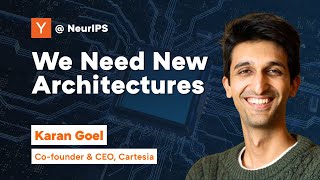
In this YC/Arc Prize after‑party interview, Ankit talks with Karan Goel, the Stanford‑trained co‑founder and CEO of Cartesia, a two‑year‑old startup building voice‑AI models for developers. Karan explains that Cartesia grew out of architecture research focused on creating more efficient, multimodal AI systems, arguing that Transformers are limited by their reliance on raw context and retrieval‑style attention. He describes state‑space models (SSMs) as a compression‑oriented alternative that abstracts information, enabling longer‑term reasoning and better multimodal integration. The conversation delves into what "multimodal" means for Cartesia—specifically audio‑to‑text tasks—and how solving this signal‑to‑symbol problem can serve as a recipe for other modalities such as video, robotics, and images. Karan emphasizes the importance of tokenization, advocating for end‑to‑end learned representations that could eventually eliminate hand‑crafted tokens. He outlines the company’s product focus, using AI call‑center agents as a concrete use case that forces rigorous, user‑centric evaluation of research ideas. Finally, Karan reflects on the cultural differences between academic labs and a research‑driven startup, highlighting the need for a single, high‑conviction vision, disciplined experimentation driven by customer needs, and the application of YC’s startup principles to keep research grounded in real‑world impact.
Chapters
I'm Ankit from YC. I'm here at NURBS with our YC and Arc Prize afterparty. I'm here with Karan Goel, the CEO of Cartesia, and we're really excited to have you here.
Great to be here. Thanks so much for having me.
Why don't you start by telling us a little bit about what Cartesia is?
Yeah, so Cartesia is a 2-year-old company. We are formerly researchers from Stanford where we did our PhDs and we worked on architecture research there, decided that it was a very important research direction and we wanted to commercialize and build products around it. So we decided to start Cartesia and a lot of people know us as a YCI company. In that we build models for developers that are trying to build voice AI applications. I can describe it in a few different ways, but I think that's like the common way that we're known.
Rewinding a little bit, when you said that you're architecture researchers, could you tell us a little bit about what that means? In a sense that a lot of machine learning for the last decade has been architecture research. In more recent years, you see people working on scaling and more like engineering problems on a single architecture. What do you mean by when you say architecture researchers?
Yeah, I think machine learning and AI is just putting data into architectures to make really cool models on lots of compute, right? That's a very short way to put a very complicated endeavor. But I think it's clear in the last 10 years, obviously with Transformers and self-attention and so on, we kind of figured out really good recipes for building really powerful models. And that became then the entire industry around LLMs. I think that when we were grad students, we were— this was back in 2019, 2020— we were pretty interested in what are some of the biggest challenges that will remain when these models are scaled to their logical conclusion. And part of what we were pretty inspired by is human intelligence. Humans are very efficient, intelligence per watt, and are able to do multimodal things, like interact with people, take lots of actions, think, and be very productive. Even the average human, quote unquote average, is very, very productive and is a feat of intelligence basically. And so I think we were very interested in what kind of architectures would make that type of intelligence possible. That's very long context. That's very multimodal where you can interact. And so we felt like the transformer paradigm, because of limitations and in the actual architecture itself would not be the right one to build something that's closer to human intelligence. And so we started working on it back in grad school. And my co-founder Albert is a pioneer in the field. He invented this area of space-space models, which are these recurrent models to build deep learning models with. And that's been an interesting set of research directions that we've kind of undertook. And I think it was really a belief in the research and the fact that I think in AI there's often a feeling of like, is there more to do? But I think we were always very optimistic about like, well, AI is a very big field and there's lots of unsolved problems. We should go out and do new things, not necessarily the same thing in a different setting, which is often what I think has happened in the last few years.
And so when you think about state-space models or architectures like that, I think about the history of how models like the Transformer came about. If I rewind the clock to 10 years ago, people were working primarily on RNNs to do language modeling and using LSTMs with attention. And that's eventually what led to the Transformer. How should someone think about models like state-space models with that history in mind? Is there an analogy to what an RNN does versus what a Transformer does that this sort of answers a limitation of each of these two methods?
Yeah, I think there's like, Architecture research is fascinating. Firstly, I think it's super interesting for folks that are working on machine learning. I think more people should work on this stuff. There's different ways to think about intelligence. And one thing that we think a lot about is this idea of compression as being sort of a very fundamental primitive for intelligence. So if you imagine trying to build a model that is going to reason over huge amounts of information, obviously you need to abstract and reason over that information in some more compressed form, whether it's because you need to consolidate your understanding of the world. Like, what does a cup mean in text? What does a cup mean in the world physically? What does a cup mean when you say the word out loud? All these different representations— audio, video, text, et cetera— need to be consolidated and put together in some way that's reasonable. And that also is something that can be used interactively. So basically what I mean by that is humans are able to take all of these representations and then use them to act in the world over 100 years. So I think that Transformers are fundamentally limited by their inability to model and compress representations in this way. And they're sort of like context window machines. They're very retrieval-oriented machines. I kind of think of the difference between a raw text file and a zipped version of it. It's sort of like you want to have these more abstract representations. Compression is a good pressure to build those.
And when you say that a transformer is a retrieval machine, are you saying that the specific primitive in a transformer with keys and values and queries is acting to enforce this prior as something that would be effective at retrieval versus what other alternative architectures would do?
Yeah, exactly. Transformers sort of sit at one extreme. That extreme is I have all of my historical data or my prompt or context, however you want to frame it, is all available to me in raw form. And I can reason over it and I can answer very specific questions about it as needed. And an example of that is I can recall facts exactly. SSMs have a fuzzier representation of the world. So they try to compress all this information, which means you lose fidelity, but you at the same time gain something, which is by compression you build abstraction. So I think that's the tension. They live on different extremes. And in fact, one of the interesting things that's emerged is these hybrid models that are basically bringing together a lot of the strengths of both of these architectures. And you're seeing a lot of modern models, like, you know, even like Qwen, et cetera, like these sort of like open source models that are being built on different forms of hybrids, right? Like these are just classes of architectures. There's many variants and so on. There's subtleties in terms of how they're implemented, inferenced. Et cetera. But I think that's, to me, the conceptual difference in terms of the extremes that they occupy. And the question really is, what is the ultimate architecture, right? Not the one that's taking bits and pieces and putting it together, but ultimately, what is going to be best for multimodal data where you can really learn and then use these models over very long time scales? I think that's what we are interested in, at least.
And it's interesting you frame it in terms of multimodality because to your point earlier, many people consider you to be a voice AI company. And so an outsider's view might be, okay, this is a single modality. It's audio presumably, or text maybe with some kind of text-to-speech thing going on. How do you think about what multimodality means in terms of the specific company you're making and why is that maybe at least an incomplete picture of how to think about it?
Yeah, I think a lot of people when the word multimodal is said, they conjure up an image or a video in their heads, I think. I think video models are very sexy, and role models are all the rage all the time. But I think what we're very interested in is what are the right approaches to actually build and scale multimodal models. And multimodal just means, to me, a signal and some sort of discrete symbol, or text, right? That's kind of how we think about it. And so even a transcription model, which is something that's perhaps considered one of the most boring tasks, is actually multimodal because you're actually trying to solve a very interesting problem of taking a signal and mapping it to a discrete set of symbols.
As opposed to it being a single— Exactly. In a standard LLM pre-training set where it's from text to text.
Exactly.
Here you're going from audio signal directly to text.
Right. And so when you have two modalities, you get many different types of tasks and different types of representations you need to build, right? So for example, One is the prediction problem of, can I generate a modality conditioned on the other one or maybe a combination of the two? There are problems in learning alignments between them, like what part of audio corresponds to what text. That could be transcription. It could be trying to understand the audio in some way, like a person is yelling in this fragment of the audio or this piece of music reminds me of Mozart. These are all different ways of thinking about correspondences between them. So it's a very rich space. And the question is, how do you do better unsupervised learning on multimodal data? Now, for us as a company, part of the reason we really chose to work on this is, A, I think we wanted to find a grounded set of problems where you don't have to bite off the entire pie. This is a very big space, and there are many difficult problems here.
As in, this is why you picked audio?
Yes, this is why we picked audio and audio text specifically because It's a signal-meets-text problem, and there are many other signal-meets-text problems like video and text and so on. But we believe that if you can solve one in the right way, you can solve all of them. So that's one of the core beliefs we have around how we do our research, that if you have the right recipe for building great audio-text models, you will have the right recipe for building great models for robotics, for video, et cetera.
Could you elaborate on that a little bit more? I mean, when you say it as a recipe, it makes sense, But when I think about, let's say, a robotics model, it's not intuitive to me what the recipe is you're referring to that comes out of audio that'd be directly relevant there. So help me understand, like, what would that— I mean, maybe some of this is future thinking, but just at least hypothetically, like, what exactly do you mean by recipe?
Yeah, a lot of the multimodal domains have common problems, which is— and I think here's a crisp common problem, which is you have a signal. How do you represent that signal? In tokens in order to train models over it. This is a very, very standard problem. And so in audio, for example, you would want to take the audio signal and the audio wave file and turn it into a bunch of audio tokens and then train models on those audio tokens. In video, you do the same thing. Images, same thing. In robotics as well, you construct— or in these joint angles or kinematic trajectories, you're constructing some sort of representation, discrete representation, and then you're trying to train models on it. Especially if you're trying to predict these things. So it's very much the same set of problems. And so the core question is, how do you actually build the best representation of a signal, right? That's the core question. And it goes to the heart of both architecture but also this idea of tokens and tokenization. This is the intersection that we work on. So we are trying to solve it from the lens of you need new architectures and you also need to rethink tokenization completely. Like you need to basically think about not audio as somebody's hand engineering 16 kHz signals into 50 Hz, but more as like, how do you learn over these raw signals in terms of hierarchies of abstraction inside the model directly, end-to-end learning of that? So a simple way to say it is we want to get rid of tokens and have the model learn this representation internally.
And that part feels transferable.
And that part is entirely transferable to any other signal. In the world, especially if it's done the right way. It would be like saying Transformers work on different types of tokens, right? Like, these are just like things that will work out of the box then. So that's why we wanted to have a focused point of view on one modality. The other piece was we felt like the impact of all this research on architectures ultimately, as a startup, needs to be on some real problems and products, right? So I think we were very interested in, as I said, quote unquote, building the average human or building these for these problems that are basically high interaction, large context, and lots of action taking. So that's why we were like, okay, let's take the call center agent and think about that because that is actually a fairly complicated thing to build an AI call center agent with a model, right? Because you have to onboard that person on day one and then you want them to do this job for the next 10 years, let's say, and improve and and be able to interact with different customers and help them with their queries and so on. So I think that's kind of one way we think about the company is we're first trying to solve it for this specific type of person. And then if we can do it the right way, we can then take that and use it to do a lot of things that quote unquote average humans do, which is not average at all, to be very clear, right? Like it is actually extraordinary what people are able to do. But I think that's kind of where we think intelligence can head. And this is very different, I think, than the notion of high IQ intelligence, which is very focused on math and physics. I don't have a gold medal in any Olympiad.
You only have a PhD from Stanford.
I only have a PhD, and that's a much lower feat, I would say, than getting a gold medal in one of these things. Albert, actually my co-founder, has an IOI gold medal, so I always speak for him. But the rest of us, I think we try to do our best and do some fairly productive work, I think, but it's not because we can solve math problems every day, right? It's because we're good at dealing with people, systems, taking lots of context and using it to solve real problems. And I think that's what AI is not. And I think that it's because of the architectures and the way that we train these models and the way they're built and multimodality being one of the key things that is not working yet and not for any other reason. That's our bet, basically.
Interesting. And maybe as like a final piece to talk about here, as you've been a researcher in entering the space, you're a researcher at a university. Now you run a research-driven company. You started to allude to it around, you know, why you have a product focus as a way of making this become real. But I'm really curious as you think about folks who might want to start research-focused companies or just in contrasting your time in research versus running a research-based company. What are some lessons you've learned about the differences between these and how your product and research sides can coexist?
Yeah, I think it's been very different from doing a PhD for sure and doing research. I think part of it is here, in research often when you're even in a PhD lab, I was in Chris Frey's lab at Stanford. It's an amazing place during the time that I was there. Tree did flash attention, SSMs were happening. There's just amazing work happening. But I think part of it is that in grad school and in academic labs, you have many different people with many different visions for what they think they should accomplish with research. And that's why it works, right? Because actually there's a lot of curiosity about doing new things and those things are all different, right? I think in a company, it's almost the opposite where there's only really room for one vision. There's not really room.
Lore versus exploit.
Yeah, and I think within that you have to find the room for exploration, right? And you have to sort of build a culture where people feel like they're not being forced to do things that are the same old, same old, right? It's not just like you do this work and that's all you do. But at the same time, there's not room for random exploration either. So I think that's the tension that is different about a research team that's in a startup versus a research lab in academia. And I think it's right actually that that is the difference because I think that, at least we think, you should be extremely focused on only one point of view and we should prosecute that to the end of the earth, right? And we happen to have very high conviction in that point of view and happen to have worked on it for 6 years, but, and want to work on it for another 20 years if we can. But I think to me, product is something that drives discipline and truth to the work you do. Because let's take an example. I think we would never ship a product or a model with an SSM in it just because. Because we have customers, and the customers that we have expect the best version of the product.
They don't care about the architecture.
They don't care about the architecture. And that actually drives a lot of honesty into research because it means that you are going to run experiments to prove that your product or your approach is better for the end user, not just because you want to publish something or you want to put something out there that's new or interesting. I think that's a level of intellectual honesty that product brings that I don't think is often seen in research for better or for worse. I don't think it's because researchers aren't honest about their work. I think it's just that Everybody wants to do things that are new, right, at the end of the day. And I think you want to be able to have the right incentive to say, actually, you don't need something new when it's not necessary. That's very important, actually. So we don't want to be— we want to be delusional about how we can change the world, but we don't want to be delusional about how well our models actually do or how much impact our architecture will actually have. So I think that is not a place where I think delusion is good. I think precision is good there. So I think that's kind of how we think about it. And that's why I think product is very important for many other reasons. I have other reasons. I think actually a lot of people undervalue the lessons that even YC teaches to founders. I think a lot of people think that research companies aren't governed by the laws of startup gravity. I happen to not believe in that. I think that all companies should be governed by the laws of startup gravity. So I think that the wisdom, the YC wisdom should actually be used by all research founders. And I try to do that as much as possible. And break the rules where necessary.
Yeah. I appreciate you saying that. Well, thanks so much for joining us. It was a lot of fun.
Thanks so much. Thanks for having me.
More from Karan
IIT to Silicon Valley: He Built the World's Fastest Voice AI | Karan Goel, Cartesia
Building Voice AI For The World: The Cartesia Story With Karan Goel | Elevation Capital Podcast
Make with Notion 2025: The startup stack: AI-first founder playbooks (Karan Goel, Marty Kausas)
How Cartesia Edges Out The Big Labs With Audio AI Models, with Founder and CEO, Karan Goel
Voice AI Founders chat: Vapi X Cartesia | Agentic AI trends, Founder journey, Biggest bets in 2025