Make with Notion 2025: The startup stack: AI-first founder playbooks (Karan Goel, Marty Kausas)
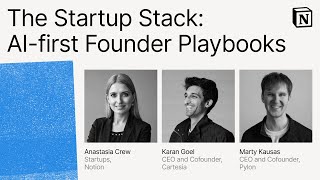
Two AI-first founders show how they built on Notion instead of juggling 112 tools. Pylon ships 2 features daily and 100+ PRs per week using a Notion database for launches. Cartesia scaled from a PhD lab to 50 people using Notion for stand-ups, onboarding, and customer docs.
Chapters
Please welcome Anastasia Crew. Hi everyone, I'm Anastasia Crew and I lead startup marketing at Notion. My team helps startups all over the world to scale smarter, move faster, and design the operation system to run their companies. That is why I am extremely excited to host the startup session today where we dive into AI-first founder playbooks. We'll get to hear from two founders that built and scaled their companies on Notion. But first, I would like to set the stage with some context. In today's startups world, an average company uses over 112 different startup tools just to get the work done. We've all been in a situation where I switch from one tool to another to do the to track it, and communicate what you're doing with other teams. The result? Endless context switching, slower teams, and missed opportunities. That's the cost of software sprawl. Startups do not have time for that. Instead of using one tool to capture customer notes, building your PRDs, and tracking your fundraising progress, they all do it in one place. In Notion. And when you bring Notion early into your teams, a lot of our startups do that. You get to put your team on the same stack with the same context and the same insight from day one. That means lower costs, faster teams, faster shipping, and ultimately a longer runway. That is why the fastest growing startups in history build on Notion. From building your MVP to hyperscale, today's top startups choose Notion as their operating system. That is why today I'm extremely excited to introduce two of the startups that have grown their businesses, raised funding, and onboarded their first customers. First, We'll get to hear from Marty Kossas, CEO and co-founder of Bylin, a company reinventing B2B customer support to be conversational and AI-first. Marty will share how they scaled from a 3-person YC startup to now a 50+ people company, all without compromising velocity or quality. Next, we'll get to hear from Karan Goel, CEO and co-founder of Cartesia, the team who's building cutting-edge voice AI systems. Karan will share how they run product research and design all in Notion, moving fast but staying scrappy as they grow. Let's first welcome Marty Cossas, CEO and co-founder of Bylin. Marty, the stage is yours.
Um, hello, check, check, check. Um, hey everyone, my name's Marty. I'm the co-founder and CEO of this startup called Pylon. First off, who's heard of Pylon before? Maybe some. Yeah, thank you, thank you. Yeah, OK, cool. Yeah, we work super hard. In fact, so hard, actually, did anyone see a Wall Street Journal article last week about 996? Have you guys? Yeah, OK. Yeah, I was the guy that was at the table alone that looked really sad. But we actually have a lot of fun. So yeah, we started the— let's see. So we started the company. And one of the things we're actually really, really known for is how fast we ship. So to give you a sense, we're shipping probably, or we're shipping 100-ish PRs per week. We launch 2 features every single day and we also publicly talk about it a lot on LinkedIn for those of you who know. So yeah, we shipped a lot of stuff, big feature launches like AI agents, of course, AI assistants, this new product SKU called Account Intelligence. And all this is allowing us to build out kind of this like AI-native customer support platform, built for B2B companies and then also absorb all these like other customer-facing products as well. So first off, kind of like back to the origins of the company. So, you know, this is a story from late 2022. It was myself and my co-founders Advith and Robert who started the company. A lot of people don't see the early days of what startup building looks like. So to give you some context, I was first a software engineer at Airbnb for a couple years. Absolutely hated working at a big company. I always had romanticized this idea of building a startup. And so I left, spent 2 years essentially in pivot hell with 2 different sets of co-founders. My now co-founders Robert and Advith, they had worked together for a year and a half. Lots of pivoting as well. And yeah, we, you know, lots of pivots, lots of startup hell essentially before we got to the idea for Pylon. So what we eventually landed on was this idea that B2B companies needed a different type of support platform that could serve their needs. What this means is in consumer companies, you have mostly transactional ticketing, very simple questions. In B2B, you have all these different teams who need to support customers. So it's not just customer support, it's customer success, solutions, professional services, account management, and we're building the first all-in-one platform to support them. This is— I really love this photo. It's actually when we fundraise, this is one of the first things we show. Because this is my co-founder Robert sleeping on a mattress in our second office. And this is— you can see the Pylon logo there. And we were actually in this office until 13 people. So people would like walk by my co-founder's bed and then we'd kind of have our desk there. So this went viral, like 1.2 million impressions on LinkedIn. It was a really fun one. We got a lot of hate for it too. But that is it. So yeah, we kind of went through this journey. Had the idea, worked really hard. To give you a sense of timeline and how fast— there's this pivoting phase of 2 years of almost no progress, and then suddenly things start moving really quickly. So we had the idea for Pylon. 2 weeks later, we get into YC, have our first customer. 3 months later, we have $120,000 in ARR. A month later, we have raised a $3.2 million round from General Catalyst. A year later, we're probably 7 people have raised— no, 10 people have raised $17 million more from Andreessen Horowitz. And then a year later, just raised our Series B from Bain. So kind of from early days, a lot of crazy work, a lot of crazy hours, but we're doing very well now. So yeah, one thing going back to what I mentioned in the beginning, we are super known for shipping really, really fast. One of the things we do especially well is making sure everyone knows we ship really fast. So we have this whole pipeline and process for creating content and keeping the team aligned on what features we're actually shipping. And shout out Yuna, who's actually here somewhere, our product marketer who helps make this all happen. And so to give you a sense, yeah, past year, 750 posts about different features or products we're releasing. And there's a whole system we have to make that happen and make it more efficient. Um, yeah, and, and people really like it. I highly recommend, like, uh, but I was told actually that they replicated our Notion table that you're gonna see and database that we use to actually organize all the feature updates. They made like a published Notion version of the Pylon, uh, feature update playbook. So you'll be able to check that out and people love it. So I recommend it. Um, okay, so the problem is we have all these things we wanna ship. Uh, we have all these teams within the company now. Who need context around what's shipping, when is it shipping, what are the details, and when's the internal launch, public launch. So for example, engineering needs to know, okay, who's assigned to each sample project? And we use a combination of tools, let's say like Linear for transactional small issues that engineers work on, but then there are the big projects which they need context on as well. So engineering needs context into stuff. Sales, our sales team gets questions all the time like, hey, when are you going to have this feature? When are you going to have this product launched? Um, they need a way to access that information. And when you're shipping so much, it's, it's really hard to organize. Product marketing needs to know, hey, we have our internal launch, but what's the public launch so we can plan maybe a bigger video or, uh, a post about it. Customer success solutions similar to sales need context on what's coming and when. Um, so what we've done with Notion is we've kind of organized all of this into a database for ourselves on, um, all the details of everything we're shipping and when. We have internal launch date, external launch date, engineering owner, marketing owner, kind of all these different fields. And we've organized that into one table for us. So this is kind of what it looks like. We did blur out some of the upcoming things. So right here, this would be where all the actual product and feature names are. But very simple. We just put it all in there. And then we have also notice at the top, there are different views on kind of what's actively being worked on, what's coming in the future, views for, for example, hey, marketing wants to know about specific, only a certain set of features that they're going to do bigger launches for. We kind of organize it all into this one place. So this helps us just like really scale out that process and do those 750 posts in the past year. So yeah, we also kind of are using Notion for kind of organizing our launch process. All sorts of runbooks for, you know, operationalizing all this stuff. And also this is like a really fun thing. We definitely leverage the Ask AI feature a lot. So because we have all the context on when things are shipping, who's working on it, details about it, we're using Ask AI all the time to be like, hey, sales team wants to know when are we shipping the email broadcast feature? And so they're able to go in, ask the question, get context, and it's super, super helpful. So yeah, you know, now you know the whole story. We at this point are around 55 people. Our office, if any of you are in SF, we're kind of like right across from the Caltrain station. There's like big building with our logo painted on the side. Come knock if you're ever in, in the area. But yeah, we're, we're super happy to be Notion customers. It's been super helpful for us. And yeah, if you are, how many of you work at a or run a B2B company? Cool. Okay. Have you guys, have you thought about using Pylon before for your customer support? Yeah, of course. I'm definitely going to— yeah, I need to glaze Pylon at least a little bit. So no, this is definitely— I should— yeah, I'll take like 30 seconds. You guys, why haven't you checked out Pylon if you know about us? We work really hard. We ship a lot. Anyone want to say— yeah, are there any Pylon users in the building? Oh, OK, 1 and 2 in the back. Perfect. OK, that's like 2 out of probably like 30 of you that raised your hands. So yeah, cool. Well, now you know, and you should use us, and that'll— then I can go back to our marketing team and say this was all worth it. So cool. Thank you so much. Super excited to pass it on to Karan, who's actually also a Pylon customer, but also has a great business. So thank you, everyone.
We are a Pylon customer, and I did raise my hand in the back, and We wouldn't be where we are without Pylon and their support. So it's an awesome product. Please, please check them out. Hey everyone, I'm Karan Goel. I'm one of the co-founders and the CEO of Cartesia. At Cartesia, what we're trying to do is build the next generation of interactive intelligent models. And one of the areas where we're focusing early on in the company is building models for voice AI. So we power Voice AI applications that developers are building today to build conversational experiences, to build support bots, to build therapy bots, all kinds of new real-time conversational experiences that are coming up. And, and, you know, I'll tell you a little bit more about the story of how the company got started and of course, you know, how we organize our knowledge and how we think about shipping fast and, and doing all of the things that, an early-stage startup should be doing. So a little bit of context that I think is really helpful to understand who we are, and I think that really informs our point of view on how we want to build the company. So I and my co-founders came out of a Stanford lab called the Hazy Research Lab. We were all PhDs that were working on deep learning architectures and really trying to understand how to build the next generation of efficient models. So obviously all the folks here have used, you know, tools like ChatGPT and understand that, you know, models can be really powerful as an assistant to help get work done. What we're really excited about is a future where you can have AI collaborators, companions, operators that can last a lifetime. So basically they're able to navigate context over a century of information and they're able to have the memory and the retention to be able to do that. This is really what we worked on during our PhDs. What is the technology that we think can get us there in the next 10 years? And we spent about 4 and a half years in academia really perfecting, inventing, and applying the technology to early applications. And then we went from there to starting Cartesia because we really felt like it was time to make the leap from doing research in a lab to actually building real systems, real products, and scaling these models so that they have global impact. So that's a little bit about how the team got started. We raised our seed round last year in February and then launched our first model product in end of May. I believe it says May 31st, 2024. So that was our first model called Sonic. It was a text-to-speech model. And one of the things that we were very proud of there is we built the world's fastest model for text-to-speech, faster than any model in the world that had ever been built before. And that was a really great milestone for the company. You can see my co-founders there, Albert, who is one of the, I believe, the next Oppenheimer for AI. He's really the person who invented a lot of the technology. And then Brandon, one of my co-founders, we're a 5-person founding team, so rather large founding team, in our office early last year. And we're looking at a meme actually about some of the research that we've done in the past. And it's, it, this, this particular meme actually went quite viral because there was a, a really crazy video that somebody built about how we were taking on the transformer model. I don't know if folks in the audience are familiar with that, but it's a very, uh, fun video if you wanna, uh, search the word Mamba and on YouTube and find that. Um, and I think we had a good time sharing that around. But, um, one of the things we did, uh, from the early days was actually we were using Notion as, uh, you know, a 5-person founding team. And part of the reason was during our PhDs, um, you know, we used, uh, Notion a lot to organize our notes and to organize knowledge that we were, uh, you know, a PhD is a pretty knowledge-intensive endeavor as you can imagine. So there's a lot of, uh, exhaust that comes out of that and used to write, you know, I personally took a lot of notes in Notion over the years. And so it was a very natural, uh, transition to be, uh, using that when we started the company. I think it was one of the first tools that we actually adopted. as a team. The other thing that I think is quite interesting about, I think, Notion as a product is, um, there are, um, a lot of evangelists, including my own brother, who is one of my founding engineers at Cartesia, uh, who have pitchforks that they use to, uh, force everyone in the company to adopt this tool because they really love using it and they can't imagine a world where they're not using Notion, uh, which I think is quite remarkable and something that we take a lot of inspiration from. At Cartesia because we want that kind of love from our users, you know, developers to be obsessed with, with our tools and the models that we're building. So when we really got started early on, you know, Kabir, who's my brother, he actually had in 2021, I believe, written a blog post about using Notion in college and actually had this whole thesis around how to organize, you know, your notes and, you know, how to build a really good system for for keeping track of your classes and so on. And he actually— that blog post is still up. So when he came into the company, he was like, we have to force everybody to use this and we have to have this be the core sort of knowledge layer for the company so that we can have a centralized place where we're putting all that knowledge. So I think this is a quote that I got from him in the last week, but I used Notion in college and organized my entire life around it. I refuse to use anything else. So That's the kind of evangelism that I think really helped early on for us. And I think as a team, as you can imagine, as AI researchers, we are very sympathetic to the idea that we should use a lot of AI every single day. Like we want to be able to use more AI. We really believe in having super lean teams that are able to do more. So this is a key part of the culture of the company. Since our seed round early last year, we've grown a lot. We just crossed 50 folks last week actually, and we did our Series A end of last year with Kleiner Perkins. Index was our seed investor. We've raised about $120 million so far to be able to build these models and build this technology. And I think something that's really interesting about our team and culture is, again, there's really this streak of independence, of high agency, of being able to just go in and do things yourself. And I think For that, you really need flexible tools that people can sort of self-drive, that, you know, allow us to build workflows and build templates and do our way of, or encode our way of working into the tool. And then the other piece that I think is quite interesting is we have a team that's, you know, 40% research, 40% engineering, and 20% go-to-market, recruiting, and biz ops. So, Actually, this team structure is quite unusual because most companies and startups don't actually have a research team, and there are not very many tools that are actually amenable to being used by a team that has that kind of structure. Because, you know, there's really no great tools for researchers and engineers and product folks and go-to-market folks to work together, right? So I think that's been a, that was also a key sort of like cultural thing for us, which is how can we bring everybody together in a single, workspace and, and what tool would be able to support that. And obviously a lot of this is, are things that we realized in adopting and using the tool over time. But I think we made some very good decisions there early on that helped us a lot. So, um, here I'm gonna talk about, uh, 3 ways that we've been using Notion as a team and, uh, and how that's been helping us, uh, uh, scale and grow, uh, the company as, as we've been adding more folks to the teams, uh, that we have today. Um, so I really wanna start with where it all got started for us, which is, uh, daily standup. Um, obviously, uh, when we were, uh, just the co-founders, we would use, uh, Notion to take ad hoc notes, meeting notes, et cetera. Um, but, um, once we started recruiting, uh, folks post our seed round, uh, one of the things we instituted was this daily standup where everybody in the company would come together at 9:45 in the morning and, uh, just be there to to share updates. And, you know, partly it was a forcing function to get everybody into the office at the same time, to be very honest. So, you know, daily standup, because it was at 9:45 and in person, it was, you know, you had to get up at 9 in the morning to, to be there. So that was, that was part of it. But also it became a place for us to track, the progress that we were making every single day. So we actually had a single Notion page where we would all fill in our updates. And often, you know, I would be running to work, and I would be on the mobile app. And, you know, a, a year later, we had so many notes that I would have to scroll like all the way down to, to fill in my update while I'm running to, to, to the office. But, uh, we really had everybody filling out these notes. And, um, and today, you know, we have an archive of, of last year's. Every single day there's like, you know, updates coming from 10, 15, 20 people. So you can really see the growth of the company and see all the work that happened over the lifetime of the company. In that one area of Notion. And as the team grew, we actually split this up. So we have more teams now. Each team now has their daily standup doc, and that's been something that we've scaled with the company. But it's really been sort of a cultural thing almost that started out as this small thing that we would do that became kind of a bedrock for how we coordinate early in the morning and work together early for me. I guess some folks wake up at 5:00 AM, so maybe not so early for them. Um, and on the left side you can also see, uh, other areas, uh, of the company that are being organized into Notion. I think, uh, if you look on the left, we have recruiting, for example, all the, all the recruiting work we do, the talent work we do is actually, uh, all of the runbooks and, and, and the playbooks and our understanding of, uh, who we need to source and, and you know, how we need, how we need to sell the company to them. All of that is encoded and, and, uh, put into these pages in Notion so we can really easily search and find all of this. and, and make it really easy for, uh, team members across different teams to understand how, uh, how we work. Um, so that's one of the key things that, uh, we do to keep everybody on the same page. As I said, we need researchers, uh, to be able to access this. We need, uh, folks on talent to be able to access this, all of that. Um, so that's a little bit about how we run, uh, internally. I think one of the things we really, uh, needed to do was get very disciplined about how we bring on folks. So we've doubled in size in the last 6 months. We were 25 folks exactly 6 months ago. And so one of the key things we really needed to do was understand how do we tell people more about each part of the company? How do we explain to them what the best way to onboard into different systems is, whether it's engineering systems, whether it's how to run, you know, model training, whether it's getting onboarded into a cluster, whether it's, you know, going and setting up Google Cloud or any of the other clouds that we're on. So all of that work that we're doing needs to be put into one place so that anybody who new that's coming into the company, the time it takes for them to onboard and really understand what's going on should be as short as possible. And this is really where we think that AI can play a big role because a lot of it is about getting answers to all the questions that folks folks have in the first week. So we've really done a lot of work in building our onboarding directories where we have all of these links, we have all of the information and entry points for folks. And then there they're able to access, you know, use Notion AI to basically ask questions, get into what's, you know, whatever confusion they might have, which, you know, as you can imagine, first week of a fast-moving startup, it is pretty crazy. So, so really giving them access to all the information and be able to answer questions, go to specific pages, go to links and know, you know, who to talk to even for each thing. I think that's been a real acceleration for us. We don't use that many tools at Cartesia. We try to kind of keep things pretty compressed. So this has been one of the key ways that we've helped folks onboard quickly. And one other thing I'll say is like in, in this workspace we have like, research expositions of like research papers sitting alongside, you know, playbooks for sales. It's quite amazing how new folks on the team have adopted the way we work and been able to sort of like onboard into that. So that's been a very, a key part of the culture. Let's see here. And one of the really cool ways I think that we use Notion is actually as a way to build culture. Collateral that we can share with customers. So that's been one of the sort of maybe off-label use cases that emerged organically for us where, you know, we were talking to customers, we needed to share with them evals around our models. And so these are like multimedia documents we need to share with them to show them, hey, our models work great, this is how fast they are, this is how they apply to your use case, all of that. You know, how do we recommend a certain, settings for the model to them. All of that work needs to, to, to be placed in one, uh, document and then be shared with them. And then it has to be a living, breathing document because they're gonna give us feedback and we need to go back and update them. So we want to have this be sort of a single, uh, pane of glass for them, uh, in terms of how they interact with our product. Uh, so this is one of the things that I think we did, um, that, that we really, um, like and I think customers really appreciate, which is we have these really good templates now for, being able to share information with customers. And then if you, if we have prospective partners, they can get access to all of these evals and all of these benchmark results. And these are pages that we share specifically with them. And then they're able to sort of leave comments or, or, you know, raise additional questions to us. But it really kind of cleans up the process and makes it super seamless and fast for us. And the other piece that's important here is because again, like we're talking about, you know, at the end of the day, we're an AI company that's building models. A lot of what we need to do is explain, uh, certain features of the model or, you know, how to use it effectively. And that means that sometimes there are questions that researchers may need to answer. So once again, everybody needs to be able to look at this information in one place. And if it was a tool that was not, um, something that was accessible to engineers and researchers, it would make it a lot harder for them to be able to put in the information that we know customers might have questions about. So it's really helping us sort of centralize that and make it super easy for us to share. Because of all of this work that we're doing, we've been able to really accelerate a lot of the progress that we're making as a company. And so, you know, over the last year, for example, as I said, we've really grown as a team, but also we've been continuing to launch new models and enable new applications. So as an example, we launched in spring our new version of text-to-speech called Sonic 2, which was, a real popular model that, you know, continue to kind of push the naturalness of what voice models are able to do. And in fact, we have another version of this coming soon. And these are state-of-the-art voice models that enable, you know, voice application builders to go out and build conversational applications really easily. So that's been one of the key things that we've been able to do as a team is really accelerate the velocity at which we ship these, research artifacts that ultimately need to go to production. And a quick highlight of some of the other stuff that we've done, we've also been launching more models on audio understanding. How do you understand what users are saying on a phone call or whether they're talking to you through any web or mobile application? How do you transcribe and understand the emotion of what they're saying? How do you transcribe the words that they're saying? All of that with the single fastest model for transcription. And then finally, very recently, we did our biggest coordinated effort across the company, which was about 15 people worked together to launch our voice agent platform. This is really helping folks build end-to-end conversational systems. So really like a model and a system that you can talk to that can take action on your behalf. And this was a very big effort that was completely organized, you know, PRDs, et cetera, in Notion. And then really helped us sort of accelerate the adoption of our models. So we were super excited about what the future looks like on interactive models, being able to do more and more for users, giving them more and more context, and really making it easy to bring AI to everyone for multimodal applications. So that's it for me. I'm going to pass the mic back to Anastasia. But thank you so much for listening. If you're building voice applications and you're excited about the future of conversation, you should look us up, Cartesia.ai, and, um, please use our models. Thank you.
Let's give it up again one more time for Karan and Marty. A huge thank you to both of them and their teams for opening up their playbooks with us today. What we've heard today and what we've seen is two founders, two very different startups, but one common thread, Notion as a backbone for scale, clarity, and speed. So what are we hearing today? A few key takeaways, if you will. Number one, operational velocity starts with the right stack. You've seen Pylon showed us how they Notion supported their growth from a 3-people YC startup to now over 50-people company while still shipping hundreds of new features every week. Number 2, startup founders are system architects. Both Karan and Marty showed us how they designed their operational systems in one place in Notion instead of using dozens of siloed tools. And number 3, AI is the rocket fuel woven into both Pilot and Cartesia's operating system. It drives speed, clarity, and accountability without the noise. So as you think about your own startups today, ask yourself, how can you collapse the software sprawl, embed AI into your daily flow, and really build a workspace that truly scales with you? So before you head out today, scan the QR code or take a picture to get all the templates from Pilot and Cartesia teams and also unlock a special offer for our startup community of, of up to 6 months free of business plan with Notion AI included. Take it for the ride and see how far you can take it. Thank you and enjoy the rest. Make with Notion.
More from Karan

IIT to Silicon Valley: He Built the World's Fastest Voice AI | Karan Goel, Cartesia

Building Voice AI For The World: The Cartesia Story With Karan Goel | Elevation Capital Podcast

How Cartesia Edges Out The Big Labs With Audio AI Models, with Founder and CEO, Karan Goel
Voice AI Founders chat: Vapi X Cartesia | Agentic AI trends, Founder journey, Biggest bets in 2025