Katharyn Havens teaches a homeschool essay lesson on Scorch Trials using symphonic thinking, which links the essay topic to unrelated domains like basketball to spark new ideas. She uses Milanote for brainstorming, a fill-in-the-blank exercise for descriptive language, and AI as a coach, not a shortcut, to keep students' original thinking central.
Chapters
So have you seen these articles by Forbes and other publications asking basically, is AI making us dumber? And then there's a study by MIT that says, well, yeah, maybe it is. And the reason for that is something called cognitive atrophy. So what do we do with that? How do we counter this as educators and teachers? And I would say that the way we counterbalance that is something I call symphonic thinking. Comes from a book, I will reference it below. And I would like to walk you through how I used symphonic thinking just this week in a lesson for my kids, in particularly in writing. I think kids especially have a hard time writing these days, and obviously the incentive is there to just use an AI to write, but I'm trying to teach ethics in AI and show them how to use it as a tool and not to outsource the thinking and the writing. We will use it later as a coach and maybe as an editor, but in the beginning, I stress that all ideas are ours. So let me walk you through how I did this lesson.
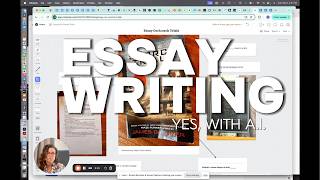
Okay, so let me go over to one of my favorite tools, which is Milanote. We use this a lot in our homeschool, actually. The kids can make these very cool interactive boards. So first things first, the title of this is called Essay on Scorch Trials, and that is because I really think it's important, especially when we're starting out writing essays, that the essay can be about something that they actually are interested in. My son read The Maze Runner. This is the second book, so he read Scorch Trials. And as we started to write an essay, a sort of a summary of the book and more, which I'll get to later over here on my chalkboard, he was having a hard time getting started. So I decided, okay, I'm gonna just give him the, the opening, the hook essentially, which is right here. Here's why I read Scourge Trials in 3 days. It's just like the way that we record videos as content creators. You need a hook. So that's where we started. The second idea to help him get going, I used this fill-in-the-blank scenario. It's a blank read in which blank happens. Then we talked about what could the words be that we fill in this blank? Exciting, gripping, page-turner. Really, I just wanted to give him some ideas. And a lot of this happened in real-time brainstorming and there were many more words that he came up with, right? So you'll see here an actual photo of my favorite tool, which is the chalkboard. So I gave him the middle part, which is, you know, a few words about what happened. Then we talked about how we use the author's name and we say, so-and-so, James Dashner, uh, drops us into blank, or Somehow we relate it back to the first book. Just as in Maze Runner, blank happened. So that's the second part. But the third part is the real important key that I want to stress on this. I am intent on helping these kids to learn how to think innovatively while using AI. And how do we do that? I call it symphony. And this idea of symphonic thinking comes from a book about right brain thinking, and I will link to it below. So symphony means take something completely unrelated to this topic and weave a thread. Let's see, how does it connect? Like, what can we bring together? So here I asked him, what does this have to do with basketball or climate change or politics, right? We talked about a lot of different things, and in the end, he actually— he's the one that came up with climate change. And so here's the essay over here, uh, as it stands after this just initial lesson, right? Obviously, you see my edits. There's a lot of, uh, work yet to be done. But the thing about the essay writing and really everything else I do in in my teaching is that we are trying to encourage this idea of symphony. So the next step, in fact, in order to just take this one step further, um, and if you've seen my other videos, you know, I talk about AI a lot. So we decided that in order to give him a platform, he could just create a website and that will be where he puts his book reviews because he reads a ton of books, and that way there is actually a repository and it could be seen. Now, maybe it won't be seen. Maybe 2 people see it, but who cares? Like, it doesn't really matter if anyone sees it or not. The point is there's an audience and he'll have to think about, uh, how do I engage the audience who might read this, right? How do I prompt the AI, um, in order to create a website? Which he will do on Replit after he has engaged with an LLM to get the prompts going. So this whole idea of writing is woven throughout, right? Why we use AI as a partner. I'll also link to my favorite document, which I highlight here, How to Use AI as a Writing Partner. The kids have this in their notebooks And we reference it a lot so that we know and remember that AI is a tool and a partner, but all ideas come from our own brains. So there you go. I hope that helps and stay tuned if you want to hear more lessons.