Kathleen Booth on Why Community is the New Google
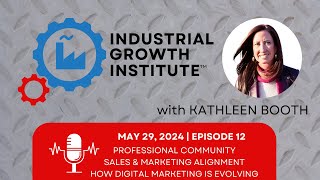
In this Industrial Growth Institute podcast episode, host Ed Marsh interviews Kathleen Booth, SVP of Marketing & Growth at Pavilion, about her unconventional career path—from political science and international development consulting to founding a HubSpot‑partner agency, selling it, and moving into B2B tech leadership. Kathleen explains how the HubSpot community first connected her with peers, and how Pavilion’s professional community has become a critical source of knowledge, support, and career acceleration for go‑to‑market leaders. She describes Pavilion’s evolution from an invitation‑only CRO/CMO network (originally the Revenue Collective) to a 10,000‑plus member global community that offers tiered membership, local chapters, Slack‑based peer discussions, mentorship, and “Pavilion University” courses such as CMO School and CRO School. The conversation covers the rapid pace of technology and AI reshaping marketing tactics, the need for continuous learning, the challenges of marketing‑sales alignment, revenue operations, and attribution, and how a community can surface the “unknown unknowns” that cause imposter syndrome at the C‑level. Kathleen also shares practical advice for industrial‑sector leaders considering tech‑focused communities, the importance of a give‑first mindset, and candid reflections on work‑life balance for senior executives. The episode underscores the central thesis that professional communities now function as the modern “Google” for peer‑validated advice, accelerating both personal growth and organizational revenue performance.
Chapters
And the scariest thing of all is that you don't know what you don't know, right? That's terrifying. If you just tell me, like, oh, Kathleen, you're going to have to figure out X, you tell me what it is. But if I don't even know I'm supposed to be figuring it out, that's what's so scary.
And Hi, I'm Ed Marsh, host of the Industrial Growth Institute podcast. One of the biggest mindset barriers that I see for industrial revenue growth is the relationship between sales and marketing. Often I'd say companies just kind of, they don't get it. And there's a journey for those who do eventually reach that point. Much of that journey depends on having folks around you with a different and maybe bigger perspective. And a lot of that is a function of the community in which you circulate. I think that's part of what HubSpot leveraged in their growth for many years, a community approach to supporting marketers and encouraging them, giving them the tools and teaching them. It was actually through the HubSpot Community that I met today's guest, Kathleen Booth. Kathleen was founder and CEO of Quintain Marketing. It was a digital marketing agency, an early HubSpot partner. She had a successful exit from her firm and then held marketing leadership roles at VC-backed B2B technology companies including Attila Security, Clean.io, Tradeswell, and she continues to serve as an advisor and fractional CMO to a variety of early-stage B2B tech startups. There's been a thread through her career for the last 5 years particularly, and that's a group called Pavilion. She joined Pavilion as a member in 2019 and later went on to become a founding co-chair of the Washington, D.C. chapter, a Pavilion ambassador, and today She's the SVP of Marketing and Growth. And in that capacity, she leads the marketing and growth for a 10,000+ member global community of go-to-market executives. In a tech speak, go-to-market means marketing and sales basically. She's got serious credentials to validate her authority. She's been recognized as one of the top 50 B2B marketers to watch by TopRank and one of the 6 global marketing advisors who are rising stars by USA Today. So, we've got a serious expert here with us today. And this is going to be a fascinating conversation. Really diving into the role of community in individual personal and professional development and in organizational success. And I'm so excited that Kathleen has agreed to spend a little bit of time with us with her crazy travel schedule and everything else to share her insights. As you listen or watch, I know things are going to jump out at you. Please don't keep them secret. Like the episode, share it, comment to share your impressions, leave a review, send the link to folks who you think might benefit. And with that, Kathleen, welcome. Thanks for spending some time with me today.
It is so great to be here, Ed, and I love that you mentioned that we met through the HubSpot community because the funny part of that story that people might not know is that we were— I think technically we were competitors, but that was an example of an ecosystem, HubSpot's ecosystem, where somehow or another all of us competitors became really good friends. And I still stay in touch with so many of them today. And so I'm so grateful for that time in my career and the lasting relationships that it created.
So, yeah, absolutely. A lot of, a lot of great connections. And the interesting thing about them is it's probably been a couple of years since we've actually spoke, but I feel like I've kept up with what you're doing. I feel like I kind of understand what you're thinking these days. And it was easy to send you an email, pick up the phone and connect. It's a very— I think there's a depth of connection that's really interesting as well.
Agreed. 100%.
All right. So we're going to get to business in a minute. But first, we've got a higher priority. And that's because Both you and I are Johns Hopkins Blue Jays. Lacrosse is a really important topic. You're actually located in the Mid-Atlantic, and so lacrosse is certainly a part of your life. And as we record this today, Monday, April 15th, I'm particularly excited because there's just one game left in the regular season and Hopkins is back doing a decent job in the rankings, ranked second in the NCAA. So here's a question for you to start things off. What's your tournament call?
What? Oh, boy. I mean, I wouldn't be, I wouldn't be a Blue Jays fan if I didn't say, you know, I think Hopkins can win it all. But yeah, here's another interesting thing though, is I have real divided loyalties these days because I live in Annapolis, which is the home of the Naval Academy, and they've got a really good lacrosse team too. And so there have been a couple of times this season where they've played each other and it's been like, oh, I don't know. I don't know. I guess you could look at it as either you know, you feel bad no matter what, or, or you feel good no matter what.
So, well, I think, I think you're going to be better off putting your money on Hopkins because as an Army vet, I could tell you I watched the Army-Navy rankings and Army is well ahead of Navy this year. So, yeah, so my money's on Hopkins, but I won't be in Philly this Memorial Day. Are you going to be there by any chance?
No, sadly. But no, actually not that sadly. I'm going to be seeing my stepdaughter get married, so.
Oh, congratulations.
Yeah.
Nice. All right. So we've got that obligatory point out of the way. Now we can start to dig in a little bit. Help us get to know Kathleen. I mean, I know you didn't start out in marketing. In fact, you were initially focused on political science. You worked in public-private partnerships with a large public engineering firm on utility projects and then a couple of master's degrees, but none of them, I don't think, in marketing. So take us through your career and help us understand how you ended up where you are and how all these steps along the way have shaped you.
Yeah, so I did, as you say, I started out with a focus on political science, and then I did a master's in international politics. I did do an MBA in marketing. But my— the first 10 years of my career were not in marketing. They were more kind of in that other direction. I did international development consulting. And it was great. I worked with 53 different countries all over the world on how they thought about contracting out their water and wastewater services. It was both rewarding and also incredibly heart-wrenching because you'd go to these places and they don't have clean water. Not only do they not have clean water, but they don't have water 24 hours a day. So it's a real, like, serious problem that needs to be solved. And I think there came a point in my career where I realized that one of the big things that was preventing them from solving it was effective communications or marketing, really. Where they would start these big public sector reform projects and they wouldn't ever get off the ground because of essentially lack of stakeholder buy-in. And so partway through my career, I recognized this problem. And fortunately, I did have that background in marketing. And so I started to shift my focus to teaching these governments and advising them on how to start communicating earlier and more effectively so that they wouldn't wind up in these situations where they're halfway through a project and all of a sudden, there's all this opposition. And apply that to anything. I mean, we see that all the time in big change management efforts. But anyway, that led me back to marketing because when I, like around 10 years into that career, I wanted to have children. I was getting married. And that was a great career for somebody who was single and in their 20s. But when I started to have kids, just was very quickly clear that I wouldn't be able to just jet around the world for weeks and sometimes months on end, um, often, you know, to places that are not great to bring a baby if you're a solo traveler. So I shifted gears and my husband and I started an agency, which is really what led me down the path that you described earlier. And, um, you know, I would say it's interesting, marketing and, and my consulting work have a lot in common in the sense that Marketing changes really quickly. You know, you can— I did an MBA in marketing and people often ask me, should I get an MBA? And, you know, it's not a clear-cut answer because there are some great skills you can learn in school, but so much changes. It's so technologically driven these days. And what— when I say marketing and consulting have a lot in common, what I mean is like to be a great marketer, you have to be intensely curious. And you have to want to figure out the answer to a problem. And you have, you have to want to understand, in this case, the customer. And so there isn't like a formula you can apply to be a great marketer. Even if you go to school for it, there's a lot you still have to figure out on your own. And it's that same curiosity that I think makes a great consultant. And so that's part of why I think I enjoyed that transition. I thrived through it. I'm a very curious person. I love figuring out and solving problems. And I think marketing gives me that ability. And unlike the consulting work I was doing early on, where you might come up with a solution, but it could take 5 or 10 years sometimes for these countries to fix the problem. With marketing, what's so great is very often you're seeing the impact of your work in sometimes days, if not weeks or months, but it's much faster, which is intensely gratifying to me. So I really do love, I love it.
Now, as you described the ideal marketer, that person with that curiosity seeking to understand the buyer, seeking to help them solve problems, really, you're also talking about great salespeople. And I want to come back to that point because as we talk about Pavilion and what you're doing now, I think there's a great opportunity for us to learn about this question of traditional friction between those and the importance of collaboration between them. But back to your agency quickly, what kind of clients did you start out working with?
Oh my gosh, it was all over the map. In the beginning, it was very local. And so, we had restaurants and law firms and commercial landscapers. But as our relationship with HubSpot deepened, we actually wound up having customers all over the country. And towards the end, we were doing a lot in B2B tech, specifically cybersecurity at the end. And so, it was interesting. It was kind of fun because I did get to do exactly what I described, which is immerse myself in all different kinds of business models and One of the things I really loved about being in the agency world is that kind of like cross-pollination you get where you see what's happening in other industries, you know, because I would often be hired by somebody and they'd say, oh, have you worked with cybersecurity companies before? We only want to hire somebody who's worked in cyber. And there's definitely aspects of the work that lend themselves to having somebody with industry experience. But my counter to that would be, you know, if you only hire somebody in cyber and that's all they know, they're just going to give you the cyber playbook, which is the same playbook everybody else is running. So, how are you going to differentiate? How are you going to get those 2x results versus, you know, I can come in and I've seen what's worked in healthcare and, you know, the trades and other kinds of software in financial services. And we can pull those lessons learned in and get creative. And perhaps we'll find, you know, strategies that will give you outsized results as compared to your peers.
I think you're gracious when you, when you call it the traditional playbook. I call it more head trash. I think people just have such a self-limiting perspective. But of course, it comes back to the point you made about curiosity. You have to be curious. You have to be a high-level thinker in order to pull those pieces together and see how they fit.
Yeah, it's like first principles thinking, really.
Exactly.
You know, forget everything you know. If you were going to start from scratch today and really just look at, look at what you know to be true, which is this is what we sell, this is who we sell to. What would you build if you didn't know how everybody else had done it? And the answer might be this: you'd build it the same way. Great, but it might not be.
And I think we're going to touch a little bit on industrials. I know that's not the space that you live in, but I want to tease some lessons out from Pavilion for industrials. But that's such a great point, too. If you think about, you know, you talk about developing markets, in many cases markets have skipped landline phones. They've gone straight from no telephones to cell phones. And it almost feels like industrials have that opportunity. I mean, a few have dabbled in content marketing and some other things, but so many can really skip the landline and go straight to the mobile phones, if we can use that analogy, by looking at what tech companies have done, what SaaS companies have done, saying, okay, based on what we know today, let's build it from where we want to be rather than trying to iterate to get there. Is it— you think that's fair?
I think it's fair. And like, let's extend that analogy. I mean, AI has just totally changed the game. And if you're starting today, for example, like You talked about content, your content strategy. I think you'd come at it a completely different way. Your customer support strategy. I mean, there are ways of feeding support information into bots now and having them answer questions. It's like kind of mind-blowing. Your sales strategy with your cold outreach, the ways you can personalize that now by enriching contact-level data. This is what I meant earlier when I said like you can go to school for marketing, But in months, what you learned is going to be somewhat outdated because of the technological advances we have, which is really more the how you do it, not the what you're doing. The what is the deep understanding of the customer and the landscape.
But if you're isolated, it's really hard to understand because everything is changing so quickly, as you said. And there's so many facets and so many different areas of expertise. And that's, I think, an important community point that we're definitely going to come back to. Before we get there, though, you were, you were running this agency and you decided to pull the ripcord and sell it. What, what prompted that?
Oh, I almost hate to say this because there are so many other agency owners out there that I love, but I just was exhausted. I was— it's a very hard business for anybody who hasn't been in it. The margins are low, like even the best agencies, nobody's getting wildly rich off of it. So when you hire your agency, keep that in mind if you're a customer. It's very dependent upon people. Like, your ability to scale is entirely dependent upon your ability to attract good talent, which is really hard. And I wasn't in a major market. I mean, I started hiring remotely in 2015. So, I feel like I was really ahead of the curve. But even then, it was hard. You know, and just, I think, I was in a business where whether you like it or not, your customer expects that they're buying results. Not the work. And the results are not entirely within your ability as an agency to control. Like, I had customers who would— I would deliver incredible leads to, and then they would get angry if they couldn't close the business, and they didn't have good sales teams, you know. And so it just was tiring. And I had kids going into college, and I was like, I'm ready for somebody else to write my check. And so it was time. And so I got— I was very fortunate that I had an opportunity to sell the company to a competitor, and we were able to transition all of our customers over to them and all but one employee, which those are my big things. I didn't want to leave a lot of people hanging. And so, it was nice that we had a situation where the customers and the employees, the team were taken care of. So, yeah, that was 2017 and stayed there for 2 years to transition things. And then, in 2019, I decided to finally go and do what I had wanted to do all along, which was really go in-house into B2B tech. My timing was terrible because it was right before COVID So I had a few tumultuous years there, as I think many, many people did. But, and have now kind of settled in, and I'm really enjoying being on the inside.
So marketing for quite a while, your husband's a marketer too. A lot of your spare time, I think, is spent advising startups and marketing organizations. So is marketing your hobby as well as your profession? Or what do you do for entertainment?
I think, I think probably if I'm being honest, yes, it is my hobby. I love work. I love my work. It's fun. I enjoy it. It's an intellectual challenge. I'm also really passionate about supporting entrepreneurs, having been one myself. Like, I love seeing people succeed and find success in, in through marketing. And so I, I get a lot out of that advisory work, you know, and it's, it's also kind of fun because you, you're in a situation where you don't have the internal politics of a company, which is a whole different discussion. But yeah, it's been enjoyable. I spend a lot of time doing what I do. I really love it. And hopefully sometime in the next 5 to 10 years, I'll discover an actual hobby outside of work. But for now, I'm really enjoying it.
Well, you're in a beautiful part of the country for, for all kinds of hobbies. And I know one of the things I've seen that your family does consistently is sponsor kids from the Naval Academy at Thanksgiving, bring them home to spend Thanksgiving with your family. That's neat for you all to do.
Yeah, it's actually not even just Thanksgiving. The, um, Naval Academy has a really unique program where every incoming freshman is assigned a sponsor family, and it's meant to be for their whole freshman year, but more often than not, it lasts all 4 years of their time here. So they become like our family, and they're usually here pretty much every weekend. Uh, they just wanna come over and crash on the couch and eat and sleep. And if they're boys, play video games. Not to be too much of a generalizer, but this has just been my experience. So it's been a lot of fun and they're great role models for my kids.
Nate, and I think you got softshell crab season coming up too, right?
Yes.
So, so anybody who hasn't had a softshell crab sandwich, you get this basically hamburger bun with fried claws poking out the edge of it, a whole crab that gets put on that roll to eat with, with some lettuce and tomato. Right.
Much easier than picking the hard shell off of a crab.
So although with a keg of beer and a bushel of crabs, that's pretty good entertainment.
Yes.
So, you touched on the fact that you had this period, particularly during COVID of kind of instability or unpredictability. And the marketing world was changing quickly. Roles were changing quickly. There's changes that are still happening. I think the tenure of CMOs is quite low. It's based on funding and the economy. And that tends to be rather different than industrials that tend to be much more stable. Certainly, some capital equipment cycles up and down, but much less of the turmoil in roles How has that turmoil kind of shaped your adaptation? I'm sure it's built resilience, but what other lessons has it taught you about the way you approach a role and the way you professionally develop yourself?
Oh boy, it's been extremely volatile. And I think if you talk to any CXO in B2B tech particularly, you'd hear the same thing. People's tenures have gotten dramatically shorter. And, you know, some of that is is a reckoning because of what's happened with the funding climate. When funding was plentiful, money could cover up a lot of sins, if you will, you know, lack of good marketing or good sales or good, you know, just lack of discipline. And so I think when the banking crisis happened and funding started to dry up, it forced a lot of companies to move into a position of what my boss, Sam Jacobs, calls PEG, or profitable efficient growth, as opposed to growth at all costs, which is what it was before. And when you're having to live off of the money you're making, it kind of like, it unmasks the work you're doing, right? You have to have really good fundamentals and you have to be very, very careful about the money you're spending. And you need to be able to justify that every dollar you're spending is bringing another dollar dollar in. And so, there's a degree of financial rigor that I think marketers and really any CXO has to have in this climate. And if you don't have it, I think that that can put you at risk. But I will also say there are many amazing marketers and heads of sales and heads of CS and heads of whatever who've been let go and they're scapegoats. Like it's really easy to have a company that isn't performing and be like, "Ah, let's get rid of the marketer. It must be the marketing." when in reality it could be a product problem. And I see that a lot— companies that just don't have product-market fit and they continuously blame their, their go-to-market leadership team when in reality it's the fundamental product that's lacking. And then the third thing I would say is what one thing it's really taught me, and I think a lot of people in this climate, is to do better due diligence when considering accepting a job. And that's easy to say. It's hard to do when you're, you know, you don't have a paycheck coming in and somebody makes you an offer. But I think really understanding deeply the CEO and their level of experience, you know, I think there's a lot of people now who are maybe less willing to take roles with first-time CEOs than they might have been before. It's not to say that all first-time CEOs are not good, but, you know, there are a lot of them that make mistakes that tend to get kind of taken out on their revenue or go-to-market leadership team, but also the investors. And it's not just like what's their experience, it's what's their attitude towards marketing. Do they believe in it? Um, are you going to be given the resources you need to do the job well, or are they going to give you lofty goals and no budget and expect a miracle? Um, and then I think lastly, it's really looking at the rest of the team, because if there's ever been a time in history when it's important to make sure you're coming in to a team that is as good as you are. You know, they say like you're the average of the 5 people you surround yourself with. I think that's true in life, just as it is at work. And if you come into an environment where the other leaders are not savvy, they don't know what they're doing, they don't have the experience, you are— there's going to be a lot of pressure on you and you're going to be set up for failure. And so a lot of lessons learned from the last several years. And I'm thrilled with where I am now, thank goodness. So I was able to internalize some of those lessons and put them into figuring out what I wanted to do next when I came to Pavilion. And it's been great and I've learned a ton since I've been here.
So I love the way you called out about the people that have found themselves on the street and often not because of their own ineptitude, but because of other circumstances. And I would call that out to the industrial space. That's a real interesting opportunity, I think, for some people who enjoy the discipline they're in but have really had it with some of the unpredictability of tech and might be looking for a more stable place to land to bring that perspective and those skills. I think there's a great opportunity for people to begin to look at industrial to get off that treadmill of tech. You, you mentioned the that all of that turmoil, and I assume that that's part of what led you to the point where you wanted community. You wanted people around you for support, for ideas, for networking, for finding opportunities. Is that fair? Is that what brought you to Pavilion originally?
I think, yeah, that was a big part of it. So, what happened was, in 2019, I had sold my company. I had gone to this other company that acquired us for 2 years. And I made the decision after about 2 years to leave. And that was in the fall of 2019. And I had an amicable parting. And because of that, I was able to take my time in looking for my next role. And I circulated my resume to a lot of people I really respected within the industry. And I just said, hey, if you see anything that looks like a good fit, you know, I'm looking. And I started getting all these really great interviews with amazing companies. And I, again, I knew I wanted to go into B2B tech. And I— there were companies like in New York City, software companies, and I live in Annapolis, Maryland. And I was thinking, how do you even know about me? And it turns out that one of the people I had shared my resume with had shared it within what at the time was called the New York Revenue Collective, which was Pavilion's old name. And when I found that out, and it's— at the time it was an invitation-only community, and I was like, how do I get an invitation in there? That seems like the place you want to be. And I did wind up through this person being able to join. And at the time, it was because I was looking for a job and I recognized that it was a really good network. I mean, it was all of the top sales and marketing leaders kind of that I had always looked up to in a private Slack community. And I thought, that sounds great. And it was. It was great. And so, I got in. It did help me find a job. And then, I would say my journey with Pavilion following that was interesting because it really evolved with me. You know, at one point it was helpful for finding a job, but also there were times when it was purely about strengthening my network just so that I could surround myself with those other smart people and get smarter because of it. There were other times when I was just starting new jobs and I needed help kind of with a good 30, 60, 90 and getting off the ground quickly. So like when I joined Clean.io, One of my first things they asked me to do was develop a go-to-market strategy for a new product launch. And this is something that I could build on my own, but it might take me longer. And instead, I went into Pavilion and I said, who's got a great template for this? And in like an hour, I had the most amazing template. I was able to fill it out with what I knew we needed to do and within a day, get it back to my company. And they were, they were like, this is amazing, you know? And so, It's stuff like that where it's like, why reinvent the wheel when the wheel exists out there and there are people who can show us how to build it? And then, I think the last thing that's so powerful about community, and this is perhaps the most important one given the discussion we just had about the turmoil, is that when you get into these senior roles, the most— most people I know who are in CXO roles have tremendous imposter syndrome, which seems counterintuitive because it feels like you made it, right? You got to that high level. You should be confident. You're the expert. You're the one everyone looks up to. But the reality is that when you get those roles, it is terrifying because there's only one of you. You know, like when you're the marketing manager at a big company, there might be 3 people, 3 marketing managers. So, you have your peers that you can go to and be like, what? Do you know what that is? Because I don't know what that is. Or how do you do that? There's nobody to go to when you're in that C-level. So, you don't have a peer that you can rely on. And then, in addition, your success or failure is incredibly visible, not only to the whole company but even externally. Like, your ability to have an impact is measured in terms of the company's success. And so, failure is spectacular when it happens. And it also impacts other people dramatically. And so, And I think the other big thing is that like there really traditionally hasn't been a way to learn how to do that job, like how to be a CMO or CRO. Even getting your MBA or whatever, it doesn't really teach you what does that look like when you're on the job. And so, you get into these roles and the scariest thing of all is that you don't know what you don't know, right? That's terrifying. Like, I don't even know I should be doing it because I know I can only speak for myself and say, If you just tell me like, oh, Kathleen, you're going to have to figure out X, going back to my consulting roots, I'm like, great, I can figure anything out if you tell me what it is. But if I don't even know I'm supposed to be figuring it out, that's what's so scary. And so, the thing that community does really, really well is it lets you know what you don't know because you can— you don't even have to participate, although I would say most people should participate in communities. You can just silently sit there in sponge mode and listen to the questions that the smarter people are asking. The stories they're sharing, the challenges they're experiencing. And it is effectively your roadmap to all the stuff you need to figure out. And so that to me was the most powerful thing is like I no longer felt alone. I didn't have that existential fear of all the stuff I didn't know that I should. And, you know, it's not to say that there aren't times when I don't feel anxiety, but I always have a solution for it now. And I know where to go to get the answers fast. And there are answers that I can trust because there are people that have been there and done that.
That's interesting. But winding back, when Sam Jacobs started it, I mean, he's got this saying, I think the company's adopted it, nice people finish first. What was the genesis? Why did he decide to start it?
Yes. So, it's kind folks finish first, which I only say that because he draws a very big distinction between nice and kind because you can be kind but not nice. Kind is kind of like doing the right thing. Nice is more about making somebody else feel good. And being kind doesn't always mean somebody else feels good. Sometimes, being kind is giving someone really, really tough feedback. Sometimes, being kind is firing somebody because it's the right thing and they're not in the right role and they can't be successful. So, it's definitely an important distinction. But yeah, it's— Sam has a great story, a great origin story where he was the Chief Revenue Officer and he was fired multiple times from his job. And he kind of was like at the end of his rope. He's like, I can't keep working for other people. And so, he started Pavilion. Honestly, it started as like a dinner party where he invited other chief revenue officers that he knew in New York City to get together for dinner. And they all kind of commiserated. And more people kept wanting to come and it just grew and grew. And he had tapped into this vein of what I discussed earlier of this existential anxiety that people feel when they reach the sea level. And the need to find other people that are in the same boat to at least feel less alone. And so that's really how Revenue Collective at the time was born and then became Pavilion. It grew dramatically through COVID, which is around when we renamed it to Pavilion. And I joined right before COVID So it was great. I got to see it through that arc of smaller Revenue Collective to what is today Pavilion with 10,000+ members. And it's still, you know, the goal still remains the same of helping every individual go-to-market executive and executive of tomorrow as well achieve and unlock their full professional potential. And so, we do that through community, through education, through proprietary insights and data, and then through events where we bring people together in person to form those bonds.
Yeah. So, two things there. I mean, a lot of great background on why community is important, why it helps. But let's talk about what the company does. And originally, it was around CXOs or CROs, and now clearly, It's for marketing and sales. It's for a variety of functions from BDR through sales rep to manager to the C-level. So it's across functions, it's across levels of seniority. And then you've got these different tools or different aspects of the community that help people access the information, right?
Yeah. So it's been really interesting. As you say, we started out as a community that was just for sales and marketing leaders, the person who reported to the CEO. And in the beginning, CEOs weren't even allowed to join. Nor were consultants or agencies or anybody like that. And so, it was very restrictive. Almost think of it like a trade union for CROs and CMOs. And as I said, we did grow considerably during COVID and we introduced a lot of different membership levels. So, CEOs can now join as can people below that VP level. But today, what Pavilion is and really the direction we're heading in the future is We're all about serving the go-to-market leadership team, which we define as the VP and above heads of sales, marketing, customer success, and revenue operations, as well as the CEO founder. That's our core audience. That's who we're looking to empower and make successful in their careers because we believe that if, A, those people are successful, then the whole company will be successful, right? Like, that's the team that drives the company's success.
Sure.
And then, in addition, the sort of next level, the leaders of tomorrow. So, we have a program called Rising Executives, which is for that like director level of person that reports into the go-to-market leadership team because we want to help lift up that next generation of leaders and teach them from the beginning what good looks like. Because a lot of us today who are in these roles were never taught those things. And so, as I said earlier, we were kind of thrown into the lion's den and told, figure it out.
Often given a checklist without any information on how to execute that checklist properly and efficiently.
Yeah, exactly. So hopefully we can avoid that for the next generation and teach them what good looks like and everybody will be set up for success.
All right. So obviously the community is largely about tech and software and community seems to come more naturally to people in that space. But we're all humans and we all need encouragement and accountability and learning and personal and professional development. So, can you kind of extrapolate based on the way you understand it? What would an industrial rep or an industrial VP of sales or an industrial marketing manager find in the community? Would it be welcoming to them? Would they find resources that are applicable for them?
I think it depends on the attitude they come in with. And this is also true of people in B2B tech. I tell people all the time, you get out of it what you put into it. And There's no doubt that our community was built for B2B technology recurring revenue businesses. But there is, I do believe that there's a lot that people can learn from that. And I also do think that in many respects, tech is at the forefront of modern go-to-market because they do get so much venture capital and private equity money. There's so much pressure on them to grow and grow fast so they can't afford to screw up. So, I think if you want to see what really, really good looks like, study very often what's being done in B2B tech and apply that to your industry. But yeah, I mean, we're a very values-based community. So, it is along the lines of Kind Folks Finish First, which is Sam's book, my boss. It's all about give before you get. And that's the big thing is we believe that you should come in and we're a no-pitch zone. So, people, people, you know, should come in and look to help others first before they ask for something. And I think if you come in with that open mindset, that give before you get mindset and the desire to learn, I think you could probably get a lot out of it. What you won't find is, for example, we have Pavilion University with classes like CRO School or CMO School. You're not going to find case studies on marketing in industrial settings. It's going to be about software. But as long as your attitude is, what can I learn from that? And how can I take that away? Then I think you'd probably enjoy it a lot. And we do have people from a variety of industries that are members.
So I'm sure that you watch closely the onboarding process and the engagement trends within the community. What's the typical lifecycle? Do people jump in with a ton of enthusiasm and then kind of burn out and then come back as they need help? Or do most start slowly and work up to it? Is there, is there a common approach that people have?
You know, it's all over the place and this is something that we're really working on and I think what we've recognized is that there's some real education that's needed on what it looks like today to learn and teach yourself how to be a best-in-class go-to-market leader. Because I think there are still a lot of people that see participating in communities as something that is outside of their job.
Why do you say that?
Because they, they think Then I hear this all the time. Somebody says, I'm leaving Pavilion because I don't have time. My job got busy. I don't have time to participate in the community. And what they're really saying is, I don't think that participating in the community is part of my job, and I don't think I'm going to get value out of it for my job. When in reality, you are doing yourself a tremendous disservice if you don't look at it as part of your everyday job for a variety of reasons. One, I'm fond of saying community is the new Google. So, when somebody goes to purchase certainly software these days, but I have to imagine there are different aspects in the industrial purchasing decision that happen this way too. Historically, a lot of them were just going to Google. But today, they're seeking out communities, whether it's a formal community like Pavilion or their community of peers on LinkedIn.
Or Reddit.
Or Reddit. They're not necessarily going to Google. They're going to their community first and they're asking that same question because the answer is often way more trustworthy. You know, they know it's coming from a community of peers. And so they, they can rely on it more and they don't have to like vet the answer as much. And sometimes it's faster, you know, and they— people really understand what they're asking. Whereas you put something in a search engine and it may not really get what you really want. So community is the new Google. This is how people are finding information. And if you don't have a strategy for your product or your company to get mentioned in that conversation, you're probably not even getting at-bats. Because the way the purchasing process happens today, I'll just use software again as an example. If somebody says, "I need good call recording software for my sales team," they'll go into Pavilion. And I see these conversations happen all the time. "Hey, I'm looking for good call recording software." Who, who have you all used and who do you recommend? And you'll see like 3 or 4 names come up of companies. And then the next question is, okay, who's used these companies and how do they compare? And then somebody else will chime in. And so very often people like narrow it down to 1 or 2 solution providers and then they go to those company websites, but they're not typing a general search in Google. They're typing the company name in. It's a branded search. So they're bypassing that whole organic search process. So if you're not getting found in that conversation, you're— you could have the best Google optimization strategy in the world and you still might not get a chance to even, you know, go for that business because you didn't get mentioned in a community. So there's that aspect of it. But then I think there's the personal side, which is the learning. And this is what we talked about in the beginning where things change so fast and You don't know what you don't know. It's true of all of us. And if you're not in a community, and I don't care if it's Pavilion or another community, but if you're not in a community of your peers, where you are surrounding yourself by people who are further along than you, who have been there, done that, who know more, those 5 people that you want to be the average of, if you're not doing that, you are not going to be able to keep pace with the change and stay ahead of those best practices. You will be a laggard essentially. And so, you do yourself a disservice on a personal level and you do your company a disservice by not looking at participation in communities as part of the job.
Yeah, that makes sense. And I love that point, community being the new Google. This community emphasis on community, it brought to mind two thoughts. Number one, the gamification of review sites. It used to be that people had another step in there that you didn't mention. Let's go to a review site. But now, they're all absurd. I mean, there's an average 4.7 for everything. And we know that everything is not a 4.7. And that's lost a lot of value. So, hearing the unvarnished truth from people is important. And as you talked about it, it reminds me also of nearbound. This big new conversation about this idea of nearbound. We had outbound sales and we had inbound marketing. And now, there's nearbound surrounding your buyers throughout their lifecycle relationship with the company. And it talks about ecosystems that you talked about at the very beginning. It feels like that's certainly a trend that people need to pay attention to.
Yeah. And I would layer onto that this rise of AI and the fact that AI is great, but it's also very, it's very dangerous in the sense that it's eroding our trust. Like nobody now knows, is that information AI generated or is it human generated? Whereas when you go into a community and you ask for people's opinions, you know you're getting a person's opinions. And so there's a trustworthiness there that you can't find in information that perhaps is from unvetted sources.
All right, let's talk about silos, marketing and sales, both critical parts of revenue growth. There's been a long discussion about alignment of marketing and sales, but you've constructed the community with very clear pillars based on expertise. I assume there's also cross-pollination. How do you manage to help people understand their specific discipline but also engage across those disciplines to become more effective?
Yeah, this is such a great question because I'm fond of saying like that marketing and sales conflict is like one of the oldest tropes in business that like somehow we don't get along. And I think I would actually expand the conversation. And this is something that we're really doing at Pavilion and say, that for so many years, we've thought just about marketing and sales. And I'll get into in a second why I think that is the case. But that's why we're focused on this go-to-market leadership organization because today more than ever, also, it's not just sales. Sales is the pre-sale funnel, right? But the post-sale funnel is just as important. Retention, expansion, upsells. So, customer success is another vital leg to that school. And then revenue operations more so than ever also, like having good data, getting your whole organization aligned behind the right data is critical. And so, I think when you are, if you're a head of marketing or if you're a head of whatever, like you really need to be thinking about this as an integrated go-to-market organization. And that's the muscle that we all need to build is working cross-functionally with our peers across go-to-market, working together to build strategies. I think a mistake that we all often make, and I'm guilty of this, is we build our strategies in our function and then we sort of present them wrapped up in a bow to the organization. And it's done in isolation of the needs of these other teams. And so, you know, for example, we just had this conversation internally. If customer success isn't going to hit its retention target, I can't just come to the table and say, well, here's my forecast for marketing, right? Like, if we're falling short on retention numbers, I need to be prepared to step in if possible and say, I can make up that shortfall. You know, here's what I need to do it on the marketing side. And I need to work closely with sales so they're prepared for the handoff and they can close that business. And so, it is very, very knit together. And I think historically, we've very much been taught to develop our strategies in isolation. But then, the other problem, and this is where revenue operations is so important, and I've run into this and been burned by it, is how we think about measuring results. Because I've been in companies where, you know, they try to attribute results to marketing or to sales. And it pits teams against one another. So, like one company that I shall not name would mention, would track marketing sourced pipeline and sales sourced pipeline. Well, what happens when your team goes to a big trade show and marketing has paid for the booth and all of the parties around it and the pre-event marketing and your sales team sends 2 people? And they get amazing leads that they personally worked on. And then, you come back and who gets that credit? Well, it shouldn't be marketing or sales. Who cares? It should be the event gets the credit. And then, you should be looking at how do marketing and sales work together to put on another great event. But I think when we try to track it as marketing or sales source, number one, it becomes zero-sum. So, it's either you get the credit or I get the credit. And now, we're all arguing over who should really get it. And the whole point of tracking attribution is really to decide where to place your bets in the future. And pitting marketing and sales against each other in that situation doesn't give you useful information to make investment decisions. Whereas if we just recognize it was really the event that gave us the results, so let's pour more money into events and both marketing and sales can support it. That's a useful insight. And that's where I think RevOps is so important in this process as almost like a marriage counselor to be able to help say, no, let's figure out what the really like useful data is and stop all this infighting and credit claiming. And, you know, look, it's no surprise that that happens because we're all just in a fight for our own survival. We talked about short tenures. Of course, we want credit. But let's stop that system where the credit is the thing that we're all focused on. And let's figure out what channels are working. So, this is my TED Talk that someday I'm going to need to give. But yeah.
So, two interesting things from that. Number one, your talk about customer success reminds me of a conversation I had with Bob Apollo. And Bob's point as he talks about his outcome-centric selling approach is that a deal truly is not closed one until the buyer has achieved the outcomes that they purchased your product or service to achieve. And so, success doesn't necessarily mean renewals of software contracts. It could be aftermarket sales. It could be the next machine that somebody's buying It could be the introductions that they make for you to other people. So, that success is something that I think software has thought about for the last, probably the last 5 years pretty consistently. But it's an important mindset that we can bring to industrials. The other thing is you're talking about that great insights into marketing and sales and collaboration. But all of that's on the inside. Then, there's the whole buyer experience, the buyer journey, which often we forget about too because we're so focused on our internal process. And that buyer's journey is chaotic. I mean, there's that great Gartner drawing, the long slow slog or some long tough slog. I forget what they called it. But it shows this chaotic buying journey back and forth and oscillating between areas that were normally marketing and areas that were normally sales. And now, is it marketing or is it sales or does it matter anymore? So, we have to think about it from the buyer perspective too, wouldn't you say?
Oh, absolutely. I mean, they don't care. They don't care about our internal company politics. They just like, I can't tell you the number of times I look on LinkedIn and somebody has a post where they're like, I literally just called a company and tried to give them my money. And they put me through this 5-step process of trying to qualify me to get me to a demo where I'm like, I want to buy, right? And we make it so hard. And so, I totally agree. Like, let's let's make it as easy as possible and reduce the number of steps and reduce the amount of friction.
For a CRO in the industrial space, they may be in other organizations, something like Vistage, for instance. How would a pavilion experience compare to a more traditional sort of a peer-to-peer experience?
Yeah, I think often, at least what I understand of Vistage, is it tends to be like your same peer. You're in a small group of your same peer and you're getting deeply to know that person, which is great. And I think a lot of our members, by the way, are in multiple communities. That's a new thing as well. But I would say the difference with Pavilion and the reason a lot of people join us and other things is that we give you that ability to have the deep connections with your own peers. But we also have, I would say, 2 or 3 other things that make us unique. One is we have local chapters all over the world, so we have a presence in 450 cities around the world. And so, you have that ability to not only connect virtually with people from everywhere who are like you. And I think Vistage is actually local. So, with Pavilion, one of the reasons I joined is I'm in Annapolis, Maryland. And if I only connected with other marketers in Annapolis, I would have a very small perspective on the world. Whereas when I joined Pavilion, there's marketers in New York City and San Francisco and London and Singapore. And I'm connected to all of them. And they have vastly grown my perspective on what good marketing looks like. So, that's number 1. I do still have the local connections through the chapters. But number 2 is the cross-functional nature of it. And this goes back to my point earlier. I don't want to just surround myself with marketers. I want to have exposure to the best CROs, the best CCOs, the best heads of ops, which I do have in our community. And then, I couple that with our education. So, we have Pavilion University. Where I always say it's where those who do teach. And so, it's not theory. It's like people currently today, we have CMO school. They are practicing CMOs teaching you what they know. So, I took that. That was the first thing I took when I joined. But then, the next thing I took was actually CRO school because I wanted to have to build empathy for my sales peers. And that's taught by practicing sales leaders. And so, that's a great kind of way of understanding the other viewpoints you're going to encounter and the other people on your team and developing the level of empathy you need to be a good coworker.
So, my guess based on listening to you, the answer is probably going to be the passion that you had for the community. But I'm trying to figure out, obviously, you're a natural leader. As you took us through your career history, that's clear. And so, it was probably predictable that you would go from member to being the chapter lead within Pavilion very quickly. But then something triggered you to go inside. What, what caused that, that transition?
So I, I was definitely a super user when I joined and I was very active. So when they started a Washington, D.C. chapter, they actually reached out to me and said, hey, we need a chapter head. We have one. We need a second one. What do you think? And I was like, sign me up. I love it. I mean, I'm— when I'm in, I'm all in. So I did that and then I became a Pavilion Ambassador and Sam actually interviewed me for for a podcast. He used to host the Sales Hacker podcast, and he interviewed me, and we talked all about kind of how I think about marketing, and particularly like this community as well as a media approach, which I had— something I'd worked on a lot. And he just— he and I just clicked, and we think about it the same way. And so, um, when I was between roles, uh, the summer of 2022, I reached out and I said, hey, I'm looking for my next job, um, if you know of anything, you know, let me know. And he was like, well, funny you should say this because we're looking for our new head of marketing. And both of, you know, he and the person who was the departing head of marketing both had thought of me, partly because they just knew me from these conversations and from the community. And so it worked out beautifully. And for me, it was interesting because I was talking to recruiters at the time for some more traditional software jobs, and one of the recruiters said, like, I don't understand why you want to go to Pavilion, because she was trying to place me in a software company. She's like, I guess afterwards you could go work at a trade association. Like, she didn't see it as a logical next step. And I tried to explain to her, no, this is going to be the future. Like, this is really how we all need to think about building our careers. And I want to be at the center of that. And so, it was very exciting for me. And I don't look back for a minute.
That's neat. That's wonderful. Obviously, you and the recruiter had misaligned incentives, as often happens with recruiters. I think that's an important point there.
But I actually got her to join Pavilion, and I think now she understands. Yeah.
Oh, neat. What a great way to wrap that story.
Yeah.
You mentioned earlier that you get out of it what you put into it. Obviously, that's a fundamental aspect of communities, but also that there's people who tend to more just observe passively. So is there substantial value for people who maybe want to dip their toe? They haven't been in the software world. They haven't experienced the excitement and rewards of community, but they think there's a lot they could learn from it. How about if they just lurk and learn for a while? Does that, does that work?
I mean, I think it does for a certain amount of time. So there are people who come in and I would say if this is you, right, if you're thinking of this and if you're thinking of joining Pavilion, what I would tell you is at the very minimum, you should come in and take one of our courses or schools. So if you're a marketer, you should take CMO School. Absolutely. 100%. And then we have another course in partnership with Winning by Design called Revenue Architecture, which is Unbelievable, applicable to anybody. It's like a scientific approach to revenue growth. Those— I would take those two courses first. And I would absolutely— you don't have to post anything in Slack, but I would come in once a day and read the conversations. There are too many people who say, I haven't been in Slack in a while. I haven't been looking. And they miss out on so much.
So Slack is the primary vehicle of engagement?
Yeah, we have an actual member hub online. It's like a logged-in place where you can actually view a map of the world and see where all of our members are. And we have mentorship where you can be matched with a mentor and all the courses are in there and the content. But Slack is where the conversation happens. And I don't know if that'll ever change because it's— I can't even— I don't want to think about having to move people off Slack. It terrifies me. But yeah, Slack is where the conversations happen and the conversations are the gold. So, I would say, just go in and, you know, lurk and listen and learn.
And Slack, for people who aren't familiar, is very similar to Microsoft Teams. Yeah, I think that would be the analog that many industrial folks would be familiar with. Yeah. Let's talk about a couple typical industrial scenarios. A company, maybe there's, there's 20 sales reps that are doing somewhere $100 to $300 million. They probably only have 2 marketing people. One of them may be part-time, one may focus on trade shows. Often the sales process and methodology aren't clearly defined. Marketing primarily focuses on trade shows and trade journal ads, and some of the terminology that we've been throwing around today— revenue operations, rev ops, go-to-market motions, terms like BDR, business development rep— might not even be familiar. Can they jump in and learn what's learned from the community, or are they going to be overwhelmed by jargon?
That's a very interesting question. And I think it depends somewhat, again, what I said earlier on their attitude coming in, because we do try to cultivate an environment of psychological safety in the community where there is no bad question. And I think if you're willing to come in and be vulnerable and say, look, I don't know what a BDR is, can somebody hop on and explain this to me? You know, I think, I think you'd find people willing to help, but it takes some courage and a willingness to open up to be that person.
And to acknowledge that there are unknown unknowns, as you've brought up several times for this conversation.
100%.
That's, that's so important, I think. Outside of Pavilion, I mean, it may be that you don't need to go anywhere else based on what you're saying, but if, if you did want to go somewhere else to learn, what blogs would you go to or podcasts or YouTube channels? Where do you find helpful information?
Oh, that is such a good question. I mean, I do, and I'm not just making it up. I do rely heavily on Pavilion. I guess there are a couple of places that I also find really good content. There's a man named David Kellogg who has a great blog, and I think it's Kellblog, K-E-L-L-B-L-O-G might be the URL, where he writes about software as a service, marketing and sales, and a very metrics-driven approach. Really, really smart. That's a really good one. I also love some of the content that some of the venture capital firms put out. Like, these actually used to follow a lot of Open Views content, but they have shut down. I really like these days Insight Partners has a lot of great thought leadership, and it's all available on their website. And then there are some great podcasts. I mean, honestly, selfishly, but it's It's true. Our CEO, Sam Jacobs, has a podcast called Top Line, which is very conversational, where he talks with two other CEOs about what they're seeing in the market and the dynamics and the trends and a lot of stuff we've talked about here today. Yeah, I mean, and then there's a ton of others, like one of my favorite newsletters, which is more broad, is Benedict Evans. He talks about just big, big trends that anyone in business should be aware of. And I always find interesting things. New ways of thinking in there.
Interesting. And, and a question that doesn't necessarily have particular value, but I find fascinating. When you listen to Sam's podcast or other podcasts, what speed do you listen at?
1.5.
Okay. I'm in the 1.5 camp myself, but it's fascinating how people approach it differently.
Oh, yeah.
How about your daily workflow? You're obviously juggling so much. I'm always interested in how people manage to prioritize and keep it all afloat? Do you start early? Do you work late? How many hours a day? How do you chunk your work to be effective?
I don't know if I'm like the best role model on this. I do a lot of meetings, and that's one of the things about working in a community. It's a lot of— you have to be open to talking to a lot of people. It's part of my job is to be willing to get on the phone with our members and discuss with them challenges they're having, problems they're trying to solve, as well as our partners. And we have a lot of partners we work with. So, I get up really early to exercise because I do find that I need that, or at least to walk my dogs or something. And then, I'm generally at my computer solidly until like 5-something. And then, I generally pull my laptop out in front of the television in the evenings. And that's when I'm going through email, going through Slack, I do work some on the weekends, but I choose to do that. It's not something that's forced on me. You know, and it's— this is an interesting question because I think there's a lot of discussion these days about work-life balance. I— most of the people I know in leadership roles tend to work evenings and weekends, and it's not visible and they don't talk about it a lot. And that's one of the things that—
this might make me sound like old, old generation, but like, oh, we are, Kathleen.
I think there's a fallacy that, that you can advance really far in your career and not have to work a little extra. I just, I hate to say it, I, and it feels like the bursting of a dream, but I have yet to meet anybody who really works like a 9-to-5 position and doesn't do evenings or weekends and is in a really high level. I hope it's possible. I would love to find someone. If you're out there, DM me on LinkedIn. And tell me your secrets. But yeah, and I think it's just— I think that's why it is so, so important to find work that you love.
And I completely agree. And I think there's two things at play there. Number one, there isn't time for the deep, reflective, cognitive work during the week. There's so many interruptions. And I think the evenings and the weekends are really the only time that you can get that. And that's critical to being a leader. That's critical to taking an organization from one place to another according to a vision. You got to have that time. And I just don't see most people getting it during the week. The other thing is that you just have to work hard. I interviewed Sean Hurd, a former Special Forces team sergeant and sergeant major who jumped after 22 years in the military into a career as a BDR. And shoulder to shoulder, 42 years old, he'd been around the world interfacing with heads of state, doing all kinds of stuff. And next thing he knew, he was next to kids, next to young people virtually the age of his kids. And, and he became the top performing BDR in his first quarter. And he did it working 15 hours a day, watching them, learning what they were doing, replicating what they were doing, iterating relentlessly, holding himself accountable and working 15 hours a day. Sometimes there is no alternative for hard work and putting in the time.
Yeah, it's— yeah, again, you got to love what you do and you got to love who you do it with. Otherwise, you're going to be miserable. And I think that's really the crux of the problem is there are people who work a lot, but they don't love their work. They're not passionate about it. They just see it as a means to a paycheck. And that is going to burn you out so fast.
So, be pretty miserable in that case.
Yeah.
All right. What have you seen as effective best practices for marketing and sales alignment? You've talked about some of the ways to try to understand each other and creating metrics or not arguing about metrics, But how have you seen people actually implement it in a way that's productive?
Oh, gosh, I think it starts with just really good communication. You know, at the outset, number one, you have to agree what you're all going to be measured by. And per my previous conversation about event-driven attribution, like, it's really important to get aligned on how are we going to measure success. And for me as marketing to know that sales agrees that what I'm delivering to them is of value. And for sales to have some accountability on the other end for how they work what I give to them, but that we're all ultimately doing this in service of the company. I mean, that's really the big thing. It's the first team thing where, like, the company is our obligation and we have to stop thinking about being super protective of our own fiefdoms and What is in service of this company and its success? And I think if you come into a place where people have that mindset, and again, this is how you have to factor in how you vet companies, then you'll be successful.
And I think that I would take it even a step further. The company is kind of an abstract idea. I talk to salespeople about, think about your colleagues in customer service or in accounting that run your payroll. They have no ability to influence the company's longevity and success. They're sitting there waiting for you to bring in revenue. And if you're not bringing the revenue in, then it's them to whom you're responsible for failing to do it, not just some kind of an abstract idea of the company.
Yeah, that's, that's true.
How about sales enablement content? I've always felt that that was potentially a fulcrum that could be used because marketing often creates it, sales uses it. And if somehow we could build conversations around that rather than an abstract idea of alignment. It feels like that's an actionable way to do it. Have you seen people build a relationship around sales enablement content?
Oh, for sure. I mean, I think that's the most tangible thing and also where the deepest pain is felt if it's not adequate. And so sitting with your sales team regularly and having conversations about what is useful, what do they need, what questions are they getting, what objections are they getting, and being prepared to like lean in and help with that. That is vital.
You talked earlier about first principles and you talked about community being the new Google. So I'm guessing I know the answer, but having watched this evolution of marketing, if you were starting with a greenfield today to build a marketing program to take a company where it needs to be in 5 years, what would you be emphasizing? What would you de-emphasize that people might traditionally consider important?
Well, I would definitely have a community strategy, whether that's building our own or how we participate in communities that exist. I would also lean strongly into LinkedIn organic. So having the subject matter experts within the company build out very active personal LinkedIn profiles and really teach them what that, what good looks like there. I mean, right now we're driving 30% of our pipeline through that.
Wow.
Um, it's, it's amazing. Um, with content, I would have a very different approach than I used to. Talk about that. I would be— to me, there's only 3 things that will make your content stand out in the future.
And this is going back to what you said before, primarily driven by the evolution of AI?
Yes. Yeah, because anybody can create great basic level SEO optimized content. And so I would lean into AI for that, but, but I would really, really put my eggs in the basket of original research and data. Because if you have that, nobody else has it. And that's also AI bait if somebody is looking for information and you can be the source of the data. So that's number one. Number two is like authenticity. So focusing on people, which is why things like podcasts are great. Video is great, although that's going to probably get harder because we'll have fake humans on video soon, I'm sure. And then unique points of view. You know, don't be afraid to be a little controversial. To have a strong opinion because again, that's something that AI, I don't think is going to really deliver on. And so, you always have to be thinking about what are things AI can't do. But I think underscoring all of this is what I would call a relationship-led approach to marketing where in this new world we're entering into, at the end of the day, the one thing that's never going to change is people buying from people and people defaulting—
Even with AI?
Yeah, yeah. Defaulting to trust. I think we want to be able to trust the information we're getting, the relationships we're building. And I think we're going to crave relationships even more than ever because there will be so much fake stuff out there that we're going to gravitate towards the thing that AI can't replace, which is human relationships. And so events, events feel so old school, but I am bullish on events because that is where you meet other human beings and you build relationships. And that is, there is some gold there that no AI can replicate.
I've been talking to several people lately about how I realize now in retrospect that I felt like COVID didn't affect me that much. But I'm realizing now that so many of those routine conversations that blossom and evolve into other things that were a natural outcome of attending events are missing and how I now have to consciously think about finding opportunities to engage that sort of way again.
That's so true.
I think you probably touched on it as part of your answer about marketing because you're talking about relationships. And so, that's largely a sales topic. But how would you say sales evolves if you had that same greenfield? How would you be setting up sales to be ready for the next 5 years?
Oh, that's a tough question. I mean, the amount of spammy outreach that's out there right now is horrendous. And I just see so much of it being done wrong. I think—
But is there a right?
Yeah, I do think there is. I, and this might sound self-serving, but I really do think like participation in communities, like it goes back to this relationship-led thing where the salespeople that I see finding success are the ones who are day in and day out active in communities, building relationships, earning trust, earning the right to have the sales conversation in the first place. And that's hard because there are no shortcuts for that, right? Like it's an investment. Just like they're the same people that go to all the events and they're just, they're always there. They're hosting the dinners, they're inviting people in, they're giving before they get. That's what works. And, you know, the people looking for the shortcut and the quick hit are not going to find it.
Yeah, you can't kick that into gear to suddenly make this quarter's numbers.
And then partnerships. That's the only other thing I would mention is that partnerships are a proxy for relationships. That's where you're drafting off of somebody else's existing relationship. And so I think like we're going to see companies lean even more into that.
Biggest concern at a high level looking at business over the next 5 years, not, not necessarily marketing sales, although that might be where your biggest concern lies.
I think my biggest concern is, is honestly AI. I think it has a ton of promise, but I do really worry about if it's not regulated well, what, how it's going to run amok and how it's going to erode our ability to trust information, period, and on all levels, the ability to do harm with it through things like deepfakes. I just, it's very scary. And I really hope we figure out a way to get it under control.
Yeah, I saw a video on, on Twitter Yesterday, after the issues with Iran and Israel, a fake video of President Biden announcing that he was calling up people under the Selective Service, anyone with a, with a birthday where they turned 18 in 2023. Completely fake.
It's crazy.
Now, I'm guessing that your answer is going to be some sort of community, but let's flip that around. Next 5 years, what's the biggest opportunity, you think, companies have?
I mean, actually, yes, community, but honestly, it's the same answer, AI. It is so unbelievable what you can do with it. And I mean, we are just barely scratching the surface. And I would say at Pavilion, my team is probably pretty advanced. Like we have a whole initiative we're working on right now where my head of demand gen is working with someone to build a system where when we have people visit our website, we're able to de-anonymize them and then run that profile through an AI that scrapes their LinkedIn and comes up with personal information, applies it, automatically generates very personalized outreach emails, and then follow-up sequences. And like, it's cool. Let me just tell you, it's really cool. And it lets us do at scale what we've been doing very manually with success. Right. And I think we're probably ahead of the game compared to most people, but we're not even scratching the surface. I mean, there is so, so much that we can automate and do better. Last night I wrote a draft term sheet for a new joint venture LLC and entirely using ChatGPT. It's just unbelievable.
And I'm sure that while you're talking about the way you're using AI internally at Pavilion to grow Pavilion, Within the community, there must be a lot of discussion for people who are wondering, if we join, will we have the opportunity to learn from others about how they're using AI? I assume that answer is yes.
Oh yeah, we have a class on it. We have a whole channel on AI and go-to-market. It's a hot, hot topic. We talk about it at every conference we have. So yeah, definitely.
A lot of people in your position have written books. Are we going to see a book from Kathleen at some point in the future?
One day I might have said yes, but I'm getting tired. I'm old. I don't know. I don't know if I have the energy for a book. And I very much enjoy just giving away what I know on LinkedIn through my LinkedIn profile. And it feels easier. So. All right.
So, we'll have to look to LinkedIn for the wisdom. I guess that takes me to the next question. For folks that are interested in connecting with you or investigating Pavilion or just learning from the stuff that you routinely post as part of this LinkedIn content strategy that you talked about, How do they find you? What's the best way to connect with you?
Yeah, definitely LinkedIn. That's where I'm most active. Reach out to me, mention that you heard me on this podcast. I do have a website, kathleen-booth.com. And if you want to learn more about Pavilion, that's joinpavilion.com.
Terrific. Wrap it up for us. Middle-level overview of marketing and sales evolution and what industrials— and I know it's not your space, but kind of extrapolate from what you understand about the rest of marketing and sales— what should industrials focus on?
I think what anybody, anybody these days in business should be focused on, industrials, B2B tech, whatever, is going back to what we very first started with, which is what's that first principles thing? And what we know today is that coming out of COVID when we were all virtual, in an era when AI is becoming more prevalent, boil it down and what are we all wanting? We want human connection. We want to be able to trust the information we're given. We, and we want, we want less friction in our buying process, right? And so that is why I am so passionate about community, why I'm so passionate about events. Like these are the things that, that lend themselves, partnerships lend themselves to in-person interaction, relationship building, trust, better decision-making with less friction. And so I think, think, put your consulting hat on. And if you know, if what you know to be true is that we all want to build relationships, we all want to be able to trust our information and we all want less friction. How would you build something that checked all those boxes? And I think that's how we all have to be thinking.
What a perfect way to wrap it up. What an amazing conversation. Thank you, Kathleen, for your time and for your insights. It's been such a privilege to chat and to have you share all this accumulated knowledge.
Thanks, Ab. This was so much fun. I'm glad we did this.
Oh, terrific. So, for those watching, please share these insights with other people. I mean, everyone deserves to hear what Kathleen's got to say because I think this is really important stuff and it's going to shape the way we go to market. Like the episode, hit the bell, share it, give a review, offer comments, and take the link and pass it along to other people who you think will find value in it.