Game Changer Public Speaker Interview with Mareshah Hych

Mareshah Hych, a project manager and wellness coach, describes how the Game Changer Public Speaking Bootcamp shifted her from "do it scared" to "do it prepared." She turned a mic failure mid-speech into a vulnerable moment that connected with her audience, and now says yes to speaking opportunities she once avoided.
Chapters
All right, we are live, live, live across 3 different platforms. I think we got Facebook.
You don't have to say them all, just, just act— don't, don't do that. I don't need to know.
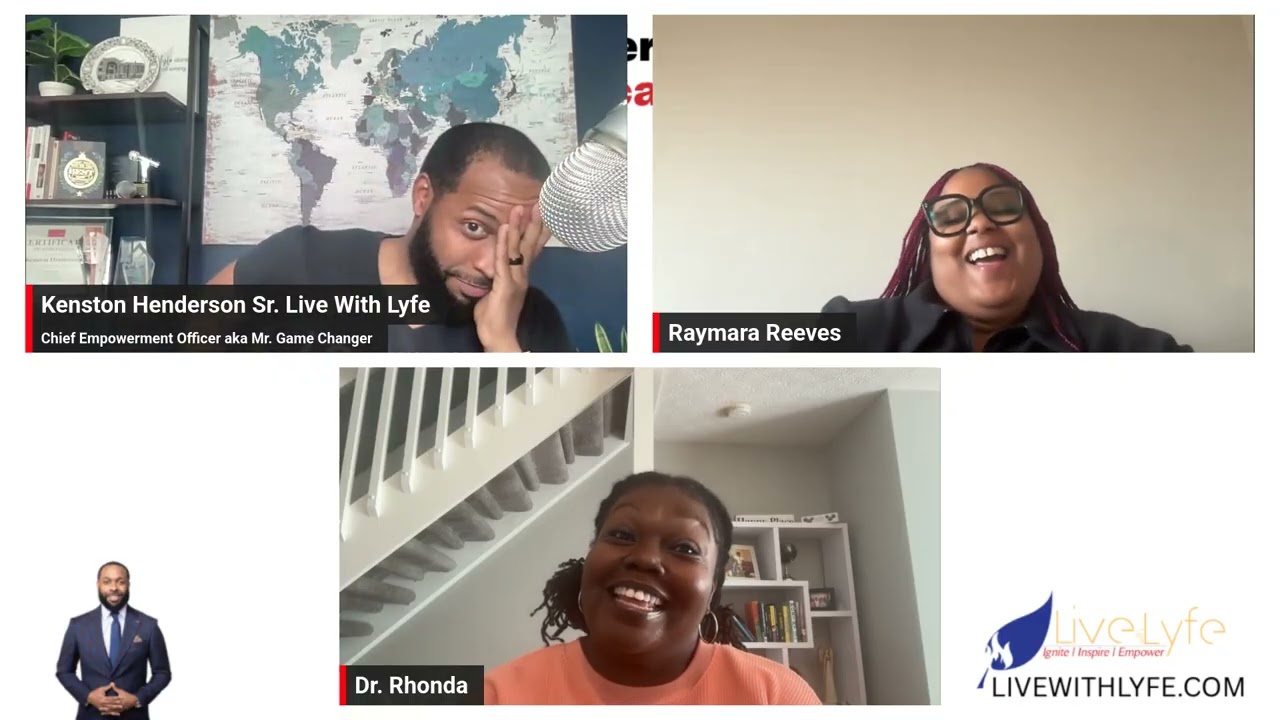
Well, listen, hello everybody, hope your weekend is going well. Um, hope you've ate enough and rested enough and I know I'm still stuffed a little bit from a few days ago, but I'm excited to be here. Those who don't know me, I'm Kenston Henderson, founder and CEO of Live With Life, and I have a special guest with me today, Marisha. And she is here to talk about, you know, really her experience as, as it relates to the Game Changer Public Speaking Bootcamp. And so as we're getting close to that date, I wanted to bring on a few people who could speak to the bootcamp and what it's doing for them even current day. And so Marisha, if you can, you know what, nope, I'm going to read your bio because you did give that to me. And so I want to, I want to read a little bit of your bio because you are a flipping game changer. And so Just a little bit about Marisha is she is a public speaker, mental health and wellness lifestyle transformation, certified health coach, functional exercise coach, host of Cap and Blazer Podcast LLC. So that's a few, few things about her. But Marisha, tell us, tell us a little bit about yourself.
Oh my goodness. Outside of all that. So those are like my hobbies. That's the stuff I do that fills me up. Um, it feels like gives me purpose outside of my main job. My current position, I'm a project manager, so fun times. Um, work for a great company. Um, I get to work from home, so that's great. So, um, just having stuff outside of work that you feel like I— what's the word— is like filling me up or helping me serve or just giving back. Those are some of the things I do. Um, I'm a mom of about to be a 22-year-old on Saturday. How? He just graduated college with their bachelor's. Oh my gosh, we put a child through college. Won't he do it? Um, 4 years. Um, I'm a wife of my husband. We've been together over 20 years. Wow. Um, our anniversary coming up in August. So that's who I am.
August what? Hold on now, we that close?
I'm August 10th. Yep.
Okay, ours is August, uh, 16th. Yeah, yeah, yeah, that's awesome. So let's, let's talk about your public speaking journey. And so, like, how did you— when did you realize that you wanted to, uh, get better at speaking publicly?
Um, I think it came along with wanting to be able to— one, at work professionally, we sometimes do presentations or we present things like, you know, if you're doing something to increase your skills at work, you can do like goals to like presentations or something and present it. One of the things I learned was I had not done it in such a long time in the work environment as well that I just felt like I was going into it blind. I didn't even really know what to do. Maybe what were some things that would have helped me better communicate the message that I wanted to present. So one, that was one of the reasons. And then two, um, just in my personal life, sharing, um, with things, um, outside where I'm wanting to be, um, more in the, um, support type of world and sharing things with people about how you overcame things. I'm big on mental health, big on healing trauma, um, and how do I share that with women or people in my life if I don't know how to get the message across? So those were my two biggest reasons for doing it. And then overcoming fear too. Totally scared of doing it. And when you have to do it for work, one, you don't have the option to not, um, perform or do your best because it counts. Um, you also want to put your best foot forward. So yeah, that was my biggest drive.
That's good, that's good. So, um, when it comes to when it came time I was announcing for the first time I'm doing this public speaking boot camp, like, what was it that excited you about it or made you just want to say, you know what, I need to be a part of that?
The way you presented it more or less was— and let me put it like this— me going through a lot of therapy, working through trauma, one of my biggest humps was getting over fear. That was one of my biggest hangups. And it— fear translates into other things, shame, all these other things. But it was debilitating, and it got to the point where I wasn't doing anything, or I didn't want to do anything, and I was terrified of doing anything. So one of the things I do know I was scared of was speaking, like terrified, like no, nope, I'm not getting up there and saying nothing. Um, the last time I had done it for work or for a group was like almost 10 years ago. And at that point, I spoke in front of 400 people, and I remember thinking, I'm going to faint. I think I'm going to faint up here. And I made a joke, like, I was trying to be so serious. I said, if I disappear behind this podium, I have fainted. I just wanted you to know. I thought I needed to tell them so if something happened. I wasn't joking. They bust out laughing. But I— that was one of the moments I realized there's something to this. There's a technique to it. Um, and in pursuing my, um, desire to overcome fear, I started approaching things that I was afraid of. So one, I jumped out of a plane. Two, then after that I came—
wait, wait, wait, wait, wait, wait, you jumped out of a plane?
Jumped out of a plane.
Yeah, I haven't— I want to jump out of a plane, but I haven't jumped out of a plane.
Just try it. It's the greatest thing you'll ever do.
Okay.
But I did the great— this instructor actually said, you want to know why I did this? I said, why? He said, I had to do a speaking engagement and it was coming up, so I came and did this before so that I would not be afraid to go do the speaking. He had no idea that I was coming to do boot camp and then had a speaking engagement coming up, so I just thought it was like lined up for me to do it in the first place. But one of the things told me is, he said, when you do this, you will never be afraid of anything again. I mean, I was like, yeah, right. Um, he said, I'm not saying you won't fear the fear. He said, you— it won't stop you. And I was like, that's the answer I needed. So I jumped, and it was the greatest thing I've ever done. Because what I've learned is there's something on the other side of fear. You can't tell me there isn't because I have absolute proof. I have the tangible proof because I did it. I lived it. So when I came to your boot camp, it was like learning that there is always a tool to overcome fear. Just go find the tool. So the plane was one, but your speaking boot camp was another. I have a tool. It doesn't mean the fear is not there, it just means go find the tool. So that's what it was. It was, I got a tool, and I was excited. I got a tool, I can combat it. So that would— that pushed me to join. I'm glad I did.
That's awesome. That's awesome. So, you know, you hitting on this thing, fear, and in the boot camp, you know, I talk about what fear is, and, you know, false evidence appearing real. And, you know, I think a lot of people have this about public speaking, or even in professional speaking, public speaking. And whenever you open your mouth, there's a fear of Uh, you know, what were some of those fears that, that came up for you? Fear of— like, I think of, um, you know, fear of me misspeaking.
All of it. Um, I don't have anything to say. Who would listen to what I have to say? Yeah, what I have to say is not that big or not that important. It won't— nobody wants to hear it anyways. I don't have anything to offer. I don't have anything. All these things in your head.
Yeah.
What if I mess up?
Yeah.
What if I pass out? Like all the things, like they're, they're constantly talking to you. So if fear is, um, the scripture says, um, about fear being there, or that there will be a point where you be, will be afraid. And when God constantly tells us don't be afraid, it's because Guess what? You're going to get afraid. It just means just still do it. So all of those things that are coming up are the fears that I was hearing is, yeah, you can't do it. I've been told, and I'm not really sure how that works, but my dentist is like, you have the smallest mouth I have ever seen in my life. I don't understand. But one of the things we talked about was because of that, when I speak, my tongue can kind of get twisted, and I've always known that. And she said, there's not much you can do, it's the way your jawbone— it's just the way you were made. But again, there has to be a tool to help. So that was one of the things I was looking at: how do I speak and not mess up? How do I stop getting tongue twisted? How do I get my mouth to open differently? If I can't do it that way, how? So I knew that there were going to be things that would provide answers to the fear I was hearing. Well, you can't do that because you don't pronounce things correctly. You stutter. You get all those things.
So yeah, yeah, no, I love it. I love it. And those who are seeing this and hearing this and watching this is that we can't allow fear to stop us. Because we all have a story to share, a story to tell. And it's going to help someone, at least someone. And so the more you allow that fear to stop you, you won't be able to deliver impact. And so one of the things I talk about is, I heard— I don't know if you've heard this statement before, Marisha, it says, do it afraid, or do it scared. Do it scared. For me, I disagree with it. I say do it prepared. Prepared. And so, because if I do it scared, then I'm not, I'm not leaning in all the way on it. But if I do it prepared, I'm at least seeking some things out to really, uh, get to the point where I'm gonna go after it. Now, I know there's a thing called analysis paralysis, but no, I'm going to do things prepared. And so, um, this is good, this is good. So let me see. Hmm, what was one of the big, biggest aha moments you had during the boot camp? Oh, um, what was a light bulb moment that came for you?
You gave a quote, and I actually have to go back to my thing because I was I go through your booklet sometimes. He gives a booklet, you guys, that you can take with you. You can keep all the notes. Um, and I've kind of put it in— sometimes when I'm speaking, I put it at the top, or, um, I put it on my notes. One, one thing you— let me give it to you. One thing you said in the beginning is you tell people to, um, be vulnerable and engage, and we're gonna all do this together. You say it a little bit differently, but I kind of spun it so I'm not stealing your words.
Oh, stop.
Obviously. But I kind of spun it that way of saying, hey guys, we're going to get vulnerable. Hopefully you'll engage with me and you'll not look at my mistakes and pay attention to those more than trying to listen to the message that I'm trying to get across. So that helped. It was like you were saying it was okay to be vulnerable in your speaking because that's what draws people in, doing something that draws them in and makes them feel just like you. So it helped make me comfortable. And then the second thing was the statement that you said, talking with purpose, it will impact you by the current and future state It will impact your current and future state by no longer holding my voice and a message. There is a message inside of me, and I added into that with freedom. One of the other big goals for me was overcoming fear, and then on the other side of that is freedom.
Yeah.
So realizing that my voice is impactful.
Yeah.
In spite of what the voices are saying.
That's so good.
The critical voice.
Yeah. And here's the thing, you know, those who are listening, you're going to time after time, whether it's public speaking, whether it's in the office, in the workplace, or whether it's you doing, giving a presentation, or you on stage, you know, there's some work you're going to have to do mentally before getting, I mean, before opening your mouth. And that's why I say the more prepared you can be, the better you're going to— I want to say perform, but the better it's going to be. And getting a lot of the jitters out, getting a lot of the stinking thinking out. And a lot of the speaker boot camp is focused on, you know, really tapping into the mindset. Because if we don't get the mindset right, you won't open your mouth, period. That's just it. And so the imposter syndrome, that's, that's a real thing. And it's that we cannot allow that to stop you from, you know, becoming who you were meant to become and to say what you need to say. And so let's see, let's see, what question can I ask? All right, so Have you since the boot camp spoken out anywhere publicly? I know you wanted to do more speaking. All right. So since you have, like, how has or how did the boot camp help you position yourself for that speaking engagement?
I think allowing myself not to be— going back to the word afraid— to put myself out there. And being willing to say, I have something to share. Um, and once you— once I shared that, um, they were encouraging people around me that said, okay, so here's— would you come share here, right? You know, or share here. So, um, then I had to say yes. That's a whole different thing. Um, you can put yourself out there, but when somebody then comes, you can't give into that feeling of, oh no, that's okay, I'm— I mean, for real, I just meant— I didn't really mean it. Like, oh, you mean really do it? Oh, you mean really come and stand it? Yeah. So those moments are where you say yes. So I'm learning to say yes even when Um, it feels challenging even when I don't know what to do. I think I'm not going to know what to do, and then just going back through and preparing. So that's what I've done so far, and that's the result it's been, on top of having people resonate with what I've shared. Yeah, that I— that still doesn't makes sense to me all the way. Um, but I'm learning that your authenticity is what people will engage with most. So I've learned to be authentic and share my story and share how I've gotten through things and over things and the process and the steps that it's taken and therapy and Jesus and all those things. Um, doesn't mean I'm I'm not, um, coming out here being an expert. I'm sharing where I'm at and then saying you can come along with me. And when I learn something else, I'll share that too. So it helped me also not feel like I had to be an expert. I just needed to share to help somebody else. And if it gets to help somebody else, then that's what I— that was my goal.
Yeah. And so, and that brings up another point as it relates to, you know, why Why do people, you know, want to, or why do people need to learn the skill of public speaking? And I'm going into, you know, school-age schools and program leadership, pro youth programming, and teaching the public speaking skill. Because I want to equip young people with this skill at even an earlier age, that way they can— I tell them it helps them advocate for themselves even more effectively. Yeah, you know, because young people, I, you know, I only have one, my son, you know, I'm like, son, you got to advocate for yourself. Like, if you see something wrong, or, you know, gotta advocate. Yeah. But just simply getting that skill. And even as adults, there's, there's only good things that can happen once you get the skill of public speaking. And you will be tapped on for different things. I say different projects, or or different things where you need to go make a pitch on behalf of your organization, or, you know, you just need to go speak on behalf of your organization, they're going to most likely select you if they're not comfortable. And so it positions you for, I would say, a lot of different benefits. And so when you spoke right after the boot camp, or a few months after the boot camp, did you feel more confident? Did you feel more like, yeah, I can do this now? Like you said yes, like, yes, I can do it, I can take on this engagement. But, you know, how did you feel preparing for that, that moment?
Um, I did feel prepared. Um, one of my strengths, but also can I can overcorrect on, is overpreparing, so that I just want to stick to what I prepared. But also something we talked about in the boot camp is things will happen where even though you've prepared every way you possibly could, a monitor might go out, your computer might not plug in, the mic might not work, all those things. And lo and behold, wouldn't you believe?
Yeah.
That when I got up there to speak, the mic decided not to work. And I was like, come on. Like, you know, the first time. But I, I think that that happened for a reason, um, because I am learning that there are two, um, both can exist— the preparedness and being ready, um, to, um, move when something changes and not getting, um, stuck or getting freezing or just giving up, those kind of things. So, because I did, there was a hot second where I was like, see, I told you, I told you you weren't meant to do this. I told you you weren't good at it. Like, and it started. So actually what I did was I put the mic down and was like, okay, well, since the mic won't work, I'll use my voice. And so I had to elevate my voice like we talked about and then just went into some things of telling the ladies. I'm— guess what I'm hearing right now?
Yeah.
You'll understand what I'm hearing. This is what I'm hearing. I'm hearing because that mic doesn't work, you all are staring at me thinking these things. I'm not good at— so I just explained what was actually happening in the moment. And that was a moment where it was like, oh, okay, there's the vulnerability and somebody understood it and that actually helped. And then the mic came back on and I, I finished speaking.
Yeah.
So those moments of where things will happen, even if you're prepared, So that was a great, um, it was a great lesson. I think it actually needed to happen the first time because I think with the way I am, I would have gotten comfortable with it being smooth. I needed to immediately have the experience of it won't always go the way you want it. Not like I don't know that logically, but when it happens in the moment, you know it. So it was a good experience.
And, and that's, and that's even another level of preparing as it relates to whether if you're wanting to speak on stage. So those who are listening or watching this and you desire to speak on stage or do more presentations, expect the unexpected. I mean, that's a speaker tip right there. Expect the unexpected. Like, I remember recently I showed up and, you know, my presentation would pull— it wouldn't pull up on the screen, but then my videos wouldn't work.. And then the music wouldn't work. And so, oh gosh, I was like, all right, well, here we go. And, you know, I said a quick prayer, but then I went and I got on stage and I started, I started beatboxing. I started doing a hand clap like I did my own music because I was determined that these people brought me here for the purpose of equipping their leaders and teams. And so I'm, I'm, you know, it's going to go down like it's going to happen. But preparing to say, it doesn't matter what happens, I know my material. And so that goes back to preparation. I know my material well enough to be able to present it and still keep moving forward. And so yeah, yeah, that's a part of, you know, the speaker boot camp is that I'm going to potentially, intentionally put you in some different situations, some scenarios, so that way, that you wouldn't normally put yourself in. So that way, you can start preparing to be the best speaker that you can be. And so tell me, would you recommend the speaker boot camp for other people?
I would. Here's what I would recommend. I think that there's a point, one, in your life, if you don't think you can continually learn something, then you're not moving forward. So even if I thought I was a great speaker, there is something you still can learn. Maybe that has changed in the industry about speaking. I think social media has changed public speaking. I think that platforms, different time platforms have changed public speaking. So to keep yourself refreshed, to keep yourself up on what are the new techniques or what are the new strategies that I need to know to be a better public speaker. So that would be one. If you're thinking, I already do this all the time, then where could you grow? I heard something said not too long ago. What if somebody said something that you don't like? Is there— could you stop and flip it in your head and say, is there any truth in what they're saying, even if I don't like what they're saying? And that to me is continuously learning. If I am a great speaker, and I know everything I feel like and all the ins and outs, could I go and still learn something that I didn't know before? Just learning to continue to grow. If you've never done it before, I think it will give you a baseline of where to start and then it'll give you a point where to launch off of. And I think once you're learning in something new, you need a base, something to start you. And then you need something to launch you. So those two things are already provided as a resource in it. And then you've, you've got the follow-up with you as well. They have more questions or they want to do more. There's the opportunity to continue to follow up and do more, more coaching, more things on the outside, one-on-one. And that just, that determines how far you want to go.
Yeah.
So I would recommend anybody try it.
Yeah. And again, those who are on the fence, it just comes down to what is your desire to be an even better communicator. And so if your desire is high or medium, whether wherever it is, like, let's lean into it. Because again, you have a story. Someone is waiting on your story. And your story is the one that can end up freeing. Marisha talked about freedom. Somebody could end up being free from your story. Because, and so no longer, and I always say, no longer do we have excuses. We got resources, we got tools. And so the Speaker Boot Camp is just one more tool to be able to help you become better at communicating effectively. And so whether it's at church, whether it's at the workplace, whether it's, you know, in conferences, you can do it. But like I always say, it's going to take you to do it and to lean in. And so I do—
let me add one more thing. I think that one of the things I'm learning too is you always have an audience whether you want to or not. Yeah, so what you're communicating matters. And even after taking your, your boot camp, a lot of things you talk about are your energy and how are you showing up. How does your energy show up? Maybe if you're a great speaker, how does your energy show up? Because sometimes you can be having a large audience and only 3 people heard you based on your energy. So knowing, um, just how we're showing up, because we constantly have an audience So that's why I've— that's one of the biggest things I took away when I focused on the 4 points that you gave about your energy, how you show up. Oh, I'm always, I'm always communicating whether I want to or not.
Yep. And here's the thing, and, and not leaning in too much too, because we're not gonna give them everything, but you know, people can tell before you even open your mouth on how you're going to deliver. And so again, this is just to speak up more in the staff meeting. This is, this is that resource for you. And so, Arisha, I truly appreciate you for sharing with us today, sharing your story. You know, for those who are looking for more information or just looking to, to get involved, You know, there's information on the screen. I'll put the registration link in the comment section. But if you're ready, like, listen to me, if you're ready to speak up in rooms where you once stayed quiet, if you want to lead your team with clarity, if you finally want to tell your story with confidence, listen to me, listen to us. This is the speaker boot camp that you will want to join. And so I truly thank you, Marisha, for joining me. And I look forward to continuing to watch you grow as a public speaker into a professional speaker, because there's, there's a difference. And so we're going there, like, okay, we, we not stopping, but we're going there because I believe, you know, your story, there's your story is multifaceted. And I believe that it's going to continue to impact lives, um, locally but also globally. So, because I mean, after all, you are a game changer.
Thank you.
You know, it's gonna happen.
That I am. I will take it. Well, I agree. Well, y'all go get your voice. That's what this will help you to go get, your voice. And thank you. This is an honor to do. Thank you.
Absolutely, absolutely. All right, y'all, till we see you again. Till we see you again.
Alright, bye guys!