Acquire or Die: Navigating the Era of Mega-Mergers & SPACS | TheGrill 2021
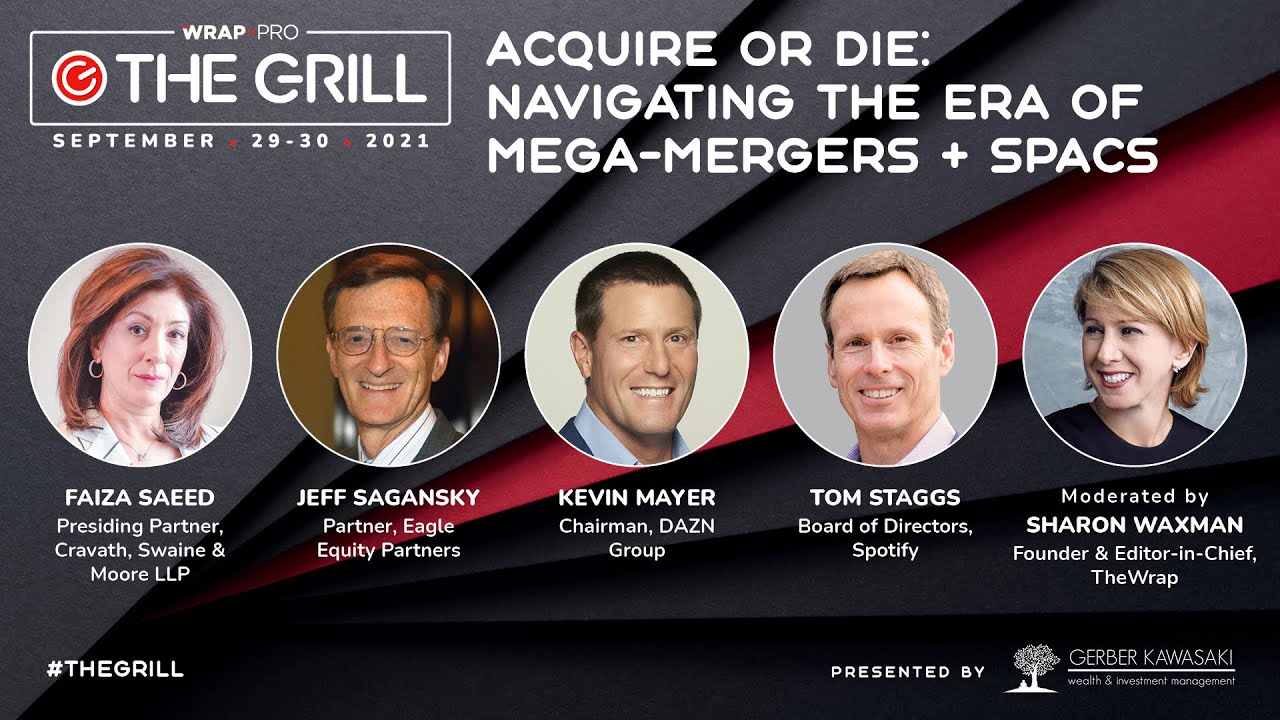
Kevin Mayer, Tom Staggs, Jeff Sziganski, and Faiza Saeed discuss why media companies are merging at scale. They cover the Hello Sunshine deal, streaming economics, gaming entrants, and TikTok's geopolitical risks in an era where consolidation feels mandatory.
Chapters
Hi there, and welcome to the Grill Conversation, Acquire or Die: Navigating the Era of Mergers and SPACs, presented by Gerber Kawasaki. For the past couple of years, consolidation has been the name of the game in Hollywood. After Viacom and CBS remerged, after AT&T shocked everybody by backing a Discovery-Warner Brothers merger, after Amazon bought MGM, Are we done? And what about all of these SPACs, these special purpose acquisition companies? With us today are the leading experts in this field. Kevin Mayer and Tom Staggs are the co-CEOs and co-chairs of the SPAC Forest Road Acquisition Corp. Kevin is the former TikTok CEO and was the head of strategy and then direct-to-consumer at Disney. He was recently named the chairman of the Dazen Group. Tom Staggs is a former COO and CFO of Disney, and he is now a Spotify board member. They continue to serve as senior advisors to their first SPAC, which acquired the digital fitness brand Beachbody in February and has gone public. Most recently, they've been in the headlines for leading the acquisition of Reese Witherspoon's Hello Sunshine for a valuation of $900 million as part of their unnamed media venture in which they serve as co-CEOs, backed by Blackstone. Over the past 10 years, Jeff Sziganski and his partner Harry Sloan have founded 7 special purpose acquisition companies which acquired and took public companies including DraftKings, Skillz, a video game competition platform, William Scotsman, America's largest modular office space leasing company, and VideoCon, DTH, which is India's fastest-growing direct-to-home pay-TV provider. His latest SPAC, Soaring Eagle, IPO'd in March 2021, raising $1.7 billion. Welcome to Jeff. Faiza Saeed is the presiding partner at Kravath, Swain Moore. She advises on mergers and acquisitions and is widely recognized within the entertainment industry as a go-to advisor Her clients include Disney, Viacom, Time Warner, Hasbro, DreamWorks, and Amblin. That kind of sounds like everybody in our space. She's also a trustee of the Paley Center and New York Presbyterian and a member of the Council on Foreign Relations. So welcome to you guys. Took a minute to read all those big bios because you're so accomplished, all of you. And you guys do know each other from the space. Let me just start by throwing out a question because we've been through this Massive period of consolidation. Is it— is that period over? Are we still, do you think, in a period of ongoing further consolidation? Anybody can jump in. Jeff, I'm going to start with you.
Okay.
I think this is only the beginning for 2 reasons. One, you've got massive liquidity in the system. Fed still printing money every month. Borrowing rates, corporate borrowing rates at an all-time low. Corporate cash on the balance sheets at an all-time high. And then you've got dry powder in the, you know, these PE firms that on a worldwide basis, last thing I read was they've got $2.5 trillion to invest. And, and then you've got the stock market at an all-time high because of liquidity. So that, I think, is driving, you know, incredible stock market returns and a lot of the M&A. And the other thing that's driving it is we're at an inflection point, you know, for all the legacy media companies where they basically have to, you know, take their incredibly profitable core business, their cable business, 40% margins, and go direct to the consumer. And that is a really expensive, difficult thing to do. It requires a lot of focus. And so we're going to continue to see massive consolidation and, and M&A around all of these, all of these issues.
Well, at some point, don't we run out of companies to consolidate? Seriously?
No, I don't think we do, because it's going to be all about the bundle. The bundle is going to be more than video. It's going to be audio. It's going to be games. It's going to be casual games. It may be gambling. So all of these Things are going to be consolidated on one platform where there's, you know, where the consumer is paramount and where we're selling the consumer a much enhanced bundle.
Kevin, Tom, Bezos, do you guys agree with Jeff?
Well, I think there has to be an end to M&A. I mean, you know, these things are accordions. Things come together and there's a lot of scale, then sometimes they go back to, you know, breaking apart a little bit. But I think basically Jeff's right. There are enormous forces, economic forces that are causing this to happen. On the legacy media side, certainly scale becomes important. The direct-to-consumer shift is real and is underway in a substantial way. That does create a need for scale. It creates a need for new capabilities. Some of those capabilities are expensive to acquire. Only so many people can have these capabilities. So it does, I think, force a consolidation on the strategic side. And then Tom and I are beneficiaries on the PE side, as Jeff pointed out, that there's plenty of money out there and the cost of capital is therefore a little bit lower. And there are really good reasons for these independent content companies and commerce companies to consolidate in the face of consolidated customers. If you're a content company, you're selling to Netflix, you're selling to Disney+, you're selling to Hulu. Those are big, big, big enterprises. And traditionally, these independent content studios have been relatively small of scale. And so I think that our— and Tom can talk about this too— but our strategy of pulling together must-have content and key verticals that are complementary to each other and going to market in a cohesive, coordinated way at scale really provides a lot of a needed benefit. The benefit of being independent is obvious, but the benefit of being scaled independent is even better. So we really believe in that. And also my time at TikTok, I'll just say that if you can take the relationship you build with customers and your fans and extend it into social media and then monetize that with commerce, that's yet another really powerful, um, a really powerful, uh, revenue source. And I think that LS Sunshine is the first instance of us accessing that. But Tom, I'm sure you want to follow up with something.
Well, I, I only to say that I obviously agree completely, and I think Jeff's point is well taken. We're at the beginning, um, but, uh, I think the forces that Kevin talked about are pretty powerful. There's continued disruption that we're going to see. And I think that actually leads naturally to M&A activity as well as you see new entrants. So, Sharon, you asked if people will run out of companies. You're seeing new folks, whether it's people that are enabling the creator economy, participate in the creator economy. There's new business models evolving for people to participate in it. And I think that that's going to continue to fuel what you've been seeing.
I also think that combinations inevitably yield dispositions. And it's a combination of factors that cause that. Sometimes it's because the combination doesn't work, and sometimes it's because there was always an intention to shed other assets. And there are also a lot of subscale content companies right now that do need M&A in order to be competitive. So I don't see this as— it's more of a continuum There's always peaks and valleys, but, um, if there's not ever like a start and an end—
I think we all agree that at a minimum, FISA is going to be really, really busy.
And we like that.
Tom, what'd you say?
That what I said? I said at a minimum, we know FISA is going to be really, really busy.
It's going to be really busy. Well, she's still working with all these companies. Well, I keep hearing people say things like, uh, ViacomCBS has to merge, uh, Sony's definitely gonna go away. I've heard about, you know, Sony Lionsgate. I mean, whatever independent— that's not considered— Lionsgate certainly is an independent company, but Sony's of course part of a huge conglomerate. Uh, I, I'd like to get your take. Um, Jeff, do you think ViacomCBS has to merge with somebody?
Um, I, I think they will. Um, whether they have to— I mean, look, I, I think one of the big issues, Sharon, is that it is completely unclear what the steady-state streaming margin is. You know, we're coming off of a legacy media business where we knew the margins were 40-plus percent, you know, for cable, which was cable networks, which was the center of this. We have no idea what the steady-state streaming margins are. It's certainly not 40%. It may be in the 15 or 20%. Right now, it's unknowable because the marketing spend and the program spend is, is it's a knife fight.
Well, hang on a second. Let's pause there one second. So you've got every— Netflix has been spending, has been underwater on spending, you know, on investing for, for a decade. Kevin, you, you ought to know how, whether Disney was— maybe underwater is the wrong way to put it, but like— go ahead.
Yeah, no, I think you're, you're right. I mean, they deficit spent for a long time on Netflix to get to where they are. There is a turning point. There is a point at which there's an inflection and you go from money losing to money making. And by the way, once you turn off, once that spigot gets a little bit titrated, you can make a lot of money. I think there's a huge amount of cash flow that's gonna be generated by Netflix in the steady state and by Disney+ in the steady state, depending on how many subscribers they can get. Jeff's right to point out, we don't have any empirical evidence yet as to what the actual margins will ultimately be. I don't think they're gonna be cable-like margins, by the way. That ended up being pretty unsustainable ecosystem. Those margins were pretty high. Maybe some cable networks over-earned for a long period of time. And I think that is coming home to roost now in terms of that bundle becoming— I mean, that was funded, those margins were funded by enormous payments from pay-TV operators to cable networks, which of course flows through to consumers. They have to make money too.
Right.
So that is what spelled the end of that bundle ultimately, I think. I think consumers, you know, it depends on the service. If you're gonna be scaled, if you're gonna have 300 million global subscribers like Netflix has, I don't know how that doesn't engender some pretty substantial margins and cash flow at the end of the day. I think they did become cash positive in the pandemic because their production ended and they— this is kind of a glimpse of what's to come. Production was eclipsed and they still ended the data growth in subscribers. They had a massive amount of cash flow for a brief instant there. Like, I don't know the answer as to where it's gonna end up, but of course Disney wouldn't have turned the company upside down completely without a belief that the margins will be substantial. And we did a comparison. Sorry.
But, you know, I, you know, when a company like AT&T, one of the, you know, top 50 companies in the entire world, when they don't have the focus and they don't have the cash to compete and they have to offload Time Warner, you know, to Discovery, that tells you a lot. It takes so much focus, so much cash to compete that there's only going to be a couple of players that are going to be able to do it on a global Yeah, it depends on how you define success, but AT&T was highly levered.
I don't remember their peak debt load, but it was unbelievably high.
$170 billion, yeah.
Yeah.
Yeah, so that's kind of hard to— they didn't have money because they were heavily levered.
I am going to come back and keep pushing on the Viacom question, but Faisal, go ahead.
Well, I was just going to say, I think you have to remember that the key thing about successful M&A is that There's a culture component, a business logic component, and then just a vision and execution component. And the ones that work get all 3 right. And so I think when you look at this media wave, and there are those deals that have worked, Disney Fox has worked phenomenally well. ViacomCBS, there's no question they're better together. Going back a few years, DreamWorks Animation Comcast, that worked. AT&T Time Warner didn't work, but I don't think it didn't work purely just on not having the money to fund the production. I think there's the culture component and what it takes to run a creative ecosystem is hard. And the beauty of a Disney is that they have the creative DNA. They've been doing it for generations, but they also understand what it is to be in a relationship with their consumer because of the theme parks. business. And you would think that distributors understand that, how to be in a relationship with the customer, but you need both pieces. And it's not as easy as it looks. It looks good on paper, but it doesn't always translate.
Well, that is for sure. And there's a lot of human cost to that that does— never gets discussed at high-level business banking conferences, but there are real people who lose jobs and get whipsawed when you have something like AT&T buying Warner and then turning around and offloading it 2 years later. There's quite a lot of human costs. We see that as a news organization. I wanna like think about that. So, all right, let's go back because I think we're talking about what are other companies, if you think that ViacomCBS, Jeff, or anyone on the panel—
You know, I think that there are gonna be buyers and sellers. We know who the buyers and builders are gonna be. They're definitely gonna be Apple, Amazon, and Netflix. Google could do it.
And Netflix? You think Netflix would buy, would buy a studio?
Well, they, they just bought the Ronald, you know, the, the doll line.
The Roald Dahl. Yeah, because that's buying content. That's different.
No, but there's no big difference. It's, it's buying IP, you know, that they're gonna, that they're gonna use multiple times.
Okay.
But I, I think you've got, you know, those 3. Google, they certainly have the scale to do it. They've got a $20 billion, uh, business in YouTube. But they certainly haven't shown the appetite to do it. And then there are the second tier of players. Spotify, we know, you know, Spotify's got a fantastic audio business and a music business. We know that they're looking to play in the video business. Is it going to be better to build or to buy? And my guess is that they're going to end up being a buyer. And then you've got, you know, Activision, you know, one of the huge gaming companies. You know, they're already playing in the casual space. They're playing in the esports space. They're a $60 billion market cap business. My guess is that they're going to play, you know, as they're going to continue to consolidate and add more services onto their platform. So then it comes down to who are the sellers? And I think the sellers are all people that aren't going to have the cash and the focus and are sort of playing, you know, they're playing catch-up. One is Lionsgate. They've done a great job with Starz. They're never going to have the balance sheet to compete. Long-term on a global basis. EA, you know, $37 billion business. But again, I think they're going to be, you know, that's bite-sized for some of these guys. Sony Pictures, you know, their parent corporation, one of the biggest companies in the world. But, you know, in the world of streaming, they're going to get disintermediated in, in a bundled streaming world. Take-Two, one of the smallest of the console businesses. And then there are question marks, you know, in terms of 2 big question marks, Discovery Time Warner, they're going to have $60 billion on their balance sheet when the consolidation's done. You know, are they going to be one of the survivors? Are they going to be one of the sellers? The same with Comcast, you know, and Universal. And they've had a slow start. My feeling is that, you know, eventually they're going to be, uh, they're going to be sellers.
Comcast and Universal are eventually sellers?
Not Comcast, Universal.
I mean, NBCUniversal is sold, and so is Discovery Time Warner. Other panelists, you agree, disagree? Tom has thrown the eyebrows at you, Jeff.
No, no, no. I think that Jeff's looking down the road a piece and projecting a future. You know, a number of those companies, especially when you get to ComcastUniversal, they probably will look to combinations. Whether that means selling or whether that means buying remains to be seen. And, but I think it points back to your initial question, which is, do we think there's gonna continue to be a lot of activity? Clearly, consensus is yeah, there's gonna be a lot more.
Okay, so now let's turn to these SPACs. Kevin and Tom, you guys have been making a lot of noise with your, well, some of the deals you've been doing are not under your SPAC, which is just friggin' confusing. Could you guys just stay in one lane, please?
All right.
And then of course, ways, you know, Jeff, I will say, is like the father of this SPAC thing. I, I, he, he introduced me to his SPAC well over a decade ago when they were doing the first— is it Eagle, whatever it's called, uh, Flying Eagle? And he took me up in a, in a plane to show me what they were going to be doing in terms of internet and Wi-Fi on planes, uh, and it's been working out. Jeff, I mean, the, the SPACs, the SPAC phenomenon is interesting. Actually, Jeff, hold that whatever thought you were gonna have. I wanna go to Kevin and Tom. Let's talk about Hello Sunshine because a lot of people have said that that $900 million reported valuation, some have reported that it was more than that, that you did with Blackstone to buy Reese Witherspoon and Sarah Harden's company. And we adore Reese and Sarah. And Sarah has been at the Grill before, incredibly impressive people, both of them on business and creative side. But people are saying you overpaid, that it was never worth anything like that. What are you talking about? So can you address that?
I'll say one thing.
Kevin, go ahead.
The bulk of this, I think. But every— we bought Pixar, we vastly overpaid. We bought Marvel, we vastly overpaid. We bought Pixar.
We being Disney, you mean, by then?
We being Disney.
Yeah.
Yeah.
But we were there doing those deals.
Yes.
We were doing the deals.
So we remember the criticism.
Just put a pin in all that criticism, I would argue. We, we wouldn't do a deal unless we thought it was fairly priced and fairly valued. And, um, you only overpay if you pay more than something's worth under your ownership and you pay more than you had to pay to get it. And I think neither of those, uh, neither, neither of those indices were met in this instance. And we're not going to talk about what the price was, but it's not always reported fully accurately. I'll just say that. Um, and, and we love the asset.
Is that inaccurate? You don't have to confirm exactly, but are we buying a lot?
I'd rather not share and talk about, talk about it. But what I would say is that we love the team, we love the strategy. It fits in the viewpoint that we have of how we— what we want to participate in as a company and as a team. Tom and I, uh, to a T. When we first had our meeting with them, what they wanted to do, what we wanted to do, were like overlapped 100%. And, and we love what they do. But I mean, Tom, you can talk more about Whatever you want to say there.
But look, I agree completely. This is a very impressive company and an even more impressive team. We love what they've built. We love even more where they're going to take it from here. And I think those that think we overpaid are actually underestimating what they've built and what, and what they're going to do from here. And we believe in them and we believe in where it's going to go.
Well, I think what's interesting is we've been talking about, um, the— what's been in a lot of the news stories are mainly production companies: Imagine Entertainment, LeBron SpringHill. Um, although you guys were associated with, uh, potentially buying Endeavor content out of, uh, from Endeavor. Is that, is that something that you're looking at?
I mean, we don't want to comment.
Well, we won't— yeah, we won't comment on anything specific. Yeah, go ahead.
Sorry.
Okay, I mean, apparently Endeavor has to, has to divest itself of Endeavor Content for, uh, for WGA reasons.
I've heard— that's what I've heard. Yeah, yeah, I think that's been widely reported, um, if I'm not mistaken about it.
Faisal, what, what are you seeing in terms of these SPAC deals and these smaller content companies being valued at such a high number and then being, uh, driven in potentially to IPOs BuzzFeed. Here's another one, you know, a billion-dollar valuation. To me, that's like mind-blowing. I think it's— I, I wish them all the best. I'm a digital media company, but that just seems crazy to me. What, what, what do you— what's your take on this?
Well, I think it's a couple of things. First, it's just a demonstration of how much content you need in order to have a viable streaming product. And, and so, you know, one, one part of that equation is just how much are you willing to spend to originate content. And Netflix, Amazon, I mean, the, the what they're spending is, is phenomenal. Disney's spending a phenomenal amount. We talked about Comcast, and so far they don't seem to be wanting to spend that much, but it's not that they can't, it's just that, you know, You can't spend $1 billion or $2 billion on Peacock and expect it to be competitive with Disney Plus. It just won't happen.
Right.
So I think a lot of players are really looking for what are these little pieces of content that I can string together and have a viable service. And that's why they're, you know, it's a great time to be a content producer and, and it's a great market to sell into. And I agree with Kevin, something is worth what somebody can do with it in their hands. And that at the end of the day, it's, it's very hard to try to value these things on forward EBITDA multiples or something like that. You just don't know. But if you can string together a viable service by putting a bunch of these things together, and some of it is niche, and some of it is targeted to a particular customer, but that's what, that's what people are trying to do.
And Hello Sunshine— hang on a second— Hello Sunshine wasn't sold to a streamer. I— maybe I would understand that it was sold to Blackstone and to Tom and Kevin, um, and of course Reese's principal. Uh, is the idea then that you guys are then, then going to sell it in a few years to a streamer? Is that what— is that what we would—
Well, Sharon, one of the dynamics that we've alluded to throughout this conversation is that there's going to continue to be intense competition amongst the folks who are streaming content. Part of that, they're not going to be able to create everything that they stream inside their own walled gardens. But the fact that many of them have brought their content into their walled garden increases the viability of being an independent player in that ecosystem. And that's one of the things that Kevin, I think, is going to be true. The reason I think that a lot of those companies are looking at things like what, what Kevin and I are doing is that there's also a benefit to having scale in that activity so that you've got the capital to invest into owning the content and being able to control your own destiny, have the IP for the long term, and still enjoy the benefit of the huge demand that the streamers have for premium content that helps set them apart. And that's, that's driving a lot of—
Yeah, you guys talk about scale when I talk to each of you, and I think that that is probably, you know, you have more experience experience than almost any person who's in the M&A dealmaking space around what it means to drive scale. Jeff, you have just raised money for another SPAC, and you're not— it sounds like you're not so interested in the content and entertainment space. Is that—
Well, we actually raised money in March, but we actually already have effected a merger. We merged with a company called Ginkgo Bioworks, which is the leader The worldwide leader in cell engineering. So that went public last Friday. So congratulations. We don't have a spec. We're going to have to go to Kevin and Tom for us.
Oh, so the whole we can make a deal, Jeff.
You'll have us back soon. I predict that's an easy prediction.
Yes, I'm guessing. Give give them a half hour. They'll have another one.
But Jeff, I mean, but in all seriousness, first of all, congratulations on getting that deal completed. That's amazing. Are you interested in the entertainment media space, or do you think it's too—
it's too full?
No, we are.
But, but, you know, I think this sort of—
Crowded was the word I was looking for.
Tom sort of alluded to it. You know, you've got all, you know, the shift to streaming. It is an existential crisis for these legacy media companies. They have to— to save their business, they've got to go direct to the consumer. It takes so much focus. And so much capital that they really don't have time for anything else. And so you see all of these higher growth businesses higher than streaming. You've got sports gambling, iGaming, esports, video games, all of these businesses, social media related. These are the ones that are going IPO or SPAC because the legacy media companies, they just have enough to do. They can't buy these companies even though they've got a younger demographic and a faster growth rate than streaming. It's incredible. You know, when you look at the under-25, they spend more time on gaming than they do watching television. And as they get older, you're going to see that continue. The business is, is sort of is aging. But these other businesses that are growing very fast and that's what we're doing. We did obviously DraftKings, Skillz. These are both video game and gaming businesses. And those are the companies you're going to see that are going to go directly, you know, direct IPO or IPO through SPACs.
Yeah, we were talking to Strauss Zelnick from Take-Two and Phil Spencer from Xbox. And just the numbers from gaming. Also, you just remind me that when I talk to you, I feel like I'm in a college course and learning something. Before we have to go, because I know we do have to wrap, Kevin, I really want to get your take on TikTok. That company, I know you were so excited about it in the period of time that you were running it, even though it was brief. And it is one of the few new social media companies to explode onto— to get to scale, to go back to your point. And of course, ran into problems with Trump and China, this and that. What do you think is going to happen to TikTok? People are still using it at scale.
Yeah, it's an amazing— and we've talked about this, Sharon, before. It's an amazing product. It leverages artificial intelligence technology, which is extremely far advanced. And the engineering corps in China has done an amazing job with it. The business leaders in China have done an amazing job. They're great people. I enjoyed working with them quite a bit. The founder, Yiming, Great guy and a great team. And it did run into this buzzsaw of geopolitical issues, which I don't know that it's— Trump had a certain way of dealing with things which were hyperbolic. I think that probably is over with. But if you look at what's happening in China and the degree to which the Chinese government itself is clamping down on youth using mobile devices for gaming, for social media, for social interactions, they want that to end. It seems like. And they've taken— they put in a time frame. And if you're under 13 or 18— I forget the age limit— you can only spend 3 hours a week on mobile games. That's now a law in China. And that is—
Wow.
That's a massive change. And that's coming— that could propagate throughout all sorts of use patterns in media in China. And so that's happening. There's a lot of things going on in China, which I don't have much insight into, of course, with the the Chinese government. And then, of course, there's still the geopolitical tension between the 2 systems, the Western system and the Chinese system. And I'm not saying what— I don't have much insight or commentary about that, other than to know it exists. And it's a bipartisan issue here, and it exists in Europe. So I don't know what's going to happen. It's kind of too bad if something does happen, because it's such a great product. I use it a lot. I'm imagining it is now becoming used by a broader array of demographics. It used to be pretty young, but now it's expanding.
Mm-hmm.
It's a great product. It's great. I really hope that the tensions such as they are don't end up nullifying such progress in social entertainment. I think it would be a shame, but I don't know the answer.
And you sincerely believe that there are not sort of more sinister forces that could be leveraged because of this advanced technology at TikTok that would make it, you know, that have downsides to to it becoming a major presence?
That, I, you know, I'm very concerned that the Chinese government could see some really interesting dance moves that our youth create over here. So, you know, that might be a real problem. Like, I don't know. I'll leave that to experts who look at that.
Well, but it's not insignificant. I mean, here we are, you know, however many, a decade and a half after Facebook, was introduced as a very benign force to connect people, and now all we're talking about is how Facebook is this toxic force that is out of control and needs to be reined in somehow. And they're American. So, you know, this is, this, this is the unintended consequences that come around from wanting to date somebody or show your dance moves. And so I think it's worth thinking about it, you know.
It is worth thinking about. I don't have any answers for you, but it is being thought about. I know that.
Yeah.
And so, well, I guess we'll find out how it's dealt with.
Yeah. All right. Well, we're out of time, but I could talk to you guys for hours. Smartest people in the room, in the sector, honestly. Jeff Sziganski, Faiza Saeed, Tom Staggs, and Kevin Mayer. We will be watching what you're doing very closely. And thank you so much for being here to talk about this era of mergers and SPACs that we're in. Thanks for being at The Grill.
Thank you.
Thank you very much.
More from Kevin
Squawk Pod: Kevin Mayer, Fmr. TikTok CEO & Disney Executive - 09/23/25 | Audio Only