Is AI Eating Education? — Interview Series with Kevin Roose & Casey Newton | ASU+GSV Summit 2026
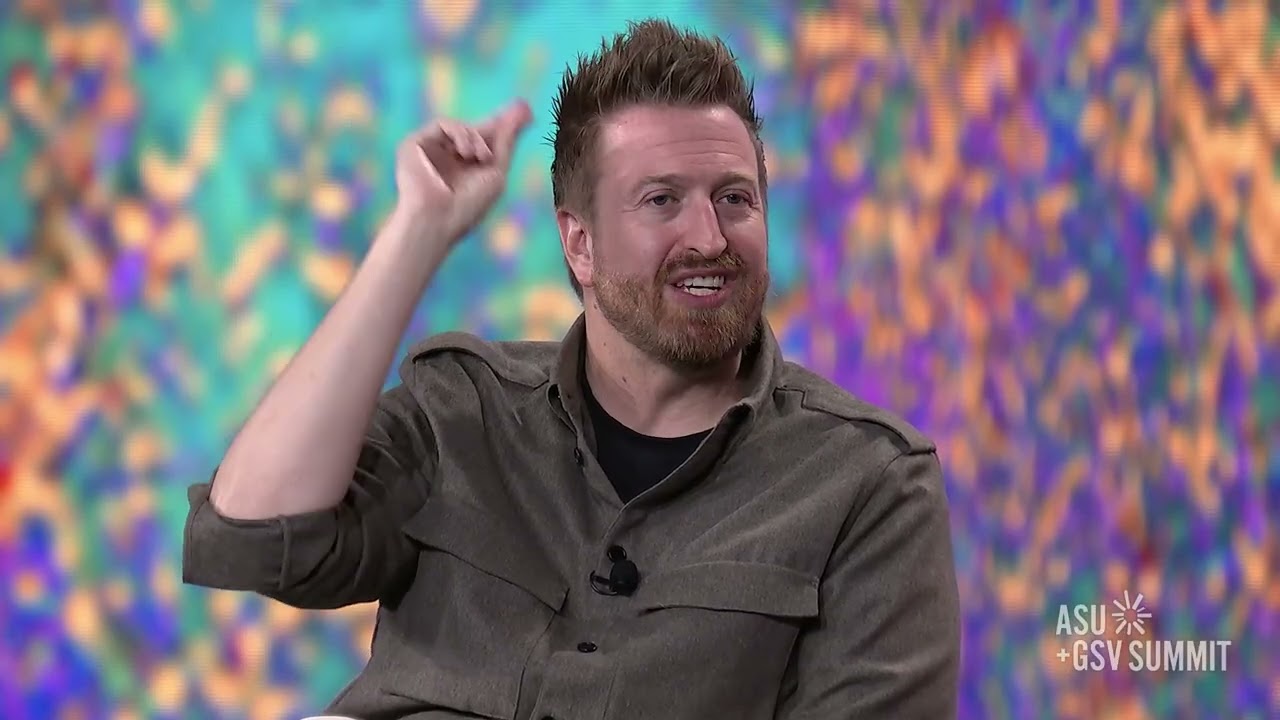
In this ASU+GSV Summit 2026 panel, hosts Kevin Roose and Casey Newton moderate a conversation with educators, CEOs, and policymakers about how generative AI is reshaping education and the future of work. They begin by noting the rapid spread of AI in classrooms since ChatGPT’s 2022 launch and cite a Gallup‑Walton‑GSE Ventures survey showing Gen Z’s optimism about AI falling from 27% to 18% and anger nearly doubling in a year. The discussion moves to two contrasting ed‑tech models: Campus’s online‑college approach that pairs AI‑enabled tools with intensive human mentorship (the “Chipotle Chelsea” persona) and Study.com’s credential‑focused, asynchronous pathway for adult learners (the “Target Tom” persona). Both CEOs argue that curricula must now be refreshed every three months to keep pace with agentic AI, and they debate the balance between automation and human support. The panel explores the looming job‑automation narrative, with references to industry predictions (e.g., Anthropic’s 300‑day work horizon) and the reality of AI‑augmented engineering teams. Concerns about assessment integrity, AI‑detection tools, and the need for AI‑native curricula are raised. Pearson’s CEO Omar Abbosh describes how the company is shifting from a publishing mindset to AI‑infused skill measurement and partnership with AI labs, while also grappling with cheating and security. The latter part of the session introduces a $100 million literacy initiative (Levy Literacy) led by Romy Drucker, Kumar Garg, and Arati Prabhakar, aiming to halve early‑reader failure rates using AI‑driven automated speech recognition (ASR) to diagnose speech‑related reading barriers. Equity issues—unequal access to premium AI tools, broadband gaps, and the risk of an “agency divide” where some students are AI‑managed and others are not—are highlighted throughout. The conversation also delves into the importance of distinguishing focused AI tutoring from generic chatbots, establishing ground rules to reduce teacher and student anxiety, scaling tutoring through AI augmentation, and building teacher AI readiness through training and creative agency. The panel ends with a call for a national, health‑level R&D effort to scale effective AI‑driven education solutions, emphasizing the need for coordinated funding, policy, and research to close learning gaps at scale.
Chapters
How's everybody doing?
Hi, San Diego.
Wow. The heart and the courage it takes to be anywhere at 8:00 in the morning, I salute all of you. All of you. Some of your colleagues are still sleeping it off, but you said no.
Casey, how was your flight down?
It was great. I love flying into San Diego because the last time I came down here, I was sitting in front of a pilot. And the last thing I heard him say as the plane started to descend was he said this to the person sitting next to him, do you know San Diego is the hardest American city to land in? So that's haunted me ever since. But congrats to everyone here for the safe landings that you all presumably had.
It just feels like a gift, you know? Now that I know that, I'm like, every time— I'm like one of those people who claps when the plane lands. Yeah, me too.
Like, you did a great job. Yes, every time I land in San Diego now, I think, this pilot's good. It's one of the good ones.
Casey, today we are here to talk about AI and education, which is— there are many decisions that we've made in the course of our podcast. We've had this show for about 4 years now that have been incorrect. We decided to name the show after a cryptocurrency concept because it was 2021, and like many people, we were going through a weird and embarrassing crypto phase. We thought This will be a durable podcast name.
Yeah.
And then we, you know, as it happened, crypto was not the thing everyone wanted to talk about in 2022, but ChatGPT was.
Yeah.
And very soon after the introduction of ChatGPT in November of 2022, we sort of said to ourselves, well, it seems like this is gonna hit first in education. And so I remember we had a conversation with a high school English teacher, Sherry Shields in Oregon, and, It was one of my favorite interviews we've ever done because we were just sort of watching the proliferation, like the sort of metastasis of this technology inside one classroom in real time, and things have not really slowed down since then.
They really haven't, and I think education has been one of the biggest subjects that we have been able to cover over the past 4 years, bringing on educators, students, administrators, trying to understand what this technology is doing in all of your lives. I think it is fair to say that it hit you first and it is maybe hitting you harder than it is hitting other aspects of the economy.
Yeah. We try to represent the widest possible range of views on the show. I think when it comes to AI in education, there is about as much range as there is in any sector. You have people like Sal Khan of the Khan Academy who just this week announced a new AI degree program in partnership with TED. All the way to at the other end of the spectrum, you have the Luddite Club of Oberlin College, my hometown in Ohio, who recently put out a statement declaring that their school's year of AI exploration was unfit, and that they didn't want to participate. They typed this letter out on a typewriter, and they said, even one semester of accepted chatbot use will jettison our student body down a lazy, irredeemable tunnel of intellectual destruction. I found that on their website. I'm not sure why the Luddite Club has a website, but—
What I love about that statement is it shows that Luddites are allowed to use a thesaurus. That's an approved technology for them.
Yeah, jettison, they're bringing that one back.
It's a good word.
So, there is a very wide range of views in education among educators and teachers. There is also, interestingly, a very wide view among students. There was just a survey released this month by Gallup, the Walton Family Foundation, and GSE Ventures that had some very fascinating stuff in it about the attitudes of Gen Z in particular on AI, which I will admit surprised me.
It surprised me too. Give us a couple of the highlights here.
Okay, so this was a survey of respondents ages 14 to 29 who sort of gave their views on a wide range of AI-related topics. One finding that I found interesting is that the percentage of these people who said they felt hopeful about AI declined sharply since last year, down to 18% from 27%. Their excitement is also down 14%, and they— nearly a third of the respondents indicated that AI made them feel angry.
Wow.
This is something that I have observed in my visits to high schools and colleges over the past few years is it's very polarized. I think there's a subset of students who are like using this for everything, very excited about it, think it's going to be the key to them getting a job in the future. And then you just have this other group of students who are like, I don't want anything to do with it. This stuff is making me feel bad when I use it. I think there are some sort of lingering scar tissues around social media and feeling like this, this thing can't possibly be good for me, even if it is narrowly useful in helping me stay study for my tests, and I think there's just a lot of fear and trepidation out there.
Well, to me, it's a really interesting shift, Kevin, because when we started talking to students about this, I think the prevailing sentiment was like, this is cool, I don't have to do 8th grade anymore.
Right.
You know what I mean? And yet, it's interesting, you fast forward a few years, and I think students are starting to have some second thoughts, and my assumption is that what they're really starting to think about is, hey, once I get out in the workforce, like, what is going to be there waiting for me? So that's kind of how they're feeling about it. But then on the other hand, you have a bunch of CEOs, and we're going to talk to some of them today who have AI initiatives that they're ready to roll out in the classroom. And they're, you know, sort of promising are going to usher us into a great new future.
Do you think it is more about the job picture that these students and these, these Gen Z respondents are reacting to, or is it kind of the, the feeling of like their own intellectual I don't know, atrophy? Mm-hmm.
Because we've—
this is something we've heard about from other guests on our show. We had a consultant from BCG on recently who talked about the notion of AI brain fry, which is when you just kind of use AI too much and your brain starts to hurt because you feel like you can't quite keep up. And all of a sudden, you're doing way more work than you were. And wait a minute, wasn't this thing supposed to stop— supposed to lower the amount of work that I did? So do you think there's a psychological explanation in addition to like the labor and Future of the economy one?
Absolutely. You know, because I think that another effect sometimes of using AI a lot, particularly if you're a young person, is it can, um, make you wonder about the point of anything that you're doing, right? Like, if, if you, you had a few years of, like, learning how to write an essay by hand, but you can now conjure one out of thin air in 30 seconds by snapping your fingers, it might just sort of make you question the point of the entire enterprise. So I wonder if for some of these students, there's just kind of a sense of pointlessness that AI is drawing their attention to. Yes.
And I think educators are also feeling all of these things. And, and I'd be interested to see a similar survey of, of teachers. But I did see that The Guardian recently interviewed a bunch of professors about generative AI in their classrooms. And I just want to read you a couple of quotes from this.
Oh, good.
These were from professors in the humanities.
And I have not heard these before.
What is it doing to us as a species? Students are the guinea pigs in this giant social experiment. And one of them said, I wish I could push ChatGPT off a cliff. So I think it's fair to say there are more questions than answers, but I'm hoping that we'll get some answers today from our— we've got a packed slate of guests, including some folks that I'm very eager to hear from about these issues. So Casey, why don't you introduce our first guest?
Yes, absolutely. And I don't know if we have a slide that we want to pull up, But for our first conversation today, we are talking to two CEOs who are working at the intersection of education and tech. So please welcome to the stage Adrian Ridner and Tade Oyarinde. All right.
Hello.
Hello.
Ah, all right, guys. So let's talk about this Gallup survey that came out showing that Gen Z's excitement about AI has been cut nearly in half. Their anger about it has almost doubled in just a year. We're in a room full of people who are trying to bring AI into education. Tade, Adrian, how do you square that?
Well, yeah, listen, the— I think Sam said recently in a podcast interview If AI were an American politician, it'd be the least popular politician that we've had in our lifetimes. And so what we have to do is shift the narrative. It has to go from AI is going to take your job and make you poor to AI is going to enable you to do what you love and get paid to do it. And I think there is a lot of opportunity if students and young people can learn to use AI to automate a lot of the barrier work to what they want to do. If you want to open a restaurant, You shouldn't have to be great at marketing. You shouldn't have to be great at accounting. You shouldn't have to be great at legal and finance. There are so many barriers to entrepreneurship that AI, agentic AI in particular, will automate. And so what we're trying to do is help students prepare for that future and then be able to have much more control over what they do in their lives.
Have you seen a moment like that where you're able to show a student something in particular and something sparks in their mind and they think, oh, aha, maybe this isn't just something that is going to disempower me forever? If so, what is that thing?
Look, the main thing is students actually have to have someone articulating a vision. Right now, there's just— it's like, oh, AI helped me cheat. There's not really a clear vision. I do think generative AI to agentic AI is going to be that shift when students— literally, I've been AI-pilled just this year. Sam Altman was our first investor 5 years ago. I didn't actually see just how transformative this was going to be in terms of what skills students need to have to be useful to employers or to be productive in their own entrepreneurial journeys until recently. I think over the next year, we're going to see a massive shift as agents, meaning AI that can autonomously go and do real valuable work, come on the scene.
Adrian, what do you think? I think the survey data is interesting, but some of the work we've done, we're working with Cal Poly San Luis Obispo and other universities, to figure out, you know, everyone's trying to figure out how to use AI, and we're doing AI faculty fellow sponsoring. The most interesting part of the research was actually not the professors. They're amazing. But the students they brought into it, because although they had anxiety when they started, as an example, when they figure out, okay, I'm in a software engineering program, but we actually brought the College of Liberal Arts, the College of Business, and the College of Engineering together because of what Tadeo was saying. This turns into an interdisciplinary issue once you graduate. They realize, oh, I'm actually not gonna be a software engineer. I'm not gonna be putting up drywall if I was building a house. I'm now the architect. So I'm gonna be a product manager, I'm going to be a designer, and I'm gonna be coding. And the best ones are gonna do that. And by the way, those people, and I have a fact that my view is they're gonna get hired faster. I know the unemployment rate for recent grads is worse right now, but I think once employers realize that they have the skills and the ability to adapt quickly and they're able to do 2 or 3 jobs at once. That's what the new workforce of the future looks like. You're going to be blended roles. I think they're going to become much more optimistic when they realize, and we've seen that with some of the students in that research.
I want to tease apart what I think is a philosophical difference that you both in your organizations have between the way that you're doing things. This gets spicy. Fight, please. Tadej, your organization, Campus, is an online university. Correct me if I'm wrong.
Online 2-year college.
2-year college.
Yes.
Built around the idea that a lot of students are having issues in schools because they don't have enough human support, and sort of connecting people with human mentors, guides, et cetera.
Yep.
Adrian, your platform, Study.com, great domain name, by the way, is one of the largest platforms in the country for college credit and certification. There's sort of an interesting way in which What you have done at Study.com is making this cheaper and more efficient for people to get certifications for these certification industries. And Tata, you are making a bet about like the human importance of connection rather than something like a certification. So maybe just talk, talk, you know, with each other about the differences in what you think is important for students to have in the labor market that we're entering into.
Sure. And there is a difference. Adrian focuses a little bit more on older students. Our average student's 22 years old. We call her Chipotle Chelsea. You know, she's, she's, she's working at Chipotle. She's thinking, man, what did God— or she's Gen Z, so she says the universe put me on this planet to go do. It's got to be more than make burritos. And we're saying, hey, you're an American, you're eligible for a Pell Grant. It's $10,000 a year to cover your education with no debt, which is super important to Chipotle Chelsea. Come to campus. We're going to help you learn from faculty who teach at the top schools in the country through live online classes. If you're a young person today, the accountability and the motivation that comes from being a part of a live social online learning experience is crucial if you actually want to get the graduation rates up. Our completion rates are about 30% higher than the typical 2-year college, and the key really is that human support. So for every 50 students we enroll, we hire a success coach who's basically like my Nigerian mom who's going to kick your ass if you start slacking. and be a shoulder to cry on if you need that when things get tough. And so kind of, on some level, it's sort of like, let's be as contrarian as possible. Everyone is saying automate, automate, automate. We're saying humans, humans, humans. It's a lot harder, but there's sort of a lot of brain damage that comes with doing it this way, but long-term, I think that's the way that people are gonna start to appreciate, for that 22-year-old, how education is supposed to look.
Yeah, and to go off of that, so our audience is a little bit different. We're talking about working adults, usually, often single parents, underrepresented, first generation. They're having 2 shifts at Target. They're trying to figure out how to get their kids to school. And for them, the flexibility, the ability to be asynchronous, trying to figure out how to grab credits they had 15 years ago from community college, which, by the way, sometimes they worked out with debt and no degree, over 40 million of them, and then convert that into the career of the future for them. That's who we're trying to help at Study.com. So in that case, flexibility, the ability to figure out how to then transfer the degree pathing into a 2 or 4-year university to finish the degree or the credentialing. And for example, we have students who are working 2 shifts who want to become a nurse, who want to become a teacher. We help them with their degree pathway and we help them with the certification pathway. And the part where we align, though, is not all technology. We have coaching. Mine is more like your Argentine mom. that is actually going to cook you la cena and help you make sure that you do it. So she's trying to help out. But the coaches are really important, and that's something we have in common in our approach. Because regardless if you're a young student or you're a working adult, that 360 support becomes really critical to success. It's why we have the transfer rates we have. So our students, when they Transfer. They are 3 times more likely to graduate than any other transfer students across the institutions that, that we partner with. They're twice as likely, they retain twice as longer as their peer group. And that's because they're coming prepared with the confidence that they need and the skills they need.
So you've got Chipotle Chelsea, you've got like Target Tom.
Yeah.
And they both need what you're, what you're offering. I'm curious, I recently heard someone at one of the big AI companies say that they believe we have 300 days left of work. And I was sort of like, oh, like before we have to, you know, get a new job. And they were like, no, 300 days left of work. This was about a week ago. So like 293 days left of work. There are a lot of crazy sounding proclamations coming out of the AI industry right now about the future of jobs. Dario Amadei, CEO of Anthropic, has said he thinks this could wipe out a huge chunk of entry-level white-collar work. Others have been more optimistic and say, we'll create a bunch of new jobs, it'll just take some time for those to show up. What is each of your near-term prediction for the next few years of the job market for, let's call them, people entering the workforce? What will those jobs be? How many of them will there be? What will be the last job that AI will replace?
I've got no bloody idea, to be honest. It's interesting, a year ago, about 40% of the code that we write, was written by AI. Today it's 92%. Um, and, um, so what happened is that a year ago we said let's stop hiring junior programmers, and we only started hiring, uh, or we only maintained senior developers. And then I was just in the office in October, and I just noticed it was like 6:30 PM, and, you know, the engineering team was just completely gone. It's a bunch of 35-year-old graybeards who were like, yeah, I'm getting out of here at 6:00 PM. That was not typically how the culture had been, right? I was like, Like, actually, I actually want those sort of 24-year-olds arguing in front of a whiteboard till 11 PM at night for the pace, for the energy. And then I talked to some of the graybeards and they're like, I actually miss mentoring some of these younger guys. And so like we actually started in November—
Did you just call a 35-year-old a graybeard? I just want to make sure I heard you correctly there.
Yeah. Don't call me out. For engineering, it feels like that. That's a good point. I'm not a graybeard. I'm a blackbeard.
I've got a little cringing in. I'm 38 and I'm highly offended.
I'm a blackbeard. That's right. But these guys, you know, they wanted to mentor these younger folks coming straight out of uni. And so we started hiring again. And now the culture is back. It's a little bit more of an intense pace. And these, these younger folks are a little bit more willing to change and adapt and redo their engineering workflow every 3 months. So I actually think there's going to be like a bit of a whipsaw sort of back and forth as employers continue to sort of explore what the future looks like. Anyone who tells you it's going to be exactly like this hasn't got a clue what they're saying. The only thing that's certain, though, is that uncertainty, I think, is going to be greater 12 months from now than it is today. And I think that's the main thing that I keep trying to wrap my head around, and I keep trying to encourage people to wrap their head around is, you know, this is like if we invented fire, except if fire were better at inventing the next version of fire, which I guess is like electricity. And so it's like, it's not going to like— it's not like the internet where we adapt once and then we just disperse the technology. You know, it keeps changing. It's like if you built a hammer, and then every time you look at the hammer, it's evolved to be a screwdriver plus a hammer. It's like it's continuously evolving. And so we're going to have to learn how to live with redoing our workflows every 3 months or at some point maybe every month. It's going to get wild.
And by the way, he just proved my point about that recent grad surveys probably overstated on the anxiety because back to hiring the early grads. And I think that that's going to start happening more broadly. I do think absolutely roles are going to be displaced. Anyone who's saying that's not going to happen is just trying to make themselves and everyone around them feel better.
Cool.
I think that the truth is that's going to happen, and we have to say the quiet loud-out part if we're going to all figure out how to solve it. And from my perspective, I think the key there is adaptability. I think that's really hard to do. We have to evolve, and I think the roles are evolving, but it's also exciting. Reimagine a workflow that you've been doing for 15 years. I think it's something that can be challenging and new and fresh, but you have to do it. My biggest concern about this is we already had a digital divide, an equity divide. Oftentimes we talk about, is that gap going to get bigger? Is it going to shrink? I'm concerned we're going to end up with an agency divide where there's going to be those of us who can manage AI and those of us who AI is managing us.
Hmm.
And that's my biggest concern if we don't get this right. And I think that it doesn't matter if you're an engineer, If you're in marketing, if you're a professor, across the spectrum, we need to be able to have enough agency to manage it versus it manages us. And I think that's a critical piece no matter what you're studying for today. The concept of the degree you have and the career and role you're gonna have, that hyperconnection is becoming more and more spread in terms of the specialty versus the breadth of what you need to study.
Last question for you two. I think a lot— for a lot of your learners, for a lot of people in college generally, college is a means to an end, right? I go there because I want to get a job. That means acquiring the skills in college I need to get that job. You just said, hey, the skill set you're going to need is going to change continuously. My question is, how much are you already having to adapt your curriculum to try to teach these students, and do you feel like you can actually keep up?
Uh, yeah, look, absolutely. We're doing it every 3 months now, and honestly, it's exhausting.
Yeah.
And there's a lot of anxiety from students that just wasn't there 6 months ago. There's increased anxiety from faculty. I'm not gonna lie, it's a new challenge to think, how do we continuously evolve? Most colleges evaluate their curriculum for relevancy, for workforce relevancy on a 4-year cycle, and we've had to adapt to doing it every 3 months. We built a Vibe Coding 101 course, we partnered with Replit, We launched it in October. We've completely thrown out the curriculum and relaunched it this March. I mean, it's, it's, it's a whole new way of sort of evolving that's going to be required for all of these institutions. What I will say, though, is that my sort of optimistic— just to end on an optimistic note— view for the future is that we can empower entrepreneurship. And so stay tuned. We have some ideas here around what would a Y Combinator for the masses and small businesses look like. I hope that we have a future where if you want to start a restaurant, like I alluded to earlier, we can have 100 small business entrepreneurs in Atlanta where I'm from disrupt Denny's. Who really loves Denny's? It's like we can have a bunch of small boutique restaurants and people can automate all of the labor that they don't want to do and they can focus on cooking and delivering a great experience for customers. I think entrepreneurship en masse is an optimistic view for the future that we're trying to train young people for.
I think on that point, we're also having to change. We had to add not just AI skills, not about just being able to do basic things in AI, but how to use it for accounting, how to use it for teaching, how to use it if you're going to be an engineer. I think the key is all the curriculum is going to have to evolve. I have a very simple rule to figure out if if its AI got bolted on or if it's actually AI native, which is this. If you take AI away and it still works, it's not AI native. Because if it still does its job, it wasn't AI native. So for example, our TOEFL test prep, if you take AI out, it doesn't work anymore because it's fully adaptive, is multimodal, and there's no such thing as taking it out. And I think that's gonna be critical for anyone in higher ed to realize and credentialing, which is, We have to be able to do this because if it doesn't adapt itself, you can't keep up with the rate of change required that the students need to be ready for the workforce of the future.
All right, gentlemen, thank you for hanging out with us graybeards. It's been a pleasure.
Tadej and Adrian, thank you.
Thank you.
Thanks, guys.
Thank you.
Thank you.
You know, I actually did have an idea for how to disrupt Denny's.
Hang on. What were you saying?
Well, I actually did have an idea for how to disrupt Denny's.
What's that?
It's Denny's, but it's only for theater kids after the show. Did you have this at your high school where sort of you would— you perform in the play and then everyone goes to Denny's?
No, we went to get ice cream.
Ice cream?
Yeah.
You got to get that Moon Over My Hammy. Anyways, well, Kevin, what'd you make of all that?
So I guess I am curious. I am just trying to put myself in the shoes of Chipotle Chelsea and looking out at the job market that exists today. And people are saying, you know, we have 300 days left of work, or none of the jobs are going to go away. It's all going to just change and adapt. And by the way, you have to like manage a bunch of agents now, or else you're going to be a slave to the agents. I can understand the anxiety, because I think for a lot of people, they can no longer reliably plan 2 or 3 or 5 years into the future, which is just a hard way to live.
It is. I'm wondering, though, how different that is really from the average person's experience over the past 20 years or so. When you got out of college, did you really feel like you knew what your life was going to be like 4 years after you graduated?
I'm a writer at the New York Times. My job existed 175 years ago. I am the blacksmith. I am the last one clinging to my forge.
Right, but like, and this is something that I'm looking forward to talking with our next guest about, because I feel like it's something that we have in common, which is like, the internet has been trying to kill us for our entire lives.
Yes.
Right? Ever since we got into the job market, there was some massive internet force that was coming, that was eliminating places where we might get a job, that they're leading to layoffs wherever we might work. I just see AI as the next iteration of that.
I feel so profoundly lied to by every career talk I ever heard when I was a student, because the orthodoxy for your and my entire adolescence was like, if you want a job, you have to learn to code. Coders have the only future jobs. Everything will run on code, and everyone will be employed as a coder. I remember, literally, I remember Marc Andreessen, the famous venture capitalist, gave a talk at a conference that I went to, and he said, if you were an English major, you're going to be working at a shoe store. I thought, well, that's not very nice.
Yeah.
And I was an English major, so I was sort of preparing myself for a life in a shoe store. And then the strangest thing happened, which is that the coding jobs got automated before any of the English major jobs. So we sort of have this, like, revenge of the humanities majors coming back.
Yeah.
And I feel very justified about that.
Absolutely. Absolutely. Also, this is a real story. Allbirds, which is a famous shoe company in San Francisco, they just sort of sold after they were basically going out of business. They announced today they're going to start selling compute into the AI market. So I don't know exactly how that connects to Marc Andreessen's prediction, but I can't stop thinking about it.
You told me that this morning and I thought you were reading like an Onion headline by accident. So Allbirds, the company that makes those annoying shoes that you and I both wore for like 10 minutes in the 2010s.
I did.
That every venture capitalist owns 8 pairs of, is now providing compute infrastructure for the AI boom. What a world.
I did. I did.
You know, my other big takeaway from that conversation was just like how exhausting it must be to be in education right now, having to adapt your curriculum at this speed.
Anyone tired out there?
Anyone raise your hand if you're tired? Okay, great. Okay.
The good news is it's only going to get more exhausting. There's this famous— I'm writing a book about the history of AI right now. And one of these lines that Dario Amodei had in a speech that he gave to his staff at Anthropic a couple of years ago was, it will never be chill again. And now they all have stickers on their laptops that say, it will never be chill again, and I feel that.
Yes.
It truly will never be chill again.
It is a strange, strange time. Well, perhaps we should get to our next guest, Kevin.
Yes.
We're going to go ahead and bring out to talk with us about even further developments in the wild world of education, the CEO of Pearson, Omar Abbash. Omar, how are you? Good to see you. Thank you, brother. So, Omar, I would love to hear a little bit of this history because, you know, I was sort of saying before you got out here, I feel like we have something in common, which is that ever since I've been part of the workforce, it seems like the internet has sort of been chasing me and threatening me. And I think if you were working for a very large textbook company maybe 20 years ago, you would have felt the same way. I know Pearson has changed a lot to adapt to the modern moment, but can you talk a little bit about what it has been like for a giant company like that to reimagine itself?
Sure, yeah, and good morning, everyone. Listen, I only joined Pearson 2 and a bit years ago. Before that, 35 years in the technology space. Indeed, I think the company did deal with a lot of the changes that you're talking about, going from a physical print era to much more of a digital era. Uh, and many, many different formats for how people engage with learning and education. And so I, you know, as I look at Pearson today, I think, uh, its core business still is around measuring human skills, which turns out that AI makes you need much more of that. Um, but also obviously helping people learn. Like, uh, you know, our, our mission in life is to help people progress in their lives through learning. Like, that's, that's all we do. Uh, and so inside the company, that means we need to take software and product development in a much more serious way. So in the old, in the old mindset, You might have had like a publisher mindset that says, I need to find experts and I need to codify their knowledge and spend years creating a beautiful artifact with images and diagrams and facts, and that's a book. And now the cadence is completely different, the format is completely different, and of course it's infused with AI. So yeah, that change.
I'm very curious that some of the AI companies themselves, mostly they're too busy trying to create the machine god to sort of dabble in education. But Google has recently started releasing practice tests for some of India's college entrance exams, some of their medical licensing exams. Basically, they have figured out that Gemini can do what a company like Pearson might have done and provide a sort of personalized prep experience for a very important test that someone has coming up. Is that a threat to your business? How are you looking at that? And do you think there's going to be more of this from the AI companies themselves?
You told me it was going to be really easy today. I mean, so listen, what I say to our people ever since I've arrived is if you stand still, you die. And, you know, you were just talking about the no more chill, you know, Demis says that. I mean, what I've always said to people is that the pace of change will never be as slow again as it is now, which is always like a bit of a shocking thought, but I really believe that in my life career that's been the case. And so it's fantastic what Google and other AI labs are doing in terms of innovation. Obviously, like, we latch on to that and apply it rapidly in our products. Um, we partner with them, we work with them, and then sometimes, sure, there'll be some competition. I mean, the Google Education model, I think people know, is mainly like it's a freemium— it's a free model to bring eyeballs and attract people to G Suite. The original theory when, when they set up Google Education like more than, you know, 10, 15 years ago was that they get kids locked into Google products and then they graduate to when they go to work, they carry on with Google. That didn't happen. They graduate to Microsoft when they go into companies. And so, yeah, it is what it is. But we can learn a lot working with them, and sure, we can compete in some areas, and that's what it is.
Talk about this sort of measuring of human skills that you're doing, and it has become a much bigger part of your business.
I mean, so actually, that's been the core of Pearson's business for several years before I joined. But what we find in an AI era where you have, um, deepfakes, you have a ton of slop out there on the internet where the quality of what is out there, you know, you can't tell for sure, um, where the guidance on how people should use it for learning is some— is often confusing. I know it creates a ton of stress on educators when the kids are using this stuff in a willy-nilly, uncontrolled way. Um, and then you can even have fake identities so people can fake who they are with AI. So at some point you want to know, Casey, that the person doing the surgery on you is actually qualified.
Yes.
And it's that— and they are that person.
And preferably I like to know that before the surgery.
100%. And so, so that's what it is, is AI forces, um, people to be able to really prove that they have the skill that they say they have. And that's what the assessments and validation is about.
Interesting. And, uh, are you able to, uh— I, I'm curious. So I imagine this is mostly happening online. Do you sort of have to spend a lot of time trying to thwart people who are trying to cheat?
So, I mean, in our assessments network, we have like ex-FBI type folks who specialize in security. I mean, security is a critical, critical part of the whole thing. And I mean, I think everyone in the room knows here, when they're dealing with people who are plagiarizing or cheating or whatever, like it's a nightmare from an educator point of view. But it gets even more serious in some cases, like for example, if we're talking about physicians.
But isn't this just a losing— like, I have been very skeptical of these sort of AI detection tools on the market. Many studies have shown they produce lots of false positives and false negatives. I think they're getting somewhat better, but I just feel like this is an unwinnable battle to try to turn teachers and educators into AI cops and have them, you know, ferret out every use of AI in their tools.
I mean, I totally agree with you, but let me sort of flip it.
Yeah.
So, so I think AI is here to stay and it's gonna become much, much more pervasive and it's gonna fundamentally reconfigure every job. I, I really believe that. And therefore, to help kids and, and adults the, the most, they need to know how to use these things really, really well. So actually, we need to imbue it throughout the whole educational system in terms of how we do it. Now, how you do it is very important. Um, you know, so again, a lot of the educators will talk about flipped classroom technology techniques, which is instead of me sending you home to learn something, you know, or to send you home with an assignment and I teach you the thing in class. I flip it around the other way where I send you home to learn something. You can use as much AI as you want to learn it, and then you're going to come and be assessed in the class, and then we know if you've learned. And, and the, the one of the puzzles about this whole AI thing is it turns out if you use it wrong, you will absolutely get dumber, and if you use it right, you can get smarter, because the The space between not knowing something and knowing something, that's called learning. And learning involves friction and painfulness. Like, you need to force neuroplasticity. And so you have to actually work to, to learn. And so I think educators understand that profoundly well. Um, AI companies sometimes don't. Now, I think they're getting the hang of that and they're coming up with cleverer approaches. But again, if you throw a tool out into the wild and make it free on the web, that doesn't actually help people learn.
You wrote in Fortune last week that what in Silicon Valley we are sometimes calling the AI job apocalypse is— well, you called it a Silicon Valley story, and you said people should stop listening to tech companies about the future of work because they're not qualified. Why is this doom narrative wrong in your view?
Again, I'm saying this with love in my heart for my tech friends. Like I said, I spent most of my life Working with these people.
Yeah, but that's what you say before you brutally drag someone.
Yeah, this is gonna be good. Bless their hearts.
That was very— that was the British version of bless their hearts.
You know, we're quite— we try to be understated in Britain, you know, but I'm trying to learn the American way as best as I can. But the, the, um, now there's 2 stories coming out of Silicon Valley. Like, one is, I need to spend $500 billion on data centers to build God. Yeah, so you should fund me, right? That is a very real thing. Uh, and yeah, if you're gonna spend that kind of money with like unclear ROI and unclear timeframes where any like little, you know, fluctuation in the future revenues would cause a drama, like you, you need to be very confident. And so that's, that's one story that's out there. The other story is coming from software engineers. And as you just heard from the guys who just got off the panel just now, um, their job really has been, uh, turned upside down by, by AI. Like it's fundamentally changed how, how soft— Now doing a direct line read across extrapolation from I do software engineering and now I can do everything with agents and I'm abstracting myself, uh, to be a manager of agents. Yeah, I mean, something like that will happen in many other jobs, but it's gonna take way longer than people think. There is real reasons why diffusion in enterprise takes a long time. And, you know, we could talk about that.
Yeah. Well, so talk about why it takes a long time, 'cause, you know, my experience has been, uh, there's this, uh, sort of, uh, bifurcation where Most rank-and-file workers are normal people. They don't love change. When the boss comes in and says, hey, here's this new tool, I want you to change your entire job, they're annoyed and maybe dragging their feet. The CEOs, though, on the other hand, are the ones saying, hey, I can actually use this right now to do some vast portion of the job that I have given to you. I want you to use this immediately, and maybe I'm going to hire fewer people like you in the future. The thing about those 2 camps is that it is the CEO who has all the power, And can drive all the change. So why do you think it is going to move that slow given the strong financial incentives that the CEOs have to shrink their workforces?
I mean, so of course you're right that our model of shareholder capitalism plus CEO incentives creates an incentive to put technology in place of people in many cases if the technology is way cheaper than the people. It turns out tokens are not that cheap. And token costs are like, yeah, going up massively. So you have to look very specifically at the use case to say like, actually, where does it really make sense or not? We did a bunch of research actually that we published earlier this year around if you use AI just for automating jobs, you can get so much economic benefit, but not as much as you think. If you use it for augmenting people's jobs, you can get $6.6 trillion in the US economy by 2034. You can make a much bigger difference. Now, to do that does require reconfiguration of jobs. And you've gotta deal with the real-life friction. So is the data good enough? Often the answer is no. Is it secure? The answer is no. Have we got our peo— I mean, like, I, I believe this profoundly, and we're saying this out loud, that there will not be a, a positive future scenario in this world with AI without an incredible deep focus on human learning.
Yeah.
If we'd like, what are you gonna do? You're gonna replace all the people with technology. Now what? Like, well, I mean, so without talking about social upheaval and tax revenues, it's just a ridiculous scenario. That's not going to happen. But a ton of change is going to happen, but in a more gradual way than people might make out. All the white-collar jobs gone in 18 months, that is just nonsense talk. It's not going to happen.
When I looked into replacing Kevin on the podcast with AI, the token cost was prohibitive.
Exactly.
It was prohibitive.
I do generate a lot of tokens.
The tokens this man is generating.
I think I take your point about diffusion being slower than the people in Silicon Valley. I also think that one mistake that people in Silicon Valley make is too much emphasis on programming as a canonical job that is much like other jobs. Programming has its own unique workflows. It's very verifiable. The code either runs or it doesn't. Most work is not like that. You can't evaluate it based on, does this thing work or not on a neat binary? But I am curious, like, if you are wrong and people do start seeing their jobs transforming outside of programming very, very soon, if some entry-level jobpocalypse does happen, why will that be? What will you have gotten wrong that would cause it to look different than you expect?
I just want to be super clear. Like, some jobs are going to change in the near term as well. So things like customer services is gonna change. Um, you can use voice AI agents to do things that we outsource to, to people. Um, to like, you know, if you wanna reset your password, that kind of thing, you can do that with a bot. And so there will be change. Um, I, I still don't think it's gonna be as uniform and applying to every single white-collar thing as people make out for a lot of the reasons that you, that you just said. Now, if, if, I mean, If I'm wrong, let me, let me put it this way. The models are unbelievably powerful. They're way more powerful than most people have understood and that most people can get value from today. Uh, so if to make a model work in the, in the wild, like you need the model, you need a bunch of apps that are really good. So Claude Coworker is an app, and then you need what the tech people call harnesses. So like how these things connect to everything else to make a workflow or a process work. The harness thing is a problem now. So if people really, cuz, cuz in a typical company you've got like 1,000, 10,000 applications all like wired and often with concrete spaghetti, um, uh, you know, with security risk, with data risk, et cetera. Now if someone can figure out how to solve the harness problem in a, like a press a button way, okay, like that's gonna change a lot very quickly. I, I just don't see how that happens.
Well, can't, can't a sufficiently intelligent AI just write its own harnesses?
I mean, listen, if you're sitting inside a big software company today, one of the issues that I think that they're worrying about is that they made money in the past by selling you a version and then selling you the next version, selling you the next version. Now, if you're the IT department of a company, in principle, you can rewrite that version you have to suit your needs better tomorrow by pressing a button. So that's why everyone's stressed out about SaaS.
Yeah.
The harness. That thing is already plugged into all your systems, so it's already harnessed. Perhaps in that situation, but that's not something coming from the outside replacing everything that's already preconnected. I don't quite know how that works.
Let's bring it to education. For all the educators in the audience, as you look at, obviously AI has already changed their jobs in many, many ways. But to the extent that people worry that someday teachers may be automated away, is that something that you sort of say, like, I can't ever see that happening? Is it, if it does happen, it's after a lot of other industries go first? Or is it, I don't know, maybe it could happen sooner than you think?
I think, I mean, I want to go back to the edtech wave. The problem with the phrase edtech is it had the ed in it, But actually it was just tech, mainly just tech. And the thing about tech people is, I mean, and again, like I say, I'm saying this with a lot of affection.
You don't have to.
Bless their hearts. They're not here.
There might be a couple, so I apologize if I offend anyone in advance. But I mean, no, so a very small proportion of people in the world have proven to be able to sit in front of a screen and glue themselves there enough to learn something deeply over time. It's about 5% of people. Tech people actually are quite good at that in general, um, you know, by definition, because as you said, like, code is like extremely structured and highly logical. And if you like that kind of thing and you don't need tons of human interaction, like, you could be very successful. Um, that doesn't apply in most cases. Teaching is way more than just imparting knowledge. It's the pastoral care. It's recognizing that the kid is sick, or that they've got a problem at home, or that they've got economic issues. It's part psychology, it's part relationship therapy. It's understanding the politics and dynamics between the kids happening in the class, which influence them way more than what you wanna teach them in Maths 101 this week. So yes, I think the role of teaching will evolve over time. I think AI can be used to offload a lot of the schlep work.
Mm.
Lesson planning, assignment marking, assignment generation. Those things, I mean, we produce those already in our products, and so do many others, and I think the industry will evolve to use more and more of that. But the human element will increase, and I'm always reminded by the coffee analogy. So you know this economic complements thing, it's like, so let's say you love coffee with milk and sugar.
Sure.
But for whatever reason, the price of coffee beans goes way down. What happens to the price of milk and sugar? Well, the demand for coffee goes up because the price went down.
Did you know that?
Yeah, of course.
I did too.
The price of milk and sugar goes up is what actually happens. And so in a world where some of the activities—
Wait, just explain to Kevin why the price goes up.
Well, because the demand for coffee kept—
Right, good.
Okay, good, good.
There were some people out there who wanted to know. So anyways, you were saying?
Yeah, so anyway, so the point being is Even if you have AI to reduce the cost of some elements of the teaching process, the other elements increase in value.
They'll become even more valuable over time. That makes sense.
I think a lot of what you're saying makes sense. I would also love to know, obviously Pearson's end users are usually students and teachers. What are the teachers getting from all of this? How can you as Pearson make their lives easier? Because I talk to a lot of teachers, I know Casey does too, there are a lot of educators in the room, they are stressed out, they are overworked, they feel like they've been asked to change everything they've ever trained to do overnight, and they could use some help. So what can you do for them?
Yeah, I mean, so, so, you know, back to the edtech thing, like one of the problems is you throw a load of tech tools in the world, you end up with 1,000 tools per school district. That's impossible for teachers to deal with. Now we're just like adding that with more AI stuff. So what I fear is that, you know, not only do we have a K-shaped economy. We have a K-shaped education system, and AI may exacerbate that if it's done wrong. Our job at Pearson is to support the 150 million educators around the world to navigate the AI era so they can help the 8 billion people around the world manage it. That, that's really the heart of what we're focused on. And so yes, that involves AI certification, AI readiness training, AI qualifications, all of that stuff. And of course we do that.
Very good. Well, I think that is all the time we have. Thank you so much, Omar.
Thank you, Omar.
Thank you.
Lots to think about, Kevin.
Yes, I loved that interview in part because I didn't get called old during it.
That was a nice aspect of that interview.
No, I take the criticism, and actually in Silicon Valley we are old. Casey, I have been reflecting as we were getting ready for this today about some of the interviews that we've done on our show with educators that have been very interesting and inspiring to us.
Yeah.
I think often we sort of tend to focus as the media on the downsides of AI and technology, because I think that's important accountability. But I also have been just like, the ones that really have stuck with me are some of the ones where educators or academics have gone out there and used AI to do incredible things. One of them that I'm sure you remember is this guy, Brent Seales, at the University of Kentucky. You remember this?
Yes.
This was a few years ago now, and he is a historian. He studies— he's an ancient papyrologist. He studies ancient scrolls and whatnot. And he sort of stumbled onto this technique for using deep learning, this AI technique, to decipher the contents of these ancient scrolls that were buried in the volcanic eruption at Herculaneum.
Yeah, they were the original Doom Scrolls. Thank you. Thank you.
Anyone have a cymbal?
Thank you. Thank you.
Wow, that's why we keep you around. And he and his students had developed this method of actually uncovering the the sort of contents of these scrolls that had been burned into little, like, ash burritos and had never been able to be unrolled. Using AI, they were able to finally open them and start deciphering them. And you know what they said?
What did they say?
You have unread invitations waiting for you on LinkedIn. No, they were ancient scrolls. Very important.
That was a good one. Any others come to mind?
I also really liked this interview we did with Mark Humphreys. He's a professor of history at Wilfrid Laurier University. up in Canada, and he had this sort of amazing story of how he was using Gemini one day to do some sort of transcription and analysis of these, like, very old trade logs. Was he trading— were they trading fur?
They were trading fur.
So it was like merchants from the 17th century who had written down their fur trading sort of ledgers, and it was in, like, you know, obviously horrible handwriting. And no, you had to sort of understand a lot about the history of the fur trade. And, um, so he was just putting this stuff into Gemini, and then all of a sudden it starts doing really well. It starts doing better than any system he's ever used. And it's giving him like insights from these ancient— not ancient, these, these, you know, many hundreds of year old texts that he was not getting from any previous system. And it turned out he was like an unwitting early tester of Gemini 3, this new version of Gemini. that had just been started to be tested. He was trying to unravel, I think we called it a history mystery of like, why is this AI model so much better than anything else I've ever used at deciphering these trade logs?
Yeah. To me, those are both good examples of how AI can help not just students learn, but actual professors who are at the frontiers of their field, who are trying to add new knowledge to the world. There just are things that AI systems can do to speed that along. So I think that's important to keep in mind because I think understandably we focus for the most part on the challenges that AI is introducing into the education system, but it is always exciting to talk to people who have figured out a way to harness the technology to help them discover new knowledge.
Yeah, and I think for students, like, they were participating in this Scrolls project too, and actually the, the, the, the guy who won the sort of Scrolls challenge million-dollar prize was a college student at the University of Nebraska. So it is, it is a way for students, I think, to participate in a higher level of knowledge acquisition and, and sort of introduction than they were before.
Yeah, absolutely. Well, we have one more conversation to have with you all this morning. I'm very excited about it. We're going to talk about a new literacy initiative that is tech-enabled. and a bunch of things surrounding that. So please welcome to the stage Arthi Prabhakar, Kumar Garg, and Romy Drucker. There they are.
Hello.
Nice to see you.
Hi, guys.
Hi.
Hi.
Good to see you.
Hi. Nice to see you. Well, so our last 2 segments were about higher ed, the workforce. Now we want to zoom in on something more fundamental, I think, which is, can these AI systems help solve one of the oldest and most stubborn problems in all of education, which is literacy? And so we're going to get into that. But first, I want to talk a little bit about something we talked about at the start of the morning, Kevin, which are these shifting attitudes around AI, which I suspect may intersect with some of the things that you all are trying to do with AI and literacy. So, Romy, your team at the Walton Family Foundation spent a lot of time looking at perspectives around AI and education. It seems like Gen Z workers, at least right now, believe that the risks are outweighing the benefits. What do you make of these Gen Z attitudes toward AI?
We're deeply committed to understanding the mindsets of this generation and supporting entrepreneurs to build for those mindsets. Generally speaking, what we've learned from our research with Gallup is that this is an optimistic generation that doesn't always come through in the headlines. They believe in the power of economic mobility. They want to reinvest in their communities. But in this latest poll, which was a partnership with Gallup and ASU GSB, we are seeing some real negativity, fear, and anxiety when it comes to their perspectives on AI. Between last year and this year, excitement about AI is down 14%. And a third of this generation, and this is Gen Z AI users, these are folks who are using AI.
Right.
This is not the Luddite Club of Oberlin.
No.
This is—
these are people who are like, they're signed in. And so a third of this generation is saying they're nervous, they're anxious. So we need to take a step back as partners, educators, builders, and think about that, and think about how we work together to help this generation feel a sense of agency. But I also think it's a signal about teachers. Teachers are going to be partners in helping students feel confident, feel a sense of purpose, be able to see into this unknown future, and so we have to be supporting teachers as well.
Kumar, you've been working on education moonshots since the Obama administration. What is the most expensive lesson you've learned about why big education initiatives fail?
Well, first time, long time listener.
Oh, thanks.
I listen to you guys while I do the dishes at night, so, like, you know, alternate experience. I think in general, a lot of what happens in the kind of edtech conversation. It's just that, I mean, we're living this with the AI companies, which is there's a desire to sell, and so you make certain cases. So when I first showed up and I was working for the president, you know, like the big debate was over like maybe whiteboards are going to like, they're going to be these screens and you can write on them, and then you don't have to use the chalkboard. And like people would, people would have meetings about whiteboards as an important technology. that can change education. And you could just step back and say, well, I don't really understand. So some of the things that I think did end up being really important bets at the time was we made a huge investment in broadband into schools. And that actually came from feedback from teachers, where teachers would want to load up a YouTube video or something else to ground what the lesson was on something that's happening in the news. And then they would get the— people don't experience this anymore, but like, oh, it's just cycling.
Mm-hm.
And everyone's like, what's going to happen now? Broadband to schools was a really important bet. I think infrastructure bets are really important, but I don't think thinking about these sort of silver bullet, one technology that can transform. I think we have to bring all of those lessons when we talk about how is AI deployment actually going to move the dial or not.
Got it. One more question to kind of set the stage here. Arthi, you were the president's top science advisor when the administration was trying to figure out AI policy. policy in real time. Uh, what did government get right about AI education, and what did it get wrong or just not get to?
Well, I think— I'm thinking about Romy's comments about how Gen Z is thinking about AI, and it really reflects where the broader society is, uh, where tech experts are so bullish. I live in Palo Alto. People are experiencing the rapture about AI. They're just so excited. But when you get out beyond that, AI is something that people— the word inevitable is the one I hear the most. It's something that's being done to people. I think that's true in education as well. And both in the broader society, but in schools, I think the whole game here is how do we manage what's coming at us so that we can grab this technology and use it to do the things that we really care about? That potential is there, but we All that work is still ahead of us.
You were in the administration when ChatGPT came out during the sort of advent of generative AI. I'm sure that was like a very busy and interesting time. I know that the people I've talked to in Washington who were part of the administration then were thinking early about national security implications, about economic implications, about what they needed to do to sort of secure these systems and make sure that our adversaries didn't get a handle on them. Were there people inside the White House in 2022 and 2023 saying this is going to be a really big deal for education and we need to get our hands around it, or was that kind of a third or fourth level concern?
No, I mean, I think the national security issues got a lot of press, but the approach from the beginning is the approach I still think we have to stick to, is to recognize that this is the most powerful technology of our times, like every other powerful technology. We humans are going to use it for good and for ill, and we have got to wrangle the risks, because if we do that, we can grab it and use it to do useful things. So in addition to working on how do we try to contain fraud and not embed discrimination and deal with what are the implications for work and the national security issues, that's about managing the risks and harms. The other branch of what was going on was figuring out how do we go to the stars with this stuff, and the kinds of things that we looked at were how will we actually use AI to generate drugs to go after diseases that seem impossible today, how will we use it to provide a better weather forecast that saves lives when the climate is changing, and explicitly we looked at how do we harness this technology to do this thing we've been working on with edtech for generations, but we haven't gotten there, which is how do we close educational gaps for our kids and let every child learn to their full potential? All of that still has to get done.
Speaking of that gap, Romy and Kumar, you guys just announced a couple of weeks ago this new literacy initiative. Give us the sales pitch. What is it?
We announced a $100 million challenge to cut in half the number of struggling early readers in this country. Everybody in this room knows the data. 2/3 of American 4th graders can't read on grade level. How long have we been saying that? How long have we been having this conference? I don't want to say it anymore. Like, we fundamentally believe this is a moment to try to eradicate illiteracy in this country. I mean, Arthi is— She knows, like, this is possible. And so we are partnering with Renaissance Philanthropy on the second iteration of this Learning Engineering Virtual Institute, and Kumar will talk a little bit about the structure, to try to drive innovation. And philanthropy can play a role in de-risking that innovation. So we have a big aspiration in this moment to build a set of tools that can help teachers and change the lives of millions of students across the country.
Part, part of the reason I was really excited about this was, you know, when people talk about big moments in AI, you know, people go back to AlphaFold, they go back to these breakthroughs. But part of what made those breakthroughs happen is the folks who are technical experts in those fields defined a narrow area where they thought a big breakthrough was possible. And so, in Levy Literacy, part of what we are focused on is there's this big challenge that happens in kindergarten through 2nd grade, which is a lot of— my son is in this sort of band. You're not ever officially behind in reading until you get to the middle of 2nd grade, because kids learn at different rates. So, a lot of people are like, well, you're not behind. You learn at different rates. So, it takes a lot of effort to actually say, Hey, you might actually be having a speech error, like that your inability to pronounce a word is affecting your ability to learn because that's how we learn reading, or, you know, early dyslexia, or all these other embedded challenges that come up. If we can actually figure out those are the actual things that are holding you back, we actually have lots of learning science that can get you back on track. Right now, our best systems is like twice a year, There's some sort of reading exam, and otherwise we're just expecting, you know, teachers and everyone else to spot these errors and then say, oh, you should get a referral to a speech pathologist. The interesting opportunity for AI on the early learning side is not AI as the learning tool, but AI as a possible screener or diagnostic where, you know, ASR 10 years ago was basically unusable for adults. Today, accuracy rates north of 90%. For children, especially children with, uh, you know, speaking difficulties, it is like way south of 50%. It's unusable. And, you know, as the companies are competing in who's going to build the best coding agent, voice is like lagging. And so this is actually a really good area for philanthropic bet to say, could we improve the state of ASR, especially for these kind of difficult areas? Can we build the benchmark?
I know what ASR is, but can you explain it to my friend Casey?
Yeah.
So So it is the most, you know, before we get to driverless cars, it is the most normal way everyone is using AI in their day-to-day lives, which is you are often opening up and like hitting the voice thing and just talking, and it's able to understand you. I don't know if folks have tried— did this a couple years ago, but you had to use very specialized software that was good at it. So why is it able to understand the words coming out of our mouth? That's actually a set of algorithms that were developed over a lot of time that convert those sounds into words.
Automated speech recognition?
Automated speech recognition.
See, I knew that.
Yeah.
In case you needed some help. You know, it's amazing. I have a story to share about this. I was recently at a startup office, and I walked in and I went to their engineering floor where all the engineers sit, and it sounded like a call center because no one types anymore. They have these little microphones in front of their desks, and they all just talk into the AI speech recognition, Then they supervise their agents, and their agents go off and do things. It was becoming a problem because so many people were talking to their computers all day that they were starting to cross-contaminate each other's mics. They're all sitting there, and they're doing ASMR-style whispering into their microphones. They're like, adjust the padding on the border. It was a very strange situation. I just wanted to share that because I thought it was funny, but I also think there's something Embedded in your assumptions about literacy is that this is a huge problem. And I think probably I and you and probably most of the people in this room share the idea that literacy is quite important. I think you could also probably find some freaks in Silicon Valley who would say, this is not actually that important. Why are we so worried about literacy? Maybe the future is just the AIs go out and read for us, and then they summarize what they find. So make the case to the sort of literacy skeptic in Silicon Valley who thinks that this is not actually a big deal.
Yeah, make the case to insane people who think you shouldn't know how to read.
I mean, I'll— I mean, in a world— in a world— in a world in which we are moving away from coding as the interface to computers to natural language, I would say that, like, to the extent that you're, like, you're even more AGI-pilled than everyone else, I would say the ability to well-construct thinking and reading will go up, not down. And so, yes, there's a part about literacy as reading, but the speaking and the reading are deeply connected. One of the things that you learn when you sort of think about how children learn is what they are actually doing when they're voicing out words and why they're able to, like, see a sentence and be— have it immediately appear in their brain is the interconnection between speaking out. So when you actually have difficulty speaking, it actually impacts your ability to read, and it flows in both directions. So literacy as like, oh, it's just an oral tradition that we could go back to, is actually not the way our brains actually handle complex ideas.
Yeah. Okay, so I still want to understand the system a little bit more. You're going to use this ASR, automated speech recognition, if you will, that— and that's going to sort of help essentially do early diagnosis of kids who are having like language issues. and then route them to services to help them with that issue. Is that the whole thing, or is there another piece?
That's the big technical breakthrough. Part of the goal, like I said, for good technical programs is you actually pick a tight technical target and actually focus on how you'd improve it. A couple of other things that I think are important. One is just what do you do as customized approaches to get The learner back on track. I think there's a lot of interesting research. There's also a lot of research on the science of reading that you can incorporate. But a big part is, what is a tool that can actually help both teachers— so there's like an in-school— parents, because I actually think parents are a huge part of how, you know, you want them to actually have tools where they can actually say, hey, I actually think something is off, and what is the evidence they can bring to a school system Actually giving them the tools to be able to do that is really important, and all the folks connected to childcare. That's the big idea. Part of the reason why we built off this is the work we did in math where I'm sure you get pitched this all the time, which is like, all we need is an AI tutor and it will solve everything. The thing that we did in our math program was we said, look, there's actually a result on high-dosage tutoring from 2012 that showed you can double the rate of middle school math learning for low-income kids. That tutoring intervention, which was high dosage, cost $4,000 per kid. Can you actually deliver that same result at under $1,000 per kid so every Title I school could get it? The actual teams that are in that program— we're in year 4 of that program— they're actually not doing— they're all doing blended approaches. It's like the digital tutor paired with a human tutor paired with an educator. and they're dynamic and they're switching. It's like dynamic dosing across the different modalities. So I think part of this is just you gotta hone in on one particular thing and then say, can we make progress on that? Yeah.
Arati, I, I'm curious, you mentioned equity, and, and one concern that I hear from educators sometimes is about equity of access to AI systems within a school. You might have certain students who are paying for the premium versions of a chatbot that are getting the best sort of highest compute models to, to help them study or help them with their assignments. You might have other students who can't pay $20 or $100 a month who are using the free versions, which are much more limited. Is some version of a broadband for schools in this decade going to look like free premium subscriptions for all students, or is that the wrong way of thinking about this?
Well, I can start. You all will have other thoughts. I think what you're describing is happening anyway, simply because kids, kids don't only have access to AI in their classrooms. They have a home life, and, and whatever their family has access to, they have access to. So I think that equity issue is very real. I also think it's important to draw a distinction between chatbots in the wild and the kind of focused AI tools that we're talking about here. That are solving specific problems and personalizing content for students. That's a combination of understanding where that student is struggling and where they're stuck, and then adapting lesson plans and, and helping them get over that hump. That's very different than exploring on your own in a chatbot. You can do some interesting things. You can also come off the rails, as we've seen. So, so I think It's important both for getting the quality of outcome in terms of student outcomes, but also then integrating it into the way we teach not just the wealthiest kids, but all of our kids.
Let me ask a sort of related equity question about literacy. It seems like, you know, often kids who struggle with literacy may be in an under-resourced school or, you know, belong to a family that doesn't have the time or the tools tools to fill in what the institution misses. So, how do you build a program like this so it's not as simple as, like, hey, like, there's a new program on the computer, go, you know, use it if you want to learn how to read, and then just kind of leave it to the kid to figure it out?
All of the leaders who are champions of equity right now are also championing the idea of instructional coherence. These are not just tools for tools' sake. They have to be aligned to high-quality instructional materials. They have to be supported with the right teacher coaching. Teaching first graders letter sounds, literally how to move their mouths in the right way to pronounce words, is a very precise craft. So we need to be thinking about— if you've ever seen it, and there are 20 kids, 30 kids in some cases in these classrooms. So the idea that we are on the cusp of a set of tools that can make that work more efficient for teachers in a way that centers students' unique needs. We talked about unique learners, but there's also dialects. There are the experiences that students are bringing from home and how they may say words, pronounce words. And each student is so— I mean, each student is gifted and each student is unique, and yet we need to teach students how to all kind of fit in. Get to the same skill set when it comes to literacy. So we just feel very excited by the quality standards that a program like LEVI brings to this R&D work, because we're not just talking about access, we're talking about quality standards, we're talking about tools that can be integrated into the best literacy approaches that are evidence-based, backed by the science of reading, and And so we need to marry all of that through innovation like this.
One thing that I think people are struggling with, and that may be behind some of the rises in anxiety, is that I think a lot of people in education understand what they are being asked to run away from, and don't have as clear a picture of what they are running toward. Like, what is a good positive outcome? What is the school that is really nailing this 5 years from now? What are they doing? and how are their students learning? I'm curious if either of— any of you want to give an example of, like, what you think of when you think of, this is what a success story would look like 5 years from now when the models are even more capable and the students are even more anxious.
I'm not sure it's about the models being more capable. I mean, I think that's what the tech companies' narrative always is, is that the next model is going to do everything. But this is about adapting it to the specific problems that are going on. The future I want is that when Romy does the next survey, the Gallup runs the next survey, that students' and teachers' anxiety is coming down because we figured out the ground rules and we've managed the risks, and now we are starting not just in, you know, the schools that Kumar is experimenting in, but in every school we're starting to be able to have teachers that know how to use personalized AI tutors or to use automated systems that detect speech or learning difficulties early on, and it's just integrated into the process. And ultimately what I think we all want to see is outcomes improving and gaps closing. That— I think that's— these are little examples. Each one is a big deal by itself, but when you think about what they tell you is possible, So that's the trajectory that we're all trying to get on.
So 5 years from now, you think that most classroom instruction will still be done by humans?
I definitely do, not only because— it's not that we're slow to change, it's we don't want to change. It is such a human process for kids to learn, and it's not just transmitting bits into their brains, it's something much more complex Yeah.
It feels like to me there's 2 different ways people think about AI capability. One way people think about AI capability as it hits education, and this is the one that both our math and this literacy program focus on, is problems that are really hard where we're not going to be able to throw more humans at the problem. Like, the big challenge with tutoring has always been that, like, we're not— if we're going to scale the high-dosage tutoring in more settings, we're going to need a lot more capability in the system. The best systems blend the educator, the part-time tutor with the digital tutor, and then you get these huge upsides. It's all about the augment side. Same thing with literacy. I think that's one big— what are problems in education where we know where we want to go, but we're not going to be able to 10x the human side of it. It's less about replacing and more about we want a lot more of something and what's the way we get there. I think the other piece will be this generation of learners and what they actually want to do with AI, build with AI, and everything else. On your question around should they get Claude Pro accounts and that sort of thing, I actually think if you look at a lot of folks who built with technology in the '80s to the '90s, You know, they all have stories of, like, their school having the early computer, and they got— they convinced the teacher to be able to, like, use it off hours. So I do think we should think hard about if there are, you know, in any school in America, if there are folks who are in 5th grade, 7th grade, 9th grade who are like, I want to do this crazy project, but I might need, like, at the school to have a couple of pro accounts. for something that allows me to really run. Because I used to run the White House Science Fair, and the interesting thing was the kids who were precocious enough to do something big enough to get invited almost always did data science things. Like, they would like— because they said they could never do anything in bio because they were under 18 and they would never be allowed in.
You can't buy the chemicals.
Yeah, and you can't— but they were like, oh, I was able to download the data and do all this stuff. And yes, I figured out this new way of figuring out, like, exoplanets and And I was like— they were like, because no one could say no. So I do think we need to think about what do young people want to build with AI and what will be the equity roadblocks, all the reasons we don't let 18-year-olds into, you know, biolabs and everything else that might be stopping them from their next idea.
And I would just say that ditto everything, but we have to start with teachers because teachers are the translators of what is possible. I went to a PlayLab training with teachers, and the point is you're not just a user of AI. You have the skill set and the agency and the sort of creative wherewithal to suddenly start building with AI to solve a problem in your classroom. If we can get teachers feeling comfortable and confident and in the mindset of AI readiness, just think of what's possible in terms of building greater trust around the possibility of this technology, and we need all these solutions and examples, but we can't leave teachers out of the equation because ultimately they are the inspirers, they are the catalysts for this generation. So we've got to think about it on an intergenerational level.
I want to— can I pile one thing on? I want to talk about how this all gets done because the amount of work it's going to take for the transformations we're talking about is not at all trivial. And we are in a moment in which something new is happening in education. We have known for ages that we're not achieving our goals for our kids. What we haven't known is what to do about it that really works and scales across tens of millions of kids. That's what's starting to come into focus, and it's happening because of experiments that are happening in states. It's happening because of the work that philanthropy has funded, just like we're talking about here. and it is time for a major national push. We need to start thinking about R&D for education the way we think about R&D for health and we think about it for national security and get serious. That has to happen in these—
I like it. A nice call to action. Thank you so much to our panel. Thank you so much to you guys. We hope you enjoy the rest of the conference.
Thank you.
Thank you to you guys.
More from Kevin


AI Is Changing Everything — but What Is Everything? A Conversation with Kevin Roose