Avoiding Legal Pitfalls in Securities Advertising: What Every Fund Manager Needs to Know
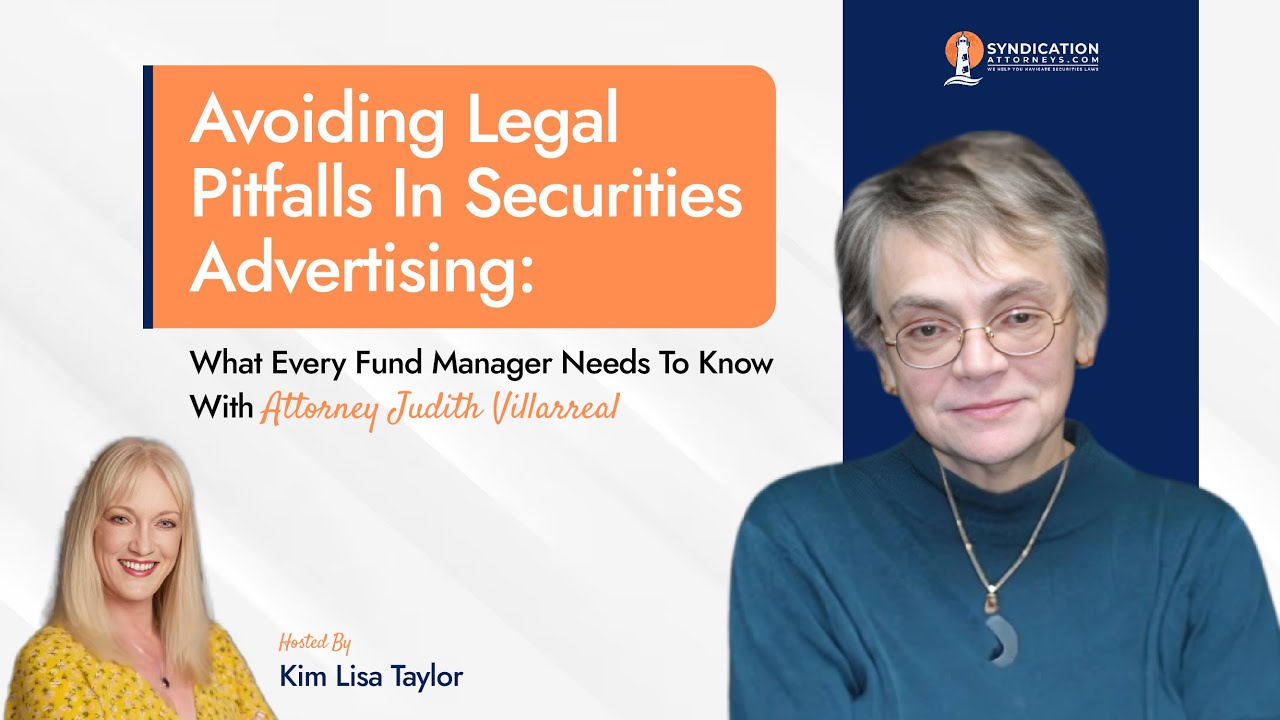
In this Raise Capital Legally podcast episode, host Krisha Young interviews securities compliance attorneys Kim Lisa Taylor and Judith Villarreal to dissect the legal landscape of advertising for private securities offerings. The conversation begins with a reminder that all statements must be clear, non‑misleading, and understandable to a non‑professional audience. The experts outline the most common legal risks—using industry jargon incorrectly, making absolute promises, and omitting material facts—and explain the severe consequences ranging from regulator enforcement to costly litigation and even criminal fraud charges. They detail prohibited buzzwords such as "guaranteed," "risk‑free," "high‑yield," and discuss how even seemingly innocuous imagery (e.g., cartoon eggs, upward‑pointing arrows) can be deemed promotional and trigger enforcement. The episode covers the nuanced differences between Regulation D 506(b) and 506(c) advertising rules, the necessity of pre‑existing relationships, and the importance of tailored disclaimers for each marketing channel (social media, websites, pitch decks, emails). They also explore the strict rules governing testimonials, endorsements, and influencer promotions, including conflict‑of‑interest disclosures and Regulation S‑P consent requirements. Practical compliance steps are offered, such as background/bad‑actor checks, maintaining accurate source citations, and using their firm’s advertising compliance review services and upcoming DIY compliance kit. The session concludes with live Q&A covering social‑media walkthrough videos, virtual Zoom meetings as face‑to‑face interactions, and industry‑specific terminology like "proven field" in oil and gas, illustrating how to apply the discussed principles in real‑world scenarios.
Chapters
Hello and welcome to Raise Capital Legally podcast and YouTube channel, your go-to source for insights on raising capital the right way. We dive into topics that matter most to real estate syndicators and fund managers with live Q&A opportunities before we wrap up. I'm Krisha Young, co-host and business development director at syndicationattorneys.com, and this is attorney Kim Lisa Taylor, the founder of Syndication Attorneys. Now, before we get started, please—
Hi.
That audio and video from this event will be posted on our podcast platform, YouTube channel, website, and social media, and will be made available to the public. You can go ahead and ask questions at the end of this broadcast by raising your hand or typing it in the Q&A. Please note that information discussed during this event is of a general educational nature and should not be construed as legal advice. So today we're avoiding securities advertising pitfalls, a legal deep dive for syndicators and funders. fund managers. In this episode, Kim Lisa Taylor sits down with attorney Judith Villarreal to unpack the critical dos and don'ts of securities advertising. So whether you're a real estate syndicator or a fund manager raising capital under Regulation D, Rule 506 for Bob or 506 for Kat, this conversation will help you avoid the most common pitfalls that could land you in regulatory hot water. From misinterpretations and omissions to proper disclaimers and dangerous buzzwords, Judith shares practical advice on how to stay compliant when promoting your offering to websites, social media, newsletters, email campaigns, and more. So tune in to protect your reputation and your deal.
But Judith has some super valuable information to share. Judith has been in the securities compliance world for a very long time. She has set up RIAs, broker-dealers. She's worked as a chief compliance officer for some really large companies. So she knows what she's talking about when it comes to securities compliance. She stays very much abreast of the rules that pertain to anyone doing private securities offerings, but also for people who are even subject to more rigorous standards, such as registered investment advisors. or fund-of-fund managers who have to become investment advisors. She's just a wealth of knowledge with all of that stuff. So we've recently started doing some advertising compliance reviews for some clients, or advertising materials reviews, and, you know, making sure that they have the right disclaimers, they're not saying the wrong things, or saying things that would attract the attention of securities regulators or could subject them to claims of fraud or misrepresentation. Later on, if the investors were to maybe lose money or somebody wants out of a deal, they will look for those things and try to find a way that you may have violated those rules and use it to force you to rescind their offering, and not just their offering, but maybe the entire offering. So the— we're going to talk about what some of the penalties and things that can happen if you don't do this right. This is an under— misunderstood area of securities laws. It's one thing to learn about securities exemptions and learn how to follow those rules, but then what everybody doesn't understand is that there's an entire other set of rules on things you can and cannot say in your advertising. And I trust you will be astounded by the end of this episode to hear what some of those things are, because to us, you know, and to everybody else in the world, they just seem like ordinary words, but the securities regulators often view them So, uh, Judith, would you agree with all of that?
I certainly would. Um, I, I always start by telling people that the, the most basic thing you have to remember about your advertising is it can't be misleading or confusing. So if, if, if someone reads it and doesn't come out with the same information that you thought you gave them, you've already got a problem. But once you get it clear so that a non-professional reader understands what you're saying and, and how you're saying it, then you can start looking at all these rules. Um, FINRA, which governs broker-dealers, has very specific and detailed rules for advertisements. The SEC is much more of a principles-based regime. They just updated their advertising rule for the first time.
So we'll get into that a little bit later. Let's not go too far down that road because I do have a specific list of questions we want to cover.
Okay.
So what are some of the biggest legal risks that you see when syndicators or fund managers start promoting their offerings online? What are the risks?
Well, one of the things is that They'll either use jargon from their business that people don't understand, or they'll— even worse, they'll use business jargon from another business, like, we're going to mark the market. Well, that's a securities term and a futures term that has a very specific meaning, which has nothing to do with real estate. But the regulators are going to see their meaning, not yours. So you want to avoid these terms of art from other industries. If you make a promise, you can't guarantee anything. You can't tell people that there's no risk. You can't tell people that you're going to make a payment every month because—
But let's not go there. Let's, let's talk about what is the risk to the people that are actually making these wrong statements that they shouldn't be making? What can happen to them?
Well, if you're registered in any capacity, you can get into regulatory trouble. But even if you're just— and I don't mean to minimize that— if you are only a real estate syndicator, and so you have no exposure to securities regulators, you still have exposure to plaintiffs' lawyers and your customers. You can also, if you do the right things wrong, be found to be selling unregistered securities and doing so as an unlicensed RIA or unlicensed BD, in which case you are back in the regulator's hands. But the, the most catastrophic— say you do a $25 million offering. It starts out at $25 million. The real estate market crashes. Your offering is now worth $10 million. And a customer finds something promissory in your prospectus. They call a plaintiff's lawyer, plaintiff's lawyer sues. You have to give everybody back their money and not only give it back to them, you're not giving them $10 million back, you're giving them $25 million back, whether you have it or not. That's really the most catastrophic thing, although falling into the hands of the SEC is not—
Well, or, or in the worst case, Even potentially accused of fraud and then prosecuted criminally because, you know, it's a real fact. There are people in jail, in prison for lengthy periods of time for securities fraud. And, you know, you don't want to go there. I mean, you have to usually do things pretty bad to go there, but sometimes I've seen securities regulators take— start an investigation because They're, you know, running for reelection, or they're, you know, like one guy was going to run for the district attorney or something like that. So we just decided to make an example of somebody who happened to be doing real estate offerings in their jurisdiction. And, you know, put a picture on the newspaper, front page of the news with their pictures in it at the bottom saying mini Madoffs, question mark, right? And, you know, they weren't doing, you know, they weren't doing, they weren't stealing money. They weren't doing anything like that. He was just trying to grandstand, make a name for himself. I've seen that a few times. So it's not maybe even anything you did wrong. You just might be in the wrong place at the wrong time.
Yeah. And there are also sort of fashions in enforcement actions. When Eliot Spitzer invented mutual fund timing as a crime, the firm I was at had 6 simultaneous audits going on by 6 different regulators because we had 3 mutual fund timing customers. But, um, the regulators all wanted to make their career as Eliot Spitzer had done. So, you know, if you see something is topical, that's what you should really avoid.
All right. So one of the things that people aren't allowed to do when they're selling securities is to make misrepresentations or omissions of material facts. So, so let's maybe even back up one step further when you're selling securities, which could be either promissory notes, investment contracts. There's other things that could also apply, but those are the most common things that we see people doing in the real estate world or in the business world, is that they're selling interest in their company or they're offering a promissory note in exchange for somebody's money. In either case, you're selling securities that triggers having to follow securities laws. That's what then says, okay, you have to now Give all of your investors all of the information they need to make informed consent prior to accepting their investment. And that's what the whole offering packages that we create are about, is, you know, the private placement memorandum that discloses all the risks of the investment, who's involved in it, any conflicts of interest, you know, all the fees, management fees, the, you know, the profit splits. What the money is going to be spent for, all that stuff. And then any other way that any member of the management team could be making money off that deal as a property manager, as a general contractor, you know, anything else that they might be doing. So it's important that you tell everybody all those things. But some other, you know, omissions or misrepresentations could take the form of, you know, maybe not telling somebody something about your background. You know, you had a bankruptcy 5 years ago because of a divorce or a business, you know, partner that stole all your money, you know, whatever it is. Maybe it wasn't even your fault. But if the investors can later find that and you didn't tell 'em about it, they had a right to know. They had a right to know whether this was someone they wanted to invest in. And maybe somebody would've said, hey, I don't want to invest in somebody with somebody who's declared bankruptcy. Yeah, that's not my thing. And, you know, and if you didn't give them that information, they find it out later. That's when that stuff comes back to bite you. So those are the kinds of omissions that I think are probably common in the industry. What about misrepresentations? What kind of things do you think fall in that category?
You know, some of these things sort of sit astride categories, but telling people, for example, you will get a payment of X every month. There are all kinds of reasons that might not happen. You know, as we've watched from all the potential defaults in our government the last couple of years, not even a T-bill is without risk. There are no guaranteed investments. So, you, and you don't want to tell people, oh, this has, you know, this is safe. You'll get your money back. You know, you can't do that. Again, no investment is safe. I like to talk about the dinosaur asteroid risk. They don't happen very often, but boy, the dinosaurs aren't happy when they do— happy when it does happen. You need to be aware that there are very rare, obscure risks that you still have to be aware of. And then there's the day-to-day stuff, but you have to deal with all of it. And yes, leaving something out, as you talked about, is in some ways a misrepresentation as well. Because by leaving it out, you are misrepresenting the nature of whatever it is you're selling. I find that—
let's kind of back up just a minute. So one of the ways that this comes about is back to when you're selling securities. Now these other obligations apply to you. And so one of the rules that applies to everybody that's selling securities, doesn't matter what, anything that falls within the definition of a security under the Securities Act of 1933 and the other various securities acts is going to fall in that category. And what that means is that you cannot— there's anti-fraud provisions in every one of those acts that say you cannot commit fraud when you're talking to investors as an enticement for them to give you their money. And that's where these other rules spin from that say that means no misrepresentations, no omissions of material fact, and being fully, fully transparent about the deal, everybody in it. You know, one of the ways that we've, we've tried to work with this with our clients is we require everybody who wants to be a syndication client or, or have us do a fund for them has to undergo a bad actor and a background check. And we do this both for the protection of the investors, but also for the protection of the other people in management. Because just because you met somebody at an event who seems like, hey, this could be a really cool fit, let's work together. Or, you know, maybe even somebody you've known for a long time, you don't everything about their background. And so what we've learned happens when we say, you know, we want to know if there's anything there that has to be disclosed or that would prohibit you from being able to be in that position. And we want the investors to know that. What happens is that the people that have those things in their background, they bow out. And so that protects the other people in management because now, you know, hey, you may never know what it was that that person decided they weren't going to do the deal for, but maybe they have a conviction for something or they've been in trouble securities regulators in the past, and now they see that we're going to discover that and they say, eh, no, I'm not going to do that deal after all. So, you know, just consider that a bullet dodged, right?
Yeah.
Anyway, so what are some examples of some— I mean, we started to talk about a little bit about the misleading language or the buzzwords that get sponsors in trouble.
Well, as I said, you don't want to be too assertive in how well your investment's going to do. Words like guarantee, Guaranteed or risk-free or no risk or safe investment. Now, it sounds like you could say safe investment, secure, proven, tested. High yield.
High yield.
There's another dangerous one. And with high yield, you're going to attract attention because they really, if they're the few high-yield investments there are, are very risky. And so they look at them. Massive returns. Don't say you're the best anything. Yeah. Unless you can prove it. If you can prove it, you better have the proof sitting right on your desk to hand to the regulators when they show up.
Right.
Don't use high-pressure sales. Yeah. Get yours now before it goes away. They don't like that. And unless it really is, you know, if you're, if you're going to break escrow in 2 days and you know you're done, Then you can say you've only got 2 days to get in. But if, if that's not true, basically anything you say to your best— your investors or potential investors has to be provably true. And my— a lot of laypeople want to leave stuff out. They're concerned about a long investment memorandum. Your investors deem to have read everything in that. Memorandum. So tell them the truth. The one person who reads it and says, I don't want to invest with him, good. That's because you just avoided a lawsuit. And most people won't read it. The, the most common readers of any offering materials are the first-year associate who wrote it and the first-year associate who is drafting the complaint for the fraud suit. But it's better to put it in because it protects you legally.
Yes, absolutely. Every statement must be true. And that even counts when you're citing third-party sources of data and information, right? So what if you're saying, hey, you know, Dallas, Texas is the fastest growing community in the United States? You better have— you better have the citation. You better have some date qualifiers in there. As of 2024, According to this source, Dallas is, you know, this. And, and you better keep a copy of whatever it is you're citing. So if you went to a website, you want a snapshot of it or a printout of it. If you found it, you know, on the news, you know, you've got to be able to, to validate that source. Because if anybody ever shows up, plaintiff's attorney through discovery or securities regulator through an investigation, they're going to ask you, where did you get this information? And they need to be able to reproduce it. So if you don't have it and that website is no longer there or that article is no longer available, you don't have that proof if you didn't make a copy of it and, and say, no, no, here's where I got it. This is what it's from. So you've got to be super careful anytime, especially in your investment summaries, your property packages. If you're using any data from the Chamber of Commerce or, you know, some local community source or even CoStar or, you know, you've got to be able to cite those sources and put some date qualifiers on it because somebody could be looking at your offering 2 years from now. And if you didn't put a date qualifier in it, that statement is no longer true because maybe it's not the fastest growing community in the United States anymore. Now somebody else is. And so, you know, you have to say as of that date. So anything you want to add to that, Judith?
Yeah, you, you also want to tell them we believe this is accurate and we believe these are responsible people who are, you know, their information is reliable. And current and accurate, but we cannot and do not guarantee that. Because, you know, you can't call the Wall Street Journal and say, you know, you've got to make this true for me. They don't care what you do. But once you publish something, you own the risk of it. So you need to tell people how much of that risk you're assuming and what you're not assuming. And you do that by saying, we believe this. to be accurate, current, and complete, but we can't guarantee it. And, and you need to disclaim that guarantee.
Uh, well, and so, so moving on to our next question here then, um, this is where we get into disclaimers, right? This is where you have to have the proper disclaimers, and the proper placement of those disclaimers is also important. And the disclaimers are going to be absolutely different for every marketing piece that you do.
Right.
So if it's a social media image, if it's a social media ad with words on it, if it's a, you know, if it's an image that conveys a concept, even that kind of stuff can get you in trouble. But, you know, your drip systems, your website, your front page of your website, your pitch decks, you know, there's, there's a specific disclaimer for every single thing. And you need to make sure that you're using the right disclaimers. And the other thing I see people doing a lot is they'll just grab a disclaimer off the internet and it has nothing to do with what they're doing, right? And so if you read it, it talks about, you know, hey, these limited partnerships are, you know, our interests are not guaranteed and they're offered by a GP. Well, if you have an LLC, that's completely irrelevant to you because it doesn't even have those, those things in it. There are no GPs, there are no limited partners in an LLC. There's a manager and there's members. You know, and, you know, you're not talking about shares. You know, if you're selling interest in an LLC, you're talking about units or interests, you know. So you've got to be— make sure that the terminology in your disclaimers matches you and what you're doing, and it matches the company that's actually making the offering.
Takes us back to don't be misleading. You know, if you're selling an LLC, and you're talking about general partners, well, you're certainly leading people down the wrong path. Well, you know, the SEC takes the position that if you've got a violation, you can't cure it with a disclaimer. But other than that, disclaimers can be very useful. For example, in the annuity world, There are guaranteed annuities. But if you tell people, yeah, they're only guaranteed by the claims-paying ability of the insurance company, you've now been straightforward. You're not telling them there's a SIPC out there for annuities. You're saying if you've got a good insurance company, you can get a guarantee. If you don't, it's not worth very much. You want to, you know, everybody This has fascinated me since the first day I came into financial services. Everybody wants to see past performance, and everybody is required to say past performance has nothing to do with future performance. And, you know, it's not predictive, it's not indicative, and you have to say that. There's— the SEC is finally decided to allow people to use testimonials and endorsements, which even includes things like like on Facebook. But there's a very strict, complex disclosure regime that goes with using those. And again, you look at what the thing says, what you want it to say, and who's going to read it. Your audience is a huge portion of What you're writing down. They're going to—
Let's talk a bit. You've, you've told me before that you've seen regulators take exceptions to certain images, which are the exact kind of images that we'd all want to post on social media when raising capital. So for an example of that, I think you talked about like an egg at the top of a tree, right? Your nest egg, right?
Yeah. Well, we had a, we had a cartoon. This was for an IRA at a bank. And it was a cartoon that made no attempt to look like anything but a cartoon of a man with pruning shears cutting dollar signs off a tree. The FINRA took the position that that was promissory. And I wrote them back and said, if I have a client who really believes that money grows on trees, he should not have custody of his. Someone else should be.
Yeah.
For him. You get golden eggs in birds' nests. They don't like that. You— a bar chart that ends up high, they object to that. They want that last arrow to be coming down. It's made up. There's no numbers even. It's just an arrow. But so you have to be very careful and understand that these are people who have a very different mindset than you do. So if someone says you're being ridiculous at making me change that, they're only being ridiculous because that's what they're going to— you're going to get from a regulator. And anything like that will delight a plaintiff's lawyer. Look, they showed me—
Let's talk about the difference between testimonials and endorsements, because that's also a fascinating area, is that people, you know, we think, hey, somebody told us good things about us. Why can't we just post that? And when you're dealing with past investors or people that have invested with you in the past, what are, what are some of the rules around that?
Um, well, a testimonial is just a stranger off the street, though why a stranger off the street would want to say you're great, I don't know. An endorsement is a current or former investor or current or former employee. Those are the 2 things that matter there. And employees, the broadest sense of that term, you know, a contractor, an officer, somebody you paid money to in the past. When you're using someone like that, and to a certain extent, you have to say it about testimonials as well, you have to disclose any conflicts of interest created by any cash or non-cash compensation you give them, which Most people don't do compensated endorsements, but focus on that non-cash. If you're giving them a free trade, that's non-cash compensation. You have to— you cannot get an endorsement or testimonial from anybody who's a bad actor. So you have to make some sort of effort to find out if they're a bad actor. There are ways to do that that aren't as expensive as having a full-blown report done, but you need to do it in one way or another. You need written policies and procedures about these people that say what due diligence you're going to engage in. So, it's not as simple as just, well, John used to work here, and he thinks it's a wonderful place to work. Well, that's nice. Is John a bad actor? Are you paying John anything for doing this? You know, and if you're going to use their names, you need to get a consent signed because giving their name out is a violation of Regulation S-P under the securities laws, the privacy rule in securities. So none of this stuff is simple, but doing endorsements and testimonials, I wonder sometimes if they wrote the rules to try to make people not use them.
Try to discourage it. Well, and then there's, you know, some people might be thinking, well, gee, could I get a— what about a celebrity endorsement, right? Well, we can, we have a perfect example of that. And that was Kim Kardashian got slapped by the SEC a few years back when she posted some, you know, promotion or something about a crypto offering. And She, you know, the SEC, there's something called an anti-touting rule. And what she did wrong was she, according to this anti-touting rule, because she's a celebrity, she didn't say this is, you know, I received, you know, she has to disclose that she was being paid and how much she was being paid for making this statement.
Yes.
And so that's when she got in trouble and, you know, she ended up settling with the SEC and, you know, it all worked out. But, you know, so I think that woke up everybody in the celebrity world about the fact that if we're going to do this for some particular type of offering, then we need to disclose that we are being paid if we are, whether you're giving them free interests or, you know, a share of the company or you're paying them cash or you're just paying them a fee for, you know, they're— what are those people called? The influencers. Right. So she's, she's in that influencer category. So if you've got, you know, any influencer that's going to promote you, then they have to, and you have to make sure that there is a disclaimer that says that this person was being paid and how much. And, and then it's okay. Because then why is that? Because the viewer, the person that's, that's looking at this information, the consumer is going to view that differently. Same as you're flipping through a magazine and you see an article about something and then you see at the top paid advertisement, right? You might still be interested in what the thing is, but you're looking at it not as an informational article. You're looking at it now as, okay, this is an ad to get me to buy something. And so you've just got a different perspective on it. And you might, you know, okay, she got paid to do this. That doesn't mean that she's doing it and I should do it too. And that's the whole point, I think.
You know, in years of dealing with marketing people and brokers who do their own advertising. If you've come up with what you think is a brilliant advertising concept and you've never seen anybody in the securities business do it, there's probably something illegal about it. The wheel has been invented and you're not going to come up with it again. And every one of these things has additional complications. You know, people want to say you can win a computer. Well, you start saying you can win anything and you're now subject to state anti-lottery laws. So, you, you know, you really have to— this isn't as easy as just writing it. I, I, I know it's easy for me as a lawyer to say you should get a lawyer, but sometimes when you're dealing with something really complex and subtle, it is worth having a lawyer.
Oh yeah. And for sure you want to have lawyers review your ads because I get people send me things all the time. First of all, the other thing that I see people doing, it's not even just an advertising mistake, it's just a, you know, I don't understand what the heck I'm doing mistake because I'll see people that, you know, will come to me, ask me to review, you know, this or that, or a lot of times somebody will send me Hey, why can they do this and how come I can't do that? And, you know, I'll often explain to them that, you know, well, there's, there's some reasons for that. But, you know, some examples of things I've seen is where somebody has a promissory note offering. So they're actually issuing promissory notes to investors, which do allow you to make promises. Okay, that's a different category. When you're selling interest in an LLC, you're not allowed to guarantee or to promise or or anything like that. Promissory note, the thing about that is that you are promising to pay regardless of whether the property makes any money. And, you know, you really need to make sure that you've got the personal resources to make that payment unless it's somehow contingent and tied to performance of the property. And then in that case, then you've got some different disclosures you have to make. But what I see people doing a lot is they'll, you know, go to a web designer. They're just starting out as syndicators. They've gone, they've learned how to want to buy something like, you know, some type of real estate. And now they go to some web designer that doesn't understand this industry and they'll create, you know, a promissory note website for them. Oh, you're, you must be borrowing money from people here. We'll use this language, right? And, and so, but you're not doing that. You're not borrowing money from people. You're actually going to be putting people into LLC interests. So you need to make sure that not only are you not you know, creating one of these red flags we're talking about, but you're also talking about the thing you're actually doing and you're explaining it correctly. And that's where you want to make sure that you've got your attorney reviewing it so that what you've created is consistent with the offering documents they've created for you. Because if there's ever found to be a disconnect, that is absolutely going to be considered to be a misrepresentation. Yeah, you've got to be aware.
What I'm hearing here is that this is why having solid counsel on your side is critical. It's critical because this— so much of this, what I'm hearing, is kind of innocent almost in a way. It's like you're saying the wrong thing, not really realizing you're saying the wrong thing or whatever. I'm sure that most of these people aren't setting out to be misleading, you know. They're, they're just like excited about their offering. They're excited about what they have. And, you know, and, and these are very costly and risky mistakes, you know. And so having the right kind of counsel to look over your marketing and really stand by your side during this, um, you know, raising capital in this way, I think is absolutely critical.
Yeah, so, uh, I, uh, we are actually in the process of creating kind of a do-it-yourself advertising compliance kit. We're going to be rolling that out here very shortly, but we've also got a more comprehensive offer that we're going to be making where we're going to be able to go in and look at all stuff. We want to look at your drip campaigns, your, you know, your social media campaigns, your website, you know, every channel that you're using and make sure that we're, you know, providing you with the right disclaimers and teaching you how to use them correctly. And then, you know, for those that are doing this in a big way and they've got a lot of marketing materials or a lot of offerings happening at the same time or doing a lot of successive offerings, then we're going to offer even a subscription service where you can have us continuously reviewing your marketing materials as they come out. So, you know, look for that in the future. We're going to be putting it on our website. We'll make an announcement when it's ready. But, you know, when we were creating some of the materials for this, you know, we came up with the list of words and categories that you can't say. So overly definitive or absolute terms. So that's the guaranteed, risk-free, no risk, safe investment, proven. We hear this one a lot. It's a proven track record. We have a proven track record. What's your thoughts on that?
Well, I, I suppose on a track record, if you really had to, you could prove it because there's the underlying trade ticket somewhere. What I see all the time that makes me crazy is a proven technique, uh, unless you've had somebody come in, some professional, and I don't even know what kind of professional you would hire to do that, uh, who has gone through And proven that your technique works and works all the time. And if you find it and your technique does that, I want an account with you. Um, but, um, it— you can't say anything is proven unless it has been proven and you have access to the proof. Uh, it's— that's what makes that a tricky word. You could say something like time-tested. You know, we've been doing this for a long time, and we've generally done pretty well is what time-tested means. That one's an easy one. You can always find alternatives. I mean, people talk about attorneys and weasel words, but if you see the way the regulators are looking at every word that they parse out of your document, you need to find ways that— of saying things that won't get you in trouble. And one word I want to address, we've talked about advertisements and marketing materials, but basically anything you give to a member of the public, to more than one member of the public, is subject to these rules. You can write somebody a letter, and, and that's one thing. But if you write the same letter to 2 or 3 people, you're now subject to these rules.
Wow, that's, that's crazy. So let's talk about some examples of some promissory language, because I think this is one we see people trip up on a lot. So, and even in their offering documents and in their investment summaries or, you know, property packages, they're talking about, you know, we make quarterly distributions. Well, you don't. You evaluate distributions quarterly and you decide whether or not you will make a distribution because there could come a time such as COVID, you know, rent eviction moratorium, something, you know, bad catastrophic happened at your property that you have to suspend distributions. So you don't make quarterly distributions, you evaluate your distributions quarterly. You know, you don't want to say monthly distributions. First of all, that's, that's dangerous for a lot of other reasons, but it's better to say scheduled. Monthly, you know, or scheduled quarterly.
And also, if you're offering documents, say quarterly, you probably shouldn't say monthly. And we— I have seen that.
Yeah, we've seen that too. Well, we've seen where people will say, oh, we offer monthly distributions, but then we'll read the offering documents that say, and, you know, sometimes not written by us, where they'll say, well, the manager has the discretion to provide distributions monthly or quarterly. Well, if that's the case, then you can't say monthly. You have to say monthly or quarterly because that's what your documents say. If you don't want that in your legal documents, then, you know, you want to be able to say that, then you've got to say that, you know, through consistently throughout all of your documents, the marketing and the legal documents. We don't like finite returns. You know, don't tell people they're getting a 15% return. What you say is our target return For investors is X to X.
Okay.
13 to 15, 13 to, you know, 16, something like that. And you could even make it dependent on the amount you invest. So you can have different tiers. So whatever you're saying, it has to be accurate and you have to say the complete thing because if you don't say, oh, well, you only get the 18% returns if you invest over $1 million, then, and you're telling people you can have returns as high as 18%. Well, then you better have an asterisk that says that, oh, that's only if you invest $1 million or more, you know, or something like that. So you've got to qualify.
Um, yeah, these are not, you know, bonds. And even bonds that have a, you know, a coupon rate— again, bonds can go belly up, bonds can, uh, be called, all kinds of things can happen. Uh, so it's very important to remember that this is a world where you have to assume something's going to go wrong. Talk like it'll go wrong, and, and that'll kind of COVID you.
Well, and also, I always counsel clients, don't ever say you're going to sell the property in 5 years, okay? Because in 5 years and 1 day, your phone is ringing 25 times from all of your investors saying, where's my money? And, you know, you're, oh, well, now I'm having to explain why we're not selling it in 5 years. So then you lied, right? You actually aren't selling it in 5 years. You never intended to sell in 5 years. I want my money back, so I'm going to sue you. You know, so you're setting yourself up for failure. So you say a range of years, you know, our plan, and we project, we, you know, hope to achieve.
Yeah.
So you never say, you know, or we believe, or, you know, you, you can say those words, but you can't say This will happen, though. Anytime you say this is going to happen, I looked at something yesterday and somebody said, you know, your returns will start on this specific date, and it was an actual date. And it's like, you don't know that, and you couldn't possibly predict that at this point in this. So you've got to— you can't say that. You know, you can always say, we think, you know, we plan to start making distributions. You know, it's a development project. So we think that the development is going to take 18 months, 18 to 24 months. Okay, there's your range. It doesn't mean you're actually— and you're not going to get paid until we actually generate income, which we think is going to happen sometime in year 3. You know, so you can say things like that, but you can't say your returns will happen in year 3 and we will refinance in year 3 because you don't know that that's going to happen. There could be all kinds of things that would happen that could prevent you from doing that. So, yeah, you know, misrepresentation, misrepresenting risks. So downplaying or omitting the details about the risks, that's, that's a recipe for disaster. Emotional language, you know, life-changing, you know, generational wealth. That's a little bit scary. You know, I think that regularly, and we hear it a lot. And, you know, so what you're hearing here today, I think, are probably blowing some of you away because you're like, oh my gosh, you know, we use all those terms and this is rampant in the industry. And it is, it is. It's, you know, if you want to hear people violating securities laws, just go to your local REIA meeting. I guarantee somebody will be breaking securities laws at that meeting, you know, because they don't know any better. You know, so.
Yeah, it's that not knowing any better. That's what I was saying before. It's like innocent. It's like you don't know what you don't know, right? And in these offering documents too, the packets are huge and there's so many places that you could potentially say the wrong thing if you're not protected and have these reviewed by securities attorneys such as yourselves.
Okay, here's another one. Don't say anything. Is SEC approved or SEC compliant, okay? Because you don't, you don't get to make that decision. They do, okay?
Well, and they will never say that to you. Um, uh, the CFTC, when they do an offering document, they say it's not disapproved. Um, the SEC says you're allowed to use it. Qualified.
It's qualified.
Yeah. So, but nobody ever says we approved this document. And if you say so, they will find you and they will destroy you. That is one of their least favorite violations. Because of course, if you say to somebody, oh, the SEC approved this, well, you're going to think that's got to be wonderful because they're the, you know, they're the regulators. They know what's good and bad. The you know the SEC all they care about is that you're telling everybody everything you have to tell them. They don't care how stupid your investment is. They don't care how smart it is. The I've seen a commodity trading advisor who trades based on astrology, who got his disclosure document through the National Futures Association. California, on the other hand, wouldn't let him buy. investors buy Microsoft because they thought it was a risky investment. So you never know what the regulators are going to do, but you don't want to imply that they have approved you. That's the one thing you cannot do. And a lot of what you do in a private offering, the regulators don't even see anyhow.
Right.
If you work with a broker-dealer and you do a private offering, FINRA may ask to see the offering materials.
Well, and I don't think our clients, most of them are not subject to FINRA because we have very few clients that are actually licensed through FINRA. What we're dealing mostly with are the people who are doing real estate offerings or doing small business offerings or fund-of-fund offerings. And those, the, like the venture capital funds that were creating fund of funds offerings, those managers are subject to the advertising rules that apply to investment advisors, and they are subject to some sort of registration as an investment advisor, maybe as an exempt investment advisor for a period of time. Once they get to a certain level of assets under management, then they have to go to a different level, but they do have some investment advisory obligations whenever you're advising people on how you, you have a fund that's investing in securities in somebody else's deal. So you're buying interest in a company, you're buying, you know, interest in somebody's syndicate or somebody else's real estate fund where you're not in control of the real estate, or it's not a real estate offering and you're, you're doing some other kind of business. Those are the people that become subject to the Investment Company Act of 1940 and the Investment Advisors Act. So if you, if you know anybody that's in that category, or if you are one of those people in that category, you haven't done anything about getting yourself, you know, registered as an investment advisor, or at least licensed at your state level, or at least find out what the rules are and trying to comply with them, then you are at great risk. And you also are subject to a much higher standard of advertising compliance than you are if you are just doing real estate syndicates and real estate offerings. But the anti-fraud rules are very, very broad for a reason. They're here to protect the public, and that is, you know, your obligation is to know them whether you like them or not, and realizing that advertising for securities offerings is not sexy. It is not. It's factual. And, you know, so that's why we're back to face-to-face, face-to-face, you know, meetings with your investors is the most, most effective way of getting investors. Anything you do on social media, any kind of public forum could come back and bite you. It easily could.
And one thing Noticed recently, and this is another one of those you shouldn't say it things. I've seen people put in advertisements, and these are just pure real estate deals. We'll help you look at your investment portfolio. No, you will help them look at their real estate investment portfolio. You know, maybe you have interest in half a dozen buildings, and they'll help you look at that. But if you start saying one of the things that makes you an RIA is holding yourself out to the public as an RIA. And if you're saying, I'm going to review your investment portfolio, that's treading awfully close to holding yourself out as an investment advisor, and you can get in trouble. And again, it's— I know it sounds like hair-splitting, and we're talking about how many angels can dance on the head of a pin, but there's a whole agency in, in Washington, that's going to be looking at how many angels are dancing on the heads of your pins. So you want to be sure, even if it doesn't sound as good, you need to identify that what we are talking about is real estate investments. Otherwise, you could be in trouble.
So we, we've just got a few minutes left for questions, and I see that there's one. Um, Krisha, do you want to read that?
Yeah, um, of course. Wow, this is eye-opening for sure. Thank you. Peter asked, how thin of a line is it to post on social media a walkthrough inspection video of a property and making statements like, we are looking for investors for our next property purchase? Is this illegal?
Okay, so this is where you're going to get the first thing we ever learned in law school, right? First day of law school, they teach you to say, it depends. Yeah, whenever anyone asks you a question, just say it depends. Yeah, so, you know, it depends on what, uh, first of all, if you are doing 506 offerings, that would be illegal, okay? Because number one, you're doing a tombstone ad because you're walk— uh, well, if this is a, this is a solicitation, this is the first step in making an offer. Hey, we're walking through through this property and we might be buying it. And so we would love you to participate with us. Well, that's an offer. Okay. If you're just, hey, this is just an example property that we walk through, you know, type of properties we walk through, but we're always looking for new investors. Anytime you start saying we're always looking for new investors, it just starts to get into that area of making a solicitation and you don't have a relationship with all those people. If you haven't pre-vetted every single person that's going to see that video, which obviously you're not if you're putting it on social media, then, then you could be in trouble. If you're doing 506 offerings, that would be okay. And so the distinction there, 506 doesn't allow advertising. The way to prove you didn't advertise is to be able to demonstrate you had a preexisting substantive relationship. meaning you already knew whether that investor was accredited and not accredited, how are they sophisticated, suitable for the kinds of, and that they're suitable for the kinds of things you're going to offer, they're comfortable with the timeline, you know, and the types of things you're doing. So if that's your, you know, if you're doing 506 offerings, you can't do that. If you're doing only 506 offerings, then you could. If you were doing 506 offerings, anybody you met, from saying that would be prohibited from investing with you because you wouldn't— they would have to say, well, you know, how did, how did you meet them? Well, I met them by— I saw their video on social media and they were talking about walking through properties. And, you know, so all of a sudden you've kind of created this fruit. We call it fruit of the poisonous tree, right? You cannot use them on that deal. And because you met them through advertising. So you've got to look to your overall strategy before you start making ads, because if you're doing 506 offerings, just don't— you know, you can say, hey, here's a property, we're walking through it today, it's pretty cool, um, you know, check out our website, you want to know more about our company, how about that, right? And then you're really careful about what's said on your, on your website where you really just giving them a bunch of educational information. Hey, if you'd like to know more about our future investment opportunities, click here, schedule a call. We'd love to talk to you. You know, so—
It's also worthwhile to put it in, speaking of disclaimers, put a footnote that, or in your frame even, that nothing on this page is an offer or a solicitation of offers to buy. And In any place where we're not allowed to sell it, and to any person we're not allowed to sell it. Now, it's not an offer to anybody, but you can also say we're talking to a specific group. It may be a group of states. It may be a group of people, like accredited or not. If you put that in your disclaimer, it may save you. And I've often recommended that, especially say you've got an offering that's registered in 3 states. Well, you can't control where the internet goes. They're gonna see that and pull out. And so you wanna make sure that you, you're not letting the customer decide if they qualify. You are saying there is a limit, and if you don't meet that limit, then you aren't, you know, move on basically. And I know anybody who's a salesperson hates the idea of sending someone away, but if you can't have that customer, You want to make sure that customer understands that and the regulators understand that you understood it.
Better than to be in hot water.
Well, we've covered a lot. Judith, are there any— oh, this looks like there's a couple more questions. Okay, let's go.
Yeah, I think we have a couple more minutes here. Um, uh, okay, quickly, um, Peter's second question was, um, when we were talking about the face-to-face conversations, right? The belly-to-belly. Do virtual, like Zoom meetings, fall under that category? And then we've got another question.
Sure, sure.
I mean, people that you can see, they can look into your eyes, they can make an assessment whether they believe that you're a credible person. You know, the SEC believes to have a substantive relationship that you need to have a live conversation, but they don't dictate, you know, that could— conversation could happen on the It could happen on Zoom. It could happen in person, you know, but a live conversation. You can't just exchange electronic forms back and forth in order to create relationships. That, that doesn't work. So yeah, so sure, Zoom, Zoom virtual meetings would qualify, or even phone calls.
Great. That's helpful to know. We've got a question here from Una. Apologies if I Didn't say that right. We are in oil and gas. We use the term proven field. We do have due diligence from geologists and well logs along with historical production and neighboring comps. Is this okay to use?
My reaction would be, one, is that used in your industry? I mean, are these fields across the oil and gas industry called proven fields? Is that what geologists call them? And I think actually that in some way is more Kim's field than mine. But yeah, so you are allowed to use the terms of art for your industry. You just want to avoid other people's. But if there are reliable reports that would always refer to this kind of field as a proven field, you can use it. I would then go on to explain What a proven field is, and that it isn't a guarantee, which I'm assuming it isn't. But you can't—
It might be better, you might be safer to find a different way to say it, that, you know, historically proven, right? In the past, it is proven, you know, and then we were going to have a disclaimer that says past performance is no guarantee of future results. And, you know, oil fields play out and, you know, all things could happen to make it go away.
Can you do some like quotes, like air quotes, like proven?
Like, no, you would have to explain it.
Yeah.
And you still have to risk it and say proven means this is a term of art used in this industry pertaining to, you know, oil fields that have been in production for X number of years with, you know, this much production capacity or whatever that definition is. Right, versus, you know, just so better not to say that. It's better to say, you know, the field is historically proven profitable. Doesn't mean it will in the future, but, you know, we're pinning our hopes on the fact that it will continue.
Yeah, that's why offering documents get so long. You can't say anything. You have to explain everything.
You can't say anything, and then it's like 500 pages of saying nothing. I'm saying everything, nothing.
Yeah. Well, okay. The important thing is there's a lot of boilerplate. Maybe 98% of it's boilerplate, but that 2% is what can kill you and put you in prison. So you need to be aware of that.
So just, Anna asked a question, how do we engage your services? Well, Judith works with us, and so she's one of the attorneys that works with Syndication Attorneys. So If you want to work with Judith or I or both of us on these kinds of things, then you could— the best way to do it is go to syndicationattorneys.com. There's a schedule a consultation button there. If you want to schedule a free discovery call, then you will talk to Krisha, who is our business development director and our client success coach, and she can usually figure out what you need and let you know what those kinds of things might cost. And if you do need to schedule a call with one of us, then there are some paid consult links there for the attorneys as well if you want to go directly to that. But otherwise, you can talk to Krisha first and then she'll let us know. But, you know, we would love to, you know, to help all of you. Our goal is, you know, we have a saying. I actually learned this from another securities attorney. I don't think she'll mind that I stole it, which is You know, we, uh, nobody goes to jail and we all make money. Uh, we'd like to keep that track record. Uh, that has been our historical track record.
Past performance does not guarantee future results, but hey. I put my email address in the chat as well for anybody who's here live. It's krisha@syndicationattorneys.com, or like Kim said, go to our website. Um, our website has lots of really awesome information too. We've got tons of articles. We also have 2 bestselling books as well on Amazon that you can—
And we're about ready to have a 3rd.
And we're ready to have a 3rd. Yeah.
Just published another book called How to Raise Capital for Real— or for Startups and Small Business. So how to legally raise capital for startups and small business. We'll actually have, uh, copies in our hands next week, and we'll probably doing, uh, be doing our actual launch of that sometime in the next month.
So, and we also have Beyond Multifamily. We've got a virtual event coming up June 6th and 7th, 2025. So if you're watching this before then, there's still time for you to register as a guest and join us at that event to learn about alternative asset classes and how to—
It's free to register. If you can't be available on those days, it's a Friday Friday, Saturday, then you can purchase the VIP ticket. I believe we're still honoring the code, which is SUMMIT20, which will get you 20% off the VIP ticket. The VIP ticket is only $97. So if the code doesn't work, it's still just a $97 investment. We've got about 45 or more speakers that are going to be talking about the different asset classes that they purchased. And there will be people there who are also introducing their training programs on these different asset classes. So if you feel like you're stuck in a rut, you're not finding, you know, the properties that you want, maybe it's time to get, you know, add some tools to your toolbox, learn about some other asset classes, start thinking of yourself as a real estate investor, not an investor in a specific asset class. Because as a real estate investor, as a commercial real estate investor, you should be able to invest in almost anything that seems like a good deal. You just got to know the tricks of that particular asset class, how you're going to get those tenants, how you're going to make it profitable. And all of our clients that start with a coach or training program always, always do much better than the people that try to go it alone. So anyway, Summit 20, Summit 20. So the go beyond multifamily.com is the website. And we've been working very, very hard along with Vinky Loomba of Loomba Investment Group to make this event happen and to be something that's of true value to all of our audience. So if you are on our newsletter, if you're getting our newsletter, you will get the announcements when we roll out our new marketing compliance plan. And we'll be looking forward to, to talking to some of you about some of your questions, because I'm sure you all have some. Sure.
Kim, Judith, thank you. You're both such amazing wisdom and very grounded, very practical, humorous as well. You know, it's a very serious situation, but we brought some levity and humor to it too. And thank you for, for, you know, being here and helping everybody sort of like get a little bit more clear Fantastic.
All right, thank you so much, Judith, your wealth of knowledge, and we love having you on our team. And you too, Krisha. Just an FYI, in case any of you have some mindset issues with dealing with investors, Krisha is also a mindset coach in her own right, and she's working on her own book in that field. So we'll be announcing that at some point in the future. Yeah, I'm excited about that. in the future, but, uh, Krisha is available to help you overcome those, uh, those challenges. So thank you so much, everybody, for being here today.
All right, thanks everybody.
Bye-bye.










