Discover the Goldmine of Mobile Home Park Investments
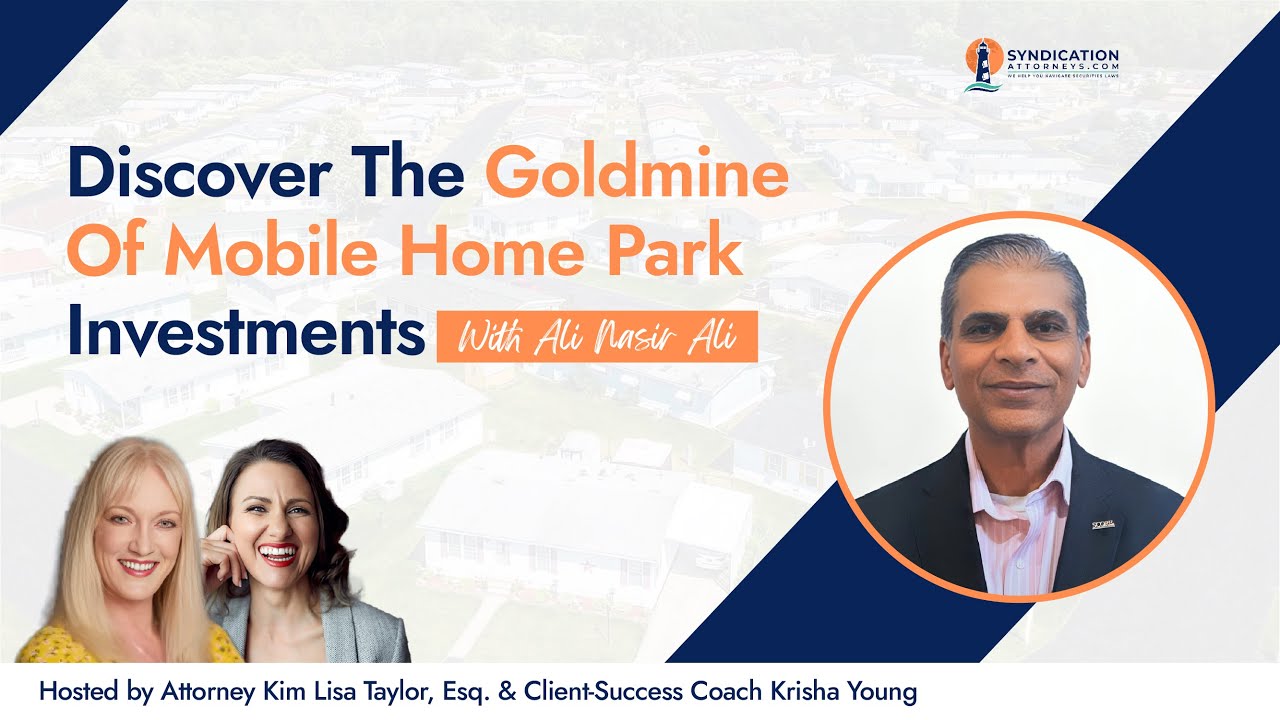
In this episode of the Raise Capital Legally podcast, co‑hosts Krisha Young and attorney Kim Lisa Taylor interview Ali Nasir Ali, an eighth‑generation real‑estate investor who has built a multi‑million‑dollar portfolio of manufactured‑housing (mobile‑home) parks. Ali recounts his family’s centuries‑old land‑rental heritage, the pivotal move from a family‑owned RV park to full‑time mobile‑home‑park investing, and the strategic focus on buying under‑performing parks in secondary (and emerging tertiary) markets. He explains how he evaluates density (≥50‑100 units per park), cap‑rate targets (≥7.5% on acquisition, ≤5% on disposition), cash‑on‑cash goals (12‑18% during hold, 22‑25% IRR on exit), and the importance of legal‑regulatory levers such as rent‑control language. The conversation also covers the evolution of manufactured‑housing quality and stigma, financing trends (seller‑carry to major‑bank loans), operational efficiencies (land‑only leasing vs. park‑owned homes), and the “immigrant‑spirit” mindset of risk‑taking and relentless action. Ali shares his networking philosophy – building relationships through informal gatherings (cigars, poker, masterminds) rather than hard‑selling – and offers practical advice for new syndicators on raising capital, cultivating a supportive investor community, and maintaining a growth‑oriented vibe. The episode ends with Ali’s contact information for listeners seeking mentorship or partnership opportunities.
Chapters
Hello and welcome to the Raise Capital Legally podcast and YouTube channel, where we talk about topics of interest to real estate syndicators, fund managers, with an opportunity for live questions and answers before we sign off. I'm Krisha Young, co-host and business development director for the firm, and this is attorney Kim Lisa Taylor, the founder of syndicationattorneys.com. Now, before we get started, please note that audio and video from this event will be posted on our podcast platform, YouTube channel, website, and social media. and will be made available to the public. You can go ahead and ask questions at the end of the broadcast by raising your hand or typing in the Q&A. Please note that information discussed during this event is of a general educational nature and should not be construed as legal advice. So today our topic is Discover the Gold Mine of Mobile Home Park Investments. In today's episode, we sit down with Ali Nasir Ali, an 8th generation real estate investor specializing in manufactured housing facilities, MHPs, and permanent resident parks. With a deep passion for affordable housing solutions, Ali has built his business by acquiring underperforming mobile home parks and transforming them into thriving communities. We'll discuss his investment strategies, evolving landscape of the MHP industry, and why affordable housing remains resilient— a resilient asset class in any market condition.
Hello.
Hi.
Hi, Kim. Hi.
Good morning, Ali. Good morning, everyone.
Great.
Thanks for joining us, Ali. So, you know, you're a client of the firm, and we've had some discussions before that sounded really interesting about some of the experiences you've had. So that's why we invited you to come, because I think this is interesting for our audience not to just hear how, you know, hey, well, I didn't come from that background, maybe I can't be as successful as Ali, but maybe thinking, forward, right? So maybe I could create something like this that my future generations could benefit from. And so specifically, you said you're an 8th generation real estate investor. What's the story behind your family history in real estate?
Well, good morning, everyone. First of all, thank you, Kim and Krishna, for this opportunity and for asking me to participate. I just want to say I was watching a YouTube video recently and about, you know, things that you can do just much like we do for health. We exercise, we eat right or whatnot. But for business and for building our business, one of the things that was mentioned in one of the recent podcasts that I watched was doing masterminds and participating in podcasts and being around like-minded people. So thank you for the mindsets that you've provided, the podcasts that you provide. I've learned, I've benefited. I'm looking forward to getting back. to, you know, participating in real time or live in those events as soon as I can. I feel guilty every time I miss one. But in any case, I think it's a great service, and thank you for that. So the story, the story behind the family history, you know, I've traced it as far back as I can. And to keep this brief—
Oh my gosh, everybody.
Hopefully you can hear me. Okay. Sorry about that. My earbud fell off. Yeah, you're good. Going back to prior to even currency. So my family's originally from India, from Gujarat, which, by the way, just being from that part of the country, they, for better or worse, they have a caste system. And we were typically from what would be the business or the merchant caste. So we were always in business, always in real estate, as far back as I can Thank you, Trace. And before currency, even when the barter system was in play, or that was the way of doing things, my understanding is that we didn't have anything to barter. We didn't have any product or service other than our land, which was used to be the bazaar where everybody else brought their goods.
Oh.
Right. So we had the flea market or the swap market, the swap meet of the time, whatever you want to call it, the bazaar. And everybody would bring their goods in exchange. that's what we would get in trade is in exchange for using our land and where everybody would congregate, we would get rice or grains or whatever. And so it's kind of an interesting story going back to those times. My father is one of those one-in-a-billion type stories. And, you know, he, during the partition, and I'll make this as brief as I'll make this brief, but during the partition of the, you know, when the country India split into multiple countries, particularly India and Pakistan. My father must have been 4 years old or something, and they ended up migrating to Karachi, Pakistan, and basically lost all the wealth. So he grew up in poverty, but what he didn't lose was the knowledge and the ambition and the determination that was passed, I think, through the family, through the stories he had heard, and he carried very closely. By 12, 13, he was out doing entrepreneurial things. By 19, I think he did his first creative real estate deal, expanding a bazaar into twofold, really taking a bazaar that was in Karachi and making it twice as large just simply by locking a lease option type deal on the property next door. Oh, that's fantastic.
Yeah.
So fast forward, You know, this guy goes through from Karachi to the— from the worst parts of the, you know, the ghetto from— of that city to the best parts, and then to— to the— the state capital, the country's capital, and then on to London, and where I— where we were living when I was born, and then on to finally to New York. Oh, before— before even London, by the way, he tells his wife-to-be, my mother, that we're going to have 5 kids. We're going to live in the West and they're going to have the opportunity to go to UC Berkeley. For some reason, UC Berkeley, that was his thing. So by '74, he gets to New York. By '77, he buys a brand new wagon from whatever he was able to muster up doing business in New York. And I don't want to go into all those details, but the point is that he buys a station wagon And a trailer, a travel trailer, an old one, a very modest one. But we take it and it was the best journey of my life. I still remember that. I must have been 7, 8 years old. And we took this 3-month summer journey, if you would, traveling the country in that trailer and that wagon, seeing every, you know, most states, most cities, most landmarks that were, that people don't even think about oftentimes. But anyway, that was quite a journey. And we ended up in Orange County at the time. This was '77. And we stayed in that trailer for another 3 months when we first landed. Within 4 years, this guy had up to 100 single-family homes in Orange County.
Wow.
Yeah, with very little, very limited resources. And I can go into that some other time, but very limited resources. He was just creative. And when you have limited resources, Of course, he was leveraged quite a bit. But the point is that after that, the '79, '80, I was a young kid, obviously, but the economy took an incredible dive. The inflation was through the roof. As you may know, interest rates were up, I think, hovering around 20%. So we talk about interest rates high now, 20% interest rates. That 100-plus portfolio of homes came tumbling down like a deck of cards because it was still quite leveraged at the time. People couldn't make their rent payments or mortgage payments on the wraparound deals that he had done. And so it all came tumbling down and that led to You know, basically him selling off, giving away, giving back to the bank, whatever he could do. And what he was left with was enough to put a down payment on an RV park. Because through that journey, through that journey and that stay for 3 months, he actually became fond of the business, understood the business model, and put the down payment on an RV park. And I'm, I'm getting into the tangent, but that's where the journey really starts into you know, investing in mobile home parks because we, we, we saw that, that business firsthand. We bought our first park. I say we because I was 12 or 13 years old at the time. It was a KOA. You guys have probably heard of KOAs or maybe have stayed at a KOA.
Yeah.
And so, yes, it was a KOA campground and the previous owner's name was Joe. And I decided that, that day when we bought it, July 9th, 1981, that I was the new KOA Joe. And yeah, and then literally changed my name to Joe, Joseph. And everybody in middle school and high school knew me as Joe. Everybody at the park knew me as Joe. I think at 12 or 13, Dad said, go, you know, go mow the lawn, go, go clean the restrooms, go, you know, take care of the pool and whatnot. So paid the dues outside. But by 16, I was able to— thanks to him, I was able to start leasing trailers out and leasing, renting trailers, leasing trailers, excuse me, even on a long-term basis because we discovered very quickly that the RV park was seasonal. RV business was seasonal, right? So you had your, you had your fancy rigs coming in to go see Yosemite where our park was near Yosemite and Sequoia National Parks or whatnot in the summer months, the nice months. But the rest of the time, you know, it was kind of slow. So, so, so we supplemented that with putting in trailers and RVs to have routine income and provide that for construction crews, for lower-income families in the area, et cetera, for retirees, et cetera. And that started working really well. We ended up expanding the park to more than double the size and ran that business as a true family business for, like, a typical immigrant family story that you would expect. Everybody was working in it. And we ran that for a solid 10 years. I think we kind of understood the business models well by then with the parks and whatnot, with the difference between transient business, and we can talk about that perhaps later, but versus permanent residents and the benefits of having mobile home parks be really the primary way to go, or having that business be the focal point.
So I see a common thread here that your family Has come back around from where it started renting land, basically, to back to we had property and we let it go or had to let it go, and now we're back to the land. So it seems like, you know, you've always made your, made your bed in the, in the land, not necessarily development, but just, you know, realizing that you can maximize, you know, you can still rent real estate without having to maintain the house.
That's right. That's right. We went full circle and got away from businesses, you know, going concerns and focus more on income from land or income properties. So, yes, that's right.
That's right. You know, and what do they say about land? They're not making any more of it, right?
That's it. That's it.
Unless we have some big seismic shift, which I would be excited about with a background as a geologist, but probably not everybody else. Right.
Or unless we really start developing on Mars.
Yes.
Yeah, yeah. That's just going to be hard to get to for a while. Okay. So we kind of, you know, I think we understand that.
Yeah.
You realized, hey, how do we overcome this seasonal obstacle? How do we get more steady income? And that's by putting some mobile homes or some, you know, trailers, RVs, something on the land that you could rent on a more regular basis and then opening it up into not just the transient vacation rentals, but the other people in the community that needed to live in those places and couldn't necessarily afford to own, I would imagine, in some of those places. You know, either they're there short-term for a construction project or they're, you know, working in the service industries and they're not able to afford those vacation homes in those areas near Yosemite.
That's right.
Really interesting. So, so then how did you you know, build on that? Once you started with that first park, did you guys begin to acquire more? Did your dad kind of stay with the park he had and then you took it to the next level? Where did that go?
So thank you. Yeah. So we sold that one after 10 years for, I think it was 3x and of course enjoyed the livelihood, the income as well from that. But we realized that, hey, this is, you know, we really don't want to be in any business. We'd like to avoid being in the rental business of renting homes. We I don't want to use the word lazy, but we wanted to make sure that we weren't in any kind of actual business that was management intensive, labor intensive. We wanted to get to where it's either passive or semi-passive. That's always been the goal. And so after selling that first park, the RV park, we bought our first mobile home park and we just kept buying additional mobile home parks. But the point is that in those parks, we weren't renting homes anymore like we did originally at the RV park. We were, we were just renting space. There are times, and this is probably a discussion for later, but there are times where people don't— you know, there's many cases where, and this is one of the reasons why parts stay underutilized, is that residents who need and want the affordable space don't necessarily have the upfront costs to buy a home, to transport it, to set it up, and to be able to rent that space. So we will still purchase homes, set them up. It's all done completely under a separate entity for other reasons, for accounting reasons, legal reasons and whatnot, but have a separate arm that places homes. But the actual homeowner, the entity that owns the real estate, the community would not engage in renting homes. So, so we had, you know, a separate arm again that would, that would sell homes and maybe even offer financing when appropriate and have notes that you could Having it as an additional profit stream. But that was all a separate business and separate, and not to say long-term, right? Those notes might be a shorter term because we're not in the mobile home sales business. We're really in the real estate business, the land business, going back to that. And so, Kim, the answer is that we just kept scaling. We initially bought small parks, maybe 30 units, 40 units, 50 units that were clustered close to each other so that we'd have economies of scale and some efficiencies. Knowing that we wanted to, and this is for the audience, really knowing that ultimately you want to have density. You want to have at least 50 units in this industry or this niche, or more. You know, 100 units would be great, but at least 50 units. And I'm not sure what the benchmark is in other, you know, what other people suggest for apartments and other types of classes. But in this case, you'd want to have at least 50 units in a community, or at least near each other. To be able to have efficiency. So that's what we started doing when we— and, and again, to answer your question, and I'll wrap it up on this, but it's, it's been a journey, right? We started with smaller parks, maybe the 1-star, 1 from 1 to 5, 5 being the best and 1 being the least appealing in terms of, you know, curb appeal and whatnot. Not necessarily less lucrative, but— Did I lose you?
Nope, we're still here.
Okay. Not necessarily less lucrative, just less curb appeal, less overall in terms of, you know, amenities and whatnot. But, and maybe the neighborhoods. But the point is that we went from the 1 and 1.5, maybe 2-star parks and smaller parks to today. You know, I don't necessarily like— don't need to be in the 4 and 5-star range because those aren't necessarily as appealing or sexy, if I may, in terms of economic returns because they're very passive and it's great for investors like, you know, the big— the REITs and whatnot. And we could be— we have 1 or 2 in that, in that category that are, you know, nearly 300 units or more, around, around 300 units. But our niche and our focus has become the 2 to 3 star where there's some upside and at least, you know, ideally 100 units or more. Secondary markets has become, and we've grown into that. So over the time, I've touched probably, you know, I don't know, over 10,000, probably closer to 20,000 units, mostly in California. We haven't— the model was, at least historically, to acquire underperforming, stabilize, exit, and then trade up and keep trading up, trading up, trading up. And I'm still doing that. But at some point, You know, that model will change depending on your goals. And my goals, in my case, I'll probably get both of them. Yeah.
So, okay. So we understand what got you into the mobile home park industry. And you said something about you primarily invest in secondary markets. Let's explore that a little bit. What do you mean by that? And, you know, why do you find those attractive?
I think the secondary markets are ideal, at least in this space, if you can For for small to midsize investors, primary markets Los Angeles, San Francisco, the Bay Area, or you know New York and whatnot. Those are just cost prohibitive. They're very difficult to get in in terms of the acquisition costs, the regulations, etc., etc. And primarily, you know, players investing in in these major cities, you know. They don't necessarily even need a return. It's not even about the cash flow for them, you know, for the foreseeable future. It's about the long-term game for them, right? So, so they're not even necessarily concerned about cash flow. It's hard to compete with that.
Tertiary markets.
Tertiary markets, you know, pre-pandemic, I wouldn't even consider them. I'm open to it now for reasons we could discuss later, perhaps. But they're becoming viable more and more. And we just did a deal recently in tertiary market, but I would say that secondary markets are ideal because you have all the right metrics. You have the population, the demographics, you have the resources, the sources of income for residents in the area. You have the infrastructure when it comes to healthcare and just essentials of life. And you have the right price point to be able to invest in those deals. So I've found that to be the best.
You know, just so the audience understands your mindset, what do you mean by secondary markets and tertiary markets? What would you consider some of those, say, with respect to like Los Angeles?
Okay. So for example, in the greater Southern California area, to me, you know, Bakersfield would be a secondary market, you know, maybe San Bernardino area, Riverside County and whatnot, as opposed to You know, trying to invest right in LA County or in the cities of LA.
Yeah.
In California, I'm big on California and I know most people aren't, but other examples would be like Fresno, Sacramento, markets like that, and not necessarily smaller towns like Tulare or, you know, or Visalia or where we actually started originally with that gateway. But, you know, in even smaller towns, you know, towns, there's so many towns that are 5,000 population.
Yeah.
Or, you know, under 10,000 population. I would consider those definitely as tertiary markets and, you know, the ones to be very careful about as you go.
And why do you say that? Because if something happens and the economy contracts, then those are the ones that suffer? Or what's the— what is not attractive about the tertiary markets?
Well, again, it used to be, and this is changing, so I wouldn't say— I'm not— I don't want— I want to be clear. I wouldn't say don't do it. I just did one. But historically, it just seems you have to look at the demographics closely, which I think is not talked about enough. Is there population growth? What's the source of income for the residents there? Is there a source of income? Is there a bank nearby? Is there a hospital nearby? Are there options? Walmart nearby? Are the essentials there for folks? If they're not, if it's not an appealing place, what's the What's the reality of— what's the likelihood of the demand and rates increasing over time and being able to really fill a community in a market that's, you know, unappealing? So, so that's changing, by the way. And I keep saying that, but 2 or 3 drivers, you know, since the pandemic, there was a lot of migration. And I think I attended one seminar where a speaker mentioned that there's been a major shift of about 30% of the population since the pandemic, that we're seeing that by 2030, 30% of the population is moving from primary markets into secondary and tertiary markets. And, and, and that was very interesting. And we've, we've seen this firsthand in California. And it's one of the reasons I've invested in a small town recently. The other thing is, of course, the whole work-from-home concept, which I know we're kind of regressing a little bit or digressing a little bit on that, but it's still Very much a thing. There's many people who have moved permanently and aren't moving back, and I think it's become accepted widespread. So that's also impacting, I think, growth in tertiary markets. Not opposed to it, just like to be a little more careful.
Right, right, right. Okay, so you said underperforming, so you're looking for the kind of the ugly parks, right? The ones where the weeds are growing and the roads are kind of potholed and You know, maybe the parks don't or the, the, the homes themselves don't have the best lot appeal. Is that, is that kind of what you're looking for? Those you can actually like, do you improve them? Do you make them better?
Yeah.
Yeah.
So absolutely. That's, that's one of— I mean, those are sexy parks to me. And so, and that's, that's the ugly ducklings are really, of course, one— that's one way that I would, that I would define underperforming parks. Right. And it's the easiest, right, when you see You see area for improvement. And with CapEx, it's a no-brainer, much, much like almost any other asset class. So yes, absolutely. If those are the things— if money can fix a problem and we know that, hey, you fix these things, there's the demand, is there everything else is there. It's just, it's just not appealing otherwise. If that's, if that's all you have to do and it's clear or one of the key things you have to do, then absolutely. But when I say underperforming, I want to make sure it's not just the physical appearance. It could be related to the financial structure. You know, it could be— there's other— sometimes there's a— I call it a silver bullet, you know, an opportunity to increase the performance of that park. For example, a city may have a rent control ordinance that is largely favored, and they do, they largely favor the residents, but there may be some language in there that actually speaks to The benefit of landowners, of the community, the property owners, and to be able to kind of extract that language, to be able to get the right support, professional legal help, and use that in your favor, perhaps, to get that park at market rates or close to market rates and have it start performing as it should, is another example of an underperforming deal.
That you've developed then is to be able to go in, look at those regs and say, okay, so how can we work this? How can You know, how can we use this as not only to benefit the community but benefit us? Is that something you feel like you've learned?
Yeah, I missed the first part of Kim.
You said, you know, like looking at the regulations and saying, hey, what can we do to fix this? Or, you know, if we have an underperforming park that has a bunch of vacancies, are we, you know, is there something constraining us? Are you able to work with the local regulators and kind of sort those things out?
Yes. So, so we're looking at— I'm looking at a deal now. It's a portfolio in a city where the city manager— and they don't have a mayor, they have a city manager type model there. The city manager, the deputy city manager in that case, was, was a key member with, with the park owner of another park independent of mine who's already done this in that city where they were able to work together. And in fact had a— where you typically see, you know, 3%, 5% increase translating to maybe about $10, I don't know, $10, $15 a month. They had a one-time hit or increase of $145 or so per month in rent. And it was justified by the city despite the rent control ordinance, by the way. It was accepted by the city and by the residents and all of that in a joint effort. based on the fact that as community owners, investors, they had the right to enjoy a reasonable cap, a return based on a reasonable cap rate.
Really?
Yes. They had the right legal team, they had the right support from the city, and I use that as a case study to say, okay, we have precedence in this city now. Let me look at And I have— we happen to have a park in that city already. And, um, so I decided to explore the options for that community as well as started looking at additional deals in that, in that same city. Because now—
Uh, Ali, hire those same attorneys. They already know how to do it.
It's already done. That's the first— that's the— and I happen to know that, that law firm, I already was using them for a couple things, so They were the first call I made.
Yeah, just, you know, that's one of my general rules. Don't train your attorneys. Don't be their first in a particular area and make sure you get the ones that already know what they're doing. And then you're going to be better off in the long run.
Makes sense.
Yeah.
Yeah.
All right. So what about loans? Like, how easy is it to get financing on mobile home parks?
You know, that's funny. I'm glad you brought that up. And to me, yeah, I remember days where it was just, that wasn't a thing, you know, especially in the lower, in the smaller parks or, you know, unless you were, I don't know, 300 units plus, maybe there was some financing. But I remember growing up, you know, late '80s, early '90s, seeing only seller financing deals, seller finance deals, you know, carries and whatnot, and really not having the not seeing much of the larger banks and whatnot. That's changed. That's changed. Now you have major banks in the game. Wells Fargo, I think GE, when they were around and doing it, they did quite a few deals. For example, they had a branch that did financing for parks. But you have large groups like that and then you have the major, major banks like Wells Fargo and Capital One and whatnot. And then you have a number of other options now. In conventional financing, whereas it didn't exist before. And I think now you can even get it for RV— not I think, I know you can also get RV park financing also, which was even greater risk because of the transient nature of that business, the hospitality and the lack of stability.
Is it? But are mobile home parks considered kind of recession-proof, right? Because if, you know, people have to downsize, then this might be an obvious transition for them. I don't know. What do you think about that?
You know, thanks for asking. I mean, definitely. It's just, uh, it's— look, if ever— if when, when times are tough, if we all come down a notch in our lifestyle, uh, and most people do, they ratchet it down a notch, I guess, if, if we have, you know, when things are tough. Well, if you want to own a home, I mean, we're, we're the least, you know, we're the most affordable option. We're the least expensive option out there. So we're at the bottom of the totem pole in terms of that lifestyle. And I always say, hey, in a good market, you know, investing in mobile home parks is, is, is, is, is good. It's a great, you know, it's a very good business. In a bad market, a recession market, it's, it's even better. You know, it's, it's even, it's even more compelling, if I may say, because, you know, because of what we just talked about being in the, being the bottom of the totem pole.
Yeah, because you do well, and, and, you know, just people that are thinking about retiring and want to contain their costs, they're going to be living on a, you know, a smaller fixed, fixed income and, uh, looking like, how can I do this and make it work? Um, plus you've probably got some families that are just starting out, and, uh, you know, or, or a lot of just working-class people are content, and the nicer you make the park as far as the outside and curb appeal and things like that, that just makes them— what I've seen from our other mobile home park clients is that once you establish that curb appeal, that people start fixing up their own units.
Right, right. And we have strategies to encourage that, to help finance that, you know, make it possible for residents and for those who want that and really encourage it. So, but one, you know, I think the The other point that I should mention right here is that, look, this is a solution. The homes are so much better now today, by the way, than they're— I think the politically correct term, in fact, is manufactured housing communities and manufactured homes versus mobile homes. There's been a shift in the industry. I should note that. So in these communities, you know, if you want homeownership at an affordable price, and what— why do people lean towards a home versus, let's say, lifestyle in multi— in apartments or condos or whatnot. And yet, you know, the key differences are, right, that you don't have an adjacent wall. You don't have a wall with it, with a neighbor. You have a backyard. You could probably have a pet easily versus some restrictions otherwise if you don't own your home. And you have many of the amenities that you would have otherwise in a nice subdivision. So, so there's true benefits that you can get in a manufactured housing community that you just can't at that same price point that you're not going to get otherwise elsewhere. And so, and the homes themselves, I mean, try taking your stick-built home down the freeway at 60 miles an hour and see if it stays together. You know, it's just, you know, it's not going to. We can't even handle the, you know, the earthquakes well out here in California. And God forbid if we hit a big one. But I'm just saying, these homes go on the freeways in sections. Right. And so they're built, the quality And even just the appeal now with island kitchens and eaves and just 2-story. I mean, it's amazing the kind of stuff you— if you walked, and I have, onto manufactured sites where they have a stick-built home and a manufactured home next to each other, and people like myself who've been in this industry for a long time, and they asked us to tell them which one's which, you know, which is this patchy or coat kind of thing. And many of us failed. We couldn't tell the difference between a manufactured home and a stick-built.
I've been in some beautiful parks, especially in California, where there were just lovely manufactured homes. And yeah, so it's no longer got the stigma, maybe because we've gone away from the mobile home park, you know, where everybody just thinks of the single-wide and they don't think about these double-wides and, you know, in all configurations, like you said, with, you know, upstairs and everything else that you can get now. It's amazing. So yeah, maybe the stigma has kind of gone away from that a little bit, especially in a better-maintained park. I went on a tour once with some guys that were buying mobile home parks, and we were in San Diego, and they took us to this park where I swear there was not a single mobile home in there that was older or that was younger than, say, 1975.
Okay.
Like in immaculate condition because it's just like people had lived there forever and it was in this premium location and they weren't going to give it up. And probably if you tried to haul that one out and bring a new one in, all of a sudden you've got all kinds of new rules, regulations, things like that, and it might not even be possible. So they just kept fixing them up and it was, it was like a step back in time, you know?
Right.
And yeah, you know, it's, it's fascinating markets like that. We have a property down near San Diego as well. And in fact, it's one of the trophy properties I was mentioning earlier. But in any case, you know, markets like that, you see the homes where otherwise if they were anywhere else, if that same home might have, might be Bakersfield, would have been in Bakersfield, like you said, a '70s model, maybe double wide, it wouldn't, you know, maybe it wouldn't be worth more than maybe $50,000 or so. But because it's in San Diego, because of the location and particularly because of the rents being locked in, in some cases the space rent, that is those the homeowners in fact benefiting from the real value of the location, right, as opposed to the community owner. That's a separate podcast. But, but I think, you know, those homes are valued at $400,000 or $500,000 just because of their locations, to your point, versus $50,000.
Have you ever bought a park that was kind of outside the city limits where you had to have your own water treatment system, or do you shy away from those kinds of parks?
We shy away. We have done them. We've done septic tanks and wells and whatnot. It's not ideal, you know, so, and for a number of reasons, you know, the materials used, the wiring and the copper wiring and whatnot, the kind of things that the way they were built and the capacity, particularly electrical, but also like to your point, the sewer and water issues. You know, there's just a lot more risk and management and cost when it comes to those areas. And so we definitely shy away. Not to say we won't or I won't, you know, pursue a deal, but it has to be very compelling otherwise for me to overcome that hurdle.
Well, Krisha, do you want to go ahead and tell people how they can get a copy of our books?
I do. Yeah. Before we go there, I'm just going to interject with my Little two cents here. So Ali, what I'm what I heard there in the story that you told was that you know obviously you come from a really long lineage there. So you so it was in your blood for a really long time. But then your father like he had nothing, right? And so it's like how do we make something out of nothing, right? And what I what I heard in that story was like that that entrepreneurial. Spirit, that entrepreneurial journey, that hero's journey, even. Like, he had nothing except the vision, you know? He had that vision. He was so clear on that, like, so clear that he told his, you know, your mom, his wife-to-be. But then he just kept taking action. It was just like action, action, action. It's almost like the delusionalness that you need to be an entrepreneur. It's like, which is just happening no matter what. and that innate drive, but also like being super creative and, um, that trial and error, just like not being afraid to fail, I think is a really big thing for entrepreneurs, you know, like, okay, you're gonna fail, like things are not gonna work out. Okay, dust yourself off, pick yourself back up, keep going. Um, and then, uh, and then you guys really hit on a niche, right? Like, so there was like a clear goal and a clear niche. And this is like from everybody that we've interviewed, Kim, like this is what I keep hearing over and over and over again as the people who are super successful. have had a clear goal and a really clear niche. And I just wanted to impart that, you know, as part of like the wisdom that you've brought to this conversation from that perspective.
Oh, thank you, Krisha. Yeah, when you said action, I couldn't agree more. But I just want to— I'd like to just add to that, the action with taking risk, right? I mean, like you said, it wasn't— I mean, I think along with that, you have to be daring. The entrepreneurial spirit was there, but he was taking risk while having 7 mouths to feed. And then maybe and beyond, right? So, so being willing to take risks despite, despite the circumstances, you know, I think that's also part of it. I think most, many of us hold back. We're afraid of that, the risk, and you have to overcome that as well.
Yeah. Well, I just let it be.
You mentioned a common thread that I've seen, and that is whenever we interview somebody that, you know, was part of a family that immigrated to the United States, there's this, we're in the land of opportunity, how can we fail attitude, right? Like, we're here, we had nothing, now we're just gonna make it happen. And so let's just go, you know, let's get to it.
Right.
And a lot of us that are raised in the United States, we, we don't have that benefit, you know, even though it seems like it's like, why would that, you know, that kind of a story benefit you? I think it does because We're, you know, more cautious. We're more afraid. We're more fearful. We're like, oh, but what if? And you could get sued and, you know, all these legal issues and that, boy, it just sounds like such a hassle. So we don't necessarily have that. Just, I'm going to forge ahead and it's just going to happen. And so what if I lose it? I'm just going to do it again, you know?
Yeah.
And I think that that's something that we all need to adopt is a little bit of that immigrant spirit. Just like, you know, hey, what would Ollie do? You know, would he go forward with this deal or would he be like, oh no, I don't know, I might lose money. I might, you know, you know, you don't strike me as that kind of guy.
Yeah. And, but, and to be, to be, you know, fair, I also was exposed to the same kind of risk or challenge of being not as ambitious or as motivated because I didn't have— that was my father's struggle initially, right? That was really his position and he had nothing to lose. Right. That was his attitude. I'm gonna go. And, and so I tried to capture as much of that as possible. I'm not as— I don't want to claim to be as, as ambitious or as entrepreneurial as he is, or— and still is. Yeah, thank God. But, but I, I think I, I think I'm close, and I think it's because I'm the next generation. I don't know that my son, by the way, or my daughters will be as much because we get influenced, right? We, we all kind of, uh, uh, have this mindset once when, when life is comfortable, but I hope we can pass that on and continue because I agree with you, Kim, that, that, that motivation, that ambition, that from— you see many immigrant entrepreneurs. I think that's, that's, it's gold.
Yeah, it absolutely is. And so, you know, I encourage everybody that's listening is that when you get to that point of indecision, you know, think like an immigrant. Okay, what would I do if I came from absolutely nothing and I had nothing to lose? And, and, you know, maybe that will help give you the courage to go forward when you should.
And, uh, so, and, and those what-if fears just like never happen. Other things happen, but those what-if fears, they just never happen.
Oh, there's, there's all kinds of things that could happen, you know, but you just live your life and you have to live it day by day, and you can't worry about everything that could happen tomorrow or you'll never do anything. You know, a lot of people, you know, so the naysayers in your lives, if you're experiencing that with, uh, some of your family members or your friends, they're the people that Afraid to move forward, so they do not. They stay with their jobs. They stay with where they're comfortable, you know. And then even then, you know, look at you know not that I want to bring political light onto this, but you know we've got a whole lot of people right now who thought they had very very secure positions who are now you know kind of forced to rethink that. Like okay, what am I going to do next? I'm not going to have this position or I need to you know. And I think there's going to be a big migration that results from from some of these you know current administration policies. But, you know, not all of it's going to be bad. And I think that for the people that are going through it right now, it probably seems financially devastating. But I bet if you interviewed a lot of those people 10 years from now, some of them are going to say, this is the best thing that ever happened to me. You know, some of them, maybe not all. For some people, it's truly going to be devastating and we feel for them. But for others, you know, they can seize the opportunity and maybe they've been too comfortable because You have to have the rug. My sister said this to me once, you got to have the rug pulled out from underneath you every once in a while, or you just get stuck in a rut, you know. And once that happens, you're like, okay, now what? Now what am I going to do?
Yeah.
Pick myself up, go forward, do something else, do it differently, whatever it takes. And, you know, and that's how a lot of our clients got here, how they got to real estate investing, is they looked into their future and said, yeah, this is comfortable, but it's not going to give me the lifestyle I want. You know, long term. It's not going to give my kids what I want to be able to give to them long term.
So, yeah.
Makes sense. Absolutely. Yeah, it'll be interesting to see how this unfolds because I think you're right. There's, you know, some people will just be compelled to take advantage and, you know, focus on their strengths and take that risk.
So, yeah. And encourage them all to do that. Hey, so maybe we'll see some new real estate investors out of this. You know, people that, you know, want to think about, well, okay, I don't really want to go work for somebody else. Maybe I can just, you know, turn what I have into something more passive. So we might see some more real estate investors, maybe some more active investors that come into this world and seek it as an alternative. Because we've definitely seen that, you know, whenever I teach an event, I always ask who's, you know, who's here because they, you know, want to augment their income? Who's here because they want to retire early? You know, who's here because they think their kids aren't going to be able to support themselves? Say, don't, don't raise your hand.
Yeah. You know, for those listening, I mean, if, if, if you're going to hear a lot of discouragement, right? And there's going to be fears and whatnot. And I don't know, I've been watching a lot of improvement type videos and podcasts lately. And, you know, somebody mentioned the other day, if you got, you know, if you're facing, experiencing problems, 75% of the people around you don't care. And 25% Hope you fail. So, so, you know, if you're going to— and that's maybe a very pessimistic view, but the point is that, you know, if you don't go to unqualified people, your friends, your neighbors and whatnot, to seek out the advice, I mean, go to, go to the lawyers, go to the experts, you know, you get the right support and, and just tune out all the other negative energy.
That's my advice. Created, uh, we created a clients-only community for our group and we do weekly masterminds there, which is kind of a gathering spot for all of our clients who are raising capital to talk about some of these things that are, you know, uh, causing them to hesitate or, you know, kind of getting this negative feedback and how do we overcome that. And sometimes the answer is you don't try to overcome it, you just try to go somewhere else.
Right.
That's the wrong pond. There's no fish there. Go somewhere else. And yeah.
So, yeah. And, and like, what I love about what we do is like, yeah, we have that spirit here. And we really encourage people to like have that like growth mindset and like that nothing to lose. But, but there is a law or two that you need to follow, you know, you know, because you need, you need that, you need the structure, you need the thing to the the thing, the structure, legal structure, and then you can play in that. You know what I mean?
Yeah.
And because you are taking, if you are doing this in a passive way, right? You're taking passive money from people. You need to make sure you're doing it right, obviously, and follow the rules where that's concerned. But then once you've got that structure and that framework in place and you really understand it, then you can like, you know, play and have fun in that, right? And our mastermind, like you mentioned, and Ali, you talked talked about our mastermind at the very beginning about that community being so positive. But we also have like 2 books that Kim's written as well that I'll just quickly talk about because raising capital, if anybody's on here wanting to raise passive income for any kind of deal, it is complex. There are a lot of like strategies and things involved. So if you're brand new to it, we do have this first book here where you can learn about the basic strategies and laws involved in raising capital. Um, and if you are, you know, experienced like Ali, um, we do have more of a desktop reference here that, um, you can go into more depth and detail about. Both of these books are available on Amazon. Um, if you search up Kim Lisa Taylor on amazon.com, you'll be able to find both, both of those books. Um, the second one is also available on Audible. And if you want us to mail you a free copy, you just need to text the word syndicate, S-Y-N-D-I-C-A-T-E, To our phone number, 844-796-3428. That's texting the word syndicate to 844-796-3428. And you can also head on over to our website as well. And you can learn about our mastermind through chatting with, with us as well by scheduling a call. And we're all— I need a cigar now. Like, I need a cigar.
Yeah, we made Ollie move because he wanted— we wanted better lighting, and he's now, uh, sitting at his cigar bar.
My 14-year-old asked me the other day, he's like, Mom, have you ever smoked a cigar? And I'm like, I have actually.
Right on.
He's like, I could totally see him doing that too. He's like, you know, sophisticated in that way.
It's the one vice that doesn't get you in as much trouble as anything else, and it still makes you feel like you're doing something. And anyway, Yeah.
Yes. Before the call that I thought was really brilliant, and you said, I don't sell, I let people come to me. How does that work?
So I don't know that it was a conscious decision originally, or it really— it just— I think it's just something that's innate or natural on my part where I don't want to I don't like to ask for the sale, and I don't feel like I need to. Call me arrogant, call me a little, but I know what I'm doing. I know my business. I know when I see an opportunity, a deal, I know whether it makes sense or not. And if the deal makes sense, the money will come, right? And then it's also about, for me, it just works out where in my natural, my way of socializing, my way of engaging. Here you bring up the cigar. It's a community like many other communities that I'm sure many people are involved in, in the audience, you know, that are listening right now, whatever your community is. And when, and in just natural conversation or in some of these masterminds that I participate in like yours, where I'm around like-minded people, when they ask questions and we have an opportunity to engage and I have an opportunity to explain what I'm doing, I generally have find people that are very curious, very interested and want to participate. And that's why eventually, you know, we have the family office and the family portfolio, which is, I should say clearly that that's a private entity that I'm only a part of. That's not exclusively mine, obviously, but separately created a fund. That's what RizeCom is for people who are, you know, looking to be passive investors or semi-passive investors and people will approach me all the time. Hey, I don't have the time to figure all this out. You've been doing this forever, whatever. And they have their questions, they decide, and they offer, they offer to participate, and then we'll see if it's a fit or not. But I don't go, I don't go deliberately, you know, clearly, I don't, I don't ask. It makes me uncomfortable and I don't feel like I need to. There's no need for it. You know, the money will come.
Yeah.
So, but I would put one caveat on that.
Okay.
That's not the case if you're brand new in this industry because you have to cultivate a network of interested people who know you and know enough about you to know what you do. And once you get to that point, then I think you can safely say, hey, when I have a deal, people— so many people know what I do and they've heard my passion and me talking about it over the years that when I have a deal and, you know, mention it casually, then they'll be like, hey, how can I get in? So, you know, in the early stages of your syndication career, you really need to take the time to establish those relationships. Now, some of you may already have a potential base for those relationships. Find the people who are like you. You know, if you're in the medical industry, then other medical professionals, you know, whatever. If you're a, you know, a car salesperson, you've got other car salespeople. If you're in the military, you know, start with your tribe. And then expand out from there. But start with the people that think like you, that know the same industry you do, even if it's not real estate. And then those are the people you can have natural conversations with about, hey, I'm starting to do this, here's why. And, you know, but you also speak their language. So I think that's critical when you're developing relationships early on. So please, please, please, we've seen people lose big coming to us with, oh, if I find a deal, the investors will come. Because it's not true. What will happen is if you find a deal and you haven't cultivated your own investors, you're going to end up giving away a whole lot of your deal to people who have cultivated relationships with investors. And you're quickly going to learn, gee, if I don't do this myself, I'm only ever going to get a piece of a deal. I'm never going to get the whole deal. So the people that have gone on, you know, our clients that have started small, gone into bigger properties, or gone on and done many, many, many more properties, you know, 3, 4, 5 a year. Those are the people that, you know, had someone on their team that was good at raising capital, good at just talking to people, you know, just getting out there, being social. So if you're not the social butterfly, you got to have someone on your team who is.
Thanks. Thanks for making that distinction, Kim. And I couldn't— I mean, I would— I just want to echo that, you know, and agree wholeheartedly. The idea of being out there is important, right? The idea of networking. Meeting like-minded people and other people who may not know the industry, but just, you know, just being out there socializing and having the opportunity to talk about what you do, I think is incredibly compelling, right? At any stage, really, but especially in the beginning, as you said. So I don't disagree with that at all. Asking directly for, you know, investment is something that I just personally, and maybe to a fault, you know, maybe I could have scaled more or can scale more if I do that. But it's just not something that I typically have had to do for the deals at hand. There's been enough just by being out there networking, socializing, etc., and people seeing what you do and actually just asking questions has led to, you know, to deals, to investment.
I remember hearing somebody on the news one time say, my brother makes millions of dollars taking people to lunch. You know, so this is somebody who is in the finance world and probably raising capital. And, you know, all they were doing was inviting people out to lunch, get to know them, they get to know you. Naturally, the conversation talks about what you do, what they do. You know, you're all— if you're having a great time, you want to hang out more. So you're going to figure out a way to keep the relationship going.
Thank you. In a nutshell, that's the model.
What I'm picking up here too is like what we're talking about, we're talking about 2 different things. There's strategy and then there's a vibe. And the strategy is to like, you know, get out there and develop relationships and, you know, like fill your hopper, right? But, but what's the vibe? And Ali, I think you're talking about like your vibe is just, it's more relational and it's coming from service. And like I've been in business development for a really long time and I think the reason why sales gets like a bad rap is that icky, sleazy, like, ew, you know, that car salesperson or whatever is because that person isn't coming from service. They're coming from that lack or scarcity or like, come buy, buy, buy, you know, and that doesn't feel right for a lot of people. And so sales gets a bad rap for that. But if you're looking at business development or sales or creating these relationships with investors from a place of service, it's like, hey, like, I really like you. I think, you know, you're cool and let's smoke a cigar and blah, blah, blah. And oh, by the way, I've got this thing and, you know, if you like it, that's awesome. You know, like, it's a different sort of vibration that then people are attracted to or they're Or not, and they're going to be curious, like, tell me more about this. Like, what is this thing? Oh, well, it's this mobile park and blah, blah, blah, whatever. And then it creates a different level of interest from people, I think, rather than just like, hey, we've got this thing and we need money. And oh my God, like panic, panic, right? Whatever. Squeezy, like, I gotta make my commission.
Right.
You know, I gotta close on this deal. And to Kim's point, like, you need to fill your hopper. So that when the deal is ready to close, you're not panicking, you know, and you've got that nice, like, you know, group of people that you can go back to and say, hey, we had a cigar together, you know, like, now we've got this thing. Are you in or out?
Right. No, that's— you summed it up really well. I think you got it. It's about the vibe. And by the way, the vibe should be mutual, right? It's not just if they're feeling it. I mean, you should be. Ideally, there'd be chemistry. And but I think to Kim's point, you got to build, you know, you got to be out there. You got to be networking. You got to be talking. You got to be meeting. Lunches or whatever you want. But at the same time, you know, I think if you're doing enough of that, hopefully you cultivate enough interest without actually having to appear desperate. And you shouldn't be desperate. Ideally, that's, you know, because that doesn't work. That just, I think that does exactly the opposite of what you want to come. Like you said, they feel like, hey, this deal, why are you chasing me? Right.
So we do have a question. From someone in the audience.
Michael, are you buying MHP with mainly homes owned by the residents or rented to tenants? Also, what is the minimum C/C return occupancy IRR for potential acquisition? Oh, and then he wants to know what you're smoking.
Oh, let's start with the most important thing first. Yeah, I'm having a Monte Cristo. It's a great cigar for the mornings with coffee. It's a, it's a great— it pairs well with coffee. It's a light cigar to start with and a very reputable brand. So try a Monte Cristo sometime. And, you know, the— I already lost my focus. I'm so into the cigar topic. But— Home parks or manufactured housing communities that are mainly with homes owned by the residents or are rented to So, so I, I mean, look, I, I particularly, uh, prefer home communities, to answer the question, that are, that are owned by the residents. The homes are owned by the residents. And because— and it's, it's again a question of, you know, what are your objectives? Do you want more cash, immediate cash flow? Do you want more headaches and, and management? I see it from that perspective, you know, management intensive, uh, more risk, more management, all those— more, uh, investment in terms of eventually having to buy and sell homes or whatnot. So if you're looking for a real business to operate, then you might be fine with homes that you own that are park-owned because you'll probably have a much higher gross income and you probably have even better returns at the bottom line. But it's also much more risk and management intensive and all those things I just mentioned. I don't want that, right? So for me, I'd rather play the long game and have the nice stable income stream from the land and not, not really get engaged myself in a, in a going concern or a business. And if I wanted to do— if you want to do that, you might, you might even consider apartments or multifamily or other asset classes that are more management intensive. You know, the idea, the whole reason for being in the mobile home park business is that you have the opportunity to not To not have to take on the headaches of plumbing, electrical, etc., etc., in a home. And because you're all— you're really renting out is the land. So that's my preference. It's not everyone's preference. I've seen people make money on both sides, but it's just really about a mindset of what you want.
All right. We've got time, but we've got a couple more questions. What's the minimum cash-on-cash return, occupancy, or IRR that you look for for potential acquisition?
So cash on cash, I'd look for— and yeah, thank you for asking that question earlier, whoever did. But cash on cash, 12% to 18% is kind of, you know, the goal. By the time I exit from a deal on an average, you know, 3 to 5 year window or 2 to 5 year window, I'm looking to be north of 22% to maybe 25%. We can still usually accomplish that. Cap rates, you know, you want to obviously buy at a high cap rate and sell at a low cap rate. So I'm looking for 7.5 or north of 7.5 on the cap rate in acquisitions and typically to be able to, for dispositions to be at, you know, 4, 4.5, 5 in this market right now. And sometimes it's much better. I can be north of 10, by the way, and sell, you know, at 3.5 or 4. But at least 7.5, is, is where I'd like to, you know, 7, 7.5 as a buying side and selling it at, you know, 5 or so.
And now you've really got to do some improvements. You've got to dress it up so that it, you know, because it's not going to sell at those low cap rates unless it looks nice.
And that's right.
So, um, all right, so, uh, Alex has a question. If you were to lose it all, start all over again in real estate, what's the one secret skill you would refine on Or how would you do it expeditiously?
Wow.
Great question.
You know, it's a great question. I'm personally not in the fund, but personally, I'm doing a deal right now just to stay close to everything we just talked about, Alex. And I'll share with you that I'm doing a deal that's north of $10 million. We're trying to do a deal that's north of— I don't like the word try. We're going to hopefully do it, right? We're going to do it. So I'm working on a deal right now that's north of $10 million and actually around $12 million purchase price with no money down. So I'm still— and I say no money, meaning no money directly from myself or any even passive investor. It's a creative structure. So I'm doing now what I would would probably be doing if I was starting over, right? And it's a creative deal and maybe a topic for another conversation, but there are still ways. It's very difficult. I remember the late-night talk shows in the— or the real estate shows in the '70s and '80s where, you know, buy real estate with no money down. And a lot of that was almost impossible, but it was possible. And I think it's still possible today to do some deals that way. You just have to get incredibly creative. So I'm challenging myself to still try and do that in this market. So anyway.
We're a little bit over time here, so I want you to be able to share your contact info with people. And, you know, Ali was gracious enough to say, hey, if somebody out there has a deal and you'd like to get some advice, he's happy to share his knowledge with you. And I guess if anybody's out there that might be interested in getting to know Ali a little better and might be interested in looking You know, some of his future opportunities, then certainly reach out to him. So Ali, how would you like people to do that?
So the email address for me is ali@joinrise.com. The fund name is RiseCom, and so Ali A L I at joinrise.com C O M M dot com. And my phone number, if you'd like, is area code six five zero four nine two. Again, 650-492-8490. And feel free to reach out. Thank you for listening.
It's been great. You are definitely the first guest that's ever smoked a cigar on our broadcast.
I think it should be a thing now.
I'm not gonna apologize. I hope that's acceptable.
But I will say that in some of our prior conversations on our masterminds, Ali said, hey, that's, that's one of my drives. You know, I invite people over, we smoke cigars, we play poker. You know, you got to find your tribe wherever it is. And it doesn't matter if it's something you like to do personally or professionally. Sometimes better if it's things you do personally because there's no pressure there. You're just there to enjoy, enjoy each other's company, get to know each other better. And, uh, you know, eventually that's going to cultivate into, uh, to more, um, prosperous opportunities for everybody that's looking for them, right?
Some people—
absolutely. Those that are— absolutely. You'll gravitate together. You'll find a way to work together if you like to hang out. So awesome. You guys are great. I love the audience. Thank you so much, Krishnas, for your valuable input. And Ali, we'll look forward to doing another deal with you.
Sounds great. Thank you, Krishna. Thank you, Kim. Appreciate the opportunity.
Thanks, guys. Thanks, everybody. We'll see you on the next episode.
Bye-bye. Bye-bye.










