From Small Deals to Serious Scale: What’s Really Working in Multifamily Right Now
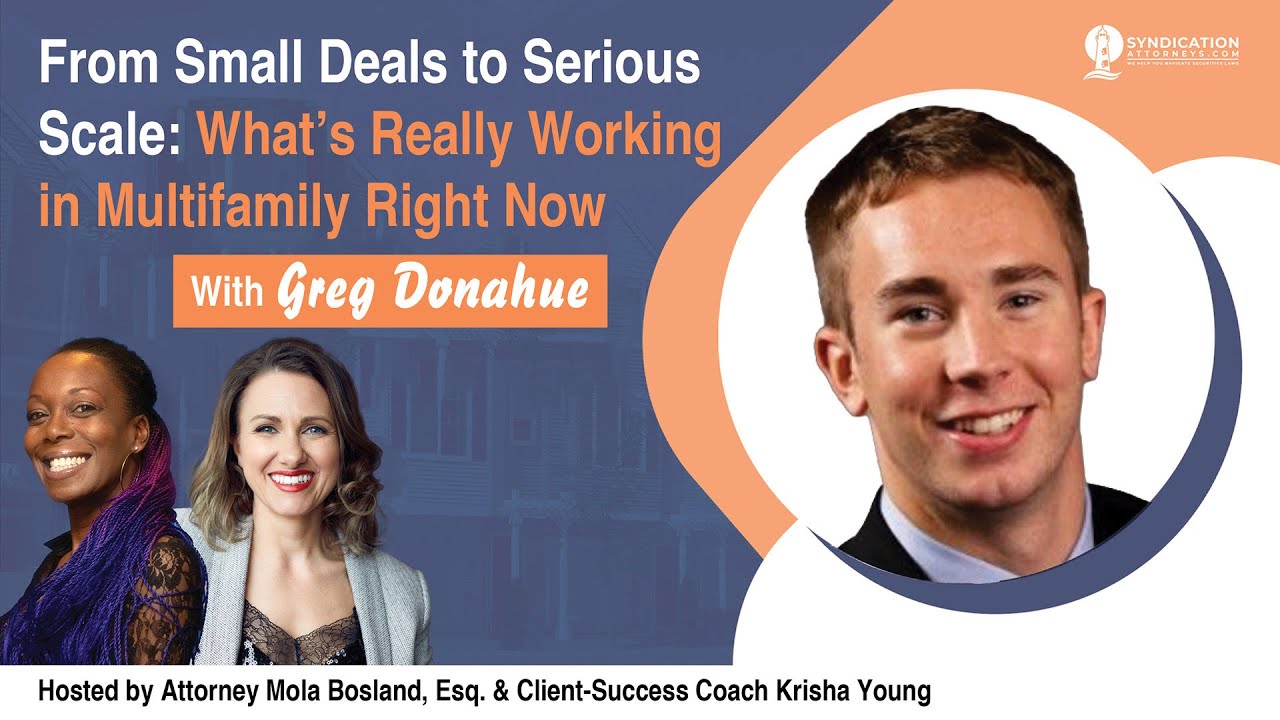
In this Raise Capital Legally podcast episode, hosts Krisha Young and attorney Mola Bosland interview multifamily investor Greg Donahue of 21 George Investors. Greg explains how his firm began by acquiring 5‑25 unit properties in New England, then expanded to larger 100+ unit deals across the country through boots‑on‑the‑ground co‑GP partnerships. The conversation emphasizes that asset management and operational systems are often under‑appreciated, yet critical for cash‑flow generation and investor returns over multi‑year hold periods. They discuss current investor expectations—7‑8% preferred returns, 70/30 splits, and a shift toward longer 5‑7 year holds—as well as the importance of conservative underwriting to build trust. Greg outlines common scaling mistakes, such as neglecting asset‑management oversight and failing to adopt an entrepreneurial mindset. The episode also covers practical syndication considerations (deal size, liquidity needs, building a track record of managing other people’s money), the necessity of consistent investor communication, and how the post‑COVID market has moved from aggressive pricing to more realistic buyer and seller expectations. Finally, they share advice on networking, leveraging educational programs, and finding investors, while providing contact information for Greg and the Syndication Attorneys team.
Chapters
Hello and welcome to the Raise Capital Legally podcast and YouTube channel, your go-to source for insights on raising capital the right way. We dive into topics that matter most to real estate syndicators and fund managers with live Q&A opportunities before we wrap up. I'm Krisha Young, your co-host, Business Development Director, and Client Success Coach at Syndication Attorneys, and joining me is attorney Mola Bosland, one of our esteemed senior securities attorneys at Syndication Attorneys. Now, before we get started, please note that audio and video from this event will be posted on our podcast platform, YouTube channel, website, and social media, and will be made available to the public. You can go ahead and ask questions at the end of the broadcast by raising your hand or typing it in the Q&A. And please note that information discussed during this event is of a general educational nature and should not be construed as legal advice. So today we've got From Small Deals to Serious Scale: What's Really Working in Multifamily Right Now. In this episode, attorney Mola Bosland and Christian Young sit down with Greg Donahue to unpack what's actually happening in the multifamily market after the post-COVID slowdown and what operators should be paying attention to now. Greg shares how pricing has reset, where deals are finally penciling again, and why smaller operators with strong local partnerships may be better positioned than ever. They dive into Gregg's strategy of focusing on 5 to 25-unit properties in New England while scaling into larger assets in other markets, the importance of true boots-on-the-ground asset management, and why many sponsors underestimate what it takes to operate well over a full hold period. The conversation also explores investor return expectations, preferred returns, split structures, and why chasing headline returns can backfire in today's environment. Hello, Mola. Hello, Gregory. How are you?
Hello, Tricia.
Hello.
Hello. Hello.
Well, I'm very excited to be here today, and I'm really happy to get to talk to you, Greg, since we talk, you know, normally when it's about deals. So now it's more background information. So since I already know you, how about we let the audience get to know you a little bit better? So why don't you tell us a little bit about yourself? and your real estate investing company.
Yeah, awesome. Thank you, Krisha and Mola. Great to get on this podcast with, with both of you. So yeah, I'm Greg Donahue. My company is 21 George Investors. I am in Boston, Massachusetts, big Boston sports fan, looking forward to the Pats game this weekend, back in the playoffs. Started investing in real estate back in 2014. I had no prior real estate experience. I got— my dad actually nudged me into joining a Real estate multifamily educational program and had no real estate experience before that. Hadn't even bought a single-family home, nothing. So, really just used that educational program and networking group as my foundation to start this real estate company. We started by buying small multifamily properties in secondary cities throughout New England. Mainly between 5 and 25 units. And since then, we've expanded through partnerships in other parts of the country to get into larger 100+ unit deals and syndications.
Nice. You know, it's always good to watch people scale up, you know. So I know that your team, you know, focuses on 5 to 25 units in the New England area, and then the larger assets, you know, elsewhere. Um, why that split? What changes operationally as you move up in like the unit count?
Yeah, I mean, I would say we started with the 5 to 25 unit properties in New England because that's what we were comfortable with. Again, being from Greater Boston, um, you know, a lot of these programs coach you to go for the, you know, 200 unit properties in Texas. Uh, you know, I had never bought a property before and I also had never been to Texas, so like How am I going to do that? So, it was just the natural starting point was something I'm comfortable with, something I can drive and check out personally. I don't need to buy a plane ticket. So, I just started by acquiring a 5-unit property about 15 minutes away from where I lived at the time, again, back in 2014, and started scaling up there. And we kind of created our business model around the 5 to 25 units throughout New England. And we were, you know, fairly successful at doing that. But as we grew and the market matured, we started to get priced out of the market a little bit. The deals weren't penciling quite as much. So we decided to expand into other markets across the country with boots-on-the-ground partners in those markets. And then naturally, as you have a partner, you can kind of go after bigger deals. As well. Um, so that's what kind of got us into the larger deals in the other markets.
Awesome. Okay, so, well, you did mention boots on the ground, right? Um, and so, you know, what breaks first when the operators try to manage properties that are remotely, like, without having a strong local partner?
Yeah, I mean, I, I think, you know, you implement the third-party management company, and again, I had no real experience, you know, with real estate before joining an educational program, you're kind of, you know, my understanding was, oh, you put the third-party management company in place and you're all set. You're pretty much a passive investor. But I learned pretty quickly that that is not the case. Um, so we bought some properties outside of New England and we really had issues with our third-party management company. Here I am flying down to Alabama, you once a quarter, multiple times a quarter, sometimes staying in a sketchy Motel 6 for 2 weeks at a time to oversee the property management company, try and get them right back on track. Next thing you know, you're firing a management company, bringing the next one in. So, after that experience, we realized if we're going to be investing outside of New England— meanwhile, we were having a lot of success with our New England properties. Because we're here, I can jump in my car, drive by the property, make sure everything's going well. So we kind of built that into our model rather than focusing on the market. I mean, we still obviously do our homework on the market, but really emphasizing the co-GP boots-on-the-ground partner first in building that relationship, strong relationship and strong partnership first, so that when you do have those operational issues at your property, you have someone in that market that knows what they're doing that can be there, you know, driving distance away. So that's kind of why we really implemented that into our business model.
Okay. Well, how about you give us a little insight on, you know, structuring those relationships with the co-GPs and the local operating partners, especially those markets outside of your area?
Yeah. So, I mean, we definitely, Try and partner, or I mean, first and foremost, it comes down to building a strong relationship over time, you know, not just meeting someone once at a conference and jumping into a deal with them, you know, building a relationship over time, making sure you have shared values, you can trust them, you communicate well with them. But it's also finding someone with a complementary skill set. I'm definitely strong with financials, underwriting, bookkeeping, reviewing ongoing financials on the asset management side. Working with the accountant, you know, making sure we're hitting our KPIs from a financing— financial perspective. So when we're partnering with somebody, we're looking for someone with more of a good, you know, construction management background or renovation who can drive by the property, make sure the units are getting renovated correctly, make sure the CapEx projects are going well, and just having those clear roles. So when you jump into a partnership like that, you understand who's doing what. Hopefully that's everyone's role is within their strength and just kind of outlining those roles so everyone's, you know, in a good position to succeed within the partnership.
And I like how you said that, right? I talk about that with our clients all the time that are talking about partnering with other people. You know, you need to find partners that are strong in the areas that you are not strong, right? You got that comes together and brings together a good working relationship. You know, it's understanding your own strengths, your own weaknesses, what you're looking for in a partner, things like that. So, you know, it's really good to hear you say that's how, you know, you've put together your structures with other, you know, co-GPs in the area, you know.
Yeah.
Um, well, I know like many sponsors do focus heavily on, you know, the acquisition part and the raising capital. You know, that's all everybody ever really focuses on.
Yeah.
But, you know, what happens about the asset management? Like, why do you think it's still so underappreciated in this business?
Um, I just think it's not as fun to talk about, you know. No one really likes to do it or really wants to do it, but it's such a huge part of this business. And I think a lot of the people that succeed over time are the ones that really focus on the asset management and oversight of the property and implement systems where they can continue to scale. And that's not to say, I mean, we work with third-party management companies on all our properties, but we still utilize that boots-on-the-ground partner to oversee them because we've had good, bad, ugly experiences with property management companies. So you just have to be prepared for everything. And I think everyone wants to talk about the acquisition side, finding the deal, closing on the deal, You know, celebrating after you close the deal. I mean, that's kind of the fun part, you know, talking about, you know, renovating units and, you know, dealing with the maintenance issue. Like, that's not fun to talk about, right? But it's a huge part of the, of the, of the industry, of the, of the business. So, you know, it's, it's You know, something you really need to focus on and spend time on.
Well, isn't that where the money's been made? That's where the money's being made.
Right.
Right.
And if you're not paying the money, right?
I mean, the whole point of it is to make money.
Yeah.
You know, the cliché is, you know, the, you know, the money's made when you, you know, when you buy the deal, you know, saying like, oh, you know, we're getting such a great deal. You know, that's when you're making all the money. But I mean, that's, I guess, partially true in a way, but you still have to operate it for 3, 5, 7, 10, you know, 10, however long your hold period is. And you still have to execute your business plan. So, you know, it's, you know, the money's not just made when you buy the property, it's made throughout the operations as well.
Yeah.
Very, very true, right? 'Cause, you know, how do you get tenants to wanna come back if the building becomes shabby and nobody's cleaning it and no one's taking care of it? Who's gonna wanna pay rent to live there? Exactly.
Yeah.
That's a major portion of it for people to still want to live there.
Yeah, exactly.
Also, like, when you're syndicating, You've got investors, like there's, there's payments that are continuing throughout the duration of the fund that, you know, are reliant on this, this part being done well.
Right. Yeah, exactly.
No tenants, no money.
Exactly.
Yeah, yeah. I mean, a huge part of real estate is the cash flow distributions, and a lot of reason why people want to invest with you is because, because of the cash flow. Um, and if you're not operating the property well, Even if you get lucky and you hit the market at the right time, you buy low and the market appreciates like we saw a few years ago and everyone was making a ton of money, but that still doesn't solve for the cash flow issue. You still need to operate the property well to give those cash flow distributions. And it's very rare to hit the cycle like that where you're just going to make money no matter what you do. But you definitely don't want that to be your business plan. Timing a market is not a business plan. That's just You know, luck in a lot of ways.
So, yeah, you know, um, you know, we've helped you with quite a few of your deals, and we know that you typically target like a 5 to 7 year hold, you know, with a 7% preferred return and about a 70/30 split. How are investors' expectations evolving around this current market?
Um, yeah, I mean, I think, um, They're definitely, I think, more open to longer-term holds, or that's something we're trying to push out there a little bit more. I mean, we've always kind of done the 5 to 7-year hold where I think a lot of people typically wanted the 3 to 5, nothing longer than 5 years. I think investors are starting to become more open to the slightly longer-term holds. And investor expectations, I mean, I think, to be honest, I think they've kind of stayed the same. I think, you know, the 7-8% preferred return is still pretty market. And, you know, just making sure you're hitting those returns and giving those cash flow distributions. So.
Okay. Let's see. So, you know, we've Talked about the investor expectations, you know, the longer thresholds. What are you most interested in exploring going forward and why?
Yeah, I mean, I think just continuing to do what we're doing and get more consistent at it, hopefully see the deal flow pick up a little bit more, you know, prior to 2020, you know, 2020 2024, we didn't really see much activity on the acquisition front. 2025, we had an acquisition. So, you know, that was, that was big to kind of get the, you know, get the acquisitions back in, back in motion. And I'm hoping we can kind of continue to grow more in 2026 and moving forward. And yeah, I mean, I think maybe get into some newer Class B assets. A lot of what we've been doing is Class C, which we're still open to. I know a lot of people are kind of pushing away from the 1960s, 1970s assets. We're still open to them if the numbers make sense, but it would also be nice to get into some newer assets as well. So yeah, definitely just trying to scale a little bit more, a few more acquisitions moving forward, and maybe get into some more Okay, okay.
Let's see, you know, we kind of field calls all day from people that are interested in starting syndication and learning more about syndication. But, you know, we have started to see like a lot of market noise around that 18 to 20%, you know, returns. How do you balance honest underwriting with competitive investor messaging?
Yeah, I mean, that's tough. I mean, because underwriting is so easy to manipulate that you can change one little thing. You know, if your deal is penciling at 16 or 17 and you're like, oh, I need to raise this money and I need to really get to that 18, you know, it's so easy to manipulate it to get there. But I think it's just sticking to, you know, at the end of the day, you need to build trust with your investors and it starts up front. You know, just putting something in front of them that you feel you can achieve. And you're not, you know, like I said, a lot of this, you know, the acquisition part of this deal, of this industry is the fun part, you know, finding the deal, closing the deal. But you have to have a longer mindset and, you know, you know, in your head that, you know, once you close the deal, that's actually just the starting line. You know, that's not the finish line. Once you close the deal, That's essentially the starting line because you have to operate the deal. So if you're putting— if you're trying to enhance your numbers a little bit to raise all the money, just remember you're going to have to meet those projections once you close on the deal. So I think it's just sticking and building trust with your investors because you want them to invest with you again. So I think You know, I hate saying I underwrite conservatively because everyone, you know, underwrites conservatively. But, you know, just sticking to your numbers.
They should.
Yeah, they should. Yeah. But, or they'll tell you, you know, they'll tell you. So will I. So I guess I'm just like everyone else. But, but yeah, just sticking to your numbers, investing based on your, on your, your numbers, and, you know, building trust with your investors so that they'll Um, you know, continue to invest with you.
Definitely. Like, I know that I've had that conversation with, you know, clients and potential clients about their projections and about sometimes their numbers are not realistic, right? And, you know, I think that when people see like these really grandiose returns, like your projections, um, you know, I, I Think of 2— people are looking at it 2 ways. One, the syndicator doesn't know what they're doing, so they're going to be able to take advantage of that syndicator. Or 2, it's a scam.
Yeah.
So it, you know, it's either like, oh, you're another Bernie Madoff, you know. Um, it doesn't look realistic when the returns are just ridiculous. Like, I've had somebody come before and they're like, yeah, we have like a 40% return. I'm like, where? How?
Yeah.
How? You know, um, can you explain that to me? So, you know, you gotta balance that out with investors' like expectations and be, you know, so I don't feel there's anything wrong with conservative underwriting. Like, if you, if they were to get more than what you projected, oh my God, you're amazing, you know. But as long as you're realistic in the game and truthful, people will, you know, more gravitate towards that. That is, you know, what I you know, have seen from, you know, doing this for a while.
Um, yeah, just to piggyback on that, I feel like investors that are flipping straight to the return section of the pitch deck, like, that's not, you know, it starts with the team that you're investing with. How many full-cycle deals have they done? You know, are they a credible team? Um, what's their backstory? What's the story behind the deal too? If you can get a 40% return on a deal, you know, why is that? You know, that, you know, which, um, you know, you need that backstory on the deal, that history. There's got to be something, you know, special way that you found the deal, or—
Right, like, how did you— yeah, so how did you come to those— that this conclusion? Like, where did you get these numbers from? You know, um, I, I have— I, I've asked those questions. I was like, you know, how did you break this down? Because I've had I had a potential, like, investor before that got documents that showed a really high number, and it was only in the, you know, in the pitch deck. And so they wanted to know, like, where is this stated in the documents? Is this money guaranteed? You know, I, you know, if this is what the returns are, yes, I want to do that. But where are they in the documents? I didn't see that in the documents. And I'm like, well, they're projections and assumptions.
Yeah.
They're not necessarily, like, you know, definitely what you're going to get. But you might want to ask some of these questions and give them a laundry list.
Yeah.
But you have a financial background, right? But it's largely self-taught. And you didn't start in real estate. Your dad kind of pushed you in that direction. But how has that shaped your approach compared to more traditional sponsors?
Yeah, I mean, I would say there's probably a lot of sponsors like us as well, you know, but again, just very numbers-driven and not necessarily future-focused. We're not going to invest in a deal and say, oh, you know, we think it's going to be all sunshine and roses in 5 years from now, so we're going to drop our exit cap, you know, and that's going to be where we can get to the 20%, you know, return to our investors. We just underwrite everything based on what we're seeing today in the market. And yeah, and just using our numbers on that, we're not trying to have aggressive market rent increases over time because, I mean, really, you can't predict what is rent growth going to be in 3 years. Like, really, no one really knows. You can look at some CoStar reports or whatever's out there to try and come up with an idea, but They're not always right either. So just kind of underwriting based on today's numbers and expectations. And we've probably missed out on a lot of deals. I kick myself, especially, like I said, I got started in 2014. I think between 2016, '17, '18, I mean, I definitely missed out on a lot of deals. There's a lot of deals I look at and I'm like, damn, if we bought all those, I wouldn't I wouldn't be maybe wouldn't be doing this right now, but but yeah, we missed out on a lot of deals. You know, we definitely missed out a lot of deals. But I mean, it's it's you know the price. You know you got to be conservative. You got to underwrite based on today. You don't know what's going to happen in the future. You know, just like you know the the market skyrocketed between you know, 2016 and, you know, whatever, and the interest, you know, the COVID spike and everything. But you can't predict, right? It's probably not going to happen again. And, and the market can go the other way as well. So pretty much just underwriting based on what you have in front of you and no aggressive, you know, expectations moving forward.
So. Listen, my grandmother always said what's meant for you is meant for you, right? So even though you didn't get to jump on that wagon at that time, it may not have just been meant for you. You don't know what other issues they may have had in the background. They could have made the money, but yeah, yeah, they had to probably jump through some hurdles, you know.
Yeah.
You know, but when you're talking— right, you know, but you were talking about, you know, '16, '17, the numbers, you know, were high. Like, I mean, there were deals out there. Yeah, but a lot of the pricing was very unrealistic. Like, and you're seeing some people pay for that now in this market, right? So How do you think today's buyers' mindset really differ from, you know, what you were seeing maybe 5, 6 years ago?
Yeah, I mean, I think you're seeing— yeah, I mean, I guess it's tough. I mean, I think that post-COVID boom when interest rates dropped, I mean, people were buying everything, you know, throwing ridiculous prices at stuff. I think people have kind of learned from that. Being more— I think the market's weeded out some people. I think the people are being, you know, less aggressive with their underwriting and predictions moving forward. So I think just more realistic buyers. And now I think the sellers are starting to slowly get a little bit more realistic as well, where, you know, for a little while they still wanted that kind of peak of the market price, but buyers weren't willing to pay for that. So there is a little bit of a stalemate between buyers and sellers. I think we're seeing sellers' expectations become a little bit more realistic. I think buyers, you know, just need to be patient and, you know, you know, invest in the deals that make sense. And like I kind of mentioned earlier, you're seeing a lot of groups pivot towards you know, 1990 or newer assets. I think that's changed, um, a bit in, in the recent years, whereas before people were buying, you know, any, you know, any property that, that they thought made sense.
So.
Definitely, you can see, you can see the shift because, you know, uh, right post-COVID, everybody was like dashing to get into real estate. I'm gonna be— I'm an investor, I'm buying this, I'm buying that, I'm, you know, I mean, it was an influx in the market. There were some really high prices. People were paying whatever just to get their foot in the door. And then in the last 2 years, you started to watch it really taper off. There was no meeting of the minds anymore between the sellers and the buyers. Things were just kind of stagnant.
Yeah.
Now you were really picking and choosing what were the best options and what are the best deals to move forward with. Um, so you really started to see that more in the last 2 years, um, especially with the interest rates had been really high. So yeah, it didn't— you know, not every deal made sense. And that is something that we've always talked about with our clients, um, about the viability of your deal, right? Because it may always sound good, but it might not be good once you get it on paper. And it might not, you know, it could, it might just be a flop, you know. So those are things that we always tell people to look out for and, you know, really to decide how viable is the deal.
Yeah, yeah, definitely.
Let's see. So, so you have, you know, scaled up and started getting involved in larger assets, you know. So for their operators out there that are looking to scale, you know, from smaller properties to larger assets. What mistakes do you see most often?
Yeah, I mean, I would say the big one is not having— I mean, for us, again, it was not having the boots-on-the-ground partner in some of the first deals we did in other markets and just saying, oh, here's our third-party management company, they're going to take over everything, I'm going to go focus on finding the next deal now. So I think, again, the biggest mistake is not paying enough attention attention to the asset management and putting your asset management systems in place, uh, to, to manage your properties after you acquire them. Again, I think a lot of this business, especially a lot of the educational groups out there, are all just, you know, the fun part, the, the acquisition part of the, of the business, uh, but don't spend as much time on the asset management. So putting those systems in place to you know, have your third-party management team but oversee them as well and make sure you're— you have your asset management systems in place. And then also another, uh, you know, another thing I see is that like, you know, we're building— at some point your mind should need— your mindset needs to shift from investor to entrepreneur. You're building a business when you're buying. If you're just investing in one deal or just buying one deal, You know, you're an investor. But as soon as you start buying multiple deals and start trying to repeat it, raise more money, buy more deals, manage more deals, you know, you're, you're building a business.
Yeah.
So you have to set up those systems internally to, to handle all that as you continue to buy properties, continue to underwrite properties. You know, a lot of people will buy one deal and they'll, you know, another thing is, you know, they'll buy a deal and get sucked too much into the the operations of that property, and now they don't have the opportunity to go buy more properties. So it's kind of like setting up those systems to asset manage and acquire more properties. Um, and, uh, yeah, so I think that's a big one. And also understanding what going big means. You know, a lot of— you go to a lot of conferences and everything, everyone says go big, go big, meaning buy a 200-unit property, you know, go for the bigger assets. But going big is more on the enterprise level, the business level. Like, if you set up your systems where you can consistently buy 24-unit prop— you know, 20-unit property, 50-unit property, 12-unit property— just can, you know, can, uh, keep buying them and you have those systems internally. I mean, that's, that's going bigger than just buying one 100-unit property, you know. So it's kind of really understanding that going big is kind of on the business side of, of this, and it doesn't mean just buy one big property and then you're done. It's setting up the systems to continue continuously acquire properties.
Definitely. So see, the mistakes can also just be advice and what not to do, right? But When you were talking just now, you're talking about some people have just bought, they'll buy one property and then they kind of feel like they're underwater. So how do you decide when a deal is no longer making sense to pursue, or even if you've already invested the time and the money into it?
You mean like on the acquisition side? If I'm like, we haven't acquired it yet?
How about both? Because we're seeing, listen, We've got— you've got people out here in the market that, you know, learning about deal viability, but then you've also got people in this market now that have already did the deep dive, and you do have some assets that are now in default, right? Their foreclosures are ticking, upticking now because of things that have happened post-COVID. So what would you do in either situation? Like, how do you make that determination in either situation?
Yeah, I would say it kind of comes— for me, it kind of comes down to the same thing. I would say on the acquisition side, if we haven't bought a property yet and we're looking at it to buy it, it would be, you know, do we have the team in place in that market to handle this type of project? Say it's a heavy lift, you know, do we have the team in place? Meaning, kind of, again, probably the boots on the ground partnership. to handle this project? And are we confident we can handle this heavy lift? If we don't have the team in place in the market, then we'll probably just pass on it. But if we do have the team in place, then, and we feel like we can handle it and hit our returns and execute our business plan, then it's like, all right, let's go for this. And then, of course, it's the price. If it gets bid up, then obviously there's a point where you just, you know, you move on from it. But assuming you're getting it for the right price, it's do you have the boots on the ground? Or for me, it's do I have the boots on the ground team in that market that can, you know, execute this business plan? Then if you already own the property and it's a struggle, you know, you're struggling with it, you're not hitting your projections. You know, I would say, you know, how if it's causing you— if you're not hitting your projections, but it's not causing you too many headaches, meaning you've kind of finally solved the issues and it's slowly moving in the right direction, even though it's not hitting the projections you originally wanted, you know, maybe you can keep that. Hopefully, you know, hopefully it works out in the end. But if it's still causing you headaches, it's underperforming, It's caught, you know, it's spent, you're spending all your time on it, you know, probably just at some point you have to move on to it and, you know, spend your time looking for another deal.
Okay. I like that advice. You know, everything is, it's all a full cycle, right?
Yeah.
So it's, you know, the work that you put in the beginning and it's also the work that you put in after. Like you said earlier, you know, closing on the deal is actually just the Starting point, right? You have to do all these other things in the background to keep the deal moving forward, right? And keep the asset cash flowing and making it attractive to the potential tenants, and also that it can bring the cash flow back to the investors because they've already put their trust in you. So it's all one cycle, whether it's the beginning or the end. It's all about how you maintain that throughout the life of the deal. So I think that's—
Yeah.
That's, you know, I like that. It's pretty interesting. And I like the way that you, you know, made it succinct for everybody. Um, let's see. So we know that you've had some of your biggest wins in like the New England area. What makes that region particularly attractive or challenging right now in the current market?
Um, I would say challenging, just that prices have, you know, it's hard to find new acquisitions in In at least the pockets we, we're looking in, in New England. So, um, we haven't acquired too much here recently. Um, that's definitely the challenge. What makes it attractive is just the, the, uh, you know, the market as a whole. The occupancy rate is in the high 90s. It's just a very stable market. Um, you know, we don't have any oversupply issues. Um, Population growth isn't, you know, you don't see the population growth here that you see in the Sunbelt, but it's just kind of a steady market. And you don't see the oversupply issues that you see in the Sunbelt either. It's a very steady market. We have, again, it comes for me, it always comes down to the team. We have a great management partner here. And then also, you know, I can drive by our properties as well anytime. So. Just have a great team in place. We can acquire any deal and fit that into our management systems and we'll be fine. So it just comes down to the team, I think, that we have here. And then also just kind of a nice steady market with high occupancy. And yeah, so it's just a nice steady market and we have a good team. So those are probably the 2 biggest things.
That's good. Like, I live in Florida, so I live in Florida where we have pockets that are completely overpopulated and underhoused, and then we have areas that have a whole bunch of new construction and not as much population. So, you know, you see the, the difference. But when you have a balance, I think that makes that market really strong.
Yeah.
So I think that's a good thing, you know. But, you know, so, but looking ahead, Right, into the next few years. What do you think successful multifamily operators will be doing differently than the rest of the pack?
Again, probably sound like a broken record, but focus on your operating systems, asset management. I hate making future projections, especially when it comes to, like, if you want to go on LinkedIn and see everyone's interest rate projections in the next few years or what the housing market is going to do. You know, you can just scroll through LinkedIn, get a bunch of predictions. Um, you know, again, I don't like to— you know, I try and underwrite based on today's metrics. And I think focusing on your asset management systems, your ability to manage assets, that's what really is going to help you succeed in this business over a long period of time.
I like that. It's, it's, well, it's realistic, you know. It's a very realistic and it's a practical thought and method with regards to, you know, managing these properties. Asset management and boots on the ground is extremely important and it affects every part of the deal, right?
Yeah.
From acquisition to the life of the deal to even closing on the deal, like to sell it. So, you know, because if it's not taken care of, then you're not going to meet your projections on what you hoped it would even sell for, right, at the end.
Yeah.
So all of that is just the integral part of how much asset management and boots on the ground really matters from beginning to end for the lifecycle of the deal, whether it's 3 to 5, 5 to 7, indefinite, it doesn't matter. It's still like an integral part of make— of helping achieve all of your goals.
So yeah, and I think it's just control what you can control. And, uh, you know, what is it, what's the saying, forget about what you can't control or whatever. But, uh, you know, you can't control what rent growth is going to be in 3 years from now or what interest rates are going to be in 3, you know, 3 to 5 years whenever you exit, you know, your exit timeline is, you know, you can't really control that. But you can control, uh, putting the right team in place, getting the right people to partner with, You know, over, you know, overseeing the asset, making sure you're executing your business plan. So that's what you can control. So that's where your effort, you know, should be going.
Mm-hmm. I like everything that you're saying here. And I like your emphasis on like the entrepreneurship part of it. You know, like it's a business at the end of the day, you know, and having those systems in place really has allowed you to sort of like rinse and repeat and realize some success in these assets, because you're, you've got something quite stable there within your own company that, and you're not like kind of cowboying it out, like going for that big massive unit or whatnot. Like you've started with like some steady, like asset types, and then like grew, like are growing from there, you know.
Right.
And it seems maybe a little more boring, but it's not because you're being successful and success is great. It's fun. That's what we want at the end of the day. Yeah.
How many syndicates have you done? Um, good amount. Uh, I don't know. Um, I'd say maybe close to 10-ish.
Wow, that's amazing.
Yeah, yeah, see, that's huge.
Yeah, yeah, it's, uh, yeah, it's gone well. I mean, it's definitely a longer, you know, definitely didn't expect, like, you know, I think some people kind of grow quicker, um, than maybe I have, but it's just been, I guess, slow and steady and, uh You know, hopefully to, you know, keep growing. So, um, that's, that's the plan. But yeah, it was definitely a realization on, on my end too. Like, I didn't realize, you know, when you start buying properties, you're just like, oh, you know, investing in real estate or whatever. But then over time, you kind of realize like, oh no, I'm, you know, I need to start implementing some systems to handle all this. And you kind of realize like, you know, you're building a business, not just, not just, you know.
Yep.
You know, managing a couple properties.
So you become a full-fledged business owner, entrepreneur. And I like that mindset, right? Because a lot of people just come in and it's like, oh, I invest in real estate. And then they never get past that mindset because that's all they've been thinking of, right? When you see big flashy, oh, I have $500 million assets under management, right? And that's all everybody is projecting for them. But then So they're like, oh, I want to be like that. But they don't think about how hard it was to get to that point. So that's why they always think, oh, big. I need 100 units, 200 units. Oh, I'm not investing in anything smaller than that. And I've had people say that to me before. And they're like, well, I don't think the property is big enough to syndicate. And I'd always be like, you can syndicate anything, right?
Yeah.
It doesn't necessarily mean that it has to be 100 units. We have clients that syndicate, you know, quads. You know, depending on where you live, a quad can be a couple million dollars, right?
Yeah.
People live in California, right? That's very expensive, right? So, um, I was like, it's based on, like, you have to look at the market that you're planning to invest in, um, and, you know, the experience that you want to gain from it. I go, not— it's not just a deep dive. I go, because with each syndication you learn something new, right? And you, then you can speak from experience. You learn something new with each different one that you've done.
Yeah, yeah, definitely. And especially if it's your first deal and you say it's too small to syndicate, like, the size of the deal doesn't matter. It's like, do you have the money or not? If you have the money and you can pay for it, then you don't need to syndicate. But if you don't have the money, then you have to syndicate it. So The size of the deal. And then if it's your first deal, you know, it's just a good experience anyways. You know, just learn how to syndicate the deal and learn how it's done. So, yeah, the size of the deal shouldn't matter.
Well, while we're on this, Tolise actually has this question, and we're kind of answering it right now. How do you know if your deal qualifies to be a good candidate for syndication? Is Is there a minimum number of units? I'm fairly new to investing and have a lot of opportunities come my way. So I think we've answered this question in a way, right?
It's like, it's not really about the units.
Yeah, do you need the money?
Right, do you need the money? Can you—
yeah, exactly—
close this deal out of pocket? And a lot of times what happens is that people that, yeah, they can close it with their own money, but at some point they're going to reach a cap where they're now They have no liquidity, right? So they have to start to keep growing. They're going to end up needing to syndicate at some point in time, um, because you're, you're own— taking that on financially on your own, after a while, just, it's going to hit a cap. Um, and some people do have the liquidity to be able to buy it on their own, but they want the experience of learning how to syndicate. And, um, so they look at the potential growth in the future, right? So they want the experience no matter how small the deal is. We've had people that have come to us to syndicate to raise $250,000. That's all they needed, right?
Yeah.
Um, it was all about, for those people, um, getting the experience and learning the behind the scenes and how to manage other people's money. Um, that is a Big thing when it comes to syndication, and people don't understand that. It's like, yes, you have a real estate track record, but it's more than your real estate track record that builds the confidence and the trust of investors. They want to know how well do you manage other people's money.
Yeah.
Right? Are you just going to throw it away and then, you know, the project's a flop? No, they want to be able to see that steady growth, that track record of how you manage other people's money. So people bring in small deals for it.
Exactly.
Yeah, that's a great point. Again, just kind of building your business rather than just investing in one deal. Like, that's a— the syndication is a system that you need to learn how to do it, um, go through that process. So as you continue to buy more, you kind of have that system in place. And then as you have more investors, you know, kind of there's a, uh, you know, investor communication, um, you know, system that you have to implement, you know, monthly or quarterly newsletter, uh, you know, up property updates to your investors. So you have to have, you know, if you're just buying properties by yourself, you don't need to send any updates out, obviously, because you're the only investor. But as soon as you have investors, it's about keeping them updated on a monthly or quarterly basis, providing them reports, uh, filing your tax return becomes a little bit more difficult, you know, getting the K-1s out on time. So those are all more— once you start accepting investors, those are all systems you have to implement into your business to, you know, stay on top of, you know, throughout the whole period.
Yeah, that's what I like. We've done so many of these podcasts and interviewed a lot of people. And the thing that I keep hearing over and over and over again is like that communication with investors is like so key. It's so key. It's the make or break kind of thing, you know, like if you don't, if you're not communicating with your investors, then like you're leaving them wondering what's going on. And even when something, if something's not going well or if things are going really, really well, you know, it's having that like really solid communication with your investors, you know, gives you a good reputation. And then if things do go a little sideways, they're there to support you. They're not going to be like, how come you didn't tell me about this? You know, they're gonna— it builds that trust that you were talking about.
Yeah, I would say investor communication is just below returns on, on what investors are looking for. Obviously, returns are number one, but just below that, people don't understand how important communication is and how much investors appreciate that. Um, so yeah, definitely, you know, communication is huge and, and you need to you know, stay consistent with those, you know, investor updates once you acquire a property and start accepting investors into your deal.
So, um, Talise said, are you able to syndicate non-multifamily properties? Yeah, you can syndicate pretty much anything.
Anything. So the legal definition of syndication is actually the pooling of funds for a particular purpose. Right? So the purpose was is to purchase real estate. We have clients that buy land and get it entitled and then flip the land. They syndicate for that. We have people that do office buildings, development, you know, your home home developments, whole developments, RV parks, mobile home parks. We have a whole series that we've done in a few of these podcasts on. Syndicating Beyond Multifamily. Um, so if you would like to go to our podcast page and also go to our website syndicationattorneys.com, you can find out more information on syndicating beyond multifamily.
And businesses too. Yep, yep. We're, we're seeing more business customers come through as well.
Yes.
Yeah.
So do we have any other questions out here for Greg?
I don't see any in the chat or anything, or Q&A. Does anybody— how about our attendees? Are there any questions here? Like, I was hearing— I always hear like the steps, you know, when I'm listening to our guests and like What, what is the secret to success here? And, you know, what I heard is like you started with this coaching program, you know, and that's definitely something that, you know, we as a, as a company encourage our clients to be involved in some sort of coaching program. Right. Because it really helps you understand the market. It helps you understand underwriting. It puts puts realist reality, um, in most of the programs it puts reality. Some of the programs are a little unrealistic, but, um, you know, and, um, so, and then, and then you started local and small, you know, like you just, it was like, well, we're here and this is like, this makes more sense to me and I just wanna see if I can do this thing, you know?
Yeah.
And this, you know, and we've got, and then that boots on the ground part, you know, was, was really important. And something that you would not have— I mean, you would've learned it the hard way if you had gone out of state, I guess. And so you learned it sort of like the easy way to be like, okay, yeah, it's really good having somebody like local here, you know, to be able to like property manage.
Yeah.
And then you mentioned like if you are going out of state co-GPing, so forming those partnerships, you know, is really important. important. And just building over time, right? Like, and I love that you said values and building trust and, you know, playing to your strengths. You know, those are all like core Business 101, I think.
Yeah.
Yeah.
I mean, and again, going back to the educational program, I mean, I think a big part of our growth was through our partnerships and All of them have been through, you know, the educational programs are great for the content they put out, but also it's in that you're, you're part of a community and a networking group. So that's where you meet a lot of people to help, you know, grow the business. So, um, yeah, so that's another good reason to join, join one of those programs.
Yeah, exactly. Like ours, like our mastermind. Yeah.
And it's always helpful to be able to meet people that are going through the same thing that you are, right? And learning at the same time you are. I think that's why so many people get Um, so much value out of our own masterminds, right? Um, because there are people that are in all different stages. Some people have syndicated for years, some are just starting out, but there's someone has always been where you were at some point. And, you know, they're open to be— answer any questions that you may have, or just have a one-on-one just to, you know, find out, you know, how did it go for them.
So yeah.
Those communities are Great learning tools and a support system. Yeah, for sure.
For sure. Do you have anything else you want to share with us, Greg?
Yeah, um, I think we covered a lot of it. I mean, I appreciate you guys having me on. Um, you know, I'm trying to think. I mean, yeah, I would say, I mean, just, I think it's definitely a long-term, you know, real estate's a long-term game. I think setting up those systems to continue to grow and acquire more properties over time is huge. And not just trying to make it big on one deal and not really have that expectation, I think, is very important in really just setting up your systems to grow over time. But yeah, I mean, I think we— you guys had some great questions. So I think we covered most of it. So I really appreciate it.
That's awesome.
That's awesome.
Can people reach out to you if they have any questions or they want to connect with you about any of your deals maybe? I don't know.
Yeah, definitely. What is— should I throw it in the chat or just say it out?
Sure. Yeah, sure.
Yep, either. I can type it out.
You can throw it up there in the chat. Okay. Oh, looks like there is a question.
How do you find investors to be part of a syndication? Oh, that's a big topic for another podcast. We do a lot of training on that in our mastermind. Yeah, so we have a private client Only Mastermind. If you would like to learn more about that, you can reach out to me, and— or there's a page on our website that talks about it. But we meet every week, and we've, we've got some great free bonus resources in there for people to help you establish relationships with investors, is more how we would word it, than find investors. It's like establishing those relationships and doing it legally. So, you know, we talk a lot about it in there. There's, there's a lot of ways to, to go about that. Greg, do you have any tips on that?
Yeah, I mean, it's definitely, you know, I guess, I guess for me, I'm more introverted. I started this business out of college. Most of my friends couldn't pay off their bar tab at the end of the weekend, never mind invest in a real estate deal. So I had like no network. So I just started joining the educational program, going to networking events. That was huge for me to kind of get out there and just find a few people who liked what I was doing to invest in deals. So the educational programs was a big one. And then just friends and family. You never know who's interested. You might just mention it to somebody who you don't think has any interest in real estate or investing, and they might call you back later and say, hey, let me know when your next deal is. So just kind of tell everyone about it. Local REIAs or meetups. I know a lot of REIAs are more single-family kind of fix-and-flip based, but again, you don't know. you know, who you're going to meet. So just really, you know, again, for me, the big one was definitely the educational program community I joined. But, you know, there's other resources out there, other local networking events, you know, pretty much anywhere in the country, you know, at least any major city. And then just friends and family as well. So, but yeah, it's definitely, you know, some people might, you know, if you've had a long career in another industry and you're extroverted and like sales and talking to people, you know, the money raising part is easy for you. But if you're more introverted, you don't quite have the network, then it's a little bit tough. That's not to say you can't do it. But, you know, you might want to meet someone who's more salesy and, you know, develop a relationship and partnership.
So that's what we did. Find yourself an extrovert.
Yep. And that's where the partnerships come in, right? Where we were talking about it earlier, it's not just with like co-GPs, it's some people build that out with their management team, right? If you know what your weaknesses are and your strengths are and their weaknesses and strengths are the opposite of yours, you may just make a really good team and you find somebody that likes to talk to people. And there are lots of them out there. They love to talk to people, chit-chat.
Yeah, for sure. I'm just gonna read out the information here. So we've got G Donahue, H-U-E, at 21georgeinvestors.com and LinkedIn Greg Donahue, Instagram 21 George Investors. That's where you can find Greg. And then I put my email address in there as well, Krisha, K-R-I-S-H-A. syndicationattorneys.com. You can come through me and I can connect you to whatever you need in our team, in our company. Yeah. Oh, and www.21georgeinvestors.com. George Investor, 21 George Investors, like, what's— that's a unique name.
Yeah, so it's a, it's a street name in Lowell, Massachusetts, where I grew up. I don't know if anyone's from Massachusetts on here, but grew up in Lowell, I grew up in Lowell, Massachusetts, and my grandfather owned an office building in downtown Lowell, which was not economically thriving. If you know Lowell, Massachusetts, especially in the '80s and '90s, it was not a place where you really wanted to own a downtown office building. But he owned it and it was on 21 George Street, Lowell, Massachusetts. And my dad managed it for a while. And then they eventually sold it, but we kept the name as, you know, 21 George Investors. So that's where we got the company name from. So it's a little family, you know, value to it, I guess. And, and now I get confused all the time because my name's Greg and the company's George. So everyone calls— I get called George a lot.
So I know I was— it was twisting in my mind too. I was like, wait, what?
It's—
yeah, right.
Yeah, but I love that. It's, it's like, like a sweet little homage to your grandfather and, yeah, you know, the original, the OG investor.
Yeah, yeah, exactly.
Oh, let's see, let's see. Anybody else have any questions?
I don't see anything else in here. Well, we're almost at time anyway.
Yeah.
Yeah.
I think we've covered a lot here today.
Yeah.
Yeah. Like if I were to conduct a podcast, you know, we would cover these main points. Yeah. Thank you so much. And well, if anybody wants to learn more about what we do, We're syndication attorneys and we prepare offering documents for people who are looking to raise capital in real estate or business. We've got a team of really amazing, super tenured securities attorneys on our team. We've got a great back office team as well to support each other. I'm on the team doing business development And yeah, we just love our clients and we love the entrepreneurial mindset and everything that goes along with this. And we really love to partner with our clients, so we're not just some document mill that comes in and, you know, whatever. You know, we really want to partner with you and really want to understand your deal and really want to help you become successful and help you understand what, what the— everything, um, you know, is involved in raising capital in this way. And we love having fun. We've got our mastermind community and we meet every week, and we've got like some really great questions and conversations that happen on there. Um, and yeah, we've been, we've been around the block, uh, for quite a while. We've got 2 best-selling books Um, this podcast and, uh, yeah, a great website with lots and lots and lots of resources.
If you need a referral, I've worked with them multiple times and they do a great job, great to work with. So definitely highly recommend them.
Thank you.
Thank you.
Wonderful. All right, Greg, thank you, Mola. Thank you everybody who's been here for your questions and all of that. And And yeah, we'll see you on the next episode.
All right.
Bye. Bye for now.
Appreciate it.
Thanks.
Bye.
Thanks.










