How to Be Successfully Unemployed with Real Estate With Dustin Heiner
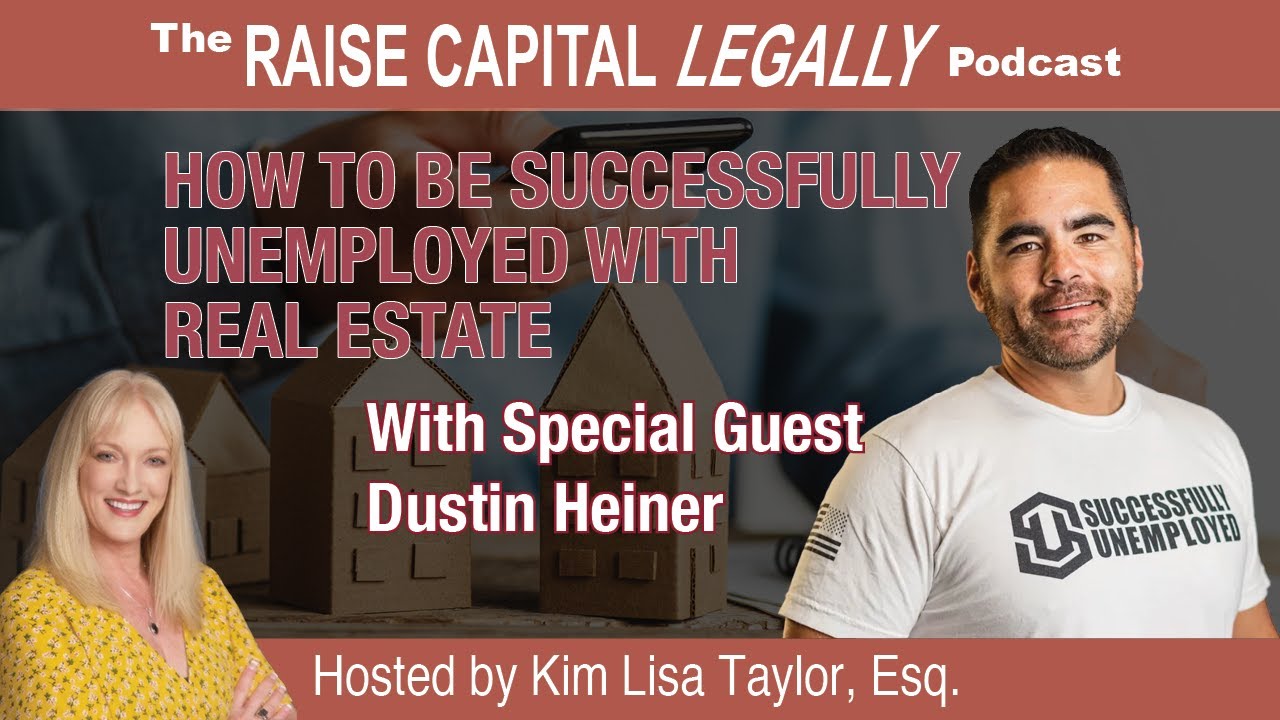
In this Syndication Attorneys monthly podcast, attorney Kim Lisa Taylor and co‑host Krisha Young interview real‑estate investor and educator Dustin Heiner about achieving financial independence through rental properties. Dustin shares his personal story of being laid off from a risk‑averse government IT job, realizing the need for self‑generated income, and building a portfolio that now exceeds 30 single‑family units and includes hotels and syndications. He explains his "successfully unemployed" philosophy, emphasizing cash‑flow over appreciation, a $250‑per‑month passive‑income target per property, and the importance of building a business infrastructure (market selection, vetted property managers, mortgage brokers, insurance agents) before acquiring inventory. He outlines a variety of financing methods—including conventional mortgages, DSCR loans, private and hard money, signature lines, and even credit‑card funding—highlighting creative ways to acquire deals without large cash reserves. Dustin also discusses his educational ecosystem: multiple books, the Master Passive Income podcast/YouTube channel, free courses, and the upcoming RubCon Real Estate Wealth Builders Conference, a no‑sales‑pitch event aimed at community building. The conversation repeatedly returns to mindset shifts, overcoming fear, the servant‑leader approach, and the goal of creating generational wealth and a service legacy for his family. Practical advice, resources (freebook URL, conference site, promo code), and actionable steps are provided throughout.
Chapters
It's not that right now. Hello, welcome to Syndication Attorneys' free monthly podcast and YouTube stream where we talk about topics of interest to real estate syndicators and fund managers with an opportunity for live questions and answers before we sign off. I am attorney Kim Lisa Taylor. I would like to also introduce Krisha Young, our co-host and business development associate at syndicationattorneys.com. Before we get started, please note that this event is both recorded and will be put up on YouTube and will be used for future promotion, posted on our website or in a broadcast available to the public. You can ask questions at the end of the broadcast by raising your hand or typing your question in the Q&A. Information discussed during this free broadcast is of a general educational nature and should not be construed as legal advice. Today, what is our topic today? Krisha, you have that handy?
Yes.
It's how to be successfully unemployed with real estate. And we have our esteemed guest, Dustin Heiner, here with us. And the reason I invited Dustin to join us is because I met him at an event and he was wearing the shirt that he's wearing today saying successfully unemployed, which of course is very intriguing. Mine actually should say unemployable. I'm self-employed. I'm a little too outspoken to, uh, yeah, bosses don't like that. I've learned many, many times. So I learned that I needed to be self-employed. Um, but anyway, Dustin, thank you. Uh, welcome to our program and, uh, thanks for, thanks for coming.
Hi, Kim and Krista. Thank you so much for having me on the show. Yeah, this is fantastic. I love being able to Well, it's really real estate investing is like, it's just amazing because it's not like real estate itself. It's what it affords me to do in my life. I literally don't work a job. I love the term successfully unemployed. Basically found a way to provide for myself and my family without working that dead-end J-O-B. I call it, you know, J-O-B, just over broke, is what you're living every time you're working that job. And so now I just, you know, have my coffee in the morning, go to the gym, hang out with the family, and come on podcasts and talk to great people like you. So thank you so much for having me on the show.
Wow, that, that's— well, that sounds like an amazing life. I'm pretty sure a lot of the guests that are on the show today, and we have quite a few people who've come to listen to you, I'm sure a lot of people want to hear the secret sauce on how they can do that too. So tell us how you got your start in real estate investing.
Yeah. So I, like every single person, like literally ever, we're always taught to basically, you know, work a job. But this is the process. And I went through the exact same process. So you go to school, you get good grades, and then you get those good grades and you go into a college or university and you get thousands and thousands of dollars into debt. And then you also get a piece of paper and you try to go with that piece of paper called the degree and you try to go get a job and get hopefully a quote unquote career at someplace and work there 40+ years of your life and then retire at 65, 70 years old and then try to live on what you managed to save that entire time you're working that just over broke job. Well, I'm doing that exact same thing, and I actually got a job at a local county government in California doing IT, like technical stuff. Very— the most risk-averse job you could ever think of. But at the same time, I've always been entrepreneurial, always loved the idea of starting businesses, owning businesses. And so when I was young, I had a newspaper route. You know, you ride on a bike and you— 5 AM, you throw on newspapers and bang them on garage doors, waking people up. I had a graphic website design company. I had a skateboard manufacturing business, even started a pizzeria and a convenience store from the ground up, built those. But all the time working that just-over-broke job. Well, this is what really shoved me into real estate investing. So at the time I was investing, I bought one property, one rental property that made me a minimum of $250 a month in passive income. I bought one property. I said, this is amazing. I didn't do any work other than buy the property. And I have experts do the work for me. I need to get more of these. But you know what happens? Life gets in the way. And as I started having my, you know, got married and started having kids, and I stopped investing, which was the bad thing. But here's what happened. So my wife and I started having child after child. Eventually we had our 4th child and I went on paternity leave. That's where the dad stays home with the mom, changes poopy diapers and all the good stuff. And well, after about 2 weeks, I go back to work. And in that same week, I go back to work on a Friday at 3:30 in the afternoon. I get a call from my boss's boss's boss's secretary, like the top dog. And she says, Dustin, would you please come to the office? I said, sure. And then I hung up the phone and I paused for a second. I thought, why in the world are they calling me to the office? Like, this isn't normal. And I've seen plenty of movies. Friday at 3:30 is not a good sign. Well, as I'm sitting there, I remembered about a month or two before I went on paternity leave. There was some rumors or some rumbling going on in the office that there could potentially be layoffs. And I immediately shook it off. I said, there's no way. I've got 12, 13 years seniority here. My bosses think I do a fantastic job. And with that, I decided that it's— everything's gonna be fine. So I get up and I walk down the hallway to my boss's office. Now, this hallway isn't very long. In fact, it's kind of short. But every single step that I took, it felt like the hallway got longer. And longer and longer, and it felt like my feet became lead bricks because it started weighing on me that I could potentially lose my job. Well, I get down the hallway and I turn the corner and I see my boss's door. His door is closed and I see his secretary there, super sweet, nice old lady, and she says, Dustin, go ahead and have a seat. And I'm looking at her and she's kind of consoling me with her eyes. She's trying to, you know, kind of, because she knows everything about what's going on. I know nothing about what's going on. She's trying to console me and she's sheepishly grinning at me. So I go in and take my seat and I sit down and I start thinking about my life. If I get laid off right now, if I lose my job, that entire plan that I've been told from the very beginning, did I just waste my life doing this? And then realize, oh my goodness, I just, we just had our 4th child. If I can't feed my children, does that make me a failure as a father? Does that make me a failure as a husband, as a man trying to provide for his family? Well, as I'm sitting there, my hands get all clammy, my forehead gets all sweaty because the nerves of everything is crushing down on me. Well, the door to my boss's office opens up and out walks a coworker of mine, a lady coworker, and she said— she's walking by me and she has a piece of paper in her hands. She is noticeably distraught. She's noticeably upset. She's not necessarily crying, but you can tell her world's absolutely been rocked. Well, she passes by me and my boss says, Dustin, would you please come in the office? So I get up and I go into his office and I get laid off. And remember, this is the government. Nobody ever gets fired or laid off from the government, but I did. And the reason why I tell the story is what I learned after. So I took that layoff notice and I went back to my desk and I sat there and I realized 2 things sitting there. Number one, I need to get another job. I need to be able to provide for my family. So I was really blessed, pray to the Lord, to find another job in the same county. A different department wasn't having the same budget issues. So check, got that. The second thing, while I'm sitting in my chair just getting laid off, I realized I need to make sure this never ever happens to me again. I didn't make sure that this never happens where somebody could take away my ability to feed my family. Well, right then and there, I realized life got in the way. I needed to make sure that never happened. So every time, and I told myself anytime anybody would ask me the question, Dustin, what do you do? I would normally reply, well, I work for the county doing technology for the county. But I'm basically replying and projecting out to the world that my value comes from my job. No, my value doesn't come from my job. My value comes from my God and from myself and from my family. So right then and there, I made a firm commitment that every single time anybody would ask me that question, I would reply, I am an investor. I'm a real estate investor. And right then and there, that mindset changed because I realized that nobody could ever pay me what you are worth. So everybody listening or watching this, you need to realize that You are not being paid what you're worth. If your boss paid you what you were worth, they would actually go broke and you would actually make so much more money. So nobody could ever pay you what you're worth. So let me fast forward the story. So this new job started buying property after property after property, each one making me $250 a month in passive income. And this is generational wealth that I will literally give these properties to my kids. Eventually, I had 30+ properties. I realized, Even though I'm making $75,000 a year at this job, I'm losing money here. So last part of the story, I went to my new boss, good boss and all. I said, "Hey boss, I'm laying you off. Like here's your layoff notice." And we laughed, and he jokingly laughed. And he said, "What are you gonna do?" I said, "Well, I don't have to do anything. I literally own real estate. It makes money for me without even working." So the last part of the story, I I usually walk to and from or walked to and from my job. Every day, a mile and a half every single day. I've done it a thousand times. Well, if you remember that short hallway that I walked down that got longer and longer and longer, well, my feet felt like lead bricks. This walk, the last time walking away from my office to my car, I felt like I was walking on clouds because I knew I would never ever need a job again because now my value is in what I create for myself. And now with 40+ hours of my life back not working for somebody else, I now invest in more real estate, I build businesses, and I provide for my family outside of having somebody else give me that money from my 1 hour that I work for them. So, I'll pause the story because you probably got plenty of questions.
Wow, that's a really amazing story, and I'm sure that it's resonating with some of the people on the call. It's definitely resonating with me. I'm, uh, yeah, I've gone down those paths before and realized Yeah, I don't, I don't want to work for other people. I need to, uh, to, to do my own gig. And, uh, yeah, you, you figured it out, and it sounds like you figured out quite young. Uh, I think a lot of—
I was 37. Yeah, 37 years old when I, when I retired or became successfully unemployed.
That's great. Yeah, and I, I know a lot of people would like to do that. So you have a real estate training program, so you share your, uh, what you've learned with others. Tell us about that.
Yeah, so I— here's what really happened. As I was quitting my job, I had friends, family members, coworkers even asking me how I was quitting and why I was not able— or I didn't need to work anymore. And then I tell them I invest in real estate, and the second question always comes, well, can you show me how to do it? I'm like, oh sure, I'll start showing you. And so I started just helping everybody just for fun because I really liked helping people. I'm a coach at heart. That's who— like how I am normally wired. And then I realized as I was teaching this, this was a lot of fun. I see people transform their lives with that. But at the same thing, another thing I realized, it's a lot of work teaching people one-on-one. It takes so much time. So what I did was I actually took all the regular questions, the general questions that everybody has, and I wrote a book. And with that book, I would literally give it out to people and say, here you go. It's called How to Quit Your Job with Rental Properties. The very least creative title ever, but it's right straightforward to the point. But I would give that book to everybody and say, here, read this. This will answer your questions, your beginner questions. They're great questions, but this will help you get down the path. And if you're ready to move forward, then I can help you out more. Fast forward, wrote a number of books, 3 or 4 different books now, started a podcast, YouTube channel, courses, coaching. And it's all because I had so much extra time in my life. And imagine if you were financially independent. Didn't have to work for somebody else. From there, you would be able to take all that extra free time, go do your own hobbies, go play with your kids, like literally have fun, but at the same time produce something that helps society. I love that I've got hundreds or thousands of students now where I'm teaching them how to invest in real estate, literally the step-by-step, everything that I learned and figured out on my own, all the bad things I ripped out of my business, all the good things put it in. And with that, Now, I'm showing all of them as well as— and you're going to be at my conference, Kim, the Real Estate Wealth Builders Conference. It's another way for me to show more people how to invest in real estate. In fact, my goal is to help 1 million people to invest in real estate and hopefully become financially independent. So, it's a lifetime goal. I don't know if I'll ever get there, but at least I'm down the path. You know, my podcast is actually close to 2 million downloads now, which I'm really super pumped about that. But it's all about just helping.
Yeah.
What's the name of your podcast?
Master Passive Income. Yeah, the Master Passive Income podcast. YouTube channel is the exact same thing. But honestly, Kim, like when I started it, I started with a mindset of, you know, a lot of great podcasts are interview-based, but I was like, you know what, I just want to give out— I just want to give this stuff to people. So it's literally like 80% me just teaching how to invest in real estate. I started back in like, I don't know, 2015. It's just constantly giving out content, but it's another way for me to help 1 million people to invest in real estate.
Wow, that's amazing. Well, you must be more interesting than me because when I teach on my podcast, I feel like it's the most boring podcast in the world.
Well, it's also— it helps with my personality. A lot of people might say, oh, he's too excited, or he had too many cups of coffee, which I'm actually drinking coffee. But what's funny enough, this is decaf. Like, it's just my normal personality. So I just really get enjoyed. And excited about sharing this stuff because honestly, I did it wrong. In fact, the first property that I bought, I actually— Kim, you probably would, and Christian, you probably would understand this. So I went to— it was 2006 when I first started investing, and in 2006 I had no clue. I was just working a dead-end job. Well, I was watching TV late at night and one of those late-night infomercials came on. They said, hey, we're coming to your town, a free 2-hour seminar where we'll teach you how to invest in real estate. I'm like, great, free, I'll go. I was so excited. I went there and it was horrible. It was all hype, all sales pitch. And then they said, now run to the back. It's $1 million normally, but it's $1,000 today. I said, yay, ran to the back, paid that money and for another 2-day seminar. But it was more sales pitch for their $30,000 course.
It was that event.
Yes, it's so with that. I took what little they showed me and bought my first property because I didn't have $30,000 or $50,000 to spend. I took what little they showed me and I bought my first property. Well, the bad thing is those quote unquote gurus, they're just regurgitating what everybody says. It's and it's always the wrong way. But my property manager started stealing from me within six months from my first property. I was like, oh, this is horrible! But now, if I would have just realized or said, you know, this doesn't work, you know. Uncle Roger was completely right. Like, this stuff doesn't work, you know, because your family always tells you it doesn't work. Well, I would not be here today. What happened was I realized that there's a wrong way that I was taught by these gurus, but there is actually a right way. I could share all that, but I know you got plenty of questions. I could definitely show you the right way as well.
Well, I think that probably people are wondering how they can get a copy of your book. And even You want, but I'm sure everybody would love to know that.
Well, I would love to absolutely give it to you for free. So everybody, if you go to masterpassiveincome.com/freebook, it's all one word, free, F-R-E-E book. I'll literally give it to you. You just pay for shipping and the cost of the book, and I'm not making any profit, literally. And what's fun is my daughter and all my kids, I have 4 kids, they're the ones that print up the labels, they're the ones that package it and send them out. So I'll literally give that to you for free.
Oh, that's amazing. That's fantastic. Okay, well, good. Um, so you then teach a lot of people. They come to you and they have their own reasons that they want to do this. And what are the primary reasons that you see people wanting to, to invest in real estate?
I think what it really comes down to is they— and the number one thing is more money, but what it really comes down to, they don't realize this, or they might Most people don't necessarily realize the ultimate goal is time. You know, in your life, you want to have more time, but money leads to where you can have more time. And here's an amazing thing. I love the idea of different legacies that we should leave in our life. Let me quickly go through them. So in our life, we should have a money legacy where we have enough money to afford whatever we want to do, fly somewhere, buy this, that, do whatever, have enough money to do that. Number 2, and which number 1 leads to number 2. So money leads into a time legacy where we have enough time to do whatever we want. Money leads into that. Then from time leads into a relationship legacy where we have— we build up our relationships because the money leads to time. Time we can now devote to our family, our friends, our community, and actually have more time with our relationships. Then the last one is a service legacy. So you're thinking about a vision of why. I really love the idea that we should all, every single person in their life should get to where they can have a service legacy. Money leads into time, time leads to relationship, relationship leads into service. And I kid you not, Kim, I know you understand this completely well. The more people that I serve in my life, and I didn't learn this until later on, more people that I serve in my life, the better my life gets and the better everybody else's life gets. It's so super amazing. Now, like I have hundreds, if not thousands of students that are now coaching how to invest in real estate. Real estate. I have, I don't know, 30, 40 properties that have great tenants in there that take care of the property because I take care of them. If you serve more people, they will help you give back to you. And what I love is also having delayed gratification. That means I'm not just trying to, hey, Kim, what can you do for me right now? No, that's— you need to lead. And my suggestion, and this is what got me very, very far, how can I serve you first? Basically, Kim, what can I do for you? How can I help you? How can I make your business better, your life better? And then after you get that enough, Kim, more than likely you're gonna say, well, this has been so awesome. I really appreciate it. How can I help you? If you come with that approach, with the service legacy mindset, my goodness, everything opens up.
So true. I wrote a note earlier on a servant's heart. Just before you said that your million people or whatever, I wrote down, he's got a servant's heart. For sure, you can tell.
Yeah, that yeah, that's something that really has helped me. Just actually, I'll quickly and Kim, I want you to share share. So I'll quickly say when I bought my first property, I felt I didn't feel fulfilled. I felt like an accomplishment. It was great. When I quit my job, it was an accomplishment. I felt great. I didn't necessarily feel fulfilled when my first student bought their first property. I felt fulfilled, like I helped another human being get what they wanted. And then now when my students are quitting their job because that's their goal, then I feel fulfilled when I connect investors together. When I help somebody get what they want, I feel so much more fulfilled in my life. And now that's all I strive for now. But I appreciate that, Krisha.
Oh, that's, that's definitely true. I, I know that, uh, the most satisfaction I get from my job is teaching. And teaching people how they can get what they want, but also how they can help the widest group of investors possible. So that's how I feel like, you know, I'm able to outreach to more people. And yeah, that is gratifying. That's great. That's a nice mindset. So I also meet, though, a lot of people that are just thinking about, okay, I want to quit my job like Dustin did, and/or they're looking into their future. Maybe they don't want to quit their job, but they're saying, hey, I'm not going to have quite the retirement that I thought I was going to have or that I'd like to have. I don't— I'm not going to have enough, you know, I'll be able to live, but I won't be able to travel the way I want to, you know, whatever it is their goals are. And they're, uh, they're also thinking about their kids and, you know, how can I help my kids? Because I guess, you know, a lot of us look around at people of the next generation and say they're not gonna— some of the opportunities that we had may not be available to them. And maybe, you know, it's going to be a little more challenging for them just by virtue of the fact there's more population, there's more competition, times are changing. You know, certainly there will be opportunities for those to seek them. But there's a lot of people who are afraid that their kids aren't going to be able to achieve what they've achieved. And, and they want to help them, give them a leg up. And that's a pretty noble and worthy cause. And in most cases, well, totally.
And I will quickly say too, that the more that I do in my life, buying more real estate, building businesses, creating things that I can then have generational wealth to literally give to my children. So that's something I'm doing. But at the same time, not just giving them money and businesses, but education as well, like teaching them how to do this sort of stuff. What's amazing is because I've coached, you know, hundreds of thousands of students now how to invest in real estate, I literally have all this content that my children are learning, and I'm literally taking them through the process. And one quick last note, So I'm not a big believer in college anymore. I just think it's a waste of money. You get— you learn everything they want you to learn as opposed to maybe what you want to learn. And so what I— for my kids now, instead of spending, I don't know, $100,000 to send them to college, I'm like, why don't I give you that $100,000 to where you can buy your first rental property and then that makes you money and then we can get loans and we can keep growing that just like Daddy did to where you have— you will never need to work a job because you have investments coming in. And then on top of that, all the business— I have 4 or 5 businesses now that make me money. having them work in any one of those. But it's all about generational legacy and generational wealth for me.
Wow, that's a pretty noble cause. So how would someone get started that hasn't bought anything yet? Or maybe they've got 1 or 2 rental properties. I'm interested to know what, what your thoughts are on that.
Yeah. So everybody, I want you to remember the saying, if you're listening to this, get this in your head as like firm in your head. I love this proverb or this, this idea, but it's a quote, basically a proverb. When is the best time to plant a tree? Well, it was 20 years ago. The next best time is literally today. So, Kim, like you were thinking and saying a little bit earlier, you know, what about like our children, having them to be able to make sure that they can do something that we have? And but a lot of people think, well, if I haven't even started, how— like personally, how do I start? Well, when you invest in real estate, you do not wait to buy real estate. You buy real estate and then Wait. That's what the goal is. Because when you own real estate over time, we just know, we've seen appreciation just through the roof. Now there'll be dips and cycles, but what we do is we buy and then wait. And here's the great thing, if you do it right, it will make you money every single month. You're not just waiting for appreciation. Actually, oh, let me quickly go into the wrong way that I was taught, but then I'll quickly help you to forget it and tell you the right way to invest in real estate. So the wrong way, I took what those quote unquote gurus told me to do, you know, the infomercial, the seminar thing. Well, they said, and you'll forget it in just a second, but they said find a property anywhere in the country. It doesn't matter where it's at. Find a property, run the numbers, which means calculate your expenses, make sure your income is going to meet those expenses. And they say— and this was 2006 when I first started investing. So they're saying you're going to get appreciation. So that's what you want. Make sure you're making $25 or $50 a month in passive income. And buy that property. So you run the numbers, then— and I'll pause that and say, I don't appreciate— I don't invest for appreciation. I invest for cash flow. So with that, they say find that property, run the numbers, make sure you make a little money in passive income, you get appreciation, then spend thousands of dollars to buy the property, then spend thousands of dollars to fix up the property, then find a tenant, and then find a property manager. Well, in my opinion, that's just about backwards. We— I did that. In fact, I did that and my property manager started stealing from me within 6 months. It was horrible. Now, when I found out my property manager was stealing from me, I realized something was wrong. And then I realized I needed to do something different. If you remember, I've always been entrepreneurial, business mindset. Remember I said it from the beginning, starting many businesses. So I said, if I give up now, then I'll never know what could come with that. Many people have done this successfully. So Let me approach this from a business mindset. That means let's build the business first. So if you hear me on my podcast or coaching, you hear me say this over and over again, build the business first. Let me give you a quick example of what that looks like. So let's say that you're going to start a convenience store, you know, candy bars and soda machines and all that good stuff. Well, you're not going to sign a lease on a location, open the doors and set a box of candy bars in there on the ground. No, you wouldn't do that. You go out of business in like 2 seconds. But what you would do, though, is you would build the business. You get the gondolas, the shelving units, all the candy bars go on the countertops, cold storage, bank accounts, cash registers, employees, insurance, like everything in the business before you buy any inventory. Once you have the entire business built, then you find the inventory, buy it, and then you put it into your business. Same thing with real estate investing. We need to build the entire business and every property that we buy, that's a piece of inventory that we put into our business. That makes us money. Now, quickly going on to the idea of appreciation and not making cash flow—that's the wrong thing. In fact, in 2006, when I first started investing, they were saying that. And I know in 2008, 9, and 10, many well lots and lots almost every single real estate investor went bankrupt because they were investing for appreciation. They were speculating that it would go up. I don't do that. I literally invested for cash flow. Let me give you a quick example. If you're going to start a business selling a candy bar. Let's say you have a candy bar you could buy for 50 cents, and you know every day without a shadow of a doubt you can sell it for a dollar. You know, 50 cents to a dollar, you make 50 cents. You would do that all day, every day. You would love it. Like, how many more can I buy and sell? What if you didn't? And this is a great thing about real estate investing. What if you didn't even have that 50 cents and you took you 25 cents to borrow 50 cents, which is 75 cents total out of pocket? You can still sell it for a dollar. You're making 25 cents. You'd be doing that all day, every day. Now take that same candy bar you could sell for a dollar. You would not buy it for $2 and try to sell it for a dollar. You'd lose money. There's no reason to go into business without making money every single time you make a transaction. Same thing with real estate investing. What we want to do— here's my suggestion— and to get started, I'll quickly give you the understanding of how to get started. But with the financial independence, the idea of being able to have generational wealth, the idea to be able to, you know, be unemployable or successfully unemployed, What we do is we buy properties that make us a minimum of $250 a month in passive income. So one property, $250 a month, that's $3,000 a year in passive income. 10 properties is $2,500 a month in passive income, $30,000 a year without working. That's just passive coming in. 20 properties is $5,000 a month, $60,000 a year without working. Now, last part I'll say, let me share with you how to actually get started. When you're building the business, there's a number of things, a step-by-step process. First step is finding the area of the country that has good inventory for you to buy. There's no reason to buy, I don't know, in the middle of a desert where nobody wants to live and there's one property. Well, you're not going to have good inventory. That's not good inventory. You want to get a city that has good inventory, right types of homes that people want to rent or eventually buy if you want to sell it. My suggestions, cookie cutter type homes, 3 bedroom, 2 bath, 1,200 to maybe 1,600 square feet. Not too small that families don't want to live there. Not too big. That's extra walls to paint and carpet to replace. 1,200 to 1,500, maybe 1,600 square feet. And then with that, you want to make sure that you're making $250 a month in passive income. So inventory in a city, let's say you found a good city. I'll give you a quick example. Midwest is fantastic right now. My students are doing terrific. I'll give you a couple of cities. Indianapolis is really good. Memphis, Tennessee is really good. Birmingham, Alabama is really good. Dayton, Ohio. So those are some really good cities that my students are investing in. So with that check, you find a city, good inventory, stop looking for properties there. My students, the sad thing, or actually it's just human nature, you know, they'll find a city and my student, like, happens all the time. A student will say, Dustin, I found a great city. I already have 5 realtors sending me deals. Like, whoa, stop, stop. That's the realtors are the last step. Like, sorry for any realtors listening to this, but you're literally the last step. Finding the properties is so easy. And I asked them, who would manage that property if you bought that property? So I don't know, I don't have anybody. Well, here's the bad thing. Let's say you did everything those gurus told you and then you buy the property, get thousands of dollars, and then you start calling property managers, say, hey, property manager, here's my house, number one happy street. Will you manage it? And they say, no, I'm not going to manage it. I'll get shot there. Well, you no longer have an asset. You have a liability. Instead, how much better would it be if you call up your property manager you've already vetted, already interviewed? They're going to work for you. I'm looking to buy this house, number 1 Happy Street. And they say, oh, I'm not going to manage it. Well, then you don't buy it. You wait. Don't waste your time. Don't waste your money. Or if they say, how much can I rent it for? What type of clientele would I have? Will you manage the property? What's the vacancy factor? You know, all the— ask all the right questions and they say, yes, this is how much you could rent it for. There's a vacancy factor. Then you have your expert information. So inventory in a city, check. Move on now to property managers. Find the right property managers. I suggest interviewing 5, 6, 7, lots of property managers. Interview them very, very well so you find the right one and then move on to mortgage brokers, then insurance agents and move down the line. Eventually you'll get to realtors and wholesalers and other investors and stuff like that. But that's the entire way to actively do it right, is to find a city, get good inventory, see that city has good inventory, find the right property managers. They're going to run your business. They're going to be the experts on the ground. Like Zillow, they're not experts. It's just a company with a database. Trulia, Redfin, they're just companies with databases. Who are the experts? They're the people on the ground that are doing the work. And quick last thing I'll say, because I know you guys got questions. Last thing I'll say is people ask me, Dustin, how do you afford a property manager? I said, I don't. I don't afford the property manager. And here you'll get— you guys will get this. So I don't pay my property manager. I don't pay my taxes. I don't pay my mortgage. I don't pay my insurance. I don't pay repairs. I don't pay for any of that stuff, meaning I don't have to get a job to pay for those things. I make sure all those expenses are accounted for before I buy the property, especially Somebody who would manage the property because I want to play with my kids. I want to go do whatever I want. I don't want to manage the properties. So that's what I talk about— building the business, making sure we're making $250 a month in passive income, and making sure we have the right people, the experts doing the work for us. Does that all make sense?
It all makes perfect sense. So what about financing? What kind of financing are people getting on these properties?
Yeah, so I love talking about financing because usually it's Most people's quick hangup, they're like, oh, I don't have the money for this. I don't have that. Well, here is a big thing about financing. Everybody really, they always know I can get a mortgage. Like, let's buy a house. I get a mortgage and a realtor, put them together and buy a house. That's just one way. So I literally have used 15, I counted them, 15 different ways to get financing to buy my property. So a mortgage is one. You can get private money, you can hard money, and the hard money is not as nearly as Crazy, you might think. Hard money. I've used signature loans where you go into a bank and say, hey, can I just get an unsecured line of credit? Yes, you'll get those. You can use bundled loans, portfolio loans. I mean, there are so many different ways to get financing. And on top of that, even commercial loans, which obviously, Kim, you know a lot about that being in the commercial real estate space. But with that, I've even used a credit card. I use— this is an advanced strategy, but I use a credit card. And the reason why, just like the candy bar analogy, I could buy a candy bar for 50 cents, and it cost me 25 cents to to buy that candy bar. Well, I still make 25 cents because I sell it for a dollar. I knew because I have my business. I knew all my expenses. This credit card, I just made sure the cost of the price of this credit card, the borrowing the money, was accounted for in the purchase price of the property. So the most easy one right now for most real estate investors is a. I'll give you two. Number one, a regular mortgage, you know, put 20% down. Sometimes you could put 10% down, even 5% down, which we can do that. There's lots of options for that. But let's say you already have 4 properties, 4 mortgages, and you're like, man, banks don't really want to lend me any money more. Here's another. It's relatively recent type of loan that came on the market. Super awesome. It's a DSCR loan, a debt service coverage ratio loan. That loan, instead of the bank, the mortgage broker, whoever looking at you, hey Kim, do you have the money to pay this back? Instead of looking at you as the person to pay it back, it looks at the property. Will the property make money in order to pay off the loan? It's an investor loan and these are awesome. You're going to pay a little bit more, not you, your tenants. Remember, our tenants pay for all this and we make money on top of that. We just need to make sure we account for all these. So if anybody has the idea, Financing is a trouble for me. Think check. This is done. Don't even worry about financing. If you have a good deal, we can. I can and all my students. We can show you how to actually take down this deal with proper financing.
Well, so it sounds like a lot of work to find these properties. How does you know somebody get started in that?
Oh, so finding properties—that's one of the easiest, honestly. Finding properties for me. Is literally waking up, drinking my coffee, looking at my email. Like literally, I get people sending me deals all the time. And remember when I talk about building the business? So we get the right people in the business to do the work for us: property managers that manage the property, mortgage brokers that find us mortgages, lenders for lenders. Also, I also get many realtors, realtors, wholesalers, other investors. Other property managers. I basically built out a— not necessarily a team. I just tell everybody in my area that I invest, I'm an investor. If you're looking to sell or you know anybody that's looking to sell, send me those deals or send me their information so I can talk to them. I even do direct mail, literally send people direct mail, say, hey, I'll buy your house for X amount of dollars. Those work really, really well for off-market where you get a discount on the property. Lots of finding the property is actually the easiest thing. That's like the last step. And so don't even be concerned about that because as we build out the business, we have these experts on the ground doing all the work for us. And all we do is wake up in the morning, check out our email, and see what properties got sent to us.
Oh, that's, that's amazing. Um, so what about— what are some of the biggest barriers that you encounter amongst your students?
I would say Well, definitely the number one barrier is fear. That's by far. I mean, it's kind of medical or thinking like it's just your brain, your mindset. It's just you and the fear to do it because people think it's fearful or it's risky to invest in real estate, where I will help everybody to realize the flip side of that or to flip that around. In my opinion, it's much more risky to work for somebody else who can literally take your job away at any given time or That company could go bankrupt, and you literally don't have a job. And then what are you going to do? Just like me, I got the most risk-averse job working for the government, and I got laid off. My goodness! I thought I had. I was stable. I was set for life. With that, it's much more risky to put your hand, your life in somebody else's hands. So much better putting your life in your own hands, especially if you have experts like you keep working with with Kim and keep listening to podcasts and try to. Make sure that you are learning how to do everything right. With that, you're going to have knowledge, expert knowledge, just like you go to college to get knowledge. Here you get knowledge. You come to the podcast, listen every single week, and Kim's going to bring on people that are going to be able to help you do this stuff. So fear is always the first start, but coupled with that is the risk, because the risk leads into them having fear. Outside of that, once they get out of their own brain, let's say they tackle that risk, they tackle that fear. The next step is not knowing how to do it and thinking, I don't know what to do. I don't know how to do it. I'm just going to stop. That is usually the second step that they have to get hurdled over. And honestly, like, you know, obviously, like I said, keep listening to your podcast, keep listening to my podcast. If you want coaching, I'm there for you as well. It's getting that education and what's fearful and what makes you feel like it's risky is because you've never done it before. But honestly, when you have done it, it makes it so easy. Just like riding a bike, you have never done it before, so you're scared. But once you do it, you're like, oh my goodness, this is the easiest thing in the world. My students— what's great, last thing I'll say is my students, usually they're trying to find real estate or invest in real estate, trying to find properties for years, and they never do it. They just don't really ever pull the trigger and actually do it. Then they start working with me, and no kidding, literally within 2, maybe 3 months, they're putting in offers on properties. And usually by 5, month 4 or 5, they have their first property under contract. So that accelerates it by having education. But the fun thing is, usually once they get that property under contract, the second property comes within maybe a month at most. And the reason why— we build the business, we have everybody doing the work for us, it's already a machine running for us. And so that is the process to get to where you actively invest. So getting past the fear, knowing that the risk— it's more risky being on somebody else. And if you have expert education You know what you're doing, the risk is literally 99% gone. Then get education and then put in the work.
Wow. Well, you know, I, I wholeheartedly agree with that. When I started my own law firm, I left a partnership, uh, because conditions weren't ideal, and I decided I wanted to, to go off on my own, do my own thing, and I instantly enrolled in a law firm coaching program. And just knowing I had that coaching program and those people that were supporting me, backing me up and kind of keeping me on the right track made me a lot more confident to do it on my own. Without that, I would have felt like, oh gosh, I'm doing all the wrong things and I'm spending the wrong time on the wrong things. And I would have just felt like I floundered a little bit longer and it probably would have taken longer to get to the goals that I've achieved.
Oh, much so. Much longer. And Kim and Christy, Christian, you guys understand this easily that you anybody when you're going to be doing something, you're going to pay either way. You're going to pay with your time or you're going to pay with your money. And what's the one commodity that you're always spending and never make or create more of? It's time. So and I I did this real estate investing my own way. I and it took me so much longer. Like it took me like seven to eight years to be able to get financially independent. My students are doing it in two or three years. Because I fast-tracked them. But just like all the coaching and the education that you get for whatever you want to do, it is you're paying with your money because you could always make more money, but you can't make more time. My suggestion is realize that sooner rather than later, because eventually you will realize that, oh my goodness, my time was just worth so much more than I could have just paid for this, this education and coaching. And so you're either going to pay with your time or money. My suggestion, pay with your money, because especially If whatever you're paying for is going to make you more money, it's like it's a no-brainer because then you get your entire life back.
Well, and your investment. It's an investment and you're getting a return on that investment. And that return is going to come again and again and again.
So absolutely.
Krisha, you have some experience with coaching. What are your thoughts on that? I'd like to hear you.
Yeah. Yeah. I did the same thing. Like, when you were telling that story, Dustin, about walking down the hallway and having the lead feed and just like, you know, whoa. And compared to when you, you know, took control or command of your own life and were just like, bye, I'm out of here. And you were walking on clouds. I had a similar experience when I quit corporate. I was just like, I'm out of here, man. Like, I'm starting my own business and I'm just like doing it, you know. But I had mentors and I had coaches and I had people who had done it before me teach me what I needed to know. I'd never sold a thing in my life. I had no idea how to sell, you know, or what I needed to do in order to start a business and be successful in coaching or whatever it is that, you know. So I think that, you know, having that support is really important. Having that person who's gone before you, to your point about like saving that time, like spending a little bit of money to save that time is like critical in order for you to be able to really be successful. And I think like the thing that keeps coming back to me that I want to talk like ask you about is the entrepreneurial mindset, you know, versus like the J-O-B. I love that. I've never heard that, just over broke. I've never heard that before. I loved that. But that entrepreneurial mindset, right? Like you've touched on it in so many different ways. And I think there's that fear factor and, you know, working around that and having that shift of perspective from being Like that, the employee versus being somebody who is like willing to take more command of their lives and create something for themselves and having that servant's heart. So I'd love to know a little bit more about that for you, like what that looks like for you in terms of having that entrepreneurial mindset.
Yeah, the entrepreneurial mindset comes from a place where I started to realize that And I think everybody either realizes this and enjoys working for somebody else or realizes and then says, I'm not going to do that. In fact, I think everybody listening to your podcast, Kim, they're probably of the latter where they're like, you know what, this working an hour and getting paid for that hour is something that I don't want to continue to do because eventually that hour goes away and you don't have enough. You know, you don't have enough hours. You can't just get more time in your life. And so eventually you get older and it's going to be hard to do this stuff. Instead of doing that, working passively. That's why I created Master Passive Income. That's my company where I teach this stuff. It's Master Passive Income because when I bought one rental property, I realized like, my goodness, I don't do any work. My property works for me. My experts do all the work and I make money. I've mastered passive income with just one property. And so that's what I want to share is everybody can master passive income. Now with that, the mindset and the shifting of your To be either much more entrepreneurial. And it's honestly like it comes with a lot of entrepreneurial mindset, but really, really comes down to do you want to put your life in your hands or do you want to just be independent instead of independent? Do you want to be independent? That was my goal, independence. Or do you want to be dependent on somebody else eventually? And it's sad, a lot of people have to go back to work after they retire because they run out of money. Their life is longer than they saved up for. And what's sad is they now have to go back to it. But even like, I have students that are 65 years old, 70 years old that are starting now, which now is the best time. Like I said, well, the best time was 20 years ago. Second best time is literally today. And so right now, if you are actually doing it right now, that's, that's the best time to do it. From there, you can pass it on, generational wealth. So the mindset of being an entrepreneur, an entrepreneur, what it really comes down to is the independence mindset, but I think the active or the actionable way of being an entrepreneur is a problem solver. That's really that. If I boil everything down, it's you are active, like you're wanting to be independent, but you solve problems. I'll give you an example of a problem that could come up in your real estate investing. Like, oh no, I don't have enough money to buy real estate. I don't have enough money to get started. Well, that's a problem. Let's figure out how to solve that. And more than likely, there are plenty of ways to actually do that where you partner with somebody, you have private money lenders, You have DSCR. There's so many different ways to do it. So that's a problem. We figure out the answer and the solution to that. Same thing with, let's say, my goodness, my, my tenant's not paying my rent. What do I do? Well, that's a problem. Let's figure out a solution to that. Worst case scenario, we evict them. Okay, that's the cost of doing business. We account for that when we buy the property. We hold money aside for vacancy and stuff like that. With that, let's figure out a problem. Maybe we can just talk to the tenant. Let's, let's figure out how to answer this problem. Talk to the tenant, see what's going on. In fact, I just had a call from one of my tenants today, and she was having a little bit of issues financially. I said— she said, can I pay $200 this week and then $200 next week? This is a problem. Let's fix it. Yes, we can do that. So my opinion, you want to be independent? If you want to be independent, entrepreneur is the right way to go. Then how you do it is you solve problems. If you need to— like, another problem you solve is, I want to be independent, but I don't know how. Well, it's a problem. Let's figure out how to solve that problem.
I love it.
It's like resourcefulness and resilient are the 2 words that I wrote down.
You're 100% right. And I love— so, Chrisha, sorry, I cut you off. The, the— yeah, sorry, the resourcefulness and resilience, those are 2 amazing words. I love persistence as well. I love being patient as well. Delayed gratification. You know, this is not a get-rich-quick scheme at all. It's a get-wealthy plan. Real estate investing— like, the only thing that's actually— I would suggest anybody, if you're listening to this right now, we know inflation's like just crushing everybody. The dollar might go away sooner or later. Eventually will. We know history. Eventually dollars or the currency goes away, the fiat currency. But with that, investing in tangible things— gold and silver, you know, things like that— real estate's Obviously very tangible. Even funny enough, guns and ammo, those are tangible things that you can sell. So if you are resilient, you can fill out, figure out a way, but then also being patient as well, having persistence and pushing through things. Eventually you're going to work it out to where it's going to be even better for you.
All right. So before we get too far, we do have some questions. We want to get to those. But I want you to talk about your upcoming event and how people can sign up for that?
Oh man, yeah. So because I've coached so many people and my podcast is doing so well now, they all— all my students, you know, hundreds if not thousands of students now, they wanted to meet up. And I said, that's a great idea. How about I create a conference? And the reason why I thought that was I only teach real estate on 4 units and below, but there's so many other great ways to invest in real estate, from multifamily to Airbnb to storage facilities, things like that, like everything. I thought, you know what, because I have been in the online business so long of coaching people, I've met a lot of other great real estate investors. And I actually realized that all of my friends who have their own podcasts, YouTube channels, and students and all that sort of stuff, I called them up. I said, how about I create a conference that is different than every other real estate investor conference? It's completely different where we are just bringing our communities together and we're coaching them, we're educating them, and we're building a community where people can network together And help each other because I'm trying to serve. I'm trying to get everybody else to serve as well. And one after one, everybody started saying yes, all my friends, and we bring all of our audiences together. Now we have 40+ expert investors that we're all bringing our audiences together. And here's the, here's the big reason why we're different. RubCon, the Real Estate Wealth Builders Conference, is different. It's because remember that sales pitch that I went to, that late night infomercial? I hated that. I was like, I want something that's the complete opposite. So my conference Is literally a no sales pitch conference. You're not going to get that. It's going to be all about you building you up to be a fantastic investor, getting you around the right. There are hundreds, if not thousands, of other investors plus forty plus expert investors as well. So that's the big vision is to help you to invest in all types of asset classes. But you can go to the Real Estate Wealth Builders Conference, R E W B C O N dot com, Rube Con, R E W B C O N dot com. And you go there and you'll see everything. We have videos and stuff you can check it all about. But this year, and it's an annual conference, this year it's going to be in St. Louis, March 14th through the 16th in St. Louis. Amazing hotel, Union Station's fantastic hotel. But what we do is we focus on you as a person, helping you grow in mindset, in, in even spiritually, health, all that sort of stuff. And at the same time, we teach you how to actually invest in real estate and then we get great companies that all of our investors can work with. Obviously, Kim, you and your company is going to be one of the sponsors there. You're going to be speaking as well, which is going to be even better. And when you just said, hey, I want to speak, I'm like, I don't know any lawyers that would actually speak. Yes, this is fantastic. Absolutely. And so, oh, Kim, we also have a 10% off promo code.
Oh, okay.
Yeah. So I want to give everybody the 10% off if you use the promo code podcast, just the word podcast. I'll know you came from Kim's podcast and you'll get 10% off that, the ticket, any ticket that you want. And it's 3 days of community, of networking, of education and building you up as an investor. In fact, yesterday I literally just talked to one of the, one of the attendees and she was telling me what she loved about the conference and she loved and she said, normally I would just go to breakout sessions and not talk to anybody, just go back to my room. She said this is the first conference she's ever went from 8 a.m. all the way till 9, 10 p.m. when the closing parties were done because she got so many more friends as well as got so much education and connected with amazing real estate investors, amazing companies as well. So we love to have you guys. We're going to have hopefully 600 to 700 attendees and 40-plus expert investors showing you, literally just giving you how to invest.
Oh, that's amazing. Well, yeah, I'm super excited to be there. This is the first time I've gone, and this is real, uh, really the first time I've had a chance to get into Dustin's head. So, uh, I'm definitely enjoying this. I hope the audience is too. Um, let's just, uh, Krisha, if you could, uh, tell people how they can get a copy of our book, and then we'll go right to the Q&A.
Yeah, absolutely. I just want to say one super quick thing about Dustin here that I'm just really, really, really enjoying is Is this passion? Is this energy that you have? And you know, I again, it's not for everybody, but it's definitely for us. And because it's it's like you're you're you're just revving off of life. You're revving off of like you know excitement and the yes that you've cultivated for yourself. You know, you don't have those lead feet. You don't have that lead balloon dragging you along in life. You know, and this is like what pure energy of somebody who's like just being passionate about your work and like being of service and everything. So I just, I love that so much. And I just wanted to like kind of loop back and comment on that.
Thank you, Christian.
How much I love, like, I, we, we love this energy. And thank you so much for being here and for sharing all of your knowledge and information with us. We do have a couple of questions. And we do have a book. Well, Kim has a book, 2 books, actually. that she's written and to get a copy. So the first one, the one on the right-hand side, that one there, that's the first one that she's written for anybody new to real estate investing. And then the second book is way more in-depth and for people who are looking to maybe do their second or third deals. And if you want to grab copies, you can text the word syndicate, S-Y-N-D-I-C-A-T-E, To 844-796-3428. You can also go to our website, syndicationattorneys.com, and grab a copy there. And if you want to chat with anybody on our team about hiring us as a lawyer to help you out with your stuff, then that's another thing that you can do as well. So we do have a couple of questions here. Anonymous attendee asked, how much did you have in monthly income before you retire? And then the second question here, how has this property investment strategy changed/evolved since you quit your job with 30 units? How many units is your portfolio now? So, how much did you have in monthly income before you retired?
Yeah, that's a great question. So, I know people are going to have a lot of questions too. So, my book is going to answer tons of questions, but I even have a free course that I can give out. Do you guys mind if I share that? Just give that away too?
Yeah, go for it.
Awesome. So go to masterpassiveincome.com/freecourse, forward slash freecourse, all one word. You could even text the word rental, R-E-N-T-A-L, to 33777. Rental to 33777. I will give you that course. It'll walk you through. I have people just from this course be able to invest in real estate. So show you how to find an area of the country to invest, how to do it right, how to make sure you're making money in passive income. So How much money in passive income was I making when I quit my job? So I'll be completely honest and say I should have quit earlier, but it's hard leaving a W-2 job because it feels like it's— even though I got laid off, I still had that same job. But it was like, oh, we got the stable money coming in and I had the passive income. But I wish I would have quit sooner. I should have quit 2 years before. But a big reason why I stayed on longer was because I was getting a refinancing. I was bundling 4 properties together in one commercial loan, and banks don't like it when you quit your job in the middle of getting a loan. So I had to wait until I got done with that job. But I want to say, oh shoot, I don't know, $15,000 a month in passive income, $10,000, $15,000. I can't remember. So it was right around 20 properties when I had. Now I have 30+ properties and I invest in hotels or syndications now, have other investments that now. So, and my wife would not allow me to share how much we make. She, that's one thing, said, hey, you can give away everything that you do. Just don't tell people how much we make. That's not not somebody anybody's business. Okay, so I won't do that. But I'll tell you thirty plus properties that I have plus hotels and other investments that I have invested with other other investors. But remember this: two hundred fifty dollars is the minimum, and I started investing back in two thousand six. Rents just go up over time. So you know thirty properties, thirty plus properties over two hundred fifty dollars a month, and some are making me six, seven, eight hundred dollars a month in passive income. So just yeah yeah that'll hopefully help round out. how much money I make in passive income. And what was the second question?
Sorry, there's sirens going right out my window here. How has this property investment strategy changed or evolved since you quit your job with 30 units? And how many units is your portfolio now? I think you just answered that, sort of.
Yeah, yeah, yeah. 30-some properties now. I want to say maybe 35, something like that. I can't remember. I kind of lose track as I keep buying. But Yeah. So how it's changed. So really how it's changed has been where I now, I look for other ways to invest, but my bread and butter is single-family. When I say single-family, it's 4 units and below. So 4 units and below, meaning, you know, fourplex and below. Once you get into 5, Kim obviously knows this, or both you guys know this, that's commercial, different loans, different everything. Like there's a lot more to, you know, entailed inside of the loan process. So with that, what I do is I now have— I invest in my residential 4 units and below because it's cookie cutter. It's— I literally can do it in my sleep. I actually take— I'll sleep and then wake up and dream and dream about actually buying real estate. But I still buy 4 units and below, but I also invest in syndications and other types of investments. So it only— if that hopefully answers your question, but if I would round out like how it's invested better or changed the way I invest to be better. It's finding better properties, finding better property managers, finding better experts. And in that regard, so hopefully that answers the question. I'm not sure if it does.
Yeah, I think you've covered it adequately. So I think this has been a very lively conference. I'm glad that you came, Dustin, and we got to pick your brain a little bit. I'm really looking forward to to your conference, you know, would add to your financing sources. Of course, that we can teach people how to pool money from private investors, how to joint venture, how to, you know, repeatedly borrow money from people who might not consider themselves to be private lenders. So those are some of the things that we'll be talking about when we're at Dustin's event. And, you know, teaching people that you have some other strategies besides just going to the bank. And those strategies can work for you too, even if you've, you know, had some credit challenges in the past that you're working through right now. Some of those other strategies, maybe joint venturing with somebody or something like that, might be something you can work with. So thank you so much, Dustin, for coming. Thank you so much as always for your input. It's always valuable. Do check out our website at syndicationattorneys.com. And I know for some of our diehard, you know, syndication students and attendees out there that this was kind of a step backwards. But sometimes we need to take a step backwards in order to move forward. And if you found yourself stuck in the multifamily world where it's really hard to find deals right now, or you're not finding the commercial deals that you want, real estate is real estate and you can, you can always take a step back and go back to the basics. So I think, Dustin, this is a little breath of fresh air for everybody, and I think we all need to have all the tools we can in our toolbox and think about using them at the right times. And there's different marketplaces and different times for all these different tools to be used. So thank you so much for all you do and giving to the community so much as you do. Thank you so much for joining us.
Yeah.
Thank you for having me, ladies.
You guys, thank you so much.
We'll see you in a couple weeks. All right, thanks. Bye.










