How to Use Regulation Crowdfunding to Advertise for Investors’ With Fred Peña
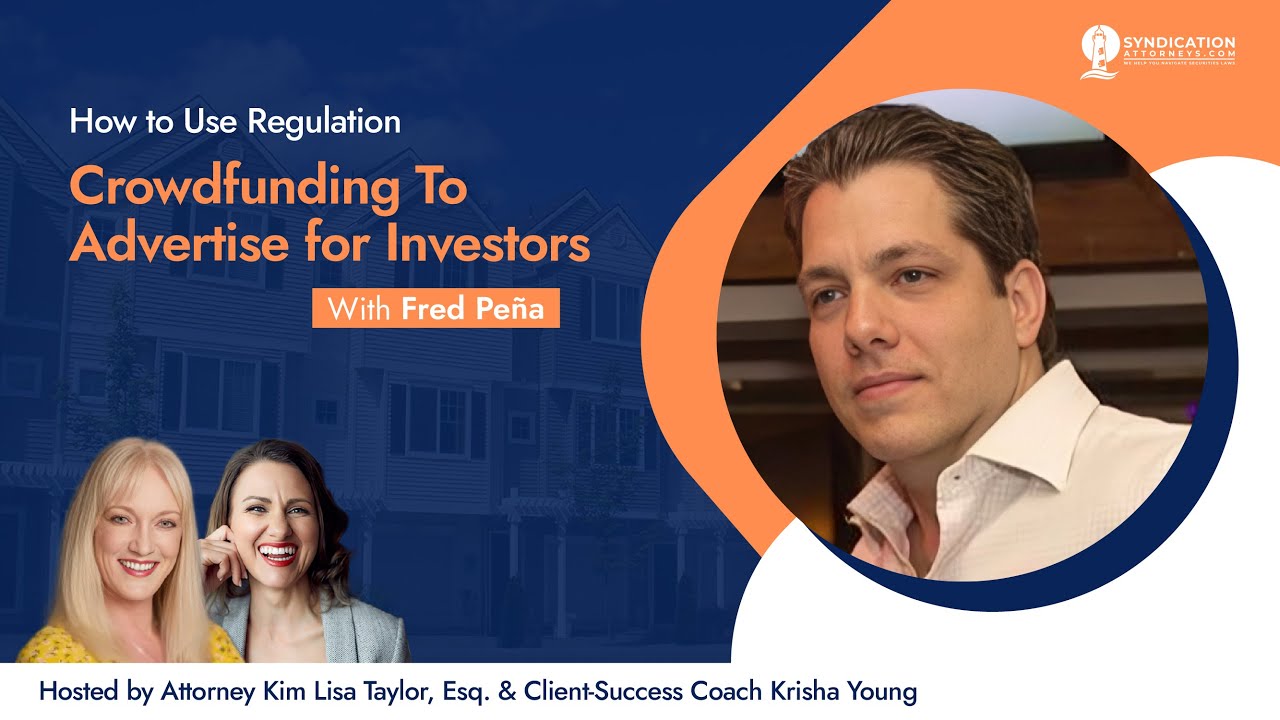
In this Raise Capital Legally podcast episode, attorney Kim Lisa Taylor and co‑host Krystal Young interview Fred Peña, founder of Ridge Crowdfunding, to explain how Regulation Crowdfunding (Reg CF) can be used to advertise real‑estate syndications and raise capital from both accredited and non‑accredited investors. The conversation covers the legal framework of Reg CF, the role of SEC‑ and FINRA‑approved crowdfunding portals, advertising allowances, escrow and third‑party handling of funds, filing requirements (Form C, progress updates, annual reports), monetary limits (‑$5 million per 12‑month period, audit thresholds at $1.235 million and $618 k for subsequent offerings), investor investment caps ($2,500 or 5 % of income/net‑worth for low‑income investors, 10 % up to $124 k for higher‑income investors, unlimited for accredited investors), offering timelines (minimum 21 days, typical 21‑28 days, recommended 60‑90 days, max 1 year but discouraged), audit and financial‑statement obligations, blue‑sky filing considerations, portal fees (4‑6 % of capital raised), handling of large investor bases, post‑offering responsibilities, permissible blind‑pool funds, and the practicalities of running Reg CF alongside Reg D offerings. The episode ends with a Q&A covering documentation, investor visibility, AML/KYC requirements, and resources for further assistance.
Chapters
All right.
Hello, everyone. Welcome to the Raise Capital Legally podcast and YouTube channel, where we talk about topics of interest to real estate syndicators and fund managers with opportunity for live questions and answers before we sign off. This is attorney Kim Lisa Taylor, founder of syndicationattorneys.com, and I am Krystal Young, our co-host and business development director. Before we get started, please note that audio and video from this event will be posted on our podcast platform, YouTube channel, website, and social media and will be made available to the public. You can ask questions at the end of the broadcast by raising your hand or typing it in the Q&A. The information discussed during this event is of a general educational nature and should not be construed as legal advice. So today our topic is how to use regulation crowdfunding to advertise for investors with special guest Fred Pena. Please join us as we interview Fred Pena of Ridge Crowdfunding about how you can use the Regulation Crowdfunding exemption to freely advertise your deals and raise capital from anyone. We'll discuss the rules, limitations, mechanics, and advantages of this important exemption and how you can use it to help even non-accredited, unsophisticated investors participate in your real estate offerings. with no preexisting or substantive relationship required. During this podcast, you'll learn how to use this game-changing exemption, how using this game-changing exemption can help you reach a wider audience of potential investors. All right, here we go. Hello.
Hey, Fred. Thanks, Tricia. Hey, Fred. Thanks for joining. Fred and I met recently at the Rubicon. conference, and he was one of the little gems I, I got out of that conference, which was great. Had, had an opportunity to network with a lot of the other sponsors. He was one of the sponsors there. So we sat and chatted for a long time. Oh, geez. And I was going to be using my Ridge cuff today.
That's okay. Like, I don't even use one. I have a red cup here. I don't use my own product. That's, that's the way they teach you.
Yeah, you gotta have some product placement there, you know. A little ad for you. Well, well, Brad, so much— thanks so much for agreeing to be on our call and educate our audience. So tell us about your background and your business.
Yeah, so my background is an attorney also. I started practicing about 10 years ago doing securities offerings and mergers and acquisitions deals at a smaller firm in Utah. And it just so happened that when I was in law school, I was neighbors to an entrepreneur who contacted me, you know, 8 years later after we moved apart. And he had an idea to, to do this crowdfunding business that's affiliated with his company so that they could use it as a referral to get funding for their companies that they were working with. He called me up and said, are you still into crowdfunding? And I said, I am. And so they hired me to set up this company for them and then later they asked me to run it for them. And so I left law behind. I still do law every day because of the securities nature of this business. And I started with a brand called Angel Funding and then moved now to expand it to Ridge where we do kind of any, anything instead of just film, which is the angel funding side.
Tell us a little bit about the angel funding side, just because I think it's so interesting.
Yeah, so Angel Studios is our partner. They're a sister company. And I assume that the people on here probably know what that term means. But they, they have partners that, you know, clients that come to them, they're doing distribution of a film or a TV series. And when they need production budget or advertising budget, they do that through crowdfunding, in part at least, in order to not just get the money but also to build their audience. And so we get referrals to work with those companies. That's angel funding. And so it's just limited to the clients that they refer to us, the angel studios refers to us. So we did Project The Chosen, and that was the first one that we closed. And then we did Sound of Freedom and we've done Tuttle Twins. And a handful of other projects that, you know, some people in the industry are aware of.
Wow. So you're actually, the angel funding side of things is actually raising money for those series or movies, right?
Yeah, exactly. And I'll say raising money for in one sense of the phrase, but not in another. And we'll get into that probably a little later as well.
Okay. All right. So our audience has primarily learned how to do Regulation D Rule 506 offerings. So they're familiar with Reg D Rule 506 Reg D Rule 506. But I always, whenever I speak at an event or I teach, I get people that are coming to me saying, hey, we want to be able to raise money from, you know, our neighbors and people in our community and people that maybe they don't have $25,000 or $50,000, but, you know, maybe they have a couple thousand dollars, or even, you know, could we accept like a $500 investment? And, you know, we'd like to be able to work with those people, but a lot of them are not going to be sophisticated. You know, they are family, friends, and acquaintances.
They're—
we'd love to reach out and include them. How can we do that? And, you know, this seems like regulation crowdfunding might be their ticket to be able to do that. Am I right about that?
Yes.
That's not, that's not all you're looking for though, right?
Yes, period.
So, so how, what, what are like from like the, you know, the 10,000-foot view, what is regulation crowdfunding?
Yeah, so, you know, people, if they've already been trained on Regulation D, they know that it's an exemption from the securities laws from registration. So typically every offering would have to be registered unless it's exempt. And so Reg D is an exemption that, you know, Congress kind of defined, or I guess it could be the SEC that defined it and said, hey, as long as you follow these rules, you can know that it is exempt. And so Congress passed a law that indicated, you know what, we want another, another version of an exemption that allows this ability to market to anybody and everybody. And like you were just mentioning, and, and so it is a separate type of exemption. If, if an issuer follows the rules of Regulation Crowdfunding, then they don't have to file with the SEC in the same sense as an IPO or, or public offering. And it does allow them to market to, you know, non-accredited investors and have them invest as well as accredited investors.
Yeah. So, you know, the distinction is here you don't have to— you can advertise, number one, and you don't have to prequalify your investors. But there is kind of a catch, which is you can't do it by yourself. You have to do it through something called an intermediary, which is an approved crowdfunding portal that has gone through the process of getting approved either by the SEC or FINRA or both, right? I mean, that's kind of what you went through, right?
Yeah. So we, we applied with the SEC and with FINRA. We're a member of FINRA as a crowdfunding portal. And so that's, it's basically like saying we're a broker-dealer light, might be the right way to say it. You know, we have fewer requirements on us, but also fewer things that we're able to do, which is strictly deal-in regulation crowdfunding. And so, but yeah, we also don't have to do all the regulation requirements that a broker-dealer has to do, which is good for us.
So we've thrown out a couple of terms here, and I feel like there might be some people saying, scratching their heads right now going, what's registration? So registration is really the process of of getting your offering pre-approved by the regulators, which is what the process you go through if you want to take your company public. So if you want to advertise it on NASDAQ, New York Stock Exchange, or, you know, any public exchange and be able to offer it to anybody, then you would have to go through this pre-approval process. And there's another exemption. So regulation crowdfunding is also called Reg CF. So you'll, you might hear that. This was born out of the JOBS Act that got passed during the Obama administration, which was at a time when banks weren't lending and people were having a hard time getting financing for projects or real estate or anything. So they, you know, rightfully came up with another way for people to be able to do it, or several ways. And that's when they passed the JOBS Act, which allowed Regulation A+. Some of you guys might have heard of that. Some of our audience is probably familiar with Grant Cardone. He has a Regulation A+ offering. That's really kind of a streamlined public offering. It is a public reporting company. But then they also passed this Regulation Crowdfunding, which is kind of like you said, like a little mini version of, of that that allows you to advertise.
That's right.
So that's what Reg CF. And then the other term that we threw out there that people are, might, may be saying, what's FINRA? Can you, you tell us a little bit about FINRA?
Yep, that's the Financial Industry Regulatory Agency, I think is the, the right, the, the full name. And the SEC just basically hands off the responsibility to, to police the securities industry entities like the broker-dealers and portals to make sure that we're kind of being compliant and doing our duty under the under the law. And, and, and I guess from that perspective, you know, I hope it's okay to go into that just a little bit.
Sure.
Is that the reason that, in my mind, the reason the SEC set up the requirement for an issuer to work through a portal is because you're now involving the non-accredited investors who are typically seen as unable to protect themselves completely. Crowdfunding is designed to allow all of them to work together. So there's public Q&A tools that allow everybody to see the questions and the answers that everybody else has asked to the issuer, which allows them to kind of crowdsource that vetting process. But at the same time, because it's involving non-accredited investors, there is a certain amount of vetting that the portal has to do. And, and that is, I guess, the minimum, you know, requirement for protection for the investor. And so that, that, that's why FINRA has us and the SEC has us involved.
Right. So there is some vetting that gets done, but it doesn't have to be done by the issuer. So the issuer, just throwing out another kind of jargon term here, we want to, want to define that for our audience. The issuer is the company that's offering the interest to investors. So it's the company that is doing the thing they're raising money for. So, and that's the SEC calls you the issuer when you're doing that. So if you're a syndicator, you're syndicating a real estate project and you create a company that's going to sell off interest to investors, that in the SEC's mind is the issuer of those securities. So that's what we're talking about here. So the structure is largely the same as far as the corporate structure goes. It's going to be largely the same as anybody would use with a Reg D Rule 506 offering, right? We're still going to create an LLC.
Yeah.
It's going to be manager-managed. We're still going to create a separate management entity. And then that manager-managed LLC is going to sell off part of the interest to investors, keep some for themselves. And, and that's going to be your corporate structure. So no real difference there. Still going to use the same kind of operating agreement, same waterfall, same fee structure that you might have in a regular Rule 506 offering. What's different though is we're going to get into that in a little minute. I'm giving it a little ahead of myself. But so your funding portal. Okay, so this is different than an investor management platform also because a lot of our audience is familiar with that. So like Cashflow Cashflow Portal, InvestNext, AppFolio, Juniper Square, all those guys, those are investor management platforms. So they're a place where you can post your deals and your investors can come in and see how their investment is doing. You can post your status reports, your tax forms, all that stuff. You can, you know, keep track of all your distributions. That's different. This is a portal that is pre-approved by SEC and FINRA that allows you to actually raise capital. So just mechanically, you say you can advertise, but what does that really mean? If I'm not able to go out and create my own website for my own offering, what can I do to advertise in conjunction with posting something on your platform?
Yeah, pretty much anything. And I don't mean you can't— I don't mean you can say anything, but you can advertise in just about any format. And so with our film industry projects, the typical advertising is happening on common websites like Facebook. And you could see the same thing happening where, you know, depending on the types of investors you're looking for, you could see that on Instagram, you could see it on Twitter, you could see it on LinkedIn, you could see it through emails like to your own email list. Theoretically, you could do billboards, you know what, posts in magazines, whatever you want to do is fine as long as you follow certain restrictions on what you say. It's kind of like a tombstone notice requirement that when you're advertising— again, they don't use the term advertising, but when you're advertising, you have to be limited in what you say because what they really want is for you to, you know, those investors to go over to the portal and find all the information and the disclosures and review everything before they, they choose to invest.
So the real distinction here is, is you can advertise your own offering, but you're driving people to the portal.
Exactly. Yep.
Right. And there is where all the information about your offering is going to get posted. That's where your operating agreement and your disclosure documents are going to be and the subscription agreements. Now, do you guys actually handle the money Or does that go somewhere else?
Yeah, we, we don't. And that is a requirement in the law. For whatever reason, they don't trust us to hold that money. They don't want us accepting it for a lot of different companies and then running, I guess. But there's an escrow agent that is involved in every single deal. They call it a qualified third party, and it can be a bank or a broker-dealer, someone who basically will accept all the funds on the investor's behalf and hold it subject to the terms of the offering. And so because Regulation Crowdfunding has certain rules in it, one of them is that an investor can cancel up to 48 hours before the closing. And so, um, wow, the escrow agent, if they receive an instruction to cancel, they have to send that money back. Um, but if, you know, it's hit closing and the investment has reached its minimum, You know, we are the ones who then give the instruction on what to do with those funds, and, and it gets distributed to the issuer, to themselves for their fees, and to us for our fees.
Okay. All right.
So, all right.
So, so you've got a third party here. So it's not going directly into the issuer's company bank account. The money is initially getting held by a third-party bank or a securities escrow, not, not like your title company escrow for a property that you're closing on, right? Different. Yeah.
Yeah, I mean, in my mind, you know, using the phrase escrow is just someone is holding the money and it's not you. So.
Right. And then what happens after they reach the minimum? Can they then collect money themselves, or does it still have to go through the third party?
Always. It always goes through the third party. Now, I will say there's the concept of a rolling close. So theoretically, a company could You know, hit the minimum and say, okay, well, we're we're gonna close, do an early close, and allow people to leave if they want. You know, they're saying that is a restriction in the law. If they do an early close, they have to notify people, and they get five days to to to cancel if they want to. But otherwise, the money will still continue to go into the qualified third party's bank account. And then get closed as you comply with the terms of the offering.
So, so it's possible to do. So we write a lot of minimum maximum offerings. So it's like, hey, if we get to this minimum dollar amount, we can close on the property, but we're going to have to keep raising a little bit more money to get all the funds we want for the rehab and all that. So then that initial money could be released and then they continue to raise. The money still goes through the third party and then gets released after some milestone, right?
Yep, exactly. And it's the same here. So you, you just set that minimum, the maximum at the beginning. You file it with your Form C. And so I, I guess I don't— this might be a good time. Instead of creating a PPM, you'll create what's called a Form C, and you'll file that with SEC just like you file a Form D with the SEC. It's just a notice filing. They don't review it for approval. That's what's different between a Reg A and a Reg CF deal, right? And yeah.
So there's no real waiting period. It's just like once you've submitted it, then you could go ahead.
As soon as you submit, it's live. And we're actually launching one today on our, on our film platform. And so as soon as it's filed, it's, it's legit. Excellent.
So does your portal actually help raise the capital?
So in a way, yes, and in a way, no. And what I mean by that is we, according to the rules, we cannot advertise for the offering. And so we can't go out, we're never on the phone dialing for dollars, you know, trying to find people who can invest. But what we do have is a user base and we are allowed to message our user base and say, hey, there is a new offering. And so some money will come from that user base And then the rest of the money is going to come through the advertising efforts of the issuer. So theoretically as well, we can advertise in general, but there are restrictions, as in, again, we can't advertise and pay money and say, hey, we just got this new offering, you should come and invest in it. We can't spend that kind of money, but we can say, hey, we exist. Oh, and by the way, we just happen to have this offering you might be interested in. It's, it's a really interesting restriction in the law that itself provides for its own loophole. It's on purpose, but it just means that we're going around the normal process of advertising. We're not, not doing normal advertising, but we can help a little bit.
So it's kind of like a broker-dealer. They can advertise that they're a broker-dealer and come to us, but they're not going to talk about specific offerings until you get there. And then, you know, you have your vetting call with them and they're going to say, well, here's some Offerings you might be interested in, look at these or something, right?
Yeah. And we don't even go to that extent. So if someone comes to us and said, hey, I'm looking on your site, you have these 5 offerings, do you recommend any for me? Like, here's my situation. Like, we can't tell them anything. We just say, go look at the deal and then you decide.
And they get to talk to the issuer too, right? You have contact information. They can talk to the issuer directly. So how do you get paid?
Yeah, we get paid out of the successful deals only. So if a deal does not hit its minimum, then the deal fails. Everybody gets their money back, the investors do. But on a successful deal, we get paid a percentage of the amount raised. So, you know, we've had deals that went up to the full $5 million, and we've had lots of deals that go to They kind of set a minimum at, you know, 1.235%, which is— there's some restrictions in there. We're going to talk about registration rules. Okay, we'll go into that of why that's a number. But so we've, we've hit numbers on those and we typically take a fee between 4% and 6% depending on the type of deal.
So 4% to 6% of the raise. So that means you got to build that into your raise that, you know, you're going to be paying Fred's company Ridge Crowdfunding, you're going to be paying them something for housing you're offering and taking that risk and, you know, being FINRA licensed so that you can put your offering there. I always have this question for crowdfunding platforms. It's, uh, so if I send my people to your crowdfunding platform, do they just see my deal or do they see everybody's deal? How do I know they don't get distracted and invest with someone else?
Yeah, so they do see everybody's deal except for the fact that you would send them to your page. And so Okay. There's a homepage that lists all the deals that are on the platform, but typically because of your advertising, you're gonna send them specifically to your offering page. And we actually haven't tracked to see what is the flow a user takes, but typically because someone has clicked on your deal and gone to look at it, they're going there because they're interested in that project. I guess that's easier to say with film because you're, you say, well, it's an action film. I saw the little clip on the ad. That's very intriguing. And it's easier to distinguish from, from other deals and say I'm not interested in those. But there is the possibility that they come. Sorry, I have like, I've been talking too much already, I guess. And so there's no way to prevent it. But typically people will go to the page, go through the flow, and then once they complete an investment is when we show them that other things exist on purpose. And so that can help you as well because you know that that's happening for other people's deals also. And so that's one way that we, we help bring in additional investors.
Right. So it's possible that other people are doing the same thing. They're advertising, driving their investors to the site. Once they invest in their deal, then they could see your deal too. So you might end up with some new investors And of course, the issuer is going to get all the contact information and subscription agreements from the people that invest with them, right? That all goes directly to them.
Exactly.
Yeah.
Yeah. It doesn't go to them during the offering stage, and we do that strategically because what we have found is that most issuers think like business people because they are. They don't think like attorneys. And what, what is true of these offering periods is that if they start communicating with people outside of the public forums, they start running into potential violations of the restrictions in regulation crowdfunding. So we don't— to prevent that, we don't even tell them who those people are until after the closing has happened, and then they can communicate with them. They become part of their community. You know, if you then look to do other private deals, you have these users who are now in in your contact list that you can just contact directly and, you know, go do a Reg D with them if you need to.
And largely that's because one of the requirements is you have to capture all the questions that are asked and make sure they're posted so that everybody else that comes to the offering can see all the questions that anybody has asked and, and what the answers are. So you're really kind of interacting through your portal and, you know, they're asking the questions, the, the issuer is posting the answers. It's becoming a public, public information. And that makes sense because otherwise it would be very easy to have phone conversations with people and talk to them about things that other people don't know. And that, that's kind of anti what the rules are about. And that's why crowdfunding is supposed to work, right? At least these ones specifically, yes. So crowdfunding, the whole concept is that, you know, the wisdom of the crowd is going to weed out whether this is a viable offering or not because they're the ones that are going to be asking the questions and getting the answers and making their own decisions based on whatever everybody has asked, and those that aren't worthy will not get funded, right? That's the whole concept behind it. At least that was my understanding of it when it was first proposed, is the wisdom—
You got it right. Yeah.
Would weed out the bad apples or the bad deals, and only those that are worthy would get funded. So—
Exactly. So unfortunately—
Go ahead.
I was just gonna say, unfortunately, if your deal, you know, you the viewer, if your deal is a bad deal, That, that's, that's, I guess, a negative for you because it might mean you're less likely to get your funds, but hopefully you're bringing a good deal to the table.
So, well, and, and also you should be able, I guess, an issuer could go and register for your portal and look around at what's there and see what they're up against, right, before they post.
Yeah, you don't even need to register to see what the other projects are. So the projects are always public, completely available, but if you want to start interacting Then you have to have an account, and that's part of the rules.
Okay. Okay.
Well, that was— what is a typical good deal? Like, what do you— I'm very curious about what—
Yeah, I don't even think we can go into that discussion here. I think we want to table that. If we have time at the end, we can come back to that because right now we really need to get through these rules because there's some rules that are going to help you decide as an audience member whether or not this is something you even want to attempt. Right. And so let's get to those next. So what is the dollar limit an issuer can raise in a 12-month period?
Yeah, that's $5 million.
Okay. And what does that mean? Does that mean that if I raise $1 million in month 1, that in month 13 I can raise another million dollars if I want to keep my offering open?
So typically there is a deadline for every offering. So you, you wouldn't keep it open indefinitely. We have actually found that shorter offerings are better anyway. Because people will take action knowing that there's a shorter window in which to take action. You know, like a typical Reg D deal, at least that I used to work on, they would always be open for like a year because the issuer has to go and drum up the business. Anyway, so we found that short deals are good for regulation crowdfunding because you're advertising and then getting people to act quickly. So if you raise, let's say, the full $5 million in that offering, yeah, you have to wait. Once the closing happens, you have to wait another 12 months before you can then do another deal. But if you only do $1 million, like you were suggesting, well, you could start another deal the very next month, you know, technically the very next day even, and raise another $4 million.
But what about So an issuer in our context, right, somebody creates a company that's an issuer and they go out and buy one property, right? Let's say they only need $3 million. Well, now when they go out and do another offering, they're going to create another company. Is that considered a separate issuer or is it considered part of the same issuer?
Yeah, so it depends. There, there is a restriction. If 2 entities are under common control, then they're considered the same issuer. And so, you know, some— you have to do an analysis per deal and say, okay, well, who are the owners of the one company and who are the owners of the other? In your scenario, it sounds like what you're saying is it's the one person or the one team who is the one management team, right? Right. So those would be the same entity. And so if you raise $3 million, you know, under one entity and then you've created another entity to go do another deal, Already, then that entity, the second entity, is limited to $2 million.
Got it.
So, all right, so collectively that issuer, and then, you know, I'm not going to go into a bunch of what-if scenarios, but I'm sure people are thinking about it like, you know, what if we have this management team here and then we swap out some members and now we have another management team, but it has some of the same members but different members? You know, I guess that's something you're going to have to analyze deal by deal. To find out how, how much control those original people have and what— whether that kind of rises to the test of same issuer.
Yep. And we have had that where an advisor has been involved in more than one deal, and it's that advisor who might be triggering the problem where the rest of the team is different for 2 companies. So yeah, we have to just analyze it deal by deal.
Okay. So basically now, before you guys start jumping up and down, woohoo, and about, uh, I can raise $5 million, I never have to do Reg D, Rule 506, Again, let's talk about what's— what the other limitations are. So what are annual— let's talk about the auditing. Okay, I know that's kind of jumping ahead a little bit, but I think the audits are critical to talk about here because there is a point at which you're raising over a certain amount of money and you are required to do an annual audit on that company for as long as that company exists. Is that right?
That's correct.
Is that correct?
No. So only as long as you're doing offerings. And so the first, you know, if you raise the— you've never raised money before, the first time that you do an offering, if you're raising over $1.235 million, you have to do an audit. If you're doing under that, you can do reviewed financials. And if you're a new entity, you could do an inception audit, which is much simpler. It's basically recognizing all your financials have zeros, basically, and you still have to pay a CPA many thousands of dollars to, to do that. But once you complete the offering, you only have to provide an audit if you have an audit. But if you don't get an audit, what you have to have is a statement by the officer of the company asserting that their accurate and, and correct. And, and then you file with what's called a Form C-A-R, an annual report, an update on the status of the company and including its financials. And with that statement, so you do not have to keep doing an audit unless you want to do another offering, then you have to get another audit, a new audit.
Got it. And, and then for, so first-time offers, It's $1.235 million. So if you've never done a Reg CF offering before, your first-time client to Fred or any other crowdfunding portal, right, they, they're looking at them across the board. It's not just your portal. It's, hey, you might— you can't hop portals and start over and get a new $5 million, right? It's, it's per issuer across portals. And, you know, they're trying to prevent you from hopping portals.
Right.
So first time, $1.235 mil. So this is great for people who are first-time Raising, you know, less than that or up to that. And then second-time issuers. So once you've been an issuer and now you're coming to maybe another issuer, then you're going to be limited. That limit goes down. And what is that limit?
It's like $618,000, I believe. And then so if you hit that limit, if you're going to raise more than that on your second offering, then yeah, you have to do an audit.
Do an audit. So, and any idea of what these— so you said for new initial offering with a brand new company, it's just been formed, not going to be that much because we're, you know, there's everything's zero balances, your bank accounts are zero, you don't have any, anything to audit. But what about, you know, subsequent audits? Then you have to audit everything you did before, like the previous offering you did, and then this one too?
Yeah. So the, the audit that you do when it's a full audit, and that's typically just based on when your entity was created, Compared to when you're doing the offering, as in you have financials to audit. It's always the previous 2 years. And so what— and what you're looking at is, yeah, $15,000 to $30,000 for a full audit. And even when we're talking about a cheap inception audit, even that can be, you know, like $5,000. So, okay, it's unpleasant.
Nice.
Yeah, that's, that's good to know. So $5,000 and $15,000 to $20,000. So, so again, I wanted you guys all to know you can raise $5 million, but you're going to incur some audit obligations that's going to cost some money, and you're going to have to build that into your upfront costs and your raise so that you've got the money to be able to do it. Now, how— what's the longest period of time somebody could have an offering posted up on your website? Could they go a full year or beyond?
They theoretically could, yes. We just, yeah, we just don't encourage it because what happens, it's from a practical standpoint, what happens is investors will come to the site, they'll see that they have a ton of time left and then they won't take action. And a lot of action is dependent, you know, people are looking to see what other people are doing also. Again, that's the whole part of the whole concept of crowdfunding. So if lots of people are coming, they're looking at it, they're determining to take action later, then the other people that are coming to look are also noticing that very few people are taking action and they, they assume that it's a bad deal or that they're just going to wait as well to see what other people do. So we always limit it to time from a strategic standpoint as well. And we would recommend anybody, just about anybody, do that, especially if you're doing a real estate deal where you might have a property under contract. You have a limited amount of time before you need that cash. So, right.
So you're looking 60, 90 days max, right?
Exactly.
Yeah. And is that typical timeframe for a Reg CF offering?
So there is a restriction in the law that says its minimum time has to be 21 days. You cannot do a shorter offering than 21 days. And we actually find that 100% of our offerings right now are 28 days or less. So the 21 to 28 days, and we actually Have, depending on the deal type, a lot of our offerings fill up in, you know, like a week or 2.
Okay, that's encouraging. That's good to know. And what if they don't make— can they extend? What if they put up a $20 million?
Yeah, theoretically they can. Now, so there's 2 ways to handle that. One is to extend, which is making an amendment to the offering. When you do that, though, There's a requirement in the rule that says you have to give everybody a notice saying, hey, we just materially changed the terms of this deal, which the closing date is a material change. And then you have to give them 5 days where they have to take action to reconfirm that they want to stay in the deal. And if they don't take action, we, the portal, have to cancel that off, that investment. And so that's Less preferred. What we, what we encourage instead is for the, the company to just keep the date, close the offering, and then, and then open it back up, you know, open up a new offering just really quickly after the first one. You just have to make some amendments to the Form C document because now you have more money, and so you have to identify that you have more money, you have a slightly less risk because of that. You I guess you don't tell the investors, hey, by the way, we have less risk now. There's always risk. So you don't, you don't tell them that, but it's just a matter of fact. And so then you just open up a new offering.
Got it. What about blue sky? Do they have to do blue sky notices also?
So there is an argument that the state in which they are located, they may have to file a notification in that state. But that all other state blue sky laws are kind of preempted similar to how they, they are for, I guess, like a 506. Even with— yeah, even with those 506, sometimes you have to— my understanding is you do have to file a notice filing. But with Reg CF, you don't even have to file a notice filing like with NASA.
Okay, great. That's good because that, that is a cost item that has to be considered. There could be, you know, on a million-dollar offering, you could have, you know, $2,000 to $4,000 in just blue sky filing fees. And just so, again, we're using jargon. So blue sky means state securities agencies want to know when you're doing a Rule 506 offering and you've sold interest to someone from their jurisdiction, they want you to file a notice with them within 15 days. Those are called blue sky notices, and they all have fees associated with them except for the state of Florida. But the fees range from $150 to $1,200 depending on what state. Northeast states are most expensive. In the Midwest and the western states are, you know, $300, not so bad. But like New York's $1,200, Massachusetts depending on how much you're raising can be like $750. So those can get a little pricey. And, you know, if you're raising $10 million on a Reg D offering, you could have $5,000 or $8,000 in filing costs because, you know, just the more states you have, have, the more your costs for that are going to be. Okay, so that's good. So let's talk about who can invest and how much they can invest. But let's just maybe before we go to that, Krisha, do you want to just read our little midpoint notice? And—
Yeah, absolutely. This is such a fascinating conversation. Yeah, thank you. All right, everyone. Well, in case you didn't know, we have 2 books, Raising Capital Legally. One is for beginners, one is for more advanced capital raisers. Um, oh good, Kim's doing the, the Vanna White thing. Yeah, I just saw some movement. Um, if you would like us to mail you one for free, text the word syndicate, S-Y-N-D-I-C-A-T-E, to our phone number, 844-796-3428. So again, That's the word syndicate to 844-796-3428. Or you can also go to our website syndicationattorneys.com and there's a button there for free book and you can go ahead and grab it there.
Well, and just a note, if some of you already have our books, you will only be able to get one of— get us to mail you one for free. We're going to ask you a question whether you've raised capital before. If you say no, you're going to get the skinny book. Which is the easy read, how to step by step syndicate. If you say yes, then you're going to get this one, which is more like a desktop reference. You're going to want to use table of contents and go to the chapter that describes in depth whatever it is you're asking about. So, you know, just make sure that you answer that question. And if you've already got one of our books, then you can go buy them on Amazon. You can also get Kindle versions on Amazon. We're going to send you a physical copy if you sign up for one of our free books. So you got to give us your address and then we'll We'll send one to you, but just make sure you do that again. Text the word syndicate to our phone number, which is 844 syndicate, S Y N D I C, and the number eight. So I see my little dog is making a guest appearance here. He sometimes shows up. Good. I can count him as an advertising dollar. He actually participated in one of our shows because he was lost when it was a big ordeal. We had so we do have a. Yeah, that was the one we did with Cashflow Portal. We tried to have a little fun doing these, Fred. All right, so let's, uh, let's go back to this because this is fascinating stuff, and I know there's a lot of information here. So you guys are, you know, when we post this, we do at our website post also the transcript so you can scan through it, you can read it. Um, we're also going to post it to our YouTube channel so you can watch it. But you'll have plenty of opportunities to get, get your information answered. And I'm also going to write an article about all of this and post it so you guys can really understand what this is about, because I think it's a powerful tool to know about. And you know, as long as you understand the limitations, what you can and can't do, then you're going to be fine, and it might open up a whole new world of potential investors for you. So So who can invest? Anybody, right?
Yeah, anybody. So I guess there's technically some issues where the, you know, if the escrow agent, the qualified third party, because they're a banking institution or a broker-dealer, they're subject to the Bank Secrecy Act. I'm not going to get into too many details, but they have to do a background check. They have to know their client. The investor is considered their client for purposes of holding that money. And so if they can't verify your identity, Then your investment will get canceled. But otherwise, anybody can invest. Even, you know, they— the law is set up where even the poorest person with no assets, no anything, can invest every year up to $2,500. And that's their way of protecting those people by limiting how much they could potentially lose.
And then— but that's across all of these Reg C platforms, right?
Yep.
Yeah. So, so, you know, you're really— when you're vetting these people, because you're the one that's kind of policing that, right? You're talking to them.
Yeah.
What other things have you invested in? How much have you invested in other, other portals or other deals under Reg CF? And, and then, uh, kind of figuring out, okay, if you haven't invested anything, you could invest the full $2,500. But if you have invested in other things, that's going to be taken into account, uh, before you can make that. Now, so that's for anybody with no financial qualifications at all. But if somebody makes over $124,000 a year, Then they can go up, right? So it's, it's, it's in the— if the investor's income or net worth is less than $125,000, $124,000, their annual limit is $2,500 or 5% of their income or net worth, whichever is greater.
Whichever is greater.
Exactly. Yeah. So it's a little bit complicated, you know. Hey, complain to your regular regulators about why they made this so, so complicated. But that's what they did. All right. So if the investor's income and net worth is greater than or equal to $124,000, then the annual limit is 10% of their income or net worth, whichever is greater, but they can't exceed $124,000. So, so you could have somebody invest theoretically up to $124,000 if their income and net worth are greater than $124,000.
Correct. And if someone's accredited, they have no limit.
Ah, okay. All right. So that's good to know.
Okay.
So they could invest $500,000, right? Okay.
Right. And that's— that benefits people from saying like, well, why do regulation crowdfunding when we could go get these big dollar amounts from, you know, the accredited investors that we already have on our contact list? And obviously it's trying to make things more equal in the sense of they don't need to protect those accredited investors is their, is their stance. And so they, they are free to potentially lose as much as they want.
Okay. Can you do a concurrent Reg CF offering and Rule 506 offering?
Technically, yes. Okay. And, and I will say, don't use that as legal advice, so still get your own approval, but there would have to be certain things that you do to make sure that you're complying with both rules at the same time. There has been a portal that got in trouble for allowing an issuer to do both concurrently. And what that portal did was when— what they asked, they vetted the investor and then they sent them to the specific offering that they thought was better, you know, the Reg CF or the Reg D offering. And that was outside of their ability to do. And so they got in trouble. So anyway, you have to figure out the right way to do it, but there is a way to do it.
Yeah, it's tricky. It's like trying to do a concurrent 506 and 506 offering. And, you know, you meet somebody through advertising that's not accredited and you're like, oh, hey, well, you can't invest in this, but you could invest in that. And, you know, that's kind of the whole bait and switch technique and not allowed to do that because you met them through advertising and relationship. So that's why, you know, we try to encourage people, don't do them concurrently, but maybe do them consecutively.
Correct. And that's often like when someone is having trouble figuring out if they can meet the requirements to do them consecutively, it's way easier to just say, you know what, just be compliant with one at a time. And then you're certain. And so it's good that way.
Yeah. So better do your Reg CF offering, see how far you get. and then close that offering and then go start your Reg D offering and follow those rules separately. Now you don't have any question of whether you complied with both. All right, so let's see. So any limit on the number of investors in a Reg CF offering?
No, from a technical standpoint, but from a— or I should say from a legal standpoint, but from a technical standpoint, there is 12 public filing requirements that when you trigger a certain number of investors, you, your company then has to file as if they were a public company. And so you might, you might want to avoid that. There's, there's some valuation triggers as well that are mixed in with that. But legally, no, there's no limit. So we've had deals go up to, you know, 9,000 or 10,000 investors because they raised the full $5 million, and that just happens to be the average.
Wow. Okay, so if any of you are cringing right now, you all should be because you just heard 9,000 or 10,000 investors. How many of you want to issue K-1s to 9,000 or 10,000 investors? Now, so after the offering is complete and it has been closed, what's your role? Are you guys done, does the offering come down off the portal and they have to manage it in one of these investor management platforms, or how's that work?
Correct, something, something like that. So the, the offering page is still public information. We, we don't have to keep it up. We could close it down and just hide it from view. But yes, what will we— would deliver to the issuer the list of investors, their contact information, etc., how much they invested, so that they can basically turn that into a cap table. And we have referrals, companies that we work with as referrals that provide cap table management services. But it sounds like you and in your community, you have management platforms that do that as well.
Yes.
And that's the idea.
Someone's got to do that typically because issuers often don't have the wherewithal to do it on their Yeah, you're not going to want to manage this, you know, on a spreadsheet. You're going to need some help. And this is where you're going to want to be looking at one of the investor management platforms that we talked about earlier and having them set up so that you can keep track of capital accounts and what's been distributed and post all of your tax forms and any status reports, all that stuff about the project that you don't have to to send those out. I mean, imagine just trying to create a group of 9,000 or 10,000 people that you have to send information to. That's going to be just unwieldy.
A lot.
Yeah. Yes. Okay. And what about— okay, so can somebody— so we have a lot of syndicators that are doing specific offerings. What about someone who wants to do a blind pool fund and they want, you know, they have a business plan, they want to, you know, they're saying, hey, we're going to buy I buy properties of this, you know, that meet this certain criteria. Are they able to use Regulation Crowdfunding?
Yeah, so my reading of the law is that in real estate, yes, they are allowed to do that as long as they do have a business plan, a thesis under which they're investing, so that the investors can have an understanding of the types of properties that that company is going to be buying. I think people sometimes get it confused. You said blind pool fund. When when the purpose is to use that money to buy another company, then yes, there's a prohibition against that. I don't know why, you know, compared to not identifying a property.
They don't want SPACs. You know, they don't want people using this for SPACs. Yeah.
Yeah. And and and so but yes, when it's real estate, you can do that.
Okay. Okay. So you can do it with a blind pool as long as you have a business plan. So if any of you are thinking about doing a blind pool. It really works best when you have a track record already doing that kind of thing, and you can demonstrate, hey, these are the other, you know, part of your resume is going to be these are the other 10 projects we've done and how they perform. So you're going to want to make sure that you have that, or if you don't, then you should have somebody on your team that has that kind of credibility or background and track record in order to do a fund. That's the only way that that's going to work. that really, it really is functional. All right, so just a quick run-through because I know we've got a few questions and we've got to stop right at the top of the hour. But so reports that have to be filed, so you're going to do this Form C, initial Form C, which is very similar to a private placement memorandum. It's just a questionnaire form that the SEC has created, and we're, you know, giving them some of the same information, but in some cases even more detailed information than you're going to put in your, your private placement memorandum. You also have to do Form C progress updates within 5 days of reaching 50% of your target, and when you reach 100% of the target offering amount. So you've got some additional filings that have to be done. What about—
And those are really simple, by the way. That's just updating the SEC and saying, hey, by the way, we reached our halfway point. Oh, by the way, we, we reached 100%. So it's not like of in-depth filing.
Okay, and then annual reports?
Yeah, that's a mini version of the Form C. So the filing that you make at the time of the offering contains tons of information. Annually, they want to know the progress of the company, and so it's similar but in a much more condensed manner.
Any material changes? So if you are doing a blind pool, you've added properties, or you've switched out some people of your management team, uh, or anything like that, right? Or you decided to, you know, change the business plan, right? You'd have to notify everybody. And then termination of reporting. So that would be when the offering is done, it's closed, you're not going to be raising through Reg CF anymore.
Yeah. So it's actually not in relation to if you're going to be raising anymore, it's more in relation to if they're paid back.
Okay.
So if they're out of the deal, otherwise you have to keep filing that notification Year after year. Okay.
All right. And then do you know CPAs that do the auditing that you refer clients to?
Yeah, yeah, we have, we have a list of 4 companies that we typically rotate through that all do audits, reviews, the inception audits, and we can, we can share that with you if you want to share that with your community.
All right. And Fred, how do people reach you?
So I'm just on LinkedIn, Frederick Peña. That's typically— I mean, I'm on Facebook, but that's just personal. So I'll probably ignore you if you try to reach out there. And then our website, which is ridgecf.com.
Okay, ridgecf.com. And of course, if you want to reach us, go to our website, syndicationattorneys.com, where we have a ton of of free educational materials, articles, FAQs, and all of our previous podcasts. This one will be broadcast there as well. And you can schedule an appointment with Krisha or any one of our staff there. All right, so what kind of questions do we have, Krisha?
Yeah, thank you, Fred. This was so informative. It's such a fascinating tool in the toolbox. All right, so we've got— I'm just going to go in order here. So Fatima Lewin. Are documentation maintenance requirements the same as registered securities? Should it be met by the company or the attorney?
So I would argue that they are much more condensed requirements, or much smaller. As we were talking earlier, it's the Form C Annual Report, or Form CAR, that you do annually, and it would likely need to be your attorney to tell you, hey, what are the relevant things that you should include, but you giving those details to your attorney to finalize it.
Right. So you are going to get some additional legal fees associated with those filings.
Yeah.
Okay. So the— go ahead, Tricia. Any other questions?
Yeah, there's a few here. Shirley Nelson, can other investors see the entire group of investors on the portal?
I guess it depends on the portal. Our platform does not do that unless you're asking questions. When you ask questions, you do have to identify who you are, and you have to identify if you're affiliated with the project. We don't want people who are affiliated kind of seeding questions and giving comments and kind of pitching through the Q&A tool.
Fair. That's good, good transparency there. DJ Aurora. DJ, do people who create SPV to raise funds doing 506 deals Also need to go through an audit if they're raising a fund, assuming less than $1 million. So I guess that's a maybe— yeah, Kim, question. I don't know, would that be a crowdfunding question?
People who create an SB— no, the 506 requires an audit when you get to $20 million. So if you're, you know, if you're doing a convertible fund where you reach $20 million, you know, we're going to encourage you to talk to the attorney company that created that for you to find out, you know, when that target is achieved, and then you're going to incur the obligation if you have non-accredited investors, okay, and/or you reach $20 million. So, um, yeah, just make sure you're, uh, okay, go on from there.
Um, Fatima Lewis, um, again here. Any SAR filing requirements?
Suspicious activity reports for AML? Not at this time that I'm aware of. What about you, Fred?
No, I'm not aware of any either. It's, again, the portal is not a banking institution. We are not subject to the Bank Secrecy Act. And so we don't have any such responsibilities. We are unaware if the qualified third parties, so the escrow agents, They may have some requirements, but I don't believe it is for like, hey, someone just invested $10,000. I don't think they're reporting that. I think they just—
And I know there's some recent proposed changes that investment advisors might start having, having even exempt reporting advisors may have to start doing suspicious activity reports. So that this is all under anti-money laundering laws. So if any of you aren't familiar with that, it just means, you know, there are certain people that, certain people, certain countries, people from countries that you're not allowed to do business with. So any sanctioned countries, you can look at the Office of Foreign Assets Control website. It's a look up OFAC, O-F-A-C, which is under the Department of Treasury, and they have the rules for anti-money laundering and the sanctioned countries and also sanctioned people. Technically, and I don't know if— do you guys do any AML checks on investors? Or I guess the bank would probably, right?
Right. An AML and a KYC or CIP are all always done on every investor.
Every single investor. Wow. Okay. And so, you know, somebody's looking at them, making sure that they don't appear on those lists. That list, by the way, is 500 pages long last time I looked. So You know, it's really going to the OFAC website, but but they're gonna you guys probably have other sources that do that for you. I would imagine. All right. So yeah, you don't want to get caught up in any money laundering scheme. If you do, then you know you're the one that's going to go to jail, and you know probably they're going to freeze all your bank accounts. As somebody put it to me once that was under a securities investigation, they said they froze all of our bank accounts. I couldn't even buy a stick of.
So have more cash on hand than that.
Yeah, yeah. And, and it takes a while to sort that out and usually hundreds of thousands of dollars of legal fees. So, um, you don't want to go there. All right, any others?
Um, there's a couple more, but we're at the top of the hour. Um, there's—
So I would encourage any of you to, um, I mean, you can go, uh, look up the rules yourself. For regulation crowdfunding, SEC has some information on their website. Also, there's several legal sources out there. If you look up regulation crowdfunding rules, you might get to one of the legal sites, and then you can read the regulation for yourself. It's a little bit cumbersome, but you know, that's, that's thank your regulators for that. It, you know, that's just the way it is. is. So, um, I think, uh, yeah, we've pretty much covered the questions we'd be able to answer today. And, uh, I, you know, we thank all of you for taking time out of your day and joining us live. That was an awesome, uh, event. Fred, thank you so much for coming and being our audience. Yeah, thank you. We really look forward to, uh, sending you some clients. We're going to be doing Reg CF offerings, you guys. So, uh, if any of you are interested in doing it, then we're going to be able to help you structure your company and, and do those Form C filings. We'll still be using a subscription agreement just like before, and we'll be working closely with Fred and his team to make sure you've got the right intermediaries and third-party escrow agents and CPAs and all of that to get all the other things you need done. Priscilla, thank you so much for co-hosting, and we look forward to seeing you all again in a couple of weeks.
Yeah, absolutely. Thanks everyone. Thanks, Fred.
Thanks so much.
Bye. See you guys. Thank you.
Bye.










