Success in Debt Fund Investing: Proven Strategies and Insights
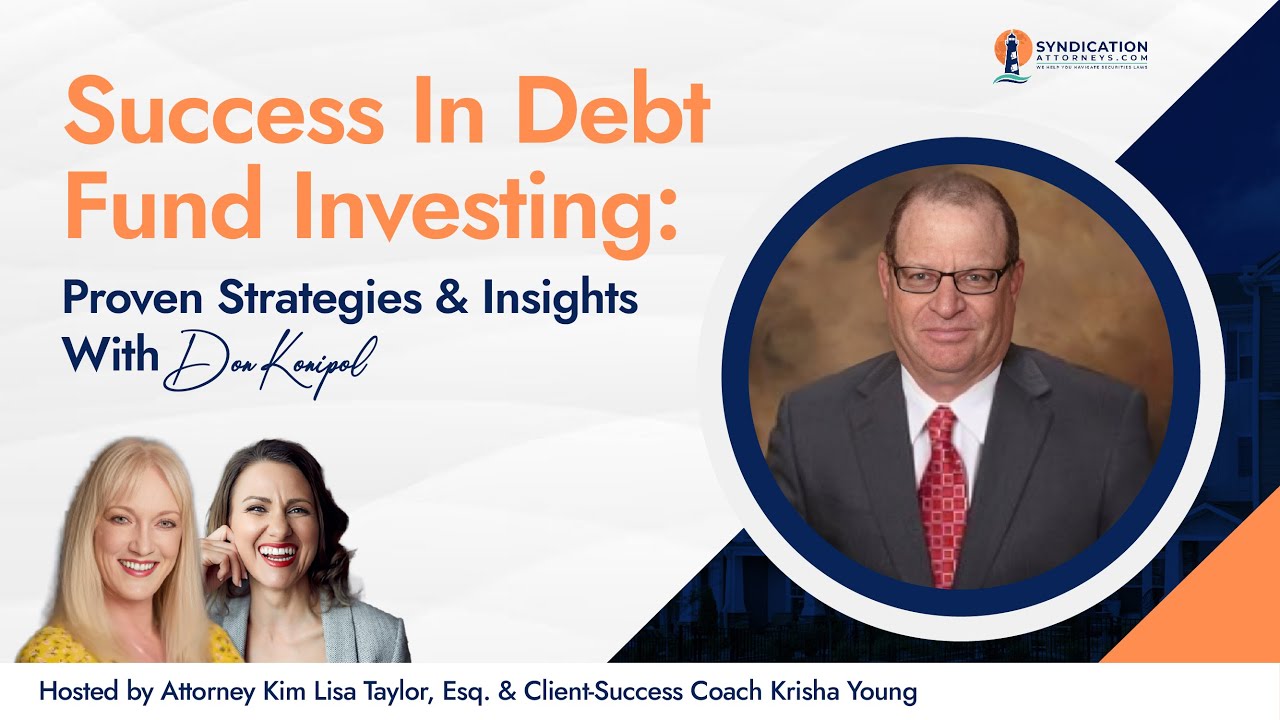
The Raise Capital Legally podcast episode, hosted by Christian and Krisha Young and featuring attorney Kim Lisa Taylor, dives deep into real‑estate debt investing with hard‑money lender and fund manager Don Konopols. Don recounts his path from a Swiss banking career to becoming a pioneer in note investing in the early 1980s, describing how he wrapped seller‑financed notes and later formalized a hard‑money operation. He explains the evolution of his funds: an original pooled fund that dissolved after the 2008 crash, and the current series‑LLC structure launched in 2015 where each loan is a separate series (now in the mid‑80s). The series‑LLC model uses master private placement memoranda and operating agreements, allowing investors to select individual notes within 24‑hour tranches, reducing pressure to deploy capital. The conversation covers underwriting criteria – asset types (multi‑tenant commercial, office, retail, mixed‑use, low‑end motels, restaurants, hotels), loan‑to‑value ranges (as low as 20‑25% for land, 50% for riskier assets), loan terms (12‑24 month interest‑only, rates 12‑13.5%), and default experience (6‑7% overall, with one notable loss on an oil‑field property). Fee structure is detailed: 3‑5 origination points, 1 % servicing fee (taken by the managers), and the managers personally invest 10‑15 % of each deal to align interests. Regulatory considerations are discussed – 11 states regulate commercial mortgage brokerage, with exemptions for low volume; Arizona and California pose the most risk, but broker licensing typically satisfies state requirements. The fund operates under a Reg D Rule 506 offering, requiring accredited‑investor verification. Don describes how the fund weathered COVID‑19 by offering interest‑only or deferred payments, and how a parallel equity fund bought a retail‑service center just before lockdown, later selling a warehouse portion for profit. Relationship building is highlighted as a cornerstone: most capital comes from repeat investors, with Mitch handling investor relations and leveraging his banking network. The hosts also touch on mindset, emphasizing realistic optimism, long‑term appreciation of real‑estate versus high‑risk startup investing, and the importance of avoiding over‑leverage. The episode ends with practical resources (books by Kim Lisa Taylor, Don’s book recommendation, contact info) and a call to action for listeners.
Chapters
Hello and welcome to the Raise Capital Legally podcast and YouTube channel, where we talk about topics of interest to real estate syndicators and fund managers with an opportunity for live questions and answers before we sign off. I'm Krisha Young, co-host and business development director for the firm, and this is attorney Kim Lisa Taylor, founder of syndicationattorneys.com. Now, before we get started, please note that audio and video from this event will be posted on our podcast platform, YouTube channel, website, and social media, and will be made available to the public. You can ask questions at the end of the broadcast by raising your hand or typing it in the Q&A. The information discussed during this event is of a general educational nature and should not be construed as legal advice. Now, today's topic is Success in Debt Funding: Proven Strategies and Insights. In this episode, we explore the world of real estate investing with a focus on hard money lending and opportunistic fund strategies. Our guest, Don Konopols, shares his journey into the industry, insights on structuring debt funding through a series LLC, my favorite, and strategies for buying defaulting loans and turning them into profitable opportunities. We discuss investment criteria across asset classes like office spaces and retail centers. the synergy between debt and equity offerings, and the dynamics of successful business partnerships. Packed with practical advice for new investors and seasoned professionals, this episode offers a comprehensive look at creating value in real estate through innovative strategies and informed decision-making. Hello, everyone.
Hello.
Hello.
Hey, Don.
Hi, Kim.
Hello. Hi, Kim. Hi, Don.
So, Don, we've known each other off and on. We've communicated, I think, mostly on BiggerPockets, right?
Right.
Big on BiggerPockets. Can you just tell people a little bit about that platform in case there's anybody in our audience that hasn't heard about BiggerPockets?
I think BiggerPockets was actually started about 20 years ago, almost 20 years ago. As a platform for real estate investors to share ideas and, and ask questions, give advice. And it became the biggest platform in the space. And right now, it's, it's a great way not only to network with other investors and to get questions answered and share experience, but also to keep up on current events and the opinion of experienced investors and how those events may, may affect the real estate investment industry in the future.
Yeah, and I, I like to go in and interact on the forums because I find a lot of people that are asking questions there, and they're getting a lot of advice about securities offerings. And, you know, always inevitably in the conversation, somebody says, talk to a securities attorney. And so I'll pipe in and Try to answer the question the best of my ability. So it's, I think, a really great idea to just put your, you know, your issue, whatever issue you might be having with any kind of rental property or property manager or anything related to real estate. You can post a question and get answers from, you know, 10 or 20 people out there, some of who are very, very seasoned professionals and who've been in the industry for years. And I don't think there's any other place where you can get that kind of a targeted response. So that's why I like BiggerPockets, and they have a great event every year. We've sponsored it before, and I don't know if you've ever gone to it, but it's a pretty tremendous event. So if anybody ever wants to go to a conference that's got a lot, a lot of people at it, that's a good one to go to. So, all right, well, tell us about you. You know, how did you get real started in real estate investing? And yeah. What, what, what do you focus on and what kind of things have you done?
Sure. I, uh, started as actually as a banker with Union Bank of Switzerland in Geneva, Switzerland, and, uh, my visa was not renewed and they provided a job for me in the US, but it wasn't the job I wanted. I ended up, uh, moving from New York City to Houston. Houston was booming at the time. This is 1978, and took a look around at what I wanted to do and decided that the independence, the ability to build wealth, and the opportunities were in real estate. So I obtained my real estate broker's license and, uh, became a real estate broker for a few years. By 1981, I was buying properties and, uh, Did that as a full-time broker investor for the next 4 or 5 years. And that's how actually how I got my start in real estate. During the time I had purchased, and, you know, 1981, people don't believe that now, but mortgage interest rates were about 17%. And so there was no, there was virtually no third-party mortgage financing. Everything was seller-financed. And I had purchased a single-family home. I think it was for some, what now seems like a nominal amount of $50,000 and rented out for a year. And the tenant wanted to buy it. We agreed on a price of, memory serves me right, maybe $68,000, $69,000, right at $70,000. And I wrapped the note It was a 6% mortgage. I wrapped it into a larger, I think it was 12% mortgage and collected the payments, the differential on the original mortgage amount plus the increased amount over the next 12 or 13 years until he paid it off. And at that point, I realized that, you know, compound interest works. And so I started emphasizing note investing as well as investing in real estate.
Wow. So you were really kind of a pioneer in the hard money lending industry. Well, were there a lot of people out there doing it at that time or not really?
No, I don't know if you've heard the name Jimmy Napier, but okay. So Jimmy was, he was really the first to to popularize it. He wrote a book called Invest in Debt, which in my mind is still the best book on mortgage notes. And at that time, there really wasn't a distinction between purchasing an existing mortgage note or hard money lending as there is now. And of course, when you purchase an existing mortgage note at a discount, there's a lot you can do to, as Jimmy called it, work the note. Or make the note a lot more profitable. You can lower the interest rate, increase the payments. There's just a whole many things to encourage the person to pay off early. And so I started buying these notes and adding them to my portfolio. It really wasn't a business. It was just an investment. And it wasn't until 20 years later in 2001 that I was seeing so many good assets to buy that I decided I had to formalize what I was doing. And so decided to get into the hard money lending note investing business rather than the, just the investment aspect of it.
So tell us about your fund. You have a fund right now, a debt fund.
Tell us about it. Yeah, so I guess the easiest thing to do would be To tell you about my original fund and then to show the difference of how the fund we have now. The original fund was a straight investment pool. People invested a minimum of $50,000. They got unit ownership, and the fund invested in a variety of loans that either we originated as hard money loans or we bought notes from from other people who had originated the loans. And so a unit ownership in that fund represented, you know, ownership, partial ownership in maybe 25, 30, or 35 different notes. And I had actually had 2 funds. The first one reached its finite life, which was 9 years. It was 3, 3, and 3. And most investors wanted to keep on investing. So we started a second fund. And then the crash of 2008 hit and we spent 3 years liquidating the fund and all the investors got their money out plus interest. The returns weren't as high as originally projected, but nobody lost money. The second fund or the second type of fund we have. We started— Mitch and I partnered on this, and we started in 2013. And what we have is a fund that is actually a series LLC. Each note is in a separate series.
You started the same fund you have now in 2013?
Yeah.
Yeah, right.
That's amazing. Okay.
So, well, I think we started the fund in 2015. Okay.
Well, it's like a deck.
And, uh, yeah, we, we— so each, each separate loan is a series, right? So like right now we're at, I think it's Series 85 or 86. And the investors get to pick and choose if they want to invest in any particular note. And so typically what happened, what was happening was because of the competition to get into these investments, investors were just saying yes without reading about it and they were selling out in 5 minutes. So what we did was we put the investors in tranches and we've got, I think, 82 or 83 active investors and we put them in tranches of 10. So the first 10 get 24 hours to decide, do their due diligence, decide if they want to invest in that note. If not, it goes to the next 10. And the next note that comes up, we pick up where we left off. So investors are not getting now to look at all the notes, but they're getting to say a yes/no on a note. However, if they say a no, they have to wait around for the next, next turn go around because we Simply don't have the quality of assets to syndicate that we have the demand for from investors.
Wow.
Wow, that's an amazing story. So you guys have really embraced the series LLCs in a, in a huge way. We offer series LLCs for a lot of our clients who are buying. Nobody's using them right now. None of our current clients are using them the way you guys are using them, but certainly could. But they're using them to buy kind of smaller assets, you know, where it makes sense to syndicate every property by itself. You know, if you're doing, you know, something you only need to raise less than a million bucks, it works really well for that because we can create a set of master docs. So just to kind of give some background on the series LLC model for anybody that might not be familiar with it, we have a master set of documents, a master private placement memorandum and a master operating agreement. And those are the longer documents that have the terms that are common to every single series. And then when we create an individual series, we'll just create a smaller set of documents. That's a private placement memorandum supplement and a series operating agreement. There may be, you know, 13, 15 pages long, and then a subscription agreement. And, you know, so instead of showing your investors 150 or 180 pages of legal documents, they're going to get like 4 45, but that presumes they've already read the master documents and understand all those other terms, including the tax provisions and things like that that are important to the master docs. And then they can just, you know, the clients can attach to that the information about the deal, the investment summary that accompanies that series offering, so that the investors know exactly this is the thing that you're going, you're being offered to invest in, and they can say yes or no. Is that similar to the way you guys do it?
Yes. Yes, it is. You know, we wanted to put the investors in a position of making a choice. That was number one. But just as equally important, we didn't want to be burdened with a lot of money that we couldn't directly, we couldn't immediately invest. So when you run a fund and, you know, you have $25 or $30 or $50 million and of a sudden you have $20 million sitting there in the bank, you feel a pressure to invest it. And we didn't want to lower, I guess, the, uh, our risk-adjusted return, take on more risk to get the same return or get a lower return that we didn't feel was justified for the risk by having the pressure of having to invest funds that were just sitting there. So essentially the funds sit in the account of the investors rather than in our account. And the— we've never had a problem raising the capital for any of the deals that we do because we're pretty particular in the deals passing scrutiny for us. In fact, there are a large number of our investors that say, you know, if Don and Mitch are investing in it, we'll be in it. Which brings up another point. Mitch and/or I personally invest in every series LLC. So, and we put our own money into it.
Yes.
Typically, we take anywhere from 10% to 15% of the offering ourselves depending on the size of the offering. So if a note offering is in the, say, $5 million, which would be our top end, Mitch and I would personally invest anywhere from $400,000 to $600,000 of our own money in that particular offering. And this helps, of course, align our interests with the interests of the investors.
Absolutely. I want to kind of explore something you talked about because it— I think a central theme that I constantly find myself explaining to investors and trying to impart on them the importance of is developing relationships with investors and, you know, getting people who are loyal to you, who understand the business model, who just want to keep investing with you again and again and again. You know, we're in this digital age right now. Everybody thinks they can throw an offering out on the internet and that, you know, checks will fall in their inbox or into their bank accounts. So we want to get them away from that thinking and start talking about, you know, how you said you have 85 or 86 investors. Are these people that came with you from the beginning of your fund? How did you develop the relationships with them? Do they invest with you again and again? You know, what's that like?
Well, yeah, most people, I don't know most people, but the majority of the money we raise by people who invest with us numerous times. And probably, I'm going to guess 15 or 20 of these people were former investors with me in, in my former fund. Um, but Mitch handles the investor relations, and, uh, he was a, uh, he was a banker, uh, for many years, has a lot of, uh, relations through the banks he worked for and through some organizations he belonged to. And then we also developed a number of investors just who've seen our website, got onto our platform, and we don't push it heavy simply because, you know, we're— the last 4 or 5 years we've had more money than deals. But So I haven't really done any extensive marketing on the— for investors, although, you know, under our Reg D 506, it is— I guess we can use general solicitation advertising.
Is that what your fund is now? It's a 506 fund?
It is.
And so if somebody— and maybe I'm asking you questions that Mitch usually handles, but So if somebody engages on your website, what happens? Do you know, is it, does somebody call them, start talking to them?
Yeah, typically they'll send us an email, or, you know, like most websites, there's a place you can contact us directly and send information, receive information. And our website is a 2-part website. One is for borrowers/mortgage brokers. who need funding and the others for investors that want to invest with us. So a lot of their questions are going to be answered just by looking at the frequently asked questions on the website. But then either Mitch or I will talk to them and tell them about the fund. If they're interested, we'll send them some samples of deals we've done. And if they're still interested, then of course we need to vet them. as an accredited investor. And once we're able to do that, we add them to the list. And then they get very disappointed that it takes 3 or 4 months for them to work their way to the top to look at a deal. But that's just the way it is right now. I mean, I wish we had a lot more product for people. I literally look at 50 to 100 deals a month, and we end up doing an average of 1.5.
Wow.
Yeah. And there's just a lot out there that does not make sense. There's a lot out there that, you know, is, is a foreclosure waiting to happen. And there's a lot out there that people should be getting financing that's less expensive than ours and don't know about it. And, you know, they won't be happy if they came with us. So we tell them, We said, you know, you can qualify for SBA 504 loan. Why are you coming to us type thing? Well, because you're easy. Well, that's a stupid reason to spend an extra $70,000 a year in interest. But so, you know, we— most of the loans we look at are just not doable for one reason or another.
So tell us about the kind of loans you do.
Well, because in the recent past, we've done a lot of owner-occupied. You know, every loan we do is commercial. So let me backtrack. We don't do anything with single-family homes, 1 to 4 family. A lot of what we see are owner-use properties, small office warehouses, industrial properties. And typically, these are people who've owned the property a long time. paid off all or most of the mortgage and the property needs a lot of rehab and/or their business needs working capital. And so we're a source for that. And then on the investor end, we do, we see a lot of mobile home parks, motels, you know, we have a tremendous demand now for office building financing, but we have to be very particular because a lot of these buildings have very low occupancy. And as a result, you just don't see how they're going to be able to cash flow. And we do apartment complexes and we do specialty deals like marinas. And, you know, we try to control risk by the loan-to-value ratio, right? So we believe that every piece of real estate has some value, and there's usually something we can lend on it, although it may not be enough to satisfy the needs of the borrower in that particular situation.
So you, if you perceive an asset class or that particular asset to be somewhat risky, your loan-to-value ratio could be as low as what, 50%?
Well, even lower than that, like on land, you know, we've done loans on land at 20%, 25%. And there's also the more a property involves a business, the riskier it is for us, right? So if you have something like a nursing home, well, that's as much business or more business than it is real estate. So that's gonna have a lot higher risk factor to us than, you know, apartments that are being rented out or, or small retail space spaces or something like that.
Yeah.
Interesting. And then what kind of terms do you offer? Like, you know, just a kind of a range of interest rates and—
No, we're, we're, we're pretty simple. Our loans are 12 months or 24 months. And right now our interest rate, depending on the risk factor, is anywhere from 12% to 13.5%. And of course, that's on our origination. The other side— there are 2 other sides of our business. One is where we buy notes, existing notes from banks and other institutions. And that's We look at that a whole different way.
And when you do buy those notes, are you buying tranches usually, or would you buy individual notes?
We buy an individual note, and typically we buy it at a discount. And if— well, notes are almost always in default. That's why the institution is selling it. And it's a real benefit to us If we can work out a way, a modification, the way that brings the borrower back into being able to make the note payments. So we'll work very hard to, to give the borrower an opportunity to save a lot of money by working with us. If we buy the note at a discount, we'll, we'll offer some of that discount to the borrower. We'll offer to lower the payments. There's a lot we can do if we get a significant enough discount on the arrears. Of course, you know, again, you're looking at most situations where the borrower just doesn't have the income to make any payments, in which case then it's a liquidation. Program rather than a debt investment program. Wow.
And so who does all the underwriting for you? So it's you and your partner. What's his name?
So Mitch, Mitch and I, and then we've got 2 part-time staff. One, one handles the accounting treasury function, the other general administration.
And so who does all the underwriting on these?
Well, that's me. That's, that's my My particular expertise is making the evaluation as to if we should invest and what, you know, how much we should invest and what LTV we should invest in and to negotiate that aspect of the deal.
And Mitch is the one that's usually handling the investors based on his relationship.
Yeah.
You mentioned something, and this is something we always harp on our clients about too, is that, you know, Some of you are thinking, well, Mitch came from banking world, so that's why he can do this. I can't. And I want you to reverse that thinking because Mitch just came into the world where he happened to know other people that might be interested in investing. Doesn't matter if you're, you know, in the medical profession or in, you know, automotive profession. It doesn't matter what profession you may have come from. You know, there's other people that are, you know, in your thinking the same way you are. Hey, what can I do to augment my income? And you really just need to educate them, right?
Is, uh, you know, hard money lending is more real estate than it is finance because most of the traditional bankers lend on credit capacity and income statements. And as a hard money lender, we're looking at the value of the assets, which is a real estate, number one value of the asset. And so Mitch had to change his thinking because, you know, of the '84-'85 series, based on the criteria that he worked at as a banker, I don't think we would have done one of the loans. It, you know, each one had some reason that they couldn't get 6% or 7% conventional financing. And that's the reason they end up paying double to us, because conventional financing or institutional financing is not available to them. Maybe at some point in the future they can clean up their, their, their problems that, that have eliminated them from consideration from institutional lenders and get back into the institutional lending. But right now, they or their property just does not qualify.
Right. So you're basing it on the quality of the asset. How often, just, you know, as a You know, off-the-cuff percentage of time, you know, other than the non-performing notes. So if you originate loans, how many of those end up in default?
6.7%.
Oh my gosh. Okay.
So, you know, really somewhere between 6 and 7%.
Wow.
Yeah. And, you know, that could be anything from a short-term default of 90 days where we put them on some kind of modification, they get back on track. To, you know, full-blown foreclosure situation.
And then, of course, I'm sure you've had your share of properties that you have had to take back. And because you're— you've carefully considered your LTV on the way in, you're always able to recoup your money, right?
Not always. The— yeah, so we had actually, you know, this is like true confessions. We had one in which Unfortunately, we and our investors had to take a loss. It involved oil, oil industry in an area that was— we thought we made a very safe loan on an asset appraised at $2 million. We lent $900,000 and the asset became worth almost nothing when this particular part of Texas ran out of Shale oil. And we ended up liquidating the asset for probably 60% of what we had in it. And that was the one deal we've taken a loss in. Of course, there have been other deals where they got bid up at the auction and we ended up getting every penny we had out of the property. And there have been others where you know, we sold the property 2 years later at a large gain. So overall, if you, if you take it overall, foreclosure has probably been profitable for— aggravating but profitable for us and the investors. But then again, you have to take the average of it, which is why I always encourage people who invest with us not to invest all of their money in, in one note. You know, better off if you've got half a million dollars to invest, invest $100,000 in 5 different notes and spread the risk around.
Right, right. Which is the beauty of the series LLC, because you've always got something that, you know, will soon be coming, but it could take a few months, like you said. I love what you said, true confessions. Christian, we need to start a whole new podcast about that. True confessions. Indicators and fund managers. So like you can come on anonymously and tell us about your worst possible deals. If you're brave, you can tell us your name.
We'll have, we'll have the voice, like, um, the, the voice thing and like a dark face.
Well, you know, I've been—
Interview John Smith.
I've been investing in real estate for 45 years and I consistently see these people or hear of these people who claim they've never They've never lost any money in, in any particular deal. I, I just don't see how that's even close to possible. Um, you know, taking any risk at all, sometimes that risk isn't going to work out. That's, that's the nature of risk.
That's Business 101 too. Like, it's just—
Or they haven't been in the business long enough. You know, what do they say about, uh, what, uh, real estate developers? If you haven't been bankrupt, you haven't been in the business very long.
I don't know.
I've heard that. Okay. Yeah. And you know what, from a full disclosure standpoint, it's important that you are open and honest with your investors that, hey, you know, we've got statistics. 6.7% of the time our deals might not work out. So, you know, you're investing with us, invest in, you know, 110 deals. It's, you know, The chance that maybe something's not going to work out on one of those deals. And if you explain to people upfront that, you know, most of them are wins, and we've got the experience, and, you know, here's how we mitigate the risk. We keep our loan-to-value ratios low. We know what we're doing. We've been doing this for years and years. And but, you know, things happen. If they understand that upfront, then they're not going to be surprised if it does happen on their particular situation. Um, how did you fare through COVID?
I'm sorry?
How did you fare through COVID?
So this, this, I'll tell you, interestingly, you know, um, immediately everybody thought that they're going to renegotiate their loan. And, uh, when they found out that what we were willing to do would be to, you know, either allow them to make interest-only payments or to even put their payments on the back end, but they weren't going to get a freebie. Most of them lost interest, and most of our borrowers lost interest. Some borrowers, you know, did have problems and we worked with them. But interestingly, you know, Mitch and I also have another fund, small, that actually purchases real estate.
Okay.
So this is not a debt fund, it's an equity fund. And we thought we had the greatest deal in the world. We purchased a property, small retail service center. We purchased it 5 days before COVID lockdown hit.
Oh, wow.
We lost every tenant except one during that period of time. So, and as it worked out, we ended up We had purchased 2 properties and we ended up on the property that we had purchased during the next year because we lost all the tenants. We had to put in $140,000 or $150,000 to make up for operating losses. But because of COVID the, you know, Amazon got bigger on their delivery. And we were able to sell the part of the property, the back building, which was more of a warehouse than office space, to a last-mile warehouse owner that needed another 12,000 square feet. And we were able to sell that at a fairly large-sized profit, make up for all the losses, plus, plus some. So. We did all right, but as often happens in a real estate deal, it can come from a direction you're not, you're not expecting. And which brings up another important part. Most real estate deals will eventually work out, but you need the long-term staying power sometimes to subsidize losses over a period of time so that you don't end up losing the property, selling it at a loss, or losing it to foreclosure. So we go into a property, you know, we go in with sufficient working capital and sufficient ability to gain capital if needed. The other thing about on the equity side, when we do these equity deals, is we're able to get low interest rate non-recourse loans from one of 2 banks that we work with. Currently, we've got a loan on one of the properties we own. I think it's at 4% interest on a 20-year note. So, you know, that alone will usually make a cash flow positive situation. Wow.
So can you tell us about, you know, some of the people that are listening may be interested in investing with you or reaching out to you about possible Investments. Can you tell us about what kind of returns you offer the borrower, or not the borrowers, but the investors in your—
Yeah, typically in our loan investments, which is, you know, our basic emphasis. So the loans right now are written at an average 13% interest rate, and the borrower, the— I'm sorry, the investor quote, lender will get a 12% return on his investment there because there's a 1% servicing fee that goes to Mitch and I. And typically those loans are written for 12 to 24 months. And obviously, if the— if for some reason we run into problems and/or we end up taking over the property, reselling it, Then, you know, the investors get 100% of any gain. Of course, they're at risk for 100% of any losses that, as I mentioned, had only occurred one time in, in our almost 12-year history now.
Do you charge origination points to your borrowers?
Oh yeah, yeah, that's how we make most of our money. So we charge 3 to 5 origination points depending on The size of the deal. And so—
The fund managers?
Yeah. So we have a, you know, a brokerage firm that charges that. So we, you know, our end of the deal, what makes it profitable for me is that I make 3 to 5 points upfront and 1% servicing. And now that's on, of course, on the the debt side. On the few equity deals we do are structured differently, and in those, we, um, after the investors get their return, we get a— we, we're in for a percentage of the, uh, of the profitability, which is just basically the normal, um, way those equity deals are structured.
Yeah, I know when I started doing, uh, this In 2008, you know, we were writing a lot of 60/40 deals then where the—
Mm-hmm.
Got 60% and then the asset manager got 40%. And then we went to 70/30, and I've seen some 75/25s. And even on some big deals, we have clients that are doing some 80/20 splits. But it's been holding steady at about 70/30 splits for the last 4 or 5 years, I think.
Yeah, that's pretty typical in the industry, and a lot of it depends on, you know, the fees involved. I know that some people in the asset acquisition will charge an asset acquisition fee. So you're piling on broker fees, asset acquisition fee. I always want to know as a— because I also passively invest in some Other syndications, and I always want to know how much of my investment dollar is going to the physical property and how much is going to organizational costs and acquisition costs and all these other costs.
So the mortgage company that you originate, is that your own firm?
Yes.
And so Are you guys— because these are all commercial loans that you're making, are there any kind of state licenses that you're required to get to make these types of loans?
Yeah, they— so 11 states attempt to regulate commercial mortgage brokerage activity, but almost all those states have an exemption for between 1 or 3 originations per year. And typically in those states, we, we don't run into more than those originations. The only state that— actually, 2 states where we could run into a potential problem are Arizona and California.
Mm-hmm.
But most of our deals are brought to us by mortgage brokers. So mortgage brokers have licenses, uh, are licensed. And actually, in California, they're now licensed as mortgage brokers. They're licensed as real estate brokers. But they, so when they bring us a deal, then their license covers the origination. But again, we don't originate or invest in any consumer or residential real estate, and that eliminates 99% of the regulatory issues that we may have.
Yeah, and I, and I think that there's probably some people that are listening and saying, but wait, if it's a non-owner-occupied property and you're, you know, loaning to an LLC, then it's still considered a commercial mortgage. But there's some states that take the position that's not true, Florida being one of them, that they're saying, hey, if it's, you know, on a 1 to 4 unit property, it doesn't matter if the person is living in it or not. It's a residential mortgage. And so I don't know what other states do in that regard, but I know in Florida that is— that can be an issue. Okay. So yeah, I could see California. I know they've got some regulations regarding that. But like you said, if you're engaging a mortgage broker or someone with a real estate brokerage license from those states to help facilitate that loan, then you kind of avoid that licensing requirement. Do you guys have an MLO license? Is that a requirement?
No.
Okay. Okay, that's great. Well, um, Christian, do you want to tell people about our offer? And then also, I know we have some questions we'd like to hear from the audience. So if anybody does have questions, you can raise your hand or you can type it in the Q&A. We're happy to let you ask Don or me or Krisha anything. And Krisha, by the way, is our Business Development Director and Client Success Coach, and she also has her own mindset coaching business where she helps people overcome mental obstacles to achieving their goals and dreams. And she's really good at it. I've seen her doing it in It's, uh, it's pretty amazing to watch. So, uh, okay.
Um, thank you. Thanks for that plug. Um, yeah, what a great conversation. Um, actually, it's funny you mentioned mindset because, Dawn, I, I'm hearing like mindset stuff here, like, like this success mindset and, and, and things along, um, around that line of like how, how you're there's just this like sort of belief system there that I'm sensing from you that it's like everything is going to be okay and we just have to be honest about everything and it's going to work itself out, you know, and like let's not stress and, you know, some things work out and some things don't work out. And, you know, I think like kind of having that chill outlook is, is really helpful, I think, in business because it can be so volatile, right? And I feel that that's just like really natural within you. Or maybe it was something that you cultivated.
Yeah, I think, I think with me it's more natural, but you're right, there are, there are people that they're going to be paralyzed and not be able to move forward because of fear.
Yeah.
Or other people that aren't going to evaluate the risks because of greed overcoming them. And to develop that positive attitude, but realistic attitude is almost a requirement for success in an entrepreneurial field. And, um, that, that, that's hard to do. I mean, a lot of my good friends are career employees who would never think of taking the risk, and that's fine. You know, live that way. You can get rich that way. You can live a very fulfilling life that way. But if underneath something is gnawing at you, Yeah. Thing is a want of more freedom or have spend your time the way you want to, and you just feel like you cannot achieve that because of negative thoughts that come in. Then, you know, then finding somebody who can guide you place mentally to be able to take advantage of the opportunities, um, would be a great thing because, you know, we're only on this earth for a short period of time and hate to have regrets at 90 years old that, you know, I never did what I wanted to do and I don't understand why because what's the real risk? So I, I understand that. I see it all the time.
Yeah, me too. Me too. Well, thank you for sharing that. And on that vein, how we can help is we have 2 bestselling books on how to raise capital that Kim has wonderfully written here. This one here— sorry, I moved my Zoom so I make sure that you guys can see me. This one here is our beginner's guide right here. If you're new to capital raising, this one goes through the laws, the structure, and the strategies to confidently currently secure funding for your real estate deals. And then this one here is the bigger, more encyclopedia desktop reference for somebody who may be already raising capital and you want to attract more sophisticated investors, have more sophisticated conversations, and just go deeper into how to raise capital legally. This is your resource. You can get both of these books on Amazon if you search up Kim Lisa Taylor. On Amazon, you'll be able to buy them through Kindle or physical copies. And I believe that the second one is the one that's on Audible. Or you can text the word syndicate, S-Y-N-D-I-C-A-T-E, to 844-796-3428 to get yourself a free copy.
And Christian, could you go ahead and just say the names of those books for people that might be listening? Of course.
So this small one with the dollar bills in the palm tree, How to Legally Raise Private Money. And then the desktop reference is with the infinity pool, is How to Raise Capital for Real Estate Legally.
Okay, thank you, thank you. And then Don, have you written a book?
Have I what?
Written a book?
Yeah, a long time ago, but I don't think it's available anymore. Don't worry about it.
Yeah, don't worry about it.
I'm too old.
Well, one of the questions that we had— That's not allowed.
That mindset's not allowed.
Oh, okay.
Well, yeah, you know what, I think that means you have an obligation to impart your knowledge to the next generation.
There you go. There you go.
It's what's that?
Yeah, so I think Eric had asked a question about that. Is there a good way to purchase your book, Investing in High-Yield Private Mortgage Notes and Trusts? Is that the—
Send me an email and I'll send you a free copy.
Okay.
Email address.
How's that?
What's your email address?
don@pmftrusts.com.
partners.com. You may get a lot of, uh, a lot of requests for that, Don, because, uh, we get a few listeners that are going to be down for a period of time.
But that's the beauty of digital products, isn't it?
Yes, it is. Yes, it is. Um, and, uh, so have you ever engaged in any kind of coaching or training programs with anybody who wants to do what you're doing, follow in your footsteps?
As a mentor or as a student?
As a mentor.
No.
Okay.
Well, I say no. I did. I was, I did one-on-one mentoring with some students at University of Michigan. I'm a graduate of Michigan Business School. And so I was assigned a couple of people who were majoring in real estate. And I did that for a couple of years. But I haven't ever sold services as a mentor.
Maybe the best way for somebody to learn would be to invest with you, right?
Well, you know, if somebody wants to ask me questions, especially on BiggerPockets, I'll be happy to answer their questions and tell them what I know and all. But actually, there are, you know, what I recommend for somebody who's interested in mortgage note investing, I recommend getting a book that was written 44 years ago, Jimmy Napier, Invest in Debt. It was the best book written on the subject ever, and I reread it about a year ago, and it's still the best book written on the subject.
Oh, that's, that's great advice. Well, good. So, so we'll tell everybody that's listening, read that book first before you reach out to Don personally. But also maybe, you know, send him an email if you'd like a copy of his book. And he is active on BiggerPockets. That's one of the places that I engaged with him, and that's how we decided we would set up this call. Great. Okay, so we've got don@pmfpartners.com and also the website. Your website is?
pmfpartners.com.
Okay, so PMF with what is that partners plural dot com, right? And PMF means private mortgage financing, right? Private mortgage financing dot com.
No, PMF partners dot com.
Partners, partners.
Yeah, have to have the partners in there.
Yeah, got that in the chat.
Yep, my bad. And you do have a really excellent website, by the way.
Thank you.
I think it's just nice and clean. You know, you've got a place there for, you know, talks about the 2 of you, talks about investors, how it works, what are the advantages for investors, borrowers, how it works, the advantages for borrowers and pricing brokers. I can see that you've got an active program where you're engaging with brokers. So I'm assuming you're splitting part of those origination fees with them, right?
Yeah, the brokers typically charge— well, there's numerous ways. The brokers don't work for us. They They work for the borrower.
The borrower.
They'll work out their own deal with the borrower and how they're compensated. But if broker brings us a deal, we're not going to close the deal unless the broker is compensated satisfactorily. So, you know, a lot of these borrowers do not understand that the brokers work on or don't Acknowledge the broker's work on commission. They hit 40 brokers trying to get the best deal, and it becomes a nightmare, and sometimes they lose the financing for that reason alone. So it's important for borrowers to find a broker that they have confidence in, and, you know, and, and stick with them, not just think that hitting every broker is going to produce the best result.
Right, right. All right, well, let's get to— Eric asked several questions. So go ahead.
I think we answered some of these, but I'll ask his question in its entirety. What are your baseline terms? What's your geographic area of preference? Do you have a preferred property type or property types that you avoid? What's your average return to investors? I think we've answered the last 2 for sure.
Yeah, well, I can give you a quick synopsis on those. So we do lend nationwide, but our preference is states that have non-judicial foreclosure. So we lend a higher LTV in those states.
Okay.
The second part is that we look at all property types. But our favorite property types are property that's cash flowing or can be cash flowing. And that's multi-tenant, a multi-tenant property rather than a single-tenant property. Current interest rate right now is 13%. Investors get 12%. We get 1% servicing fee. And what was the final question?
What are your baseline terms?
Oh, yeah. So our loans are 12 to 24 months. They're interest only. And, you know, there are some exceptions. So there are loans like if we make a loan to somebody trying to sell a property and there's no income in the property, we may instead— we may forego the current interest. and take a set amount of the amount that the property sells for over a certain amount. Usually we're looking for generated return of about 20% on those type of deals.
So you're like, so those are like a participation loan where you get—
Yeah, you can be— that can be that. We can, we can, we can structure it a number of ways sometimes. We structure it as we buy the asset and becomes a sale leaseback. And it just, just really depends. A lot of that is state-specific because of the state laws that we may become involved with. So, you know, we're engaging attorneys in, in all different states through, you know, our attorney in, in Texas, and he's engaging different attorneys, and we get different answers to the question. Like, the court doesn't Look favorably on this, or the court looks more favorably on that case law. You know, all this stuff that you attorneys come up with to make this so complicated for us real estate investors.
Right.
Well, is there anything that you'd like to share that we haven't asked?
Well, I, I think the one thing that I believe in very strongly is that real estate is a long-term appreciating asset, and that, as I stated before, owning real estate long-term will make up for a lot of mistakes. So even if somebody overpays for a property, and even if temporarily they can't lease it out for enough to make the mortgage, if they hang in there And are able to sustain ownership of the property, typically over time, the property is going to appreciate in value. The rents are going to go up. Amortization is going to pay down the note, and the person's going to look pretty good after 10, 15, or 20 years. And the same cannot be said of business in general. I think people investing in business a lot more A lot riskier. I know today it's a big thing, invest in these startups, invest in a billion-to-one shot, and I guess when they pay off, they're great. But when they don't, then somebody loses their life savings. So I'm still just a big advocate of real estate investing, and as long as it's done without over-leverage, And without the expectation of instantly, you know, having a cash flow that's going to allow you to retire from your day job. If you're realistic about it, I think real estate is a great opportunity.
So when we were talking before the podcast, I think we had run through a few different asset classes that you haven't lent on before. So I just want to maybe share these with the audience in case somebody has a need. Uh, I think you said multifamily for sure, uh, office, certain office spaces depending on occupancy, uh, retail.
Yes. Yep, definitely retail. We lend on retail.
Uh, mixed use?
Yeah, we do mixed use.
Low-end motels?
You know, the low-end part, we have done it. And there's a lot of aggravation involved. We, you know, when I, when you say low-end motels, I'm thinking of people who that's their permanent residence, but they're on a month-to-month and that's all they can afford. And we've owned those properties and we've been profitable with those properties. The importance of management though cannot be overemphasized on that day-to-day guy who's there in management. And they're very difficult properties to run and they're very difficult properties to keep up. And what you see is a lot of Holiday Inns that are just too big and just obsolete for the market being turned into those kind of longer-term transient motels. It's— that's a difficult area. And having said all that, we'd still finance one at a lower LTV, maybe 50%.
Here's what I thought. We talked about restaurants and bars.
Yeah, so we've done restaurants and bars again. That's another product class in which we're looking at 50%, no more than 50% loan-to-value.
Hotels?
Oh, sure.
Any kind of hotel. Okay. And typical loan amount, loan size?
Yeah. So our minimum loan amount, depending on the state the property's located in, is $400,000 to $700,000. And the maximum loan size we advertise is $4 million. But in truth, we lend $5 to $6 million.
All right. Well, I think we've imparted a huge amount of knowledge to our audience today. I know I've learned a ton. About this. And, um, this is, uh, if anybody is interested in investing, uh, in Don's fund, it is the PMF Partners. Did I say that correctly?
Yes, you did.
Okay. And, um, it is a— the, uh, offering— I, I would assume both your offerings are Reg D Rule 506 offers?
Yes, correct.
Available to verified accredited investors. So before you would be invest with them, you would have to go through a verification process to prove it or provide a, you know, letter satisfactory to them from your own professional, probably, or whatever their criteria is. But yeah, do check out their website. I think it's a wealth of information. I think you've set a standard in the industry. Your 13% terms are, you know, really modest. In today's environment, I mean, we've been hearing private equity coming in and, you know, offering 15% to 20% returns. That's a question. Do you guys ever take a preferred equity position in anybody's deal?
We don't syndicate those because it doesn't fit the risk profile of our investors.
Okay. All right. Well, I think we've probably picked as much of your brain as we could.
There's nothing left.
Thank you.
I wrote my first book. I got kind of depressed. It's like, oh, that's like all I got is 168 pages. I felt a little better when I expanded the other one to 312 pages. So I guess I So, uh, all right, well, double what you know.
Okay, thank you.
Thank you so much.
Thank you. Bye-bye.
Bye.










