The Top 7 Questions Everyone Asks Before Raising Capital
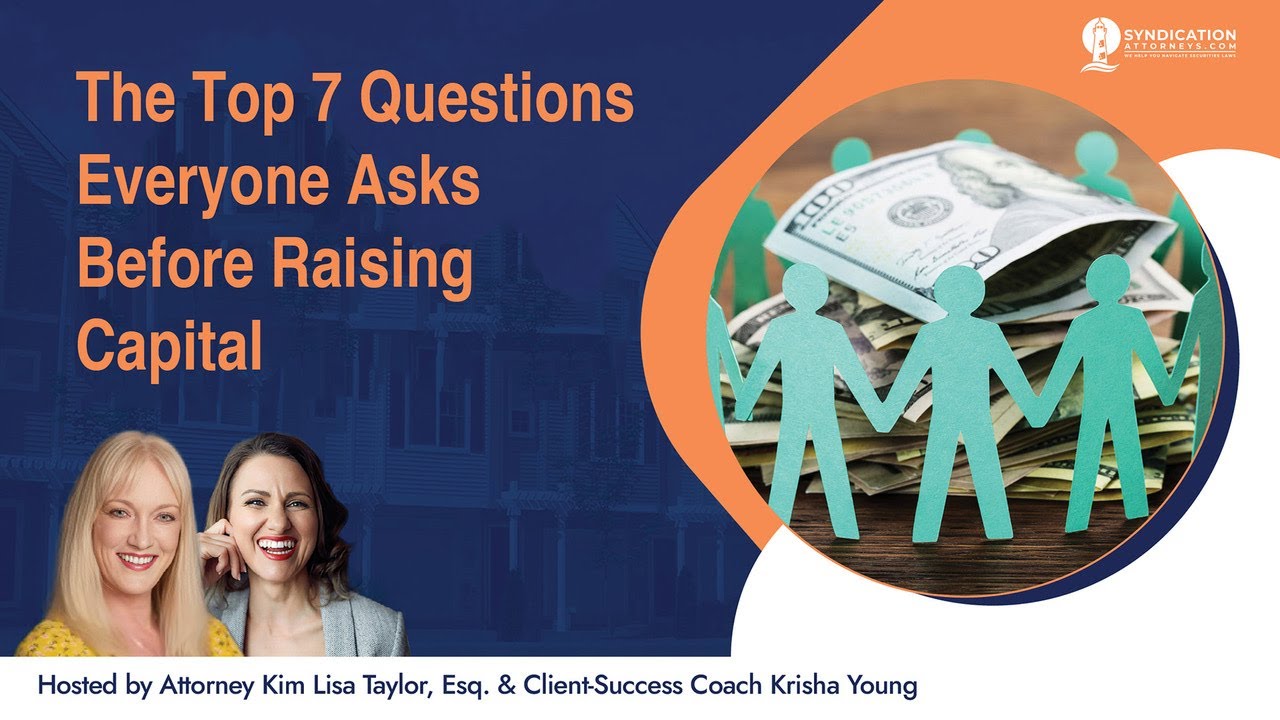
In this 2025 podcast episode of the Raise Capital Legally show, Krisha Young (business development director at Syndication Attorneys) interviews firm founder Kim Lisa Taylor. They walk listeners through the most common misconceptions and practical questions that real‑estate syndicators and fund managers face when raising capital. The conversation begins with a historical overview of the Securities Act of 1933 and the creation of Regulation D, then dives into the two primary exemptions—Rule 506 (the “country‑club” rule) and Rule 506(c) (the advertising‑allowed rule). They explain how to determine whether an offering is a securities offering, the definition of an accredited investor, and the verification process (letters from attorneys/CPAs, third‑party services, and the 1‑million net‑worth/200‑k income thresholds). The hosts stress the importance of establishing a substantive, pre‑existing relationship, conducting suitability interviews, and maintaining detailed record‑keeping to satisfy SEC requirements. They compare different capital‑raising structures—syndicates (single‑property offerings), blind‑pool funds, series‑LLCs, and “flex” or customizable funds—highlighting when each is appropriate and how investor allocation works. Practical compliance issues are covered, including audit obligations for non‑accredited investors, fiscal‑year timing, and limits on the number of non‑accredited investors (35). The episode also recommends investor‑management platforms (Cashflow Portal, InvestNext) that provide CRM, document storage, and accreditation verification. Finally, they discuss pending legislation—the INVEST Act (HR 3383)—which could expand the accredited‑investor definition, introduce an exam‑based accreditation path, and affect disclosure rules. Throughout, the hosts emphasize best‑practice habits, resources (books, mastermind groups, vendor referrals), and where to get further help.
Chapters
Hello and welcome to the Raise Capital Legally podcast and YouTube channel, your go-to source for insights on raising capital the right way. We dive into topics that matter most to real estate syndicators and fund managers with live Q&A opportunities before we wrap up. I'm Krisha Young, your co-host and business development director at Syndication Attorneys, and joining me is attorney Kim Lisa Taylor, the founder of Syndication attorneys. Now, before we get started, please note that audio and video from this event will be posted on our podcast platform, YouTube channel, website, and social media, and will be made available to the public. You can go ahead and ask questions at the end of the broadcast by raising your hand or typing it in the Q&A. Now, information discussed during this event is of a general and educational nature and should not be construed as legal advice. Now, today we are going to discuss us some generally asked questions, misconceptions, myths, unknowns that we hear on our sales conversations from clients that come into our firm. Hey, Kim. Hey.
Hi, Krystal. Hey, thanks for joining me today. And for all of you who joined to hear AJ Goyle about his medical practice, we're sorry that he wasn't able to attend. He had— he is a physician. And he had an emergency that he had to attend to. So we will go ahead and fill in the time with some of the things that we think are super important to you guys. Also, there's some pending legislation that could be a big deal. So we can touch on that. It's, it's only partially through the process. So let's start though with Krisha. If you guys don't know Krisha very well, she's been with our firm now for a long time, and she is one of our, um, most highly valued team members. She's our frontline person, right? So we push Christiana out in front. She's the one you're going to talk to first. Uh, she'll introduce you to our products, to our services, uh, to what we can offer as a firm. And, uh, she's also very, very knowledgeable. She's a mindset coach in her own right, and, uh, she's getting ready to publish a super exciting book.
Yes.
Yeah. So, uh, we're, uh, you know, we're really glad that she's part of our team, and we always like to have you get to know her. Um, and that's why she's one of our co-hosts on the podcast, but she's also an excellent interviewer. Um, so we, we love her for her skills, but today we're gonna turn the tables and we're gonna interview her. I love it.
I love it. Thank you for that intro, Kim. It, it's such an honor, um, being part of this team. I love it so much, and I think, I think it's going on like 3 years now. So I don't know, I've kind of lost track of time, but yeah, yeah. And, and I, and I'm so grateful for, um, how much that you have taken my skill sets that I don't even know that I had and highlighted them. So I'm, I'm really grateful to be here. Thank you. And you're such a great leader.
Oh, thank you.
You, you gotta, you gotta mention in my, uh, in my, um, appreciation in my book. You don't even know that.
Okay. All right. So, Kusha, you being the frontline person, you're seeing, you know, you're hearing from the people that contact our firm. What is it that they, you know, what are their concerns? What are their questions? You know, what are the things that seem to be most, you know, maybe confusing or just Uncertainty. And let's hear what some of those are.
Yeah, so I've made some notes here, and I can run through the list, and then we can pick whichever one we want to start with. But generally speaking, there's a lot of misinformation, I should say, or myths about what 506 means and what 506 means, and that Like that, some people don't understand that they're doing what's called a Reg D offering and that there's exemptions under that. They don't know the terminology. And then there's confusion about, well, I'm only raising from friends and family, so I don't, I'm not doing a securities offering. So, what is a securities offering? So, those are 2 questions there. I get asked a lot about timing. When's the right time to hire you guys? Like, am I too— I'm probably way too early, you know. And a lot of people use the word fund in place of what we would call a specified offering or a syndicate. I do get asked about fund of funds quite a bit, actually. A lot of people think that that's a really easy way to go and raise capital. And what entity are needed. So I would say those are the top ones, I think, for— I think we could fill the whole hour with that.
We can pretty much fill the whole hour with that. But I do want to make a note of the pending legislation as well. And I've been taking some notes here. And I'm just trying to think if there's anything else. It'll come up in the course of conversation as far as other things that people are asking me about. But okay, so Rule 506 versus 506, that's probably one I should answer. Okay, so Regulation D. So here's what it is. Let's start all the way back at the beginning. Securities Act of 1933 came into being after the stock market crash that facilitated the Great Depression. And what it was about was protecting retail investors because a whole bunch of people had been swindled out of money. They lost all their savings. And then they said, we didn't know there were risks. We didn't know that we could have lost our money. Nobody told us about this stuff. And so the Securities Act of 1933 was born, which defined what are securities and also what kind of information has to be provided in order to protect investors and also made violations of securities— securities violations became a federal crime. Prior to that, it was handled individually at the state level. So it became very easy for someone to commit fraud in one state and then hop over to another state and do it again, and the prior state didn't have jurisdiction over them. So when they made it a federal crime, then all of a sudden the SEC was born. Securities and Exchange Commission came shortly after the 1933 Securities Act so that it could now take jurisdiction over all of these crimes and violations on a federal level. And so the Securities Act of 1933 is still alive and well. It has been modified many, many times. You can still look it up online. You can look at the current version and see what it says. But in the Securities Act of 1933 is a definition of what's a security. Because, you know, I mean, common usage, security means, you know, the cameras and the Ring doorbell at your house, right? Right.
I don't even think about that. I'm so ingrained in what these types of securities are.
Yeah, and so, and it's a little bit different nomenclature also because, you know, we call them securities, not— you can call a thing a security, but it's really documentation. It's paperwork. It's an agreement. It's a contractual agreement between the person who's raising the capital and the people who are contributing the capital. It forms the framework for what kind of an agreement they're going to have with each other and what kind of promises they're making to each other within that contractual agreement that have to be honored. So in the case of real estate investors, there's several rules that apply, but the primary rules that people use is something called Regulation D. And underneath Regulation D are 2 subsections. One is called Rule 506, and the other is 506. So when new legislation is passed, this becomes the, you know, the legislators say, okay, we want you to do this, and they then delegate that out to the appropriate agency or department that handles that. So the Securities and Exchange Commission is an actual commission that is tasked with then creating the set of rules that implement that thing that the legislators want to pass. So if there's a new rule and they say, oh, we're going to raise the definition of accredited investors to, you know, include these higher financial qualifications or whatever they say, or we're going to add some new provisions, well, they're just going to hand that to the SEC and just say, do this. And then the SEC has a certain— first of all, there's a waiting period. They have to put everything out for public review for a certain period of time, usually. Well, actually, I'm getting ahead of myself. The SEC then would have to implement the rules on how that— the actual specific procedures on what we're going to be looking for, what the specific rule is. And then before that can become final, they have to propose a rule. They have to put it out for public comment for at least 90 days, and And then they have to assimilate the public comment into their final rule, and then they issue the final rule, and then that sits out on the Federal Register for a period of time before it becomes effectively law. So that whole process can take about a year. So just because the legislator said you can now do this doesn't mean you can immediately go do it. It means now the SEC has been tasked with creating the actual specific rules, and once those rules are passed, then we can do it.
Okay, that makes sense because you want to like— they, they need to massage it. They need to see like, how is this going to work if this, then that, right? Like, need to apply it to like real life scenarios. So I could imagine it could take a while before they say, okay, yeah, rubber stamp it and now we're good to go. And then it goes out to the public, I guess.
Well, and there's also big players that are going to be commenting on all of this stuff along the way. We've got FINRA, which is the self-regulatory agency for financial service industry, and they, they kind of serve in a quasi-government role where they do their own enforcements versus deferring everything back to the SEC, which has a lot of other jobs. And, you know, so there's— and then also the states, there's 50 securities divisions. There's actually more like 63 because there's one for every state plus every territory, commonwealth, or, you know, any other U.S. holding.
Wow.
Uh, so they all, um, they all have their own set of rules. Um, and even, you know, there's, there's something called the North American, um, Securities Administrators Association, NASAA, which also includes Mexico and Canada. And they all meet. And, uh, you know, Canada has its own set of rules that are sometimes you know, very similar to ours, to our Regulation D Rule 506. So, so it's kind of a long answer how legislation happens. The— so the regulation was what the SEC created. We're going to create this regulation. Underneath this regulation, we're going to have a specific rule. There are multiple rules that you could raise money under. Rule 504, we don't hardly ever do Rule 504 offerings, but you can do them. You can raise up to $5 million, I think the limit is. Uh, might even be 10. I just don't keep up with it because nobody ever wants to do it. Because then the reason they don't is because you still have to comply with all the individual state laws, and it's really— and you actually have to get state preapproval. Um, but then, uh, in some cases you can actually advertise. So, you, you know, most people don't want to do it because our clients are— come from a nationwide database. They go to these nationwide training events. They learn how to raise capital. They know people in many, many states. They don't want to try to limit it to 2 or 3 states that could review and approve. approve it, and then they're just only can raise money in those states. So with the Rule 506 is more popular because it allows you to do that. It allows you to raise money from people anywhere in the United States, doesn't restrict what, you know, where, where you can raise money from, and it preempts all the individual state laws. So that just means that nobody, no state can say, oh, and, you know, by the way, they can't, you know, the investors from our state can't invest more than 10%. of their net worth or something like that.
Right.
In addition to whatever rules Rule 506 has in place. So originally there was just one Rule 506, and it came out because— came about because people were saying, why can't I go raise money from my family and friends? It was actually originally kind of called the country club rule, right? You know, so somebody in the country club, hey, what are you investing in? Oh, I'm investing, I'm buying this multifamily property. And then their buddies are like, well, we want to do that. And, you know, prior to the 1980s when Rule 506 was born, there wasn't a way for them to, for anybody to be able to legally do that without going to the SEC, getting preapproval and getting their blessing, which is a long and expensive process. And they didn't have time to do that when they're trying to close on a property within 90 days. So that's when the SEC relented and said, okay, we'll create this rule that if you just do it word of mouth to people that you already know, who includes your friends, your family, your acquaintances, So, and you're not doing any kind of public advertising, then we'll allow you to do that with this close-knit group of people. Okay, so that's where the Rule 506 came from. So the actual rule is that you can— you don't— there's no limit on how much money you can raise. There's no limit on how many accredited investors you can have in your deal, so you don't have to count. Accredited investors, and you're allowed to have up to 35 non-accredited but sophisticated investors. But you cannot find any investor through any means of general advertising or solicitation. So that means that you cannot put social media posts out. Of course, remember in the '80s when this came about, there was no such thing as social media advertising and email blasts and things like that. So, you know, but at At that point, you know, you weren't allowed to advertise it in the newspaper or, you know, on the radio or the media avenues that were available at that time. Well, now here comes the internet. Everything explodes. Everybody starts doing everything online. People start complaining, hey, why do I have to do this? But the way to prove that you didn't solicit to the public is to be able to demonstrate that you didn't talk about your deal. If it's a fund, you didn't talk about your fund. If it's a syndicate where you have a specific project under contract and you're offering specific returns, you didn't talk about that specific offering to anybody that you hadn't already established a preexisting substantive relationship with. Okay, preexisting means it predated your offering. You had that relationship in place prior, but it also had to be substantive. Substantive means You had a conversation with that person, or you or someone on your team had a live conversation with that person and talked to them about their suitability. This is the SEC word, suitability, to participate in your offering. And what does suitability mean? It means how sophisticated are they? Do they meet the definition of an accredited investor? If not, are they sophisticated? There is an SEC definition for sophisticated. Do they meet that? And it's really— I like to simplify it to say it's more than somebody with savings and a job. They have to have some level of investing experience, maybe heavily invested in the stock market, own their own real estate, investment real estate in the past, have, you know, owned businesses, own their own business now. You know, they're a CPA, they're an attorney, they're a financial advisor, you know, something who— or someone who's been through a training program on how to buy the asset class that you're buying. And they are looking, you know, they're at that training program looking to meet other people that they can invest with. So, you know, it has to be something more than just savings and job. And they're going to tell you in their own words why they feel like they meet that definition. The true definition Is someone who, with the help of their— either on their own— the actual definition for you here.
Yeah, because they're going to be getting like a huge packet of documents that they need to— like legal documents that they need to read, understand. But not only that, that they're handing over money that there— it is at risk. Hence why these laws are here, you know. Like, there is still a risk. Just because the law is here doesn't mean that there's no risk anymore, right? It's just like now you are made aware of the risk. You've signed your name on the fact that there's a risk, you know. Like, you can invest this $100 grand or whatever it is, and you know that you might not get that back. Maybe, you know. Like, but so you have to be sophisticated enough to understand that, right? Is how I—
Well, and not only that, it's more about can you withstand the loss if it were to happen?
Right.
You know, are you able to recover from that? You don't want to take somebody's last $50,000. You don't want them to depend on your returns to pay their bills. You know, so that's part of what you're asking is, you know, is this going to be something that you could even handle? And, you know, if it— if the worst were to happen, is it going to be financially devastating for you? Are you going to be able to recover? So their true sophisticated rule is to be sophisticated, the investor must have either alone or with their purchaser representative such knowledge and experience in financial and business matters that they are capable of evaluating the merits and risks Of the prospective investment. So back to what Krishna said, reading this pile of documents, understanding what it means, and the issuer's responsibility. So you, if you're the one promoting an offering and you're creating a company, that's going to be called the issuer of the securities. That issuer has sufficient; it has a reasonable belief based on a factual inquiry. that the non-accredited investor falls within this description.
Right.
Okay, so you give them the definition, hey, this is the definition, do you meet this? And then they'll say yes or no. If they say no, then you're not going to be able to help them with a Rule 506 offering. There are some other exemption types that we might be able to help you with, and then you will be able to determine whether or not, you know, ask them, well then, how, how do you feel like you meet this definition? What, what is your background and experience? And And where did you obtain that?
And you can't feed them the information. You have to just, like, hear what they have to say and then write, write it down. Like, you're not getting involved in sort of, like, guiding the people in any way, shape, or form.
Well, and even when you're having the initial conversation, you can ask those questions, and you should. But the 3rd part of that preexisting substantive relationship— okay, so one, they had to either be accredited Or they had to be sophisticated and you determined their suitability, whether they could withstand the loss. But you also want to talk to them about the kind of deals you do and the, you know, kind of general returns you have and the duration, to make sure that all matches their needs. So you have to decide whether their investment goals match yours. Somebody tells you, oh, I only want to be in a deal for 2 years, then, you know, you don't want to put them in a property where you're going to own it for 5 to 7 years. It wouldn't be suitable for them. So you've got to figure out whether or not there's a place for them in your deal. And if there is, make sure that it matches their needs. But you also, then the third part of that, are they accredited? Are they sophisticated? They match those tests. Are they suitable? Yes. Then you have to have a recordkeeping system to prove that you had the conversation and what was discussed. So, so that you can say, no, I talked to them on March 13th and I didn't make the offer to them until April 1st. I didn't tell them about the deal. I just talked to them in general about their sophistication and, and whether they were accredited. So basically comes down to you have to know that information first and you have to have documented when that call occurred. The SEC does not believe that this can all happen through an exchange of forms, of electronic forms. That those aren't relationships, that's just data. And you have to actually have that conversation. During that conversation, the practical thing You know, what that happens is you're going to get a sense of whether this is something that's right for this person, or if this is more like, is this somebody I want to do business with and have them in deal for the next 5 years?
Yeah.
Because if you already are getting a distaste, um, for things they're saying or the way they're saying things, or they act like they know more than you, or they seem like they, you know, just might not be an agreeable, uh, investor in a group setting, then you would want to be able to rule them out just based on, I don't think this person's good fit mentally or, you know, psychologically, or just not a good fit for me because I don't like them, you know.
And that's important because, you know, especially when you're just— if you are doing a C offering, which we haven't yet talked about, but where you're just doing that general solicitation, you're just like, hey, anybody come into my deal or whatever, as long as you're accredited, there's still a relationship that needs to get developed there. because you're going to be in business with this person for a long time, for a long time. So I think you want to have, like any business, like any kind of customer, like anybody that's in your sphere, you want to like vet them to a point where you're like, okay, yeah, I can, I can work with this person, you know. And they're not like giving you the ick or, you know, making you— making, you know, if they have like a blaming type personality or something like that, you, you'd want steer clear of that, I think.
Well, and, and one of your suitability questions might be, have you ever been in a deal that went bad? What happened? You know, and if they start talking about, oh, I sued this guy and I sued that guy and I'm in 7 different lawsuits, well, maybe you don't want to be in business with that person.
And you're like, thanks for letting me know.
Good luck with that. Bye. Yeah. You know, and, and it doesn't mean that things don't go wrong. And, you know, how many marriages fail, right? That's kind of partnership too. But, you know, and, and And there are some statistics out there that say that somewhere like 50 to 70% of partnerships fail. But largely they fail because there wasn't a meeting of minds in the beginning and probably not clear documentation on who did what, who got what. And, you know, and, and then also holding each other accountable and actually paying attention to what each other are doing and making sure that nobody's taking advantage or doing something they shouldn't be, stopping them early. Okay, so you gotta stop people early.
Well, that brings me to the question though, like the, the, the one that people are I know we still need to talk about C, but I'm just raising money from my friends. I'm just raising money from my family, or I've only— I've just raised money from friends and family, and now I'm ready to do a securities offering. That's still a securities offering. This is literally called the friends and family, right?
Yes.
And so even with that, so there's, there's like this other thing that, that like it's still a securities though, even if it is your besties. That you're raising.
Yeah, that's right. That's right. And, and you know what? It's not the people that you know that are going to cause you trouble because you could, you know, hey, this is my golf buddy. I've known him for 25 years. Or, you know, it's my next-door neighbor, whatever it is, but it's not them that you have to worry about. It's what if something happens to them? You don't have a relationship with their heirs. And in their heirs' mind, hey, this person has my parents' money. We want it back. And, you know, or they get a divorce and the, you know, the interests in your LLC go to the spouse and, you know, the original person but not the spouse. And the spouse again may just have a different idea of, okay, I'm just going to cash out all his investments or her investments and, and, you know, live on the cash. So you don't— you've got to guard yourself against the unexpected on both both on the management team side, making sure you're prepared for it within your own group. And if, if you're a sole syndicator, you've got to have some kind of a continuity plan in case something happens to you.
Right.
The same thing is you want to know, you know, that your investors are reasonable and that you are protected in the event that something happens. Somebody else gets control of that investment, could be a bankruptcy trustee who again They just want the money, and they start pressuring you to give you the give them the money when you don't have you know you're you're in the middle of a deal. You don't have the money. You can't give it back. So we've got to make sure that we've guarded you against that stuff. And all right, so let's cover 506C. I know we've belabored this quite a bit. Let's kind of get through it. Everybody complained in 2012, saying, "Hey, why? You know this is the age of the internet. Everybody's advertising on the internet. This is ridiculous. We should be." able to post our deals online, do them. And the SEC said, okay, and we will create a new rule called Reg D Rule 506. So we've just kind of divided 506 into friends, family, and acquaintances, preexisting relationships required, no advertising. And now we're going to give you, slice out a piece of it and say, okay, this, if you do it just this way, you can do the advertising, you can use online advertising. And so 506 says, You can still use the Rule 506 exemption. There's no limit on how much money you can raise, but you can no longer, if you're going to advertise, have non-accredited investors. Everybody has to prove that they're accredited. So in the 506 setting, they can just fill out a form at the time they make the investment. So you're going to have the conversation with them prior. They don't have to fill out a form then. You need to keep a record. You can have them fill out a form, but it's kind of extraneous at that point. You're just having the conversation, you're documenting the conversation, what was said, keeping it in your own internal recordkeeping system. And then for 506, you don't have to have that now, but the investor has to prove by providing you with a letter from someone with technically not— and it's not Absolutely required, but the guidance is get it from somebody with a license— attorney, CPA, financial advisor. If they are accredited, there's a good chance they already have people in their world that can write this letter for them. Although I know my CPA is like, oh, I can't write comfort letters. It's not out there. You know, it's not my, you know, insurance. So you might have to go to a company that actually does that. So CPA, attorney, financial advisor—these third parties—you know—we've got one through our. website that you can go to get verified tab and your investors can go there, get verified. We don't get their information. It all goes directly to the third party that we've contracted with who does those verifications, sends the information directly to either the issuer or to the investor. They provide it to you. So there's plenty of those out there that will do it for under $100. It's just a little extra step for the investor to go through if they don't have their own person Yeah. Because they've got to provide their financial statements or their income statements to somebody to prove they're accredited. Somebody out here might be saying, well, they keep talking about accredited. What does that mean? It means they have over $1 million net worth, excluding equity in their primary residence, or over $200,000 a year income if they're single, or $300,000 a year if they are cohabitating couple. And that income has to have been for the last 2 years the expectation it will continue indefinitely into the future. So you, you need to— I just call it 1-2-3 rule: $1 million net worth, $200,000 income single, $300,000 if they're a couple. And if you just kind of keep that in mind, then you'll know. There are some additional hoops you have to jump through if you're going to do a 506 offering that you don't necessarily have to do for a C. There are some financial statements that you need to periodically provide. Even if you have a zero balance in your bank account, you've got to provide a statement saying, hey, we put $1,000 in the bank account to open it, and we haven't done anything with it. Here's what we provide to the investors up until the time we close on the property. And then after you close on the property, you need to update that and tell them what actually happened, and you need to keep that current. It's every 120 days, but a better practice would be just to update it every 90 days as long as you're raising money. So as long as you're raising money, if you have non-accredited investors, you can also incur an audit obligation. So you would have to have your financials audited, which is going to be very costly, $20,000 or $30,000. It's going to take up a lot of your time. So how that happens is it's The audit obligation comes into play at the end of the first fiscal year of your offering. So you have to be cautious about what you choose as the end of your fiscal year. If you start an offering in October and you just kind of default choose December 31st as your end of your fiscal year, then—
Okay.
At the start of January, you're— and you're obligated to incur an audit to, to produce an audit, audited financials, if you're going to continue raising money from accredited— non-accredited investors. Okay, so if you, you know, you can either limit the time that non-accredited investors will be accepted to within the first fiscal year, or you can start providing audits and continue raising beyond the end of that fiscal year. So we've got an article about that on our website if you'd like to look that up. that would be really helpful for you to know. But yeah, so there are additional hoops you have to jump through. You've got to give, you know, some biographical information about your track record, your background, and you should be providing the same information even in a 506 offering. But you don't incur an audit obligation in a 506 offering. I would argue that those relationship-building steps, that suitability conversation should be had with every single investor. Regardless of whether it's a B or a C, because that's the only way you're going to know whether you really want this person in your deal. There's a whole lot of people out there that have money that probably have no business investing in these types of deals because they're distrustful. They just like to do their own thing. They want to be running the show themselves. You know, it's just the nature of people. Some of them are suitable, some of them are not. So think carefully about that. If you have that conversation with every single person, then you're going to have a pretty good feel of who you're letting into your life for the next 5 to 7 years. And if you vet them carefully enough, then you won't be letting people into your life that could be troublesome.
Yeah, this is, this is such a huge topic. And thank you for all that. It's so big that on our, on our, I mean, like We have articles on this. We have 2 books that people can go and grab that will tell you more about this. But also we talk about this almost every single week on our mastermind too.
We do.
And we have a mix of people in our weekly— we've got a weekly clients-only mastermind. And you know that anybody watching, if you're not a member of that, you can contact me and I can talk to you more about how you get enrolled in that. But every single week, even with what we call like the legends, so we have some clients who have done multiple deals, they've been with us for many years, they've been raising capital for a really long time, who show up every week and still raise their hand and still ask questions, you know. And then we have people who've never raised capital before. That's why we call it the Pre-Syndication Program. is because, you know, a lot of people just haven't done it yet. And so, they're learning about this, right, while they're going out there and they're practicing having these conversations with investors. And, you know, I've heard you say many times, generally speaking, that, you know, just even if you're doing a 506 offering, to like follow the B guidelines anyway as best practice, right? It just, it covers you in a really deep way, even if you are doing a C offering.
All right. Well, let's go on to one of your next questions, because I think it all ties into what we just talked about.
Yeah.
How do I know if I'm selling securities? How do I know if I'm selling securities? Right.
Yeah. That, because that's the one. Well, it's only friends and family. Like, you know, it's, yeah.
So those things that we just talked about. Regulation D, Rule 506 and are derived from the Securities Act of 1933, and what the Securities Act of 1933 said is if you're selling securities, you either have to register your offering, which is getting pre-approval from the SEC before you offer it to anybody. So that's what happens with an initial public offering, or when a company goes public, that is called registration. Or if you don't have time, or it's not the kind of offering that you, you can afford to go through the registration process, then you have to qualify for an exemption from registration. And that's exactly what Regulation D provides. Regulation D provides these exemptions. We mentioned 504, 506, and 506. 506 is by far the most common exemption used. The SEC receives filings, so there's a form we have to file with the SEC telling them which exemption you're, you're, you're claiming, and then you have to provide the documentation. If a regulator or opposing counsel from an investor dispute ever asks for it, you have to provide the documentation as to how you followed it. So I always say think of this like a tax deduction. If you, you know, have the documentation to back up the deduction you claim to on your tax returns, you're self-reporting, then you are entitled to keep it. But if you're audited and you can't produce that documentation, then you don't get that deduction. There's going to be penalties, there's going to be interest. And, you know, in, in, in the case of an IRS violation, you're just going to get penalties and interest. But in the case of a securities violation, you could get a regulatory investigation. It could become a really big, ugly, horrendous this defense. And so you want to guard against that just by following the rules. The rules aren't that hard. You need to get to know those rules.
Yeah.
But 506 is the most common. The SEC estimates that out of the 25,000 Form Ds that are filed every year, that 90% of them are 506 offerings, and 95% of the capital raised in 506 offerings is through 506 So 506 is still available to you, but you can only— you can advertise to everybody, but the only people that can invest are verified accredited investors. They have to provide documentation that they're accredited before you accept their investment. So they can send you the money. You just don't admit them to your company until you've looked at that verification. You need to make sure that the verification letter they provided matches their subscription agreement. The companies are the same. The check is coming from the same company's bank account. All of that stuff has to jive. And if it does, then you can accept them as an accredited investor. Now, there are investor management platforms out there. Our friends at Cashflow Portal and InvestNext are excellent at helping you gather that information. And they, they even have places where your investors can log in, get their own account in order to invest with you. You can post all your documents. The investors go there in a secure location. they can then actually get accredited, verified as accredited through those portals, and, uh, and then that information comes back to you and stays in their record. So if you're going to be doing this, it's a good idea to consider one of these investor management platforms. Um, our clients love these 2— Cashflow Portal, InvestNext— they love them both. And, uh, you know, we, we just can't say enough about how easy they've made it, um, not only for you to, uh, document whether somebody's accredited or not, but also these suitability conversations because they all have a CRM built in, a customer relations management software where you can keep track of phone conversations you've had and what was said, and that becomes that recordkeeping system that the SEC requires when you're determining whether somebody is accredited or not accredited. In the 506 offering, investors are going to sign a subscription agreement at the time they make the investment that certifies to you In their own words that they are, they do meet one of those definitions. If they're sophisticated, they'll say why. You'll review that as long as you think it's acceptable then and consistent with what you know about them from your prior conversations, then you will admit them. If anything is off, you don't want to admit them. Or if they don't, you know, here's, here's one of the bigger mistakes that a lot of clients make is they don't review the subscription agreements. And then you start looking at the subscription agreements and the person never answered the question whether they're accredited or never answered the question. whether they were sophisticated, um, you know, and then that's going to become a big ugly issue later on if there's a regulatory investigation. They're going to say you didn't know whether these people were accredited or sophisticated, you had no business admitting them.
So you got to think you have to be careful. Yeah, and so, um, I think like there's, there's 2 things going on here when, when you're raising capital for real estate or whatever. There's the business side of the real estate side of things where you're property managing or hiring out a property manager or whatever, but you're overseeing the actual real estate business of that. But then there's this whole security side that you really— you can't be ignorant at. You, you need to understand it. You need to understand the documents. You need to dot your i's and cross your t's for, for both of those businesses, right? And so generally, like, that's a lot of work, right? for one person. So sometimes partnering— I've heard you say that a lot, you know, finding good partners or whatnot in your deals can help like kind of make them go better, for lack of good grammar.
Well, and you need to, you know, think of every time you're starting a new— and let's, let's go into your next question. You said there was some confusion about terminology. What's the difference between a fund and a syndicate? Well, you know, a lot of people just generically use, you know, a lot of trainers. There's people out there training people how to raise capital.
Mm-hmm.
Um, we've got a, a few good friends that we know who are doing this. Um, one of them is, uh, um, Tim Mai has, uh, been doing it for a while. Um, he's actually kind of, um, integrating into the RE Mentor Program and, and gonna be, you know, facilitating some of his training through that. There's also Marcin Drozd. He has his M1 Capital program. So they have a coaching program teaching people how to raise capital, and also Hunter Thompson. So these are people that we've known. I don't know Tim as well as Hunter and Marcin, but, you know, they all have been out there for a while teaching people how to raise capital. And so if you who, you know, need some coaching in that area or want some coaching in that area, that's, that's a good place to go. So fund versus syndicate. So you may hear from them, they may be just saying fund, go raise a fund. And but when you get to us, we're going to try to parse that down and say, well, what do you mean? What are you raising capital for? What is it for one thing? Is it for multiple things? Are they just, you know, multiple things that are like each other? Are you just going to be buying the same asset class over and over? Do you want to have all investors— if you're going to buy multiple things, do you want all your investors pooled in one entity and then that entity goes out and owns those multiple things? Or do you want to have some kind of a separation between investors and properties so that you have a separate group of investors for each property? And so there's different structures that can be used for Or are you going to invest in somebody else's deals? And are you going to do it in a way where you'd like to isolate the investors that say, yes, I'd like to invest in that specific deal from other people in your fund? So there's really kind of 4 different types. I'm not going to spend a whole lot of time going over this because, as Krish has said, you know, we, we could spend the whole time just talking about deal structuring, and, and maybe we will do that at some point.
Yeah.
Let us know if you'd like us to do that, but So blind pool fund, that's the— well, let's start with syndicate. Syndicate is the simplest thing. It's where most people start. A syndicate is what we also call a specified offering. You have something specific under contract that you're raising money for right now. And so, you know, I'm going to— you're estimating I'm going to get a bank loan for 70 or 75% of the purchase price, and then I need to pay all these other things. So you're going to create a whole uses of funds. These are— this is called The sources and uses of funds. Where's the money coming from? How is it going to be spent in order to acquire the property and to implement your business plan for the property? So this doesn't go into cash that you're getting from operations of the company. It's just how much money do I need to raise upfront? So the things you need to raise money for: down payment, closing costs on a property, the acquisition fee for your asset management team, the capital improvement budget for whatever you want to be able to do to that property. So if it's a development project, well, it's your whole construction budget. If it's a value-add project, it's what are the costs for the renovations, estimated costs for the renovations. Then you're going to have some upfront bank processing fees. They're going to charge you some upfront fees to do their due diligence on your deal. And to look at all your asset management team's financials and determine who's going to be the guarantors. They're going to look at all of that, and they're going to charge you some upfront fees for that. So all of those things, plus our legal fees— our work has to be done before you can raise any money. So we need— we ask for our payment upfront so that we can get your stuff done as quickly as possible so that you can go out and start raising capital. So that's a syndicate is one thing. You're— that's your uses of funds. Your sources of funds are going to be bank loan, maybe seller financing if you have it. If not, you're just going to have 2 line items there: bank loan, cash raised from investors. If you have seller financing, you'll just add a 3rd line to that sources of funds or seller credit that goes into the sources of funds. And then your uses of funds is all the things you need to spend the money on to get the property, plus some operating capital and reserves. And then that number has to match your sources of funds. That's how you determine how much you're going to need to raise from investors. Well, now you know that number, then you're able to, you know, do some further financial projections about cash flow and income and expenses over the period keep, you plan to keep it in, plus your potential exit strategies. I'm not going to get into that either because that in itself is a whole—
It's a whole other topic.
Yeah. But so that's a syndicate, one thing. And maybe you even have 2 things, maybe it's 2 properties side by side, you're going to get separate loans, it's okay. But you're going to have one pool of investors. It's still specified, you know what those things are, you can determine the actual cost or at least the estimated cost. The second thing, um, Is a fund. Okay, in a fund, you don't have anything under contract. You just have a business plan. We call it an investment summary. The investment summary describes what kind of properties you're buying, what you know geographic areas, what criteria they have to meet, what kind of due diligence you're gonna do to and you know to protect the investors, and you know any kind. of proposed returns or anything like that that you might do. So, you know what, that's what a blind pool fund is. Okay. Syndicate, easiest way to raise money. Blind pool fund, hardest way to raise money. What will increase your odds of raising money with a blind pool fund? Bringing somebody on your team that already has significant experience with the asset class you're trying to buy, or actually having a track record. So having done 5 or 6 syndicates with your team, and then your team decides, okay, now we're going to do a blind pool fund. Instead of buying 1 property, we're going to buy 5, and with this 1 pool of investors. So when we hear fund, we think blind pool fund. We're always trying to, you know, determine from you whether that means the same thing to you as it does us, because you may be calling a fund what we call a syndicate. So a lot of our, Chris's initial calls are just trying to determine what it is you're doing. And the way we do that is we just ask you, don't tell us what you're doing or what kind of legal structure you want to use or what exemption, none of that. Just tell us what you want to do. Are you raising, what are you raising money for? Are you raising money from non-accredited investors as well as accredited investors? You know, that's going to help us determine what the exemption you're going to use. And then, you know, how do you want to structure this? So there's another structure. What if we want to just keep buying the same thing over and over, but we want to isolate investors and properties into one, you know, separate groups? Well, then we can do what we call a series LLC, where we create a master LLC that says, hey, we're going to go out and buy a bunch of self-storage facilities, and we're going to create a separate series for each group, each one. And with separate investors in each one. When we get another one under contract, we're going to do another. Each series is created as if it were a separate securities offering. So you'll still— we'll pick for the master, are we going to be— are you doing 506 offerings or 506? And then you're going to continue with that whole series with that exemption. There is an exception where if you run out of non-accredited investors at some point in time, you still can only have 35 across all the series, um, would you— you could at that point convert to a 506, and from that point on you can begin advertising. Um, but you can't go back and forth for each deal. That's a question we get a lot.
Yeah, I get that question too. Can you convert from a B to a C? Yeah, that's another one.
Yeah, you can convert from a B to a C. It's harder to go back, and you can't flip-flop. So it's harder to go back from a C to a B because you have to stop raising money for 30 days and then you can start your B offering. Well, if you're in the middle of a deal, you don't have time for that if you've got a 90-day close. So easier to go from B and then convert to C. You can do that immediately, but we do have to reissue PPM and the subscription agreement for the C offering. It's different than the B, and you would from that point forward not be able to accept any previous accredited— non-accredited investors you'd talked to. And then there's the fund of funds or It doesn't matter. You know, fund of funds just means you're not going out and buying your own deals. You're investing in other people's deals, and you're bringing your investors in your own group. It can get a bit complicated. There are a lot of people that don't think it's complicated, but unfortunately, it is the most complicated way you can raise money. There is something that, you know, has been created in the industry called a— we call it a flex fund. Cashflow Portal calls it a flexible fund.
Okay.
Avesta calls it a customizable fund. What it really is, is we're creating one fund and then we're isolating the investment opportunities by providing, hey, here's an investment opportunity. You invest in our fund, would you like to allocate some of your investment or all of your investment to this specific investment opportunity? And so we would create for each opportunity, an investment opportunity summary that includes a supplement to the PPM talking about specific risks of that deal, how that deal is structured, what you're offering those investors, and a subscription agreement amendment where they clearly designate, I want this much of my money to go to this deal. I've reviewed everything I need to. And you're also going to be providing them with all of the offering documents for that deal you're investing in. So that they have a complete understanding of what, what their investment is being put in. So it's, it's a lot more work in some ways for you because you have to gather the, the offering documents from the other people. You're doing your own securities offering, and now you have to further get these investors to designate a portion of their funds towards this specific thing. The other thing I would caution you against is if you don't understand underwriting deals, This is really dangerous territory because you have to understand and be able to, you know, vet every deal that you're offering to your investors yourself to make sure it's a good deal. And if you haven't done that and that deal then fails, then you could be easily held negligent for not having done that correctly.
Wow.
So I think we've kind of talked about, you know, the entities are all going to depend. Are you doing the blind pool fund? Are you going to do a syndication? Are you going to do a series offering, or are you going to do one of our flex funds? The entities will be slightly different for each one. They're all basically, you know, pretty much have the same basic foundation. And I do want to— I know we've only got 4 minutes or so. Do we have any questions, Krisha?
Nothing in the Q&A, just James, will you put the platforms in the chat? Yes. Yes, I can do that.
Okay, so let's just spend the last 4 minutes talking about the INVEST Act. So the INVEST Act just went through the House, has not yet been to Senate. It has— let me see if I can get you the link to that.
While you're looking, for anybody here live, I've put the Trusted referrals or our vendors tab, and that's where you can find InvestNext, Cash Flow Portal, and any anyone else that we you know refer our clients to. And I also put an article in there how to create a substantive relationship that is found on our website just to. round out the discussion and the information about a 506 offering and what to do. And we cover a lot of this in our mastermind too, in our books.
And I mentioned underwriting. And so one of our preferred vendors, in fact, one of the top ones on our list is Commercial Underwriting. It's a— Bob Bowman is the proprietor of that. He's created a commercial underwriting software that will work with any asset class, and it comes with a tremendous amount of support and training. Training. Bob and his wife Diane are very, very knowledgeable in the commercial real estate investing space. They've invested in a lot of different commercial asset types themselves as well as taught it for years. And so if you're maybe with one of those capital raising coaches and you feel like, well, I'm not really— they're not really teaching me the underwriting part of it, which is where you're usually getting that from, uh, you know, some kind of a real estate training program, then you may want to check out Bob Bob's Commercial Underwriting. If you go from our trusted vendor page to any of these links, they will offer you a discount. We always try to negotiate a discount for our clients to go there.
Yeah, so we interviewed Bob too recently, so it's also in the last—
In our podcast, we've interviewed Perry Zhang from Cash Flow Portal.
Yep.
I don't know if we've interviewed InvestNext, but we know them and, uh, they're Reputable people and absolutely loved by some of our clients. All right, let's talk quick about the INVEST Act. So this is HR 3383 called the Incentives, New Ventures, and Economic Strength Through Capital Formation. It's, it's funny what words they try to put together to write out the acronym they want. The Invest Act. So nobody ever knows it by anything except the acronym. But anyway, so it's getting some— it's been floating around there for years and years. It's actually finally getting some traction now. So this is a good thing. Title 1 is called Expanding Access to Capital for Small Businesses. So it really kind of caters to people who are raising for small business, not necessarily as helpful for people who are doing real estate. Title 2, though, talks about increasing opportunities for investors. And I did just put the link to that summary. Then also, you know, you could go online and you can find the full text if you'd like. I just realized it's not fully implemented yet. It could still change when it goes through Senate. There's, you know, certainly it could change substantially. So don't get too excited about it. Just kind of be aware that it's on the horizon. And if it does pass, it's going to be a big deal.
Um, but Title 2, the law as it is today.
Yes. And again, even if this legislation passes, it still has to go through the whole regulation, regulation creation and rulemaking process. And they have actually— if it passes, SEC has a year to implement it, right? But you still wouldn't be able to do it for a full year. Um, so, uh, but the, uh, Title 2, uh, increasing opportunities for investors includes, uh, expanding the definition of accredited investor, uh, to include inflation-adjusted net worth and income tests. So that could all of a sudden not be such a great thing because no longer might it be $1 million worth of net worth, it could be $3 or something else. Uh, there was a report that came out last year that said if the, um, criteria used when it— the rule was originated was applied today, uh, 10% of the population at that point was considered to be accredited. And if we were to apply those rules today, it would be $3 million net worth test and the income requirements would be like $360,000 or, you know, $600,000 something. It was a lot more than what people have had to do so far.
Yeah.
But it could allow certain licensed professionals and individuals with qualifying education or experience. So maybe open it up to attorneys, to CPAs, other financial professionals that might qualify. just by virtue of their profession. It also could require SEC to establish an exam program for people who want to test to become accredited. Those who pass the exam could be accredited. There is also a senior investor task force who is going to be used to study and report on issues affecting investors over 65. So there we might see some limitations on who can invest over the age of 65, and maybe they have some different criteria.
Wow.
And then also improving disclosure for investors. So that allows electronic delivery of documents, but— excuse me— so some certain rules that would go into place regarding that. We don't know what those would And then also expanding closed-end investment companies' ability to invest in private funds. This is a little different because there's a whole regulation around somebody who wants to become an investment company, which is a completely different set of criteria from what you guys are following now. So just keep an eye on this. It's, you know, really designed to help help, you know, kind of facilitate the private markets and capital raising that individuals can participate in. So it could be a big deal. And we will, of course, keep you informed.
Yeah, well, definitely on our newsletter, I'm sure. But, but for sure in our mastermind too. Yeah.
And so sorry for all of you who came on to see AJ. He had an emergency. He wasn't able to participate today. But Krish, I think this has been tremendous.
It's been great.
You know, information that we know our audience likes to hear, and the more you hear it, the more it starts to gel. If you want to even gel it further, go on our website. And if you haven't already gotten one of our books, How to Raise Capital for Real Estate Legally is the second book I wrote. It's a little bit more encyclopedic. The first book I wrote is How to Raise, uh, Legally Raise Private Money. It's really a, it's kind of a step-by-step guide for syndication, shorter read, about half as long. Um, so, you know, if you look up my name, Kim Lisa Taylor, on Amazon, then, uh, you can get those books will pop up and, uh, you can decide whether to get one or both of them. But, uh, you know, maybe you want to read it on Kindle instead of, uh, getting, you know, a PDF version or, or, uh, something. Then that would be a way to go. Um, but yeah, I suggest everybody who's in the capital raising business have this one on their desk as a reference. Yeah, uh, we would love to have you have that.
The big guy, the big guns. This one.
Yeah, and it's going to tell you all about the things that we just talked about as well. Uh, so thanks so much for coming today.
Yeah, thank you everybody. We had, we had a nice, nice attendees.
Yeah.
Healthy numbers. So that's amazing. And I put all of the links in the chat. My, my email, if anybody wants to reach out, is krisha@syndicationattorneys.com. Thank you.
Yeah. And if you want to, if you want to get a paid consult with me or with Jason Hargadon, our business attorney, those links are there as well. Just go to syndicationattorneys.com. And click on the schedule consultation. You'll see some options there. But Krisha is always our frontline. She can help steer you in the right direction, and she gets a lot of really great reviews.
So, yeah. Yes, thank you, everybody.
All right, thank you. Thanks all.
Bye.
Have a great day.
All right.










