Unlocking Energy Wealth: Troy Eckard Explains Mineral Rights as Alternative Real Estate Investment
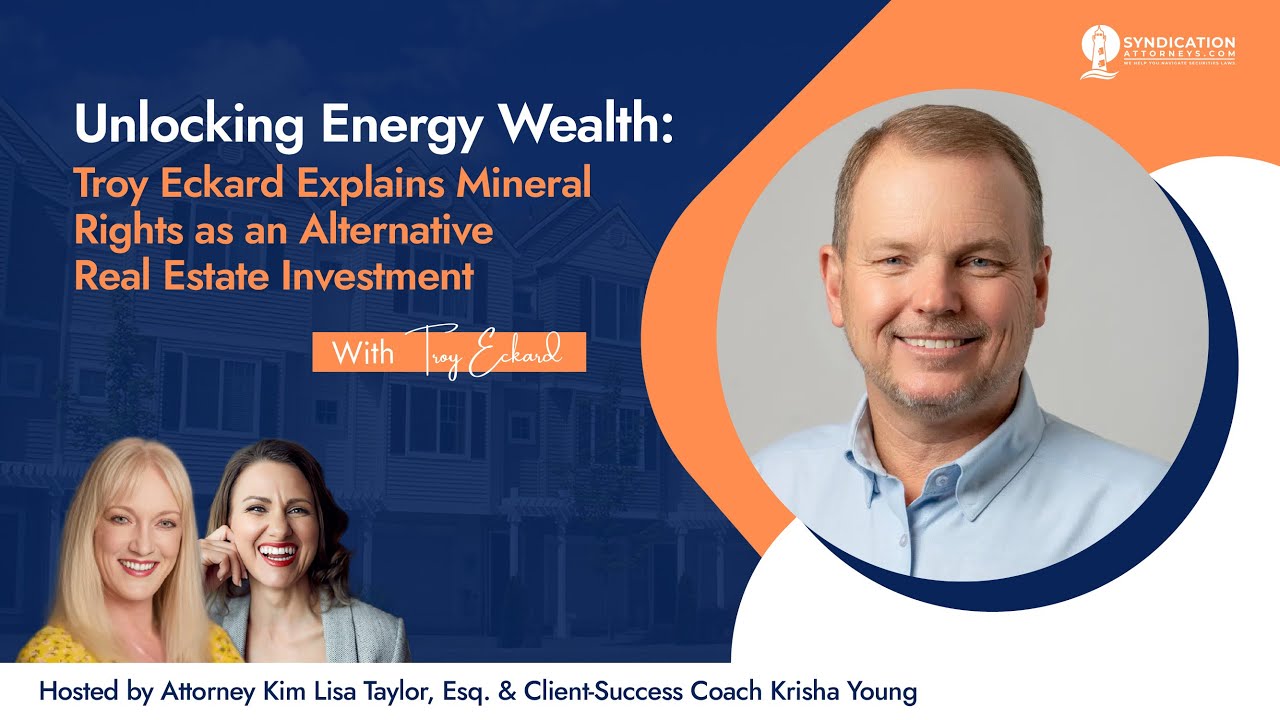
In this episode of the Raise Capital Legally podcast, host Kim Lisa Taylor interviews Troy Eckard, founder of Eckard Enterprises, about using oil and gas mineral rights and working‑interest drilling as an alternative real‑estate asset class. Eckard explains how mineral rights differ from traditional real‑estate, why they are undervalued, and how his firm educates high‑net‑worth investors to view them as a cash‑flow, tax‑advantaged investment. He outlines his business model: direct fractional ownership of producing mineral tracts, purchase‑sale agreements that give investors true title, a proprietary "Eckerd Insights" app that provides real‑time deed, production, and API data, and the ability to use 1031 exchanges and self‑directed IRAs for tax efficiency. The conversation covers capital‑raising philosophy – the need to underwrite deals, educate investors, and maintain credibility – and how AI is reshaping investor screening and due‑diligence. Eckard shares his track record (about $1.25 billion raised in the last six years, aiming for $10 billion in assets within five years) and growth tactics, including a P2P marketplace for secondary sales of mineral portfolios. He warns about fraud, the proliferation of AI‑generated offering documents, and the importance of vetting sponsors, emphasizing fiduciary duty and the necessity of deep industry expertise. The interview concludes with practical advice for both sponsors and investors on relationship building, liquidity, and navigating a volatile macro environment.
Chapters
Good morning, everyone. Welcome to the Raise Capital Legally podcast and YouTube channel, your go-to source for insights about raising capital the right way. We dive into topics that matter most to real estate syndicators and fund managers with live Q&A opportunities before we wrap up. I'm Kim Lisa Taylor, your host. I'm I'm reading Krisha's, so I'm not Krisha. I am the founder of syndicationattorneys.com, and joining me today is Troy Eckard, who's been a guest on our show before, but we're super happy that he's come back because he is like the uber entrepreneur. And we can all learn something from Troy about being a steadfast entrepreneur and just continuing to increase business over time. So before we get started, though, please note that audio and video from this event will be posted on our podcast platform, YouTube channel, website, and social media, and will be made available to the public. You can ask questions at the end of the broadcast by either raising your hand or typing it in the Q&A. If you do raise your hand, then your voice will be recorded and, and put out there for the public. If you'd rather just have the Q&A, we can just use your first name. Information discussed during this event is of a general educational nature and should not be construed as investment or legal advice. So joining us today, Troy Eckard of Eckard Enterprises. Topic is Unlocking Energy Wealth. Troy explains mineral rights as an alternative real estate investment. So Troy, welcome to the show.
Hey, thanks for having me again. It's great to see you.
Yeah, you too. You too. So we've been kind of chatting before the show, and Troy is telling us that while the rest of the real estate market is kind of in a slump, Troy is doing great business and his business is exponentially increasing. So we want to learn what's going on with him and how is it different. And so tell us about your fund and what its purpose is and what you do that's different than everybody else that just buys buildings.
Yeah, I think the main thing that I find with investors is that those that are very focused on traditional real estate, you know, sticks and bricks and vertical and land and farm, fail to recognize that the natural resources below the surface, which is called mineral rights, can be equally, if not exponentially, more valuable. And so because it's not the mainstream kind of asset class, most people never give it consideration. So when you talk about it, it's almost talking like a witch doctor. You know, here's how you get cured. You take this peeling their fine. But as we begin to educate and we begin to discuss with traditional real estate investors the nuances and the advantages of owning oil and gas mineral rights, the light bulb goes off. And now they see it as a complete integration of their assets and their portfolio by saying, how do I move in and out of traditional real estate into mineral rights, the cash flow, the tax benefits? And all of a sudden the light bulb goes off and it's a whole new asset class they've never considered before. So What we've done for the last 7 years is we've focused on education, information, and making people aware. And that's created an unbelievable vacuum of interest by wealthy investors, high-income earners into the energy space.
So how did you learn about doing this? You know, I mean, easy to learn about how to buy a multifamily apartment. Everybody understands that. We've all lived in one or know someone that's lived in one, and we get the whole concept. How did you learn about mineral rights?
Well, I grew up in a fairly poor family and I didn't know anything about oil except for the 30-weight oil I put in my truck that leaked oil when I was a kid. So I happened to have a stepbrother that had found himself in the oil and gas investment world owning a small brokerage firm in Dallas in 1985. And in college, he stopped by. I hadn't seen him in a couple of years and I met him up at the IHOP and he goes, you look horrible. You got fever. You're skinny as a rat. Your hair is long. I said, man, I'm just, I'm starving trying to get through college. Get my degree in economics and finance, but I've got 3 jobs and I'm starving to death. He goes, come to Dallas. I'll take care of you. You can go to school in Dallas, but let me get your license and teach you how to be an investment broker in oil and gas. And I'm like, how does it work? Well, you call wealthy people. They want tax write-offs. And I said, I can't get $20 out of my parents. You think I'm going to call somebody on the phone with money? And he's like, well, there's a way to do it. So, being the kind of what I call putzer as I am, I went to Dallas. Got involved. Took me 2 or 3 months. I just, I thought, there's no way I can do this. I don't understand. It's beyond my scope. But I was always into the details. So, I would go out to the rig. I would go out to the wells on the weekend because I was single and I was a kid. And I'd go spend time out in the field. So, when I came back to the office, I'd be talking to investors who had either been involved in oil and gas or had heard about it but never invested. And they were like, so, you really been to the rig? No, I was on the rig. I was there yesterday. Here's what it looks like. And they're like, No one I ever talked to really goes out there. They just talk a good game. And so, I learned early on there's a huge differential between the oil and gas industry and capital. The oil and gas industry has no respect for money, in my view. I've been doing this 41 years. And the investors out here know that, but they also know there's huge advantages both in income and tax write-offs. So, you had this separation. Money wants in, big guys just want your money for you to shut up and sit in the back of the car. They want you to buy their stock and the bonds, but they don't really want you to make the money. I figured if I could create a path that allowed me to educate investors how it worked, and I could go out and figure out how to compete with larger companies by aggregating capital from high net worth investors, I now could play at their level with partners who could finally understand how it worked. So, I've done that for 41 years. And I think we finally got the, as they say, we finally got the recipe right about 8 years ago. And it had all the right ingredients came together at the right time. And that's how we've been successful the last 7 years. It was, Perfect timing, 40 years of expertise, and finally making that right recipe.
So here's what I heard, and this is something that we teach all of our clients just about capital raising in general. Number one, you got to learn the business, right? You got to learn how to underwrite the deals. You got to know what you're selling and you have to understand it. So for everyone out there that thinks you're just a capital raiser, if you don't know how to underwrite deals, you don't know how to explain to investors what they're investing in, they're never going to invest with you. They don't think you know what's going on. So you've got to get out and get in the trenches. Number 2, you're not selling, you're educating, right? So you're teaching investors how this works when nobody else is teaching it. And instead of just trying to pitch a deal, hey, you should invest with this, it's a great return, you're actually explaining to them how the business works and you're creating a model they understand so that they understand exactly what they're getting when they invest. So, you know, you can all learn from that. Troy, just like ballpark off the top of your head, how much money do you think you've raised over your career?
Over my career? Ooh. We've done $1.25 billion in the last 6 years. So, before that, we averaged maybe $20 million a year. So, I'm saying probably $1.5 billion. But after 35 years of being in the trenches and trying to figure out the right concoction, the right recipe, When I got it all right, we've done $1.25 billion in the last 6 years. We'll probably be over $1.3 billion by Christmas. We'll do $100 million between now and the end of the year, $100 million. And I think next year, the way things are going, we'll do about half a billion next year. And then our strategic plan is we'll average a billion a year starting in 2027 and higher. We think we'll be at $10 billion in assets within 5 years. And it's all because of what you said. It's all because of, you know, And you try and you fail, you try and you fail, you try to figure out the right mix. But I mean, I'd be more than glad to share to your audience the problem with capital raising. And I said this in a Scottsdale event 2 weeks ago. There was a presenter before me. It was a panel of real estate guys talking about real estate. And the host said, how many of you in the audience are raising money? And there was like 10 hands went up. How many of you need help raising money? All 10 hands stayed up. And so, they were talking about it and I'm listening and I'm the next speaker. I get up, I said, well, I have no offense to anybody that just spoke. But why do you think you're having trouble raising money? Nobody answered. I said, I'll tell you why, because your deal sucks. See, raise— raising money is the easiest thing in the world. Finding a good deal is almost impossible. So you've got to look at the deal you're raising money on and say, would I buy that? I don't buy things where I stick my hand in a brown bag and go, I don't know any of the details, I have no idea what's inside it, but you want me to put $100 grand into it. I'm not doing it. Or if I ask you, hey, well, tell me about what you're selling, and you know, well, it's a brown box that has 4 sides, well, you're telling me you're not an expert at it. So you haven't truly made yourself an expert at your industry. If you're selling a loaf of bread and you're a baker and that's the last bread in the shop, I'm not buying it because that's the one that fell off the rack, got kicked under the shelf, the rats chewed on it. You're going, oh, I found this one, I should sell it. If you're only selling a deal, you're then you're pretty much just a promoter. You're not really in the industry. And capital raisers never look at their own methodology and their own product from the other side of the table. They don't do it because if they did, they would adjust their strategy, they would adjust their presentation, they would adjust their terms and say, if I were on the other side, would I buy what I'm selling? If you start that from that premise from day one, you'll be very, very successful. But most people don't get that because They're so focused on making a paycheck, covering their bills, paying their fees. They don't know if they can get a second deal, so they're gonna make all their money on one deal. Now the deal's overpromoted, it's a bad deal. And so you become that guy on the street corner selling watches, you know, open the trench coat, do you wanna buy a watch? I'm like, no, I don't wanna buy a watch. It's a lifetime guarantee. What are you talking about, man? You're in a coat on a corner. There's no lifetime guarantee. So money raising is super easy. Finding a good deal is extremely difficult. Very difficult.
So you have now built yourself, you started out raising money yourself, it sounds like, and then have now built a team. So you said you have multiple sales reps out there doing sales for you. Can you explain to us a little bit about what the path of an investor would look like if they find you, say, see you speak somewhere? Well, how would they find you? How would people find you?
Well, that's a good question because the, we've been drinking from a fire hose for about 36 months because we started off in 2019. with this business strategy. We had about 120 existing accredited clients. And then I recognized that there was a window of opportunity in oil and gas that I'd never seen in 40 years that was wide open. And now the playing field was equally afoot between major oil companies and you and I as individual investors. And so, I recognized that. I structured the product. As you said previously, it's the terms, it's the structures, the comprehension, it's knowing how that market looks compared to Real estate, Bitcoin, crypto, etc. And then what I did is I said, okay, if we have 120 partners now, we have this much capital to spend. We'll be out of capital long before we ever even put a debt in the market. So what we did is we started setting up a pathway that put ourselves as a company on the investor side. How will I know this is a true asset? How do I know you own it? How do I know I can get paid? So we started from the consumer side by saying, if we're going to buy, what do I need? Well, the first thing I decided is I'm not giving you serious money if I can't even find out the details about my investment. So we built our own app at about $3 million plus investment. And now you can go online, pull up Eckerd Insights. It'll tell you every deed title, what your wells produced yesterday, every well you own, the number given to it by the government, the API. So, I said, if you build the app, you've taken an alternative asset class and you now put it mainstream. I can check Robinhood for my stocks and I can check Eckerd Insights for my oil. That was first and foremost was access to information. The second thing was the ownership strategy. I don't want to be in a partnership. I don't want to be in a JV. I don't want to be in a fund because that's a whole layer of documentation that really protects the sponsor, doesn't protect the investor. I always say the thicker the book, The less rights you have. So we decided to do everything through a purchase sale agreement, which meant that we would manage it for you. You would own your fractional share, but it was direct ownership. So you actually had real estate. You weren't buying a fund or an SPV. You actually owned real estate. So we do that in our drilling and in our minerals. No one else does that. So all of a sudden now you have sophisticated investors saying like, okay, I'm not in this wrapped up SPV with all these rules, regs, and ways that I can't get to my asset. I now actually have something I can do a 1031 in. I have something I invest in my self-directed IRA. It's mine. I can see the deeds and titles. I own minerals, I own wells, and I have access to it on the app. That exploded. So, we went from 120 clients. Now, we have almost 3,000 Millionaires and we have 4,500 accounts. And I think by next year, we'll be close to 5,000 partners that are investing with us.
So, how are people finding out about you now? You speak a lot and you have a pretty robust website. Do you do a lot of internet outreach?
No, I don't. What happened is we just started putting ourselves in the position of being the authority on ownership of mineral rights and working interest. And then what I did was I was very specific, specific, like with you. I was very specific and very choosy who I got online on podcasts and information because, you know, it's like you always align or assume the person talking is like the person they're talking to. So you have to, you have to keep yourself elevated on who you associate with. But what happened is I decided that investors are super busy. They are like this highway outside my building. It just sounds like noise. Nyow, nyow, nyow. I said, how are you going to distinguish yourself from all that crypto and stock market and bonds and tariffs? And how do you do that? Well, you got to say a message that's like a flashing light on the side of the road, like an emergency light, right? You've got to give them what they need. Nobody cares. Car salesmen are horrible. All I need to know is, do you have the car I want in the color I want, the keys ready, and a price? And how do I turn the radio on? Other than that, I don't need anything from you. So, the more you talk, the less I want to buy. Investments are the same. Usually people know if I want a multifamily, a self-storage, an oil investment, right? They want facts and they want to be able to have the latitude of making the decision themselves. So, we did that on the podcast. And that worked really well. So, we find, I find specifically in the last 12 months, I hear from clients over and over again, I found you on a YouTube. I found you on a podcast. I found you on a YouTube. And what they're doing is they're measuring the message I give on those YouTubes and on those podcasts against everybody else. Everybody else is the guy on the street with a trench coat. They're selling a deal. They get on a panel. Instead of talking about the industry, instead of talking about the empirical data, they talk about the deal they're selling. Well, that tells me you really don't have a business. You have a deal. So I think most fundraisers have to start treating their company differently. They start—
have to—
they have to make themselves a company, a viable enterprise that'll be here for a decade, not today because they have a deal to sell. That's why I think most people fail.
Yeah, I think that's a really valuable insight. I know, you know, people try to co-GP and then they're just outselling somebody else's deal. They don't really understand the deal. You know, they might bring in a few hundred thousand dollars and, you know, get a piece of the cut or something like that. But it's really not the way to do it. You know, the way to do it is get in the trenches, figure it out, learn how to underwrite the heck out of these deals, whether you're going to invest in others' deals or you're going to do your own deals. You got to learn underwriting. And if you don't learn how to do that and how to figure out it's a good deal, and you don't learn the industry inside and out, what's going on in the market, where we are in the market cycle. Then you're at a disadvantage from the people that do know that information because they're going to get the investors and you're going to get, you know, a marginally successful—
Well, I'll tell you, the new toy everybody's using, and I've seen it over the last 6 months, they're taking your offering document and they're loading it on AI. And then AI is going out to what's currently available on the web. Could be all incorrect information, but they're putting your document in AI. Let's say it's a multifamily and it gathers whatever multifamily documents are out there that AI can find and it's doing a comparison. And those investors are saying, according to the AI, you got too much fees, too much promote, you're in the wrong geography, you're in the wrong town, you're in the wrong market, you're, you don't have enough keys, your NOI is too low, your cap rate's too high. And so the investors now are trying to make investment decisions based on what AI is telling them, even though it's probably 40 to 50% incorrect. So, not only are you having to create a business, you now have investors who are bypassing experts, bypassing financial planners, bypassing CPAs. They're saying, AI is my new expert. And that expert says you're either in the top or bottom part of that particular asset class. So now, the question becomes, do you not access capital because they make their mind up because AI, before you ever have a chance to discuss it, they've already made their mind up? You don't get in the final door because AI says you don't belong there. It's a new game and it's massively changing capital raising. And everybody that's out there raising money better drop your own document into AI. And you might— so what I do, Lisa, Kim, is I, I go ahead and print off the AI report on my stuff and I hand it out to my partners. I do it ahead of time. Here's what AI says. Here's the part AI is right. Here's the part AI is incorrect, and this is why it's incorrect. And so I'm already— I call it unloading their gun. You unload the gun by assuming what they're going to do and the question they're going to ask, and then you provide them the answer before they ever ask it. And so they go, oh, he's already asked those questions. Oh, he's already answered those questions. Okay. Do I have anything else?
Hmm.
No, I don't. Now it's just the decision. Do you have the money or not? So it makes the process of putting together a venture, having the right Q&A, the right answers, the right data and empirical information ready. So the capital raise becomes very, very easy.
Well, and clearly something that distinguishes you, and we've mentioned it before, but it's like you are clearly an expert when you get on a panel. I've seen you speak now 3 or 4 times, and when you get on a panel or you're speaking on a podcast, you clearly know this industry inside and out like nobody else.
Correct.
And you have the ability to explain it to investors in plain English, what's a very complex subject.
Right.
And so when you have those 2 skill sets and you're able to put them together, that's when people are looking at you like, I have complete confidence in this guy. He knows what he's doing. He's gonna be able to tell when, you know, things are gonna, you know, downturn, upturn, whatever. He's gonna be able to predict that because he's been in the industry for a long time. He knows the industry, you know, from the field, uh, you know, all the way up to the, the top. And, uh, you know, so he— you're somebody that people can, place their faith in.
So I'll be blunt. So how long you been in business? Probably 35 years. You've been, you've been in your career for about 35 years?
I've been an attorney for a little over 20 years.
Okay. So you've been through 2 or 3 cycles and you've been through 2 or 3, you know, black swan events. You know, black swans supposed to come along once every 50 years. I think we've had 42 black swans in the last decade, right? COVID, all that kind of stuff. And here's the problem. When you're looking at a business or capital raising, If you really look at the expertise or the experience of the person that's in charge, you're going to find that, in my view today, 90-plus percent of the people in charge of raising money never even experienced the 2008 crash. They've never had a downturn. So, what you're doing is you're trying to go hunt dove with a guy who's never owned a shotgun before. You're trying to go look at what the beach looks like when somebody doesn't— has never left the mountains. So, you and I have seen major iterations, the Dodd-Frank Act change of '08, all the Ponzi schemes. And today, what I'm seeing is, I mean, it is worse than I saw in '08 by a multiple of 5, the amount of bad actors, fraud, Ponzi scheme. But here's the other thing, just sponsor principals who who are touting expertise in certain asset classes who've been doing it 3 or 4 years. I mean, you've got to be through 4, 5, 6 different cycles just to say, I am an expert. How can you be an expert? I got to know the bottom and the top. And I've had to be to both of them really to know what the measuring stick looks like. So, to investors and to capital raisers, investors, I would— the only question I would ask is the who. I don't care about your deal, the structure. Convince me you're the expert. Otherwise, I don't care what's in your document. I learned that from one of my billionaire partners, right? But from a capital raiser side, you've got to build the who for the smart investors who are going to ask you who you are. How do you have that credibility? And if you're just putting money together for real estate or multifamily or self-storage or cold storage or raw land, I should be able to ask you about land in Pennsylvania or California or the Panhandle of Florida. And you go, let me pull that up. I know about that. And here's my consultant. Here's what I use. But most people truly are not in the business to be an expert. They're just trying to make a living. They're trying to figure out how do I make $100,000, $200,000 this year and, and go to the next deal. Smart investors know that. They smell that. Now you might sucker some doctors and dentists and uneducated, or at least not very street savvy people, but you're going to trick them once or twice and then you're done. So you're, you're on this treadmill of trying to build your client base. But if you truly took the time and effort to build your credibility, And the expertise, and you're really meant to be successful, you will be successful.
Well, and that's true. When I became a securities attorney, I went to every seminar I could on it. I had a mentor that had been doing it for a lot of years before I started working with him. I read every book I could find on it, and I did it. You know, my husband and I actually syndicated some properties, and we still own real estate. So I actually got myself in the trenches. I went to every real estate seminar on all these different asset classes that my clients are buying. So I understood their business model. So if you're not doing all of that, or you're not, you know, taking the time to become that expert, you're not going to stand out in the field, and you're just going to be another deal. And like you said, you know, someone that knows you, or, you know, a few people that— handful of people that you meet might invest with you. But the people that are really good at this are really going to stand out as experts. I do want to mention, though, that you mentioned— you talked about the downturn, and I've heard some Tragic stories in the last several weeks and months.
Yeah, it's deep.
Well, that, you know, didn't— and even people I warned, you know, because I'd been through that last downturn. I said the people that got in trouble last time overleveraged their properties, they had too short of maturity dates, and then this time they threw in the adjustable rate mortgages. So it's almost like it was a setup, you know, in some ways. And it was certainly a setup for the people that hadn't lived through the last downturn or didn't heed that You know, the lessons learned. So, you know, some of the people that are losing their deals right now just got caught up in the escalation again, you know, oh, I can, you know, buy this now and I can make it profitable later. And it doesn't work that way.
Well, the one thing I've done, which has been very interesting to me, it makes me realize how old I am. You go to a room of, let's say you're doing an onsite presentation at a conference or something, you say, okay, how many of you remember the '08 crash? 2 hands go up. You go, oh hell, I feel like I'm talking about World War II because it's been 17 years. And so it might— you might as well be talking about inflation in the 1970s. Nobody remembers, right? But if you've been hit in the head with a 2x4 when you were 8 years old, you're not going to ever get in a position where somebody can hit you in the head with a 2x4 again. '08 was a 2x4 right between the crack of your cranium because I went from almost retired to almost broke in about 6 months. It was that bad and that fast. So, one thing I would say is that expertise is a verb. Expertise is every day I learn more about my— every day I learn more about the oil and gas business. Every single day I sit down with my geologists, my engineers, we talk about what's going on in the field. Every day I'm learning. People assume expertise is like a trophy. Well, I've been doing this for 5 years. I'm an expert. You were if I look backwards at 5 years, but today is a different day, different capital, Different liquidity. We have two wars that have been going on, blah blah blah. So expertise is a verb, but most people don't realize that. And invest. So I would say one thing I was going to give you an analogy. I think it's important is investors have to start thinking themselves about being like a doctor, right? They've got to look at and say, and the sponsor has to be the same way, by the way. They got to look around and say, you know, my my patient's coming in because says his throat sore, right? Like like everybody else, you you want to be cured. But that doctor can't evaluate what's wrong with you if they haven't checked your feet, your ears, your nose. If they're not fully rounded, they may not know that what's causing your throat to be a problem is something else that may be going on with you. Investment's the same way. So, what I used to do, I'd go to self-storage conferences. I didn't sell self-storage. I'd go to multifamily cards. I'd go to resort and hotel cards. I would go to crypto cards. And I'm going, why? Well, if you're asking an investor who's got a portfolio that's balanced between stocks, bonds, real estate, And you're saying, I think you ought to take some of that capital and redeploy it in my space or my asset or my offering. Well, they're taking it out of a portfolio that they believe is already sound. How do you divert that money? How do you let them know that I, I get your 1031 exchange, I get your self-direct, that I get your liquid capital, I get your yield, your tax needs? But people don't do that. I sit down with so many people and they go, I don't know anything about oil and gas, I want to know nothing, nothing about it. I go, You do realize that oil and gas drives the economy. The economy was robust during President Trump's first term because why? He liked cheap oil. That kept everything cheap. Biden didn't. Biden had anti-fossil fuel policy. Oil went really, really high. Here comes inflation. Here killed the cap rates. So oil killed the real estate market. Now President Trump's come back in the second term. He goes, I want $50 oil. What's happening? Interest rates are falling. What's happening? Your cap rates are coming down. What's happening is The banks might loosen up around your throat and not put you out of business by foreclosing your property. It's also keeping the economy robust because everything runs on it. So, if you're not looking at oil, even if you're not in oil, you're totally missing the fuel that runs the decision-making on whether your asset class is going to be good or not. And I think it's one of those things that either you really are eating, sleeping, and breathing the expertise in the sector you're in, or you're a fraud. Simple math.
You know, it's interesting. I, I don't think you, you may not know this about me, but my first profession, the law is my second profession. I actually am a licensed professional geologist in the state of California, and I was in the environmental industry. And, uh, so I called myself a parking lot geologist, right? Because I drill for soil and groundwater contamination and then design remediation systems to clean it up. But as part of that, I just, you know, I learned that there's more to real estate than the ground surface up. And—
Sorry, I think my light thought I was dead. Go ahead.
That's okay. There's more to real estate than the ground surface up, you know.
Oh, yeah.
You're dealing with the stuff that's underground. I remember writing a paper during my— and I'm not going to say when that was, but when I was in college, that was all about you know, global warming and, you know, that the oil industry was going to run out. And the things that they were teaching us at the time were that in 20 years, there was not going to be no more oil. It was all going to be exhausted. It was going to be done. And of course, that happened, you know, a few years ago. So, you know, we're still, we're still going strong. Tell us what, you know, what you think about that.
Well, so peak oil theory has been around since the '70s. And peak oil theory is, is, in my view, nonsense. So, even today, with all the shale revolution, the shale basins that have put the United States as the number one crude oil producer, they're still talking about what they call tier 1 versus tier 2. And we're running out of tier 1 and the oil industry's flatlining. But let me explain to you the way it really works. We have more oil and gas than we'll need for the next 500 to 1,000 years. We have more oil. And the reason is, is that it's there and it's present. The difference is, is no different than traditional real estate. If I wanted to build a multifamily, I'm better off buying land and putting that multifamily where I've already got entitlements and roads and water and electricity and permitting. And I've got people around me that's gonna use my multifamily. We have massive oil and gas reserves all over the planet, but those reserves are not economically viable at $60 a barrel. But if you pay us $85 a barrel, I bet we have 25% to 35% more reserves today than we had yesterday. If oil goes to $200 to $300 a barrel, we triple, quadruple, it's exponential increase in reserves. So really, if you look at oil over my career, 40 years, I started when oil was $11 a barrel. We used to cross our fingers and pray it got to $17. When it went to $17, we're like, oh man, it's up 50%. Natural gas was barely over a dollar. I mean, we, in today's price, that's giving it away for free. free. But the wells we drilled were predicated on the economics of that price. So peak oil was the theory that there's only so many natural oil and gas reserves in place that we can actually extract from. Well, then that theory got blown in 2000, in the early 2000s because of the horizontal drilling in the shale. Also, now we're the largest oil producer in the world. We did that in like 8 years. So then the question becomes, well, now that we have Guyana coming online, Venezuela is the number one oil reserves in the world, but Guyana is right next to it. We're adding 2 million barrels a day from Guyana in less than 24 months. Well, we didn't even consider that to be economically viable because we had Venezuela that was obstructive to that kind of development. So I think the consumer and the investors out there need to know oil is like every other product. It's supply and demand driven on its expectation of future value. And if you think we're running out, which I believe we're gonna have a real supply problem here in the next 12 to 24 months, You can see oil back to $85 or $95 a barrel. Well, that's going to add massive inflation. It's going to slow the economy down, blah, blah, blah. So, I'm not worried about oil and gas. What I really want is I feel like I'm the guy that showed up at 8 o'clock in the morning on Easter Sunday, and the field is full of eggs, the big eggs, the little eggs, the golden eggs. And I'm sitting there and I've got Exxon and Chevron sitting behind me going like, we don't, we don't need to chase the eggs, little man. You, you go have your fun. Because we own the egg farm. So, what's happened is in our industry is that the majors have positioned themselves with huge positions in all these very low-risk basins. But there, there, it's 200 million acres of oil and gas we've discovered in the last 15 years. So, there's not only room for little guys like me, but it's wide open Easter morning with eggs all over the field and virtually no competition. So, are we at peak oil? No. We are always at peak oil. Financially, we're never at peak oil in terms of supply or opportunity.
So explain to the audience how your business model works for investors. What, what do they get? You mentioned that they could do 1031 exchanges.
Let's talk about that. Well, it's very simple. So we, we as a company go out and buy producing income-generating mineral rights in either North Dakota, Williston Basin, Oklahoma's Anadarko Basin, or the Permian Basin in West Texas. We'll buy 5 acres in this tract, 20 acres under this tract. We already know who the operator is, the oil company that's managing, because that's kind of the jockey, the horse. We know what the wells are producing. We have the advantage that we've never had before. Now all that data is online through the internet. We couldn't do that 10 years ago. So we know every well in the United States, what is produced and why. We then take those different blocks and we put it into a single portfolio. Maybe it's a $10 million portfolio of mineral tracts across 20 different oil producers and And projects. And then you as an investor, so you can say, out of the $10 million project, Troy, I want to put $100,000 in. Now you own $100,000 of the $10 million portfolio, and you own a small piece of each one of those tracts and all the wells that come with it. We liken this to owning an orchard. So we're not buying full orchards that are loaded with, with oranges, right? We're buying saplings that have 1 or 2 wells, 1 or 2 pieces of fruit. It's 1 to 3 years ahead of full development. And we're buying it at the right price 'cause we know it is going to be developed. It is going to be loaded with fruit. We just want to buy it at the right price. We make our money on the buy side. So as an investor, you buy through a purchase sale agreement. You sign an exhibit says, I own these minerals for my pro rata share based on my money. And then 6 months after you invest, you start getting a check. It qualifies for 1031. You can invest in your self-directed IRA. When you invest in your self-directed IRA, the conversion to a Roth normally garnishes a 40 to 70% discount in value. Why is that? According to the SEC, according to the IRS, they only give value to producing wells. They don't care about market value. They don't care about the additional formations. They don't care about the additional wells that are going to be drilled. In the market, we have to pay for those. So if I spend $10 million, that independent third-party appraiser is going to say, ah, we think it's worth $4 million. I convert from my traditional to my Roth and I get a 60% discount. Huge tax savings, right? The other thing is we do working interest. We drill wells and we let partners participate for the tax write-off. We do it the same way. We buy 40% of a well. We offer that out to our partners. They take whatever pro rata share they want. Under the new one big beautiful bill, you write 100% off your taxes that year off your gross income. Wells start cash flowing in 9 to 12 months. They'll last 25 years. Huge tax write-off, cash flow in 9 months. Most of our projects pay out in under 36 months worth of cash flow, and we haven't had a dry hole in 7 years. So low risk, high taxes, lots of income. If I didn't know who I was, I'd say I was full of bull, but we've got the track record to back it up.
Wow. Okay. So yeah, for accredited investors, this sounds like it's a really great way to diversify and, you know, get out of the ups and downs of the general real estate cycle and maybe, you know, experience some of the highs and lows of the—
hopefully that's the— Kim, one thing I would add that's kind of interesting that most investors don't know When all these mergers took place the last 2 years, Exxon buying out Pioneer and Conoco buying up Marathon, you shrunk the number of players in the game. They just consolidated. Now they own more in one single entity. So Pioneer's gone, Exxon's gone, et cetera, right? Not Exxon, but Marathon's gone after 100-plus years. But what's happened is these major oil companies, they didn't want to buy $60 billion in Pioneer. They really wanted $40 billion. They got $20 billion they really didn't care about. So they're peeling off, they're trimming the fat. It could be a $100 million package, a $50 million package, a billion-dollar package. The problem is there's no money out there. So private equity, typical traditional Wall Street guys, they chase the shiny nickel. They're all chasing AI, Nvidia, electric grids, AI data centers, Bitcoin. They're chasing the— and shiny nickel's not oil and gas these days. Shiny nickel has left oil and gas about 5 years ago when the Biden administration said they don't like fossil fuel. It has not returned. So, what you have is you have a lot of vacuum of tremendous assets, in my view, being sold for half price. We closed on a deal in May that should have gone for over $200 million. We paid $117 million for it. We closed in 45 days. We raised $90 million in 45 days, closed it. That thing's kicking out $28 million a year in cash flow. Crazy. We should, we should have never got that deal. So, what we're finding as contrarian investors Which is very hard, by the way. A contrarian investor, you might as well have leprosy because people don't like contrarians. Contrarian says when it looks really ugly and really bad is when you buy the most, i.e., Warren Buffett, right? Everybody else can't stand that. They want to be on the very bottom of an upswing thinking they're a genius and going to ride everything up. That's already taken by the billionaires and the algorithms of computer software that's outsmarting you because you're not as fast as a computer. So investors have to think what happened in the 1980s and 1990s back when I was there. Investors would tell me, I don't invest in anything that doesn't have a 10-year time horizon. I'm not smarter than the computer. I'm not smarter than people on Wall Street. So I've got to invest in something that's going to make it through 2 presidential elections and I got to make it through 2 cycles because I'm not smart enough to be able to move it in and out. And I think that's the problem with investors today. So you guys raising money need to know this. They don't care about your preferred return in 4 years. They don't care about your creation of value and that uplift in value in the lower cap rate. They care about today, now, proof, cash. Not because they need the cash. They've just been taught if you don't have cash flow and you don't have— you don't sell the property in 36 months, rotate out of it, you must be a loser and I'm not going to invest with you. But that has been the critical problem. That's why they've been burned by Ponzi schemes, because just tell them what they want to hear and they give you all the money that you want. And that's what happened.
So what's the minimum investment in your fund?
$10 million. No, I'm just kidding. No. So like in our mineral portfolios, $25,000 per portfolio. We'd rather have you diversified. In drilling, we're doing 3 to 5 well packages. So it's anywhere from $75,000 to $100,000 at a time. But what I really have enjoyed about this is we'll have a partner say, look, I'll put $25,000 in, but they're in 45 portfolios. We'll have somebody say, I'm going to drill with you, but they're, but they're in 4 drilling programs with 20+ wells. The reason I always laugh at the word minimum is here's, here's the perfect description we use. Our average investor out of 3,000 clients is about $680,000 per partner. Some would put $200,000, some would put $6 million, right? We started 6 years ago with little bitty positions because we were just getting the whole model started. In the last year, I think that average has gone up. But here's the thing, I'm not asking you for $600,000. What I'm saying is, I need to know you could access $600,000. If I tell the truth, I deliver the performance, you like what you find, is this something— I can't have you build a brick house of energy in your portfolio if you can only afford one brick. If you can afford one brick, there's plenty of public stocks you should buy. There are public mineral companies. You can buy Exxon stock. But what we're doing is we're allowing you to build your own. So think of it this way. A good example I give is Exxon pays a 3.5% dividend. I've owned Exxon stock since I was 20 years old, right? I love the stock. I love the price. It goes up. I love the dividend. But Exxon keeps the other 96.5%. With us, you own what Exxon owns. You get all of it. We don't take carries or backends. You get 100% of your revenue, 100% of your mineral royalties, 100% of your interest. So it's really for those who want to be in the game. They want to own those assets and they want to reap the financial benefits that Exxon does.
And now, how liquid are the investments?
The minerals are much more liquid than the working interest. And the reason why is we created on that app that we built, we created a partner-to-partner called P2P site. Clients are going to say, I've got 42 portfolios, I need to sell one of my portfolios, I'm going to buy a lake house. They put it on P2P. We charge a $250 transaction fee. We take no commission, no fees. We don't take a part. And you've got 3,000 piranha all waiting for the right property going online. And they're all buying each other out. Now, they think it's funny because they go, when we buy on P2P, we don't have to pay Troy's fee. It kind of rhymes, right? So, I've got all these clients doing millions of dollars of transactions. They're going like, we're buying everybody else's minerals and we're having fun and Troy doesn't make any money. I go, no, but what you are is making me money because I don't know of another alternative asset class that allows the luxury of a built-in liquidity opportunity. And that's created a massive way for people to get in and out. Now, we're going to add our drilling to that The only reason why drilling is a little more different is because when you own a well, it's declining, has less in it, and you only own that straw. When you own the minerals, you own the entire milkshake. So we can transfer minerals much easier because there's no expenses and liability. Working interest takes a little more sophisticated investor, and we've got to figure out how to disclose the liabilities in terms of transactions so nobody gets caught owning something they really don't want.
All right. I'm sure this is not the first time this analogy has been made, but I keep flashing you. That's okay. Go for it. I like it. These early days, you out in the field, landman, Billy Bob Thornton.
Every, every client I had said when, when Billy Bob Thornton came out and did that line about everything in the windmill, they go, God, that's Troy. You've been saying that for 5 years. You've been telling us everything in your desk, your computer, your phone, your shirt, it's all made from oil and gas. So my, my analogy has always been the same. If you don't believe in fossil fuel, then you need to go stand on a dirt road butt naked using sign language, because anything else uses a barrel of oil. Your marker, your pen, your cardboard. The asphalt, everything's oil and gas. So oil and gas is a great energy source. Should we find other alternatives? Absolutely. But those other alternatives have to be economically viable in a free market. And I said back in 2000 and, um, probably like 2019 when we started, I said, if you do a pure economic comparison, wind and solar makes oil have to be worth $150 a barrel without subsidies. So when oil prices plummeted, okay, it destroyed all the economics, even with subsidies of wind and solar. Now Trump's taking away the subsidies. You're gonna see pretty much, I think, 75 to 85% of all windmill and solar farms are bankrupt. They just haven't filed Chapter 11 yet. What that means is alternative energy's good, but there's nothing more apparent, more transparent, more accessible, more reliable than America's fossil fuel. So Billy Bob Thornton is right. And I like that show until it's focused too much on the mom and the slutty daughter. And I said, okay, I'd rather have focus more on the only gaslight. That's more interesting to me. But that's just me.
Yeah, I get it. Yeah. All right. Anything we haven't covered that you'd like to talk about?
Yeah, I'd like to talk about what's happened since President Trump got elected. So your listeners need to be very astute and they need to pay attention. As soon as President Trump won in November, I've probably seen 50 to 75 brand new startup oil and gas sponsors. Now they're using AI, making websites that look like they're Exxon. They're hiding their information. They're, it's, it's, it's rampant. But the investors have heard about the one big beautiful bill and they've heard about all these new companies and they look like they've been around forever. But if you peel back the onion one or two layers, they're felons, cease and desist orders, bad deals. They were selling apartments last year, but that crashed. So now they're selling oil and gas. And my only advice, both in terms of people who are raising money and those that are out there looking to invest, is it's going to be extremely precarious because of AI. And what you're going to have to do is you're going to have to do more homework and be more savvy today than you've ever been before. Now, I'm only saying that because let's say you're raising money in real estate, okay? And so you'd have nothing to do with oil and gas, but your client, your investor is looking at oil and gas drilling write-offs compared to cost segregation. And depreciation. And these guys are pitching it saying 100% write-off, one big beautiful bill. But if you really look at the terms of the IRS, when they say tax deduction, you get a tax deduction because you lose your money. See, oil and gas drilling should be making you money. It should be called tax deferment. So these guys are experts at convincing so-called sophisticated clients into buying into their false pretenses. So you're competing not just for dollars, apartment Multifamily to multifamily. You're trying to do real estate cost segregation against super sophisticated liars, crooks, thieves, and cheats. You better be familiar with what they're selling and doing because that's what that client's not going to tell you. Why are you not investing my self-storage or my multifamily? Well, I'm putting $1 million in this drilling deal because it's going to hit 100% guarantee. I get 100% write-off. That client not only loses his money for taxes, but he loses money in general. Now he won't have money in 2 years to invest in your multifamily.
Yeah.
Because he just lost a million bucks. So, all of us have to be aware how the wolves have changed the clothing that they're wearing.
Yeah. You really got to dig deep with a sponsor. Like, how many have you done before? And they're always going to defer to their team and then start digging down into who on your team has done this before. Let's see their specific resume. How long have they been doing this? How long, you know, what has been their experience?
Kim, they won't give track records. We, we, I have clients call these other sponsors. They will not give you a track record. Would you ever get—
You a track record? Tell them I'm not investing with you. I want to know your real track record.
And I always say, first thing you should ask is who owns this company, not the front person that's the salesman. I want to know the owner who's getting all the money, and I want to run a background check on them. That's simple to do online. Let's say that pans out. Okay, second question I ask is, well, you say you're going to make me all this money. Show me in black and white what you've done the last 5 years, and I need to see what was invested, what's been returned, You start looking at the track records, most of them have never even paid a well out in 5 to 7 years or even come close. So, I don't go to a doctor who's sitting in a retail strip center who has a cardboard says brain surgery here, half price. Well, why would you go invest $1 million or $100,000 of your hard-earned money? I know how hard I work for my money. And I've told my clients over the last 6 months, this is going to be the most important time in your life. We are in an evolutionary change in technology and information that we've never seen in my adult lifetime. Because now you're competing against the highest level of fraud and fraud with intent masked under AI hacking. It's critical. So if you're going to be a smart investor in any asset class, you better have relationships. You better sit down. Kim and I have dinner and go, okay, it's not a chatbot. It's Kim. I need to make sure that the principal's who the principal is. It's very, very precarious. So it's going to take a lot more effort on your part to be smart and savvy or you're going to lose your Well, and you also need to make sure that the investors are for real, right?
Because you're trying to, you know, impersonate real people in order to lock money through you. And when that, you know, whole thing gets discovered, guess who goes to jail? Not them.
They're not— Yeah. We, we've, we've actually seen some of that already. We, we lost $500,000 in a hacking last year that was very sophisticated. But even with our systems and walls, $500,000 out the door, couldn't, couldn't track it. Right? We have seen that because now the chatbots and everything else, There are laundering money. We've got, we had one guy showed up with a bag of cash last year. I'm like, he goes, can you take the envelope? I go, no. What do you look like, an idiot? And actually I called the police and said, this guy's trying to give us cash. There's something funny with this guy. It's, it's the most weird time I've seen in 40 years because the creativity, the ability to be, the ability to mask, to use the internet, it's, you really, you need to have a cup of coffee with the person you're giving money to or taking money from.
My email got hacked last week. And went in and scraped my LinkedIn account and sent out, you know, a proposal to everybody, to all my LinkedIn contacts. And yeah, it's crazy. So—
I think I saw you were a Middle Eastern terrorist is what I saw on LinkedIn. I'm not sure. No, it's scary. I got hacked in Facebook a couple of weeks ago, and I found out there was like 5 Troy Eckert accounts. They, Asian guys, they took my name, had 5 different. I'm like, what are you doing out there? It's nuts. Well, I, I would tell you this for your, your audience that is raising capital. Um, you'll raise more capital in chaotic times like today than you will in good times. Why is that? In good times, everybody looks good. So I'm having to choose between 10 people. In chaotic times, I'm looking for those that are focused and have strength of character and a very specific plan. So don't be down in the dumps. You can't raise money. You're not raising money because you're not marketing right. And your deal terms, you need to be honest. You got to say you got to look at your deal terms and go, what is it you don't like about your deal terms? And then run it through ChatGPT, run it through AI, and let AI tell you what they're going to find about your deal. So if you really want to survive, now's the time to do it when times are precarious and chaotic. You'll make more money, raise more money in the next two to three years than you've ever raised in your lifetime because chaos is opportunity. But most people look at chaos and they they don't. They don't alter, right? If I'm on the Titanic and I see water and the boat's listing, I'm not grabbing my hat and my sports coat. I'm grabbing a paddle and a bottle of water and a knife for the sharks because I want to be in the water. You better figure out how to change the way you've been doing business because we're in a brand new playing field for the next 3 to 4 years. Brand new set of rules. If you don't modify it, you're gonna have a difficult time raising any money whatsoever. We're averaging about $2 million a day inbound capital right now. We'll do $100 million between now and Christmas, and over half that money will be from brand new investors who've never met us, don't know us, who are inbound coming in. So, it is— the money out there is crazy. I'll leave you with this comment because I know we're running out of time. About April 1st this year, I knew from the first quarter people were scared, they were nervous, war's going on, Trump's throwing tariffs at them, and all my clients hypothetically were saying, We have no cash. We're hunkered down. Storm's coming. We don't have any liquidity. We found this really great project, the one I described earlier. We locked it down. And then I presented the project. $90 million committed in about 3 weeks, right? So, my joke to my clients is, I'd like to be your kind of broke. You told me you were all broke, but you had $90 million in 3 weeks. I need that kind of broke. I said, what you did was you lied to me. Now, I know you're lying to me. What you're saying is it must be really good. It must be really disclosed. It must make Total common economic sense. And if it is, there's plenty of cash to be had. I think we have the highest liquidity we've ever had in the history of the world right now. It's just what do you have to do to get them to release that liquidity? And that's where you have to get smart.
Yeah. And I think kind of what we've hit at early on in this interview was it really comes down to you obtaining the true expertise in your field. And, you know, with that comes credibility. And also relationships, right?
Absolutely.
Beware of people you meet on the internet because they just could be out to scam you. So make sure that you're developing relationships with people in your own community that you can have dinner with, that you can meet face to face, you know, and then just make sure they're real and that the relationships are real because otherwise people will invest with you. I bet there's people that have invested with you that you've never heard from again that probably forgot about their investment.
Happens all the time. The other thing I'll tell you is don't take advice, uh, about how to cut down a tree from a guy with one arm. Because one of the things you got to remember is all these so-called masterminds, all these so-called experts, um, every one of them, they're out trying to make a fee from you. They're trying to charge you a fee to join their group. They're sending you over to be in deals they're getting kickbacks on illegally for commissions they're not supposed to take. So people have joined these masterminds, they join these groups, You gotta look at somebody like Kim and her organization. You gotta look at people who are legitimate and go, now picking the, the, the group I'm in, the environment I'm in is just as important as the deal I'm in. Because they've created those groups so they can figure out how to skin you alive. That's how they make their money.
Yeah.
And I've seen that happen. I've got 2 or 3 groups that are just massive, massive failures. And I bet you the 2 groups I'm talking about, I bet you their investors are down $400 million they've lost. In what those 2 groups have sponsored. They were almost all failures. It was— they got skinned alive. So, yeah, you do have to be smart. You got to see who you're associated with. And you got to ask the question. I'm simple. I'm going to ask you a couple of basic questions, nothing personal. But if you don't tell me the who, the what, the track record, I'm not going to get mad. I go, it sounds so nice, Kim. Nice to meet you. And click.
Yeah. Yeah.
I'm not going to talk to you.
That's right. That's right. And if you don't have the credibility, then find a mentor who actually does have the credibility.
Right.
Exactly like you said, be careful of whose mastermind, whose education program you own, because you really want to know their specific track record and you got to dig deep on that. I can't tell you, probably over the last 5, 10 years, about once a week I'd talk to somebody, oh, I'm in so-and-so's group. Have you heard of them? It's like, nope. Okay. And I'd go, okay, there's number 20 and number 21. And now, you know, I got up to like 30. There were like 30 people teaching people how to do multifamily. And I swear that probably 25 of them had done one deal. You know, oh, this is great. I'm going to teach people how to do this so I can get investors.
And you remember the old saying, probably from law school, right? Those who can't teach and those who teach can't, right? So I, I don't need a mastermind. I need access to data. I need to go to a multifamily conference. I need to go to an oil and gas conference. I need to go. I don't— the person teaching me, it's like all the books written on playing blackjack in Vegas. They were so smart they wouldn't write a book. So you're like, if you were good at blackjack, you wouldn't have to write a book. And I sure don't want to tell you the secret. I want to win all the money. So, I just think it's one of these things where probably more so now than I've ever seen, you're going to have to be a sophisticated investor. Doesn't— money does not make you sophisticated. You know, a fool and his money are soon parted.
Yeah.
Being sophisticated means you're evolving as the market evolves. You're learning and becoming expert by having that treated as a verb. So, you every day need to get up and know you're facing a brand new battleground. That you've never faced before. And if you do that, not only will you win, but you'll protect the assets that you've been accumulating your whole life and you won't lose it. Now, your investors are not getting told that by the other sponsors. I hear every morning, you should be fully loaded in the stock market, never be in cash. Now's a great time. I said, name one time an investment advisor has ever told me, you know, the market sucks, you should go to all cash. They don't because they don't make any fees in cash, right? I, I like my lawyer for one reason. I'll come to him with a A lawsuit or something I'm mad about or something. He goes, you know what, it's really good and I could probably make $200 grand. You're gonna lose the case. You're just being a pain in my butt. Shut up and go make some money. We have a great relationship. He, he, he— I need to have reality in my life. I need— if you're a money raiser, you should look at your own investment with the same most jaundiced eye you can look at it from your toughest critic investor and go, what would my toughest critic say about the deal I'm doing? It doesn't mean he's right or she's right. It means that's the, the highest end of the spectrum of criticism. Now I'm gonna go backwards. You've got to do that because then you're really like being an MMA fighter. When you do that practice sparring, I need the guy to give me a black eye. I need the guy to punch me in the face so I know what it feels like. You've gotta be tougher on yourself so that way you're prepared to play the game. That's the main thing I think most sponsors, most people raising money don't get. They don't get You've got to be willing to be subjected to the tough scrutiny to make sure what you're doing is correct. Period. End of story.
All right, Troy, I think you scared everybody. Nobody's asking questions except for one.
That's okay. You can always call me. You can always email me at tackerdeckerenterprises.com. My cell phone number is 469-422-1781. I'll send it to Kim later. But the thing is, I don't mind helping other people. But I will tell you this, I have a lot of people calling me about raising money. And I say, I'm always here to mentor. I've been very blessed. I've been very fortunate that I was able to do what I've done. I've hit the right stride, et cetera. But I refuse to raise money or help you raise money if I think you're a crook or you're not diligent or you're a fraud or you're lazy. I won't do it because that just takes money away from sophisticated investors. If you truly have a plan, you have an idea, if you don't mind, I'll be blunt with you and help you. But I refuse to help anybody I believe that I wouldn't write a check to.
So, I had somebody call me once, a potential client, and he was laying on a couch and he had his head on a bed pillow and he kept adjusting the camera so I could see his head on the bed pillow. You know, this guy can't even get out of bed to talk to a securities attorney. There's no way I'm gonna help him raise money.
No, no way.
Yeah. And he called back and called back and called back. I finally had to block him. I was just like, no. I'm not helping you, you know?
And that's the point though, Kim, is we've got to, we as experts, we got to be careful who we talk to on podcasts. We got to be careful who we mentor. We got to be careful who we're doing because it is really a very dangerous world out there in the investment world. And it really requires those of us that are serious to hang around other serious people. That's the reality. I get calls all the time and I'm like, yeah, it sounds really good. I'm just not here. It sounds really good. I can't help you. I get emails, LinkedIn all the time. I'm just like, absolutely not. And I do mentor people. I do have legitimate people that are starting up. They got a great plan. They got a great strategy. Got a good team, or they have a great idea. And I say, have you thought about this? I'm not going to tell you what to do, but have you thought about this? Have you thought about this different strategy? Why? If we help each other create good investments and good product and good sponsors, it heightens the level of quality and it makes the rest of the riffraff fall to the bottom. You know, cream rises to the top.
Yeah, absolutely. And yeah, as far as people that will help raise money, you know, because we've got to give them the mechanism before they can go out and raise the money legally. And there's a lot of people that we turn away and just say, no, we can't help you, or, you know, get into our pre-syndication program so you can learn what this is about and then decide if it's for you. But, you know, other than that, we can't help you. You know, we're not going to help somebody who's 24 years old that just woke up today and decided he needed to have $50 billion in assets under management. We're not going to help him. You know, start out in his garage. And we've turned people like that away before. So, you know, you gotta, you gotta get a, you gotta do some work. You've got to, you know, get in the trenches. We do have a pre-syndication program for people who are not ready to syndicate and they need to learn about capital raising. They need to learn how to build relationships. They need to learn what the documents look like and what they're offering. We can help with all of that. We don't help with learning how to deal structure. You're going to get that from a real estate coach or— You know, somebody else who's in your industry that has done it before. You need a mentor, you need a sponsor, you need a, you know, somebody else who, who can help you with that part of it. But we're gonna teach you the capital raising side of it, uh, if you're worthy. You know, you've gotta be worthy. And, uh, you know, just because you need some money absolutely isn't the right reason to go raise money from other people. Uh, so.
That's correct. Well, it's a fiduciary duty when you take third-party money. You, you just signed up to a fiduciary duty that's A higher responsibility than even to your own marriage. And most people don't understand that. It's not a game. When you take on third-party capital, you've assumed a role that now can be criminal if done incorrectly. It is fiduciary management. You're the last one out. You're the last one to get paid. You're the last one that can walk away. And so, it is a very, very serious opportunity when you're a capital raiser. And if you don't understand that, don't get into it.
Absolutely. Absolutely. Can you give us your website again where people can go learn more about your company, Troy?
Yeah, it's teckard@eckardenterprises.com. T-Eckard, E-C-K-A-R-D, at Eckard Enterprises, plural, dot com. I type my cell phone number in there, and if you go to the website, I'm pretty accessible. I have an assistant named Carmel Ross. You get a hold of her, she'll put you on the calendar. I get up around 5:30 in the morning because I can't sleep, and I'm usually in bed by midnight. I just, I don't get tired that often. So, I'm pretty much, I love what I do. So, I don't really need an alarm. So, if you, you know, just text me, 9 times out of 10, you're going to see a response back from me within, within 24 hours because I get about 400 emails, about, seem like 150, 200 texts a day. But I enjoy what I do. I love what I do. I just, I just want to definitely help those who need help and I want to make sure we're all successful by doing things right.
All right. Tell me how you get through 400 emails a day. I've got to know this.
I delete half of them because they're probably from some chatbot that's trying to get a hold of me. When they start asking my Social Security number, I just delete.
You have associates going through your emails, I would assume.
Correct. That's correct.
Absolutely. All right.
It was great seeing you again. I hope this has been helpful to you and your audience.
Absolutely. I'm sure that people are in stunned silence right now going, wow, he really knows this stuff. And always appreciate talking to you and wish you the best.
Yeah, you too. You guys have a great holiday. If I don't see you soon, I'll see you sometime probably on the other side of January 1st. You guys take care, and if I can ever help, just reach out to me. Okay?
Thanks, Troy.
See you guys.
Bye.










