Unlocking Your Unfair Advantage: How to Attract the Right Investors by Owning Your Story
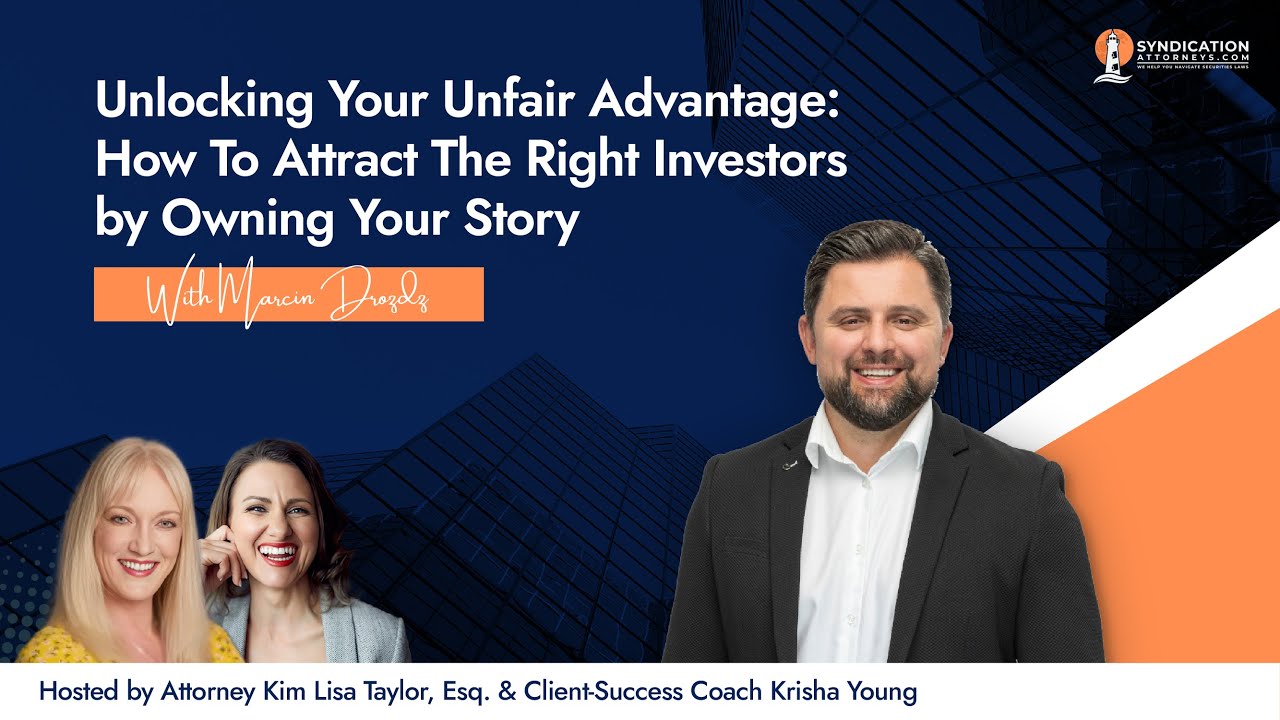
In this Raise Capital Legally podcast episode, co‑hosts Krisha Young and attorney Kim Lisa Taylor interview capital‑raising expert Marcin Drozd. The conversation introduces the "unfair advantage" framework—story × why × proof—as a way for real‑estate syndicators and fund managers to differentiate themselves and attract ideal investors. Marcin explains how to build a repeatable capital‑raising system, from packaging the founder’s narrative to generating and converting investor leads, and stresses the importance of legal compliance, proper disclosures, and structured deal terms. The hosts critique common industry practices such as over‑reliance on acquisition fees, highlighting the need for sustainable money models, robust investor communication, and clear plans for handling troubled deals. They also discuss scaling operations through documented processes, the role of legal counsel, and resources like the M1 Inner Circle program, their books, and the syndicationattorneys.com platform. The episode ends with practical advice on starting, investing in mentorship, and where listeners can learn more.
Chapters
Hi. Hello and welcome to the Raise Capital Legally podcast and YouTube channel, your go-to source for insights on raising capital the right way. We dive into topics that matter most to real estate syndicators and fund managers with live Q&A opportunities before we wrap up. I'm Krisha Young, your co-host and business development director at Syndication Attorneys, and joining me is attorney Kim Lisa Taylor, the founder of syndicationattorneys.com. Now, before we get started, please Please note that audio and video from this event will be posted on our podcast platform, YouTube channel, website, and social media, and will be made available to the public. You can ask questions at the end of the broadcast by raising your hand or typing it in the Q&A. And please note, information discussed during this event is of a general and educational nature and should not be construed as legal advice. Now, today we're going to unlock your unfair advantage, how to attract the right investors by owning your story. Why would somebody invest with you? In this powerful episode, co-hosts Kim Lisa Taylor and Krisha Young sit down with capital raising expert and investor mentor Marcin Drozd to explore a concept that could radically change how you approach raising capital: the unfair advantage. Marcin shares how your unique combination of background, mindset, skills, and life experience, when properly understood and communicated, can become your most valuable asset in attracting ideal investors. Hello. Hello.
Welcome, Marcin. Hey, we're so excited that you're here.
I love it. Good to be here. Thank you.
Yeah, I think I met Marcin a couple of years ago now at the Best Ever Conference in Salt Lake City, and we had an interesting conversation. I shared a copy of my book with him. He shared a copy of his book with me. We had a conversation later on and thought, Hey, you know, maybe there's some synergy here. We'd love to be able to, you know, kind of help each other help our clients, right? So you've got students, Marcin has students that he teaches how to capital raise. We have clients who we're trying to keep them doing it legally and making sure that they're, you know, staying in conformance with the law. So we feel like it's a really great synergy and we love Marcin and what he does. And his, by the way, we will, we do compliment your students. A lot of your students that come to us are a lot more advanced than a lot of the other typical people that we talk to that haven't done deals before. So even your students that haven't done deals before come with some foreknowledge, and that is so critically important to their success. So we applaud you for doing that. But so thanks so much for coming.
Excellent. Yeah, I'm glad to be here. Let's do it. Let's talk about money.
So tell us about your background and how you got into this space of being a mentor and a coach and helping people learn how to capital raise.
Yeah, sure. I mean, I started this business. I bought my first property with, with my best friend back in, I think it was '06 or '05 or '06 or something like that. And we, we made every mistake in the book you could possibly make. We overpaid, we didn't negotiate, we, we took the first bids for renovations. I mean, and despite all that, we still made money, which, you know, was amazing at the time. And yeah, one thing led to another. I got recruited into a private equity firm and we were in 2007 when I started there, we were raising money with MC Companies. So, Ken Macro, MC Companies, we'd, as a firm, we raised, I think it was about $300+ million for them in about 2 years, which was really impressive because— pardon me, closer to 3 years, closer to 3 years. But it was impressive regardless because if you remember, the world broke back in '07, '08. Yeah, that was— so I learned, I cut my teeth in the capital raising business during the worst financial crisis, you know, historically that we've had. So that was interesting. But through that, obviously, I got to see, you know, deal structure business. Everything I was doing before then was, you know, just a rounding error compared to the stuff we were working on with MC, right? So I just remember looking at some of the properties, I'm like, 300 units, that's like 400 toilets. Like, I couldn't comprehend the gravity of it, right? But, you know, you become acclimatized to things pretty quick and that kind of became the norm. So I did that for a few years, did really well. Then, you know, in my— I was still in my mid-20s at the time, you know, as a young man would think, I'm like, oh, I got all this figured out. So I went out and, you know, started doing my own stuff. I learned very quickly I didn't have it figured out. So It took me about a year to a year and a half to kind of get a baseline. And then we started our own. We started my first 8-figure equity fund where we bought medical plazas in Arizona. So, that's what we were doing. It was, you know, back then, it was 2010, now 2011, you couldn't get financing. So, we had to buy cash. So, we raised cash, we paid cash, and we were buying stuff, Kim. I mean, we were buying stuff for like 30 cents on the dollar. It was wild. Because, like, the medical plazas, well, they were, they were retail plazas, but they had a medical anchor that was still there that was getting paid for Medicaid, Medicare, whatever it was. So they were still in business, whereas everybody else was just decimated, as you guys remember. So with retail in particular, you only pay for NOI, existing NOI. So effectively, we got 3 quarters of the buildings for free, which was just wild.
Wow.
So we did that. And at the time, you know, we raised an 8-figure fund and I'm in my 20s at the time. I thought that was a lot of money. Well, we bought a few assets and we were out of money. So my only regret from then was we didn't buy more. I should have, you know, did a 9-figure raise, but, you know, we still did okay there. Fast forward, I've done operating businesses, real estate roll-ups, we've done acquisitions, we've done reverse, we've done all kinds of different things. And when COVID hit, I was at home like so many other people, and I had my buddies calling and texting, and this whole Zoom thing became a thing before it was like you'd have to go fly and drive and see people. So we just having this type of an interface made it really easy to start teaching people stuff. And that's kind of when the light bulb went off. And, you know, we, we had a whole bunch of people show up to a, to a thing that I did on a Saturday, and I thought it'd be 2 hours. It spent the entire weekend just beginning peppered with questions. So then we, we, we put— we started building out a framework and program. And, you know, fast forward today, we've had, I don't know, 500, 600 paid clients go through our community. We've consulted on their files. Our clients have done well over a billion plus in their own transactions. And, you know, it's, it's been fun. I mean, we're still doing our own funds, our own deals, but that has kind of taken on a life of its, of its own. So here we are.
So, um, just to clarify what your coaching business is about, it's really more about the raise than, uh, analyzing the deals. Am I right about that, or do you do a little bit of—
Yeah, I mean, I wouldn't really call what we do coaching in a lot of ways. People don't come to us for coaching because most of our clients are already— they already have chosen the vehicle that they want to pursue, i.e., multifamily storage, commercial, industrial. So they have their business figured out typically, and they've gone through actual coaching on another platform. But now it's like they need to raise $1 million or $10 million. So where we specialize is regardless of what their vehicle is, we help them install a capital raising system into their business. And that's unique in this space. And I'm uniquely positioned to do that because that's kind of my gift. I've, that whether it was with MC companies 20 years ago or equipment leasing or commercial services businesses or other businesses that needed capital, there's first principles that are the same across all businesses. And that capital raising system is the thing that I've proven to do across multiple assets. That's what we, we consult on with our clients to help them implement that into their business.
Yeah, which is a little different than what we do. So we sometimes do get a little confusion. People are like, well, you're teaching people capital raising, they're teaching people capital raising, you know, why do I need both? And the reason is because we're really focused on helping you get super confident about the legal aspects, you know. So what is the, you know, what are these exemptions? What does it mean to follow these exemptions? How do you develop these preexisting substantive relationships that you could defend to a securities regulator or to opposing counsel if you ended up in litigation? You know, how can, you know, what you can, what you can and can't say in your ads, because there's rules about that. You have to be super careful about, you know, even just, you know, making an innocuous statement like, you know, we pay distributions quarterly can get you in legal trouble because what if you don't? What if you have to suspend distributions because something happened? You know, you lied as far as a regulator is concerned. So you've got to be really careful about what you say, how you say it, making sure you have the right disclaimers, you know, and making sure that you're not always like just jumping into an offer the first time you meet somebody. Hey, yeah, I do this. You want to invest with me? You know, we— it's a very, you know, kind of choreographed step-by-step process to make sure that everything's done legally. And the other thing we really focus on also is helping our clients get super comfortable with the deal structures that are available to them and kind of helping them understand, hey, this is, you know, where you're at right now. This might be the best course for you. Or maybe, you know, you're a little more advanced and you've done some deals, you know, maybe, maybe you are ready to do a blind pool fund, you know, versus a syndicate. Or maybe there's some hybrid in between that we can offer you that helps you achieve those goals as you replicate your model over and over again. So, you know, so that's really our focus is really just on the legal corporate structure And, you know, the splitting of money with investors, making sure your waterfalls are very concise, making sure your waterfalls and your fees are in line with norms. And then also just making you confident. You know, we want to make sure that our clients are really confident so that they don't feel afraid, you know, to talk to someone. So then we unleash you. So you're putting all these systems in place, telling them how to talk to these people, how to reach out to the potential investors how to actually implement that relationship, right? Is that, is that kind of a good example? And, and, you know, yeah, yeah.
I mean, so, so before, before, so obviously, even just to give you a practical example, even in my world, before I actually do the legal thing and structure everything legally, I want to make sure there's a business case for it, right? So at a practical business level, before anything else happens, you know, do you have The right money model? Do you have the ability to create liquidity within your— like, all the things, the underpinnings of a business, right? Those are really important things that, for myself, that we've done. Like, I'll give you an example, Kim. We have a lot of clients that they come to us and they're even like proven operators and they've got a great business and everything's fantastic, but their fundamental money model is broken. So, in other words, how they create liquidity within their business doesn't work. How they potentially split profits is something that they've seen 100 other people do but doesn't actually apply to their business. So ultimately, the investor is just looking for a certain type of outcome and protections and things like that. But the fundamental business that you're setting up has to make sense for you as a business so you can actually execute. So in my world, structuring that first, I mean, I don't mean structuring legally, I mean like a business case, right? Like, like, like theoretically structuring it or like practically putting it down, right? Then Once that's done and your personal packaging is done, then doing it with like yourself, like securities attorney, to actually make it all legal because business and legal, that all comes together. And then yes, once they have that, then the practicality of the rubber hits the road. Then you have to get out there and actually do the things. So, you know, that's kind of the, the flow of things, so to speak, from our perspective.
Yeah. And a lot of it is, you know, like people don't even know, like, where am I gonna go and find investors? And then when I do find investors, how do I keep in touch with them? You know, what's an appropriate, you know, drip system to put them on, or, you know, implementing some kind of a follow-up system so that, you know, a lot of people just go to events, grab business cards, first of all, stick them in a drawer, do nothing, right? Or they then pull them out at some point, put them in a database, and then they don't know what to do. So, you know, I think that, you know, my sense of your program is that, you know, you're helping them, like, Take those next steps. Here's what you do. Here's, you know, go forward, you know, reach out this way, have these conversations.
Yeah, that's definitely part of it.
And it's a huge gap in the marketplace, right? Because, you know, there you can go to real estate trainer and learn how to buy multifamily, how to buy self-storage, how to underwrite those deals, which ones to do, which ones not to do, all that. But, you know, and then we're going to teach you, okay, here's your legal docs, here's your structure. But we get so many people that are kind of like, for the first few deals, they're deer in the headlights. Like, it's like, oh, there's just such a big gap between what I learned how to do the real estate and now how I have to do all this stuff legally. I just need the practical implementation of it. How do I actually make this work and understand it well enough that I will be able to follow it when I have a deal? And when I'm operating this company for years to come.
Yeah. So when I, when I got started in the business, I, the best way it was explained to me is there's really 3 legs to the stool. You have asset management, you have acquisitions, and you have the capital side, right? So, and, and the way I learned it was this, typically the most underappreciated is the capital raising because everybody thinks that a great deal, the world will just beat a path to your door. So what ends up happening is a lot of people— and you're laughing because it's true— most people think that they have like the no-brainer deal and the world's just going to beat a path. It's like the entrepreneur that creates a new widget and thinks that everyone's just going to beat a path to their door. That's not how it works in any set of circumstances. So what ends up happening is there's a disproportionate amount of focus and training put on here's a good deal and here's how to manage it, which is super important because without those 2 things, nothing else happens. I get that. But on the other side, if you actually can't write the check, then you'll either be a real estate broker, a mortgage broker, or you'll be a service provider working for someone else. Because if you don't have the money, none of this stuff will apply in your own context.
Absolutely correct on all of that. You know, we see that exact same thing, that they come to us, they understand the deal, and then they don't realize that they're creating a whole new business. Right, where they have to now, you know, have people on their team or develop the skills, you know, people with the skills or develop the skills to be able to go out and talk to investors. And it's completely different than talking to brokers and finding deals and analyzing deals and, you know, doing due diligence, all that stuff. It's a completely different skill set. So, you know, and it's a big job for one person, you know, for one person.
It's an impossible task for one person. It is literally an impossible task. You, you have entire departments that you can eventually build out on the capital raising side. I gotta, I gotta tell you guys, we have clients that we consult on. They come to us, they already have existing 8 or 9-figure portfolios, and some of them did it just through like sheer grit with no department, no mark— like when I talk to them about marketing, they think marketing for like marketing their units. Like they have no context of this. At all, right? So what you made the comment that many of our clients are more advanced because the kind of clients that we tend to attract are the ones that have already kind of gone as far as they could with friends, family, and their own kind of just ability to go stand at a booth and collect business cards. And now they're like, this sucks, like I can't scale this. So then they want to actually build a real set of systems and processes and that mirrors the legal stuff that they've implemented. Well, that That ends up becoming its own thing.
Yeah. And having the systems and processes, that is one of the absolute hardest things to do for a business because I can tell you, we've been in business since 2016 and ours is constantly a work in progress. And that's probably one of the hardest things. One of the easiest things to say, and now we're not gonna have that meeting this week, we'll just skip that. And, you know, and then it gets pushed off and then next year you're like, why haven't we completed these yet? You know, and now the process is different. So you gotta, you know, back and change it. So yeah, it is one of the hardest things. But with that, those systems and processes in place, you have— you mentioned it— you have such an ability to scale that you wouldn't have any other way, right? Because it's really hard to bring somebody else in and help them, you know, train them on what you've been doing and how you want them to do things unless you have it written down. If it's all in your head, all of a sudden that next person is just going to add to your burden of things you have to do. for the next 3 to 6 months until you've, you know, imparted all that information to them. And if you still haven't written it down, you know, how do you hire somebody else? So it just, you know, it's, it's, um, so critical. And I think that so many people overlook that as a real need. But you've been involved in other operating businesses before. I mean, that if you don't have your standard, you know, operating procedures and systems, your business isn't going to do well. Don't— do you agree?
You can't scale. I mean, you can't go beyond yourself. If you look at— and many people listening or watching this are going to say that you've met people that you're like, well, how did they build a $100 million business? Or how did they build a $300 million portfolio? They're not smarter than me. They don't have access to better deals than me. So why are they at $300 million and you're still stuck at, you know, your first syndication or your first $50 million? And the difference is, is that they've operationalized what's in here. And That's why the thing, the first thing I wanted to talk to you guys about was that whole unfair advantage concept, because what the unfair advantage does is it actually operationalizes those unique selling propositions that people have written you a check for. So how do you, how do you leverage that? So you're no longer the one who's out there doing the thing to get the check every day.
Yes. Yeah. Okay. So, so tell us a little bit more about that. I mean, so you're just really You know, tell us how that works. How do you— how do people do that?
Sure. So the unfair advantage is, is a, is a, is a framework that I kind of just mapped out, and I'll dig into it because we've— I think we got some time to do it. So the first— the unfair advantage is 3 components. It's your story multiplied by your why multiplied by proof or evidence. So you literally, you could write it like a math equation. I'm gonna give you the, the, the variables here as well. So story, there's 4 ways to tell your story. One is an origin story. 2 is a struggle story. 3 is a credibility story, and 4 is a vision story. So an origin story is literally where you came from and what shaped you, right? Your struggle story is the obstacles that you've had to confront and how you work through them, because those tell a lot about who you are as a person, what you're capable of, what you've been through, you know, your, your ability to— your grit effectively, right? Your credibility story is, is another piece where Talk about like some of the results and relationships that really edify who you are and what you've been able to do. And then the final is your vision story, which is where you're going and why people would wanna join you on that. So for example, my origin story is I was born in a communist country. And, you know, we came across from Poland to Canada initially. And, you know, I saw my dad who was a master-trained mechanic pushing a broom. My mom who was supposed to become a pharmacist was Working at a thrift shop, right? So, you know, when we, when we went through that process as a kid, I learned that there was no plan B. You just work plan A in multiple versions until it worked. Like, it was just so, so for me, that was a big part of that, right? Struggle. So I kind of gave you my origin and my struggle story, right? An example of a credibility story is I worked my way into being able to raise capital for MC Companies. We raised a couple hundred million dollars. I learned the business the right way. And my vision, or portion of my vision story, is the gifts that I have enable me to help entrepreneurs and business owners do XYZ. So those are 4 different frameworks just to be able to tell your story. Now, your story is the first piece. The second piece is your why. So again, there's, there's 3 types of why. You have your personal why and what drives you. So for me, it was watching my dad get up at 3, 4 AM in the morning to deliver newspapers when we first came to the country. It was sharing a house with 2 other families. It was eventually moving into what was workforce housing and the shitty condition— pardon me, the crappy conditions that we were in there. You know what I mean? Like, it's just like those really shaped my why and what I expect, like wearing clothes from a thrift store. Like there's, there are certain things that I was like, life is going to be better than this because of this, right? The second why is alignment. So in other words, People want to— people don't want to feel like you're, like you're, like you're, like you're panhandling, like you're asking for your, your money. So they want to understand what's in it for them. So in the why, you have to be able to explain what is the reason that I care. So for some people, it's obviously financial, some it's significance, some it's legacy, some it's tax planning. But getting clear on that is, is, is really important. And the last why is Your why that's anchored to significance. So all of us have the need to feel significant and your significant is mapped out in a lot of different ways. For me, significance is a way to leave a mark on the planet where I can help Main Street entrepreneurs compete with Wall Street and not need the banks anymore because that for me is a form of significance, right? That's how I get that. So Again, your unfair advantage is your story multiplied by your why. And then the last one is the easiest, which is the evidence or the proof. So what are the things over the course of your life that you've done that could signal to someone else that you're consistent with your life's journey? So what are the things over the course of your life that you've done? So for example, for me, we've raised multiple 9 figures. I've done 8 different funds. You know, I've a lot of different businesses. There's a whole bunch of evidence, hours. By the way, if you're, if you're newer to business and you don't have the, like, the receipts for the actual things you've done yet, then you have proof of effort or proof of work. So for example, you've walked over 100 properties, you've interviewed 20 lawyers, you've, I don't know, you've had the longest running podcast interviewing people on a specific topic. Like, you're just, you're showing that you're putting in the effort that's congruent with the things that you are naturally best equipped for. So I know I threw a lot there, but the point is, if an operator or business owner could start framing things out in that manner, and then from there you can get your mission, your vision, and your strategy for your business. And then that makes it easy for someone on your team to pick up that playbook and share the story because that's kind of the— and then you'll start attracting the right people and culture is a lot easier to define that way too. So because people buy into that, that narrative, that story. And I think, you know, my thing and within my book and anything we teach is we, we really lean into making somebody define their unfair advantage because once we have that, everything else becomes easy.
Yeah, that in itself sounds like it's a pretty deep exercise and could be pretty uncomfortable for people because you kind of have to go back and relive some of those struggles and think about which ones are appropriate to talk about, which ones maybe You know, best left out, maybe because they're too painful for you to talk about. You're not ready, or, you know, it's just not relevant.
And it's not meant to be a therapy session for you with your potential investor, right? It's just meant to— it's meant— it's meant— you're not meant to confine everything. There is such a thing as oversharing. But if you look at your life as like a movie and you were to pick several points in your life that were defining characteristics of the kind of person the kind of woman, the kind of man you became because you could have gone left or you went right. Those are defining moments in your life. And those are the types of intangible things that your investors, potential employees, business partners, they look for that. That's a filter. That's like a subconscious filter that people are— you've met people where you're like, I don't even know what she's doing, but I'd write her a check. I don't even know what he's doing, but I definitely go work for him. Like, you've met people like this and it's because you've bought into Certain things within their life.
Yeah, that's— it takes some self-examination, I can see, to get to this point. But I'm also kind of hear some of the people that we interact with on a regular basis saying, yeah, but when am I ever going to have a chance to talk to investors like that?
How—
when could I even have that conversation?
Well, you don't have to, but from those things, you're going to be able to pull up. So one of the things So, Kim, one of the first things we do with our clients is we interview them for about 30 to 40 minutes. We transcribe it, then my marketing team and copy team and about 300 different prompt variations put our clients' transcripts through a series of things to give them things that are then going to resonate with their ideal investors. So just because you had certain experiences doesn't mean you're gonna share that, but you can pull intangible characteristics out of that that apply to certain types of people that will buy into you because of that. So again, it's— you're not telling your life story to everybody, but because you have that, it makes all of your marketing, your copy, your content, your emails, your newsletters, every communication point with people externally, even though it's chopped up into like thousands of little pieces, it all feeds into a very similar narrative and it's It's coherent and it brings everybody back to the same place, which is what most— by the way, most real estate investors are horrible marketers, absolutely horrible marketers, because they think that none of this matters. All that matters is look how great this deal is.
Yeah.
But if I call that—
I call that, uh, yeah, I call that Field of Dreams thinking. And I don't know if you remember that movie. Yeah, it's like build it and they will come. And, uh, you know, it's not true. Well, maybe the come, but the real people with the checks don't.
And there's people out there that hate on certain public figures that are really good marketers, but maybe not good at doing deals. Well, that's the other side of the same example. Like, you shouldn't be hating on them for getting attention. They've done that part of the equation, right? Maybe their deals are horrible, but you got to give credit where credit's due, where they've built the attention. That, that, and that's something that a lot of people in this space just don't You know, they fight it. They're like, no, the deal should speak for itself. Maybe. But that typically isn't—
It doesn't. It's, you know, build it and then market the heck out of it and, you know, work it and then you'll get some results. You know, and I don't know what your sense of this is. But, you know, there's kind of some ideas out in the industry. And I think it's largely true that you've got to have 3 or 4 times as many investors as you think you need to raise the money you need to raise. So, you know, SEC statistics say that the median raise for Regulation D Rule 506 offering, which most of our clients are doing so they can raise money nationwide, they can buy properties anywhere. The median raise for that is $2 million and with 14 investors. So that's SEC statistics. So if you think that you need 14 million— 14 investors to raise $2 million, what you really need is about 45. Because there's, you know, you know, 2/3 of them are not going to be ready. Don't, you know, they haven't decided they're going to invest with you yet. Whatever their reasons, they're not going to do it. And, you know, maybe a third or a quarter of those people are going to go forward. So, you know, that's your target. And, you know, we constantly talk to people all the time. It's like, well, you know, how many investors do you have in your database? Well, I've been talking to 2 people, you know. It's like, well, that's not going to get you where you want to go. You know, or, you know, we've had, you know, somebody even said, well, I've decided that I'm going to change my marketing shift. Instead of trying to talk to a lot of people with $50,000 or $100,000, I'm just going to try to find big fish. And I was like, okay, well, you know, good luck with that. Come back next year when you want to change that back to what you were doing before, because that model is not going to work for you until you've got a lot of experience in the bag. And it's a double-edged sword because that does— that kind of money does not come without teeth. Right? You were in a private equity space, right? Would you agree with that? That kind of money comes with strings attached.
I mean, you've got governance, disclosure, reporting. They want seats on the board. They want to tell you what color pants to wear on what day of the week. Like, they, you know, it's like the largest individual commitment that I got was $100 million. It was for an operating business and it was one check and you had audited financial statements. You've got this, you've got this, you got bank access, this, they want, they want, they want to sweep the account whenever they need. Like, there's all kind of like, which is a cash sweep, just so you guys know, they can come in and they can just sweep your account. Like, you have no say in the matter. So, you know, there's all kinds of things that come with those bigger checks. And if you look at any of the larger fund managers or syndicators, they still have a $50,000 minimum. for their retail accredited investors. If it's good enough for somebody like my mentor, Ken Macro with MC Companies, it should be good enough for just about everybody in the space.
Yeah, absolutely. Yeah, we've done— we've had a lot of clients that have done those private equity deals. And usually, it's not just what they want in the beginning, they have ongoing, and you almost have to hire somebody specifically to meet requirements. Yeah, they want ongoing reporting, they want to see, you know, regular bank accounts, regular budgets, regular, you know, all these different things. And if you don't set, you know, if you don't designate somebody to be responsible for all that and you don't do it, they usually always keep takeover rights. And I've seen it, I've seen it happen where people just didn't understand what they'd agreed to because they didn't have representation to help them, you know, create that list of, okay, here's all your deliverables, here's when they're all due. You need somebody designated to make sure that happens, or they're going to take over the property, or they could, you know. And then there's also some people out there in the private equity space that are really not nice people. You know, they're in it for themselves, and they don't really care about you other than if it's a good investment for them. And if you falter and don't perform as agreed, then you're out, they're in. They're going to usually take over the property for what they've got in it. strip you and your investors of everything you invested in it. And, you know, they've got the deal, you don't. So you've got to be careful about, you know, looking for those single investors. You know, our clients that have been the most successful have 300 to 500 pre-vetted investors in their databases. And I've seen those guys be able to raise, you know, $10 million in a week. If they need it, they can get it because they've already developed those relationships, they've got those systems in place, they've kept in touch with those investors, you know, they've had them invest with them before, they've kept them informed along the way with the deals that they're in. And, and those people are, you know, they believe in them and they're ready to keep going, you know. And even if the deal fails, it doesn't mean that you're not going to be able to ever raise capital again, depending on how you handle it. Okay. Because, you know, I've seen people who were ill-advised, in my opinion, by their counsel to stick their head in the sand. You know, cut off your email, change your phone number, move out of your office, go hide. And ultimately, that person can no longer raise capital. They are out of the business. They will never be able to recover from that. And that was just poor advice, in my opinion. And they could have had an opportunity to try to make those investors whole in a different way down the road had they stood up, took responsibility, explained what happened, been transparent about it, and, and said, look, here's what we're going to do to try to help you move forward.
Yeah, well, if you've been in the business long enough, I mean, look, you're going to have deals not work. I mean, it just— it's statistically not possible for things not to work, for things to work perfectly all the time. I mean, whether it's market forces, corrections, I mean, you can have contractors go broke, you can have people walk off site. There's just so many things that And it's how you conduct yourself through that process that really makes— you're absolutely right. That really makes the difference.
Yeah. And one of the things, especially right now, because we do have some people that are struggling with deals and there's, you know, I'm hearing about it, you know, every day more and more people are struggling. And the thing is, is that the more— if your deal is in trouble, it's not time to stick your head in the sand. You need to step up your communications. If you tell everybody what's going on and all the different things you're doing to try to fix it, You listen to their valuable input. You take that into consideration. Maybe they'll even help you change course. Maybe they can help you fix it. If you do that with all of your investors, then you're going to be able to save face. They're not going to sue you. And when the deal fails, you know, they're going to understand that you really fought for them. If you don't tell them what you're doing, and here's a big mistake I see people making a lot, we're kind of getting off topic here, but I think these are just such important messages right now. Is, uh, don't be pouring your own money into the deal without telling your investors. That is a huge mistake. And you know what? It pisses your investors off. And the reason is because they're like, wait a minute, we never knew the deal was in trouble, and now all of a sudden you're telling us, hey, it's going to foreclosure next week. They didn't even know that they— you know, you were bolstering the deal. And now they're like, well, wait a minute, you know, you loaned all this money, did you get paid Well, you know, what happened? You know, did you put yourself ahead of me? Did you, you know, why didn't I know about this? Why wasn't I given an opportunity to help try to solve it, or at least to understand what was happening so I could have been forewarned?
So, yeah, a really good, a really good— I mean, maybe just to kind of put a bow on it from my perspective, a really good framework whenever you have to deliver news to people that isn't great, always don't just deliver news without a plan. So, in other words, you know, there's material disclosures, and I'm sure you guys can talk about this with your clients all the time. But in my mind, whenever something happens that's not what I wanted it to be, or not what we initially agreed, then the thing that is really important that I keep in my mind is, hey, we planned this, this happened, here's why it happened, here's what we're doing about it, and here's how the same set of circumstances, for example, is not going to repeat itself because of whatever changes we've made internally. So, and it could be as simple as a budget overrun on, let's just say, a roof, or it could be something that maybe you hired the wrong contractor, or maybe vacancy didn't drop, or maybe you didn't fill the units as quickly as you wanted, or maybe something else happened. The point is, here was the plan, here's what actually happened, here's why it didn't work. And here's how we're fixing it, like, right now, or how we've Ideally fixed it would have been better. But if it's a longer thing, here's how we're fixing it. And then here's what we've put in place so that this doesn't happen again. And I think as long as you have that type of a mentality and framework before you go and deliver bad news, because a lot of people just deliver bad news and they have no plan, well, then your investor is going to freak out because you literally have no plan. And if you don't have a plan yet, but you have to deliver it because the lawyer tells you like, hey, this has to be told right away. Then at least tell them what your potential options are and what the next steps are, because people will, will, will support you as long as they know that you're still moving in the right direction. If, if you just put your hand up and say, I don't know what's gonna happen, well, that's when people are gonna freak out.
That's right. That's right. And, you know, and if you're seeking— it's the same thing, like if you're trying to seek some rescue funding or, you know, private equity infusion or even a capital call from your investors, you don't just go, hey, We need more money. You go with them, to them with your updated pro forma, you know, showing them exactly what you said. Here's what happened. Here's what we planned. Here's how it is now. Here's what we're planning, you know, to do here. If we can get this much money, here's how it's going to help us bridge that gap until we can get a new, you know, get the property sold, get new financing, whatever it is that's going to help that project survive. So you've got to go with, you know, you got to— it's a new sale. It's a, you know, I'm Selling you again on the same project you're already in and letting you know that, you know, hey, if we can raise this money, get it in here, whether we have to bring in a superior class or if you guys want to put up the money, you know, whatever it is, we got to have this money or we're a sinking ship right now, but we think we can salvage it. Here's what we've— here's our plan. Exactly that. Exactly. Well, here's our plan. So I love that you said that. Thank you. Thank you for saying that. So I do know, and I'm not going to ask you to cost talk about pricing or anything like that, but I do know from industry standards, you know, I think your mentoring or your, you know, your programs are very reasonably priced. And, you know, I think people need to realize that, you know, Marcin is clearly a, you know, high-caliber individual. He's been in the trenches. He's done this himself. He's figured out how to make it work for himself on a big scale. He can help you scale your stuff So if that's where you're at and that's, you know, what you, what you feel like you need advice about, I, you know, highly recommend that you think about talking to him about his programs and what might be available to you that could help you. So, you know, we've, we've just had a lot of good positive feedback from your students who have come to us, and I, and I just can't say enough about how I think, how important I think this is.
Yeah, no, I appreciate that. And I mean, look, just to give you guys context, I mean, before we had M1 Inner Circle, I was, I mean, I've been doing this for 20 years now, right? So, when COVID came and I had time to myself to actually frame out everything and then continuously improve the processes and the systems, before, the challenge I was trying to solve is because before COVID when a client would hire me, whether it was for my fund or a third-party fund, a client would hire me, I would charge them $20,000 to $30,000 a month, 6-month minimum retainer, and I would take a piece of the company because if they were going from $25 million or $100 million to $200 million, you know, giving me a piece of the upside is not a big deal. Well, I mean, they didn't, they didn't do it. They didn't want to do it. But like, what are you going to do? Like, you would have obviously done it if you could have done it. So they, so they ended up becoming clients.
Right.
But my point is that the problem I solved with M1 Inner Circle is the vast majority of people can't afford to pay somebody like me $20,000, $30,000 a month. Corporate— if you want to Google an equivalent type of thing, it'd be like corporate finance services effectively to have somebody like me come in, gut your business, help you reposition things, reestablish them and go out there and be able to, you know, scale beyond 7, 8, 9 figures, whatever it is. That's what corporate finance is effectively. So what we did is we took that and we created that into a system of systems, processes, training and feedback and made it at a fraction of that price point with no backend or interest in people's companies. And that's, that was the mission of M1 Inner Circle, to create an environment for people that already know what business they're running to just be able to— that they get to a point where they hit the wall and they just don't know how to reposition it. And it could be as simple as literally their money model within how they're syndicating because they've never really questioned the— like, for example, Kim, the model I absolutely despise is the acquisition fee model for funding growth. Like, I despise that model because Syndicators, they use that model to not only pay their bills, but then whatever money they have, they then break themselves to try to do another deal. So, they're always broke. And even worse, they're paying their overhead and their operations from the syndication, from the acquisition fee. And the whole industry does it. And the whole industry does it. And they all do it because they think that, well, that's how everybody else did it. But in private equity and institutional and all these, they don't do this. They have other models, other structures. that give them, the GP, the working capital to go out and actually have a sustainable build-out process to actually fund operations, fund SG&A, fund all the things that they need so they can actually run a sustainable business. There's so many syndicators that right now are having trouble because they don't have the acquisition fee.
Yeah, I call them— I've seen a few of those people come through our doors. I call them acquisition fee junkies.
Yeah.
They're always closing for the next deal. I got to get the next deal. I need that acquisition fee or I can't pay my bills.
Well, because they've built their entire money model on the acquisition fees. So actually, when you psychologically think it through, the acquisition fee is inverse to the investor because adverse to the investor, because the more I pay for an asset, the more I make. That's wrong. Because like the last deal I did, I actually screwed myself out of the acquisition fee because I negotiated a couple million dollars off. So technically I made less to make the fund more. Now that's the right thing to do, but not every— people don't think that way. They're just trying to maximize their cash, right? Yeah. So the fundamental issue is the money model in a lot of these businesses.
Well, and I do think that, you know, it does go to structuring because, you know, there are certain crowdfunding platforms out there, certain, you know, other models out there that you know, kind of insist that, oh, you pay all the investors back before you get a dime. And plus you have to pay them everything you promised them for all their preferred returns. And, you know, they gotta get everything before you get anything. And you end up working in a deal for 5 years for no money. And in my opinion, that creates a disconnect between your interest and the investor's interest because your only reward comes when you sell and they're enjoying the cash flow. And so, you've sold them securities, you have a fiduciary obligation to put their interests ahead of your own. Too bad for you. Go, you know, figure out another way to have income. And it really kind of, it is a disservice to investors because at that point, you're turning your attention away from their deal to go do something else to feed your family. And you're misaligned.
Not paying attention to the asset.
Well, that's right.
And this goes back to the beginning when we were talking about if you're positioning yourself from your unfair advantage versus just the deal as the commodity. If you commoditize yourself and the deal should speak for itself, let's assume it does, and all you have is the deal going for you, then what an investor is going to do is look at your spreadsheet versus someone else's spreadsheet and say, well, theirs says I'm going to get this, yours says this. And then they try to grind you down on fees and splits and all that stuff until effectively you're working for for free. Whereas if they've bought into you and your team and your process first, and then the deal is second, then you're not having that conversation anymore. Because if they try to commoditize you, it's like, okay, well, if you want to do that, you should go do that. And people are like, well, no, no, I want to work with you. Got it. So here's how we work. Are you okay with that? Yeah, I'm good with it. All right, let's rock and roll. Because, because they're bought into you and your process. So it's not like the deal is the reason why they wrote you a check versus Deal is important, but it shouldn't be the only thing that drives the decision.
So, Krisho, do you want to talk a little bit about some resources that our listeners can access that can help them?
Sure. Yeah. Well, we've got our own resources. Our website syndicationattorneys.com is a plethora of amazing resources. There's a ton of articles and all of our past podcast recordings, such as amazing interviews like this. We also have 2 bestselling books that are available both on Amazon. There's one, How to Legally Raise Private Money. This is the one that I say with the palm trees and the dollar bills on the front. This is your sort of basic how-to. And then we've got a more in-depth advanced version as well. And this one's How to Raise Capital for Real Estate Legally. And we also have our own, you know, clients-only mastermind where we meet on a weekly basis and discuss all things on the legal side of capital raising. Because that's, as we've discovered here today, it's a very big part of the process. You know, you've got the business side of it, then you have the real estate side of it, and then you have the security side of it. And so we like to help take care of the legal side of it.
Yeah. And what we don't do though, and, and I want to just point it out, is that you still need Marcin because Marcin's going to help you build out those systems so that you can actually have those conversations. We're just going to help you make you comfortable so you know you're doing it legally and you're not afraid to engage. You know, he's going to teach you how specifically though, you know, what you can't, you know, what you, what, you know, what to say to an investor at what point in the sales process, how to, how to engage them in your system, all of that.
Mm-hmm.
And and make you create a scalable system for you so that you can bring on other staff as your company grows, and and make sure that you're doing things the right way as well. So you know we work companion, you know hand hand in hand together to make sure you guys get the best possible outcome. That's really what it's about. You know here's you know I thought about kind of like our why when we were having that discussion earlier, and and our why is. I want to have the biggest possible outreach. You know, my mom told me when I was a little kid, she said, you have this unique ability to explain complex subjects to people in an understandable manner. And I took that to heart. And so now, you know, I feel like I have kind of a mission that I need to do that. And I took it upon myself to become an expert in a specific field, you know, securities law related to real estate transactions, business transactions. And also corporate structuring. And now I, you know, I want to share that with people in a way that they can absorb it, learn it, let it be part of their being so they're no longer nervous about it, afraid about it. And then they can go out and make the biggest possible impact on all the investors in their lives. So, you know, we're helping our clients achieve their dreams while they're helping their investors achieve their dreams. And in so doing, we have the widest possible reach that we can, we can have. So that, that's kind of our why. We, we really like to make sure that people have the tools to go out and be successful. And I know that, uh, I believe that, Marcin, that you guys have that, a very similar philosophy.
Yeah, no, I appreciate that.
Yeah.
So, um, also let's talk about Marcin's book. So Marcin, uh, tell us about your book.
Yeah, well, the book Unlimited Investor Leads, you guys can get a free copy on my website, or I'm sure there's a link here as well. So if you guys are interested, this is— this has been an Amazon bestseller for quite a while. And ultimately, that book goes through— there's typically 4 things that people are missing when they're building out their capital raising systems. And for context, we crank out about 2,000 investor leads a month at this point in time. I just checked You know, that we're probably around there. So, you know, kind of, kind of know what we're doing. And there's 4 pieces to it. The first one is packaging you and your offer. The second is actually having a predictable way to generate traffic for your business, investor leads. The third is conversion and follow-up. So how to take I'm interested into here's a check, obviously legally with your lawyers. And then the fourth step is actually how to scale your capital raising operating system. So There's a full package there. And that implementation, if you want information on that, the book will give you the frameworks for it, which is really helpful. And Kim made the comment earlier that building capital, capital raising is its own business. It really is. So a lot of people think that, oh, I'm a real estate guy, you know, I'm just going to do this when I need to. No, no, that's not how it works. If you're seriously going to be raising money consistently, then that's why this world is so important, because This is a standalone world. And hopefully you guys are seeing that once you understand this world, you can bolt it onto any business. And that's what I've done in multiple assets and multiple industries because this world lives on its own. A lot of you know this as Wall Street, by the way, this world, so to speak. You know, I'd like this to be a Main Street equivalent for people so that you could actually take the small business owner, the real estate investor, the entrepreneur, whoever it is, And not have to rely on the institutional guys on this side to, you know, as Kim made the comment, come at you with deals that have teeth. Because I've been at the table with the $100 million term sheets and commitments. And yeah, they, you know, they're not taking your soul, but they're not far from it. So.
Yeah. And that is something that we do also help our clients with. So, and aside from us being able to help you with your syndication documents, with your fund documents if you want to do a fund, and all kinds of hybrid models in between that, that have been working for a lot of our clients. You know, we are going to make sure that you, you know, if you're going to do a joint venture with somebody, whether it's just at the asset management level for your syndicate or fund, or whether it's working with some big private equity company, we can represent you in those transactions and make sure that you understand Understand what you're getting into and that you have the right outs, you know, that you can get them out, you know, if it becomes unworkable. You know, you might have to— it might be painful. You might have to go raise a lot of money and get them out. But, you know, you want to make sure there's always an exit strategy that is, you know, something you can live with as well, even though it might be a little painful. But all right, well, do we have some questions? You know, any of you that have questions, this is a fascinating conversation. We have, you know, a lot of people on the call. I'm sure some of you have questions for either Marcin. Also, Krisha Young is our business success coach or our capital raising success coach. She has her own coaching program as well, where she helps people work through barriers to getting what they want in life. And, you know, she can help. I've seen her work wonders with, with clients, you know, and myself even, you know. Uh, just helping people just kind of overcome these I can'ts, right? Yeah, but I can't do that because, uh, you know, so she can absolutely do that. She's got a book coming out soon, which is, uh, you want to tell us a little bit about your book, Krisha?
Um, sure. Well, I'm not quite yet ready to market it, but it's called The Gracious No, and it's about basically ending the disease to please. And, uh, yeah. Written a whole concept around it, to build a boundary system, all sorts of deep introspective work in there about why you're people pleasing and how to overcome all of that. And there's scripts in there about kind of similar to Marcin, what you were saying about having those difficult conversations and getting, getting your needs met. And, you know, yeah, saying, saying yes when you mean yes and saying no when you mean no and overcoming the Stuff that, that gets in the way of being able to do that. So yeah.
Yeah. And so we'll be helping Krisha launch her book when she gets ready to put that out. So you'll be hearing about that in the future. But she's an incredible resource for our team as well. She helps host our masterminds. So, you know, I'm the matter-of-fact person. I'm gonna say, hey, you know, don't do that, you know, be kind of blunt about it. And then if somebody says, oh, well, I've got this issue, I'm like, Yeah, Krisha, you're on. I'm not the touchy-feely person. That would be Krisha. But anyway, so you have, you know, we do have a question. Let's go ahead and get to that question.
Yeah. And thank you, Kim. All right. So the question is, could you go back to private equity? You said they have other avenues to make money instead of acquisition fees. Could you discuss the other avenues a little?
Sure. Yeah. I mean, I'm literally going through the process of structuring a fund along these lines. And there's a lot of different— so I'll give you some context. There's a lot of funds out there where, and I don't mean this in the retail syndication space, but there's a lot of funds out there where you have, first of all, I'll say 2 things. One is most of the syndicators are creating a negative cash cycle for themselves. In the business. So what I mean by that is they put themselves out financially to get the deal tied up, which is one thing, but then they don't properly reflect those expenses to get reimbursed when they actually buy the assets. So, and the extreme version of it is they just eat it and they forget to claim it, and then it's a hot panic after to figure out how to reconcile it because that ship has already sailed. And Kim's laughing because I'm sure you've had clients that have just flat out forgot To like tell people that they spent money, they syndicated, now they can't recoup it because they never disclosed that they were going to. That's one, it's like the most rookie mistake that people make. 2 is they take those fees and then they take them back, which is fine. But what ends up happening is the acquisition fee that they get, that they charge, they use that as their working capital to keep going. That's actually your profit. That should be your profit, and you're paying other operating expenses that you didn't account for out of those acquisition fees. So it's some of it's an accounting issue, some of it's a structural issue, all of it's a disclosure issue. Kim will tell you, I can see her sitting there. All of it is a disclosure issue in terms of sources and uses of funds, both on the front end and on the ongoing operations, and then on the liquidity events. So you're asking a big question, but without going into a major rant, the major thing that has to happen is you have to get off the acquisition kick high. Of that's the thing that pays all the bills because that's just one piece of the whole puzzle and understanding how to shift your ongoing costs again against operations versus exit versus the front and understanding how to properly— it's like going on a long drive and having like a ton of cargo. When you load the trailer, you need to properly load it in a way where when you hit the lights, it doesn't all flip over. So there's a way to financially load your business. And that's actually a big piece of what I ended up doing for a lot of our clients, even for us, just to make sure you have the right liquidity and you have the staying power within your business. That's really what it is. I know I gave you a high-level answer, but the main concept is to take the revenue over chunks and stabilize your earnings as opposed to just having this one hit upfront every time you do a deal. Because then you incentivize the wrong thing all the time.
Yeah. And we usually always advise our clients that, you know, if you can do a deal where maybe for, you know, 1 or 2 years you're not going to get a share of the cash flow, you're going to give it all to investors, that's fine. But if by the 3rd year you're not making a percentage of that cash because the property doesn't, you know, you're not— your projections don't even show that it's going to generate it, then that's a problematic deal for you and it may not be worth doing. You know, you've got to think about how you're going to get cash flow along the way, and you've got to make it happen. And, you know, one of the ways you see the acquisition fee as a problem, we see people that don't raise enough money. So they'll do a minimum and a maximum raise, and they'll get to the minimum, and then they, you know, get the property, they're all excited, they get immersed in dealing with the property, and they forget to keep raising money till they get to their target. And if they never get to that target, that's when they're reinvesting their acquisition fees and all that into trying to keep the property going. If they raise the money they need that they targeted, they'll have enough for an acquisition fee. They'll have enough to reimburse themselves for all of their pre-closing expenses. They won't have to put that money back into the deal to keep it afloat. They shouldn't ever have to do that if they've raised enough money in the beginning. So, you know, so I think that we're aligned with with thinking about that is making sure that, you know, your acquisition fees are your reward for all the things you did before— working with Marcin, working with us, you know, learning how to do this, learning how to buy that particular asset class. That's what you're, you know, you're getting paid for that time that you spent doing that out of the acquisition fee. And, you know, if you choose to reinvest it into the deal, it should be to buy interest alongside your investors and get the same return on that money they're getting. If you, if you, you know, choose not to, then go, you know, invest it in something else, invest it in your retirement account or whatever you want. All right. So we are kind of up against the end of the hour. Any parting words that you'd like to share, Marcin?
It's, it's a process. Don't, don't, you know, as people say, is people overestimate what they can do in a year but underestimate what they can do in 10, right? I mean, capital raising, Building a business. And guys, I've been at this for 20 years. I learn every day. So don't feel overwhelmed. Don't feel like you have to know everything before you do anything. Just start. Keep going. Spend the money. Get the advice. I can tell you right now, the things I pay for, I pay attention to. So whether it's legal advice, consulting, training, mentorships, workshops, VIP access to tickets, I buy everything. I'm what's called a laydown lead because, you know, if it adds value to my business, I just pay for it because If I can get one thing out of it, if I don't have— if I can pay for it in money rather than time, I'm in a good place. So.
That's fantastic. All right, Marcin, how could people learn more about your M1 program? I know we gave them a link to get your book, and that's in the chat here. We'll make sure it gets into the show notes for the podcast and YouTube. But how, how can people learn more about your M1 program and how they might participate?
Yeah, well, my website, marcinrose.com, has a tab for it. They can just go there, hit the apply button. You know, we are, we are pretty selective about the people that, you know, do qualify to be part of the program. But at a minimum, we're happy to talk to you and worst case scenario, help you put together a little bit of a plan. And best case scenario, if it's a fit, potentially help you out.
Okay, and I want to spell Marcin's last name because it's a little unusual. So it's M-A-R-C-I-N. D-R-O-Z-D-Z dot com. Okay, so once you spelled it once, you'll never forget how to spell it again. But you know, this is a name you need to know. Marcin is a powerhouse in the industry. You all need to get to know him because he can help you really accelerate your growth. And Marcin, we appreciate you very much, and we'll be in touch.
Yeah, this has been fun.
Okay, thank you so much.
All right, thanks. Bye-bye, everyone. Bye-bye.
Thanks, Krisha. Thanks.










