Kirby Winfield on Growth of Seattle's Venture Ecosystem
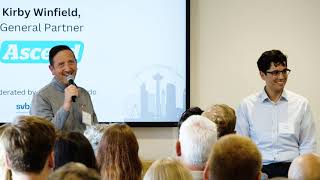
Kirby Winfield recounts his path from joining startups in the mid-1990s through multiple roles (marketing, GM/P&L) at companies such as GoToNet and Marchex, discusses the dot-com boom and bust and the multi-year recovery that followed, and compares that cycle to today's AI-driven excitement. He explains why he moved from founding and operating startups into angel and VC investing (to leverage lessons, meet many founders, and help avoid mistakes), describes the key difference between angel and VC (must invest for fund returns, not just personal affinity), and offers a positive but measured outlook for Seattle's venture ecosystem—noting deeper talent and notable exits while acknowledging that much capital still flows from the Bay Area.
Chapters
Thanks, Pablo. Thanks for having me. Of course, Joaquin. It's nice to see you again. Last time we saw each other, we were outdoors at a. At another tech event. A little smaller crowd than this one. So glad to be here. Wonderful.
And I was really excited to help moderate here. One of the things that we really love about your story is.
Operator.
And even in. One of the things I wanted to ask you about was in 96, when you were first invited to be a part of the startup that five years later IPO'd, it was a completely different world. Can you tell us a little bit about your start there and what you thought about it?
Luckily, it didn't IPO five years later. Thank God it IPO'd. Actually, a year later. Five years would have been 2001. Bad time to IPO, but we'll get to that in this history lesson. We'll get to that. So, no, yeah, I kind of tripped and fell into a startup right out of college. Older brother of a friend had called me and said, hey, I'm doing an Internet company. You want to come back to Seattle? And I said, I don't know what that is, but sounds better than the roaches in Manhattan. So I came back and did that. So what was the question? Sorry, I got distracted. This is going to go great.
How was it like in 96 Media Tech in Seattle?
Oh, yeah. You know, and I think there's a question coming about the difference between then and now, and maybe I'll just jump to it because I think the thing you got to realize when at the beginning, and some of us in this room, I know we're there for this, maybe not many, maybe some won't admit it, but in the beginning of the commercial Internet, there was this sense if you were working at a startup, first of all, nobody had ever heard of a startup. It wasn't a thing that you did. I mean, if you were smart and motivated, you went to Wall street or you went to Madison Avenue, or you maybe went into academia or whatever, but you probably didn't go work for a startup. So, A, nobody knew what a startup was. B, the Internet had not been commercialized, nor was it widely accessible. And so those two things made for, like, this sort of missionary zeal, I think, where if you were working at a startup, probably your parents thought you were crazy and were pissed because they'd pay for you to go to college if you're fortunate enough, or they'd watched you go into debt, and either way, they figured you were throwing your life away doing some crazy thing as opposed to just going on to become a doctor, a lawyer, or productive member of the then existing commercial hierarchy. So everyone felt like a rebel. It seems crazy to think that going to a startup is like rebellious because it's really now it's just another path. But you kind of felt like all the odds were against you and you were the only person who could see this future that was coming and everyone else was telling you you were nuts. And that's. We worked seven days a week, 14 hours a day for five years. And you did it because you loved the people you worked with and because you believed that you were onto something that was really special. And I think that can still exist, but I don't see it existing at scale in the same way because it's just. It was a moment in time.
So back then, what was your role exactly? Did you participate in the fundraising? What was that like?
So when I did the third startup, which was the first one that I ended up running, there was an article in the Geekwire or I believe, or whatever the paper, and it said, yeah, the PI. The PI. The paper would hit the front door and it said, former GoTonet executive Kirby Winnfield takes on whatever new thing. And someone wrote in the comments, it was online because I remember someone wrote in the comments if Kirby Winfield was an executive at gotonet, I'm an astronaut. And so I always characterize my experience. At my first startup, I ran marketing, but I was flying by the seat of my pants. I had an advertising internship and an English major, and those were my qualifications to run marketing for a $4 billion company. I'm shocked that I didn't feel worse than I did, but managed to hire myself a really good boss. Learned a lot from him, and I think that prepared me for the next thing.
So eventually, by the late 90s, there became a craze around everything dot com. Are there any parallels between that and, say, AI right now?
Yeah, I mean, I think, look, I think we're at a stage of the cycle much like the late 90s, where the revenue isn't there to support a lot of the valuations. I think the value creation cycle is much longer than people think and I think it's going to take a long time. I mean, people forget that really most of the value created on the commercial Internet hadn't even been founded before 2003. I think there are those similarities to the negative, perhaps, but I also think to the positive, this is one of those inflection points where a technology evolves because the Internet People forget. The Internet was around for a long time before it became commercial. And AI's been around for as long as the Internet's been around. But there's an inflection point with these technologies where they become so cheap and easy to use and accessible that they're able to solve problems that either weren't soluble, solvable. Soluble before, or B were just not solvable in such an efficient way. And so there have been a handful of those moments in my short, short career that I've seen. This is one of them.
So another one of the startups you worked at was in 2003 and that was right after the dot com bust. That's 20 years ago.
Yeah. Again, I think Marchex was the first tech IPO in this market. I want to say somebody will correct me, but three years, maybe there was at least two. Yeah, at least two years. So the window was shut. People who have talked about 2022 as a crash or a sort of a reset like the dot com crash tend to forget that the recovery from that took about five years. And then when it recovered, it recovered in a big way briefly. But so I think, I honestly think that we're. I don't know, I'm not like a macroeconomist, I'm an English major. But I think we're far from having felt the pain. I think there's way too much money got pumped into the system and it's not found its way out. And so I think things are actually going to get worse before they get better. Which would look a lot like the dot com era where we really started selling in 2000. 2001 was the terror show. But then the wasteland was 2002 and 2003 and things started coming back. Right. 2004. Ish. So yeah, we're probably in for it for a couple more years. Sorry.
So back then, did you participate in management for that company?
No, they kept me away from the investors. I was again much more focused on sales, marketing, bd. I eventually ran a P and L division of the company as the general manager. But no. And for what it's worth, both Gotonet and Marchex run by an amazing financial engineer named Russ Horowitz who basically spake both companies before there was such thing as a SPAC in a really smart way, used a small business filing with the NASDAQ to be able to take. We never raised venture for these deals. They were friends and family money and we were able to take them public and then use the equity to roll up a bunch of other smaller technology companies and build these. These big platform companies. It's more like PE than venture, which is why I had to learn so quickly and had a hard time learning about venture. As a startup CEO my first time in 09 and again in 13, I think I never really learned. So that's why I became an investor.
So what inspired you to start investing? I believe I was in 6, 16.
I just really. It's a good question. I didn't want to go and start a company. I wasn't any good at that, and I didn't want to run a company. I struggled at that. And I didn't want to work for anyone because I wasn't good at that either. So I was like, well, what's left? No, you know, I think I stepped into some success and had some. Was around some successful people and thought I'd learn from them. I thought I might have some good lessons to share with entrepreneurs. And I'd also failed 20 ways to Sunday as a founder and figured I'd want to help people avoid the mistakes that I made. I always felt like, just honestly, if there's a way I want to spend my day, it's meeting with really smart, driven, focused people who are working on something that I probably don't have much understanding of or background in. And look, I'm going to meet. See 1000 deals a year and meet with 400 entrepreneurs and invest in 10. But if I can learn something from every one of those interactions, selfishly, it just trains my algorithm as a human. It makes me a more interesting person, I think, and it makes my life more interesting. And so I was like, that's a pretty good way to spend my time. And fortunately, some founders thought it was also a good way for them to spend their time and to spend my money. And so we partnered up and had some early companies do well, and those experiences went well for, I think, all parties. And so that led to raising funds.
So going from an angel to a vc, what was that transition and what is fundamentally different?
You can't just invest in people because you like them. That's honestly the number one transition to me. Like, you just can't do that. And that sucks because I really like people and I want everyone to win. And I love seeing people, especially people maybe who I wouldn't invest in. I almost want to see them win more in some ways. And so you just can't do that. Right. This is. This is. I'm the biggest LP in my funds, but I've got a lot of People riding right along with me. And we all have a duty to, to create the best possible conditions for big returns for the fund. That means investing in the people you think are going to actually see around corners, build the future and create those multi billion dollar outcomes. And so that's the big shift. And I know we're probably taking way too much time. I'm seeing that. I've been here before. I've seen people pointing and whispering into their earpieces. No, that's the CIA. Oh yeah, sorry. That's different. Is there a helicopter up?
So over time, where do you see the transition in venture or angel investing system in Seattle? Where do you kind of see it going in the next few years?
So Seattle's a different place than San Francisco. And I think in a lot of ways that's a really good thing. That's why we invest mostly in Seattle. It's why I'm a big believer in this ecosystem. So I think the ecosystem as a whole is poised to take off. We've got finally have the breadth and depth of big tech off ramps that the Valley has always had to allow talented people from Microsoft, Amazon and other places kind of step down and step down to a place where they are ready to do a startup. And by the way, also 40 unicorns in the market where there were none in 2015. So people know how to build unicorns and build actual companies that sell for 17 billion like Tableau or 32 billion like DocuSigner. 6 billion like Auth0. So all that talent and all that stuff, so good for the ecosystem. Angel investing and venture investing in Seattle. Majority of the money here is always going to be from the Bay. That's just the way the capital flows. And I don't think that's going to change. I think it's great to see more bigger Series A type firms and more seed firms built here, which we have now with a lot of folks in this room and certainly most of them raise much bigger funds than me. There might be some more micro VCs. I don't think angel changes much here because I think it's cultural and I think it's not a sport that people want to show off and be a part of. And people aren't motivated by the same sort of social capital that they are in the baby. That's a personal theory, but I don't see that changing. And that's okay. I think there's enough talent now, enough of that talent creating new funds or partnering with new funds. And by the way, also when I was raising in 2010, I got told point blank by a Silicon Valley investor. Oh, are you from Seattle? They don't work that hard up there, do they? Dead serious. And. And that was the attitude, I think, from a lot of folks. And now that we're stacking up the outcomes, I tell you, I'm invested in more deals with value investors than I am with local investors, and I think that's really good for this ecosystem. So I don't know if that answers it, but what a lukewarm way to end it. Great conversation. Thanks, Joaquin.