Abelo/Lyson Heather Loosener Review/Demo
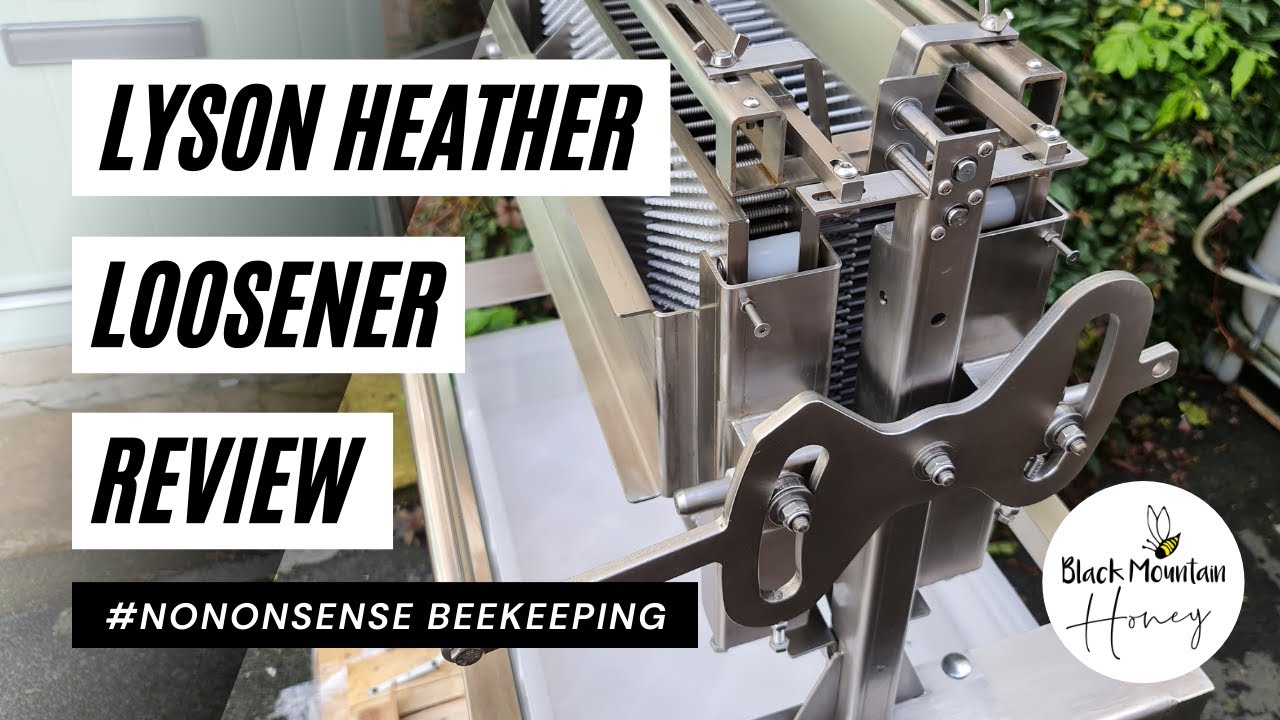
In this instructional video, Laurence Edwards of Black Mountain Honey explains why heather honey is notoriously difficult to extract and reviews the Abelo/Lyson Heather Loosener (needle‑pricker) as a solution. He outlines the limitations of radial versus tangential extractors for heather honey, describes his previous extraction methods (apple press, hydro‑press, wax cappings press) and their drawbacks, and then demonstrates the setup, operation, and performance of the Loosener. Key operational details include the need for multiple passes (minimum 4, typically 8‑16), the mechanism that advances the frame, needle dimensions (≈2 mm plastic), frame compatibility (national, Langstroth, Dadant, commercial), build quality (food‑grade stainless steel, portable on wheels), and cost (~£3,700 incl. VAT). Edwards recommends the Loosener for large‑scale heather honey production (50‑60 colonies) and suggests a hydro‑press for small‑scale work. He also notes the importance of protecting combs, re‑using them in spring, and previews upcoming videos on full extraction workflow and extractor reviews.
Chapters
Hi, I'm Laurence Edwards from Black Mountain Honey. Welcome to another episode of No Nonsense Beekeeping. We're back in the very cramped, very hot extraction room log cabin, and today we're going to review and demonstrate the Abelo Lysan Heather Loosener. So first off, a little bit about why heather honey is so difficult to extract. So we've spoken before about how it's a really, really difficult crop to actually get hold of, to get the bees to forage on it and to make a decent surplus. But the heather honey, it really is an absolute nightmare to extract. It's so much slower compared to normal kind of extraction in a normal centrifuge or spinner. And what you need to do is you need to agitate it or loosen it with a loosening machine like the one I'm going to demonstrate today before you can actually spin it. And then you actually need to spin it in a special way as well. You can't just spin it normally in order to get all of that honey out of the combs. So what you need to do is you need to agitate it on the loosening machine, and then you need to spin it in either a swing cage extractor, or if you've got a tangential extractor, that will work as well. That's perfect. And if you've got a radial extractor, you need to get special screens to put those in. Right, so I'll just demonstrate this on a kind of basically an empty frame. They're a bit heavy, the ones that are full. So on a radial extractor, you place the combs in that direction and they spin. So basically, you place the combs in that direction and they spin like that. So they're turning round and all of the honey is firing out in that direction. Now, see that again. So they're kind of pivoting around this point here and they're turning like that. So that's what a radial one is. And then a tangential extractor does the complete opposite, so turns it 90 degrees and spins it like that. So I hope that makes sense. But all that happens on that is that only the comb, only the honey on this side of the comb spins out and everything on this side of the comb remains in. So what you need to do is halfway through, you switch that over and then you spin it like that. So a bit of a background to the difference between radial and tangential. But when you are spinning the heather honey, you do need to be careful and follow a few key steps in order to not blow your combs. So the first one is, do not try and do it radially. I've seen some people writing about this recently and say that it can be done. Not sure where that was. I've never experienced that. I definitely can't get more than trying like 20 or 30% of the honey out of the combs doing it radially. And I get a huge amount of comb blowouts. I think because the extractor is not properly balanced, it blows the comb. Now what I use is a swing cage basket extractor. So on my Lyson 24-6 machine, which is— it does 24 frames radially, and then it's got a 6-frame swing cage basket function as well. Really like this machine. Doing a separate view today on this so you can see it. I'll put the video up there. But yeah, you need to follow a few simple steps when you're extracting heather honey, and that's what we're going to talk about in a separate video as well. So this video, I'm just going to focus on how to use, and I'm going to review the Abello Lysine Heather Loosener. We'll do a separate video, so make sure you subscribe to our channel. We're going to do a separate video on how to extract heather honey, so from frames into the jar, and then we've got a separate video on the extractor as well, so the 24/6 Abello 24-frame radial, 6-frame swing cage extractor. Right, so let's get on to the Abello loosener. Now, previously when I've extracted my honey, I've gone through quite a number of different methods actually. I've done some in— I used to have a 100-litre apple press. That worked really well, but it was terribly slow. You needed to kind of keep on mushing it up and doing it again and again and again, and it wasn't very efficient. So you left quite a lot still in the cappings that you needed to melt out. So I did away with that. I then moved on to a 40-liter hydropress, and that was phenomenal. Like, that's probably the best method I've seen, small-scale method for extracting heather honey. But I lost all of my combs, and that was— I didn't like to lose my combs. And also, the other risk with the hydropress I really, really didn't like is I basically, I was at the mercy of a hose lock fitting. If a hose lock fitting broke or exploded, I I lost my entire crop because it would've just submerged it in water. So I really didn't like that risk. I then moved on to the wax cappings press, and that is what I was going to use this year. I was going to use my wax cappings press to extract all my heather honey. Trialled it on a couple of frames, and it's just a bit too slow. Like, it's very effective, very efficient in terms of the amount of wax that it takes— sorry, in terms of the amount of honey that it takes out of the wax, but it's too slow. So I didn't want to do that, and obviously I'll lose my comb still. So then I bit the bullet and bought the Abello loosener. So this has come straight from Lyson. I've wanted one of these for years, and the high cost has always put me off. Like, these are not cheap. So it's £3,700 including the VAT. You only really need it if you're processing quite a lot of heather honey. But for me, do you know what I mean, the fact that I was kind of going up there, taking 30 or 40 colonies up there each year, losing a lot of boxes of drawn comb. And I really came to notice it in the spring when I didn't have enough boxes of drawn comb because I'd either crushed them all or melted them down for the heather. So that's what led me to buy the Abello loosener. So let's have a look. So I have to say apologies again, it's so cramped in here. You should see behind you, there's literally 100 supers. So I'm kind of moving around, a bit distracted because there's a big cluster of bees in that corner as well. That's what 6 weeks of extracting will do. All of the bees go and cluster over there, so excuse the odd bee. Right, so the heather loosener— I'll do a couple of close-up shots as well, but ultimately all it is is a needle pricker. It pushes needles into the honeycomb and temporarily, and I stress temporarily, loosens and agitates a thick stropic honey so that it will flow. So heather honey just doesn't flow. You can literally turn the jar upside down, and obviously eventually it will fall out. It does it very, very slowly though. So the best way to describe it is that it's a jelly. So, I mean, it wobbles, and you touch it and it kind of springs back. But if you get a spoon or you agitate it in any way, so do this with a jar of heather honey if you've got it, it instantly liquefies. So obviously I don't want to get a toothpick and go into each little honeycomb cell and agitate it one by one because I would be here for millennia. So this machine does it for you, and all it does is it takes a cell and pushes a needle into it. You need to make sure that every single cell on the frame has a needle pushed into it, and these needles, they're probably about 2mm in diameter, so 2mm. They're not like thin syringes or needles. About 2mm in diameter, made of plastic, and they're loaded on a spring. So all you do, it's very, very simple, is you just, you take your comb, you pop it in there, and you push down. And that's it. It's, it's as simple as that. Now I found you need to move it at least 4 times, and I'll cut to a close-up of a mechanism here because it's quite important, this mechanism. But there's basically a mechanism over on this side of the honey loosener that should automatically, after each push down and pull up, move the frame along 2 or 3 mil. Now in my experience, it doesn't work. It just all gets a bit too sticky too quickly. But it doesn't make a massive difference to me that it doesn't work because I do this one-handed and I've got one hand free and then I can move that across like that. So you need to do 1, 2, 3, 4. That is the minimum that you do. So I'll just turn this around the other way so you get a better idea of that. So this is the mechanism here. You start it off on there and you push down once, and then you should lift up and it goes, it's jumped along there, so that's moved 2mm to the left. Push it again and it's done it. So that time it has worked, doesn't always work. So if you want to do it two-handed, does work. I find though, because I'm only using a 6-frame swing cage extractor, I've got loads of time. So if I just go 1, 2, 3, 4, and I do that 6 times for my 6 frames, I'm done way before the automatic function on this extractor is ready. So I've experimented with just doing a few more, so I'd probably give it 16 goes in total. It doesn't seem to damage the comb. I mean, the comb gets damaged anyway using this process, but it works really well. So I found it's probably a little bit better just to give it a few extra goes. You don't need to go crazy on it, but do you know what I mean? Maybe like anywhere between kind of 8 to 16 is probably optimum, but it's recommended that you do as an absolute minimum 4. And use this, even if this little function on this side doesn't actually work, use it as your gauge. So don't just do 4 random kind of distances. You do your first one there, and again, it's difficult to see here. I'll do a close-up so you can see. Do 1, And then if it doesn't jump, move it along one. 2. Again, didn't jump, so I'll just move it along one. 3. Move it along one. 4. And that's it. So minimum of 4, and then that should get all of them done. So as you can see, I mean, that's not wrecked the comb at all. Um, I'm just doing one on here that's basically empty, but you can see like little bits of damage on the comb. But there's really not that much. I can even, once they're extracted and spun, do you know what I mean? Yeah, it'll break off a bit of wax, but the bees will easily repair that in the spring. They'll much, much prefer that to foundation. I'm going to store these wet, I'm going to keep them out of the way of the bees, and then feed these back to the bees in the spring. So not only do they get nice drawn comb, but they get lovely kind of remnants of honey, in this case heather honey. in order to lure them up inside the supers. So it's a really, really nice kind of all-round technique, that. So what else to say about the Abello Heather Honey Loosener? It's really well made. Like, it's expensive, do you know what I mean? You'll click on the link and I'll put up a link to where you can buy one of these. It is so expensive. And for what it is, and this is what's put me off it for years and years, is that how can that be so expensive? But wow, it like, it's really, really well made. And you can see how much effort has gone into it. Like, there's a huge amount of bending of the steel, there's a huge amount of welding. Obviously everything's 100% food-grade stainless steel. There's nothing that can really go wrong, do you know what I mean? Like, on an extractor, the motor could blow, or on an uncapping machine, you could get a leak in the cleaning— in the heating fluid. There's loads that could go wrong in all of the kind of complex machinery. This one, There is nothing that can go wrong. And if something did go wrong, like a screw came loose, it'd be a really, really easy fix, something that I could do with my poor machinery skills. So yeah, 100% food-grade stainless steel. Comes with a plastic tray there, 'cause you do get quite a lot of honey drop through, but then that just goes back into the uncapping machine to reclaim all of that heather honey. It's heavy, like, it's, like I say, really well made. Comes on wheels, quite portable. It's a really nice height just to kind of extract and to use that mechanism there. The mechanism feels lovely. Like, they've obviously kind of, I mean, you can see where they've shaved little bits off to get that real kind of like pushing back up like that. It does, it just, it's well made, it works really nice. Like, you can hear that, it's a solid, solid piece of machinery and you can see where the money has gone in that. So another thing to mention on here is obviously I've got this set up for a national size. So when you set it up for national, you can use a shallow or you can use a deep, but you have these, um, little caster things here and these move along. So that will go all the way out to there and you'll go all the way into there. So it caters for a really, really wide range of frame. And even when I've got the national deep in there, it's nowhere near to the bottom. So you could do a 14x12 in here. And then obviously I think it's all of the other sizes of frames are going to work as well. If it'll do a 14 by 12 and then it's got that additional dimension along the kind of length of it like that, you're going to be able to do Langstroth, you'll be able to do Dadant, you'll be able to do commercial. So it would be a right pain if you, if you kind of had 2 different sizes of frame and they didn't both fit in the same heather loosener and you had to buy 2. That would be a proper kick in the balls, wouldn't be good. Um, so yeah, it covers all of your frame sizes, which is really good. And that's it. So I'll do a couple of close-up shots just showing the mechanism working, showing how these needles actually go into the honeycomb, showing how you're supposed to move that along, and showing this little mechanism here. Um, and then we'll cut back. So that's it for the Abello Lycan Heather Loosener review and demonstration. Bit of a mouthful. I'm so, so glad I bought this machine. And again, I mean, people will say, oh, you're sponsored by Abello. This isn't an advert for this machine, although this machine is great. This really is kind of me just saying, I think if you can afford one of these machines, it's a good investment. And whether that's from any of the other suppliers, doesn't matter. I think a heather loosener is a really, really good idea if you're serious and interested in doing a lot of heather honey. And by a lot, I mean, do you know what I mean, taking 50, 60 colonies up to the heather. Not just 5 or 6. If you've just got a small amount of heather honey to process, my recommendation would definitely be the hydro press. You can pick those up for kind of £300 or £400, and they're incredibly efficient and effective, but you do lose your comb. But if you're only doing it on a small scale, that's the way that I would go, and that's the way that I was at for ages. But it's the only reason I changed is because I was wrecking so many of my boxes. So that's it for the video. Like I say, we're going to do a follow-up video to this, so I'm going to show you the full method of honey extraction. So from in the frames, through the loosener, into the swing cage basket, after it's been through the uncapping machine, then how we filter it, then how we jar it. So I've got a really, really good video to come. So if you're interested to know how heather honey is extracted, make sure you hit the subscribe button in that corner there, and then you'll see the video as it pops up. Also to mention, do you know what I mean, other videos we're doing in this honey extraction room, We've got the 24, 6-frame extractor to do, so the 24-frame radial and the 6-frame swing cage. So we're going to do a review of that soon as well. And I think that pretty much covers the majority of the machinery that we've got in our extraction room, depending on which order I've published the video. So there might still be a few more to come. As and when we get any more extraction videos or we do any more honey extraction, we will post it on our website. So make sure you hit the bell and you're notified of every single video that we do. So as always, thanks for watching. Please hit the subscribe button. Please hit the bell so you're notified of every video, and I'll see you next time.










