Autumn Heather Apiary Snapshot - Last Inspection - Some Huge Colonies of Bees!
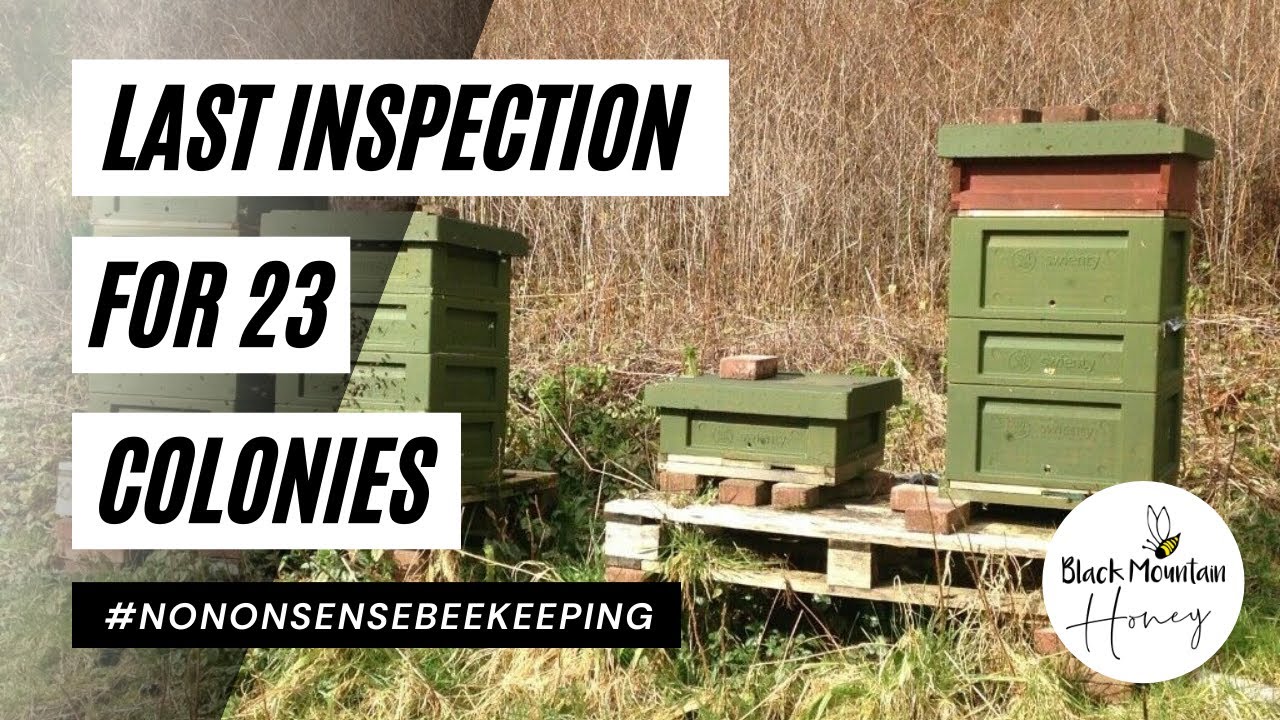
In this episode of No Nonsense Beekeeping, Laurence Edwards of Black Mountain Honey walks viewers through his autumn inspection of a 23‑colony heather apiary on the Welsh moors. He removes eight‑week Apivar strips, records the size and health of each colony, and explains why he leaves the apiary in place over winter despite conventional advice to bring hives down. Edwards cites the apiary’s four‑sided shelter, abundant surrounding forage (gorse, ivy, etc.), and his own multi‑year experience of successful overwintering as reasons to keep the colonies up. He categorises colonies as strong, marginal, or likely to fail, estimating a typical 10‑15 % winter loss and predicting 2‑3 failures this year. Looking ahead, he outlines a plan to build massive double‑brood colonies (14 × 12 frames) to maximise the heather honey crop, and commits to future “snapshot” videos in spring and summer to track progress. Throughout, Edwards stresses transparency—showing both thriving and weak colonies—to help beekeepers of all skill levels understand realistic expectations and management strategies for UK beekeeping.
Chapters
Hi, I'm Laurence Edwards from Black Mountain Honey. Welcome to another episode of No Nonsense Beekeeping. Today I'm going to show you around my heather apiary and talk to you about why I'm leaving my bees up here for the winter. So beautiful North Wales weather is grim up here today. It's A little bit windy, very rainy, but I need to get into these colonies to take out the last of the Apivar strips. Had the 8 weeks up now, so I need to get in there, take those strips out, because I don't want my colonies building resistance. So what I'm going to do for this video, I've got myself strapped up with my GoPro. We'll see how well the footage comes out. It might be a little bit shaky, might be a little bit rainy, but we'll do our best. What we're going to do is we're going to go through each and every colony. Got 23 colonies up here. I'm going to take those Apivar strips out and I'm going to give you a snapshot of the size of the cluster as well. So you'll see every single one of the 23 colonies up here. Got a bit of a variety in terms of sizes. Some are absolute monsters, some aren't that big, probably shouldn't have come up to the heather in the first place. A real mixed bag, but you'll be able to see in this video every single one of the colonies up here in the heather apiary. So talk a little bit first about why am I leaving my colonies up here in their heather apiary over winter. Obviously the normal guidance is you need to take your colonies down, they shouldn't be left up high over winter. This apiary here is a little bit different from the rest of them. So as you can see, we've got really nice shelter on all, all 4 sides of the hives, so they're really, really well protected from wind. Not so much protected from the rain, but they're going to get rained on anywhere. They're quite high. We're about 950 feet and the heather moorland is all over there. The rest of the place around here and towards that way is actually just village and open farmland, so there's lots of other forage available for them. There's lots of gorse, there's lots of ivy, there's loads of different forage available for them. So it's not a case of once the heather's over, there's nothing else for them to forage on. There's plenty available for them. The other thing is I've actually had colonies up here the last couple of years, nowhere near as many as these, but they've lasted and survived really well up here. So I'm using my own experience to say the colonies have done well up here, so I'm just going to leave them up here full-time from now on. Now this is driven by the fact that it's quite difficult, this location, to get them up here. Getting them in, getting them out is difficult, but it's a really, really good location. They do very, very well on the heather here. So it's definitely an apiary I don't want to give up, but it's something that I can't manage kind of on a year-in, year-out basis. Taking them up here, taking them back down, it's a bit too much effort for me. So amazingly, the landowner said, you know what I mean, keep them in this spot and you can keep them up here all year. So this video, I'm going to show you a snapshot of all of the colonies, but then next year I'm going to give you an update as to how these colonies are getting on, and then I'm going to do something a little bit different with these colonies. So I'm not going to run them for a spring crop. I'm not going to run them for a summer crop. I'm basically going to build them up, build them up, build them up, get them ready for heather, try and get them into monster colonies for the heather, and then go for a real super crop from the heather. So that's the plan. Right, I'll get my hood on and we'll take a look around at some of these colonies. Like, it's pouring down with rain. I'm not going to open them up too much, only just crack them open, take the Apivar strips out, take a quick picture of the cluster, Close them back up again, and that's it. That's the colonies done for winter. So I'll get my hood on. Let's take a look at some bees.
Colony number 1, looking really nice and healthy, over 10 frames of bees. Going to get those Apivar strips out now. Colony number 2, again over 10 frames of bees, really nice looking colony. Let's get those strips out. Now this colony here, not finished their syrup, maybe slightly weaker than the other ones, but still, I mean, a Full 10 frames of bees, really, really healthy. It doesn't matter if they're a little bit smaller, I mean, these are really big strong colonies. Now what do we have here? There is something wrong with this colony, something's not right. They may have had a late go at supersedure. I'm not going to open them up, I'm not going to bother to look, but I can pretty much guarantee this colony will not survive the winter. It was big, it was huge about 8 weeks ago, and now It's no more than watermelon size, something's gone wrong. Look how much feed they've left, it's just not right. So I mean, we'll keep an eye on this colony, but pretty much guaranteed this one's not going to make it. And then we're straight back into the big boys, absolutely jam-packed, 10 frames all the way down to the bottom, really heavy, you know what I mean. You're always going to get duds, but as long as the ones next to it look like this, we're very, very happy. So this one, not quite as loosely packed as the others, Not 100% sure on this one. Doesn't strike me that everything's absolutely spot on. There's not as many bees in here, but again, you know what I mean, I'm not going to open up, I'm not going to look at any of the frames. There's nothing I can do. That's what the colony looks like. I'll put this one and mark it down as a maybe. Again, not quite as big as the others, but this one does look good. You can see that the bees go all the way down, probably over maybe 8 or 9 frames. But yeah, I mean, you get a lot of variation between these colonies. That is still a pretty healthy colony. It'll probably cluster up over about 6 frames, but you've got to remember these are 14 by 12 frames, so they're a lot deeper than the standard national. Again, not quite as big as some of the monsters, but still a really fair size for a colony going into winter. I mean, they're probably clustering up there on like 70%. Look, look, a nice healthy colony. It's definitely not a maybe. This one looks good, just not quite as strong as some of the other colonies. Now here's a couple of the smaller colonies, and And whereas the other one I was really concerned, this one looks to be in quite a nice cluster. And I find if they're clustering up like this, it tends to just be the genetics. When they're running around and there's a little bit of craziness going on, I'm more worried about a drone laying queen. This one, I reckon we'll get them through, um, maybe dummy them down a little bit. But I mean, that, that's a reasonable size cluster, especially on a 14 by 12, probably equivalent to like a standard national. Right, not liking the look of this one. Again, if I had to kind of hedge my bets, I'd say there's been a late supersedure gone on here. Doesn't seem to be enough bees, not in any sort of cluster pattern. Yeah, really not liking the look of this one. And then there we are, straight back into the really nice strong colonies. This one, over 10 frames of bees, really looking healthy. We'll get those strips out and close these ones back up. Again, straight back onto the strong ones. Look at that lovely cluster of bees in there, full to the brim with bees all over the feeder as well. Big strong cluster, this is what we want to see the colonies like. So straight back into the big boys, this was the best performing colony of the year in terms of the heather yield. This one yielded about 35 pounds, really, really happy with this one. Yeah, so you can, you can see really nice gentle temperament as well, Great production capacity, they took a lot of feed as well, so they really like to take their feed down. They've turned it into a lot of bees as well, but that's what we like. We like big colonies, we don't mind if they take the feed as long as they produce the honey. So another really nice strong colony, not as prolific as the one next door, but nonetheless a really nice strong colony. These guys will cluster up, probably a 70% cluster once it gets a little bit colder. But you can see them coming up now, lots of bees, really, really happy. And there's no letting off, again, really nice big colony, nice and strong over all 10 frames. So there's another colony, really nice and strong over all 10 frames there. They're a little bit kind of void from the middle, but that's just because I've taken them off. We'll get the Apivar strips out and close these guys up. So not quite as strong as the other ones here, but again, over 6 or 7 frames once clustered up, you know what I mean? That's probably the size of a national. These could go in a nuc, but there's no need to. They're in poly boxes, they'll be able to keep that warm. Still plenty of bees in there, really happy with the way these are looking. So next colony, really grumpy for some reason, didn't like me breaking that propolis seal. But again, 10 frames of bees, really healthy. They're still taking down a bit of syrup, these guys, and they're very, very heavy. So these are looking really good to go into a Another Ginger Buckfast colony, 10 frames of bees, absolutely full to the brim, really heavy, really nice gentle colony. These are going to go through the winter really well. And the final colony finished with an absolute belter, you know what I mean, 10 frames full to the brim with stores, no doubt loads of brood in there as well, although they might be on a brood break, we never know. Don't go into your colonies at this time of year, just no good that can come out of it. All we're doing here is we're going in, taking those Apivar strips out, closing them back up, and then we'll see them again in the spring.
So there we have it, just like that. That is the end of the season. That is my last inspection. All of the colonies are fed, all of the Apivar strips are out. It stopped raining, which is a miracle because it was absolutely bucketing it down while I was doing that. The reason I wanted to do this video though was to give you that snapshot of all 23 of those colonies. I'm not here to hide anything. I'm not here to say, look at my colonies, aren't they great? I never have any failed colonies. I never have any drone-laying queens. I never have any duds. That is not what no-nonsense beekeeping is about, and that's not what we're about at Black Mountain Honey. We want to help beginner beekeepers, novice beekeepers, intermediate beekeepers. Basically, we want to help all beekeepers, um, to understand what you can do and to live with the constraints of beekeeping in the UK. So we'll show you the dud colonies, we'll show you the rubbish colonies. I'll give you the snapshots of the colonies that I think are going to fail. On average, 10% of the colonies up here— that's about the average that we work to—
will fail.
So I've got 23 colonies up here, I'm going to have 2 or 3 colonies that are going to fail. And I think from the snapshots that I've just showed you there, you can probably pick out the colonies that are going to fail. We might have some that starve, If I'm not on top of it, the drone-laying queens, late-season super sieges that you miss is a classic. I mean, that is a real classic reason as to why colonies fail throughout the winter. There's not a huge amount you can do about it unless you're going to go in and inspect really late in the season, which I don't recommend. I'd say just put up with the losses, factor them in, factor the fact that you're going to lose 10 to 15% of your colonies, make up some nucs to try and counteract that. And then make some splits early in the spring and you'll get your numbers up absolutely no time at all. So I think you'll agree though, on the whole, this apiary looks really, really good. There's a lot of bees in most of the colonies. They're big, strong, heavy colonies. Obviously we haven't gone inside and looked to see if there's any brood, but you can tell, do you know what I mean? The amount of bees that are there. The queens have been working into overdrive the last 2 months to get the bees up to a kind of state where they can cluster around her over winter And get them through into the spring. So I think this apiary will do well. I'm really glad that I can just leave them here now. You can see the moors over in the background. We'll do a snapshot revisit video early in the spring to show you how many of those colonies failed. If I had to have a guess, I'm going to go with 3. 3 colonies, that's probably about 12 or 13% losses, and I think we'll find the exact ones that I've identified as being weak, they're the ones that are going to fail. So if I can come through the winter and have 20 colonies still here, then we're going to do something a little different with this apiary next year, and I'll do kind of like a regular video update showing you what I'm doing, how I'm getting those colonies ready for the heather. I want to get them on big massive double broods, 14 by 12 double broods, and I'm going to condense them down all into a single 14 by 12 brood box and put the supers directly on top like that. So we're So we'll cover all that in a separate video early next year, and I'll show you how I'm trying to maximize my heather crop with a static heather apiary. So I hope you've enjoyed this video. We're going to do more videos like this next year. I'll give you snapshots in the spring of each apiary. I'll give you snapshots kind of throughout the year, and then more importantly, I'll give you a snapshot at the end of the season, final, final inspection, and then you can see how they fare through the winter. So a final message to everyone, Thank you so much for subscribing to my YouTube channel. Thank you for the support. Thank you for the likes. Thank you for all the messages. We do this for you. We do this to help you, but I'm not gonna lie, I really enjoy it as well. It's so much fun coming up here, doing the videos, editing them, reading your comments, seeing the amount of subscribers going up week in, week out. I really do enjoy it. So thank you so much for your support throughout 2020. As always, Hit the subscribe button. Please hit the bell so you're notified of every video, and I'll see you next time. Bye.










