Black Mountain Honey: Let's Talk Bees with Laurence Edwards - Episode 59
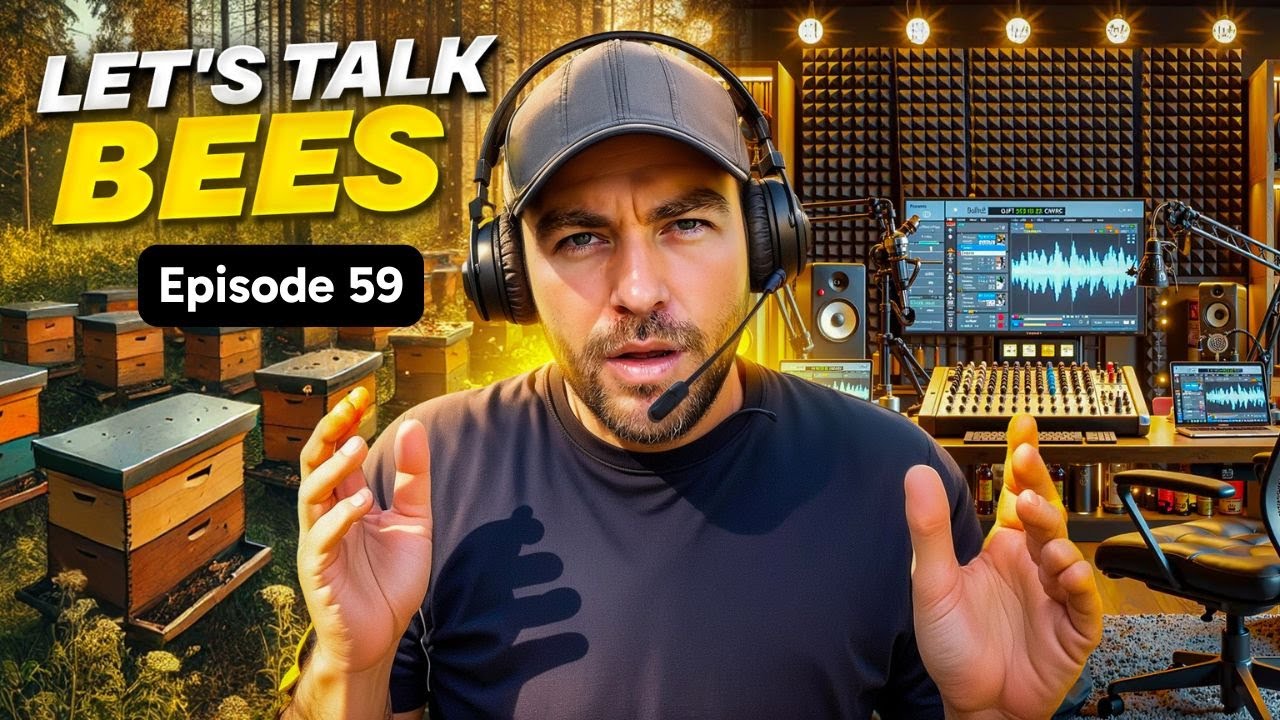
Laurence Edwards talks bees after a grueling six weeks of selling queens and shipping nucs. He answers rapid-fire questions on hive management, Asian hornets, winter prep, and frame tools, plus updates on Black Mountain Honey sales and a new beekeeping course.
Chapters
Good evening everyone and welcome to another episode of Let's Talk Bees. Now you may notice that I look a little bit tired. You may also notice that my voice has gone a little bit husky. That is because it has been a very, very, very long week. Uh, we have sold lots of queens, we have sent out lots of nucs, and today I have been filming the first module for Hive Q 14-day beekeeper course. I'm really, really tired, so we're going to jump straight into it. We're going to answer as many questions as we possibly can. I'm not going to answer any of the questions from the spreadsheet because I think within about an hour and a half I'm going to be ready for bed. I know that is an inspiring introduction to Let's Talk These, but that is the god-honest truth. This time of the year is very, very, very busy. I would say the next— well, the, the last 3 weeks and the next 2 or 3 weeks are the, the busiest time of the year, busiest 6 weeks, and then And it gets a little, a little bit easier once the overwintered nukes are out the door. Last— next week is the last week of the overwintered nukes going out, so we are officially halfway through sending out the nukes now. We've got a target goal in mind that we are like 2 or 3% away from hitting, and then we've sold over 50% of that target goal, and then we will stop. So we're not going to be sending out any nukes in after the first week of June. So the first week of June will be the absolute deadline for nukes. So let's jump straight into it. First question is from . Channel member. He says from Chris in Hythe, Kent. Hope this is the correct way to ask a question. It certainly is, Chris. He says, "I'm interested to know what camera kit you use when filming your videos." Oh, I like questions like this. I said to myself today, right? Don't go off on any tangents. Just answer the questions really, really simply, and we get to the bottom within two and a half hours max. And then a question like this comes along, which is like my favorite thing to talk about. But I will keep it simple. I use all Sony equipment, so I've got loads of Sony lenses. I've got a lot of lenses. I've got 24mm, I've got the 50mm, uh, I've got, um, the 24-70, I've got the 16-35, all the Sony G Master lenses. And then I use an FX3, a Sony A7S IV, a Sony A7S III, and then an A7 IV. They're my 3 cameras and I absolutely love them. Uh, right, next question, or it's comments. There's Marcus, Marcus from Walking Behind. He says, good evening. Hello to you too, Marcus. Uh, John Begri says, hit the like button and sit back and enjoy the show. Thank you very much, John. Michael Martin says, hi Lawrence, hope everything's going well. I've got 6 queens coming from you on Friday. Oh, you did actually get 6 queens from me on Friday. Pop the tabs on Monday, planning on having a look on Sunday, or should I leave it a week till Sunday the 28th of the 4th when I'm planning on inspecting all 3 sites anyway? I would probably just wait until you're going in and doing the inspections. Once you've popped the tabs, you pop the tabs on Friday, I always just leave it a week. Anything earlier than that and you just risk something going wrong. So I always like to leave it a week, definitely wouldn't go in for a special visit. I have 3 honey production hives and one that I was thinking of keeping to keep for splits. What would be the best method to make as many splits as possible this year to then sell on or for honey next year? So my favorite method for splits is double brood. So you just take a single brood box at this time of the year, put another brood box on top, get the bees to completely draw all of that out, and then depending on the boxes that you've got, you maybe have like between 20 and 22 frames of bees and brood and honey and stores and pollen, and and then you can just split those up very, very aggressively at that time of the year. Minimum of 1 frame of brood, 1 frame of stores, good shake of bees, and add a mated queen. Place that off into a nuc, and then that nuc will, before the end of the year, need to go into a full-size hive, and you can potentially split it again and again and again. I think I got from 1 colony to 20 colonies in like from April to June when I was running the experiment and then realized it was way too much work, so gave it up. But I do think hitting 80 is possible. to go from 1 colony to 80 with unlimited drawn comb and unlimited mated queens and unlimited feed. I think it is doable in a good season, and this season you couldn't get a better season to do it. I wish I'd done it this year, it would have been absolutely amazing. All right, where did we get to? Evening all, it's been a cloudier— uh, sorry, it's been a bit cloudier and cooler in Norfolk this week, but the bees are still keeping busy on the oilseed rape. That is probably a good warning to anybody who's looking out the window and just thinking it's drizzly and cloudy and the bees aren't going to be doing anything. From people who have been going in and inspecting their bees, the bees are very much doing stuff this week, even in the damp and the drizzle, because they get maybe like 2 or 3 hours some of the days to go out and forage, and that's all the bees need to go out and collect a huge amount of nectar. So all of the hives that I've been looking in, I've been thinking, right, they need more space, and I didn't, I didn't think that this week was going to yield so well, and then I look at next week and next week looks even Better. What will we go into next? Graham says hello. Hello to you too, Graham. Frolly's Bee says, "Hey everyone, Lawrence, where did you buy your benches for your honey house from?" I got them off Facebook Marketplace actually. Someone was closing down and had some very nice stainless steel benches, so I got those. Sean Seymour says, "Hi Lawrence, looking forward to receiving my bees on Thursday." Thank you. We're looking forward to sending them out as well. Lots of people on this one. So this is the first of the overwintered Langstroth. Batches that are going out. Um, the Langstroth, like, it's crazy, like, picking them up and feeling them this week, how much bigger and how much heavier they are than the Nationals. And they are the same price, which we might need to, to look at because they take a lot more work and a lot more feed and frames and stuff to get them up to speed. Uh, Sean also says, how is your NL hive going? Uh, it's very, very packed and I do not have any additional boxes for it, so I just have the brood box. Uh, so what I have done is completely bodged it and put a Lysan 9-frame poly box on top and try to seal up the edges, and I'll do some sort of conversion. But the bees seem to be doing very well in it. Hey y'all! Hello to you too. Evening, Laurence. Looking ahead, after supers have been removed and extracted, the advice I have been given is to put them back on the same hive. Is this critical, particularly if they're stored wet over— I'm guessing you're gonna say winter, but there's no ending. So it does depend. Like, in an ideal world, you would take the exact super off a hive, extract it, put it straight back onto the hive, let the bees kind of clean it all out, the same bees, and then put it off into storage. And then the following year, you put it back on exactly the same hive. A lot of people do that, but it limits you, really does limit you a lot by doing that. So say you've got 4 supers per colony, so 4 supers for each beehive that you've got, and in one particular year, one of the colonies has swarmed and you're not really getting that much honey on it, and the other one has got 4 supers rammed full of honey. And then you've got all of these supers here with loads of drawn comb that you can put on, but your rule is that they can only go back onto the hive that they're assigned to. So logistically, I think when you ramp the numbers up, it becomes very, very difficult. So I don't know a single bee farmer that would run a system like that. You get people who do it apiary by apiary though, so I think doing it apiary by apiary is a more sensible way of doing it. So you say, well, all of the supers from that apiary can be interchangeable between the hives that are on it, but then I'm never going to mix supers, I'm never going to mix anything from apiary to apiary, and I would say that's probably a fair compromise there. I'm gonna have a sip of my drink. Frollies Bee says, what program do you use for your video editing? I use Adobe Premiere Pro. And I'm absolutely rubbish at it. Uh, Holloworks Stores says good evening all. Evening to you too. Uh, EJ the Arctic Beekeeper says hi from Norway. The Arctic. When do you— when does your queen rearing start? Well, it's funny you say that. Queen rearing starts this week, so I'm going to set up my starter finishers this week. I'm going to have a go of a slightly different method. I know the method works well, but I'm just going to tweak it so I can do like a slightly different video, maybe make it easier for people who don't want to do the big all-out 10 over 10 method, the, uh, the Michael Palmer method, which is a very good method. But I am starting to set that up this week, so very, very excited about that. Hi Lawrence, this is my third year and possibly my first spring crop. When extracting, how many supers should I put back on whilst I'm extracting the other supers? Would one be okay? So you just have to go with your gut feeling on this one. I generally feel if you've got 2 supers full of bees, you can condense them down for a short period into one. So if you're taking off 4 supers, I'd give them back 2 as an absolute minimum. Now you might go back later on that evening and they're just all bearding out the front and there's just not enough space, and then you'd have to add another one on. But I think it's a good ratio, like a 1 to 2 ratio. So for every 2 supers that you're taking off full of honey, you want to put back at least 1 new super. You can, you, you can just rush it. Say, say you're doing this like in your garden, so you've got 1 colony of bees and you've got 4 supers on and it's full. honey, you could just go and take the supers off and just let the bees cluster up for a few hours, go and extract the honey, and just go and put it straight back on. It didn't take that long to extract 40 frames of honey. You think if you've got a 6-frame extractor, it's only like 7 spins, um, and then you're, you're through. So it doesn't actually take that long to do it, but best practice is to give them some space in the meantime. Um, where are we going next? Sorry if I'm struggling to read the questions. One, I'm very tired, but two, my, uh, my eyes are just, uh, I don't know, really bad after a day of filming. Maybe a sip of tea will help. Oh, there we go. Right, Frollies Bee says, have you worked out what nucs you're going to use once your stockpile runs out? You're going to use the one Simon is now making? Oh, very much so. So we will continue to use the Payne's ones. And even better, I think he's working on some tweaks to make them slightly better than they previously were, so we will continue to use those 100%. Evening everyone, what's happened to this weather? What's the best way to change comb from old to new foundation? So there's a number of different ways of doing that. First of all, yeah, come on, let's get that sunshine back. So you can do a shook swarm. Shook swarm is probably the most aggressive way of doing it and one that I would only recommend in kind of exceptional circumstances, which is you just shake off all of the bees from the old frames into a brand new beehive or freshly scorched beehive, Brand new frames and foundation. You leave it for a couple of days, 3 days, let the bees empty their stomach to start generating some wax, and then you feed them and build it back out. That's a very, very aggressive way of doing it. Another way of doing it is just go double brood. So you just have a single box of bees, and once we get the draw— the drawing app back out— I know people like the drawing app. Let me work out how to share the screen on here. There we go. Right, so you should be able to see that now. Oh, is it gone? Should be able to see that now. So this is probably the way that I would go around doing it. So I'd get— you'd have your box of bees like that. So that's your box, just your brood box with kind of everything in it. And then I would get another brood box and put that on top, and that's the one with all of your nice new shiny frames in. And then once the bees have drawn all of that out, so they're going to kind of be starting off down here and then they'll get bigger and bigger and bigger. Once they've filled that box out, you find the queen, put the queen upstairs, put a queen excluder in between the 2 boxes, let all of the brood down there emerge, and then you can just take that box away and discard the old brood once it's emerged— the brood frame once it's emerged. That's probably going to be like the quickest and neatest way of doing it. That's what I would do. Right, let me reset all of that so it's nice and clean for when we come back to it next. I do like having the drawing board there, it's cool. Uh, right, Hi Lawrence, I meant to write and thank you for the nuc. All settled in and doing well. Happy Easter, Charles. Thank you very much, Charles. A lot of A lot of people have received nucs so far. We sent out 500 overwintered nucs so far. That was the milestone that we hit this week, uh, so lots of customers, uh, lots of happy customers, I like to think. Um, but it's great seeing all these people posting the videos of their new nucs and bees orientating. I absolutely love it. All right, Good evening all. Good evening to you too. Hi from Simon in Devon. I installed my first 2 Black Mountain Honey nucs this week. I want to convert the nuc boxes into swarm traps. I have Correx. How do I secure it to the top and bottom to make the ideal trap? So if you have Correx, it's really, really simple. Just cut out a piece of Correx bigger than the, the top mesh and bigger than the bottom mesh, and then I just like glue it in place. Um, you could probably, you could probably screw it in place as well if you wanted to make it a little bit more removable, but that would be fine for the bees. The bees wouldn't need anything more than that. They just don't like the, the air. They can kind of like feel that the air goes through the mesh. So if you just put a piece of Correx on the, the bottom of the nuc, that's what I would do. Cut out a big piece of Correx, stick it directly in the bottom of the nuc to block the bottom mesh, and then the top mesh I would put the correct on the top. And then what was the next question? In terms of fixing it to a tree, I just used to use a ratchet strap. So I ratchet strap the lid on, or you can screw the lid on and then just ratchet strap it to a tree. It doesn't need to be that high, you know. I tried loads of different heights and the ones really high up in the tree didn't do any better than the ones that were just off the ground. So meter, a couple of meters off the ground facing south, and you should, you know, catch some decent swarms in it. It's a— I guarantee you, you'll have made it, you'd have brought them back down and made a split from the nuc before you catch a swarm though. That is my prediction. Sam Brister, channel member, says, I only have 4 hives with plans to expand to 10 honey hives and some overwintered nucs. Is it worth rearing my own queens, or is it better to just buy mated queens? So you're asking someone who sells mated queens for a living this question, but I would say to you, uh, you, you, an unexpected response, which is give, give it a go. Definitely give it a go. Mated queens are brilliant because they're a very easy, uh, solution, and it's very easy for you to make up the splits. And, and without any offense, it's very easy for people who, who don't know what they're doing to make up splits with a mated queen. Rearing your own queens requires a little bit of skill. It's not that difficult, and once you put in a bit of practice, you get good at it quite quickly. It's incredibly rewarding. I recommend everybody who keeps bees have a go at rearing your own queens. You don't need to graft. There's tons of different ways of doing it, and it is really, really good fun. So give it a go. And maybe give it a go, and if they don't get mated, then find the virgins, the failed virgins, kill them, and then some mated queens in as like a backup. Collectors Rick Honeybee says stack silver, gold, and honey. Okay, good advice. Hi Lawrence, I'm a beekeeper from Jersey. We have a problem with Asian hornets. Have they reached you yet? So they have reached us. They've been here for a few years now, probably close to 10 years now. I think the first few years it was kept kind of out of the press a little bit, but I don't know whether— I think it was just, yeah, there were no nests at that point, but there were like individual hornets, either sightings or trappings. and then it's ramped up, and now there's obviously overwintering queens and nests popping up. But last year, you couldn't have really got a worse spring for, for any sort of wasps. But, um, in particular— I say in particular hornet, I'm not sure if a hornet is a type of wasp— but any kind of, you know, insects like that. And it, it meant that there were hardly any throughout the whole of last year, and everyone thought, wow, we're on top of this. And then this spring is just the complete opposite, like it's the best possible conditions for them. So I am expecting later on this year to see a lot more nests being found and a lot more sightings of Asian hornets, but it's nowhere near as bad as you have it in Jersey. Like it's impacting very isolated apiaries at the moment, and hopefully we keep it under control. I have just built a pond and there's tons of bees flying all over the surface. So they will do that. They like to go there and collect water, either to kind of break down any honey stores that they've got or regulate the temperature in the hive. Bees go out and collect water all the time. JK Photography says, hi Lawrence. Hello to you too, JK. Rob O says, hi Lawrence, I seem to find myself in opposition to many BKA who, generalization accepted, seem to promote Black British AMM and are, generation accepted, against any foreign bee queen there's going to be some more somewhere else. The problem is that the British Black AMM are relatively more difficult to handle and aggressive than Black Mountain Honey Buckfast, or frankly any other nicely bred queen. I'm just looking— oh, there you go. Do I just give up trying to find a common ground with my local beekeeping association or go all in on nicely bred foreign bees? So I'm going to jump back to the first bit so I don't miss out anyone else's questions. It's a really good point, and you are not alone there. You're really not alone. A lot of beekeeping associations are, you must buy your nucs from a 5-mile radius, you can't bring nucs outside, definitely can't have any bees that aren't local black bees. And, you know, if, if you want to do that with your beekeeping, you're not welcome here. Like, they might as well put that on a sign because that is what a lot of them believe in. And they'd say, oh no, no, everyone's welcome. And it's like, no, you need to keep the right bees and you need to do what the BKAs say or you're not welcome, which is, which is not nice. And they're not all like that. And I've worked with and kind of like spoken to some really progressive beekeeping associations that are there to promote honeybees, and that's kind of all they care about, and everyone is welcome. And I think they're the really good, progressive, thriving beekeeping associations that are doing that. But you do find a lot of them are still like this. And my advice to you, which is exactly the same thing that happened to me, is you've got to pick a side. It's a really sad world that we live in there. But I don't want to promote conflict, and I hate that. I just like, just want to get on with, with what we do and not have any impact on anyone else. And they say, well, you are having an impact on us because our queens are mating with your drones. And I say, well, my queens are mating with your drones, and I don't, I don't want your drones' influence. And they say, yeah, but we were here first. And you say, well, it's only, it's only like a few years. You've not really not been here that long because you kind of— AMM was like fully wiped out in the 1900s, and then they imported it from Europe. And I saw, I saw recently a big, uh, a big conference about AMM in Europe and like preserving the, the European honeybee. And I think, well, where do you think like Ligustica bees come from? They come from Europe too. And what do you think like Carniolan bees, they come from like Slovenia? That's part of Europe. So I don't— I just don't get— I just don't get the hate for these other bee races. But anyway, you can see which side I sit on. There's, there's no way I could ever— rephrase it— there's no way that you can ever agree on, um, like shared ground where everyone's happy. Because if you keep the bees, if you keep imported bees, then they're not happy because the imported drones are in the air. And if you, if you keep the AMM, like you said, you're not happy because they're really difficult to work with and they're quite aggressive and it puts a lot of beekeepers off. So that's— that is a real generalization. Of course there are going to be like local stocks of bees out there and feral stocks and close to AMM that aren't always aggressive. So I do apologize if I'm overgeneralizing there, but I do feel that you probably do need to pick a side one way or another, or do what many people do and buy really dark Carniolans or Caucasians, and they're the best AMMs ever. And, you know, they're dark and they're black, and people are like, yeah, that is, that is totally what I'm into with beekeeping, not appreciating the fact that they've just been imported from somewhere. I received a VSH Buckfast queen from you yesterday. She looked Looks good. Excellent. Glad to hear that, Simon. Anthony says, good evening, Lawrence. My bees are doing so well, mate. Brood has now been extended down to the bottom box on 4 frames, the top box full. Smart supers are on. When would you normally expect to take the first honey off? How do you judge the right time? So Anthony there is talking about things in Paradise Smart Hive, but a Flow Hive would be the same. So having the double brood box there is going to slow down that honey collection substantially, but that is a good thing. Bear with me, because if you hadn't added that additional brood box, the super would probably be close to being full now, if not a couple of weeks off, and then you really need to be on top of tapping that throughout like the main swarm period. So having the additional brood box there gives the queen space to lay, so they shouldn't swarm through congestion in the brood box. But the challenge that you're going to have later on, even in the double brood configuration, is how many bees are actually in that beehive. So when you take the first honey off, judging the right time, like for us in North Wales, for a spring crop, there's no oilseed rape, you're going to be looking kind of like towards the end of May, I would say, is a suitable time. And I wouldn't be taking off the honey until all of the frames have been completely built out and filled with honey and capped over. So I would say around the end of May, it's going to be a good time to go in there and have a look at that. Uh, where are we going next? Right, I'm checking the Demeray top box tomorrow, first time trying this method, so interested to see how many queen cells. I will also take a look at my first Black Mountain honey queens. Stinky Slight, uh, interesting point there, and I saw someone make a comment about this the other day. So they don't always create swarm, like, emergency cells in that top box. Sometimes they do, sometimes they don't. You need to assume that they do, shake off all the bees, and take down any emergency cells they do create. If they, if they don't create them, then no problem, you can just continue as normal. Channel member says, hi Lawrence, 2 questions. What sort of blowtorch do you use to clean wooden hives, and what nail gun do you use to put together frames? Um, so I'll have to get a link for the, the nailer. So it's a Makita. If you Google this, actually it will work. A Makita 18-gauge brad nailer. They only do one of those. It is, it is expensive, um, but it's a good one and it's an electric one. It's about £350. They also do Makita, an 18-gauge brad nailer that's a, um, a pneumatic one, so you need to link it up to a compressor. Equally good, and the, the actual gun attachment is considerably cheaper than the electric one. And then the blowtorch that I use, I just use like a big roofer's torch from Screwfix. And if you want to be all flashy with it, get the one with the automatic ignition on the end. It's very, very nice. Northeast Scotland and found swarm cells in a 6x6 nuc. No kit on hand to split, so remove them. Can't believe how fast this season is ramping up. It is the craziest season in the world. Fed the bees about 2 liters of 1:1 syrup when I installed them yesterday. Should I be looking to top up and how much? I, I have One really strong nuke and one that is a bit further behind. So for me, I'd balance the nukes. I do think it's a good idea to do that. Like we do our very, very best to give people like the balanced, the most balanced nukes possible. When you're sending out that many, you're always going to have ones that are stronger and ones that are weaker. And it it's always sad because I think if people get two nukes, they say there's one that's behind, where in reality the one that's behind is probably the one that's like our perfect vision of what a nuke should be, which is. Plenty of frames of brood, couple of frames of stores, and just about enough bees to cover all of that brood to get it through the postal system. That's what it should look like. And then we, we'll go and inspect them and we'll kind of like stack them up ready to go. And then a few days goes past when they're in a holding apiary and all of the brood emerges, and then you're kind of like packing the boxes ready to go, the nucs, and you're looking at them and you're thinking, whoa, that is like way, way, way overpopulated. But then for a customer, that's like, oh, that's what they should look like. and then the one that's standard is like behind. So just a little bit of reasoning because we do get that, you know, people buy 2, 3, 4, 5 nucs or whatever and they say some are really strong, some are weak. But over like the next 3 or 4 weeks, they'll balance out really, really quickly. And all I would say is that by taking one frame of brood out of the strong one, capped emerging brood, shaking off all the bees and giving it to the weaker one, you'll be amazed just how much of an impact that will have in terms of balancing it. So that's what I recommend as well. Um, so when, when should you be looking to top up the feed and how much? So I would say you've given them 2 liters of 1:1 syrup in a nuc, that's a lot of feed to give them. Um, it's fine, that's what I would have done, but I wouldn't even really look to top that up. I'd feed them again when you transfer them over into their full-size hives. And if that's them in their full-size hives, I would just take a look at how much they're actually taking down. Are they drawing out the foundation? Are they storing lots of stores there? they're like, whoa, there's loads of stores in the frame so I can leave them for a bit? Are they flying? If they're flying in and out even for just a few hours a day, then they should be going and getting a really decent amount of kind of incoming nectar at this point of the year. So I would, I would do everything I can to not feed them at the moment, but if they do need some help, I would give them maybe another liter or so. Can you tell me the story behind the Buckfast bee? Where did they originate from? So they were bred specifically by Brother Adam who was a Benedictine monk from Buckfast Abbey, uh, and that's where they originate from. And many people have continued his legacy after him. Uh, channel member, says, evening, Lawrence, hope you're all good. Hello to you too, Matt. Uh, where are we going next here? Uh, Derek says, hi Lawrence, joined the mentoring this week. Can I ask about care for an existing hive after a swarm? What should I be doing, leaving the new queen to go forth and multiply, or should I be inspecting? So thanks for signing up to be a channel subscriber first, Derek, appreciate that. And of course you can ask. So your aftercare for an existing hive after a swarm, what should I be doing? Leaving the new queen to go forth and multiply, or should I be inspecting? So I would say the most important thing to do when your colony of bees swarms is to have a little bit of a plan of action. So the first thing you need to do is going in and identifying, have the bees actually swarmed? Is the queen still there? Is there eggs? They're the 2 things I look for. If you go in and you find no queen, No eggs and capped swarm cells, multiple capped swarm cells, the bees have definitely swarmed. So if you're in this situation, you have a number of options in this situation. The first option is— I see loads of people teaching this, it is rubbish advice, but you still see people doing it, and I still do occasionally do it because sometimes you just have to give it a go. And I'm only saying that to caveat what Jon said earlier because Jon's done it as well, which is you just take down all the swarm cells and Cross your fingers, and 9 times out of 10, the bees still swarm. The other option that you have is taking down all of the swarm cells barring one, leaving one good, preferably open swarm cell. If not, choose the best capped one, the right size, nice dimpled appearance, and choose it in a decent location on the frame as well. So try and find one maybe on the face of the frame, not always supercedure on the face of the frame. Find it somewhere where you know you're not going to squish it putting back in, and then leave that colony to requeen itself naturally. Or if you're a beginner and you don't want to be messing around trying to find failed virgins in your colony later on in the year, you can buy a mated queen at that point. So you can just take down all of the swarm cells, every single one, come back 8 days later. It's not exact, the maths here, but 8 days will give enough time for all of that brood to be capped over. So take down every single swarm cell, come back 8 days later, take down every single emergency cell, and then you can requeen, put a new queen in, leave it 24 hours, pop the tab. leave it 7 days, and that is probably the easiest method that I would use there. Be interesting to see how many of these early season swarms and splits get mated. I'm guessing that it's going to be higher than normal average with that good weather. Evening, Lawrence, finally made it to a live. Loving the member videos. Thank you, Simon, I'm glad you enjoy them. We put out 5 different member videos this week, and I gave you a look around the, uh, the HiveQ shelter on that one, and I've been in it all day today and it worked Brilliantly, so I'm so happy with that one, and we will do more channel member videos next week. If anyone watching this live stream is interested in becoming a channel member, I would highly recommend the exclusive VIP mentoring section where you get access to all of our exclusive VIP videos, and that's generally just me driving around giving you advice and giving you a heads up on the season. But also we do like live beekeeping inspections on there as well. John says original queen not seen, but sure she is still there. So John. is hedging his bets, taking them down. Channel member says, hi Lawrence, my partner's colony swarmed on 3rd of April. I managed to collect them and took out 7 queen cells from the original colony the same day. We inspected last Wednesday and found no broods— or sorry, no eggs or no brood. Uh, gotta find the next bit of your thing. Continued. Do you think it's hopelessly queenless? We couldn't find the queen, but it is hard with unmarked queens. Oh, I would say— oh, it's really difficult to know because it all comes down to whether any of those virgins emerged before you got there. If you took out— if you're 100% sure that all of those queen cells didn't emerge, then they are hopelessly queenless now. But it's famous last words calling a colony hopelessly queenless without testing it. I always say just test it with a frame of eggs. Test it with a frame of eggs. If they draw out the cells, Then you know it's hopefully queenless and you can take them down and you know where you stand. If they don't, then they think they've got a queen. Doesn't necessarily mean they do have a queen, but they think they do have a queen. Uh, Harry Reynolds says, evening Lawrence and all, caught my first swarm in the garden yesterday, moved them to a quarantine spot last night. Would you wait a week before first inspection? Um, oh no, I'd probably go in sooner for a swarm like that. Swarms kind of skond. So what I like to do is I do— I like to let them to Purge themselves and not feed them for the first three days. But if they stay for the first three days, I like to give them a little bit of feed. And so I'd probably go back in after three days and see if they're still there. That's what I would do. The Curzonator twenty-four says, "Good evening, Lawrence. Could you explain when to feed fondant versus sugar water and why?" So you can feed fondant all the way throughout the year, like twenty-four seven, three six five. I'm gonna say Ali G one in it. Twenty-four seven, three six nine. Um. But, and it has no impact, so you can feed fondant whenever you want. You can feed 1:1 sugar syrup, so like a light sugar syrup, absolutely at any point throughout the year, with the one exception of towards the end of the season. So when you're building the colony up for winter, so anytime in like, well, basically the last few feeds of the season shouldn't be 1:1 syrup. That's, that's the only rule that goes with 1:1 syrup. And then 2:1, you can feed 2:1 at any point throughout the year. It will stimulate a flow, so it will stimulate a colony by simulating a flow early on in the season, the same way that 1:1 will. The bees don't kind of really differentiate too much about what's actually coming in, they just know that something's coming in, so they'll send more bees to go out and get it and take that sugar syrup down. So it's as simple as that. 2:1, you can feed at any point throughout the year, all the way through the year. Fondant, you can feed at any point throughout the year, all the way through the year. 1:1, you can feed at any point throughout the year, all the way through the year. except for the last few feeds, and that is about as simple as bee feeding really needs to be. So I wouldn't get caught up on different products or different times or anything like that. They will take it all down equally. Hi Lawrence, what do you recommend in terms of footwear for inspections? So I have always been a welly man. I've always liked wellies when I inspected. I saw people wearing boots and I thought, I don't like wearing boots for inspections because the bees always kind of like managed to get into the boot somehow and like sting me, and I'd get like a sting in a sock and it'd be really painful and I have to take it all off. So wellies were good for me because it meant that they're like fully waterproof, which is good for like winters in Wales when you're going around, but also kind of like spring inspections generally. And I found, I found them quite good, but I sold a nuc, um, like sent out a nuc a few, a few weeks ago to, to, to a gentleman who works for a company called Vivo Barefoot. that people might recognize the name. And my wife is like a massive, like ridiculous fanatic of the company. So I messaged the guy just as I was sending the new cat and said, by the way, like my wife loves your shoes. I have to say it because she spent a lot of money buying all of these shoes. And he very kindly said that he'd send me out a free pair. And I said, oh, I feel really bad now. I honestly wasn't like trying to get a free pair of shoes because I I have to be honest, I, I wasn't like, uh, overly keen on the way that these shoes looked. Um, so I wasn't trying to get a free pair, I was just genuinely saying to him like, my wife, my wife loves your shoes, maybe get a discount code or something. But he sent me a pair of shoes, he sent my wife a pair of shoes as well. So I thought, you know what, they're not really the kind of shoes that I would wear to go out. I'm just more of like a trainer, trainer kind of man, or socks and sandals. Love socks and sandals as well, or slippers. So quite old-fashioned. So I thought, well, I've got this, I've got this pair of boots and like they look, they look nice. I was like looking at them thinking they look, they look really well made and they're nice and big, they're quite wide as well, so my feet are quite wide. So anyway, for everyone who's completely bored by now, I thought I need to, I need to do something with these shoes, I've got to do something with them, I can't just not wear them. So I will, I'll give them a try for beekeeping and as I was putting them on I was thinking these are going to be really, really good for beekeeping. So they're Big, thick, solid leather, like really solid leather. There's no way that the bees can sting you through it. Big rubber soles, so again, no way that the bees can sting, but good support, fully waterproof. And then what's nice with the leather as well is that if you do get any kind of mud or dirt or stings on it, you can clean it off. But then the design of the shoe comes round and like folds over itself and comes quite high up the ankle. So as I was putting them on, I was thinking, these are going to be really, really good for beekeeping. So I've used them now for 4 weeks, and I'm a complete convert. and I'm not touching the wellies at all and not getting sweaty feet at the end of the day of kind of doing 10-hour inspections in my wellies. And I'm using them and they're brilliant, so I'll do a video on them at some point. But I can highly recommend Vivo Barefoot, the— I think it's like the leather, whatever it is, leather boot. I don't even know what they're called. But if you're watching, person who gave them to me, thank you very much, they are brilliant. Hi Lawrence, if I'm going to split my bees, can I put— can I place a new queen into the beehive straight away, or do I have to wait And if so, how long? You can tell that I'm genuinely struggling to talk tonight. Here we go. I have a feeling we're going to get to the end of this quite quickly. So splitting your bees is really, really simple. Take a colony of bees and take out a frame of brood, a frame of stores, and a good shake of bees. So that's your split, and then you need to leave it 8 days. Really important. I've had a number of people message me and say, can I do 5 days or 4 days? And it's like, No, 8 days absolute minimum. Can do day 8, day 9, day 10, day 11. You cannot do day 7. So leave it 8 days, go through, shake off every single bee off every single frame, take down all of the emergency cells, wait 24 hours, pop the new queen in, and then you want to pop that tab after 24 hours. Just trying to work it through my head. I think I've added in another 24 hours there, but it doesn't matter. And then leave it for a week, and then that is how I would requeen. It's a little bit over the top, but it works very, very well. Hi Lawrence, uh, temperature in Wiltshire today has dropped from low 20s a few days ago to 12 degrees today. Wanted to inspect tomorrow, is it too cold? Again, I've had this question a lot. Absolutely not, it is not too cold to do your inspection. Even if it's drizzly, get out there and do your inspection. The one week that you miss your inspection because the weather's not right is the one week that you come back and they are gone because they have swarmed. So I would get in there and do it. Uh, we did that one there. Andy, channel member, says, evening Lawrence, have you ever had issues with workers not fitting through a punched metal queen excluder? Had to swap mine out for a plastic because workers were unable to get through and some were stuck in it. Uh, I've never had the issue personally, but there has been cases, rather large batches of queen excluders coming into the UK where the sizing is wrong, and I think a lot of people lost out on a huge amount of honey and multiple swarms when the batches, uh, were released to the UK market. But luckily I never got hold of any them. Colin says, when adding a new super with foundation, is it best to add it above or below the existing nearly full super? So it really doesn't make a massive difference, you know. I, I do both, and I do both kind of with no real logic either way. So I'll show, um, what Colin is talking about there. So if you've got, um, like a brood box and a super on like that, the question is, do you put The, the new box on the top there, or do you kind of put it in between this gap here and lift that one up? Oh, I don't know. I, I don't know the answer to this one. It's not like, oh yeah, do this, this is the best way of doing it. It's— I don't think it makes a huge difference either way, and I think you can interchange each way that you do it. So you can do it on top one week and then split it the other week. I would say if you're at all concerned about the colony being congested in the brood area then put the foundation as close to the brood area as possible. Gives the bees something to do. That would be my logic. Would you recommend using the Technic— Technicet Q8 Castle system? It looks interesting and it's not too expensive. So I'm, I'm doing a video on it at the moment, so I've not used it. I've got it, I've seen it, I love the idea behind it. I've not reared any queens in it yet, so I will reserve judgment, but it is, it is cool and it does seem well made and it's not that expensive. Um, it is— I've definitely not ruled it out. I've definitely not kind of got to the point I'm like, that is rubbish, I'm not using that. I'm halfway through my studies and so far it looks promising. In your opinion, can you make good queens in a packed 6-frame nuc? I don't want to use a full-size colony and resources. Absolutely you can, yes. Make sure you've got lots of nice young bees in there and they will feed those queens with jelly very well. What's the best way to make frames OVA glue or nail them? Uh, so sorry, PVA glue. So a lot of people glue and nail them. I don't, I just nail mine together and they're absolutely fine. So I don't, I don't like to do, um, especially now where frames, where the price, the energy required to reuse the frames is so high, I don't like to put too much work into the frames and see them as like a bit of a disposable object that you can like chop up and use as firelighters at the end of the year. So I don't like putting glue on them. Um, Big Nose says, how do you remove crystallized honey in super frames? So if, if you get a really big strong colony of bees, just put, put the frames onto a big strong colony of bees and they'll clear them out very, very quick. If they don't, spray them a little bit, get some water in, just get like a water sprayer and spray inside the crystallized, uh, honey, like the frames, and then they will clean it all out. Uh, Andrew Ellis, channel member, says buy them ready, but buy them ready-made wired and drop wax in a battery to heat wires. Super simple. Fast. Um, so yeah, that's a good one. Uh, Sephi Adem says, glad to see you're back on Twitch, that deserves a sip of tea. It does. As I was clicking on the Twitch button, I did think this, uh, that Sephi Adem will be happy because we're back on Twitch. And to anybody else watching on Twitch, if there's any other one person watching on Twitch, hello to you too. Rin says, hey, I would also like to make videos of my bee adventure, but what is the best way to do that? Is a phone okay, which I have, and do you have any tips about that? Oh, 100%, a phone is okay. Like really good content on a phone. My best tip, yeah, for anybody thinking about doing anything like on social media or YouTube or videos or anything like that is do it tomorrow. There we go. By the end of the day tomorrow, have it done. It's done. If you're going to fail, fail fast, but don't procrastinate on it. Don't plan it all out. Don't kind of think about what different audio systems you're going to use and how you're going to get the best lighting or, you know, you're going to turn that light off, or if you're going to turn that light off, or if it's going to be this light here, or, or if like the lens is zooming and the right stuff. Like, you can just get so bogged down with all of that. Or the lights behind as well. There are a lot of lights in here, believe it or not. But your first video is going to be terrible. Everybody's first video is terrible, terrible, terrible. And I look back, and for anyone who, who fancies a really good laugh, go and filter the videos from the beginning to the end and watch the first few videos because they are so, so bad. And I'm not saying, you know, I've got amazingly good or anything, but I think I've got a little bit better at talking to the camera. And the reason is because if you sit there editing your really bad videos for that long, it becomes very boring and you soon develop a reasonable persona to be able to edit those videos well. So that's my advice. Don't worry about all of the technical stuff or the kit. Just get it done by tomorrow and then you take it from there. And you can improve every single day. John Gorgeous says, we know we can no longer import queen bees from the UK to Northern Ireland. Do you know if your European supplier is going to export directly to Northern Ireland? I am not 100% sure on that. I assume so, considering that they are still well and truly within the EU. Uh, where did I get to on the questions here? Wow, there are a lot of questions. Uh, Ian says, how should I quarantine a caught swarm, i.e., not one of mine, given I only have one apery. So it— that's the risk that you have to take if you're going to go out and collect swarms that aren't yours and bring them back to your apiary, then you're not quarantining them. It's— you can have it on the other side of an apiary as best as you possibly can and face the entrances the different way and not use the same smoker or hive tool or gloves and clean all your kind of kit in between, but it's not really quarantined unless it's in its own very, very separate apiary. But have a look around, I see a lot of people have been finding good apiary sites just by going out and asking on Facebook. So I would do your best to find a second apiary site and then have that as your quarantine apiary. Cheryl Shed said, I'm needing to check, uh, F. Not sure what that means. Says, just started my first hive this Tuesday. Uh, Tuesday, very exciting times, Owen. Says, hi Lawrence, brand new beekeeper here. We received a nuc from you last week and over the moon with the bees. Many thanks. Oh brilliant, that's good to hear, Adam. Love it when people come on and give good positive feedback like that. Hi Lawrence, I just started my first beehive this Tuesday and going to inspect it on Sunday. Excellent, it's a very exciting time of year going in for those first few inspections to kind of like see what the bees are doing, seeing that growth. I love it. I'm needing to check 2 Demeray hives tomorrow, day 8 after the Demeray was done, but the weather isn't great for the next 7 days. Bit of rain and cold at 11 degrees and windy. What's your advice? So you've got to get in there, got to get in there and inspect that top box, shake all the bees off, take the emergency cells down. It's a relatively quick inspection, but you have to do it. You can't wait. Channel member says, what would be the best course of action? Either put brood box on top to double brood, or new brood box underneath to double brood? The plan with this is then to take the second box away and make a split. So my advice to people, kind of as you're coming out of winter, so if you're talking like February or March or even the beginning of April, I would say normally go underneath. Much, much safer— pardon me— to be underneath because of the fluctuation in temperature. We are well and truly into the beekeeping season now, so I think new boxes should go above. So that's what I would do if you had a double brood box now. I would double brood above. Oh, my voice is definitely going. Wow, it'd be fun tomorrow. Oh, we did that one, get a free one, right? Stacy Richards says, good evening, just joined, so sorry if it has been asked already. Do you think wasps will be an issue this year? I've seen so many and they are huge. I think it's going to be wasp Armageddon this year. I do, because what you generally find with kind of like when the population plummets, the following year is a really, really bad year, like as in lots and lots of wasps. But then it's also been coupled with this weather, which just couldn't be— and you— everybody I know says, have you seen the amount of queen wasps that are knocking around this year? And I'm like, yeah, I've seen a lot of queen wasps already this year. So if you're seeing a lot of queen wasps and the weather is like this now, they just go off and start off their nests, and, and just before you know it, there is going to be a lot of wasps, so I'm not looking forward to that. So I'll be giving people, um, channel members, lots and lots of advice on how to prepare your colonies to make sure that wasps are not going to be an issue. Uh, where did we get to? Uh, oh, sorry, there we go. Rob, there's multiple versions of that one, um, says all 9 of my colonies in Cumbria came through really strong last winter because I wrapped them in thermal insulation. Wood hives just don't keep the bees warm enough. Apparently 1.3 to 1 is the perfect syrup mix all year. I'd take 1.3 to 1, that'd be fine. Insulation for beehives is incredibly important. More importantly is where that insulation is, so as long as it's on the top of the cluster. So I find a wooden brood box with a poly Ashworth feeder on top is very, very thermally efficient, with a nice setup as well to make sure that the top of of the cluster always remains very, very dry. But wrapping them, so long as the top of the cluster is more insulated than the sides, is obviously going to be good for those bees. Hi Lawrence, I introduced a Black Mountain honey queen as well. Hopefully the queen just split 6.5 days ago. Found her alive and marked today, but no eggs or brood yet, and she was walking slowly. I also found one queen cell. So it can take a good 3 weeks for the queens to come into lay. It kind of depends more on the amount of bees that are in the colony. So if there's not that many bees in there, The queen can't lay that many eggs, but if it was you know if it's like a really really big colony, then you should expect to see it within probably a couple of weeks max. I would say if they need a feed as well, feed can kind of like kickstart her back into life. Finding a queen cell is is slightly concerning though because it means either they're trying to supersede her or they are that there's a missed virgin cell that is due to emerge at some point. So either way, I would take it down if they create another superseder cell then. Then get in contact and we can look at fixing that because there'll be something wrong with the queen. Um, but I, but I suspect if you take that supersedure cell down, give them a little bit of a feed, and the flow comes back, she'll be laying in no time at all. Uh, there we go. There was some more of that, but I think I've answered it anyway. Uh, done these ones here. Uh, so Paul Hatcher says, popping the tab on last week's prize queen tomorrow. Thanks very much for that. 7-day inspection of the 3 I actually paid for on Sunday. Looking forward to see how they go. Excellent, you did find it in record time as well, Paul. So we had to change it up a little bit. It's a good, it's a good point actually for me to go on and have a look at some of these other ones. So let me share, uh, another screen. Uh, how do we do that? Stop that screen. We'll share this one here. So let's have a look at some of these frames here. So I'm on my Facebook page here, and I've been asking people this week, instead of finding the free queen that people worked out how to do within about 30 seconds on the website. I've decided to, uh, do some promotion on social media. So I asked people this week— you might have seen lots of posts popping up— to post their best brood frame and tag me in it. And then I've shared some of them. I shared the ones that I really liked on Facebook. I shared pretty much everyone. I've also got Twitter. I've also got Instagram up there as well. So let's have a look at this, and I'll pick my winner now. Right, so you have to bear with me. Right, so That one was from Draygon Honeys and Bees for Sale. Very, very nice. I like the addition of the bit at the bottom as well. Nice ring of pollen, very nice frame. That one is very, very good indeed. I'd say they're equal, those 2. I think that's my leader so far. I like the angle, I like the fact that there's no bees on it so you can actually see where all the gaps are. So I very, very much like that one. So Dartmouth Bees, you're in the lead. Uh, what else have we got here? So we've got some queens and some videos and stuff. Uh, that's not all. I like that one, added a video in as well. David Johnson, very nice. Uh, whoa, Bountiful Bees Gloucestershire Honey. That one, oh, it's kind of like 2 for the price of one, isn't it? That one, I'm just going to go back and compare you to that one. Oh, I remember doing this last time. I don't think people were happy with the results. Um, I'm gonna stick, I'm gonna stick with Dartmouth Bees on that one. Oh, I do like that one from Chris Place with the banding, but the other one probably still winning it with more brood. I do like the video versions, got loads of member-exclusive videos there for anyone wondering what they actually look like. Well, okay, so that's it for Facebook. So Dartmouth Bees is, is still in the lead. Oh, I'm gonna stick with Dartmouth Bees because a bit of drone brood on that one. Um, oh, John's was very nice as well, but yeah, I think I still with Dartmouth Bees. And then there's a couple on Instagram there, right? So that is it, it's as simple as that. Dartmouth Bees is the winner of the free queen, so get in contact blackmountainhoney@gmail.com and I will send you a free queen next week. Uh, Heaven Chip says thanks for my queen, she's a beaut. Sent out lots of queens this week. Matt Page says, are Instavat worth it and can I use any 18-volt battery on it as I use Makita but I only see them with DeWalt? Uh, Instavats are very, very good indeed, highly recommended, and my version takes the Makita battery which is definitely the best battery, so you can get them with Makita. Eggs and Honey says, I only know the frames, it makes it easier to reuse, risk of snapping the bottom runners. That's a very good point, I would never glue on the bottom runners, but the top, the top bars could be glued in place. A lot of people I know do glue them. Guy Walker says, good evening Lawrence, I checked one of my apiaries today, all 3 hives with charged queen can I take a 2-frame split from each and combine into one new, uh, and requeen all of them at the same time? So yes, 100%, you can do that when they're in that situation there. You can just kind of treat them however you want and make up splits as long as you're not putting the queen in, as long as you're not putting any queen cells in. You can just make up splits with the frames as normal. Thanks for the beautiful queens I got last week, they're laying already. Good to hear, JK. On Twitch says, I was wondering, can you do splits into brood boxes with dummy boards to reduce their space? Yes, so you don't need to do splits into nucs or smaller kind of like mating nucs or whatever you're doing into. You can just do it into a big brood box and then either like use a dummy board or a follower board or an insulated dummy board just to reduce the size down in that box. Absolutely fine way of doing it. Frollies Bee says, my first video was terrible. I hope I'm getting better. We'll have to come over and have a look, but I'm sure you are. Rob O says, on 2B brood box format, can I scratch off the tips of honey frames on the lower brood box to encourage the bees to take the honey up into the supers? Absolutely you can. And if you checkerboard it as well, so bruise the frames, take off that cappings, or like scratch the cappings and put it in between 2 frames of brood, they will do it in record time. Kerno Physio says, hey Lawrence, how much should I wax plastic foundation for a maximum speed of drawing comb? So you'd kind of think that like more will be quicker, but you just want a nice thin even coat on there. You might need a couple of rollers over to get it, but it's quite, it's quite a tricky thing to get it right. It looks a lot easier than it is, that one. I'm not a fan of plastic foundation in any form, I'm afraid. Hi Lawrence, I just use my rigger boots when working the hives. Sorry about the panic message about the queen the other day. I haven't looked in the box since. When are your queens available? So next batch of queens is being sent out on Thursday the 1st of May, and we are— we've got like 5% left, so they'll probably be gone in the next couple of days. But then the following week there's, there's good availability. Would you recommend a small battery staple gun or nailer to put together frames a bit easier quicker. So I love mine. I, I'd never make frames with a hammer and pins again. So I use the Makita. You've got Makita batteries already. The 18-gauge brad nailer, it's called something like ZPZ or DPT353ZPZ or something like that. They, they only do one electric 18-gauge brad nailer, but it is very, very good. You'll like it. Uh, Adam says, started with 2 hives 2 weeks ago from 5-frame nucs. We found a queen cell in following weeks. So more experience speaking came and cut it out and we would try and get it to hatch. Interesting to see what happens. Oh, excuse me, my throat is terrible. So G. Carlin says, tips on approaching landowners to install out aprons on their land? I am not going to answer that question because you are gonna love tomorrow's video. So 8 PM, uh, GMT Saturday— that is Saturday, yeah— that there is a very, very long video I'll say very long, a very detailed feature-rich video that explains that in a lot more detail than I would go into now. Kieran says, hi Lawrence, I bought a new Buckfast queen from yourself to requeen a very nasty hive. How long will it take from adding the new queen? Will the temperament of the hive change? So when you add the new queen in, assuming that she lays and like maybe takes a week to start laying, and then it's gonna be another 3 weeks after that before you even see the first new Buckfast fast bee coming out. So for the first 4 weeks, I'd expect to see zero change, and then after that, you're going to just start getting like a very small proportion of the bees in there to be buckfast. So you're not really going to see much of an impact kind of in, in between like weeks 4 to weeks 8 maybe, but then after that, kind of like 10 weeks after, 3 months after maybe, you're going to start to see a real impact. Excuse me. So I would say a good 3 months, give it until like April, May, June, Early July, and you should have a very happy colony of bees. Right, let's get to the next one here. Eggs and Honey said, advice: I bought a relatively cheap camping table, made my apiary life a lot easier. Oh, I like, I like a table in the apiary. David says, do you think the fake wasp's nest work? I'm not 100% sure on it. I'm pretty sure I've seen wasp's nests setting up close to where other wasp nests are. Rin says, hey, here in the Netherlands, hornets have nested. They kill a lot of honeybees. What can I do about it? Without having lots of costs. Um, I have to say I'm not an expert when it comes to dealing with Asian hornets. I'd probably go and look at what Richard's doing, Richard Null, because he has had to deal with that for years and years and years, and he is, is way better versed in that than I am. Uh, Julian Lawley says, evening Lawrence and evening all. Good evening to you too, Julian. Titan Games says, hi Lawrence, Cosmic here. Wasp here in New Zealand being a pain. Use No Pest wasp lure, works great. My question, I'm going to go mid-autumn, one hive 2 boxes full and the other 3 boxes 2 boxes, but what should I do? I couldn't be more confused with that question. I'm really sorry, I am tired and I'm struggling with that one. My question, I'm going into mid-autumn, one hive 2 boxes full and the other 3 hives 2 boxes, but what should I do? Okay, so if it's a term for winter prep, I like to compress my boxes right down. So if that was me and I was in August, I like to compress maybe down to a single brood box, probably a double brood box at that point in the year if you're struggling for space, but I do really, really compress my colonies down, and I try and overwinter on a single brood box by the end of the year if I can. Hi Lawrence, I got my first bees last June, 6-frame nuc. They got up to 2 brood boxes and a super, took the supers, left the brood boxes. Yesterday, 3 frames of brood and about 4 frames of bees. Big drop-off, normal? So you do get big drop-offs like this in the, in the spring. It's called like crossover day, and once you get to the point of crossover day, that's when you can, you know, you can start counting your eggs. what that means is that the bees are producing more bees to offset all of the dying winter bees. And you think, if you open up a colony in say February, and you think, I don't know how many bees in there, like 5,000, 10,000 bees, whatever it is, fast forward like 8 weeks and every single bee that's there is going to be dead, and it's going to die at some point between when you're inspecting it and like 8 weeks' time. But with winter bees, you just get this, you generally get this mass die-off. So when the colony knows that they can produce enough bees to keep the brood that's warm there warm, and for them to emerge, and for the colony to kind of go ahead and thrive, the bees just seem to die en masse. So I wouldn't worry too much about a big winter drop-off, so long as the bees can— sorry, a big spring drop-off, so long as the bees actually do come back from it. Hi, can you recommend any bee-related books, not necessarily about how to beekeep? I'm not answering a lot of questions today, I do apologize. The reason is, I'm just not a book guy at all. Like, I've read one book in my entire life, which is Of Mice and Men, which I had to do for my English GCSE, and it was like torture. So I don't read books, not a book reader. I like to— I'm a kinesthetic learner, I like to break stuff. Um, so I can't give you a recommendation of a book because I've never read a single beekeeping book ever. Should I condense them, Laurence? Sorry, I couldn't fit them in one box. So I would say if you can fit them in one box, condense them. If not, get them down to two boxes, and within a few days they will all fit into two boxes. Paul Hatcher says, "Sorry about the speed of finding her. I got very lucky." I've missed. I think I've missed another little bit of that. Glad you found her. DIY Pest Control says, "This year will be very interesting regarding wasps because the product we used to kill the nest has now been banned from January this year. There is no product that comes replaced." Oh wow! So there's no product that comes close to replacing it equals more wasps. That is very, very interesting that they are banning the— what's it called, the product that they use? Because the guy came around and did ours and it was some seriously toxic stuff. But like, it was good, it killed the wasp nest, which is what you want. But oh, that, that is interesting and potentially not very good news for bees. Uh, Julian Lawley says too wet in sunny Devon to go in yesterday and today, but going in but going to be stacked to brood. I think you'll find very, very busy in there. John says congrats to Dartmouth Bees. Don't worry everyone, there will be lots more competitions to come. Channel member says evening, our Black Mountain honey nuc is well into filling its first super already, delivered the end of March. Taken the second out of the storage, stored dry but had some pollen in that has gone moldy. Will the bees clean it up? The bees generally clean it up. They don't want it in there. What I would say is put it in, give it a few hours. If you start to see it coming out the front, then they will clear out every Last little bit. Simon G, channel member, says, "Hi Lawrence, the queen you sent arrived on Thursday sooner than expected. I was planning to install her today, but the weather was pants. How long is she going to be okay in the cage in the house?" Oh, so not long at all. The the colony, the queens need to go into the beehives like immediately after delivery, like delivered and then ten minutes later they're in the beehive. That's our recommendation. Um, it was it's Good Friday today, so there's no there was no delivery, so we have to send them earlier this week. Otherwise. They wouldn't— we wouldn't have been able to send them until Wednesday next week. We'd have basically lost a whole week with, uh, with the bank holidays. So, uh, there was, there was no way, unfortunately, for us to get, um, get them sent out to you today or, or Saturday, because then they have to sit in the post for a day as well, which is not ideal. So I would, I would get them in as soon as absolutely possible. Um, I'd give them a drop of water on the cage. I keep the cage in a dark, warm part of the house and just keep an eye on them. Um, sorry, that was the rest of it there. He's here! Excellent. I didn't, I didn't even see that they were here, but yeah, you genuinely won. That was a fantastic frame. Amazing. Uh, Come on everyone, thumbs up for the video! Would really appreciate a thumbs up. Uh, Ricky Sharp, channel member, says, have you heard of bees attacking a delivery driver? Apparently my angry colony attacked an Amazon delivery driver today. I've not heard of that, but you know that they'll go for, they'll go for anyone if they are angry. Matt Page says, is it better to instant vat through the entrance or maybe crack open from my poly feeder at the top and vape through that at the top and then let that sink down from there? So I vape from the top. I have like a purpose-built eek. Take the roof off, put the eek on, and then vape from the top. Find it a little bit easier. Ricky— John says Ricky Sharp must have been a prime target. I knew, I knew John would come out with that one. That's quite good, that one, John. Right, where are we going here? I don't know how I've jumped down that many. Oh, Heaven Chips saying we are not in GMT anymore. You are correct. Uh, so I've been telling everyone GMT, we are actually in British Summer Time. You are correct. So thank you for pointing me right there. Not with it today. Uh, Flower Street Farm Bees says hello from Colorado. Hello to you too. Joanna says, hi Lawrence, should I pop an entrance reducer on my Flow Hive when I install my nuc? coming 22nd of May, conscious of the comments regarding the wasp population. So the, the best thing that you can do for wasps is to have a really big strong colony. Wasps generally don't become an issue to bees until they get into the sweet feeding stage, which is the back end of the year. So April, May, June, not going to see any wasps at all, and then as you kind of get like towards back in June, early July, and then like July and August and September, they're the 3 months where wasps are really bad. So back end of May they should be fine, I wouldn't worry too much about it, and a big strong colony of bees will protect itself from all but the strongest of wasp attacks. So your best form of defense is a good offense and having a nice big strong colony of bees at all times and making sure that they don't swarm. Hello Lawrence, I just want to say a huge thank you for all your advice in the videos you produce. I hope everyone has a successful season. Nigel from Scottish Borders. Thank you very much, Nigel. You have a good season too. Love all the videos, mate. You gave me the confidence to get going with my bees life. Also have built the underfloor entrances like yours I love it. Get a sip of tea there. Thanks, Matt, and I'm glad you've been enjoying the videos, and thanks for being a channel member. Lawrence, thank you once again for providing genuinely value-adding free advice shop to all beaks. Your efforts are greatly appreciated. My pleasure, Rob. I, um, you know, I enjoy coming and doing these things, and there's no way that I could just, uh, get into bed and call it a day after having booked in my live stream, uh, to talk to everyone. And I'm definitely not rushing to get to the bottom of all of these comments. I am, I am rushing a little bit, but I am quite tired, so I'm sure you will forgive me. Uh, right, Hi Lawrence, 8 days into my new bees, I'm looking to hunt the queen down over the weekend. Are all your queen bees marked? So all of our queen bees are marked, but that doesn't mean that the bees don't be really annoying and go and wipe it off. So it was marked a couple of weeks ago, it might have taken either some or all of it off by now, but they should be marked. Says a Bello Polyhive came with black vents and white blocks for the vents in the roof and one of the brood box. Would you use the vents or just use the white blocks? I throw away all the vents. I never use the vents ever, um, because if I transfer, I'll use like a big mesh— like if I'm moving the bees, I use a big mesh screen on the top anyway. So I just use the white ones, um, but I don't glue them in though because it's handy to sometimes take them out and use it as an entrance. Says cheers, Lawrence. Says so the Makita 18-gauge nailer, cool, thank you. And I'm guessing the nicest nails that you can get for that. I use the 20mm brads for that one. Um, next one, Hi, I'm 16 years old now and have 4 closets. I'm going to study now, that takes a lot more time. Imagine if I have to stop now and continue in 4 years, or do I have enough time for that? Um, I think that might be colonies. I would keep at it, keep at it with the beekeeping. Just kind of keep it as a side, a sideline, a hobby. You're learning the whole time, becoming a better beekeeper. Definitely don't pack it up to go and do anything else. Eggs and Honey says, I read Brother Adam's books and Manly. They're very interesting from a time gone by. I probably quite enjoy going back and reading some of those books when I, when I get a bit older and have more time to do anything that isn't working. But I love work. I hate it when I see people say, oh, you know, another Sunday out doing my work. And it's like, you do choose to work on a Sunday. You don't have to. The same way that I choose to work on Good Friday. I don't have to, but I, I like to do it. Uh, Hi Lawrence, I have a 3/4 full but uncapped full super of honey nectar from last year. It has been frozen all winter. What would be the best thing to do with it without wasting the comb, as it's not honey? Um, I'd, I'd leave that, leave it until winter, and then I would nadir it onto a colony for them to use it as their stores over winter. So I wouldn't be putting it on until kind of like back end of August, something like that, early September. I'd let it thaw I'd put it under a strong brood box, bruise all of the frames, and they will take it up into the brood box, and then you can just remove the super again. Hi Lawrence, if I do a walkaway split from my hive, when do I start the weekly checks on the main hive? My hives are close to rapeseed fields. So if you do a walkaway split, you obviously always just continue the inspections on the queen-right half of that split, and then I say wait a minimum of 4 weeks before starting inspections on the other one. And if you go in and there's no eggs or you're seeing drone brood, then you need to find the queen and kill the queen at that point as well. I don't give it kind of any longer than that. If it's not mated after 4 weeks from the point of the walkaway split, then I say that that's not going to work. I don't do walkaway splits though, so take my advice with a pinch of salt. Bees build brand new honeycomb but are not using it. Um, so they will use it. They probably just had like really nice weather and they're building up, and then the weather's gone a bit bad, so then they're kind of just like going back a little bit. They will come around and use it very quickly. Uh, DIY Pest Control says product used was called Ficam D, which is a bendiocarb. We're predicting a massive increase in wasp numbers, especially from 2026. That was the one, Ficam D, because I had to buy it for him. Wow, that's not good news. Does the same process apply to June/summer nucs that it does to overwintered, i.e., feed until covering 80% of the frames, or should I not feed them and let them forage? Thanks, mate. So it's exactly the same. That 80% rule is the— is a really good rule to remember, which is you have a box of bees, doesn't matter whether it's the brood box or the shallow or the supers or whatever, And when it's full, when it's 80% full, so if it's a 10-frame box, once the bees are covering 8 of those frames, you add another box on top. And the same for the super, the super above it, you know, once, once you get to 8 frames or 80% full, you add another box on top. Um, in terms of whether you should feed them, I, I think it's, it's good practice to feed the nuc once it goes into the, the beehive, but I don't need to give them one feed. Give them maybe like a liter, and then if they're foraging and it's like really nice weather, you can, you can get, you can quit after that and let them just forage naturally. Andrew Woods says, hey Lawrence, I think you should make a top bar hive out of some scrap wood for under £25. I think you would love the journey, as would your viewers. I would love to do that, minus the building of the top bar hive. So if someone wants to come to one of my sites and build me a top bar hive, then I will gladly do some videos with it. That could be cool. Julian Lloyd says ant powder is good for wasps. I don't want to endorse that one there, Julian, so we'll take that that one away. Um, I'll leave, I'll leave that one to the professionals. Trying to be, uh, politically correct there. Uh, Good evening, Lawrence, to you and your family. Have you ever tried mad honey? I haven't tried mad honey. That would be quite an interesting one, wouldn't it? I'd be up for that, you know. Uh, Channel member, says, what percentage of your swarm traps actually catch swarms? I have 10 poly cooler swarm traps and was wondering how many swarms to plan for. So I don't, I don't catch any swarms. anymore. I don't like set traps up for catching swarms, but when I did, I would probably hit maybe like 20%. 20 or 30% would be a very good number. Should the bottom brood box after hatching the entire brood be used as a super even though the combs may be contaminated with chemicals used to combat varroa? So you should never extract the honey out of those frames because those frames will be contaminated with Amitraz if you use Apivar. But what you can do is you can bruise all of the bruise all of the wax and put it at the bottom of the box, create some space at the top, and then the bees draw all of that honey up, put it into new supers, and then it is safe to extract. Hi Lawrence, just wondering, is that logo on your left shoulder physically in the room, or is it a digital, a digital addition? It is actually genuinely in the room. It is made by a company called Neon Filter. I'll go over there and show you. You can't do that with digital. I've just given it like a little knock. There you go, you can see it wobbling around. I love that. I've just bought another one and, uh, for Hive Q, and I bought, uh, I bought one for Hive Q and I bought another one, meant to buy a small one, and it is massive. It's like 6 times oversized and it cost me £400, so I'm left with a logo light that I cannot use. Uh, Bart van Roeg I think says, hi Lawrence, I want to change the new comb. Can I put the new foundation in the lower brood box and the old brood box with the brood on top? Um, I would say and do exactly what I did on the previous one. On your existing hive that you've got, just place a new box on top— new box, new foundation— let the bees go up into it. Once they've drawn it all out, find the queen, keep her in the top box, and then queen exclude it in between the two. Let all of the brood emerge from the bottom box, and then you are good to go. Honey channel member says, just got back from a catch, uh, from catching an absolutely huge swarm on the trunk of a tree. It had 4 queens and one still hanging on trunk that I can't reach. I love, I love swarms that have got loads of virgins in it. It's brilliant. They're so much fun. Well done for getting it, um, and, and I hope it goes well. Stacy Richards says, I opened my hive last week and there were 3 dead wasps. I've been finding that under the lids. That's absolutely where they love it. JSCFB says, what's the strain of the Yelanta bees that you sell? So they have Carniolan varieties and they have Buckfast varieties, and we just get a lucky pick and mix of what is available. Uh, I know that the family is always the last to know, but I think your dog's a junkie. Hey, he's not a junkie. Hey, Jazz, Jasper, poor, poor— thank you very much. Right, he said he's not a junkie. He says he's just a very old, weary greyhound. Um, he does look a bit skinny though. Oh, put that one on there again. Okay, stop getting me in trouble. Um, I'm not going to pronounce your name there, but a subscriber from Greece says, I just wanted to say hi from Greece's beekeepers. Hello, thank you very much. I love Greece, absolutely love Greece, just a beautiful selection of islands and country or whatever. I'm just talking rubbish now. I do like Greece though. Hi Lawrence, greetings from Limerick. Would you recommend underfloor entrances to reduce wasp attacks? So underfloor entrances definitely help the bees defend wasp attacks. but with a prerequisite that you have to have a big strong colony of bees. If you have an underfloor entrance and just a weak little piddly split, it's going to do nothing. Big strong colony is the way forward. Thanks for the advice on my first question, helped a lot. Have you ever had the problem with Payne's nuc leaking from the feeder? If so, do you have any tips on fixing this? So yes, I do have problems with Payne's nucs feed leaking from the feeder. It is a very known issue, a very well-known issue with the nucs. And something that they are working on fixing. So hopefully there's some good news that can come out that will eliminate that problem going forward. Uh, Titan Games says, how often would you feed 2:1 syrup for winter preparation? Autumn flow has been horrible. So for me, it's more about building the colony up to weight. I know the correct weights roughly for my hives by picking them up at the right time of the year. So then I just feed 2:1 syrup to get them up to that weight. Uh, James says, hi Lawrence, did I imagine seeing you looking for a graffiti artist, or was I dreaming? So I, I was looking for a graffiti artist, and I, I think I have found— well, I have found a very, very good one, so I'm super, super excited about that. But, uh, but if you have anyone else, I've always got stuff that we can do cool things with, with paint. I do like graffiti artists' work. Uh, Heaven Chip says, Lawrence, if you can't use the honey from the frames that have been treated with Apivar, how do you stop the bees moving that honey up to the super when you put it on? So it's surprising how much this question gets asked, gets Asked. There we go, let's get it out. So the Apivar, the amitraz, doesn't taint the honey. It's wax soluble, it taints the wax. So what they're saying is you can't extract out of these frames because the wax has been tainted with amitraz, which is something that you don't want to get anywhere near your honey. But it's not the honey that's tainted. So if that honey is moved out of those frames into other frames, then it's perfectly safe to eat. And when people say that's, that's rubbish, that's not That's not how it works. And I say, well, like the nectar that comes into a hive just normally, where does it go? And they say it goes in the supers. And I say, well, really go— doesn't really go straight to the supers, does it? Where does it go before that? They say, oh, it goes to the brood nest first, put it in the brood nest, and then overnight they move it up to the supers. And I say, it's the same then, isn't it? Because it's just honey that's stored in— like all of your brood frames are tainted with Apivar. And they say, yeah. I say, well, the wax— so the nectar's being stored in them overnight and then going up to the next untainted frames? And they say, yeah. I say, well, it's the same process, it's exactly the same. And they, they can— they still— I don't know, people disagree on that one. It is legitimate, you definitely can do that. Uh, Agent X4 says, hi, how long have you been beekeeping? What got you started? Where did you learn all your knowledge? And when did Black Mountain Honey start up? Oh, 4 questions in one, I love it. So I've been keeping bees for maybe 13 or 14 years now. When I started, I started back in Birmingham in 2012, so maybe 13 years. Where did I learn all my knowledge? So I watched lots of YouTube videos and I made lots and lots of mistakes, and then Black Mountain Honey started up in 2019. It was originally called Hendrefoyle and Honey, which is where I live. We rebranded, but yeah, going well. Matt Page, channel member, says, do you get the weekend off As of now, or are you running around all the time? No, we don't, we don't get weekends off, but it's not, it's not like a fair thing. I, I do, it does annoy me when I see people, oh, woe is me, work, little old me working on a Sunday in my own little business, and it's just like, yeah, what, why are you fishing for sympathy online? Um, so I am, I obviously worked all day today, I work all day tomorrow. I've got Sunday and Monday off though. I'm gonna have some nice family time. Says, I use National but been offered Langstroth hive. What's the best way to make them National? So, uh, if you go on to the Black Mountain Honey website, there's a blog page, and there is— if, or if you Google how to convert from National to Langstroth blog, the blog will come up that Adam wrote for me last year, and it gives you a step-by-step, uh, guide in order to transfer them over, and it's very, very good. Says, how much honey does it take to draw out a wooden frame? So they they say it takes a pound. No, was it eight pounds of honey to create one pound of wax? So it's got very very energy intensive. I'm quite tired, so that might that stat might have just come out completely wrong. But you you get the idea. I don't know how much honey it takes to draw out a wooden frame though, but I would imagine that is is quite a substantial amount. Just yeah, we get. There's only a few comments left, right? Focus, there's a few comments left. Agent X4 says, a couple of weeks ago you mentioned where you got your labels printed. Can you repeat the answer again, and who designed your labels? So our labels were by Source Design, and we get them printed at Printed Easy. Andrew Rogers, channel member, says, any tips on when the bees ignore the supers and how to get them to start drawing using them? So patience is key here. Within 2 or 3 weeks, all of the brood in the brood box will have emerged, and the bees will need that space up there to get going. At that point, if the weather's right, they'll start drawing them out. How do you feel about buying bulk honey, then jarring and selling? Absolutely no problem with that whatsoever, as long as you know the provenance of your honey and you're not misleading anyone, then there is no issue in that. Hi Lawrence, getting into beekeeping. I got some secondhand National hives. I was going through the hives today and noticed some are bottom bee space, um, and I'm guessing you're going to say, and some are top bee space as well. Very, very annoying when you do that. I would convert all of the top bee space ones to bottom bee space. Much, much easier to convert from top bee space to bottom bee space than it is from bottom bee space to top bee space, and just get everything lined up. You should be good. Best thing about treatment is I don't have to do it. Haven't treated since 1999. Very, very good if you've managed to not treat your bees since 1999. Good stuff. Got my first bees 3 weeks ago, loving it so far. Thanks for all the videos. My pleasure. I'm gonna subscribe to your channel because I like allotments. That looks cool. Uh, Go to sleep. I think I'm, I'm halfway there already. And says, one of my hives is constantly filling the brood box with honey. How can I encourage them to go up to the super? They did the same last year. So patience is definitely key. Uh, if you can, if you've got drawn comb, that will help as well. If you've only got a bit of drawn comb, checkerboard it in between the foundation, but the bees will get up there eventually. You just need Give them a little bit of time. That is it. We got to the end of the stream, and it only took an hour and 14 minutes. So before anybody else sticks another comment on, I am gonna go. Sorry for being so tired. It has been a very long day. I wish all of you a very, very happy Easter, and I hope you have a good, very happy, and just give up there, innit? I hope you enjoy your Easter, and I will see you next time, which is on Saturday, a week tomorrow at 10:20 a.m. BST. See you all later.










