Black Mountain Honey: Let's Talk Bees with Laurence Edwards - Episode 70
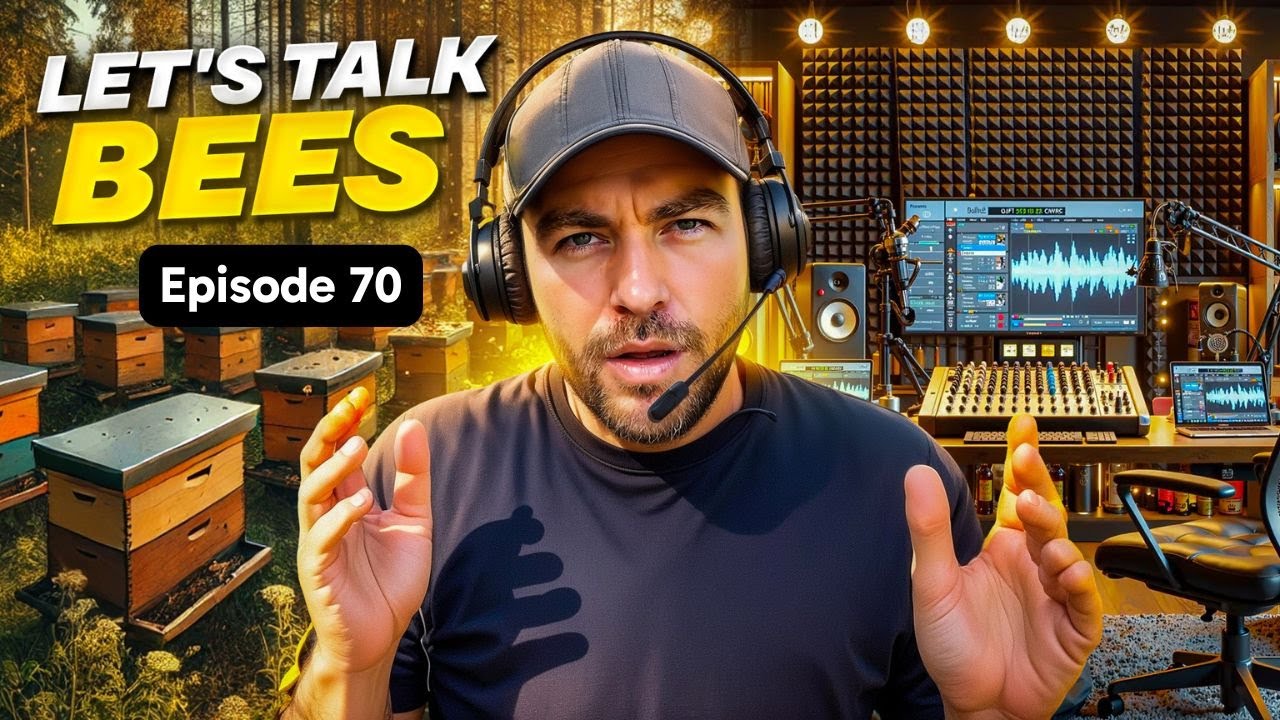
Laurence Edwards answers rapid-fire beekeeping questions on varroa management, winter feeding, split techniques, and hornet traps. He shares personal mistakes with queen introductions and discusses resistance to treatments like Apivar, while preparing for an upcoming beekeeping show in Telford.
Chapters
Hello everyone, let's go and do another episode of Let's Talk Bees. I got the intro completely wrong there, it's way too early in the morning, isn't it? I thought I'm gonna go in really confident, just say exactly what I normally say, and within seconds I've got it wrong already. That's embarrassing. But the reason that I'm doing an incredibly early Let's Talk Bees is because my scheduling wasn't very good. I wasn't supposed to be going to the beekeeping show, my plans changed at the last minute and it meant that I could go, so I'm very, very excited and I am literally about to go and drive down to beekeeping show, but I've got maybe 30 or 40 minutes before I do that, and I thought I'd come on here and do the live stream that I said I would do every single week. And I really do, I will, I am getting into the habit of that now. So every other week on a Saturday about 10 o'clock, I might do it, unless the 7 AM slot works for people. Maybe people want to rock out of bed and have a coffee and let's talk bees really early in the morning. That would suit me probably a bit better. So this could be a test run for the future of Let's Talk Bees early morning, Saturday mornings at 7 AM. I'm fresh, I'm ready to go, I've been up for a couple of hours already, so it doesn't bother me doing it this early. And we have got John. John is the first person in, so good morning, John, I hope you're well. I will— let's do a little bit of an update on the studio. So I've been working hard, you will have noticed that it is quite a different studio to the last Let's Talk Bees, and all I will say is that it is not finished yet. I would have loved to get it finished for today, but it's not, it's not done yet. So there's going to be something there, there's going to be something there, there's going to be some better lighting. Zane told me I had to get rid of all of the plants that I bought and I was only allowed to keep one, and then I'm gonna have like a light there or something. It'll look nice, it'll look pretty, I'm quite proud of it. And I'm amazed at how much effort goes into producing something like this because I've not done any of it, but it takes a rather long time. So the Beekeeping Show, I'm really excited. There's going to be so many people going down there, and the biggest treat for me going down there today, and this sounds this sounds really, really silly, but it's forecast to be 13 degrees Celsius. When has it got to 13 degrees Celsius in Wales for the past however many months? It's very, very cold up here. Um, and I, I went down, I went down to watch Arsenal play Wolves the other day. What am I doing going to watch Arsenal play Wolves? I went to Arsenal-Villa as well. For anyone else who's wondering why we keep on losing when we go away to teams in the Midlands, it is because I've been going down there. But when we drove back, it was a blizzard. We had to really slow down. I'm not a fast driver anyway, but I had to slow down to like 30, 40 miles an hour on a full motorway because it was just so much snow coming back. And then it melted the next day, but it's been cold. It's been— yeah, it's not been very nice weather at the moment, and it feels like the weather should start to turn now. It's kind of— oh, it's getting— sorry, I'm reading the comments. I can't do 2 things at once. It feels like it should be getting closer to getting a bit warmer. Sorry, I'm just— someone's saying to move the plant there. definitely gonna knock it. How many weeks do you reckon we've got before that plant there ends up on the floor? It is a snake plant, this one. Apparently no human can kill them, so I thought, well, this, this is the kind of plant that I need because I'm not the best with plants. So if anyone has any tips on plants, do feel free to give me a shout. Um, right, hornet traps going out. I forgot, actually, I got to stop doing this. I'm not allowed to do this anymore. I gotta stop putting the comments up there because I'm going to try and snip some of these videos up, and then I realized that putting the comments up there do ruin the little snippy video. So Pooh Bear says, morning, I'll be putting out yellow-legged hornet traps out today due to the forecast temperatures this coming week. I would say it's a really good time to go and do it. I've got mine on order, they're literally on the way here, so they should be here Monday or Tuesday, and I'll be doing the same thing. Because on a day like today, 13, 14 degrees, nice little sunny pocket, like, that is when those early season queens could be coming out. So good to get them out as soon as you possibly can. Gene, we've got Gene. Good evening from chilly California. Good evening. Wow, how cold is it in California at the moment? For us in the UK, we see California is just— it's always, it's always sunny. And I bet you come back and say that it's like warmer than it gets here most of the year in California. Go on, how cold is it there? And, and also, what time is it in California? Because I do get very confused when it comes to timing around the world, and then people watching from different places, and I think, well, that would be— that would be suitable for someone, they're not suitable for someone else, they're generally not suitable for anyone. So I'm sorry about that. Says greetings from sunny Spain as well. Hello to you, Graham. He's just getting ready for the bee show. So hello anyone who's getting ready for the bee show. I realized that kind of no one's gonna— no one's gonna watch this this morning because everyone's gonna be getting showered and going and having breakfast ready for the bee show. But I will— I will be down there in a little bit. Very excited. I'm gonna— I'm gonna finish this coffee. I'm gonna do my best to finish this coffee, actually. And then I'll make myself another coffee, and then I'm gonna come. It's about an hour and a half away, so I reckon I'll be there for no later than 10. There we go. It might be a little bit earlier than that. Okay, so Jean says it's 57 degrees, which is— oh, that's— that's kind of similar, I guess. To what it's going to be like in Telford today. I'm— someone, someone told me the conversion the other day, what you're supposed to do, and I've forgotten it already, the conversion between Fahrenheit and Celsius, or Celsius and Fahrenheit. And it turns out I should, I should be a little bit better at this, so I will. I'll get my, I'll get my sliding rule out for next time. Um, David Rusher, good morning from New York as well. Hello to you too. Got lots of, lots of people in America. Hello everyone in America, because it's, it's gone a bit crazy on YouTube, but especially on Facebook with number of people watching from the USA. So hello to everyone over there. I'll tell you a funny story about the USA. So we released the, the video, the Na'vi video, last week or the week before, and my daughter is like, Dad, can we watch the video? Can we watch the video? And I really want to sit down and watch the video with my daughter, and it's, it's quite difficult to get the timings kind of just right if you've got young kids. We've got 2 young kids, to get the timings right to sit down and watch something that's an hour long. So we've been struggling to do it. So anyway, we started watching it the other day and little Lily was going, oh, Daddy, Daddy, first time she'd seen me like on a screen. I didn't tell her it was just YouTube, it's not TV style, but she liked it. And then Ivy really, really liked it as well. And then she liked it so much that the following morning, we only watched 10 minutes of it 'cause yeah, we didn't get the full hour in. The next morning she wanted to watch it all. So she sat down and watched the rest of it 'cause she said, I've already started it now, so I might as well watch it. And then she came back in, she was like, Dad, I love it. Why do they say— Black Mountain. And I said, what? She said, yeah, they don't say Black Mountain, they say Black Mountain. And I couldn't work out what she was saying at first, but it turns out what she was trying to do and what I was trying to do there was an American accent. And for anyone who knows me, I'm really, really bad at accents, so do not take any offense there. But it really, like, it melted my heart a little bit that she picked up the accent part of it. But yeah, it's really nice. For me, looking back, and watching those videos and realizing that Ashley from Bee Beers is just calling me. Hello, Ashley. But watching those videos and just going over it again and realizing that the nice moments that I had and the connections that were made and stuff and just the way that people talk. And I've got people out there who I can talk to, you know, friends who are in America. It does. It means the world to me, the fact that there's this kind of people watching from all over the world. And on that note, we've got Chris from Australia as well. Got a lot of people from Australia. And it was interesting, the question we had last week about the difference about getting bees kind of past the equinox and how there's so many similarities between beekeeping kind of anywhere in the world, and then on the other hand there's so many differences as well. Like, it's just, it is very, very different where you go, but we all have that like real structural underpinning of general beekeeping husbandry. I would say, right, that's 15 minutes of me not answering any questions at all. Let me go and have a look on there. Oh, says, Laurence, what is the best way to keep spiders out of a hive? I would say, unless you've got a real problem with spiders, I wouldn't— I don't think they do any damage whatsoever. I'm quite happy when I see spiders in there. It's not, it's not something that causes me any concerns. But maybe they're— are they attacking something? Are they grabbing something? In the UK, our, our pests are pretty tame. And then like maybe Australian spiders do something crazy different, or American ones as well. Yeah. Pests over here are just relatively minor, so if I find them not doing anything to the bees, I do just, uh, I do just let it, let it go. Wonder if Bob Binney will take a break from his Scottish tour to check out the beekeeping show? I have no idea yet. I'm gonna wager yes. I'm gonna say, I'm gonna say yes, and I genuinely don't know. The only reason I'm gonna say yes yet is that when, when I say to people, I, I gave up in April because it was a bit too far away, and they say, oh, how far away was it? It was, it was a good 40 minutes, you know, 35, but a good 40. They said, what? I have to do the accent because it's always someone else, and they say, yeah, we drive 17 hours to take our beehives there. So for Bob in Scotland, that little trip down to Telford, it's just a— it's a hop, skip, and a jump. So you never know. So Horrobs, I forgot I'm not allowed to put them up. Yes, I am, I'm going down to the beekeeping show. I'm gonna have to get into a new habit of not putting them up. And we've got a few, few more people saying good morning. Got the Arctic Beekeeper saying good morning. Got to be really early at your end, 8 in the morning here, 7 in the UK. Yeah, it is. So I'm going to the beekeeping show today, hence the revised time. How are your winter losses looking this year? I've heard from a few people having a massive issue. I'm all good so far, but fingers crossed still. I've heard from a lot of people that there are some serious issues going around, and I have to say, from my own initial observations— and I'm— I just know not to count my chickens before you kind of get to the point where they're hatching out, but— oh, come on, See, this is why I'm not allowed to say phrases. My wife says, just don't say phrases, you always get them wrong. So we'll regurgitate that one. I'm not counting my losses yet until I get to a point where I actually know if they're going to be losses or not. There's a lot of colonies there that could still die this winter, and going and checking to see if they are actually dead now, um, I can understand why people want to do it if they want to get a grip of numbers, but there's no real benefit to doing it. The only thing that I would do is if it's clear that a colony is dead, I'd be flipping the underfloor entrance Upside down now. Really nice technique, that one, and one that I've just started using, which is if you, if you design the underfloor entrances— can I have my coffee first? Sorry. If you build your underfloor entrances exactly, uh, kind of like as the standard design, what it means is that when you have the floor the normal way around, the bees can come in, they can come out, they can do whatever they want. But if you just take the underfloor entrance away and flip it upside down like that and then put the box back on it, it kind of looks like the bees can still get in and get out, but they can't. They're completely sealed in as long as the bottom— as long as they can't get in by the bottom slot. So it's a, it's a very useful way of ensuring that you don't get colonies being robbed out at this point in the year. So if you know you've got a dead out, you can just flip the floor upside down, ratchet strap it all together, and obviously if you can, take it and go and process it straight away. But if you can't, just strap it all in situ and then you can deal with it all at the end before the colonies get robbed out. But I wouldn't, I wouldn't necessarily be going and checking colonies to see if they're dead yet. If you're seeing activity, there's really no reason to be doing that. If you're not seeing activity and you're kind of popping the lid open and like, well, the bees are dead, and then you go and do it to the next one and wow, the bees are dead, then you've clearly got an issue, and I suspect you'd probably want to go in and do some more investigation, and I am seeing that some people are having that issue. This is the problem with bees, is that every single year is completely different, but we still contend with the same underlying issue, I think, which is varroa. The way that varroa is just always there and completely— is completely dependent on the day length, the temperature, the conditions to be able to thrive. And then sometimes those conditions enable the bees to thrive in the same way, but then sometimes you get those conditions at the wrong time of the year. You'll get a colony really going downhill in terms of numbers because it's just getting ready for winter, because maybe the temperature's doing that. And then you'll get a condition or a set of conditions that really help varroa thrive. So if you get the number of bees coming down and the number of varroa going up, they intersect at a point that's very, very dangerous for the colony. And I suspect what's happened is that that point, a very arbitrary kind of point that no one knows where it is for each and every season, has been reached in a number of colonies this year. So no, I'm not seeing anything untoward in my own bees, but I'm not, I'm not making kind of like a full judgment on it yet. For us, we've always said anything under 10%, we're really, really happy with. We've operated between 5 and 10% for about 3 or 4 years now. That's not to say that if we were to get like a 15% loss, it would be catastrophic. It wouldn't. We keep plenty of buffer to make sure that we can fulfill all of our orders, so there's no issue there. But it is something that I am seeing a lot of people talk about, and it is quite concerning. Right, Keith says, my bees are on fondant at the moment. When would you recommend going into syrup? I'm in Yorkshire. So for me, I always always do my best to not feed fondant. Anyone who's seen 14 Day Beekeeper would have seen me say that so many times. I do, I don't like feeding fondant, and I don't, I'm not, I don't think the bees like it that much. Richard is absolutely sure that the bees don't like it that much in terms of tiring them out. So I find fondant more difficult to feed, I find it messier, I think, and if we go, if we go with what Richard's saying, let's say that the bees find it more difficult to process, So there's all of these. Oh yeah, and it doesn't give you the, the stimulative effect that feeding syrup can give in terms of replicating that nectar coming in. The bees will just break it down and store it, but it won't give them— it won't turbocharge a colony. So it's got 4 really big disadvantages compared to syrup. And if you feed your bees properly and you feed your bees at the right time of the year, you never have to use fondant. You just don't have to use it ever, apart from kind of like in an emergency situation. So That's my, that's my view on it, which is if you, if you feed your bees up nice and heavily using syrup going into winter, you'll get them so far through the season into the spring that you reach the point, which is around now, where the colony will probably start to take down syrup. So all I would say with feeding syrup at this time of the year is that feed, feed little, feed little and often, because if you leave too much in the feeder, it will start to go mouldy. Feed 2 to 1. I know people say feed 1 to 1 in the spring, and 1 to 1 in the spring is the right thing to do. definitely not the spring yet, it's very much the winter. So if you want to do anything with syrup feeding at the moment, definitely want to go with 2:1. Don't put any additives in, no Hive Alive, nothing like that. People think they're doing the best thing putting Hive Alive in. I love Hive Alive, use Hive Alive on every single colony every single year. It's the last feed of the season. Um, if you put Hive Alive in the syrup now, guaranteed you're going to get horrible thymal taste up in your supers. So I know that's not really answering your question, but I would say For me, you can switch over now, remove the fondant and get some syrup on, ideally in a poly-insulated or polyashworth feeder, but a nice insulated feeder. And then what will happen is the bees will go up on a warm day, if it's 13, 14 degrees, they'll go up, they'll take some of the syrup down 2 to 1, put it back downstairs, and as long as it doesn't go really, really cold, you shouldn't have any moisture issues, and 2 to 1 will stop all of those stores fermenting. And then what might happen is that the bees will shun it for a couple of days, but because it's invert, it won't go off and it won't go mouldy, and then it might get colder again, and then once it goes back up to 13, 14 degrees, whatever it is, whatever temperature triggers your bees to go up into the feeder, they'll go up again and they'll feed. So it's quite a nice easy system. Don't overfeed though, you can, you can block things up at this point in the year. What am I doing with my bees at the moment? I'm not feeding them syrup, I'm not feeding them fondant, I'm not doing anything because they're just there going through the stores, the syrup stores that I fed them back in kind of August, September, October, and maybe they even took a little bit into November. Uh, Jean says, Lawrence, how would you do a walkaway split? So it's— I like to get into the habit now of saying to people, like, what's, what's the split for? So what is it? Is it, is it a straightforward split? You just want to turn one colony into 2, or is there, is there another way of doing it? Because a lot of the time when I ask that question, they say, oh yeah, no, I don't really want 2 colonies. I'd prefer just to have like one colony and then like one little mini extra colony that I could give away. And I say, okay, well, that's— that is interesting because it really does change the way that I would do split. But a standard walkaway split is, is as simple as this: you take however many boxes you've got and you split them evenly. You put them next to each other as close as you possibly can, um, and then you put the queen on one side and you put the colony that doesn't have the queen on the other side. Now luckily with the walkaway split is that you don't need to find the queen, because if you split a colony that has a queen evenly in 2, then one of the halves has to have the queen. And then if you kind of straddle the middle of the entrances, say you've got a beehive here And then you're going to put another one there. What I do is, if you can imagine the middle of the first beehive, I make it there, and then I put the second one there. Made no sense, that, did it? Let me try and explain it. Imagine you've got one beehive and you turn it into 2 beehives. That middle point where those 2 beehives are touching, and I literally have them touching, would be the exact center point of the original beehive. Hopefully that made a lot more sense. sense. And then once you've done that, it is, it is as simple as just splitting the resources, um, evenly. So if you're on a double brood configuration, just have one brood box on one side, one brood box on the other side, and then split the supers evenly. If you're on a single brood configuration, just have one brood box on one side, one brood box on the other side, split the frames evenly from the one brood box that you've got, and then fill it up with foundation. If you're going to do that, I suspect you're not going to have— sorry, if you're going to be doing that inside the brood box, you're probably not going to have the supers on. No, you might have supers on. Okay, all I'm thinking is it's a starvation risk doing that, putting half a colony in with foundation without a feeder. But just if you've got 2 or 3 supers full of honey, then there's no issue. If you're putting on stacks of undrawn supers onto there as well, I'd say, oh, maybe, maybe take a step back and just start feeding them up at that point. Um, but then walkaway split, you just leave them 4 weeks, come back, hope it worked. And if it didn't work, you've got to find the virgin to save all the rest of the bees. I don't like walkaway splits. I think there's, I think there's a lot of better options out there in terms of doing splits, not necessarily adding queens in, but I just think there's better impulses that you can use rather than the, the emergency impulse. Um, you can, you can kind of like force a supersedure instead, or you could take some swarm cells. And yeah, okay, you might propagate swarmy genetics, but I think the cells, I think the cells are better. So lots and lots to do there. Right, John, I've forgotten not to put it up. Sorry, John. When do you think crossover day will be when you're happy to call it over? Oh, crossover day this year. So when they're creating more bees than they're dying? Middle of April at the earliest, I would say. We are so far away from it. My job at this point in the year is to let everyone know what they should not be doing, and that is most things. I have seen some videos of some inspections, and what can I say? I'll be a hypocrite because I went in in December and did a video, but the idea was to prove a point in my defense on that one, and it did prove the point. And you saw the video, hopefully some of you saw the video go out last night, which was showing that, because it gives you a useful tool against varroa that's a non-intrusive method. And okay, I had to prove that by using a very intrusive method, but hopefully it, it proved it in that instance there. And I'm going to do more, more kind of like trials around that, and hopefully we'll do some more trials in different places in the UK and try and identify that really good targeted period to get in there for a natural brood break. Um, but yeah, crossover day, miles away, absolutely miles away yet, John. Uh, Hello, says, hi Lawrence, see you at the show later. Just a quick question on the blueprint section of 14-Day Beekeeper when talking about making splits with nucs. You say to put one frame of brood, one frame of pollen, and then a lot of bees and a mated queen in, but when you're trying to make them queenless, you have to leave them before you add a queen because they will kill her. Why won't the nuc kill the nuc queen? Um, so when you're making up the splits like that— and I, I will put a note on that video there, Ryan— it's very specific times of the year you can make up aggressive splits like that. So when you're doing a split, say in April and May, you can definitely do one frame of brood, one frame of stores, so hopefully some, some some honey in there, some natural stores, maybe some feed if you need it, and some pollen, and then fill it up with foundation, mated queen, and feed, but taking it to a new apiary. That's the system that we use. Very, very good early season repeatable system. Later on in the season, you need to put more bees, more stores, more brood, more everything, just to get over any wasp pressure or any robbing pressure. But the reason that they don't kill the new queen— I should drink my coffee. I'm just, I'm just double-checking that I'm understanding the question there. You're saying, but when you try to make them queenless, you have to leave them before you add a queen because they will kill her. Why won't they kill the new queen? So it is, it's the question of hopeless to queenless. So if you, if you make the split and then you just put the queen in, they say, we, we have the resources to make a queen, so thanks but no thanks. That's what they do. They've got— they're queenless, but they've got eggs, they've got larvae. they've got bees, they've got the ability to requeen themselves quite easily, so they just reject the queen. Now, they don't do that 100% of the time. A lot of the time they'll say, yeah, thanks very much, saved us a job, we'll accept you. And I see— I know, I know bee farmers, I know lots of beekeepers that don't go through that hopelessly queenless process. But for me, for someone who sells queens to people, and for someone who, who wants people to have success with my queens, I want to give you like the very best chance of getting those queens to a point where they're successfully introduced. So we don't lose queens using that method, we— it's as close to 100% as you would like to get it. But what it means for— sorry, but in comparison, if you don't go through that Hopelessly Queenless process, I speak to bee farmers and they say, yeah, it's like 85-90%, so it really isn't an issue. And I say, oh wow, 15% or 10%, that's huge. And the amount of people that we would be kind of letting down if those numbers did stack up would be a significant one. People would be be unhappy with that. So the process for us is to make sure that they are hopelessly queenless, to take out any chance whatsoever that the colony thinks it can requeen itself. At that point, I will add in the caveat, caveat, um, by requeening itself through using their own eggs or larvae. What you do occasionally see is supersedure after that. So the new queen lays up and then they try and supersede her. It's like a last-ditch attempt. And what you need to do at that point is just constantly take down all the supersedure cells every 3 to 3 to 4 days, the idea being that you have to do it before any of the new queens come out. Once you get to that point and once the new queen's offspring is in the colony actually as emerged bees, they do stop doing it. But yeah, there we go, that's the reason I did go back full cycle. So hoping to see queenless is just a way of making sure that the, the odds are stacked in your favor, that the bees have no alternative option and they have to accept that queen. Now there's still ways things can go wrong when you're accepting queens or introducing queens. It could be that you keep on coming back in to check. Um, and, and I remember doing that. I remember going down and buying my first— I think I've already done this story before— but going down and buying my first queen because my bees had swarmed and, oh no, I needed to need a new queen. And going down and getting it and putting it in and doing the 4-hour round trip, whatever it was. And then going and sitting in the kitchen, like, looking out my garden, uh, look— looking kind of out my kitchen window at my garden where the bees were, thinking, I'll give it 10 minutes, I'll give it 10 minutes and I'll go and see what's going on. And going back in after 10 minutes and the bees just like What's going on? This is— who's this guy? What does he know? And then I probably went back in like 6 or 7 times that day, like poking around and doing— and then I thought, they're not, they're not getting through the fondant. It's been, it's been at least 3 hours, they're not getting through the fondant yet. So made a hole for them to go through and then went back in and the queen had gone. And that was like the first ever time I introduced a queen. Um, so I know what it's like. It's easy, you can— so even with the best intention, even getting them hopelessly queenless, you can still completely ruin the introduction. But that, that is the process. They— if you do all of the things right in the process, they won't kill the queen. You'll be good. Says, lost 2 hives at our club apiary so far. One was smaller due to last year's wasp attacks, and the other one was full of diarrhea. Oh, not nice. Sealed both up. Uh, others were flying well earlier in the week. That's a perfect thing to do though. Seal them up, get them out of the way, focus on the good ones. Says, I love your beanie. Do you offer it for sale to California? I love my— I've got loads of these. I told you I went to America and bought hats that fit, and maybe a bit small still, this one. Um, aren't they cool hats? Let me show you this one. I can't remember the company, this is the only thing, but if you go and have a look on the Bee Expo video, you'll be able to see that. And, and this is what's cool. Yeah, this is the party trick, and I didn't realize this until I went to— I went like away for the weekend, but if you shine like a UV torch, you know, if you go to like a rave— always going out to raves— but if you shine a UV torch on the B, the B's there, then it's UV, it glows. I think that— I think the luminous yellow bit on it is UV-reactive thread or whatever, and it is without a doubt the coolest hat I think I've ever had. So I have every color, I bought every single color they had. I've got maroon, I've got gray, I've got blue, I got— I can't remember all the colors. Um, and I want to say it's like Crazy Bees, maybe it's Crazy Bees, give that a go. Um, but highly recommended, and luckily for you, they're, they're an American company, so you should be able to get them shipped in. Right, I'm new to beekeeping. I bought a nuc colony last November. I transferred them to a proper hive and it's been months, but they're not occupying new frames. What should I do? So, see this problem a lot. Um, I also realize that on a lot of the Q&As I say Like that. I get excited. Stop saying ooh. But I do, I get this— I've got a problem, my arm's nervous now. I get, I get this question a lot, and it's, my bees aren't growing, what's going on? So when you, when you get a nucleus colony at the beginning of the year, they'll start to grow out like that in the brood box. They get to a point where they cover 80% of the frame. So if you've got a 10-frame box, it's covered, the bees are covering 8 of those frames. And at that point, I say you should put a super on. Now generally what happens there, people put the super on and they say Okay, put the super on. Do I do anything else? And I say, no, no, that's it, just put the super on. The bees will now build up. It'll take a little bit of time, but the bees will build up. And then you get an email a week later saying, still not up in that super. And I say, no, no, it's fine, that's, that's what it should be like. You put it on plenty of time, um, they'll be up there soon. And then a week later they say, still not up there. And I say, yeah, trust, definitely, definitely put it on at the right time. It's no impact to the bees, but they'll get up there. And then they come back the next week and they say, yeah, they're up there and it's full and they've probably gone off and swarmed. But it's— that's what it's like with beekeeping. It's, it's like watching a kettle try and boil and you're sitting there, nothing's happening. You're like, come on, do some things, come on, move, take over the frames, and they do nothing. And then you get this explosion of brood, this explosion of new bees within the colony, and then all of a sudden you're like, whoa, like, where did that come from? That's crazy. You'll see this on the outside of your colonies as well, which is there's not that much activity going on, and you'll see the first sunny days and you'll bit of orientation and it's nice, and then all of a sudden you'll come back in, it'll be 14 degrees, bit of sun, and it's like, whoa! And people say, my bees are swarming, and I say, no, it's definitely not swarming, that's orientation. But you get to start to see these, these differences in sizes and the amount of bees coming out, and you see exactly the same on the frames as well. So what happens for some people, it's only because the reason I was going off and saying that is because you said you got the colony last November, so depending on where you are, if that was the UK, that's very, very late. But, but for some people, if you bought a colony late in the year, the advice is kind of different. It's not always about just adding more space to give the bees an ever-increasing amount of space in, in the winter. In the autumn, it's the opposite. It's reducing it down and getting it to a point where the bees are quite small. So if you look at the size of my clusters from like August, like from August, September, October, November, December, January, February, March, So 8 months of the year my bees live in a single national brood box, 8 months, and then you have to teach people that, yeah, but after those 8 months they don't, they don't live there anymore, they get really, really big really quick and you have to keep ahead of them. So this, it's been months and the bees are not occupying new frames, it could just be the wrong time of the year, it could be the time of the year where they're dormant, it's the time of the year where they're just in that single box doing nothing and then it's And then it's about working out when that rapid acceleration comes in, making sure that you are there in advance to give the bees plenty of space. Regarding losses, a lot of beekeepers are starting to question the effectiveness of Apivar. Great talk on Richard Knowles' page regarding using OA or its UK-approved version, very interesting. So I would agree, always with anything like that, hard chemicals, hard miticides, there will become a point where things become resistant to it. And hopefully that will push on the technology and that will push on other manufacturers to come up with suitably approved products. But luckily for us, we do have a wide array of products that are already very effective against varroa. Now you can combine those treatments with mechanical methods as well to make the treatment, say for example oxalic acid, far more effective by caging the queen and making sure that there's no brood. So you can do the same with formic acid and obviously taking into account the differences or the impact that it can have on queens and the loss or the cannibalization of brood as well. But there's, there's lots of different methods there. My recommendation for everyone is always to use like a 2-pronged method. So we don't, we don't recommend blindly just using Apivar. We recommend people use Apivar because it's a really good first line of defense. But you know what, there might come a time where Apivar doesn't work and the resistance to the chemical is building and it requires a reformulation. So then you've got this backup, you've got this really nice safety net backstop of a very effective oxalic acid treatment during a natural brood break. Now, if Apivar was rendered completely useless, then I don't think the backstop of a mid-November to mid-December oxalic acid, Varoxyl, whatever, whatever's legal in your country, sublimation, would be, would be enough. I don't think it would be enough, and I think that the winter bees would be significantly impacted by the viruses by that point that it wouldn't work. So you'd have to go down the route of doing what Richard does and caging your queens at certain points throughout the year, but it's just, it's husbandry, it's management, it's a way of managing your bees and making sure that you're keeping them in a very healthy state. And if Apivar doesn't work, like there's a system in place and a kind of schedule for using Apivar, and if that becomes ineffective for whatever reason, then it's up to us as beekeepers to kind of like recognize that and adapt and change and share what's working, And yeah, maybe approach it with a little bit of collaboration. Oh, okay, a few more people. I'm gonna have a sip of coffee. So Haze Purple said, why would they be dying over winter? Hunger, cold, varroa, moisture— can't all of those issues be taken care of? So hunger is very much down to the beekeeper, so there shouldn't be any issues on that one. Cold and moisture, not in the UK. Bees don't die of cold and moisture in the UK. Just just doesn't happen. They die of something else, and then you have a cold, wet box that's open to the elements, and then people go in and they say, "Oh, it's cold and the damp that killed them." It's like definitely something killed them first, and then it looks cold and damp because it's just a big massive pile of dead bodies in a box. And then so so it leaves Varroa, and I think it's almost certainly Varroa. So it's either apivar resistance. Or incorrect application of Apivar, the wrong timing. I still see people saying, I did my Apivar treatment, I put it in back end of September. I say, oh, that's very late for Apivar. And then the season that we had, we had a very, very long season in terms of temperature, so varroa would have been active for a huge amount of that season in quite high numbers. So then if you have a delayed treatment, and it can be just a few weeks late, causes the colony to collapse in such a fashion. So I, I don't know what's causing them. I would be very surprised if it wasn't linked in some way to varroa though. Um, Gene says fondant causes small hive beetle here in California. Okay, another, another reason to not feed fondant. I'm not, I'm not a fondant hater. You'll see on some videos I do feed fondant. I have tons of fondant in there. Um, I use fondant in my queen rearing. I use like pollen, real pollen-infused fondant. Um, so there's definitely a place for fondant feeding. It's not— I'm not saying that. I just just my system to make it easier for me and easier for the bees and to not have to worry about the faff. I just, I prefer to not feed fondant if I can get away with it. -15 today and cleansing flights are 2 months away. Looking forward to putting on pollen patties and start the season. Are you using pollen patties during the season? Interesting, this one, because I'm not a fan of pollen patties for the UK. I appreciate in some parts of the world, like, there is no other way of getting your bees ready for the flows without using pollen patties or pollen substitute or pollen that you're collecting yourself. Just for me, in our position in the UK, for what we do, there's no need for it, um, other than like aggressive, aggressive expansion that comes with a lot of risks as well. And that's not, that's not how we work. We're quite a sustainable outfit when it comes to numbers, so we, we don't do that. The reason that I don't like doing it is that it's— it forces the bees to do something at a time of the year where it might not be that natural for them to do it. And what I found every single time that I fed them pollen— sorry, that— so that I fed them pollen subs, so something like Ultra Bee, and I've used Ultra Bee, use Ultra Bee in queen rearing, big fan of Ultra Bee, uh, but when I've used it, this is what happens, which is I think, oh right, gonna feed the bees pollen patties or pollen sub, mix it up, put it on, the bees say, yeah, okay, we'll eat that, they start eating it, the natural pollen becomes available a few days later and they shun it, and I have to go back in and clear it all up, chuck it away. So I got, I got bored of doing that because my view was I don't want to feed them so much earlier than the natural pollen is available, because why am I doing that? I don't, like, I don't need to do that, don't want to do that. It's just bringing the swarming season earlier and giving me problems. So I'll feed, I'll give them it at a point when I feel comfortable to give them it, and that point for me is literally the point that all of the natural pollen is available. So I just, there's no point forcing it for us if you don't need to. force yet. However, there's always a however, isn't there? This year, and I'm looking out the window today and the weather looks so much nicer, but when we were living in that cloud for the last 8 weeks of the year, I was thinking, well, this is, this is probably the— if this continued through May, just cold 8, 9 degrees drizzle, I would probably consider it. I would probably consider feeding some, some pollen sub at that point because it fills the void then. The, the bees are responding to the temperature, but they're probably more responding to the day length, and They're rearing brood and they need, like, they're going to burn through their protein and their carbs and they need to go back out, get more protein in the form of pollen. If they can't get back out because it's raining, you need to go in and feed pollen. So it's a very useful tool at that point. Luckily, the weather is starting to change though, and I would say, looking at the weather today, if it's going to be 13 degrees and weather like this, all of my colonies, ones that survived, are going to be really active going out collecting pollen, bringing it back in. So I'm not I've got anything to worry about in terms of that. I would just, yeah, I know what people are like because I was like them. I am a genuine person as well, but you want to do the best for your bees and you see these products available and you think, well, what harm can they do? And pollen patties and pollen sub and pollen fondant at the wrong time of the year on the wrong colonies could do a huge amount of damage. Sometimes the best thing that you can do for your bees, a lot of the time, the best thing you can do for your bees, especially in the winter, is just, just do nothing. There's not much that you can do to help them. You should have done it already. I know that's a bit hard-hitting, that, isn't it? Especially for 7:41 Saturday morning. Um, unfortunately, Ryan, I'm gonna, I'm gonna shy away from that question there because I, I kind of disagree with it. The question is, what is the best strategy to gradually breed calmer bees from my local mongrel stock? And oh, sorry, I, I have completely misread your question there. I do not disagree with that. I will answer that one, right? So Ryan says, what is the best strategy to gradually breed calmer bees from my local mongrel stock? I know buying queens is the easiest option, but I want to improve my local genetics over time for the challenge. So I would recommend everybody to have a go at doing this as well. It's great. I do this. I, I have local mongrel colonies and I'll do some sort of selection. It's never— it's not the most successful because of kind of the influence of other bees that I have here as well. But the strategy I would say for you is, if you're looking to breed anything from your local stock, the first thing you need to do is define what is local, because it's not the clearest-cut kind of description. Is local the bees that are in your apiary at the moment? Is local the bees that are under your management but in different apiaries around that site? Are bees that are local just in your village or your town or your county? Like, what is local to you? Because the next— you need to know that because the next thing you're going to do is identify the very best colonies that you've got that are local, and that might be within your apiary, within your back garden, or that might be within your entire county. And I personally think, why would you not take like some of the wider benefit there? And maybe local for me is a little bit bigger than local is for somebody else. But then the process is very, very simple. It's just— it's selecting on the basis of what you want to select for, but you're trying to always underpin that with the health of the bees. You can't just— you can't just go for calmer bees and then say, well, they're riddled with chalkbrood, but they're the calmest bees ever. You have to take note of kind of any other things that are there. So you're just— you, you can see there'll be loads of breeding kind of selection pro formas that you can have online, but it's quite simple. You just need to develop a scoring system for each of the traits that you're looking to breed from, and then you're just going to go through and score your colonies. Then the easiest way to do that, I would say, is just pick your best colony. You're going to effectively create your own breeder queen from your internal stock. There's nothing fancy that you need to do. The queens are already there, and then it's just a case of propagating the genetics as best you possibly can on that maternal side. So the colony that you select, you're going to be taking the genetics from that mother queen, and then you're going to be open mating in your— in the local vicinity, which is going to give you that kind of diverse range of genetics. Now, doing that one year, doing that exact process one year, could result in different— will result in very, very different queens to doing it in the following year. So then the idea for you is that, that you want to have as much control as possible over the maternal side, which is your selection, looking into your colonies and saying, okay, This is the calmest queen, so I'm going to breed from her. I'm scoring her for everything, making sure that her offspring are carrying both the kind of calm genetics but are not showing any signs of anything strange as well. And then for the paternal side, it's up to you then to, to rear as many good, good drones as possible and try and come up with a solution or a system within your local area as to how you're going to keep as many of the good drones as possible in the air. And then it's just rinse and repeat, it's just doing the same every single year, you're just selecting from the very best. And this is why I say about choosing what's local, what's local to you, because if local to you is the bees that are in your back garden at the moment, you've got 3 colonies there, there's not really a huge amount that you can do, you are just completely dependent on what is up in the air because you've got 3 colonies, you're not going to be able to select and improve a huge amount from those 3 colonies because the baseline level's probably been reached in your area anyway. If you're happy to expand that locality and say, okay, well, maybe team up with people from the local association and we can review and say, okay, well, yeah, you've got, you've got really good bees that are calm, and Dave's got really good bees who are kind of good at fighting varroa, so maybe I can take some virgins and graft. And you're introducing risk and you're sharing, and maybe some people don't want to do that, and maybe it doesn't become local anymore, but for me, that's— it's a really nice fun, interesting system, and you can see where you can get, and you can see that iterative improvement, um, along the way. So I recommend everyone give that a go. What I say to people with buying queens is as simple as this: if your bees are not performing, for the cost of one queen, £40, it's probably going to give you back hundreds of pounds of additional honey. It's as simple as that. So it's not a case of throwing money away at something each year. It's giving you significant increased performance and a huge payback on your investment as well. And obviously, if you want calm bees, they're going to come with the Black Mountain Honey Seal of Approval, going to be the calmest bees in the UK. Arctic Beekeeper says— I shouldn't put that up— what are your thoughts on shook swarm as a split? So no, that's not, not for me at all. The shook swarm is hugely disruptive to a colony. It's a massive waste of resources. It's a very, very good tool for treating asymptomatic EFB as kind of like a last resort, And I would say that's the only reason that I would use it. I wouldn't even use it as a way of getting rid of all of the comb, because if you've got like loads of old black comb, because there's easier ways of doing that as well. In terms of a split though, I just, yeah, I'm really, really not a fan of using it as a form of splitting because I just, I don't see any benefit to it and it's going to significantly knock your bees back. David McDowell says Tropilaelux is going to be a massive problem when it arrives. Lots of beekeepers, only a few hives will finished. Caging queens is going to become more common for forced brood breaks. What I'll say there, David, is it's clear, isn't it, that you've listened to Richard Knowles' talk the other day. I'm not as convinced as Richard that it's going to be such a catastrophe. I open the challenge with— I welcome the challenge, I would say, with open arms. Um, and, and let's see what happens. Let's do everything we possibly can to remove or reduce the chance of it coming over here. Let's be prepared And I'll just stand by my position again. If you ban the imports of queens, Tropilaelax will get here a lot quicker because people will flood the market with unregulated illegal queens. We do things by the book at Black Mountain Honey, and I let the UK public have that choice. What do you want? Do you want someone who is responsible, law-abiding company to import queens, um, with full oversight from the National Bee Unit? Or do you want them just to come in on the back of a ship with no regulation whatsoever? And just be sold for pennies and flood the UK market with cheap illegal queens that probably will carry Tropilaelaps. The choice is yours. I, I know it's a little bit hard. It's getting a little bit hard-hitting, isn't it, for Saturday morning? There we go. Oh right, we've got 12 minutes left. Yeah, thank you. John's just said watch your time. Okay, um, let's do a couple more. Marco says, hi Lawrence, can I make a split in autumn or would you recommend just holding off until next spring? Definitely wait. I've made this mistake so many times where you aggressively split split early— or sorry, you aggressively split late on in the season when really it's much, much easier to do it in the spring. It's the wasp pressure, it's the robbing bee pressure, it's the fact that you can turn one colony into 10 nucs if you wanted to in the spring if you're buying your mated queens, where even taking one hive and turning it into 2 in the autumn is risky. You can do much more aggressive splits in the spring, so I would wait for that. Confused, thought you were in Telford. No, so I am at home, but I do not live that far away from it, so I will be there by about 10 o'clock. How often do you replace your queen? I replace them every 2 years, but if they go into the 3rd year, I'm not that fussed. Morning, fella, hopefully see you later, my first ever show. Anyone at the show, come and say hello, I will be more than happy to have a chat. I killed an aggressive queen and inserted eggs from a calmer colony. If the new queen genetics ended up calmer than all the other hives, could I repeat the process to develop calmer bee genetics for all? So yes, you definitely can, but as I say, 50% of the mix comes from the drones up in the air. So even with the best intention in the world, the best selection, going out choosing really super calm colonies in your apiaries, if your local drone population is angry, then you might struggle. Do whatever you can to improve the local drone population in any way that you can. Hi Lawrence, in Western Australia, so no varroa here yet. Your thoughts about the varroa controller box using heat a feature treatment might. So I'm always open when it comes to new technology. I love seeing it there. I'll never judge it properly until I've used it myself. When Wolfgang— I love the name Wolfgang— when Wolfgang demonstrated it to me, the logic did stack up. His system was very, very detailed and very well scheduled in terms of timings. I do see the kind of logistical issues on doing that on scale, but I think a lot of beekeepers just you know, 2 to 8 beehives or whatever it is in their back garden. So something like that would work. I love the fact that there's no chemicals involved. I love the fact that he scheduled it in a way to kind of trap the varroa into an ever-increasing brood nest and then take that one and then heat treating it. I thought that was really cool. So there's loads of bits, there's loads of bits that I like. I do see the logistical issues with it, and I kind of think, well, I wouldn't want to— I wouldn't recommend it until I tried it myself, and I probably wouldn't buy it myself to try it because it wouldn't suit my system. But from, from people that I see using it, see Norma Mae using it, Norma Mae Honey in Australia, she, she seems to think that it is doing the job. So fingers crossed. Uh, Sebastian is here. Hello, Sebastian, the world record holder for the world's biggest cucumber. True story and very, very impressive. Uh, what are you growing? What are you growing this year, Sebastian? Some sort of crazy pumpkin, probably. Uh, Jean says, have you tried Varaxon yet? No, I've not tried that one yet. I'm gonna have a look at some new products today, so hopefully get to that one. Uh, Harry says, I've actually thought that a while ago, as Apivar never seemed to have the impact that others did. Of course, it could be caused by the length of treatment. I will be keeping a close eye on Apivar resistance. It's not, it's not a new thing. It's not something that's not been spoken about before. It's not been something that's not been quite clearly proved that the mites will effectively become, or eventually become, resistant to some forms of it, like it's very much proven. I've not experienced it with my own bees on scale, and you could argue with stuff like that. It's not until you see a big impact, like a big drop in the efficacy, that you actually start to notice it. So it could have been becoming increasingly less effective over the years, and then all of a sudden it's just had a big significant Jump. So we'll keep keep an eye on that, monitor that, and and keep that backup, that backstop in place with the oxalic acid. The bigger test is to see yeah how many colonies come through. Sebastian also says have a wonderful day in Telford today. Thank you. He says please pass a big hi to Ian Stepler. I think there'll be a big queue to get to Ian Stepler, but I'll give him a wave if I see him. Ryan says I have a big jar of crystallized honey. Can I use that to feed the bees in winter? So nice. No, you can never ever feed bees honey. It's as simple as that. It can carry EFB and AFB, and if you feed it to your bees, you're potentially risking all of the bees in the local vicinity. Never ever feed your bees any sort of honey. Right, I'm jumping through to make sure that I'm not going to miss anyone here. I got The Honey Herd. Morning Lawrence, watching from North Wales, really appreciate these lives. As someone building a small sideline, what's the biggest mistake you see in the second season? Oh, there's loads of mistakes that I see in the second season. There's complacency, and it's thinking that you kind of understand everything, and then being really aggressive with the expansion. I wish I'd learned beekeeping in a slightly less aggressive manner. Not— it's not aggressive, it was just too quick. It was too much failure and learning from failure where a nice slow organic build-up from 2 hives to 3 hives to 5 hives to, to 10 or something like that over the years, and then building the products to go with them is a much better way to learn beekeeping. It's not a much better learn-to-way— isn't— sorry, it's not a much better way to learn the business side of it though. And this is where, this is where the expansion gets driven, I think, for most people, in that they'll get some honey, they'll, they've got the logo, they've done all the design, they've got the jars, it's out my honey, it's brilliant. And then they go out and sell it, and then come October, like, all the honey's gone, and they think, oh, that's, that's a bit annoying because I thought, I thought we were going to last through until next year. So we're not. So I need more bees, I need more honey, I need to do something else. Then it drives this expansion kind of ahead of the curve of learning how to manage the bees properly. But also, so that's, that's not— that's a big mistake. I would say that's not the biggest mistake though. So the biggest mistake I see in beekeeping is the propagation of myths about what keeps bees alive through winter. Terrible. And you, you see some people saying you do not need to treat bees for varroa, my bees have developed a way of dealing with varroa, so you do not need to treat them. And then they don't treat them that year, and then the bees get through to the spring and the bees are looking okay, and the person says, told you, treatment-free bees don't need treating. I don't know why I go into Brent mode when I do that. It is very Brent. Sorry for anyone else who noticed that. Um, but it's that— so it's that propagation for them in their head that their decision impacted the success of their colony. You see the same with rhubarb leaves, you see the same with banana skins, you see the same with anything that anyone puts on a hive and says is going to do that. Or they put something on a hive and they say the bees aren't going to die, and then they say, yeah, it was, it was this hat. this hat was the reason that the bees didn't die because I put it quite close to the colony. And then they do it the following year, and this is where varroa gets you. Yeah, you do it the following year and you say, okay, tweaked it a little bit, it's now half a banana skin, put it on at that angle, done, that's the method. And then they get through to the 3rd year and the bees limp through, and they say, okay, they're not looking great, but they're, they're still alive, they're still alive, that's definitely it. And by that point, they've got social media, they've got Facebook pages, they've got everything, they're telling everyone about their their varroa treatment-free system and how they do this and how they do that, and then they're constantly going out and collecting swarms to cover all of the losses as well. And then it hits, and I think it's that kind of 3— between year 3 and year 4 when just everything dies and it's just varroa. But it's really easy to do that with beekeeping, and I'm sorry if that is kind of patronizing or condescending or rude to anyone, but I do see a bit of that, and my personal view of it is that it's irresponsible. because it's, it's proven that varroa are a major contributor to bees dying, um, and it makes them sick. So I understand the logic, I understand that, well, if we all, if we all kind of let our bees die, there'd just be some survivor stock somewhere that we could all breed from. But I can't stand by and watch those, like, hundreds of billions of bees die while we find those mites. Like, there's ways of doing the two together. So I always think You need to treat. The biggest mistake I would say people— I see people making is this naivety that they've stumbled across something in their back garden that's a treatment-free Varroa bee. They're going down that method, and then it's kind of 2 or 3 years down the line that they see the colonies die, and they think, maybe I didn't get it right. Right, just jumping through if there's anyone on there. Okay, I think, I think we're done. It's 3 minutes before the end. I'm gonna have to go. I'm gonna have to go to Telford. I am sorry, there's a lot of questions that I missed on there. I will be back. I will do this again. It appears that this isn't a terrible time to do it. I might be able to do longer live streams if we do it at this time. So let me know in the comments if you're watching this later, is, is this a decent time? I'm going to finish my coffee. I'm going to make another coffee. I'm going to head off down to Telford now, and I'm going to have a real good fun day at the Beekeeping Show. So I'll see you all there.










