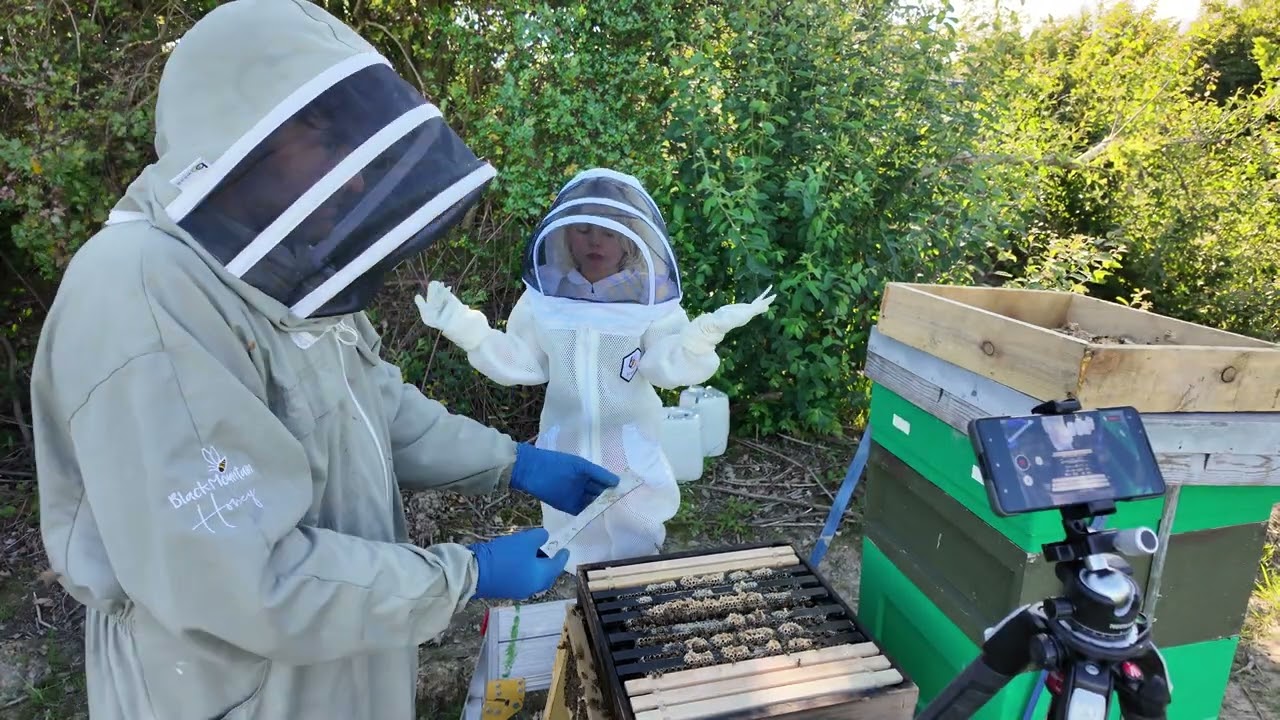
Laurence Edwards and master beekeeper Ivy show how to remove burr comb from a hive. Burr comb clogs the 8 mm bee space and lets frames stick together, inviting wasps. The harvested wax is high-quality and can become candles or foundation sheets.
Chapters
I'm back in the apiary with the master beekeeper Ivy, and today we're going to learn how to remove burr comb.
And lots of bees are trying to sting me.
Lots of bees are trying to sting her.
And you.
And me. Have you been stung yet?
I barely have.
Barely have. How's the bee suit coping?
Good.
Is it good?
Yeah.
You like it?
And we've got a little holder in here too, so we can See the bees, because if they were completely covered in black, we wouldn't be able to see them, see how they were getting on.
Right, so on this colony here we have burr comb, which is wild honeycomb on top of the frames like this. And this is not good for the colony of bees. You know why it's not good? Why is it not good, Ives?
Because the wasps are also trying to steal the honey.
Because the wasps will come and try and steal the honey. Good, that's a good idea. The actual reason why it's not good is there is a thing called bee space. And if you don't get rid of all of this burr comb, they stick the frames together, which means that it's very difficult to do your inspections. So we need someone to help remove this burr comb.
I can help.
You're gonna help?
Yeah.
Excellent. Okay, so underneath the box as well, we've got burr comb up there. We're gonna need to remove all of that. So all we're gonna use is a hive tool. If you've got a smoker, you can blow the bees down, but if you just give them like a little bit of a shake as well, you can do that. And then we're just gonna scrape the frames like this, and it can be a little bit tricky.
Yeah.
But you just need to get every little bit of comb off like that.
And sometimes the, the wasps, we don't want that on it because it also might make the bees not well, really.
Will it make the bees not well?
Maybe. I also don't want to make sure you get any of the bees with that tool. I'll make sure your kids at home don't use the bee varroa. It's quite sharp, isn't it?
So what were you saying about this, Ives?
Um, you might not want to let your child touch it at home.
Why not?
Because it can be really sharp.
So it can be very sharp at that end there. So really, this is adults only, this bit, isn't it? So what we're trying to do is scrape off all of that wax there.
Be careful of the bees, Dad.
That's right, we're going to be as careful of the bees as we possibly can. And you can see I didn't get any bees there, did I?
Yeah, we nearly did.
Nearly did. So if you just go like this with your fingers—
Oh, there's a little bee on me here too.
Ivy's going to distract the bees, but if you go like that, you can also use smoke to get rid of the bees, or you can just mush them out the way a bit.
This bee is kind of looking for someplace to sting me.
But you just want to get the frames nice and clean like that.
And you can also see on some of the bees, as you can see on some bees, they have little fluffy bits as well, don't they?
So what's the fluffy bit?
I'll try and get one to show you. Come on, come on, little bees. We're doing a little video here. Come on, come on, bees. Oh, come on.
Oh. The reason that the bees actually create this burr comb there is because the spacing wasn't correct in the previous box. Basically, anywhere in a beehive, you need to have all of the spaces at pretty much 8 millimeters. If it's any less than 8 millimeters, what they do is they propolize it all together, and if it's any more than 8 millimeters, they fill the gap with burr comb to create an 8 millimeter gap. So by taking this away, all of the bee space is correct again on the beehive, and it means that they shouldn't create any more. I've just been collecting all of this burr comb here. This is good quality beeswax, this. So if you melt this down, you can turn this into beeswax candles, you can turn it into foundation, you can do loads of things with this. But don't just chuck it on the floor. It's a disease risk chucking that away. So keep it nice and secure somewhere safe. I'm going to chuck all of this into a bucket and then we'll reuse it again. Now I've got loads of burr comb on this side of here as well. I'm just going to try and get the bees off it with a little tap.
Oh, you doing big taps, not little taps. And why would you do big taps then?
So just getting the bees off there now. So what's all of this made of?
Beeswax.
Beeswax. So we're going to take that home, we're going to render it down, we're going to produce some beeswax, and then maybe we'll make our very own candle.
Yeah.
Good idea. I really enjoy doing the videos with Ivy. I think we deserve a high five. Oh yeah!