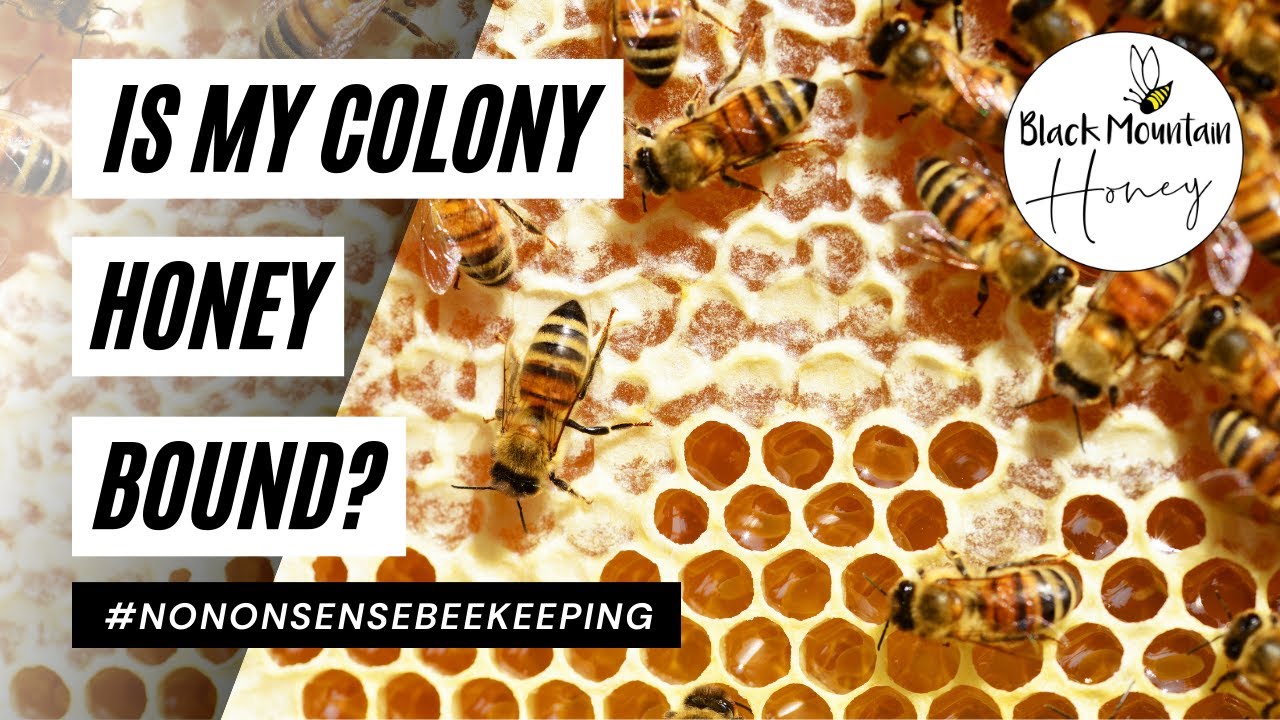
In this instructional video, Laurence Edwards of Black Mountain Honey demonstrates how to recognise a honey‑bound colony and why it is problematic for bee health and honey production. He explains that delayed requeening can leave a brood nest backfilled with nectar and honey, limiting space for the queen to lay and increasing the risk of swarming, which ultimately reduces seasonal honey yields. Edwards outlines a simple two‑stage remedy: (1) create additional space above the queen excluder by adding extra supers, and (2) selectively remove the most honey‑laden frames from the brood box, repurposing them for splits, nucs, or honey extraction, then replace them with drawn comb or foundation to encourage rapid expansion of the brood nest. He also advises condensing the remaining brood frames, adding a new super with foundation to draw out comb, and highlights practical tips such as shaking frames to assess nectar content, using pollen‑rich frames for nucs, and the interchangeable use of foundation versus drawn comb. The video concludes with a recap of the manipulation, a call to support the channel, and standard subscription prompts.
Chapters
Today I'm going to show you a honey-bound colony and show you how to remedy it. Hi, I'm Laurence Ederson, Black Mountain Honey. Welcome to another episode of No Nonsense Beekeeping. I hope you're all having a bumper summer harvest so far. What phenomenal weather we're having in the UK. It really just is quite perfect, especially up north where the ground is still wet and it's just the sunshine just keeps on coming. The problem I have though is I have a number of colonies that are honey bound. That's what I'm going to show you in this video, how to identify a honey bound colony, talk about some of the issues that colonies going honey bound give you as a beekeeper, and then I'll show you how to remedy that as well. So I'll get my bee suit on, get my smoker lit, let's get into the hive, see if we can find some honey bound colonies. Right, so here we are in a honey bound colony, and the problem that I've got pretty much all the colonies in this apiary here is that I had a bit of a delay in terms of requeening the colonies. So I let them go a little bit too long. They didn't turn drone laying, they didn't turn laying worker, but there wasn't much in the way of brood. So the colonies have come in, the bees have come in, they've backfilled all of the brood nest with honey, and now I'm at a point where I've got a newly introduced queen, she's not really got anywhere to lay, and then the whole of the brood nest is full of honey. So we've got a honey-bound colony where the brood box has been backfilled with nectar and stores. Which is a real pain, and it means that you have a problem in terms of swarm management. You need to create space in the brood box. The only way that you can possibly do it is to create space in the brood box to reduce the congestion down there in order to stop them swarming, give the queen enough space to lay so she can expand that brood nest. Ultimately, it impacts on honey production. I know that's completely counterintuitive, But the more honey they bring into the brood nest and keep down there because they've not got room upstairs, the less honey they're ultimately going to bring in over the course of the season because the queen hasn't got enough space to lay, which means there's not going to be enough bees to go out and forage for honey. So the way to deal with it is really, really simple. It's a 2-stage approach. The first stage is make sure there is enough space above the queen excluder. In this colony here, there isn't enough space anymore. So I've got 2 National Deeps and a national shallow above the queen excluder, and they are full. So that's contributing to the issue here. I'm going to add additional space above the queen excluder. I'm going to add it directly above the queen excluder. And that is the first part in contributing to relieving congestion downstairs in the brood nest. Now, if you're hearing a weird whirling sound, a blurring sound, I've got my neck fan on today. This is just the best thing in the world. So I do apologize if there is a bit of a background noise in this video. It's normally the bees, but this time it is a neck fan that I'm wearing just to keep me cool because it's about 30 degrees outside. Now the next part is identifying what you've got in the brood nest, and what we've got down here is a frame that is full of nectar, not turned into stores yet. A frame like that can stay down in the brood nest as long as you give them sufficient space upstairs with the aim of them moving it up. So don't feel that you've got to move every single frame. that is congested with nectar like this, the bees will just bring in nectar in the day and they'll start to move it up. So when you go through your colony, you need to identify the frames that are most capped over, and it might be a case that none of them are capped over, everything's just open and full. You want to take out the worst offending frame. So ideally, in a colony like this where 8 of the frames are honey-bound and only 2 of them have got eggs or brood stages in, You want to take out as an absolute minimum, say, 50% of the honey-bound frames and go for the worst ones. Go for the ones that are the most full. I'm not suggesting going and chucking them away. Go and use them for something else. Perfect for making up splits. Whenever you're making up splits, you always want one or two frames of stores in there. So just take out the most capped or the most mature frame of stores that you've got. Take that out to one side. Go and put it somewhere where they're not going to start robbing it. Go for the ones that are filled with pollen, especially if you're making up nucs. If you're doing it just to ease congestion and you're going to use it for honey purposes, that doesn't matter. If you're doing it to make up nucs, go with the frames that have got the most pollen in. That gives the nuc a really good start in life in terms of the amount of protein they've got access to. And then all you do is you replace it with foundation, or you replace it with drawn comb, one or the other. It really doesn't make a massive difference. You'll get a quicker Expansion if you're using drawn comb, and you probably reduce the chance to swarm a little bit more if you're using foundation. But like I say, don't get caught up too much on that. Either or is absolutely fine. And that is the simple method to reduce the brood box being honey bound. I guess the question that most people would have here is, what do you do with those frames? And I've said it before, just go and use them, make up some splits with them. If they're full frames of capped honey and you've not done any treatment on the frames, Feel free just to take those brood frames out and just melt them down. Take the honey, spin them out. Perfectly acceptable to use those as honey frames. So that's all I'm going to do in this colony now. I'm going to take out 4 frames of stores from within the brood nest and I'm going to replace it with drawn comb or foundation. So just take out the worst offending frames, give them a good shake. You'll see you'll get a bit of nectar coming out as well there. You want to ideally do it with the ones where the nectar is not going to shake out like that. Any nectar that shakes out, they should bring up above the queen excluder. Ideally, you're looking for the ones that don't shake out, so give them a little shake first. Try and get the ones that don't actually shake out. That's going to give you the biggest benefit in terms of the amount of space that you're going to create. So I've taken out 4 big frames there full of stores, and what I'm going to do now is I'm going to condense the brood nest down into the middle, and then I'm going to backfill it with a bit of drawn comb and some foundation. And that's it. That's the manipulation complete. Plenty of space now created down in the brood nest. I'm going to take those frames. I'm going to go make up some splits with them. Really valuable resource. So before we close it back up, I've got a brand new super. Foundation works really, really well here because they just got that desire to draw it out. If they're on the flow, they're going to use the stores and the nectar from downstairs in order to draw out that foundation. Serves two purposes: reduces the congestion downstairs, gets a nice new box of super foundation drawn out. I'm going to place that directly on the queen excluder, and then I'm just taking the rest of my boxes, stacking everything back up again. And there we go, that's the manipulation complete. Hope you found that one useful. Said it before, we've got a new feature on our channel. If you found that useful and you want to support the channel, feel free to hit the thanks button. and you can support us as much as you like. But I hope you enjoyed that one. As always, please hit the subscribe button, please hit the bell so you're notified of every video, and I'll see you next time. Bye.