Cheapest Way To Extract Honey - Simple Crush And Strain Method For Clean Raw Honey At Home
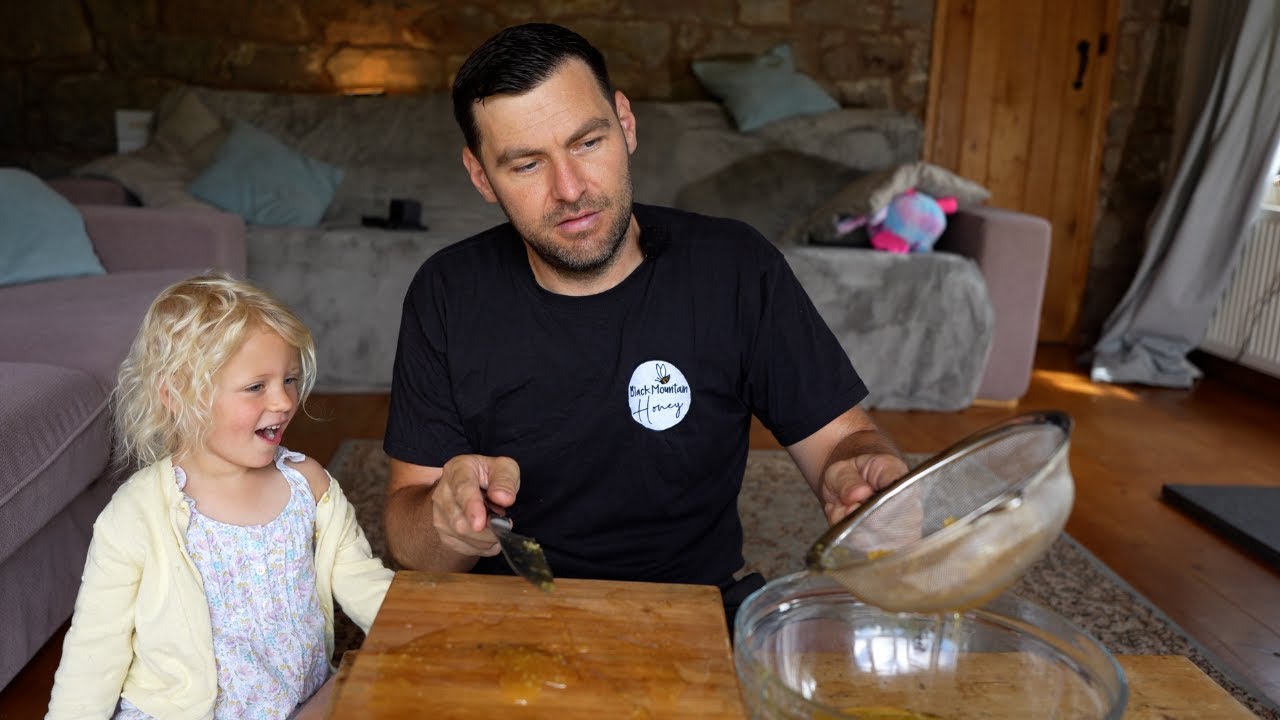
Laurence Edwards shows how to extract raw honey at home using just a bowl, sieve, and jars. Chop the honeycomb fine, strain it twice to separate honey from wax, and you get clean honey for almost nothing. It's messy and slow, but the wax scraps become candles.
Chapters
In this video, I'm gonna show you the simplest, cheapest method for extracting honey from either frames or wild honeycomb. For the purpose of this video, I'm gonna use the wild honeycomb frames that I got from my upturned feeder, and if you've got an upturned feeder, you can actually do this exact manipulation and get this honeycomb here. If you wanna do it the way I did it, which was completely and 100% deliberate, strike that, it was a massive mistake. I took an upturned polyashworth feeder, I left the bees to go into it and just create wild honeycomb. They did this and they did this, and I got beautiful Welsh wild natural honeycomb with no chemicals, no foundation, nothing. Completely wild and made by the bees. But this isn't the exact kind of thing that you can put into an extractor, but it gives me the opportunity to show you the simplest method in the world for getting wild honeycomb or honey that's in a frame into a jar using nothing more than a bowl and a sieve. Everyone would have heard of it. It's called the crush and strain method, and I highly recommend the There's only one big drawback in my mind. Okay, 2 drawbacks for the crush and strain method. One, takes quite a long time and it's a little bit messy. And 2, it means that you lose your wax year on year, which means that your overall yield will go down. But if you've just got 1 or 2 hives in the back garden, you don't need hundreds of pounds of honey, you don't need a fancy extraction room, you don't need an extractor. You can do this method, it works well, gives you beautiful honey, coarsely filtered, all of the good stuff stays in. And it costs you nothing because you can do it with stuff you've already got in your house. So what I've got here is lovely, beautiful Welsh honey. I've been having so much fun doing this, and I've been having so much fun tasting it as well. So for the purpose of this video, I'm gonna show you it with wild honeycomb, and if you wanna do it on frames and you wanna set yourself up for this, my recommendation for you would be to use unwired foundation. You can even use completely foundationless frames, but don't put any wires in it. Don't put any strengthening in it because when you come to do the crush and strain method, it makes it a lot more difficult. if you've got cables or wires or anything running through the foundation. So just go for a standard, straightforward, unwired, thin foundation. That's the best foundation you can use if you're gonna use the crush and strain method. So all you're gonna do, if you're doing it on a frame, cut it out of your frames, get it to a point where it's like this, which is just big hunks of honeycomb with loads of honey running all over the place. And all I'm gonna do here is I'm just chopping it up, really kinda hacking it. You wanna hack it into bits. Do it in your living room, do it in your kitchen, do it wherever your wife's not gonna find out that you're doing it.
Quickly clean it up afterwards.
I'm doing it in my living room. And you just wanna get it to a point where it's kind of like a fine mush. And you can see, that's looking good now. So once you get it to a point that it's looking like this, and before it starts leaking off and going all over the floor, maybe get in there with your finger, have a little bit of a lick. As I said, this is for personal use. This is definitely not going out for sale. You wanna get it to a nice, fine consistency like that. It'll become clear later once you get it into the sieve why you wanna get it at this point as fine as you possibly can. Basically what you're doing is you wanna puncture every single cell so the honey can leak out of it. If you don't do this, you'll end up having to do it in your sieve, and then you start blocking the sieve. Once you get it here, all you're doing is you're just gonna start transferring it over to the sieve. You're definitely gonna make a mess. This is not an easy, non-messy task. Great to do with kids, this, as well. Lots of sticky things that need cleaning up. And all I do is just scrape it over like that and get it into the sieve. If you can get someone else to hold the sieve, it makes it a lot easier as well. And if you wanna go and actually spend some money, The double sieves that you can get do make this easier, but what I would always suggest is take out the top really fine filter and do a coarse filter first, and then go back through and do a fine filter if you wanna do it. Otherwise, you will be there forever. So just gonna continue to work now, getting all of that honey into the sieve. Right, so as I said, perfect thing to do with kids. What's your name?
Ivy.
And are you a beekeeper?
Yes.
Oh, right, you're a beekeeper. And what have I got here?
Honey!
Honey. And where are we putting the honey? In the—
Freezer!
In the freezer?
Freezer.
Yeah, in the freezer. What's this?
Whisk. A whisk?
What is it, a s-s— Silly!
A silly?
It's not a silly, it's a sieve. So we're taking all the honey and we're putting it in the sieve.
Why are you doing that, Dad?
Good question, why am I doing that? So I'm taking the honey with the wax and the comb, I'm putting it in the sieve to separate out the wax from the honey. Now, did you wanna come and taste some of this honey?
Mmm, yum yum yum!
And who made that?
The bees.
The bees. Tastes good?
Yeah.
What does it taste of?
It tastes of pooey dad.
Pooey dad.
Dad, can I come under here?
Right, so I've got my little girl Ivy helping with me. We're just gonna scrape the rest of that honey off and we're gonna scrape it into the sieve.
Daddy was dropping some on the table.
Ivy's correct, I am dropping some on the table, but as I said before, if you get like a nice wooden chopping board and a good sharp knife, you can get the vast majority of the waste off the board and actually on and into the sieve.
Ah, no, no, stop it, stop that!
Go on then.
We don't like it. Go on.
Right, so I said it was fun to do it with kids, it definitely wasn't easy to do it with kids, so Helen's come away and taken Ivy. She's gonna go downstairs and get the jars ready. I'm gonna scrape off the remainder of all of that honey there, and as you can see, it's just going straight down into the container. So in here now, I've got my finely minced wax cappings, and you'll see how efficient this becomes at going through this sieve here. The coarser grade of sieve, the quicker it will all go through, but as you can see, it's already coming through nicely there. The majority of it's already come through. And then all you need to do is just keep on mushing it around like this, breaking up any cells that you didn't break up previously. And over time, as long as it's a nice warm environment, then all of that honey will just gradually drain through and you'll just get left with lots of nice wax cappings. Now I said at the beginning it's a disadvantage because you lose a lot of your wax. One of the huge advantages of this process is that you do gain a lot of wax. So if you wanna do your lip balms, you wanna do your candles, and you want access to a good amount of clean wax from your bees each year, each year, crush and strain method actually works really, really well for you. So it's just a case of waiting now. I'm gonna give it about 5 or 10 minutes, complete some further agitations, get my jar ready, and then we'll take the honey from this container and we'll get it into a jar. So it's been about 10 minutes now, and I just continue to mush that honey around. And when you go on to your next cycle, you can just add more honey into this. Really does work very well, very efficient. You can see it's still a little bit mushy, but if you leave that overnight in a warm environment, And all of those cells are pierced, you will get the vast majority of that honey out. There's still a really good amount of honey in there, so whatever you do, don't throw that away. Just keep on working it down, getting all of the honey downstairs into the jar. So then, just take a jar, any jar. You know me, gherkin jars are the best. I really do like them because one, they're free, and two, they're a really good size. So I think you can get like a pound and a half in some of the bigger jars, maybe even up to 2 pounds. And all of the lids do seem to be interchangeable. But if you look inside the honey there now, really nice, thick, viscous honey, beautiful air bubbles in it as well. And then it's just as simple as tipping it out into a jar and watching it all go down into it. And there we go, it's as simple as that. Crush and strain method, one of my favourite methods, definitely the cheapest, gives you pure, beautiful, untampered honey, doesn't cost you anything.










