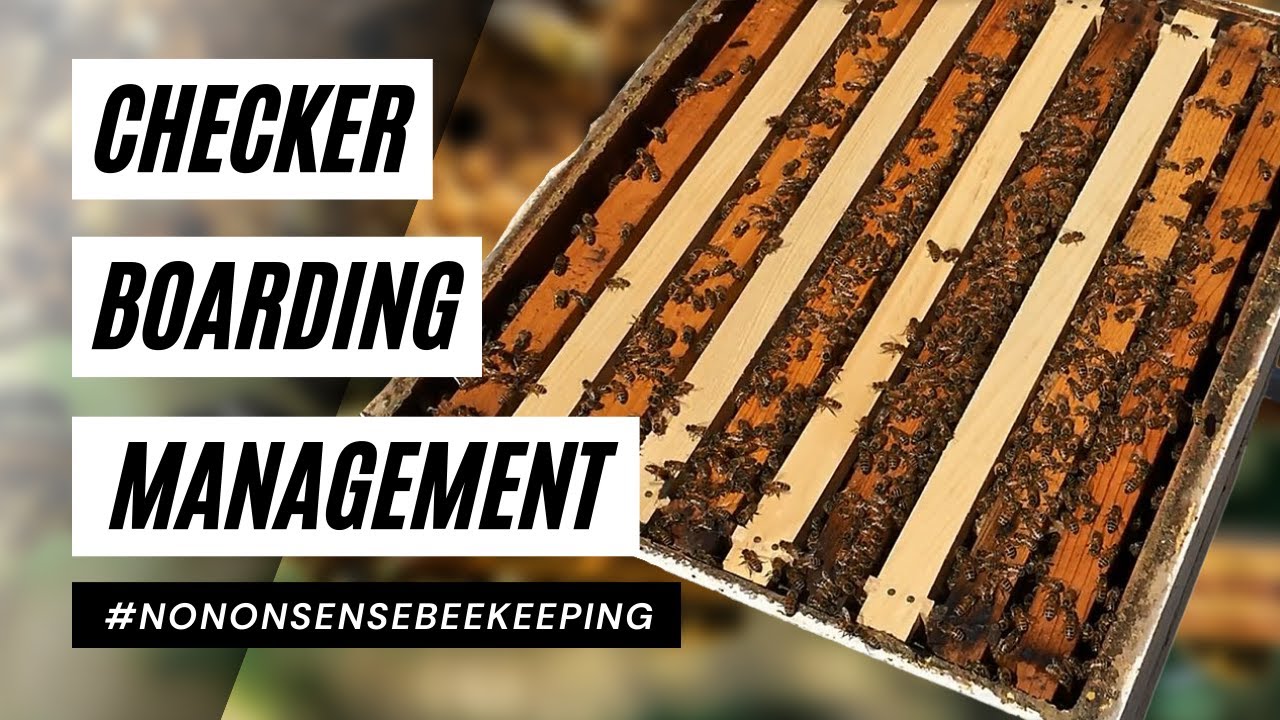
In this episode of the No Nonsense Beekeeping series, Laurence Edwards introduces the "checkerboarding" technique as a proposed swarm‑control method. He describes the system as alternating frames of drawn comb or foundation with frames of stored honey, ensuring that a box of this mixed configuration is always kept one level above the bee cluster. Edwards explains that the method must be started very early—around December to January in the UK—well before the typical swarming season, and that the beekeeper should continuously stay ahead of the expanding brood by adding boxes so the bees never reach the hive ceiling. He references a detailed book on the subject, showing its diagrams and timeline recommendations, and outlines his own experimental plan: to apply the technique to a single colony this year, document the results, and, if successful, expand to multiple colonies in subsequent years. Throughout, he expresses cautious optimism, acknowledges uncertainty about the method’s efficacy, and invites viewers to discuss and share their experiences.
Chapters
In this video, I'm going to talk to you about the process called checkerboarding as a method for swarm control. Hi, I'm Laurence Edwards from Black Mountain Honey. Welcome to another episode of No Nonsense Beekeeping. How good would it be to never ever have to inspect your bees and guarantee that the swarms will never leave because you're using a method called checkerboarding? I had a really interesting Zoom call about a month ago now, With a really interesting, friendly group of beekeepers who were advocating the use of this system here. They've sent me the free book as well. In this video, I'm going to talk to you about this process, but later on in the year, I'm going to put this into practice. I'm going to follow this book as my Bible, and I'm not going to do a single inspection on this colony. And this book tells me that the bees will not swarm. Now, you know me, I always, always, always want to try new things. I'll never say to someone, I don't believe that works, because how would I know if it doesn't work? I like to try things out for myself. Even if they fail, I think it's useful to put it on the camera and let everyone see what has happened. So checkerboarding is a beekeeping system that involves alternating frames of either drawn comb or foundation with frames of stores, making sure that you've always got one box above where the bees are And within that box, you've got a frame of foundation, frame of stores, frame of foundation, frame of stores. That's what checkerboarding is. It means putting those frames of foundation in between frames of bees, frames of stores, or frames of brood. In this instance here though, it's very specific that it needs to be frames of stores. I can't wait to give this a go because what it says in this book is like the best thing in the world for beekeepers, especially commercial beekeepers. It says if you do that to your bees, At certain times of the year and you're always ahead of them, so they're never hitting the ceiling of that beehive, then your bees will not swarm. Do I believe that? I genuinely don't know. I really, really want to believe it because it would make my life so much easier. I'm going to try that this year with one colony. If it works with one colony this year, I'm going to try it next year with 5 colonies, and I'm just going to keep on going with this, see how far we get. If it doesn't work in the first year, maybe I'm doing it wrong. It's always my interpretation of what's in this book. Sounds like a really interesting philosophy though. And what's even more interesting about it is the fact that it starts so early in the year. So when I was on this Zoom call, I was thinking, well, this is going to start maybe March, April, May, before the swarming season starts. And apparently no, you start this really, really early in the year, around the December time. So when you're doing your oxalic acid treatments, Very, very odd. I couldn't quite comprehend that at the time, but they were very insistent. That is when you start this manipulation, and what you need to do is you need to get on top of that cluster and you need to start alternating those frames. And then all you're ever doing is lifting up the lid. If there's no bees at the top, that's no problem. You're going to crack up underneath, see where the bees are, and you just need to keep one box ahead of them at all times. So they put together a really nice little book here. This is a proper book, this isn't just a pamphlet, and it goes into a huge amount of detail. Swarm management with checkerboarding, really nice diagrams and photographs page, contents. They've gone into so much detail on here. I'm not going to open up all the pages because obviously if you're going to read this book, I'm giving it all away on camera. But it's good, like it gives you these diagrams here, tells you like what checkerboarding is, tells you how to carry it out, and gives you a really good timeline. And I'll just zoom in here. Timing— this must be carried out early. We recommend before February in the UK. So I'm going to come back in. I think I'm going to do it around January up here because I don't want the colony of bees getting too high up and I don't want to miss the opportunity to do it right. But I just found that bit really, really interesting. Must be done before February. So you're mitigating losing swarms in April, May, and June, maybe July as well, by doing a manipulation in February. Really, really interesting. So this is going to be the final page that I show you in this book because I think it gives you a really good indication of what's going on. So this is a standard configuration. If you didn't take any honey off your colonies, this is what you're going to be looking like. You're going to have brood in that bottom brood box, and then you're going to have maybe a couple of supers of honey above it. So then in the middle, what they're saying is that's what you should be doing. So you should be taking that top super, alternating it with wax combs or foundation, So you get that checkerboarding approach like that. And then the final one is you can see that rapid spring expansion. And then what you need to do as soon as they keep on going up, you need to stay ahead of them and make sure they've always got boxes on top so they never hit the ceiling. So that's it. That's all I'm going to show you from the book at the moment. I'll definitely come back to that and refer to it later on in the year. But I'm going to try this. I am so, so interested by this. Even if it fails, you know, I'm just interested to see what happens, how the bees respond to it, how my bees respond to it in this apiary here. Where the growth and the rapid spring buildup is huge. They produce a lot of honey here as well. What I've seen from the guy who made this as well is some of the stacks of honey that they produced. No inspections, and they were 7 or 8 supers high. I like the idea of 7 or 8 supers high. So as always, I will try things like this. If you have a method of swarm control, if you've got a nice little neat book, it definitely makes it easier for me to follow as well. But I'm always up for doing something a little bit different. I'm always up for trying something new. Will it work? Will it fail? Definitely give a guess in the comments below. Do you think this is a viable method of swarm control? Is this something that you've tried yourself? Did it work? Did it not work? What did you learn? Always up for a decent discussion about swarm control. So I'll follow this up, probably going to be about 6 weeks away now when I do this video. I'm going to run it as a series all the way throughout the year. Probably do about 5 or 6 different episodes showing you what I'm doing, not showing you the inspections, and I'm going to set up a little camera on it as well. Hopefully we won't ever see a swarm leave. So I hope you enjoyed that video. I hope you found it useful. As always, please hit the subscribe button, please hit the bell so you're notified of every video, and I'll see you next time.