Concrete Bee Bunka Beehive - First Look
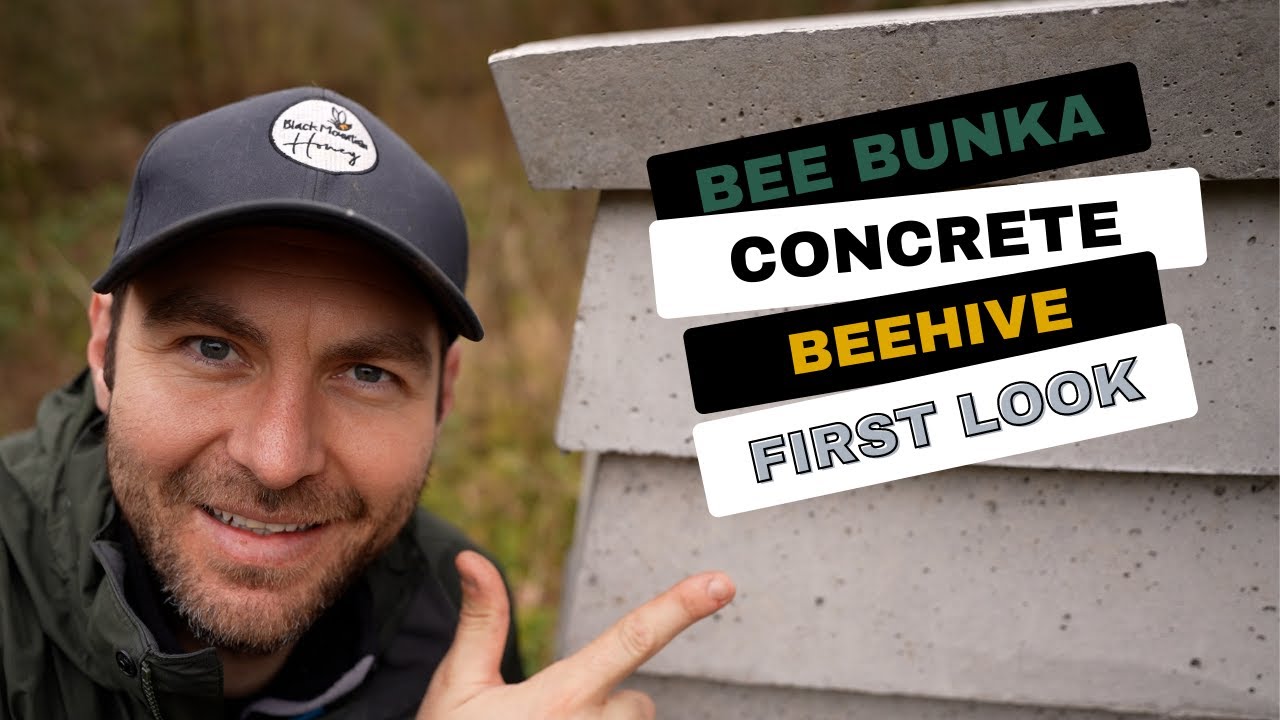
Laurence Edwards tests a concrete beehive system designed for durability. The main concerns are weight and poor insulation, but the concrete offers theft resistance, weather protection, and defense against woodpeckers and badgers. He plans to run them through a season and add insulation to address condensation.
Chapters
Today I'm going to be taking a look at my new set of beehives that are made of concrete. Now you might be thinking, what on earth is going on here? Beehives are not made of concrete, they're made of wood, they're made of polystyrene. I know someone that's making them out of mycelium, which is a kind of fungus. These ones here, however, they are made of concrete. I bought myself 2 of them, paid for them with my own money. I'm going to run them throughout the season, see what I like about them, see what I don't like about them. If In this video though, I'm gonna give you my first impression of the Bee Bunker concrete beehive, tell you what I think of it. So first off, why have I bought myself 2 Bee Bunker concrete beehives? It is purely out of curiosity that I have bought these. I've not thought there's a problem here that I need to fix and oh, a concrete beehive is gonna fix this problem. I saw them, I thought that is so cool, a beehive made out of concrete. I've done my very best to try and kind of import some of the molds, work out how to build them myself, and then I realized that was just way too difficult. I spoke to a guy called Ross down in Rugby. He's bought some of these molds already. He's called the Stone Apiary on Instagram, and he has very kindly provided me with his first 2 production Bee Bunker concrete hives. So of course there are some concerns that I have with these hives as well. First one I have, obviously these are very, very heavy beehives. They really are heavy. Lifting them up, no frames, foundation, bees, honey, anything in them at the moment. And they are difficult to lift. And I'm talking about each of the individual components. So the roof, the supers, the brood box, the floor, all of them are very, very heavy. So once you get the bees in there, you get the frames in there, you get some honey in there as well, it is going to be exceptionally heavy to lift these off. And they're without a doubt not the kind of beehive that you're going to stack up a load of supers in the back of your car and take them off to be extracted. However, not everyone is a commercial bee farmer. Not everyone needs to stack up the supers and take them to the extraction room. So I do think there's mitigation in that. If you just want to have kind of one or two beehives in your garden, you can just take the frames out individually. I do that on my long hives. There's no other way of doing it. You need to take the frames out as and when the bees fill it with honey. You could decant them over, take them over to a different box, and take that in to go and be extracted. Yep, there's definitely more work involved in doing it that way, but there's a quite simple way around it if you're going to keep these in your garden. The second concern that I've got about these beehives is the Thermal efficiency of the concrete. Concrete's definitely not a good insulator, but bees do seem to thrive in cavities of walls. They seem to thrive in chimneys. To be honest, bees pretty much thrive anywhere. Now that's not me saying let's not give them a good start. Let's not give them a nice warm cozy home. You know I'm a massive fan of highly insulated wooden hives and highly insulated poly hives. And I think you get the best out of your bees by insulating them as best as you possibly can. So I think that these concrete hives are gonna be very low on insulation. And the way that I'm gonna run them is a little bit of a hybrid system where I introduce some sort of insulation onto the walls maybe of the beehive, but certainly above the cluster. I'm gonna work out a way that I can insulate that roof. So they're my 2 main concerns. And I think I can kind of get around both of those. Definitely not on a commercial scale. I've got 2 beehives here, but I'm probably gonna combine them together in the season and just have one big beehive in order to do what I wanna do and put the insulation in. But now I'm going to talk to you a little bit about some of the benefits of this beehive system. It's been designed in South Africa to eliminate 2 major issues that they have out there. One is beehive theft. So these beehives are going to be very, very difficult to steal. They're designed so you can clamp them round with a chain, a big metal chain, put a padlock on it, and there is absolutely no way that anybody can come and pick up that beehive and move it away. Obviously, if they've got mechanical assistance, That's going to make it a little bit easier for them. But still, you're not going to get kind of 2 or 3 of these in the back of the pickup truck and just drive away with them. They are very, very difficult to steal the hive as a whole unit. Obviously, people can still just come along and take the roof off if you've not got it all strapped down with a chain, take out the frames, take out the queen. So the possibility of theft does still remain a little bit, but it certainly mitigates it to a certain extent. The next area where this beehive really does excel is its ability to withstand major weather conditions. So big gales blowing over your beehive, that is never going to happen. And even bigger than that, because the issue that I have isn't so much the beehive blowing away or the roofs blowing off when it's really windy. I just strap them down and that stops it. The bigger issue is tree branches coming down and smashing into your hive. Now, that's not me saying I think these are going to withstand a big tree coming down and falling on them. Concrete is notoriously brittle and not very good at absorbing impact force like that. But anything else, small branches, fence panels, things like that falling onto your beehive, it's going to do a much better job than say wood or poly. And then the third and final really big benefit that you get with these beehives, and this is something where I can totally see why they want something like this in Africa, is that it stops a lot of invasion of wild animals. So that could be woodpeckers pecking away at your wooden hives or your poly hives, could be badgers trying to get into the front. My poly hives get ripped to shreds by badgers. Especially in some of the bad out apiaries as well, where there's big badger sets nearby. And then obviously in Africa, they're going to have a whole host of other animal pests that are trying to get into these beehives. Making them out of concrete completely eliminates that risk. There's not even a tiny little bit of risk left over. Nothing is getting into those colonies there. So there we go, 3 really good pros, 2 rather large cons as well. I'm going to run these all the way through the season. I'm going to get my GoPro now and I'm going to show you and give you a top to bottom look of the Bunker concrete beehive. So this is what the beehives look like from the front, and as you can see, we've got a really big solid concrete roof, got a slant on it so all the water comes off, and then it has a notch in that section there which means you can get a chain around it and secure it. Really good at preventing against theft. And then the rest of the beehive is completely modular. So these look a little bit like the WC lifts that you get, but these are in fact the actual bee boxes. The frames go inside and I'll show you that in a little bit. Each one of these boxes here is effectively a shallow and it takes shallow Langstroth frames. And then the box that you've got at the bottom, that goes onto the base. I'll give you a close-up in a little bit and it gives you this additional extension down here in order to put deep Langstroth frames at the bottom. So what you're seeing there, that will be one single level of a deep Langstroth and then we go up a level, that'll be one single level there of a shallow Langstroth. And then up to the next level we've got one single level of a shallow Langstroth as well. So you can see what I mean on the inside there. That bottom level is completely blocked, completely solid. Be interesting to see if you get any pooling of water in there. There's issues as well in terms of if you want to do any varroa treatments, apibioxal, you'd have to vape in from the front, which isn't really a major issue, and you get a nice sealed unit in order to do that. So I have no issues with any varroa treatments. I really like the design of the corners here. So what you can see You have one of those on that side and one of those on that side, and then what you do is you run a piece of metal or a piece of wood and just sit that in this groove. And then once you've got that piece of wood or metal in there, you can just sit your Langstroth frame on it, and that's what works as your frame rests. I really like that nice simple molded design. Obviously had to work out how to get that perfect for the molding process to get it off. I really like that design. In terms of the base, I have to say I love it. It's such a simple design. And there's one really important thing that I just love about it is that inside here, this single entrance that's got an integrated landing board is 8 millimeters thick, exactly the same as the Suyenti floor that I've got. So you haven't got to mess about putting any mouse guards on. Nothing is going to be able to get into there and mess around with your bees. It's a really simple design and one that you just don't need to mess around with throughout the year. Now you can see here like a little bit of damage and you will get this with concrete. It's not going to be perfectly flawless, but it's going to retain its structural stability for years and years. You can see here a few little air pores in that concrete, but the finish is really nice. He's done a great job of the finish there. And you can see, if that's focusing all right, you can see we've got a few filaments in there. That's to increase the tensile strength of this concrete. I'm really interested to see how well these are going to work. So that's the detail of the hive. I have to say though, I think it is a design masterclass. I would have one of those in my garden and not even bother putting any bees in it. I think it's the coolest looking beehive I have ever seen, especially with that jaunty angled roof and the staged kind of modern look. I just think these look so cool. So there we go, that's the first look at the Bee Bunker concrete beehive. I'm going to cover how I'm going to manage the bees in there in upcoming videos throughout the season. I'm going to talk to you about how I'm going to put that insulation in there as well, because that's my major concern with this beehive, is that there's going to maybe be issues with condensation through kind of like the lack of ventilation and the poor insulation properties of that concrete. But in terms of a first look, what do you think? Do you think it's a good idea? Do you think it solves any of the problems that you have? Or is it something that you just don't think is going to get off the ground? If you're interested in beehives that use alternative materials, check out this video here where I upgrade a wooden national beehive to an insulated cork beehive.










