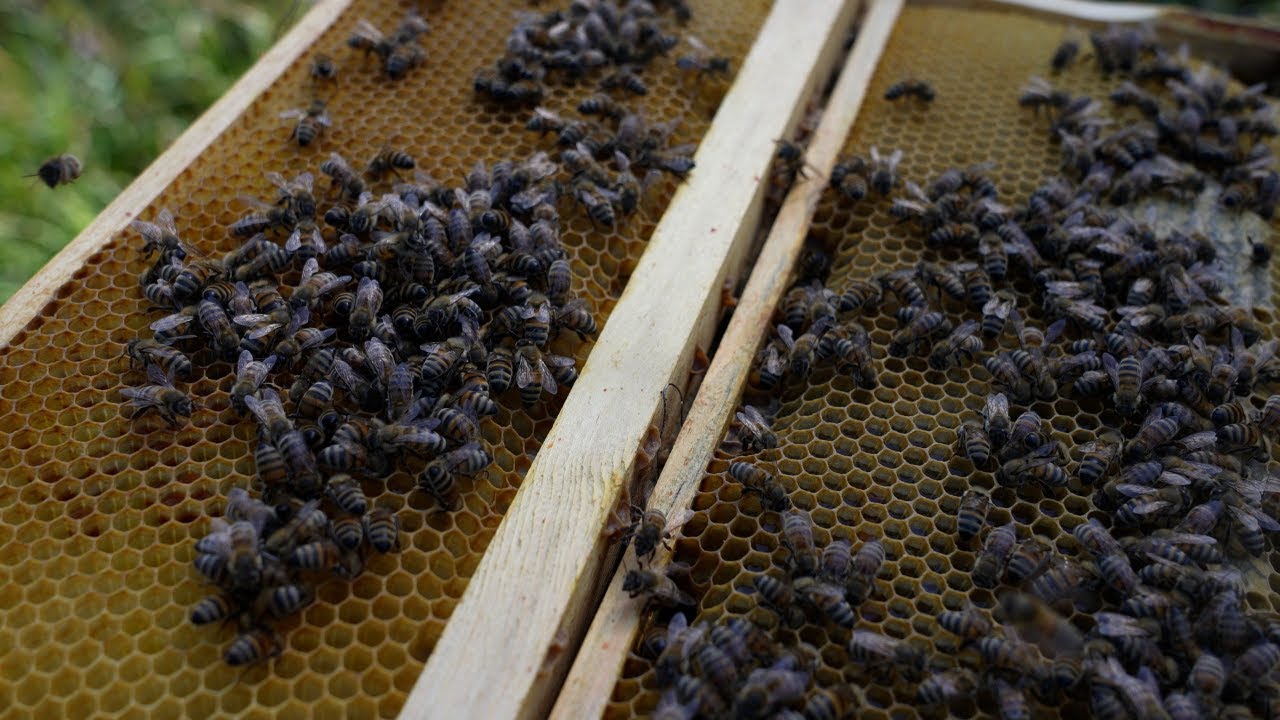
Beekeeper Laurence Edwards tests John White's claim that small-cell foundation bees never need varroa treatment. The colony shows no mites or deformed wing virus, but unusually light brood coverage. He'll monitor through winter to see if small cells alone can control varroa without chemicals.
Chapters
I've been sent a colony of bees by a guy called John White. He's told me that I will never, ever, ever have to treat these bees for varroa. Over the next few seasons, I'm not gonna treat them, and we're gonna see how well they do. So what we're talking about here is small cell foundation. That's when the size of the cells within the foundation are progressively smaller to a point where varroa can't get a stranglehold on the colony. I've seen reports, I've seen data on this in the past to show that this isn't an effective way to combat varroa. But when I speak to John White, he is adamant that it really does make a massive difference. So much so that he has actually given me a colony of bees on small cell foundation with the bees intact, with the queen. He's never treated them, and he's happy for me to put them through their paces this season, this winter, next season, all the way forward, to see how long we can get these bees to survive with no varroa treatment. Now, if you've watched this channel before, you will know that I love doing these kind of tests. It's all well and good reading something in a paper, in a magazine, and then forming your opinion based upon that data. I'm much prefer to get hands-on, have a go, even better to show you my failures and my successes. So thanks to Jon, I'll go and get my bee suit on and I will introduce you to the first small cell foundation colony that I've got that isn't going to need any varroa treatments and is not only going to survive but it's going to thrive. Right, how exciting is this? This colony is never ever going to be treated for varroa. Do you think they'll do well? Do you think they'll fail over winter? I have no idea. Today though, I'm going to open them up, show you inside, See if you can notice that the bees are ever so slightly smaller. Alright, so there's my first look inside. Opened them up, no smoke, and they seem relatively calm, which is nice. We'll pull out a few frames now, see what the brood's looking like, see if we can find the queen, see if we can find any varroa, any signs of varroa, deformed wing virus, and then we'll keep an eye on these guys and see how they get on through the winter. So a really nice start, big healthy box of bees, nice and calm. Let's get inside, see if we can find the queen, see if we can see any brood, and see how the bees are getting on. So, nice frame of stores on the outer edge. I'm just gonna get that off to one side now, just to give me a little bit of space to work. Another nice frame of stores there. Again, nice frame of stores. The bees are doing well. So there's my queen, yellow marked, really nice, beautiful, long queen. Bit of brood on this frame as well. Just gonna let that queen go away there. I'll put that frame off and show you some nice frames of brood. So, few things to say. First thing, really, really interesting, is that there is hardly any brood in this colony. I found eggs, few eggs. I found one frame with maybe 30 or 40% brood on it in a decent pattern, 4 or 5 frames of stores, and then lots of frames just of nothing. So what I'm kind of thinking is maybe these bees here, the small cell is helping them combat varroa, but also the type of bee is giving themselves a brood break, and they're using that as a mechanism to fight varroa as well. A very effective mechanism and something that you can definitely breed for, and something that I would see as a positive trait in terms of resilience against Varroa, but maybe kind of like a negative trait in terms of building up big strong colonies when you're looking for honey crops. That's not to say that that's a positive or a negative for everyone, but for me, I'm always kind of looking at, is it going to be a big strong colony? Is it going to produce a lot of honey? I completely accept though that not everyone's looking for that, and maybe for some people that is in fact a negative. Very interesting though. I can't really tell the difference between these bees. I'm looking at them and thinking, okay, maybe they do look a little bit smaller than normal, But I wouldn't have known if someone had given me this colony and not told me. I would have just kind of looked at it and said, okay, it's a colony of bees with not much brood in it. But they look healthy, can't see any signs of varroa, no deformed wing virus at all. It's clearly a healthy, big, strong box of bees. In this series though, I'm going to follow it all the way through winter, spring, all the way through next year. I'll give you plenty of updates on this colony, and I give you my word, I will not do any varroa treatments whatsoever. Stick it in the comments. Do you think it's going to work? Do you think they'll survive the winter? Is this something you've done, something you've tried? Did it go well? Did it fail? Let me know. I'm always interested to hear your experiences.