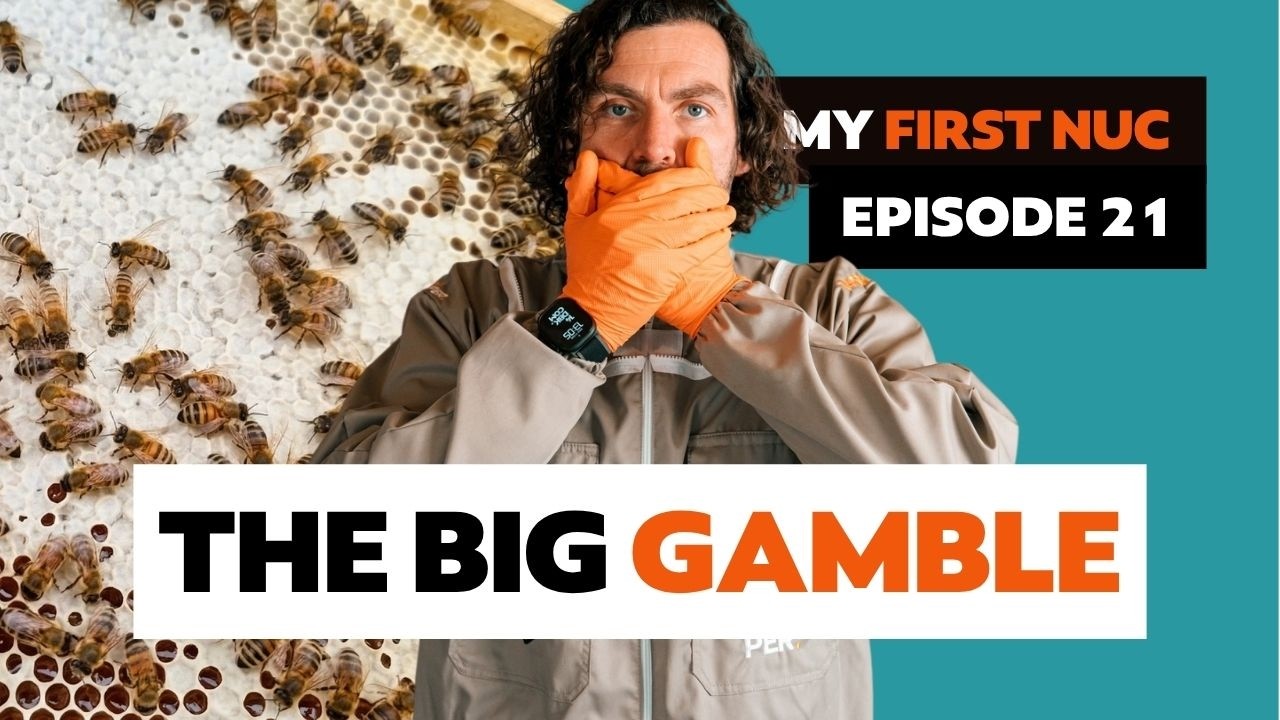
In this episode of the "My First Nucleus" series, Laurence Edwards of Black Mountain Honey evaluates a nucleus colony placed on heather in early September. He reviews recent weather—moderate temperatures and a warm forecast of 26‑27 °C—and notes that the heather is still in full bloom, prompting him to gamble on extending the honey harvest by one more week despite typical practice of ending the season. He inspects the colony, describing rapid population growth in weeks 4‑5, the super becoming packed with bees, and the onset of capping, which signals the flow is winding down. He comments on the bees' increasingly irritable temperament, the quality of the white capping wax, and estimates a potential yield of 20‑25 lb of pure heather honey from a national‑deep super. Laurence outlines his upcoming plan: episode 22 will capture the final honey crop, episode 23 will cover varroa treatments, episode 24 feeding, and subsequent winter‑overwintering of the colony, with continued documentation into 2022. The video blends observational beekeeping, weather‑driven decision‑making, and forward‑looking management strategy.
Chapters
We're on to episode 21 of the My First Nucleus series. Hopefully we're going to see a bumper crop of heather. Hi, I'm Laurence Edwards from Black Mountain Honey. Welcome to another episode of No Nonsense Beekeeping. Again, the weather's not been perfect for the past week, but it's been okay. Been up around 17, 18, 19 degrees, gentle wind, hardly any rain, which is really good. The heather is looking fantastic still though. So into the first week of September now, normally I'd be saying, let's cut my losses, let's get the heather off, let's get the varroa treatments in, let's get the feeders on. But the heather still looks really good. There's lots of nectar still coming in, and next week looks even better. There's 3 days where it's forecast to be about 26 or 27 degrees up here, which at this time of the year is bonkers. It's never that warm this late in the year. And And normally by now the flowers have gone over. I'd be thinking there's no point in keeping the colonies up here anyway, or at least keeping the supers on. However, this year I'm going to go for one more week. So episode 22, next week's episode, will be the last episode for honey harvesting. We'll still do varroa treatments, we'll still do feeding, we'll still do getting them ready for winter, but I'm going to give it one more week in terms of honey harvest. And my confidence is growing week by week. Again, I'm not going to bother going into the brood box this week. I'll show you in the brood box next week to show you how that nest has contracted down, How they've backfilled it with heather and just generally what the brood nest is like. But all I'm interested about in the colonies up at the heather is how much honey they're packing away in the supers. So let's get inside now, take a look, see how much honey we've got in the My First Nucleus colony. Right, so let's get inside. Don't be fooled by the additional height here. We've got the national deep, queen excluder, national deep, empty feeder, and then the super that I put on for a few days and then took off because it was the wrong thing to do. Let's get inside the colony though. Maybe we're going to see a nice full national deep full of heather honey. So week on week you can see the expansion in the colony. The queen, as soon as she got up here, she started laying. They've been up here now for around 4 or 5 weeks, and as I always say, it's that 4th to 5th week when you see a big increase in numbers. So this is what the top of the super looks like now, full to the brim with bees, and that is how you get a good yield of heather, is by having enough bees to bring in a big yield of heather. And I know that sounds really quite patronizing, but unless you've got the bees to do it, you can't get the honey. So it pays to have them big and strong at the beginning of the flows, and then you're going to get honey all the way throughout that flow. Hopefully up here though, we've timed it, got the colony up here just in time. They've boosted them up, got the strength going, and now we're going to start seeing some nice honey in between. Every single frame now though, completely full of bees. If you go back a few weeks, they weren't even up in this box, and then it got slowly bigger and bigger week on week. You can really start to see a big expansion in the numbers. Let's pull out some frames then, see if they're filling it up, see if they started capping it, more importantly. Well, this is what we want to see. They've well and truly started capping it. That does indicate that the flow subsided a little bit. They don't really tend to move onto capping that quickly unless the flow's come down a little bit. Also note the temperament of the bees— nowhere near as calm as they were last week. They were so calm, so busy last week, no capping at all, and now they're angry, they're tetchy. They're starting to cap, which does indicate that the flow is well and truly coming to an end. However, for the sake of a one-week gamble, it's not going to do them too much damage in terms of additional varroa load. The temperature next week does look too good not to give this colony a chance over those three days where it's going to be 26, 27 degrees, and the fact that the flowers are still out—a little bit of a gamble, but let's see what happens. Certainly going to leave all of my other colonies up here. as well. But look at that capping. This is typical of heather honey, beautiful white capping wax. You can just tell this is really good quality, very pure heather honey, from the way that it goes on the hive tool like I showed you last time. You don't always get perfectly white capping wax. For example, this one over here, that's all still pure heather. Just because it's not white doesn't mean that It's not heather honey. It's just indicative of heather honey. Same over here. Really, really nice. You have to remember this colony here had a lot of foundation up in that national deep. All of my other colonies start up here with drawn comb, so the yield is substantially more. But still, filling a national deep with a smaller colony up at the heather—I'm very happy with that. Not completely full. If we give it another week, though, I reckon we're going to be talking maybe twenty. 25 pounds of heather honey out of this colony, and you certainly can't grumble at that. So just look at the bees, they're so angry today. It's about 16 or 17 degrees here today, still relatively still, but a noticeable drop in temperature. And if next week didn't look good, I'd be harvesting this now because I'd say they're tetchy, the flow has definitely stopped, the weather's not permitting. However, the 2 things and the 2 reasons that are making me leave this for one more week Is the fact that when you look at the heather, it's still completely purple. Must be 70 or 80% still in flower. That doesn't mean everything though. It's the weather forecast next week, the fact that it's going to be so hot, and the fact that on the heather they only need a couple of days to get a really, really good amount of honey. For the sake of one more week, I'm definitely going to go for a little bit of a gamble, see if we can get that box full. But obviously the rest of my colonies up here, that's what I'm more concerned about. See if we can fill all of these boxes here. The last time I checked, they were mostly full, but I just want to get every single frame all the way up to the edge, everything nice and capped. So I'll leave it one more week, and I'll come up here next week, and I'll do a bit of filming when it's really, really hot as well, just to see whether they've come back onto the flow, to see whether the gamble had paid off. But if you've got your bees up at the heather in a normal year and you've not got the forecast like it is next week, and they've taken in a nice And they've been really gentle, and then you come up and they're like this. That's it, it's game over. First week of September, just get it off, get your varroa treatments on, get them fed, call it a day for the year. So we're on episode 21 at the moment. Episode 22, I'm going to show you my final honey crop next week. Then we'll move on to episode 23, which will be varroa treatments. Episode 24, feeding. And then we'll keep this series going all the way into winter with this colony, which I'm going to overwinter up at the heather. And then hopefully I can give you a snapshot of the colony throughout the winter going into 2022. I hope you enjoyed that video though. As always, please hit the subscribe button, please hit the bell so you're notified of every video, and I'll see you next time.