Finding Virgins With Carl
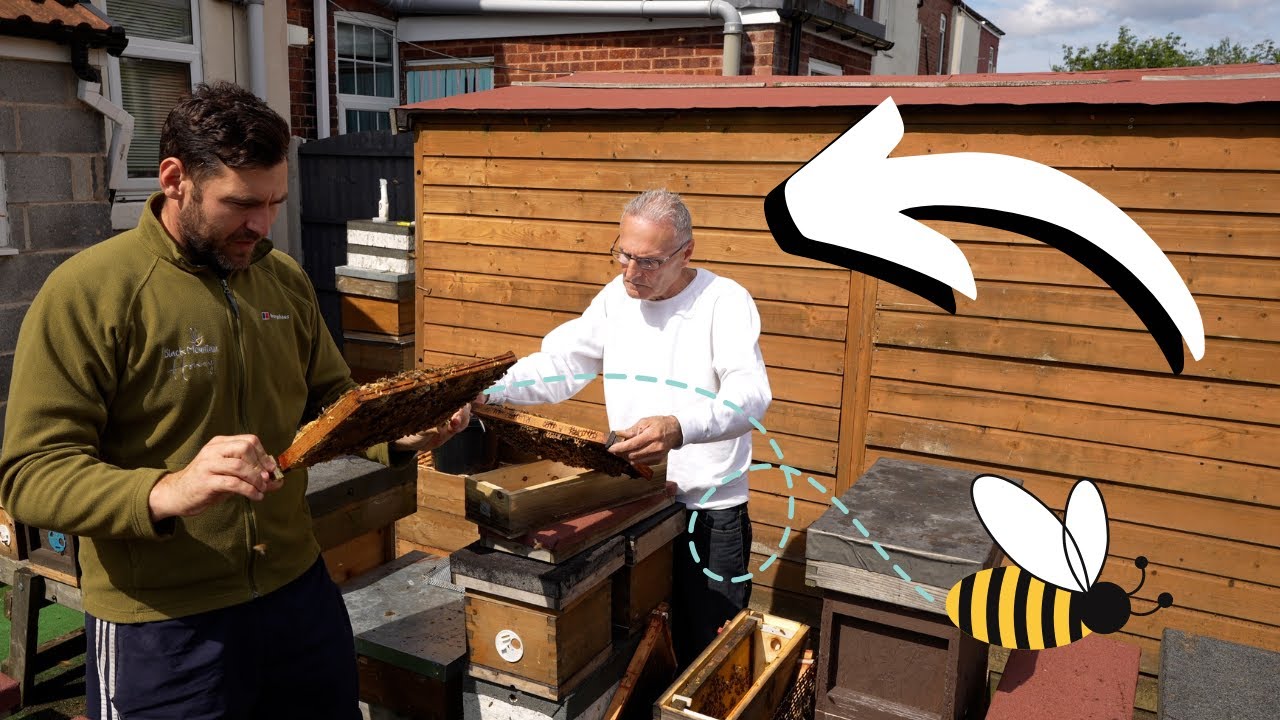
Beekeeper Carl Lockyer and Laurence Edwards capture virgin queen honeybees in Carl's garden apiary, demonstrating techniques like the wing-grab and thorax methods. They discuss the 7-10 day window after grafting when queens are ready for artificial insemination, and explain why drones must empty their guts before collection.
Chapters
I'm in Carl Lockyer's garden apiary, and in today's video, we're gonna collect some virgins that are gonna be artificially inseminated later on in the afternoon. So as I said before, calmest bees in the world in this apiary. Absolutely love it. You can see the rows of bees here all out working, and Carl's busy over there trying to find these virgins. So what we doing, Carl?
We're trying to find a virgin queen in here, and I'll cage her for later on.
And do you mark your queens before insemination or after insemination?
After.
Okay, so we're looking for an unmarked virgin, yeah?
Yeah, she could be very small, but I don't see her.
And how long after kind of the grafts, and how long after emergence, do you get them ready for insemination? Are they ready straight away, or is it—
No, I usually leave them 7 to 10 days.
Okay, 7 to 10 days. And is there like an optimum day that you tend to go for? Is it like day 7, day 8?
In the UK, it's weather permitting. Okay.
Oh really? So you like to inseminate When the weather's good?
Yeah, because otherwise it can be a bit messy, you know, collecting the drones. They'll shit and piss all over you.
Okay, so you want the drones to have gone out, been to the toilet, and then come back before you tap them?
Yeah, and if you get them in the hive, you're looking around for small drones because the small drones are the ones that are mature. The fat drones, they're not mature and they won't produce anything anyway. And I found the queen, she just She's sitting so still on the frame that you'd miss her. The queen is here.
Oh yeah, I see her there.
So I need to just get this queen to turn around so I can get her, creep up on her. She knows, she knows she's going to get caught.
So what's your method for picking up queens then, or virgins?
Just get them on the wing, get them by the wing, and just try and feed them in there like that.
It's interesting, isn't it? Everyone has their own different way of picking them up. I know a lot of people pick them up by the wing. I like to pick mine up by the thorax. I don't tend to pick up many queens, and I don't tend to move them that far.
Well, this one now is cage ready. So if we pop this one back together, we need to find something else.
So what will you do with that little mini colony now? Is that right for another cell, or do you kind of add some more brood or what?
No, no, no. We'll just let this emerging brood here.
Yeah.
We'll let this emerge, and that'll be a starter for this queen to get going.
Okay, so the same queen.
Lots of nurse, young nurse bees.
Okay, so once she's inseminated, she just goes back into the same pot.
Yeah.
Okay, good stuff.
So if I pop that back there and sit this in between, yeah, and then just pop that back on there.
Okay, and then she's ready for insemination later on in the day?
She's ready for insemination later on in the day.
And remind me, Carl, why do you do that? Why don't you just come straight in when they're ready to inseminate and find the queen?
Well, later on in the day, there's like a buzz goes around the apiary, round about the 1, half past 1, 2, half past 2, whatever time of day suits the drones. On a nice day, there'll be a huge buzz around in the apiary, these drones flying around, and it incites the queen to want to fly because she knows that she's a virgin queen and the conditions are right. We need to cage her this side of the 1 o'clock so she won't fly.
Okay.
And then we've got her in position that we can just get our hands on it, tuck her in there, inseminate her, and back in the hive again.
So there we go, simple as that. Doesn't Carl make things look so easy? Like the way he picks it up by the wing, straight into the cage. Really interesting about the timings of it as well, because I would have thought you just go out, take the queens directly out of the hive when they're ready for insemination. But as I'm beginning to learn more and more about artificial insemination, it's the structure and the planning and the process is quite regimental. And you can see that Carl really is an expert in doing this. So we're going to carry on now. We're going to fetch a couple more virgins. But if you are interested in learning about artificial insemination, definitely got to hit the subscribe button because we have got lots and lots of videos here today with Carl. I'm going to make the most of my time with Carl and get as many videos as possible. So I'm just still in love with these bees and how gentle and calm they are. We're going to play a little game of spot the virgin, I think, on this one and give you a chance to see it before Carl picks it out. Always tricky spotting virgins. I say to people all the time, if you need to requeen your colony, do it before the virgin emerges. Once she's out, and especially on big strong colonies, if you've got them on, say, double brood or 4 or 5 supers on there, oh, it is very, very difficult trying to find virgins. Obviously Carl is an expert. I like to think that I'm pretty good at it as well, but I do find on the odd occasion a big colony, they completely beat me, and it'll be 30 or 40 minutes and I just will not be able to find that virgin at all. Any luck, Carl?
No, I usually, usually spot them straight away, but I mean, sometimes they'll get out, sometimes they die, you know. It's much like ourselves, you know, you can look over a frame and miss it.
Are they just on one frame or two? This is great. I've done so many beekeeping videos of just me in my apiaries on my own, and it's pretty boring to be honest, but it's so much more fun being out with someone else and letting them do all the talking, and I can just pick up frames and have a little play. So let's see if I can find the virgin on this frame as well. You've not set us up to fail. There definitely is a virgin in here.
Yeah, well, I'm hoping there is, but here we go.
I have genuinely found her that quickly. That's not a setup.
There we go.
She is there. Let me give you a little close-up to that camera. Prove it was me that found that one. And I'm not going to show you where it is. It's definitely on that frame there. Nice dark virgin queen. Beautiful buckfast. Let's go and show it to Carl and see if I'm a little bit proud about it.
You've lost her.
I've lost her.
Yeah.
There we go. I did that the other day. We shook swarm in a colony.
Show him where it is.
We were shook swarm in a colony the other day, and my job was to. Find the queen, yeah, and then hold the frame with the queen. And then we shook some bees into the colony, and then I had to go and like put the queen in. I kept on doing it, kept on finding the queen, said, oh, here she is, and then I'd lose her, and it was really annoying. But there you go, there she is. I'm going to let you hold this one, Carl.
Right, just pop it on, on, on here.
Right, so we did find it. It is now in Carl's hand.
We're going to pop it here and, and let it run up into there.
Okay, right, let's see if we can film that then. Okay, so she's just going to—
there she goes, she's up there.
Oh, she's gone back down. Hold it and keep it in front of the camera there.
Right, right, she's up there now.
There we go, I like that, that's a great little technique. So you put her in your hand and then you're holding the cage and then she's just going to run up to the light.
Yeah, and I've got the, the top here just to pop it on so she can't get back out.
I really like that technique, so you're not kind of like placing the queen into the cage, you're giving her no other option other than to run into the cage herself.
Yeah, she'll run up to the light. This can go back together, so that's That's 2 we've got to inseminate.
Right, so that's 2 queens that we've caught now, and I'm learning so much while I'm here. Little tidbits of information from Carl the whole way. Love that little catch the queen in your hand and then let her run up into the cage. Can't do that on the cages that I use, but on those cages there, that works really well. We're going to go ahead now, we're going to find the final queen that we're going to use to inseminate later on today.
These are running around in here because I've shut it down that much that they can't, they can't get out. I've shut it down because of the wasps. Look, wasps are everywhere. This one I've had shut down and the bees were a little bit runny because they're wanting to get out, so I've opened the door a little bit for them to get out.
And why have you shut it down?
For the wasps and the robbing, because it's a small colony. Well, I'm saying a small colony, there's quite a few bees in this.
But it is a real issue this time of year, and would you say worse this year? I'm finding really bad this year for wasps.
They're all over the place. Every year, every year we're bothered with them.
Yeah, you've got to be careful with wasps with big colonies, but definitely got to be careful with wasps with the smaller colonies as well. They can obliterate a 3-frame nuc like that in a matter of hours. Does not take them long at all to do that.
This will be a dark queen as well on here, whatever she is.
Great, innit? Don't have to do anything. Carl does all the work. I come in, find the virgins, take the glory. This is the decider, I think, Carl, as well. You found one, I found one.
Yeah.
Do I lose any points for losing one?
No.
Here's something interesting on this frame here. So the bald brood— what's your view on the bald brood and that one in particular there? Because I've got a kind of— I think I know what that is.
I don't know, it might be chalk brood, I don't know.
So I'm just going to get a close-up for the camera because I'm pretty certain I know what that is. Right, so on this colony here you can see we've got a little bit of bald brood there, and I don't think bald brood is anything ever to worry about. It's either a sign that the bees are quite hygienic And they're clearing— oh right, that's the first sting of the day. I got stung in the beard. Um, yeah, baldrood really isn't a massive thing to be worrying about. So it's either a sign that you've got a varroa-sensitive queen and they're clearing out the varroa, or in this instance here, far more likely there's a wax moth larva underneath because of the way that it's all connected together. You get a little line of them. As I said, nothing to worry about. You've probably just got a wax moth larva. moss, but an interesting find in this colony.
I found the queen, found the queen. There's a queen.
Yep, see ya. Right, so Carl's taken advantage of me just blabbing on talking about other stuff, and he has won the competition 2-1. Um, and again, virgin queens, look, it's a good thing to have a look at there. How small is that queen?
Yeah, she's as big as an ordinary bee.
She, she really is, isn't she? And that's a perfectly acceptable size for a virgin queen, and you can see how quick they are as well. Very, very difficult to find, equally difficult to catch because they're flighty like that. See if you can still see her. I think I've just about got her in the shot still, top of the frame. How long you been keeping bees, Carl?
Uh, about 11 years.
So Carl's been keeping bees and trying to find virgins for 11 years, and it does— it takes a little while to catch them. They are difficult to catch. I really, really struggle picking them up. So when I say to people, try and avoid having virgins in your colonies if you don't want them, That's the reason why.
Yeah.
So there we go, 3 virgins found, 3 virgins caught. We're all ready for artificial insemination later on in the day. Definitely hit the subscribe button, it's going to be the very next video.










