First Honey Harvest! Getting Zayne’s Bees Ready for Winter
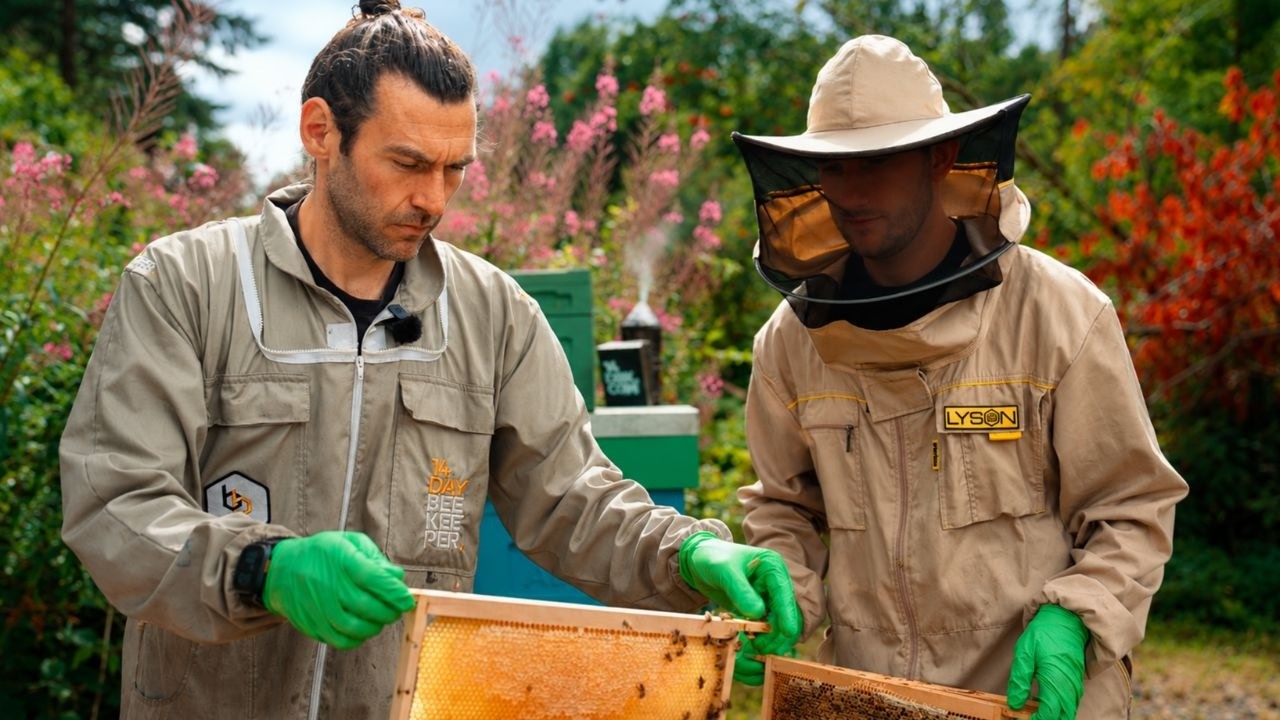
Zane harvests honey from his first nuc colony and prepares it for winter. The host treats varroa mites with Apivar strips, sets up frequent small feedings to avoid clogging the brood nest, and checks the queen and brood before sealing the hive for the season.
Chapters
Zane's First Nuc, episode 17. Time to take the honey off. So, Zane, are you sad?
It's over too soon, isn't it?
It's over too soon, and I think I'd be a little bit sad as well, mate.
Why? Because of the depressing amount of supers going on?
You've just been really unlucky with it, you have. Right, so before I open them up, to give you the context, yeah, see the Demeray colony we've just done?
Yeah.
That was the exact same size nuc as this. And it went in 3 weeks before this one.
You're joking.
No. So that's the difference.
Well, yeah, I remember filming that.
Yeah.
Okay.
It's 3 weeks the difference. So there's not like huge amounts. And that one just rode the nice early wave, got strong, got big, got an early flow. You look at that honey, it's been there the whole time, hasn't it?
Yeah.
Not got really tall really recently.
So it's just a timing thing.
Yeah, just the timing. That one took off and did well. This one needed to requeen and it sets it back.
Yeah.
Yeah, don't feel disheartened.
Well, I do.
But there'll be some honey in here. So what we're gonna do today is we're gonna take all the honey off, everything that's there. We're gonna extract it, we'll get it in the jars, we're gonna feed, we're gonna treat for winter, and we're gonna do all that in episode 17. Should we do it?
It's gonna be a long one. Let's go for it.
So talk me through what you're seeing, Zane.
Should we have a look?
Yeah.
That's heavy, it's a good sign.
Nice.
Yeah, do you know what, even if I left with that I'd be happy.
See how those frames have been like that for a few weeks now though? There's been a few good frames in there, hasn't there? And it's the same with the one over there, the big Demeray one. All the honey was there ages ago and what they've done is they've just stalled and stopped doing anything else. And then like frames like that, yeah, where there's nothing, yeah, in a strong flow they'd be filling them up in a day. You'd be coming back and they'd be capped over again. You just missed the flow and then got unlucky with requeening. And then look, you got the nice frames, so they finished all of those off. Those are uncapped, really nice.
That's a lot of weight as well in that. Okay, so what have we got? 1, 2, 3, 4, 5, 6, 7, 8 solid honey frames, I'd say, as long as this one's— no, okay, I'm lying. Call it 7.
So we get it extracted, or we get it harvested, we'll take it to the extraction room, we'll get it into jars, and you can take it home to Chrissie, yeah?
Yeah.
Right, so it's going to be quite easy to get all the bees out of here. We're just going to blow them out in a little bit. I'll put my veil up for that. But we need to set the bees up for winter. So 2 things, we need to get the Apivar strips in, treat them nice and early. What's the date today? 5th of August. So going in, I always recommend going in before middle of August with your treatment.
Yeah.
So the season, the season is done.
You picked that up awfully easy. At least pretend to struggle.
They were heavier over there, but that's a—
No, that's a good amount.
And it'll be tasty. It'll be nice honey. You'll like it.
Yeah.
I know you're not a fan.
Do you know what? Tasting my own honey is going to be a nice experience though, because I've always just had jars from you. This is going to be like technically my honey.
Zane's honey.
It's our honey.
Bit of porridge. What will you have it on?
Porridge. On porridge, definitely.
There we go. No queen there. What are you thinking temperament-wise?
They're chilled. I like it.
They are chilled, aren't they? So there's probably still— they're probably still getting like rosebay willowherb. There's like a little flow coming in. There's enough to keep the bees very happy. There's no wasps around either, but there's not enough to like prolong the season. So what we're looking for now, Zane, you can kind of say the honey's been taken off. And dealing with the colony differently now. We need to make sure that we do everything we possibly can to like try and get these bees through the winter. And the way you do that is by like focusing on their health, focusing on varroa, and then focusing on managing the space over the next few months.
Okay.
It's quite easy to do. It's quite easy to mess it up as well.
Right.
So that's what we're thinking about. That's what we're going to set up today. So the thing that I like to do before I set all that up is do like a last check. Make sure there's no disease, make sure the queen's in good condition, make sure the brood is there.
Yeah.
So let's have a look, but remember, like, this is probably the last time we're going to go into the brood nest this year.
Ah, okay.
So, like, we don't want to kill the queen.
Yeah.
So I'm going to be super careful. Imagine you go and you do your last inspection of the year and you're all happy and you put everything on and you say, right, I'll see you in the spring, and you kill her on the way down. Just like, not good. Do you remember that frame from the last time you were here?
I think I do.
Have a look on it, yeah. I'm pretty sure they found something there, Zane. Like, there's a bit of nectar on that side and it's capped on the other one. I'm pretty sure that was bone dry last time we came here.
Yeah, it was.
Yeah, which is a good sign. It's a good sign that, so there is a little bit of something coming in. The bees have got quite a lot of space in the brood nest still though.
Okay, that's a good sign, yeah.
If you take a look down in the brood box there, every single frame filled, yeah, like 2 rows of bees. We've never had them looking so good, I would say, in the brood nest.
In all fairness, it's the best they've looked, isn't it?
But let's find the queen. Let's have a look at the brood and see what we can see. So that's a nice heavy frame of nectar, definitely something coming in. So really nice frame of brood in all stages, both sides. Beautiful frame of brood. If you look around the edges though, Zane, like at the bottom there's a little bit of stores, but at the top there's not much, and that's always a concern at this time of the year. So we are going to set them up with a feeder and give them a little bit of feed now. But now that the super's off, you can treat. Now the super's off, you can feed, and they'll, they'll come on really strong. So same on that frame. Loads of brood, really nice looking brood. Same again, lots of open brood there. You can see like a lot of open brood at this time of the year. They're prepping, they're getting ready for winter. Like, these will be probably not the winter bees, probably the next round will be the winter bees, but it's getting close. The longer you delay the varroa treatment now, the bigger risk. That frame has collapsed a little bit there, but it's fine. So you can see I'm back to stores again now. I've not seen the queen.
It's fine, it's fine, she'll be there.
She'll be there. There we go, mate, your queen. My handy paint job there, a little bit on her wing, but she's happy enough, isn't she?
Yeah, nice and gentle.
Very gentle, yeah. So she's back in. I'm not going to do any more frames because I don't need to. I'm going to shake those off.
So you're just giving yourself the space without risking—
Just want to—
Trapping her.
Get the queen all the way over there, so when I'm putting this in, like, A, I'm not squishing any bees, but B, if I am squishing them, it's not a queen.
Mm-hmm.
Right, so I'm happy with that. So the honey is off. We need to get our Apivar strips in. I recommend before the middle of August, so we're doing it about 10 days early, which is very good for these bees. You've got a brood box pretty much full, Zane, and you need 1 strip per 5 frames. So it's kind of 2 strips. We want to get these strips in as close to where the brood is as possible. Now, I don't want to go over this area here because that's where I know my queen is. So I'm going to put 1 in here. And you can kind of just let them like float down. See what I mean? You don't— they will just go down by themselves. You don't really want to push them too much. And then if there is anything there, like, it shouldn't squish it. You see some people, they'll get a toothpick and hold it there, which is a good position, but you need to put a toothpick in. I've been trialling a slightly new way this year, which is get that bee off and then you push down. This is Apivar. It's like a contact miticide. So you want more of the strip down like that. The only problem with that is it does, it pushes some of the frames apart if they're not fully propolised in. And then you put another one kind of over here so you can see like how easily they fall in. I would say just be careful doing that. Like if you're doing it at home, I'm just, I'm experimenting a little bit with this. That's probably the safest way to leave it, I would say. So that's it. That's the colony treated for varroa. How easy was that?
It's pretty simple, innit?
What you have to do is you have to come back in now in 8 weeks and you have to take these strips out.
Right.
Otherwise the The mites get used to it, and then it doesn't have the desired effect when you put it back in again.
Okay.
So we're back in 8 weeks. So then the super's not coming back on, we're going to put the feeder on. And I've said I'd like to give them a little bit of feed today. So what would you be thinking now, Zane? Go on, talk me through. If you were a beekeeper, like a new beekeeper, and you were doing this all by yourself, and you were following my advice, and it said take the honey off and feed.
Yeah.
What would you be thinking?
No idea.
No idea. Go on, if you had to guess, if you had no one to ask, how much feed would you give them? You've seen, Containers like that. Yeah, that's about that's fourteen litres. That one, I think. I would say no, no, ten litres. Fourteen kilograms. One point four.
Fill the feeder.
Fill the feeder. No. Okay, good. Just fill the feeder.
Brim it. Brim it. And then maybe come back in a few months and just have a few months or next month.
So that's not set up. I've not told you to say that, have I? That is genuinely you saying that.
Hundred percent.
So we that's that was last week's newsletter, which is stop. Don't feed your bees so much syrup yet.
Okay.
A lot of people take off all the honey and then think that they need to put all that honey back in for the bees. And you're kind of right, you don't want to take all the honey and then not feed the bees, but putting it all back in, you can clog the brood nest out and then the colony might not have any space to lay.
Ah, yeah.
You've got lots of brood in there, so it wouldn't be too much of an issue for you, but really what you want to do is just feed little and often.
Got you.
So we're going to give them maybe like a litre or 2 this week. And see what happens. And then come back and do a little bit more. And you're doing this for like 6 to 8 weeks. You're coming back, you're kind of hefting and feeling the weight of it. But the risk that you introduce by doing that is swarming. So you could just take the queen excluder off here and go and store it, but I like to put it back on here and then there's no disease transfer. And it's fine for the feeder just to go directly on the queen excluder. Let's puff the bees down. Go on, Sam.
That's it.
So just cleaning up the feeder, there's a couple of like live bees in here that we can just get them to fly off, hopefully. But any dead bees in there, you just want to clear out most of it, stop any mould forming. And then, so you can feed more in this configuration. If you're just feeding into a single brood box, I'd be recommending like 1 or 2 litres of syrup. Now you've got a whole brood box to fill out there, so you can't really overfeed too much. I'm going to give them like 3 or 4 litres, I think, something like that. And then I'm just going to drizzle a little bit over the bars, just shows them where it is, and it'll get all the bees coming up and feeding. Right, I'm going to get the lid on quick because I don't want to invite all the bees in robbing. Right, so that's the colony treated, double brooded, fed.
Yep.
We just shake the bees out from over here.
Okay.
So keep your veil up.
Yeah.
So see frames like that, don't you?
Yeah.
If all the box was like that, you couldn't extract that frame. But the majority of frames are capped over, so you can kind of like chuck one of those in. I would say 1 to 5 ratio of really poor frames like that that aren't shaking any nectar out, but have clearly got honey in, but it's not been capped. So it's gonna be high moisture content honey. As long as you've got 5 frames that kind of look like this, then once you mix it all up in the extractor, the moisture content is going to be absolutely acceptable. So I'm just going to go and grab a box and we can just get a few of these, put them in.
Can I have a little look?
Yeah, yeah.
So that's it, that's—
That was my hand.
That is pretty cool, that. It's cool, innit? That is very cool.
You see on this one here how there's like a combination of the 2, so there's some open and some capped. They're fine as well, so anything like that will go in the mix, that's fine. I'll go and get you a box and we'll package yours up, yeah?
Yeah. Check that out. It's pretty cool actually seeing it in person because before it's just like frames with bees on, but that's— we know that's frames of honey and we're going to extract it. Yeah, I can grab another one off here.
Okay. Human frame rest.
Yeah.
Let's put those in.
Yeah.
Good. So that's the end of episode 17. The honey is harvested. Zane, let's go and extract it.
Yeah.










