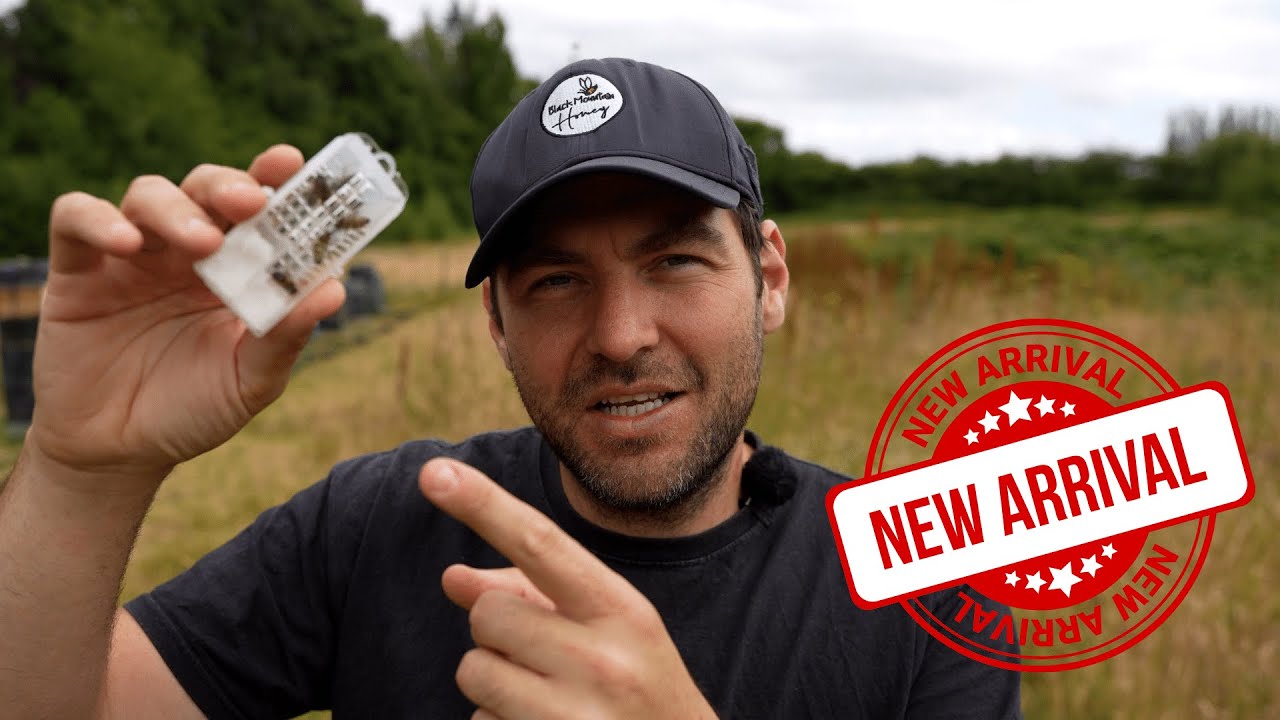
In this YouTube vlog, beekeeping enthusiast Laurence Edwards presents his first experience with an AMM (Africanized‑Mediterranean) queen sourced from Jonathan Getty in Northern Ireland. He explains his pragmatic philosophy of testing different queen lines rather than relying on opinions, noting the uncertainty around "black British native" queens and aiming to obtain the purest AMM queen available in the UK. Edwards outlines a detailed plan to evaluate the queen’s performance—looking at colony size, strength, overwintering success, disease resistance, honey production, and how it compares to the popular Buckfast line. He demonstrates a simple double‑brood split in the same apiary, describing how he moves the majority of brood to a new location while retaining honey stores for the original hive. The video walks through his standard queen‑introduction protocol: placing the 8 mm caged queen on top of the frames, using a poly feeder or eke for spacing, waiting eight days, then removing queen cells and allowing the queen to emerge. He discusses practical adjustments when the cage does not fit between frames and anticipates a few weeks before the queen begins laying. Edwards promises future updates to track the colony’s development over weeks, months, and years, providing a real‑world comparison of AMM versus Buckfast genetics.
Chapters
What we have in this cage here is an AMM queen from Jonathan Getty in Northern Ireland. I've just put that queen down now so I'm not shaking it around while I'm doing the video. If you've seen my videos before, you'll know that I'm always open to trying something new. I don't have a real strong opinion on this type of queen is better than that type of queen. I know what works for me, and I know what works for me because I've tried lots of different things. And I say this to everyone if they say, well, what do you think works best? I'll give people an answer, but I will say, you know what, just try it out for yourself. Try a few different things and see what works for you. So on that basis, I've got myself an AMM queen from Jonathan Getty in Northern Ireland because I don't have any AMM queens. And a lot of people ask me, do you have any black British native queens? And I kind of say to them, I'm not really sure there is such a thing as a black British native queen. There's probably queens with like a high percentage of AMM genetics, And even then, it's kind of verging into the point where I'm not 100% sure what I'm talking about. So I thought I'd try it, and I thought I would get as close to a pure AMM queen as I can get. And even then, I'm not 100% sure if it is 100% pure AMM queen, so I'll have to get that information from Jonathan. But what I do know, it is as close as you can possibly get within the UK to an AMM queen. She is big, she is black, she is beautiful, and I'm going to install her in a colony today, and then I'm going to give you regular updates to show you how she's getting on, How are the colonies performing? Are they big? Are they strong? Are they the right size? How well do they overwinter? Do they resist disease? Do they give you a good honey crop? Do they work better than Buckfast in certain situations? Are they more resilient than the Buckfast? Loads of questions that I want to answer, loads of comparisons that I want to do. I reckon what we're going to find out with this colony is that some things the AMM is better for and some things the Buckfast is better Completely dependent on your own situation and what you want to get out of your beekeeping. But I won't just guess, I'll film it, I'll analyze it, and I'll put it up on my YouTube channel. So I'll get my bee suit on, we're going to go and make a split on a colony. I'm going to introduce the queen using my standard method, come back after 8 days, knock down the queen cells, release the queen, and then hopefully we'll get them overwintered well. And then in 2023, we will have a fresh start on a really nice AMM colony. Right, so this is the colony that I'm going to split. Going to do a really, really simple split. I've got 2 brood boxes down there. Just going to split the brood boxes, leave the majority of the honey on this site here, and then I'm going to take the majority of the brood to the other site. The brood is what's going to keep all of the bees, or the majority of the bees, in the new location because I'm doing it in the same apiary. Obviously, the original queen in this colony here will stay on the original stand. And I'm just going to move the bees over there. I'll stick out a link at the end of the video showing you how to make a split in the same apiary if you've not done it before, but I'll fast forward and just show you exactly how to do this one here. So first thing you need, a floor, one of my underfloor entrances. I'm going to go and place that on a new site over there, and then I'll start moving things over. Right, so whoever told you that queens don't go on frames of capped honey, clearly a myth, because it took me ages to find this one, but she is on a frame of completely capped honey. See if you can spot her. If you've not spotted her, she is at the top of the frame. But I can go and put this queen off now to one side, and then I can harvest as much brood as I want, a little bit of stores to go and make my new split. Right, so we've made our split, really simple double brood split, and I've taken the majority of the frames that have got brood on. So open brood, closed brood, anything that's got a honey frame I've left behind. Because I want to retain as many of the nurse bees as possible. You will get drift, you will get bees that go back to the old site, but you'll still retain a really good amount of bees here because you've taken a lot of brood. This is what it starts off looking like, probably going to shrink down to maybe 6 or 7 frames, but it doesn't matter. This works well for an introduction, and all of those flying bees will return back to the original hive, leaving me with very gentle Easy to introduce to nurse bees. So all that's left to do is to take my 8mm queen, introduce her into this colony. I'll then wait 8 days, come down, knock down the queen cells, another 24 hours, open the tab, leave it for a week, and then hopefully come back and you see her laying eggs. Can take kind of like 2 to 3 weeks after you've had a caged queen like this for them to come back into lay. I'm confident though, give it a couple of weeks, we'll see this one laying. And then I'll do future updates further down the line. So the cage is quite a thick cage. If you're watching this, Jonathan, I'm not 100% sure how you put it in between the frames. Definitely doesn't fit in between my 2 frames here. So I'm going to tweak things around a little bit. I'm just going to leave it, lay it on top of the colony, on top of the frames, and then I'll either put an eke or an upturned poly feeder on it just so I've got the space around it. And hopefully, because it's mainly nurse bees, they shouldn't draw too much brace comb. And anything they do, I'll just chisel it off. And then once we get into queen introduction, we should be fine. So there we go, I've introduced the queen into that colony. Now, be very surprising if you didn't get a reaction. Probably not always going to be the best reaction as well, cuz at the moment you've still got all the flying bees there, but they're coming over, they're checking out what's going on. I'm going to close them up, give them the 8 days for them to become hopelessly queenless once I've taken down those cells, and then that queen will come out and she will be the new leader of So all I'm gonna do, just 'cause I can't get that cage in between the frames, take a polyash forth feeder, turn it around the wrong way, I'll brush the bees off and I'll place this on top. And for the first 7 days, I'm gonna leave them like that. We'll get a little bit of brace comb, they'll build some wild comb up in this feeder, but hopefully as the bees bleed back over to that original stand, shouldn't be too many bees in here and I won't get too much wild comb. So there we go, all finished. AMM queen introduced. We will see over the next weeks, months, and years just how well they get on.