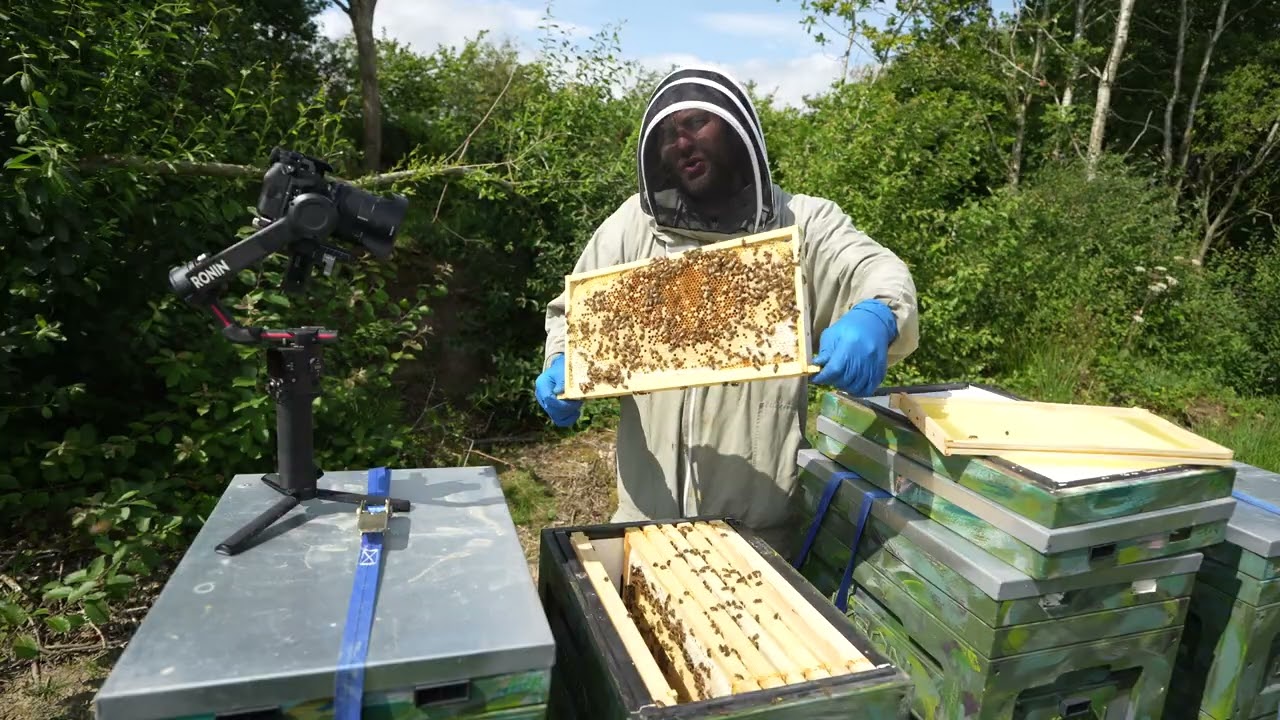
In this video Laurence Edwards inspects a colony he re‑queened eight weeks earlier with a Caucasian queen sourced from Melitta Bees. He begins by describing the hallmark traits of Caucasian queens – very dark coloration, gentle temperament, smaller size compared to Buckfast hybrids, and a strong propensity for propolis production. He walks through the hive, showing the progression from a 5‑6 frame nuc to a nearly double‑brood box, highlighting a dense, healthy brood pattern and calm bees. Throughout the inspection he contrasts the Caucasian workers with the original Buckfast workers, noting differences in size, color (darker, grayer versus orange‑tinged Buckfast), and wax‑working behavior. He presents the marked 2024 green‑dot Caucasian queen, comments on her acceptance after a previous loss, and explains the seasonal availability of Caucasian queens (mid‑May to mid‑July). Finally, he outlines his management plan: winter treatments, feeding, and the goal of building a strong colony for 2025, while emphasizing the value of propolis‑rich, dark‑bee colonies for beekeepers who desire calm, productive hives.
Chapters
Today we're going to take a look inside a colony that I requeened with a Caucasian queen about 8 weeks ago. So our Caucasian queens available from Melitta Bees are very, very dark, super calm, super gentle, slightly smaller clusters than the Buckfast hybrids that we have, and their specialty is lots and lots of propolis. We might not see the propolis this side of Christmas because they're still in the requeening process, but definitely next year if you're interested in getting colonies with tons of propolis, if you're looking to trap propolis, or you just like the fact that your colonies have lots of propolis inside, Caucasian bees are definitely for you. We have sold a huge amount of Caucasian bees this year. Let's get inside here and see how the queen is getting on. So when we started off with this colony, it was about a 5 or 6 frame nuc, and as you can see, they've moved up into the top brood box now. They've not filled out the top brood box, they've not filled out the bottom brood box, but there's been really good expansion within. Let's get out a couple of these side frames of foundation. And then I'll give you a close-up of that queen and show you some of the brood and show you some of the differences in color of the bees as well. So lovely frame of eggs there. Love to see brand new frames drawn out like that. And you can see here, really nice calm bees. They're not jumping up, they're not swarming. This is nearly a double brood box full to the brim. Really nice brood pattern. And if you think that's a nice brood pattern, wait until you see the next frame. Just had a little peek down there. That is what we're talking about. Beautiful brood pattern. Super, super calm bees. Right, let's see if we can find that queen. Another lovely frame of brood there. And what is already noticeable in here is, is the difference between the Buckfast bees that were originally made up in the split and the Caucasian bees. One really noticeable thing that I'm seeing there is the difference in size. The Caucasian bees considerably smaller, so the bees might need to do some reworking of the wax. They're darker, they're fluffier, they're a little bit grayer as well, but you still get good brood. Look at that, that is a lovely frame of brood there. Nice stores around the edge as well. But this is the kind of colony that you can have if you're looking to keep darker Caucasian bees. Some people like dark bees. I like dark bees as well. I just like nice friendly bees. I like bees that do the job that they're supposed to do. I like healthy bees. I don't get too caught up on the color. What I do like though is choice, the ability to have kind of what you want as opposed to what you're given. So we've got one frame of foundation there at the end, just going to turn that one round. I'm going to do a tiny bit of checkerboarding on this frame here, just going to put that one in. Effectively one frame of checkerboarding. But let's get downstairs and see what they're doing down there. We've got some action downstairs as well, which is very nice to see. Now we've got a few frames that, that need a bit of work in here still, but the bees are expanding nicely, which is very good to see. And again, nice frame there. It is interesting when you give them the double brood configuration how they generally tend to start the expansion at the top. I guess they feel it's safer up there, and I guess they feel it's a bit warmer up there for them to be able to maintain more brood. And then as we go through the year, they start to go downstairs. So that is the middle frame in the bottom brood box, and that is full to the brim with eggs. And I'll just see if I can give you a bit of a close-up on that frame there. If you can see the difference in color between the Buckfast bees and the Caucasian bees, you'll see ones that are darker and ones that are more orange. Now the more orange are the Buckfast and the darker ones are the Caucasian. And as you can see, getting on like a house on fire. Adding queens into Buckfast colonies is generally very, very easy. Sometimes the other way around is a little bit more tricky. So there is my queen, Caucasian queen. Is she nice? Really nice, super dark. I'll get you a close-up of her now so you can see. Really nice extended abdomen, green dot for 2024. So beautiful dark color there for that Caucasian queen, and you can see her offspring are very, very dark indeed. Really nice extended abdomen, good bit of paintwork on this one. Thanks Melita Bees for doing a good job painting this one. And if anybody watched my last live inspection video, the the one where I lost the queen and she was on the band. This is the queen. I popped her back in here and look at her now. She has taken back over and I think the bees really did miss her for a little bit there. So she's very keen to go back down. I'll just do a final couple of seconds of pictures of her. She is a wonderful queen. Our Caucasian queens are not available all the way throughout the year, so they're not available early on and they're not available late on. If you want a Caucasian queen next year, you need to get it kind of like middle of the season, from the middle of May onwards through to maybe the middle of July, something like that. I've been really, really impressed with them so far, but I'll obviously keep this queen and do regular updates to let you know how she's getting on. So there we go, first update on my Caucasian queen. They look really, really good going into 2025. I'm going to get this one back in now, get my treatments on, get them fed up for winter, and let them build up nice and nice and strong to make a bang in 2025.