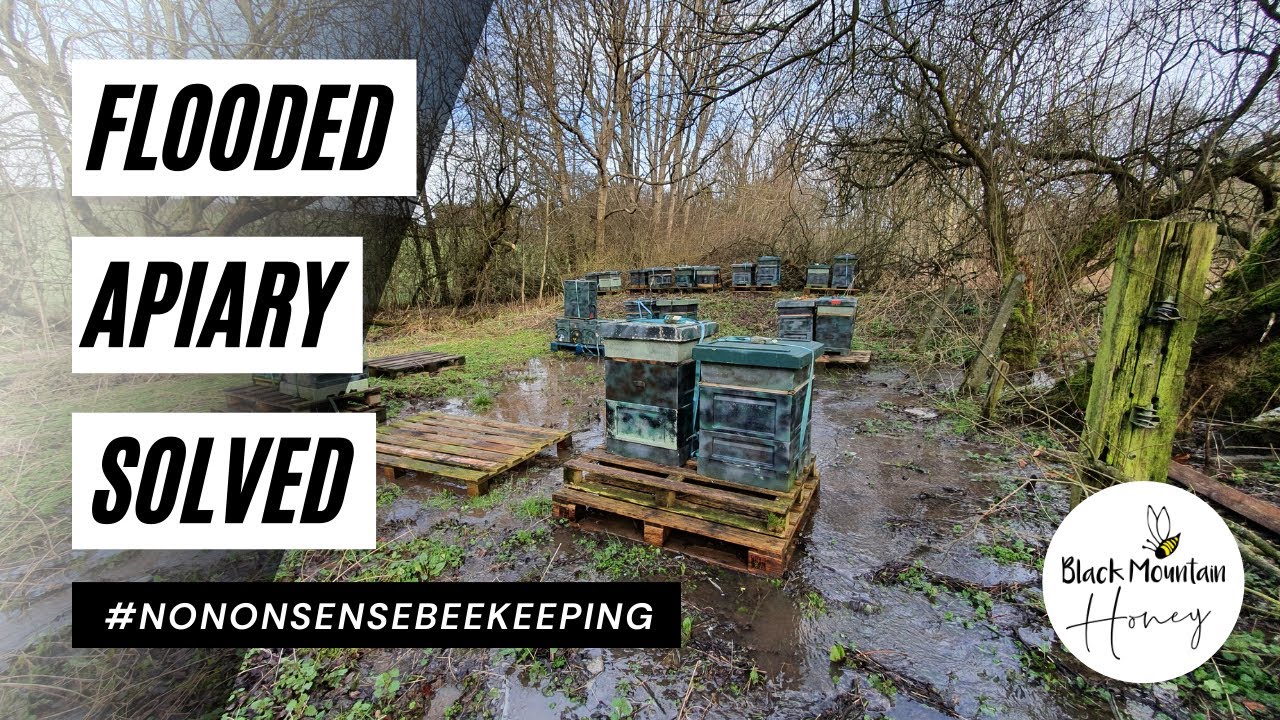
Laurence Edwards of Black Mountain Honey fixes flooding at Valley Apiary by clearing a blocked culvert and building small dams. Water drained within minutes. The bees are being fed pollen patties and fondant through the cold weather to keep brood developing.
Chapters
Hi, I'm Laurence Edwards from Black Mountain Honey and welcome to the Valley Apiary. Now we came and had a look at this apiary a couple of weeks ago and showed you the bad flooding that was taking place here. Obviously nowhere near as bad as kind of other areas in the country, and condolences goes out to anybody who's experiencing major flooding at this time. So appreciate this is very minor, but it is something that we have to take tackle and, um, kind of put in place some mitigation to try and stop it happening again, um, and just to kind of try and minimize the impact on the bees. So doing a bit of digging and looking around this apiary, um, I've been doing some physical digging as well, but doing some kind of metaphorical digging and thinking, how can I reduce the water flow? So I've gone and had a look upstream and I've solved it. There was a blocked culvert, so all I've done is I've gone and unblocked the culvert and just kind of put a bit of a dam around it to stop any overflow if it does get blocked up again. And within an hour it's already dried up a little bit, so I'm, I'm very, very happy about that. So I'll continue to double up all the pallets here just as a kind of, um, risk mitigation. And then the stream that runs down that side there, I might kind of dig, um, some, some banks and just kind of try and increase the kind of flood defenses a little bit. But I really do think unblocking that culvert— like, as soon as I unblocked it, it went whoosh and all the water kind of started going down there. And I've dammed it a couple of little extra places down the stream as well. So hopefully this should dry up now. Really hoping it does. So very, very quick video. I'll just show you where I kind of unblocked the culvert. Just something to look out for if you've got minor flooding issues like I do. Quite easily solved sometimes. So I'll give you a look and you can see what you think, and then I'll show you it again in 2 or 3 weeks, and hopefully it'll be a lot drier, a lot easier to work in. You can see behind me, this is where the stream was, and within 15 to 20 minutes of me closing up Damming it further upstream and opening the culvert. So I just kind of put a couple of dams in there and opened up the culvert. As you can see, it's dry, so I'm really confident that that apron, within a couple of weeks if it doesn't rain anymore, is going to be dry. But going forward, when we have those kind of extreme events, it's diverted back into the— funnels into that stream anyway. All I've done is I've kind of just opened up the culvert so it kind of remains in the stream that it should have been in anyway. So I'm happy with that. When I came here this morning, this was pretty much underwater. You can see the sediment running along, so I'm happy with that. So we'll pop up there and I'll just show you the culvert again. Sorry, it's really windy, so please excuse the audio. As you can see, I tried to do a little dam just here, try and stem the flow of water getting into the apiary, um, but it didn't really work very well. It stopped it a little bit, but the water was still kind of getting through it and getting down there. I did this before I realized the culvert was blocked, so just showing you kind of my first attempt to try to stem the flow. So this is where the water comes into the apiary. It flows off down the fields. Like I say, it's the valley apiary, so we're kind of in a big V-shape. It flows in from both sides, and as you can see, it's not been raining for probably 24 hours, but it's still properly coming off quickly off the fields. So it flows down there and then into the culvert, and you can see I've kind of just dammed around the culvert as well just to kind of stop any leakages. I'll give you a close-up on the culvert just so you can see that as well. So that's the culvert there. Um, I had no idea it was blocked. So all you can see, it was, it was absolutely kind of jam-packed full of leaves and bricks and all sorts. So, uh, I've just given it a good clean out. It cleaned out really, really quickly. And then I've just dammed it around the back to stop any kind of additional flow. But that's it, it's completely stopped it dead now. You can see my pickup truck kind of back there in the background. There's no chance the water's getting down there. It's going Through the culvert, underneath the road, and then back into the stream, which is where it's supposed to be. And then that tracks down into the river later on. So that's it. As you can see, very, very simple solution. It was just a blocked culvert. So I wish I'd, I wish I'd realized that 2 or 3 weeks ago, but hey-ho. So that's it for this video, very, very quick one. Please hit the subscribe button, please hit the bell so you get a notification of every video, and that's it. We're getting really, really close to the season now, although the weather's decided to take a terrible turn for the worse. So I've stuck pollen patties on, as you've seen in a previous video. We're just going to sit tight now, give the bees a chance to kind of expand using that pollen inside the hive. They literally don't need to get out of the hive at all now to access anything. They've got sugar and kind of carbohydrates in their fondant, and then they've got protein in order to kind of rear the brood that they need. So they can do everything within the hive now. We just pray that we don't get snow or really, really cold temperatures. And then we should hopefully start to see some expansion, start to see some brood. The queen will kickstart laying, um, we should be ready for some flows kind of around May time. So that's it, thanks for watching, and I'll see you next time.