Found Queen Cells? Do This Now! How To Stop Swarming And Make A Successful Artificial Swarm
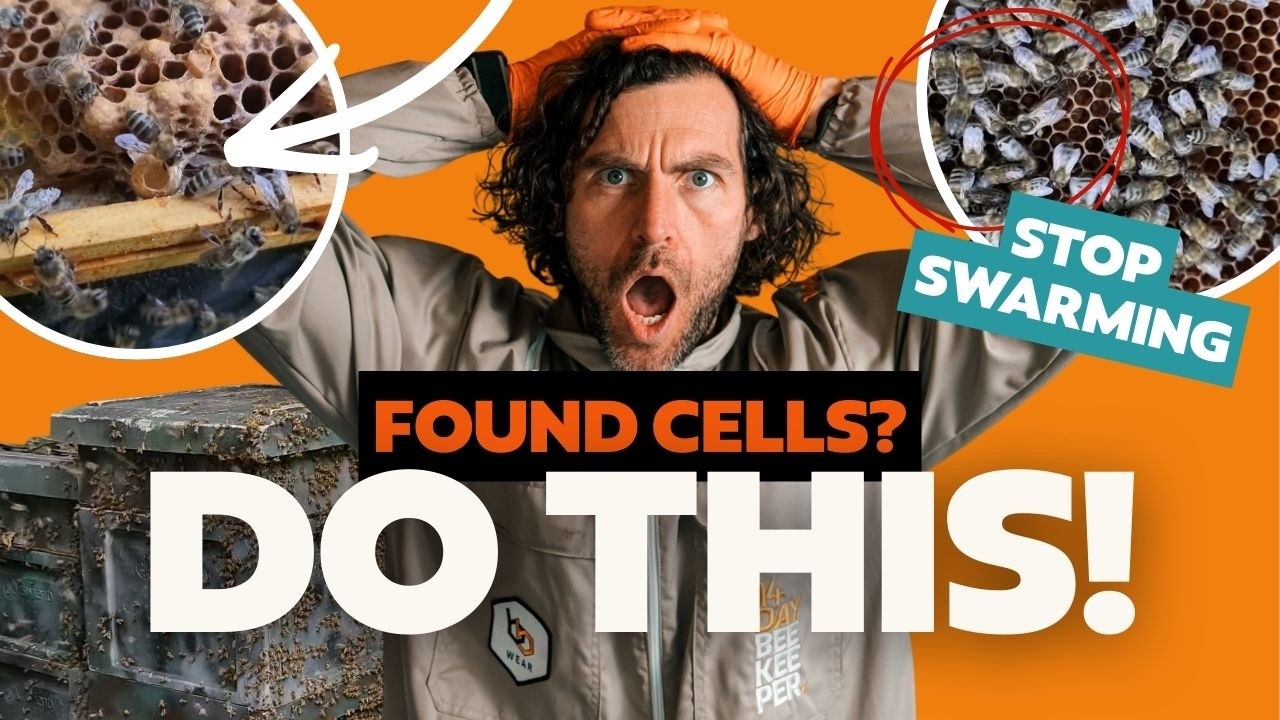
Laurence Edwards shows how to split a colony with swarm cells by moving the queen to a new box and leaving one open swarm cell in the queenless side. He checks both halves at 7-8 days, 4-5 days, and weeks later to confirm the virgin queen mates and lays eggs, ending with two healthy colonies.
Chapters
In this video, I'm going to show you how to do a simple artificial swarm on a monster colony of bees. Hi, I'm Laurence Edwards from Black Mountain Honey. Welcome to another episode of No Nonsense Beekeeping. Do not think that these bees are angry with me. I'm taking no stings whatsoever. I'm standing in their flight path, and I've just done a video showing how big and strong this colony is, 8 weeks after a Demarais split that I did to stop them swarming. If you saw that video, you would have seen that they'd started to draw queen cells again, and I'm in the position now where I'm going to do an artificial split with a colony like this. So all of these boxes here, they're just boxes full of honey. They are supers. You could ignore those. The box over here in the corner, that is a big brood box, brood in all stages. The queen's still there, and I've got swarm cells on a number of frames. You will find this almost certainly throughout the course of the season, and there's various different things that you can do in order to remedy it. Now, normally I would probably just go ahead and do another demarée here. That would be my preferred method, but it's a little bit late in the year for me to do that, and I'm a little bit low on the colonies here in this apiary. So what I'm going to do, because I've not done a video on it before as well, and I know with all of these kind of splits and different things that have names on them, I read up about them, I do them, and then I kind of develop my own way of doing it. So I don't even know anymore if what I do is the correct way. All I know is how to do an artificial split if you find swarm cells in your colony. Right, you have to excuse all of the bees because there is the equivalent of about 8 supers worth of bees there and a massive brood box worth of bees, and they just do not know what's going on at the moment. So this is normally their flight path going into there. I had it blocked up with all of those honey supers, so I've got those out the way. What I'm going to show you now though is how to do this artificial split, artificial swarm. Really simple indeed. Right, so the first thing you need to go and get, you need to go and get yourself a floor. This is just a floor that I've got lying around here, a little bit grubby, nothing wrong with it whatsoever. You're going to take that floor and put it next to the entrance of the existing hive. Put the entrances, butt them up right next to each other. You want it as close as you can possibly get it. Then you need to go through your colony, and if you've got a colony like mine It might be a little bit tricky, but you need to find the queen to do this method. Go through the colony and you need to find the queen, pop her in a cage or just keep her safe, know where she is. That's the first thing you need to do is go and find that queen. You then need to go and find a box that is the same size as that box there. So you need to make it the same size because you need to have the same frames. Obviously, if you haven't got that, just improvise. So I'm using a National Deep and a National Shallow because I haven't got any 14 by 12 boxes available. So now it should look something like this. You've got the brood box in the colony that's trying to swarm. Right next to it, entrance facing the same way, is another brood box, or whatever box you've got the same size as that box over there. Or if you're doing what I do, just improvise as best as you can, because what you're going to do is you're going to transfer some frames from the brood box there into this box over here. So then what you need to do is you need to go and find the frame that's got the queen on it. I know it's very easy for me to go and find that queen. I knew where she was from the previous video, so I just pinned her down. Part of this method though, you do need to find out where that queen is because you're moving her to the box next door. So find the frame that she's on, make sure she's definitely on it. You can see her there. But then what you need to do is make sure that the frame you're putting into it has no swarm cells on. If you take a frame over and it's got swarm cells on with the queen, they could, they could swarm for the second box as well. So you're trying to do an artificial swarm. You're trying to take the queen and a proportion of bees into that new box with no swarm cells. So if you find the frame with the queen on and you're a little bit stuck and thinking, ah, I've got swarm cells on there as well, way to do it is kind of just pop that whole frame in there like that. Go and find a frame that hasn't, definitely hasn't got any swarm cells on. If you want to shake it off, you can. Just double-check, no swarm cells on. Pop that on its side like that. Pick up the frame that's got the queen on. And then if you're not comfortable picking off the queen, you can just shake her on, or you just pick her up like this. I'll tell you what, I'll show you how to shake her on because that— if you're not comfortable picking up the queen, that's what you'll do. So there we go. Now I've got a frame. Doesn't matter whether it's got brood on it or not, but it's got the queen on it. Can definitely see the queen, she's right here, and it's got no swarm cells on. So then you want to take this frame, put it into the new box, and from there on in, this manipulation It's so, so easy. It really is such an easy manipulation. All you need to do now is even the colonies out. In this side of the split, the new side, you want the queen, about 50% of the brood, loads of bees. Put some honey on top as well, that's fine. You've made a new split. In this side of the split, take it down to one open swarm cell. People have different opinions on this. My advice, One open swarm cell is what you want. That's going to give you the best chance of getting a mated queen because you've got a visual, you can see the larva. That's what I always go for, one open queen cell. So the best way to do it is to find a frame with that open larva on, and I've got that down here. So there she is, that's my cell, my open cell. You can see inside we've got a nice larva in there, loads of royal jelly. And then over here we've got another one as well that's open on the other side. What we're going to do is we're going to identify the best one. This one here I think is the best one, and we're going to take down the other one, and then we're going to reserve that frame off to one side. So this frame here is a frame of brood in all stages with one open larva, one open swarm cell with a larva in it, and I'm just going to put that back into this colony, and I'm going to come back to that later. Now all of the rest of the frames, all you need to do Shake the bees into the new box here and then inspect the frames. So much easier to do it once you've shaken the bees off. What you're looking for is swarm cells, and you want to knock down all of the swarm cells. And the reason I say go back and check that one first is you don't want to knock down all the swarm cells and then realize you've knocked them all down, you've not got one to make a new queen. So go through all of the frames, knock down all of the swarm cells once you've reserved your one. And the way that I like to do it is I like to go with a 50/50 50/50 split in terms of brood. And like I say, people do this differently. Some people say you shouldn't put the brood with the swarm side. Some people say the queen should have all of the brood. This is just the way that I do it. I find this gives you a really well-balanced split, just the way I do it. So split the brood 50/50 in between the 2 hives. So this is what my colonies are looking like at the moment. I've got the original side over here that has got 50% of the brood, one open swarm cell, no queen. And then this side over here, 50% of the brood, no swarm cells, and the original queen. And then you can start putting everything back together again. So queen excluder on each side, and all I do is split the supers, if you've got supers on, 50/50. So half on that side, half on that side. And there we go, that is the manipulation complete. This colony is just bonkers how many bees are in it. Like every single box there is just full to the brim with bees. So don't go anywhere, that is not the end of the video. We've got a long, long way to go yet. What we're gonna do is we're gonna come back in 8 days and we're gonna check the original hive to see if they've drawn out any emergency cells. We're gonna also check that the single open cell that we left is fully capped over. And if we see any emergency cells, we're gonna take them all down 'cause we wanted to leave just one swarm cell, because otherwise it can throw off cast swarms after the prime swarm goes. This split here, this should pretty much take care of itself. All you need to do is come back and check that there are some bees in it and they've not just completely absconded and left the queen. But it tends to be the original one where you've taken the queen away that you might get some issues with. But in this video, I will give you step-by-step instructions and updates on both of these hives here, both parts of the artificial split. And I'll give you updates all the way through the year. So I'll fast forward 8 days, I'll come back and I'll check the status of both of these splits.
Right, 7 days later, we are back here again, and now instead of having one monster hive, we've got 2 monster hives. And I'm going to get straight in and show you how both of the colonies are doing. I'll remove the supers, I'll pop them off to each side, and I'll give you a status of the queen-right half of the colony and the queenless half of the colony. So let's get in, see how they do. So before I go any further, what we're looking for here is an even distribution of bees. Doesn't matter if it's 70/30 or 60/40 or 50/50. What you don't want is all of them to have gone back to one half. You want a relative split. You want to be able to build up one half of the colony, the colony that's queenless. So we can see already from here I've got lots of bees on the top, so I know that I've got a good amount of bees in this Half of the colony. So in the brood nest on the right-hand side colony, we've got lots and lots of bees, so we're really happy with that. Good to see there's lots of bees. Let's go and see if we can find any cells or see that queen. So we have successfully avoided them swarming. This is the queen-right side. As you can see, I've still got my queen. Laying eggs all over. You can see eggs all over the frame. Nice little close-up of them there. What you need to do though is just continue to go through this colony just to double-check that they're not trying to swarm again, that there's no swarms. So there we go, I've been through every single frame in the queen right side. We've seen the queen, we've seen eggs, there's no swarm cells. This colony here You just treat it now as a normal colony of bees. Weekly inspections, and that's about it. You're just looking for disease and swarm cells. We've averted the swarm, we've made a split. Now our attention is going to focus to the side of the colony that doesn't have a queen. And as I said before, that side of the split is always the easy side of the split. It's that other side of the split that potentially does cause you issues. And this colony is just massive. There are so many bees in this colony, so excuse them flying up around my face. Again, I'm not being battered, but they're not the friendliest of bees, these ones. Um, and the weather has really turned here. It's kind of about 16, 17 degrees and a little bit grim as well, so excuse the bees. Right, so let's get into the queenless half, and what we're looking for here is we want to see a single swarm cell. Hopefully it's capped over now, just Just be really careful on that frame. You need to protect that one. And then we're going to go through, see if there's any emergency cells, and we're going to knock down the emergency cells. So as I said before, we've got a little bit of an uneven split, but I'd say it's about 70/30. The 2 boxes where I've got all of the honey, they are full of bees, so they don't need too many bees downstairs because there's no new brood. And that's why you get this split where it doesn't look But there's plenty of bees using the entrance, no problem at all. So we'll get inside, see what the place is like. So the first thing you want to do is go and identify where your original swarm cell was. And I know that looks a bit big, but there's no problem with that. It's because it's in a gap and they've capped it over nicely for me. But then they've created emergency cells. I've got one there, a little play cup down there, and then up here I've got emergency cells as well. So I need to go through the colony, being really careful not to damage this original larva here, this original swarm cell, taking down all of the emergency cells to ensure the queen comes out.
So I'm just going to go through.
If they're on the frame that's got the swarm cell on, don't shake it. You need to make sure you protect that larva that's in the cell. Just use your hive tool, take up all of the emergency cells, put that frame off to one side so it's nice and And then you can shake off all of the other frames to make sure you get all of the emergence. So I've been through every single frame over here, a couple of emergency cells, I've taken them all down. And to summarize what we've got now, full colony of bees over here in this hive, one queen, no emergency swarm cells, the colony is good to go. And then on this colony here, it's a little bit weaker, we've got one capped swarm cell, Taken down all of the emergency cells. I've got no queen in here as well. They're now hopelessly queenless apart from that one cell. So if that one cell doesn't work, then the colony is pretty much doomed. If that happens, we'll cover it in this video, but hopefully we'll get good emergence on that cell and then we can get that queen mated as well. So the reason I like to split the brood evenly is that I don't want to completely knock both colonies back by giving all of the brood on this side Or giving all of the brood on that side. I like to keep them relatively even, and I find that the one that's still got the queen in will still continue to perform. The brood will emerge, the queen will lay new brood, and the colony just motors on. If you take away all of the brood, you do reduce the chances that the colony is going to swarm, but it knocks it back a little bit more. So I like to do it 50/50. I know a lot of people don't really like that, but it does work for me, so that's just what I do. So The next part of this video is going to be a little while away because once you get the colonies into this position, all you really need to do is 7-day checks on this colony here. You don't want to start interrupting this colony just for the sake of it. You've got a queen cell in there, there's no need to take it out. So what I'm going to do is I'm going to come back in around 3 or 4 weeks' time. Hopefully by then the queen will have emerged, she will have matured, she will have gone out and mated if the weather's good. And then we'll come back, hopefully see some eggs. So as always with these videos, stay tuned to the very end. Hopefully we're going to get the colonies to the point where this one is prepped, loads of honey going into winter, and this one has started to build up really nice and strong as well, and they're expanding that brood nest with amazing brood. So I'll fast forward a couple of weeks, come back, see how the colonies are getting on.
Right, we're on to the next part of the video. It's been about 4 or 5 days since I did the last part of this video. And I'll just get this out there: if these are your bees, do not do this stage of the video. The only reason I'm doing this is just to show you the different stages that go along. This colony here, no action required, weekly inspections, business as normal. This one here, I just want to show you that the cell has emerged. If you can see the virgin as well, I'll show you the virgin queen. There's no way she can be mated yet though, so not going to be checking for eggs. Not going to be checking for brood, but I just want to show you that the cell has emerged, hopefully show you there's a virgin queen in there, and then we genuinely will shut them up for 3 or 4 weeks and then come back and hopefully show you a mated queen, some eggs, and some brood. So I'll get inside this colony now, see if we can find a virgin queen. So there you can see, when the bees finally get out of the way, you can see that the virgin has emerged from that cell. So If you're seeing a cell like that, that means the virgin has emerged. That is exactly what we want to see. I'm not going to go crazy trying to find the virgin because all I really wanted to show you is that that cell was viable and that she's emerged. Don't really need any further action. I'll have a quick glance over a couple of the frames, see if we can see her. If not, we'll close them back up. So no sign of any virgin queen, and I really did just take a quick glance on a couple of frames. Searching for virgins is not something you need to do and is something I definitely don't recommend. I'm doing it for the purpose of the video here. I wanted to show you that the virgin had emerged from that cell, and ideally I wanted to show you the virgin as well. But the fact that I can see that the virgin has emerged from that cell, she's going to be in there somewhere, or she's going to be out mating. Everything is fine. We're going to fast forward 3 weeks now, and I'll show you the state of both of these colonies. Queen right colony here, and hopefully another queen right colony over here once that virgin's been out to mate. Right, things are getting a little bit desperate with this split, and this is the problem with walkaway splits, artificial swarms, is that one side, no problem at all because you've got a mated queen in there. The other side, you're running the risk of the virgins not mating. We saw the virgin queen last time. There were no eggs and there was no worker brood. I really hope that we're going to find some eggs and some worker brood in here today. 'Cause otherwise I'm going to have to find that virgin, I'm going to have to kill her, and I'm going to have to add a mated queen, and I've lost basically 6 weeks of colony expansion. Important thing there though is to realize when to cut your losses. Don't push it into September thinking it's going to get mated, it's going to get mated, because when you get to September, you're just not going to have a colony left. It's going to have dwindled away to nothing. Be proactive, cut your losses when you can, kill the virgin if you need to kill the virgin, I really hope we're gonna go in there today and she's gonna be mated. So let's get inside, take a look. Right, there's my queen. I'll try and flash up the image of her last time 'cause she was nowhere near that long. That is a really nice looking queen. Little bit skittish still, but newly mated queens still will be a bit skittish, but she's so much longer. So long abdomen, also with the presence of eggs. I reckon she's going to be mated, but obviously until we see capped worker brood, we can't be perfectly sure. Want to assess that brood pattern, see what's going on. What I am going to do at this point though is I'm going to get her marked and then she'll be a lot easier to find. And then on the next frame along, really, really pleased to see this capped worker brood. Never going to judge that brood pattern on the first frame that she's laid, but it's actually pretty good. Give it like a 7 out of 10 maybe. What we can definitely say for sure now is that virgin has gone off, got mated, and this colony has now got a mated queen. So there we go, that's the video complete. That has taken a long time to record that video. I've showed you how to do my version of an artificial swarm, and we finally got to the point where the virgin queen is mated. This colony here, absolutely massive. It is booming, over 10 frames of brood. This one just didn't stop and it's kept on going, produced a real bumper crop of honey. And this one here got a perfect split now, going to prepare them for winter now, but it's actually brought in a decent amount of honey whilst it's requeened itself. Sorry about the poor audio in the middle of this video. If you've got this far, I do appreciate you've done quite well because that was really, really bad audio. Tried to repair it, but sometimes you can only do as good as you can do. I hope you enjoyed it though. As always, please hit the subscribe button. Please hit the bell so you're notified of every video, and I'll see you next time.
Bye.










