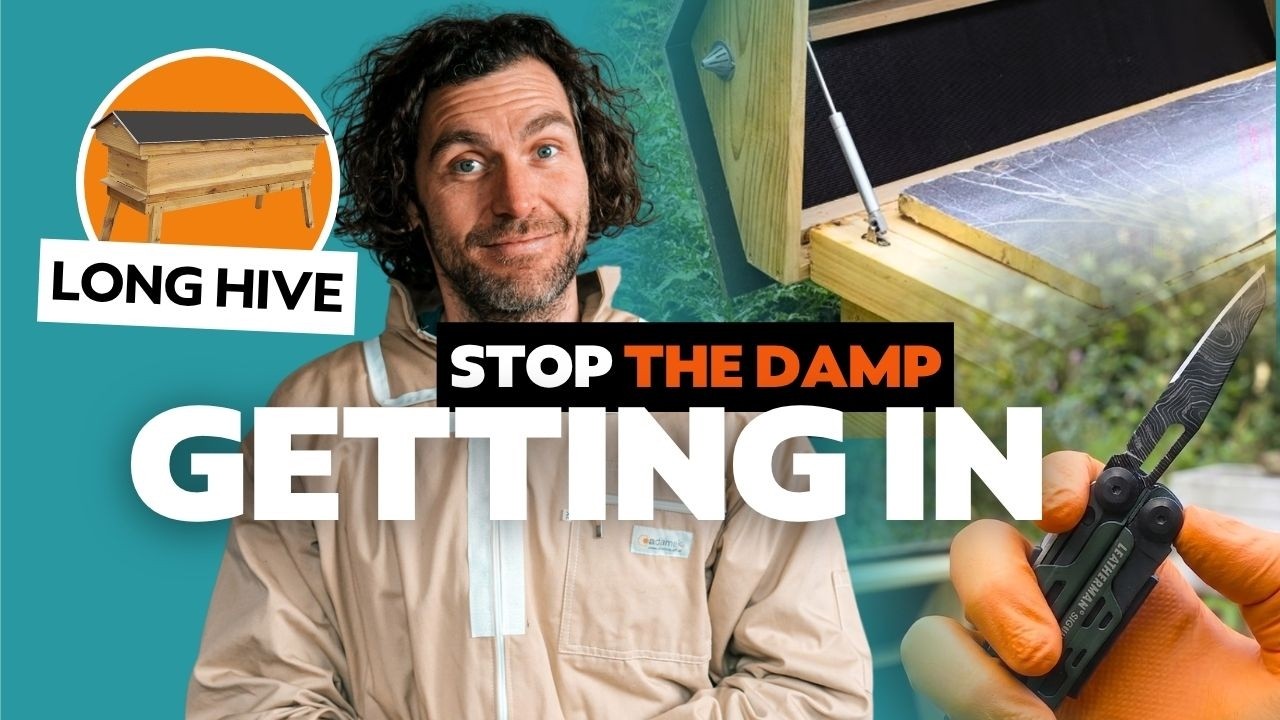
Laurence Edwards prepares a Layens hive for winter by leaving all honey inside, applying Apivar varroa treatment in mid-August, and adding sheet insulation over the top bars to prevent condensation. He argues that neglect, not cold, kills bees, and that simple, inexpensive measures keep them alive.
Chapters
In this video, I'm going to show you how I get my lay-on hive ready for winter. So in my lay-on hive, I've not taken any honey from it this year. I've left the bees all the honey and I've treated them for varroa. Got the Apivar strips in nice and early, and it'll mean that I need to do a full recycle on the frames next year before I do any honey extraction. Just wanted to do that to build the colony up nice and strong to make sure that I get them through their first winter. And in terms of the winter prep, there really isn't a huge amount that needs to be done. Don't have to feed them because they've got Absolutely loads of stores. I've done my apivar strips nice and early. Middle of August is about when we go for. Going to leave those in for two months. Take those out. The final thing that I think's missing from the Hyde Hyde Lands hives is some insulation on top of the colony. That's what I'm going to fix today. So the Lands hive's got a really nice simple combination of a normal frame and a top bar frame design. Means that when you open it up like this, there's really not that much insulation between the top bars and the top of the hive. I'm a massive fan of top. insulation on poly hives, on wooden hives, long hives, laying hives, it doesn't matter. I really like to do whatever I possibly can just to give the bees the insulation above them, which means that the condensation forms on the walls, keeps the colony and the cluster really dry throughout winter. I know it's a cliché, people say it— cold doesn't kill the bees, the damp kills the bees. I'll tell you what definitely does kill the bees is neglect. I like to give them a nice warm cozy home with top insulation. And then at least I feel like I've done everything I possibly can. Even better than that, it costs me absolutely nothing. Don't go buying Celotex, don't go buying insulation. Use whatever you can. The beauty of a system like this, even though I've got a couple of cracks in here, is that the bees can't actually get up above the frames like that. It's not like a National, not like a Langstroth where you've got access up through the frames, which means that you can go in there and you can use kind of any old insulation. You can use rockwool insulation if that's all you can get. I find sheet insulation though better insulation value, much easier to work. Also, I've got so much of this, absolutely tons of this knocking around. It's a little bit battered, but for this it's perfect. I've also got my new Leatherman Signal, which is just so much fun. I'm devastated I lost my other Leatherman. No point in having a lifetime guarantee on them or even a 25-year one if you lose it after a couple of years. It has got like the swankiest Damascus blade. All I'm doing, chopping it open, scoring the back. Just need to score wherever you want tip, chop the foil off the back, place a piece of insulation on top like that, and it's literally as simple as that. I'm not even going to bother going double level. Closing it up now. They've been fed, they've been treated, nice and insulated and cozy. My lay-on hive is ready for winter.