Good, Bad and Average Winter Clusters
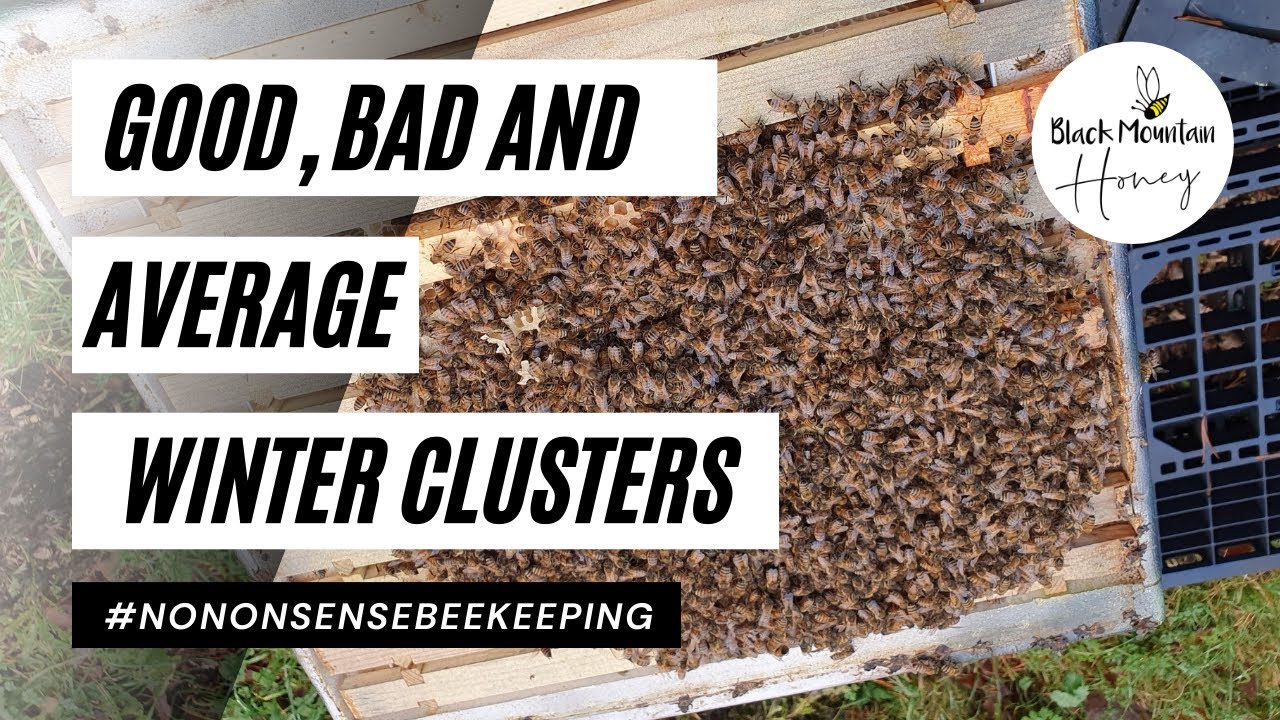
Laurence Edwards inspects four winter bee colonies using a polycarbonate board, showing what healthy clusters look like: dense, oval-shaped, covering multiple frames. He explains why bees cluster tight around the queen, demonstrates using a dummy board to help small clusters conserve heat, and notes that a VSH breeder queen with Buckfast genetics limits varroa damage through brood breaks.
Chapters
Hi, I'm Laurence Edwards from Black Mountain Honey. Welcome to another episode of No Nonsense Beekeeping. Today I'm going to show you what a healthy winter cluster looks like. So before we go any further, please check out my website honeybeebay.co.uk, an online beekeeping marketplace connecting buyers and sellers. So healthy winter clusters, really important to understand why the bees cluster over winter, I'm going to talk a little bit about that in this video, but I'm going to show you a few examples of my hives, some good ones, some average ones, and a couple of the rubbishy ones as well, and give you a bit of a flavor as to what a healthy winter cluster looks like. So the first thing to say is please don't look at this video and then go out and check the cluster size of your bees unless you've got it on a polycarbonate board that you can see through. The only reason I'm doing this video is because I'm applying some oxalic treatments to my bees I'm actually using a product today called Varomed, so I'm opening the colonies up anyway, and I'm just doing this video in between just to give you a snapshot of what those clusters look like and what is a healthy cluster size. So I won't bore you too much about why bees cluster. It is a very simple mechanism though. They're trying to keep that queen warm, and they're trying to keep the brood warm, if there is any brood in the colony, in the most efficient manner possible. So that's all they're trying to do. They don't want to be disturbed. They condense down into a really nice dense cluster, and they're just trying to keep their temperature up to maintain the queen and maintain the brood and use as little stores as possible. So there's the science bit out of the way. I won't bore you. We'll get straight in and look at what some good clusters look like. Right, so here's the first colony that we're going to look at. It's relatively cool today. I don't think they're going to fly up at me. We're just going to do a really quick snapshot and show you what the cluster's like. So there's the cluster, very average size, this one not covering all of those frames. Got a couple of outer frames there that they've not really even touched. They're over about 5 or 6 frames, but these are 14 by 12. That cluster will go all the way down. You can see really nice movement. They're not too tightly clustered. It's about 6 or 7 degrees here now today, so they're freely moving over the top of the frames. But they're remaining in that cluster formation. This is a perfectly acceptable cluster. If you see your bees like this, you can be happy. They seem to be doing really well. They're forming into a cluster. We're going to close these guys up now and go and have a look at another hive. Right, so this colony here was considerably smaller than the previous colony going into winter. I think we're only going to be over about 3 or 4 frames as a cluster here, but what I'm looking to see is a nice dense cluster. I don't want to see bees sprawling all over the tops of the frames. If they're doing that, they're doing it really without a purpose, and the whole point of that cluster is to keep the queen warm and to keep any brood warm. So if you have them sprawling all over the place, it's not a good sign. What you're looking for is a nice dense cluster. Now that doesn't mean to say that if you see a nice dense cluster that everything's perfect. They may have disease, they may have a drone-laying queen, but in my experience, if they're all sprawling all over the place, They tend to not get through the winter. If you've got a decent-sized cluster and they're nice and tight, you stand the best chance of getting those bees through the winter. So I'll open these guys up now and you can take a look. So as you can see, so much smaller, but they are over 1, 2, 3, 4, 5 frames, not all the way along though, but they're nice and densely clustered. These guys, I'm pretty sure we're going to get them through, but it just goes to show how much smaller the clusters can be. So if you've got a colony like that, again, I wouldn't be worried. You might want to dummy them down, probably a good idea at this time of the year just to dummy them down just to help them conserve that heat a little bit, and I'll show you how to do that now. So we keep our dummy boards always in the hive like that, just ready for this situation. You just want to identify the last frame where there's absolutely not a single bee, shift everything along a little bit, and then just pop the follower board in. And all you're doing is you're reducing the size of the void that they need to keep warm down by about Really does help them along. It's a small manipulation, but it does help. So as you can see there, we've moved that follower board 3 frames in from the left, and we're going to close these guys up now and move on to the next colony. So these guys here, much more indicative of what we're finding. These are, these are definitely an above-average colony. Lots of movement in there, but this is predominantly what we like to see. So I'll get— we'll have a closer look and see what these guys are like. Now this is exactly what I want to see when I'm coming to look at a healthy winter cluster. This is what we mean. You can see that perfect oval shape. That's what your colony should look like. Nice oval cluster. It's over 9 or 10 frames. Remember, these are 14 by 12 boxes, so these go all the way down. That is a lot of bees there. They're really healthy looking. There's plenty of movement. There's no visible disease, deformed wing virus, or any varroa or anything like that. These guys are looking really healthy. And this is what we aim to achieve here at Black Mountain Honey. We want all of our colonies to look like this. So we'll just look at one more colony. Don't need to go through all of them. I just want to give you an indication of what's really good, what's average, and what's not so good. So we've kind of seen all of those already. I'm just going to show you this one though, because this is our F0 breeder queen. So this is the mother of a lot of the queens that all of our nucleus customers will be getting this year. Really nice colony, really good at overwintering. Obviously got VSH tendencies as well. That's why we bought it as a breeder queen, and I'll crack it open now and I'll show you how nice the cluster is on this one. So what I really like about the cluster on this colony, and I specifically wanted to show you this and talk to you about it, is the fact that it's not a monster. It's not your typical Buckfast. You look at these guys here; they're not super orange, although they are a little bit orange, and they're definitely the most frugal Buckfast that I've had. But what I find really interesting is the fact that they've got VSH. tendencies, and I think that the reason they're so good at limiting the amount of damage that varroa can do to them is in some way to do with the way that they overwinter. They don't create a huge colony that has brood in it at all times. I think they give themselves a chance to have a bit of a break from varroa by having a significant brood break over winter. So you can look at this colony here, that is a really nice cluster. It's really dense. Again, remember these are on 14 by 12, so these go all the way down, but these guys will be booming come spring. The speed in which these guys grow and kind of fill that box there is quite remarkable. But I just wanted to give you a snapshot of what that F0 breeder queen's looking like at this time of year, because this is going to be the mother to all of the Nucleus customers' queens. So there we have it. I've showed you 4 different clusters. I've showed you a really, really big one, A really small one and a couple of average ones. Don't think that just because your cluster isn't as big as some of the bigger ones there, or some of the ones I see on the internet, absolutely vast, and we've got loads of those dotted around, we find in this apiary they do tend to be quite a bit smaller because we're so high up, which is a little bit counterintuitive, but we find in the lower down apiaries where they can rear brood further into the season, they do go into winter considerably Considerably bigger than this, but don't draw too much into the size of that winter cluster. What you're looking for is a nice shape, a nice shape, that clear oval shape. That's what you're looking for. You're looking for dense clustered bees, tightly clustered, doing their job. You don't want them sprawling about on the frames. If you find that, there really can be something wrong. Another thing to say is if you crack open your hives to do some sort of winter treatment, Definitely don't go in there looking for the cluster, as I said earlier in the video, and there's nothing there, or it appears that there's nothing there. Don't be too alarmed by that. What that might mean, and what it generally means earlier in the season, is that the cluster is low down. So the way that bees work is that they build their brood nest at the bottom, and then through the winter they work their way up, so they get to the top later on in the year. So I've got loads of hives here, You crack them open and it doesn't look like there's a single bee in there. And what the reason is for that is that it's a 14 by 12, and sometimes I've got a couple of double brood boxes as well, and all they're doing is they're occupying the space at the bottom. So the way that you can do that is you can do a beneath box inspection. You can just tilt the box up and look underneath, probably going to find a really nice big cluster of bees. So don't be alarmed if you can't see the cluster sitting at the top. That may well mean they're just underneath or a little bit lower down. That's perfectly natural. They form at the bottom and work their way up over winter. So that's it for the video. I just wanted to show you a snapshot of what a healthy winter cluster looks like, a good, an average, and a weak colony. Now I'm confident that every single colony I've showed you here will get through the winter. I'll do a follow-up video to this one showing you what they're like in April, May, And showing you just how far they've come along in that time. And my prediction is you won't be able to tell the difference between any of those 4 colonies, because the Buckfast bee in polyhives rapidly expands in the spring, especially if you give it some form of stimulative feeding. The speed in which these colonies take off really is remarkable. So I hope you've enjoyed this video. I hope you found it useful. As always, please hit the subscribe button, please hit the bell so you're notified of every video. And I'll see you next time. Bye.










